
2012 Curriculum Award
Embedded and Mobile Computing
November 2012 - Award Winners and Ceremony at the ECSS 2012
The winners of the 2012 Informatics Europe Curriculum Award for Embedded and Mobile Computing were presented in a special ceremony held during the ECSS 2012 in Barcelona, Spain.
A team from Denmark, led by Jakob E. Bardram, from the IT University of Copenhagen and a team from Germany, led by Stefan Kowalewski, from the RWTH Aachen University, shared the 2012 Curriculum Award, fully organized and sponsored by Informatics Europe.
The Award ceremony was held in Barcelona, as part of the ECSS 2012 program, where the winners had the opportunity to present the achievements of their educational efforts in the area of Embedded and Mobile Computing.
The winners were selected by a committee composed of top international experts and chaired by Prof. Friedemann Mattern from ETH Zurich. A number of excellent proposals were received by the committee, which had the difficult task to select the winners in an evaluation process that run from March to August 2012.
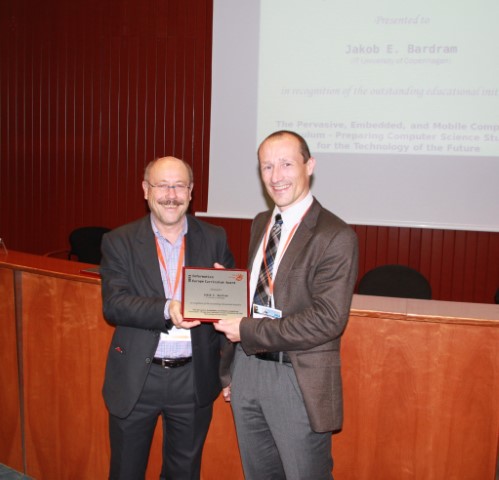
Jakob E. Bardram received the award for the outstanding proposal "The Pervasive, Embedded, and Mobile Computing Curriculum - Preparing Computer Science Students for the Technology of the Future". The evaluation committee praised the curriculum described in the proposal as a comprehensive, well-structured, and innovative curriculum, covering a broad spectrum while focusing on novel aspects of mobile and embedded computing. Conceptual and practical topics are combined very tightly, and lab courses for hands-on experience with a variety of technologies are part of the curriculum. The curriculum has had an important impact both in terms of scientific publications and in industry adoption. The course material, refined for almost a decade, is well-structured and widely available for the community to use. The curriculum could serve as a commendable model for other educational establishments.
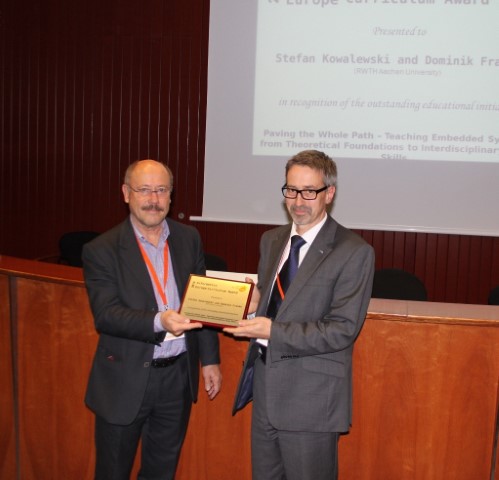
Stefan Kowalewski received the award for the outstanding proposal "Paving the whole path - Teaching Embedded Systems from Theoretical Foundations to Interdisciplinary Team Skills" praised by the evaluation committee for the comprehensive, well-conceived, nicely implemented, and proven curriculum on embedded systems. The committee was very pleased by the innovative set of lectures and lab courses aimed at interdisciplinary teams of students which covers the theoretical foundations of the topic and reaches to the topical domain of cyber physical systems. Theory and practice as well as software concepts and hardware concepts are well-balanced. The curriculum can serve as a role model to other Universities, in particular to those with an engineering focus.
The photos below show the winners Stefan Kowalewski (top) and Jakob E. Bardram (bottom) receiving the award plaque from the president of Informatics Europe, Prof. Carlo Ghezzi, during the Award Ceremony in Barcelona. More photos can also be seen at the highlights page of the ECSS 2012.
August 2012 - Curriculum Award Winners Selected
The winners of the 2012 Curriculum Award were chosen by the committee of top international experts from the Embedded and Mobile Computing area, chaired by Prof. Friedemann Mattern, ETH Zurich. Two proposals have been selected and the winners will be publicly announced at the 8th European Computer Science Summit in Barcelona, during the Award Ceremony, where they will present a summary of their curriculum projects.
March 2012 - First Call for Participation
Informatics Europe proudly announces its 2012 Curriculum Award, devoted to curriculum initiatives in the area of Embedded and Mobile Computing.
The Informatics Europe Curriculum Award recognizes outstanding European educational initiatives that improve the quality of informatics teaching and the attractiveness of the discipline, and can be applied and extended beyond their institutions of origin.
The Award will reward a successful teaching effort in Europe that
- has made a measurable difference in the teaching of Embedded and Mobile Computing
- is widely available for reuse by the teaching community
- has made a measurable impact in its original institution and beyond it.
Examples of impact include course results, industry collaborations, student projects, textbooks, or influence on the curriculum of other universities.
The 2012 Award is devoted to curriculum initiatives in the general area of Embedded and Mobile Computing.
The Award carries a prize of EUR 30,000.00.
The Award can be given to an individual or to a group. To be eligible, participants must be located in one of the member or candidate member countries of the Council of Europe (www.coe.int), or Israel. Members of the Informatics Europe Board and of the Award Committee are not eligible. The Award Committee will review and evaluate each proposal. It reserves the right to split the prize between at most two different proposals (individuals or teams).
The proposal should include:
- Names and addresses of the applicant or applicants;
- Indication of whether the submission is on behalf of an individual or a group;
- Description of the achievements (max 5 pages);
- Evidence of availability of the curriculum's materials to the teaching community (max 2 pages);
- Evidence of impact (max 5 pages);
- A reference list (which may include URLs of supporting material);
- One or two letters of support. The letters of support may come for example from department management, academic colleagues in the same or another institution, industry colleagues.
Submissions are closed!
Deadlines:
- Abstract (max 1 page): May 15, 2012
- Full proposal: June 15, 2012
- Notification of winner(s): August 1, 2012
The Award will be presented at the 8th European Computer Science Summit, in Barcelona, 20-21 November 2012, where the winner or winners (one representative in the case of an institution) will be invited to give a talk on their achievements.
- Friedemann Mattern, ETH Zurich (chair)
- Mark Harris, InnoVaventures (vice-chair)
- Anind Dey, Carnegie Mellon University
- Cecilia Mascolo, University of Cambridge
- Luca Mottola, Politecnico di Milano and Swedish Institute of Computer Science
- Mieczyslaw Muraszkiewicz, Warsaw University of Technology
- Michael Rohs, LMU München
For further inquires:
January 2012 - Informatics Europe is proud to announce the 2012 Curriculum Award, devoted to curriculum initiatives in the area of Embedded and Mobile Computing and the nomination of the Committee chairs:
Committee Chair: Friedemann Mattern, ETH Zurich
Committee Vice-Chair: Mark Harris, Innovaventures
2011 Curriculum Best Practices Award
Parallelism and Concurrency
November 2011 - The winners of the 2011 Curriculum Best Practices Award for Parallelism and Concurrency have been presented during the ECSS 2011 in Milan, Italy. A team from Germany led by Georg Hager, Gerhard Wellein, and Jan Treibig from the Erlangen Regional Computing Center and the Department of Computer Science at the University of Erlangen-Nuremberg and a team from Russia led by Victor Gergel and Vladimir Voevodin, from Nizhni Novgorod State and Lomonosov Moscow State University received the Award during a special ceremony where they also presented and discussed the achievements of their educational efforts in the area of Parallelism and Concurrency.
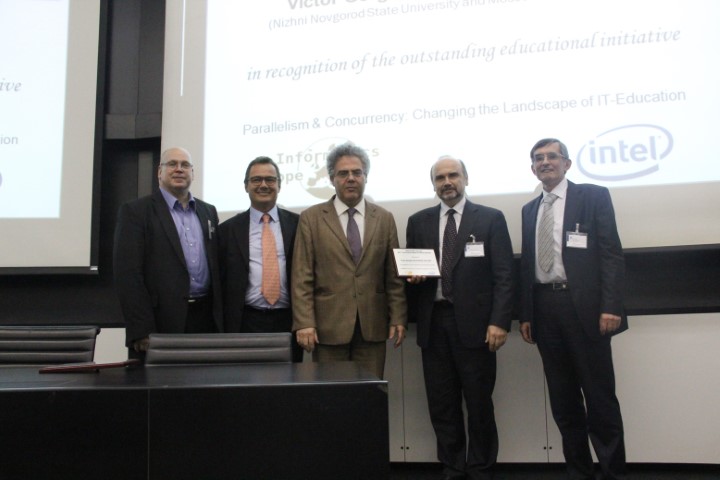
Victor Gergel and Vladimir Voevodin received the award for the proposal “Parallelism & Concurrency: Changing the Landscape of IT-Education” praised by the evaluation committee “For the development of a broad and significant project to develop curriculum materials for parallelism and concurrency.”
The impact of their activities in developing the curricula, programs and courses for the improvement of education in the sphere of Parallelism and Concurrency is diverse and versatile. The textbooks published by the team are actively used in several Russian universities; numerous educational events (conferences, schools, seminars, educational programs), based on the developed training materials, have been organized and collaboration with leading IT companies and industrial organizations have been established. Only in 2010 more than 400 people had training in Parallelism and Concurrency within the project's scope. The participants of the project published 6 textbooks and tutorials in 2009-2010. The developed courses and training materials were used for holding annually two youth schools, focused on the issues of Parallelism and Concurrency, and three conferences. Probation of the developed materials is carried out by the authors in the frames of educational programs of the three Competence Centers and in the large-scale Presidential Program of training specialists on supercomputing technologies.
More information about the group's activities:
http://www.srcc.msu.su/nivc/index_engl.htm
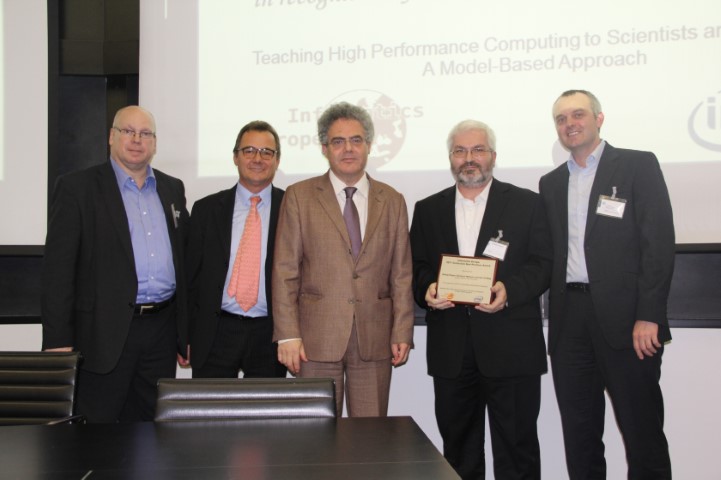
Georg Hager, Gerhard Wellein and Jan Treibig received the award for the proposal “Teaching High Performance Computing to Scientists and Engineers: A Model-Based Approach” praised by the evaluation committee “For the development of a complete set of material for teaching programming of high-performance computers.”
The team's unique approach that combines the classic areas of parallelization and code optimization with the rational use of performance models is conveyed not only in lectures, but also in international workshops and tutorials. In 2010, Georg Hager and Gerhard Wellein published the textbook “Introduction to High Performance Computing for Scientists and Engineers,” which is meanwhile recommended reading for many courses worldwide in the field of scientific and high performance computing. Its widespread acceptance clearly shows the impact of the team's work on teaching activities outside their own university.
More information about the group's activities:
http://www.hpc.informatik.uni-erlangen.de/
http://www.rrze.uni-erlangen.de/
The photos below show the winners Georg Hager and Jan Treibig (top), Victor Gergel and Vladimir Voevodin (bottom) with representatives from Informatics Europe (Bertrand Meyer, President, Mark Harris, Board Member) and Intel (Carlo Parmeggiani) during the Award Ceremony in Milan.
|
|
 |
August 2011 - The winners of the 2011 Curriculum Award were chosen by the committee of top international Concurrency and Parallelism experts, chaired by Prof. Michel Raynal from IRISA. Two proposals have been selected and the winners will be publicly announced at the 7th European Computer Science Summit in Milan, during the Award Ceremony, where they will present the results of their curriculum projects.
March 2011 - First Call for Participation
Informatics Europe is proud to announce the 2011 Curriculum Best Practices Award, devoted to curriculum initiatives in the area of Parallelism and Concurrency.
The Informatics Europe Curriculum Best Practices Award recognizes outstanding European educational initiatives that improve the quality of informatics teaching and the attractiveness of the discipline, and can be applied and extended beyond their institutions of origin. The Award will reward a successful teaching effort in Europe that:
- has made a measurable difference in the teaching of parallelism and concurrency;
- is widely available for reuse by the teaching community;
- has made a measurable impact in its original institution and beyond it.
Examples of impact include: course results, industry collaboration, student projects, textbooks, influence on the curriculum of other universities.
The 2011 Award is devoted to curriculum initiatives in the general area of parallelism and concurrency.It is funded through a generous grant from Intel Corporation.
The Award carries a prize of EUR 30,000.00.
The Award can be awarded to an individual or to a group. To be eligible, participants must be located in one of the member or candidate member countries of the Council of Europe, or Israel. Members of the Informatics Europe Board and of the Award Committee are not eligible. The Award Committee will review and evaluate each proposal. It reserves the right to split the prize between at most two different proposals (individuals or teams).
The proposal should include:
- Names and addresses of the applicant or applicants;
- Indication of whether the submission is on behalf of an individual or a group;
- Description of the achievements (max 5 pages);
- Evidence of availability of the curriculum's materials to the teaching community (max 2 pages);
- Evidence of impact (max 5 pages);
- Up to 5 letters of support. The letter of support will play an important role in the evaluation and may come from (for example) department management, academic colleagues in the same or another institution, industry colleagues;
- A reference list (which may include URLs of supporting material) (max 3 pages).
Submissions are closed!
Important Deadlines:
- Abstract: May 1, 2011
- Full proposal: June 1, 2011
- Notification of winner(s): August 1, 2011
The Award will be presented at the European Computer Science Summit, in Milan, 07-09 November 2011. The winner or winners (one representative in the case of an institution) will be invited to give a talk on their achievements in the ECSS 2011.
Award Committee:
- Michel Raynal, IRISA/University of Rennes 1 (chair)
- Gregor Engels, University of Paderborn (vice-chair)
- Gregory Andrews, University of Arizona
- Mordechai Ben-Ari, Weizmann Institute
- Thomas Gross, ETH Zurich
- Dan Grossman, University of Washington
- Rachid Guerraoui, EPF Lausanne
- Mark Harris, Intel
- Jeff Kramer, Imperial College
- Walter Tichy, University of Karlsruhe
- Akinori Yonezawa, University of Tokyo
Available for download:




 Netlogica