
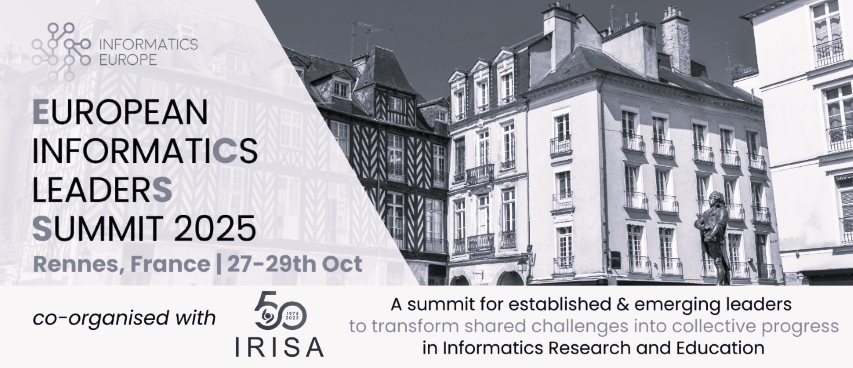
Deans, academic leaders, all levels of researchers, public policymakers, and industry representatives across and beyond Europe gathered in person in Rennes (France), 27-29 October 2025, for the 21st edition of the European Informatics Leaders Summit, ECSS 2025.
See the conference highlights and photos.
Download the slides of the various talks on the ECSS 2025 program page or through the individual session links below.
Quick Links:
- Conference Program
- Keynote Session
- Leaders Workshop
- Professional Development Workshop for Early Career Researchers
- Open Science & Open Source Workshop
- Green ICT and ICT for Green Workshop
- National Informatics Associations "Upskilling & Societal Engagement" Workshop
- Diversity & Inclusion Workshop
- Ethics Workshop
- Speakers and talks summaries
ECSS 2025 is the 21st Summit of Informatics Europe. It is the only place, once a year, where leaders and decision-makers in Informatics research and education in Europe gather to debate strategic themes and trends related to research, education, and policies in Informatics. It is a unique opportunity to meet leaders in the field and discuss critical issues of the discipline related to education, research, funding, entrepreneurship, management, career development, and policies.
Conference Chair:
- Jean-Marc Jézéquel, Informatics Europe / IRISA / University of Rennes (France)
Leaders Workshop
The 2025 Workshop for Leaders of Informatics Research and Education was held on 27 October, co-chaired by Ana C.R. Paiva from University of Porto and Jean-Marc Jézéquel from IRISA / University of Rennes. The central theme was "How to cope with changes in Informatics departments?"
Speakers & Panellists:
- Maarten Steinbuch, Eindhoven University of Technology (the Netherlands)
- Hans-Joachim Bungartz, Technical University of Munich (Germany)
- Nicola Gatti, Politecnico di Milano (Italy)
- Guillaume Gravier, IRISA (France)
- Dimka Karastoyanova, University of Groningen (Netherlands)
Professional Development Workshop for Early Career Researchers
The 2025 Early Career Researchers Workshop was held on 29 October, co-chaired by Dimka Karastoyanova, University of Groningen (the Netherlands), Elisabetta Di Nitto, Politecnico di Milano (Italy) and Gregor Engels, University of Paderborn (Germany).The Workshop commenced with a joint opening session and panel discussion held in collaboration with the Leaders Workshop. Fostering dialogues and engagement between emerging and established leaders in the field, the workshop aimed to nurture talent and cultivate a diverse pool of future leaders.
Speakers:
- Andrea Cini, PhD Graduate from Università della Svizzera italiana (Switzerland)
Currently: Postdoc Researcher, Università della Svizzera italiana (Switzerland) - Federica Filippini, PhD Graduate from Politecnico di Milano (Italy)
Currently: Research Fellow, Department of Informatics, Systems and Communication (DISCo), University of Milano-Bicocca (Italy) - Erasmo Purificato, PhD Graduate from Otto von Guericke University Magdeburg (Germany)
Currently: Scientific Project Officer, European Commission, Joint Research Centre (JRC), European Centre for Algorithmic Transparency (ECAT) - Drishti Yadav, PhD Graduate from TU Wien (Austria)
Currently: Research Associate, University of Luxembourg (Luxembourg)
Keynote Session - “Integrating Quantum Technologies into European Informatics Departments”
The Keynote Session featured a talk by Manuel Wimmer from Johannes Kepler University Linz (Austria), titled “Quantum Software ante portas”, which explored the emerging field of quantum software engineering, emphasising its pivotal role as quantum computing transitions from theoretical promise to practical reality.
Upskilling & Societal Engagement Workshop
Building on previous conversations about the impact of generative AI and other emerging technologies on education, the 2025 Workshop was held on 30 October, chaired by Heri Ramampiaro (NTNU, Norway) and co-organised by IE member National Informatics Associations (NIAs), focusing on two key topics:
- Engaging Society and Youth with Informatics
How can we raise public understanding of Informatics and inspire more young people to choose it as a field of study? - Upskilling for a Rapidly Evolving Future
How can we support educators and professionals to stay up to date in a fast-changing technological landscape?
Speakers:
- Gregor Engels, Paderborn University (Germany)
- Martin Hitz, Informatik Austria | University of Klagenfurt (Austria)
- Enrico Nardelli, University of Rome "Tor Vergata" (Italy)
- Constance Thierry, SIF - Societé Informatique de France | IRISA (France)
- Jean-Marc Vincent, Université Grenoble Alpes (France)
Green ICT and ICT for Green Workshop
Co-chaired by Marco Aiello, University of Stuttgart (Germany) and Monica Vitali, Politecnico di Milano (Italy), the workshop was held on 30 October, Wednesday morning and offered an in-depth look at the evolving landscape of Green ICT, with a focus on both academic research and real-world practices in industry and institutions across Europe.
Speakers & Panellists:
- Anne-Cecile Orgerie, CNRS, IRISA (France)
- Rafael Capilla, Rey Juan Carlos University (Spain)
- Gabriele Gianini, University of Milano-Bicocca (Italy)
- Gilles Perrouin, Namur Digital Institute (Belgium)
- Sebastian Werner, TU Berlin (Germany)
Open Science & Open Source Workshop
The workshop, co-chaired by Lenuta Alboaie, Alexandru Ioan Cuza University of Iași (Romania) and Philippe Krief,Eclipse Foundation, explored how Open Source Program Offices (OSPOs) — originally designed to foster open source practices in industry and universities — can serve as strategic instruments to embed Open Science principles within academic institutions. By drawing on successful models and proven methodologies from both sectors, we aimed to bridge the gap between open source and open science.
Speakers & Panellists:
- Boris Baldassari, Eclipse Foundation | OSPO Alliance
- John Crowley, PHGD Group
- Roberto Di Cosmo, Software Heritage | Inria | University Paris Cité (France)
- Yannis Ioannidis, Association for Computing Machinery (ACM) / National and Kapodistrian University of Athens (Greece)
- Bjorn Levin, RISE Research Institutes of Sweden (Sweden)
- Violaine Louvet, Laboratoire Jean Kuntzmann, CNRS & Université Grenoble Alpes (France)
Diversity & Inclusion Workshop
The workshop was held on Wednesday afternoon, 29 October, and co-chaired by Simona Motogna (Babeş-Bolyai University, Romania), Chair of the Diversity & Inclusion Working Group, Oana Andrei (University of Glasgow, UK) and Lola Burgueño (University of Malaga, Spain). In today's interconnected and diverse world, academic departments are spaces that bring together people from diverse backgrounds, cultures or locations, with diverse expectations and views. This workshop explored the dimensions that make these spaces inclusive, and create collaborative, safe and flexible communities.
Speakers & Panellists:
- Matthew Grech-Sollars, University College London (UK)
- Letizia Jaccheri, Norwegian University of Science and Technology (Norway)
- Malvina Latifaj, Mälardalen University (Sweden)
Ethics Workshop
The workshop, chaired by Covadonga Rodrigo, UNED (Spain), was held on Wednesday afternoon, 29 October and focused on the Societal Impact of Information and Technology Use, as well as their interaction with human beings. Speakers addressed the responsible development and application of information systems, encompassing areas such as accountability, misinformation, ethical awareness nad tools and motivating best practices across the field.
Speakers & Panellists:
- Petra Saskia Bayerl, CENTRIC (UK)
- Kristina Lapin, Vilnius University (Lithuania)
- Rafael Pastor, UNED (Spain)
- Mirela Riveni, University of Groningen (Netherlands)
- Tatjana Welzer, University of Maribor (Slovenia)
Audience
The ECSS audience includes anyone with a stake in the future of Information and Communication Science and Technology in Europe. Traditionally, many department heads, directors of both industrial and academic labs, and other decision-makers make up a substantial share of ECSS participants. However, the scope of the conference is much broader and professionals from all levels and all sectors (academia, industry, government) would benefit from the discussions and critical debate on the future of the discipline.
Purpose of the European Computer Science Summit:
- Debate the future of the discipline, its role, and influence in both academy and society.
- Expand the international network of deans, heads of departments, and research directors in Informatics.
- Provide a forum for discussion and the exchange of solutions and best practices on common issues.
- Examine ways in which Informatics leaders can work together to improve teaching and research, implement the Bologna process, can influence the policies of their universities, governments and the EU, and take joint initiatives on many other issues.
- Provide opportunities for liaisons with other groups pursuing relevant interests.
| ECSS 2025 was organised by | |
 |
 |
Sponsored by
 |
 |
 |
 |
|
 |
  |
 |




 Netlogica