
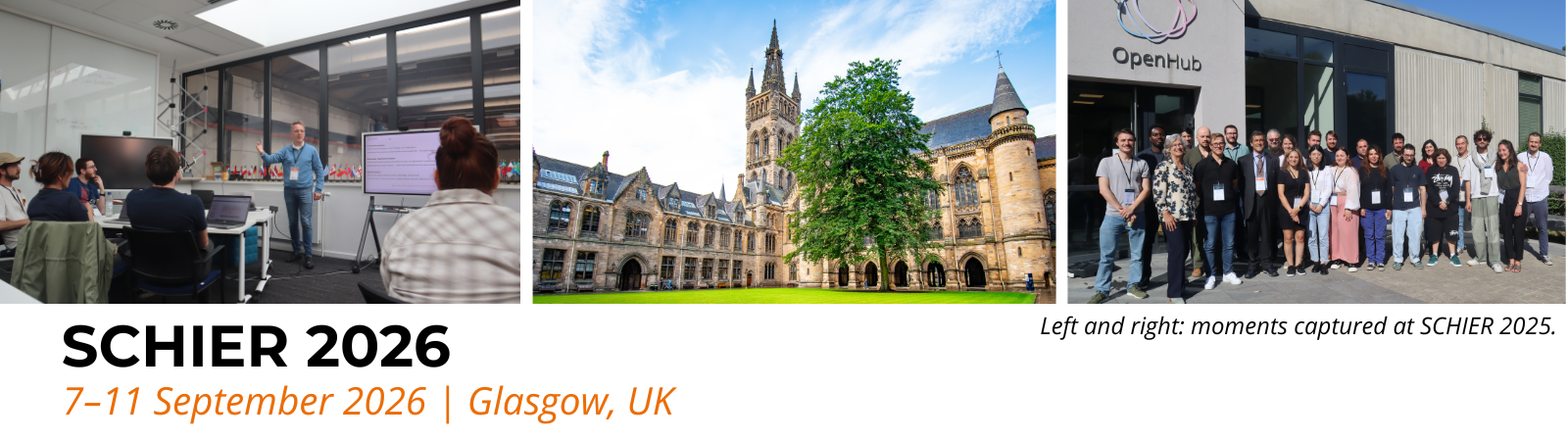
The third edition of SCHIER took place from 7 September to 11 September 2026, co-hosted by University of Glasgow in Glasgow, UK, sponsored by IBM Research Europe.
SCHIER 2026 Format
The School was organised as an in-person event hosted at the University of Glasgow (Gilmorehill campus). It is structured around six thematic strands that combine foundational perspectives with practical approaches to Informatics Education Research. Two themes focus on general methodological foundations, covering both qualitative and quantitative approaches. The remaining themes emphasise the design, implementation, and ethical dimensions of research in practice.
The programme spanned five days and integrated lectures, interactive sessions, participant-led activities as well as social and networking events.
|
Monday |
Tuesday |
Wednesday |
Thursday |
Friday |
|
|
Morning |
Research Paradigms |
Theoretical Framing |
Quantitative Methods (II) |
Qualitative Methods (I) |
Qualitative Methods (II) |
|
13:00-14:00 Lunch Break |
|||||
|
Afternoon |
Student Self-Presentations — Poster Session (16:15-18:00) |
Quantitative Methods (I) |
IBM Invited Presentation Structured Poster Discussion |
Ethics & Reflexivity |
Participatory & Design Approaches |
|
|
Reception Evening |
Social Dinner |
|
|
|
SCHIER 2026 Curriculum & Instructors
SCHIER 2026 brought together distinguished scholars from academia and industry with expertise in Informatics and education research. The sessions combined theoretical grounding with practical guidance for conducting high-quality research.
Research Paradigms with Dr Mark Peart, University of Glasgow (UK)
Session description:
In this session, we explore research paradigms, the underlying ways of thinking that shape how we understand the world, what we consider to be knowledge, and how we go about producing it, from a social science perspective. Research paradigms are more than abstract philosophical positions as they influence the questions we ask, the methods we choose, how we interpret data, and how our work is evaluated by others. Whether we name them explicitly or not, paradigms are always present in research practice.
The session is structured to look at theoretical foundations, introducing key paradigms commonly used in social science research and examining their assumptions about reality, knowledge, and the role of the researcher. We move into practical and applied tasks, where we reflect on how these paradigms play out in your own research.
Understanding research paradigms is important because research is not just about choosing the “right” method, but about making coherent and defensible research decisions, particularly in the early phases of your career. Being able to articulate your paradigm helps you explain why you work in certain ways, engage critically with existing literature, and respond confidently to supervision, peer review, and examination. Just as importantly, reflecting on positionality encourages ethical, reflexive research practice and reminds us that knowledge is always situated, relational, and contested.
About the instructor:
Dr Mark Peart is a Lecturer in Teacher Education at the University of Glasgow. He is a Fellow of the Centre for Transformative Change in Schools (CenTCS). Mark currently serves as Programme Lead for the MSc AI in Education and holds the role of International Regional Champion for Europe within the School of Education’s Internationalisation team
He has experience in teaching, assessment and module leadership across Initial Teacher Education (ITE) programmes in both UK and international contexts. His teaching and leadership contributions span curriculum and pedagogy, school organisation, digital technologies, educational innovation, and modules on educational research. Mark also supervises undergraduate and postgraduate dissertations.
Mark’s scholarship explores teacher education, critical digital literacy, the curriculum for technologies, and the wider social, cultural, political implications of digital technologies and AI in education, including digital divides, transformative education and social justice. He has published an array of journal articles and book chapters and has an established profile of contributions to international conferences. He is co-author of an edited book, acts as a reviewer for several leading academic journals related to his research areas of interest.
Learn more about the instructor Dr Mark Peart.
Theoretical Framing with Prof Andreas Mühling, IPN (Germany)
Session description:
The session focuses on how (educational) theories are essential in guiding empirical research in Informatics education. As a starting point, the session highlights the complex nature of learning and teaching and gives an overview of several established learning theories, both general ones and ones that are more Informatics Education-specific. It then discusses how theories can be used as lenses to frame research questions and interpret and discuss results using exemplary case studies. The session aims to enable participants to become aware of and actively embed their research into the existing landscape of (educational) theories.
About the instructor:
Andreas Mühling is heading the computer science education research group at the Leibniz Institute for Mathematics and Science Education (IPN) and at Kiel University. He focuses on empirical research in K12 computer science with a focus on compuational problem solving and AI literacy, both from learners and teachers perspectives.
He has co-chaired several CSE-related conferences, most recently Koli Calling 2023 and 2024, has organised doctoral consortia and serves as a steering board member for the WiPSCE conference. He also serves as Associate Editor for the journal "Computer Science Education" and is co-speaker of the German Informatics Society's group on computer science education.
Learn more about the instructor Prof Andreas Mühling.
Quantitative Methods with Dr Utkun Aydin, University of Glasgow (UK)
Session description:
What makes a quantitative study credible rather than merely technical? Across these two sessions, participants explore how quantitative methods help researchers frame research questions effectively, make sound design choices, and interpret evidence with greater clarity and confidence. The first session introduces the foundations of quantitative inquiry, including the logic and purposes of quantitative research, descriptive and inferential statistics, correlation analysis, and key study designs such as experimental, quasi-experimental, cross-sectional, and longitudinal approaches. It also introduces the role of validity and reliability in judging the quality of quantitative research. The second session moves to more advanced approaches, introducing regression, exploratory and confirmatory factor analysis, and path analysis. Each session combines conceptual input with practical activities, giving participants opportunities to engage with both the theoretical foundations and the applied use of quantitative methods. Together, the sessions are designed to help participants move beyond procedural knowledge of methods towards a stronger understanding of why, when, and how particular quantitative approaches matter in informatics education research.
About the instructor:
Utkun Aydin is a Lecturer in Mathematics Education in the School of Education, University of Glasgow. She is a member of the Maths Team, which received the College-Level Teaching Excellence Award in 2023, and holds a Recognition of Excellence in Teaching Fellowship (2025). She is Co-leader of the Quantitative Methods in Education SIG and contributes to the Open Lecture Series in Educational Research Methods, and is an Associate of the Centre for Transformative Change in Schools. She began her academic career as a research assistant and completed her PhD in Secondary Science and Mathematics Education at Middle East Technical University, Turkey. Across 23 years in international higher education institutions (Turkey, Kuwait, and the UK), she has taught mathematics, mathematics education, and advanced research methods courses, while also contributing to course moderation and curriculum development. Her research spans mathematical thinking, test anxiety, metacognition, test development/adaptation, and school-university partnerships, and several of her publications have received awards. She has particular expertise in experimental designs, structural equation modeling, and multilevel modeling. Since 2022, she has led the Principles and Practices of Research MSc (online) since 2022 and currently teaches the Quant sessions in MEduc courses. She has also delivered several open lectures on research methods and statistical software, contributing to capacity-building in quantitative methods for students and researchers. In addition, she has served as a data analysis advisor and invited instructor of research projects supported by European Cooperation in Science and Technology and Turkish Scientific and Technological Research Council. Her software expertise includes SPSS, LISREL, Mplus, and ITEMAN.
Learn more about the instructor Dr Utkun Aydin.
Qualitative Methods with Prof Michael Rücker, Friedrich Schiller University Jena (Germany)
Session description:
Qualitative research involves analysis of non-numerical data, such as interview transcripts, students’ products, open survey questions, and recordings. This two-session lecture provides a theoretical and practical basis for conducting qualitative research in educational settings. It addresses methods for collection of qualitative data, coding strategies for data analysis, quality aspects of qualitative research (including strategies to enhance this quality), design of qualitative studies, and presentation of qualitative research.
Learn more about the instructor Prof Michael Rücker.
Ethics & Reflexivity with Dr Sarah Honeychurch, University of Glasgow (UK)
Session description:
This interactive session introduces the main ethical areas that need to be considered when designing educational research projects: such as informed consent, confidentiality and anonymity, risk, power dynamics and perceived coercion, and secure data management. After an introduction to each of these concepts, participants are presented with a range of scenarios and given the opportunity to investigate each of these in collaboration with their peers in order to ascertain the main ethical issues and devise strategies to resolve or mitigate against them.
About the instructor:
Sarah Honeychurch is a Good Practice Adviser at the University of Glasgow. She has a background in Philosophy and a PhD in Education. Sarah co-chairs the Scholarship of Teaching and Learning (SoTL) Ethics Committee at her institution and led on the design and implementation of the application and review processes needed to establish this interdisciplinary committee. She also co-leads the SoTL Network where she provides support and guidance about ethical research and scholarship to colleagues across the institution to help them to successfully progress their educational research.
Learn more about Dr Sarah Honeychurch.
Participatory & Design Approaches with Dr Nathalie Tasler, University of Glasgow (UK)
Session description:
In this session, we explore research methods that will enable researchers to engage in joint meaning-making with their research participants. This is a hands-on session that invites participants to experience some of the methods themselves, and build a toolkit of methods that goes beyond the questionnaire, interview, focus groups triptych. Together, we navigate the tension between structure and spontaneity, challenging traditional researcher-subject hierarchies to uncover richer, more nuanced insights. Be prepared to move, create, and perhaps even co-determine the session’s path through the very participatory tools we aim to master.
About the instructor:
Dr. Nathalie Tasler is a Senior Lecturer in Academic and Digital Development at the University of Glasgow, where her work centers on dismantling the barriers between traditional academic practice and creative agency. Specializing in the Scholarship of Teaching and Learning (SoTL) and creative pedagogies, she focuses on the "how" of educational research, championing participatory and arts-based methodologies that facilitate collaborative sense-making. Her approach is defined by a commitment to bridging the gap between theory and hands-on inquiry, often utilizing playful and design-led tools to challenge established hierarchies and invite researchers to grow confidence in their research practice.
Learn more about the instructor Dr Nathalie Tasler.
Student Self-Presentations
Participants are invited to give a short self-presentation (approximately 3 minutes), introducing their background and research interests. This session aims to foster connections and provide an overview of the cohort’s research directions.
Poster Session and Structured Poster Discussions
Session description:
Participants submit a poster describing their current research, which may relate to their PhD or other ongoing work. The Scientific Committee evaluates submissions, and accepted posters are presented during dedicated sessions. Structured discussions, facilitated by members of the Scientific Committee, take place on Monday and Wednesday afternoons. These sessions are designed to provide constructive feedback and encourage peer exchange.
Posters should typically include
- a clear description of the research problem;
- motivation and research questions;
- research methods used or proposed;
- an outline of the research plan (optionally including alternatives);
- current progress and any preliminary findings.
IBM Invited Presentation: A Brief Introduction to Quantum Computing
Abstract:
Quantum computing is an emerging computational paradigm that aims to solve problems that are intractable for classical computers. However, designing algorithms for quantum computers can be challenging, as they represent and manipulate information in a fundamentally different way from classical computers. In this talk, the invited speaker gives a brief introduction to the core components of quantum computing and the IBM educational tools available for learning the subject. He also discusses the practical challenges of implementing algorithms in practice, as well as ongoing research efforts at IBM Quantum.
About the speaker:
Víctor Valls is a researcher at IBM Research Dublin, where he works on quantum computing. His research focuses on the design of quantum algorithms for optimization problems, with a particular emphasis on networking applications. He holds a PhD in Applied Mathematics from Trinity College Dublin and was a postdoctoral fellow at Yale University before joining IBM.
Why SCHIER?
As Europe’s only summer school focused on Informatics Education Research—a field recognised by the EU Council as vital—SCHIER offers a unique experience. Read our initiative statement, testimonials, and FAQs here.
Registration
SCHIER 2026 targets PhD students, Post-docs and any researcher interested in Informatics Education Research. Participants from IE member institutes benefit from reduced registration fees. The Summer School takes place in person only, with limited spots available.
Registration Fee*
- Participants from IE member institutes: GBP 225 (around EUR 260)
- Other participants: GBP 270 (around EUR 310)
*Note: Registration fees must be paid in GBP. The EUR amounts shown above are for reference only, and participants are responsible for any payment processing fees.
What is included in the SCHIER 2026 registration fee:
- Participation in all SCHIER 2026 academic sessions and activities during the 5-day program;
- Handouts and other relevant teaching materials;
- Coffee breaks and meals according to the schedule (lunch from Monday to Friday, all coffee breaks, reception on Tuesday, social dinner on Wednesday).
Not included: travel, local transport, accommodation and other personal expenses.
Application Process
To apply for SCHIER 2026, participants are required to complete the application with the following in one PDF document:
- Motivation letter: a written statement of motivation in English (max. 1 page).
- Curriculum vitae: max. 2 pages.
Application Deadline Extended: 7 August 2026
Applications will be reviewed by the SCHIER Scientific Committee (considering your relevant achievements and motivation) on a first-come-first-serve basis. Allocation of places (if positively reviewed) will take place in this order.
Applications not conforming to the above rules will be rejected without consideration and notification.
Confirmation of Admission
Around two weeks after your application submission, you will receive notification of your SCHIER 2026 final admission status, sent from our official email address:
Note: Due to the summer period, admission confirmations may be slightly delayed. For enquiries, please contact
Request for Visa Support Letters
Please note that, as a SCHIER participant, it will be your responsibility to ensure that you have the valid travel documents required to enter the UK for the duration of SCHIER 2026 (and possible additional travel days before and after the program). For any questions concerning access to UK, please consult the website: https://www.gov.uk/browse/visas-immigration
Admitted SCHIER participants may request a support letter for visa application purposes during registration, if needed. Please allow up to 10 working days for processing. The SCHIER Organising Committee will not directly contact embassies and consulates on behalf of visa applicants.
Accommodations
Please note that accommodation is not included in the SCHIER registration fee.
Glasgow is a popular event destination. Once admitted, we recommend booking refundable accommodation early, for example via www.easyhotel.com.
Note: Informatics Europe and the SCHIER Organising Committee have not appointed any agencies to handle accommodation arrangements. Stay alert to fraudulent claims.
SCHIER 2026 Scientific Committee
Formed by members of the IE Education Research Working Group
- Enrico Nardelli, Università di Roma "Tor Vergata", Italy (Chair)
- Maria Kallia, University of Glasgow, UK
- Violetta Lonati, Università di Milano, Italy
- Jan Vahrenhold, University of Münster, Germany
SCHIER 2026 Organising Committee
- Oana Andrei, University of Glasgow, UK
- Matthew Barr, University of Glasgow, UK
- Maria Kallia, University of Glasgow, UK
- Syed Waqar Nabi, University of Glasgow, UK
- Nuria Auguera, Informatics Europe Office
- Kit Wan Chui, Informatics Europe Office
Contact Us
SCHIER 2026 is co-organised by the IE Education Research Working Group and University of Glasgow, with sponsorship from IBM Research Europe.
For enquiries, please email




 Netlogica