
News

New Strategic Agenda for Europe’s Software Future Presented in Brussels
- Details
The SRIA was launched on 23 September and formally presented to Thibaut Kleiner, Director for Future Networks at the European Commission’s DG CONNECT.
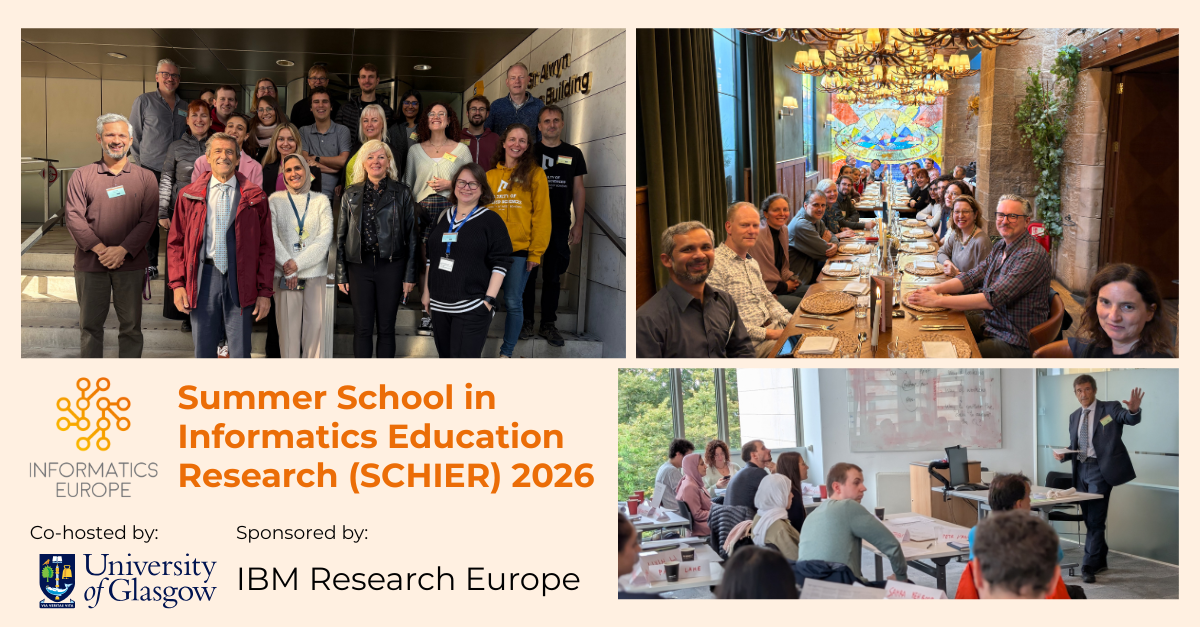
SCHIER 2026: Strengthening the Community of Informatics Education Researchers
- Details
Growing the next generation of Informatics Education researchers starts with creating opportunities to learn, exchange and connect.

ECSS 2026: Registration Now Open
- Details
Registration is now open for ECSS 2026, a unique summit for Europe’s Informatics community to address timely strategic and policy issues in Informatics research and education.

The Second IE Perspectives: Introducing New Section & Co-Editor-in-Chief
- Details
Discover the latest IE Perspectives, featuring a new "Foundations" section dedicated to stories of European curiosity-driven Informatics research that has shaped disciplines, technologies and society.

Nominate Now: IE Minerva Informatics Equality Award 2026
- Details
The Minerva Informatics Equality Award (MIEA 2026) returns for its 11th year, recognising the inspiring work that pushes forward gender equality in Informatics research and education.

IE Calls for Caution on Mandatory Age Assurance for Online Services
- Details
The Board of Informatics Europe urges policymakers to focus on the sources of harm rather than the identity of online service users.

New Paper on Curiosity-Driven Informatics Research for Europe’s Digital Future
- Details
Europe’s digital sovereignty is built on a legacy of curiosity-driven Informatics research which fuels breakthroughs across distributed systems, programming languages, artificial intelligence and beyond.


Erasmus+ AIM-PRO Launches to Advance AI Education and Professional Training
- Details
AIM-PRO (AI Literacy for Multidisciplinary Professional Readiness and Outreach) project has officially launched, kicking off a three-year collaboration to advance responsible AI skills across education, training and professional environments in Europe.

Apply Now: SCHIER 2026 - Europe’s Only Summer School on Informatics Education Research
- Details
Applications are now open for the third edition of Informatics Europe’s Summer School on Informatics Education Research (SCHIER 2026).
IE Bulletin
Find out what's new at Informatics Europe, our member institutes and the informatics communities across Europe.
Contribute to IE's growth
Adapted image from nicepng.com
We represent ca. 200 university departments and research institutes in Informatics from all over Europe.




 Netlogica