
The 21st edition of European Informatics Leaders Summit (ECSS) concluded in Rennes with remarkable participation and engagement across the European Informatics research and education community.
Co-hosted with IRISA on the occasion of its 50th anniversary, the Summit gathered 130 participants, representing over 90 institutions across 26 countries, reaffirming ECSS as Europe’s leading forum for academic leadership in Informatics.
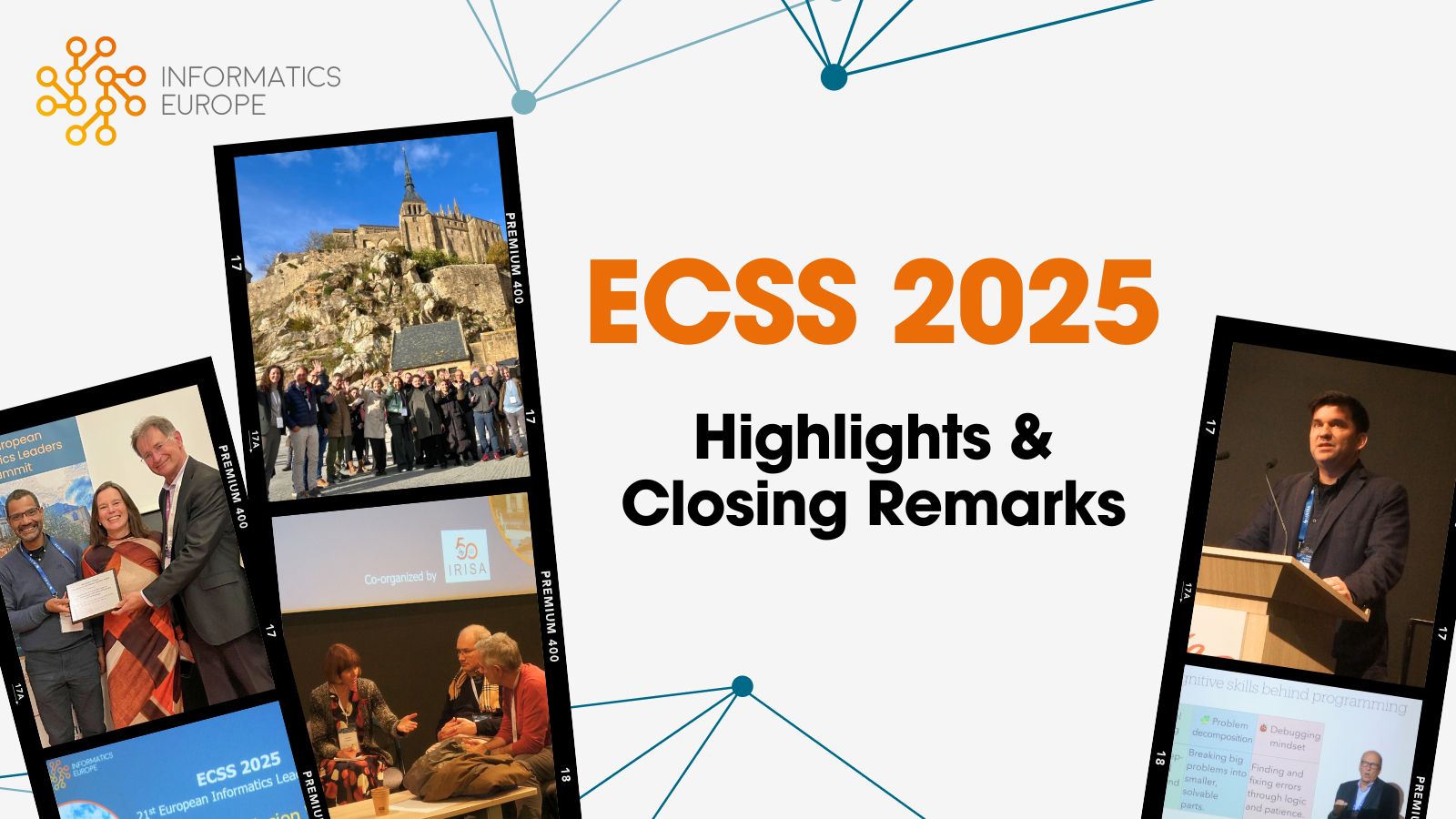
As in every edition, ECSS 2025 provided a platform to examine the strategic and organisational challenges shaping our discipline and to exchange on common issues that require coordinated action. The keynote on integrating quantum technologies into Informatics departments—delivered in the context of the UN International Year of Quantum Science—offered a forward-looking perspective on how institutions can prepare for quantum-era education and research. The Leaders Workshop complemented this with a blend of high-level reflection on how universities must evolve amid accelerating technological and societal change, and a practice-focused examination of challenges widely faced across departments, enriched by concrete examples from leading institutions.
Alongside these central sessions, the programme featured a series of focused workshops that mobilised Informatics Europe’s Working Groups and community initiatives:
- Green ICT & ICT for Green: showcased cutting-edge research and practical initiatives in sustainable computing—from energy-efficient infrastructures to greener software—and fostered a collective discussion toward a shared framework for Green ICT.
- Open Science & Open Source: examined how openness is transforming the entire research lifecycle and explored models for supporting reproducibility, research software engineering, sustainable open-source contributions and coherent institutional policies. Participants underlined the urgency of coordinated action to ensure long-term accessibility, reproducibility and scientific sovereignty.
- Diversity & Inclusion: highlighted long-term, evidence-based approaches to gender and cultural diversity in academia. An interactive exercise translated expectations into concrete practices, giving departments practical guidance on building welcoming and inclusive environments.
- Ethics: combining hands-on learning with a multi-institutional panel, the workshop addressed pressing ethical challenges in today’s digital society—from dark patterns to high-risk AI and misinformation—while outlining next steps toward the WG’s new report on embedding ethics more effectively into Informatics curricula.
- Upskilling & Societal Engagement: moved from diagnosis to action, presenting practical models for engaging youth, supporting inclusive pathways and scaling teacher upskilling, reaffirming programming and computational thinking as essential foundational skills.
- Early-Career Researchers: through joint sessions with senior leaders, focused panels and a hands-on PhD symposium, the workshop emphasised mentorship, communication and strategic planning as pillars of a successful research career, offering participants concrete advice on framing and refining their work and developing key professional skills.
Building on these exchanges, several reports, recommendations and new task forces are already in preparation, ensuring that the ideas and collaborations sparked in Rennes translate into concrete follow-up for our member institutions and strengthen the collective progress of the Informatics education and research community in Europe.
The Summit also celebrated excellence within our community through the Informatics Europe Best Dissertation Award and the Minerva Informatics Equality Award, recognising outstanding doctoral research and impactful initiatives supporting gender equality. Participants also enjoyed a memorable social visit to UNESCO World Heritage site: Mont Saint-Michel, offering a unique opportunity to strengthen connections in an informal and inspiring setting.
We thank all ECSS participants, contributors and partners for their active engagement. We look forward to welcoming the community again at ECSS 2026 in Porto, Portugal (26-28 Oct), where we will continue advancing collective action and shared leadership in Informatics across Europe.
Presentation materials and highlights of each ECSS 2025 session, along with photos from the Summit, are available online here. See you next year in Porto!




 Netlogica