


At Informatics Europe, we are celebrating 2 decades of joint achievements while continuing to shape the discipline's future.
With 200 member institutions in over 30 countries, Informatics Europe connects more than 50,000 researchers, promotes concerted positions, acts on shared priorities and supports policy-making in Informatics Education, Research and its Social Impact across Europe.
Visit the full list of member university departments, research labs and industrial members here.
 |
Our activities address strategic matters and emerging trends in informatics and related fields, fostering unity in the variety of our member institutions and promoting pan-European collaboration. As a non-profit membership association, our work is mainly performed by scientist volunteers who collaborate in working groups and ad-hoc task forces. Outcomes are endorsed by our community through its Board of Directors.
As a community of European leaders in Informatics Research, we empower each other to:
- Create opportunities for joint initiatives and knowledge exchange between academia & industry & society.
- Engage with society on the nature and impact of Informatics.
- Advocate for Informatics in European policy discussions.
- Promote quality standards and best practices in research, education, and knowledge transfer.
- Foster ethical and responsible Informatics teaching and research.
- Nurture talent and assure a pipeline of diverse leaders with a broad understanding of the discipline.
The potential of Informatics Europe can go as far as our collective ambitions take it!
You & your organization are key for IE
We have a common cause and a common interest. This is the reason for university departments, research labs and industrial organizations to join us, for their affiliated researchers to contribute our activities since 2005 and for National Informatics Associations (NIAs) to choose us for engaging in European discussions. This is a call to:
Current & Potential Members
Demonstrate your institute’s support by becoming a member and empower your researchers to engage in our activities for collaborative success in Informatics in Europe. As an Informatics Europe member, gain the opportunity to amplify your presence and influence decisions at the pan-European level, engage in learning and knowledge exchange with peer leaders, and enjoy exclusive IE members-only services. We welcome university departments, research labs and industrial organizations engaged in R&D activities leveraging advances in the field of Informatics.
The greatest membership benefits those who collaborate the most!
Students, PosDocs and recent graduates
Informatics Europe aims to nurture talent and assure a pipeline of diverse Informatics leaders with a broad understanding of the discipline.
Boost your career development with the Early Career Researchers WG and Academic Leadership Courses. Submit your nomination for the Best Dissertation Award. Increase your mobility opportunities with our Job Platform. Join a training school and bring your research to the next level.
More will follow soon!
Companies at large
Looking for a targeted and impactful approach to engage with the leaders in the European informatics research community other than the IE membership? Eager to recruit informatics talent across Europe? Explore our sponsoring opportunities.
Share our flyer with your colleagues to join forces and amplify our impact together as Informatics Europe!
Discover the impact of our initiatives and services first-hand
While some are exclusive to Informatics Europe members, many are open for the benefit of the wider Informatics community. Explore them in a snapshot:
- Utilize our Department Evaluation and Academic Leadership services;
- Access our extensive array of Publications and Policy Recommendations;
- Nominate deserving individuals for Awards celebrating achievements in gender inclusion, informatics education, and ground-breaking research;
- Boost your international visibility by collaborating with us on EU projects, presenting your latest research results in an Informatics-Europe hosted webinar, updating your information in our Research & Education Directory or featuring relevant activities on the ECSS members spotlight section;
- Engage in strategic and trend-setting discussions during our European Informatics Leaders Summit (ECSS).
- Take an active role in Working Group activities, including organizing related training schools and sessions during ECSS.
- Access the only in its kind Higher Education Data Portal, for pan-European benchmarking;
- Enhance your talent pool and career prospects through our Job Platform.
Keep up with IE's latest updates
Follow us on 


 and subscribe to our mailing list and bulletin here.
Latest News
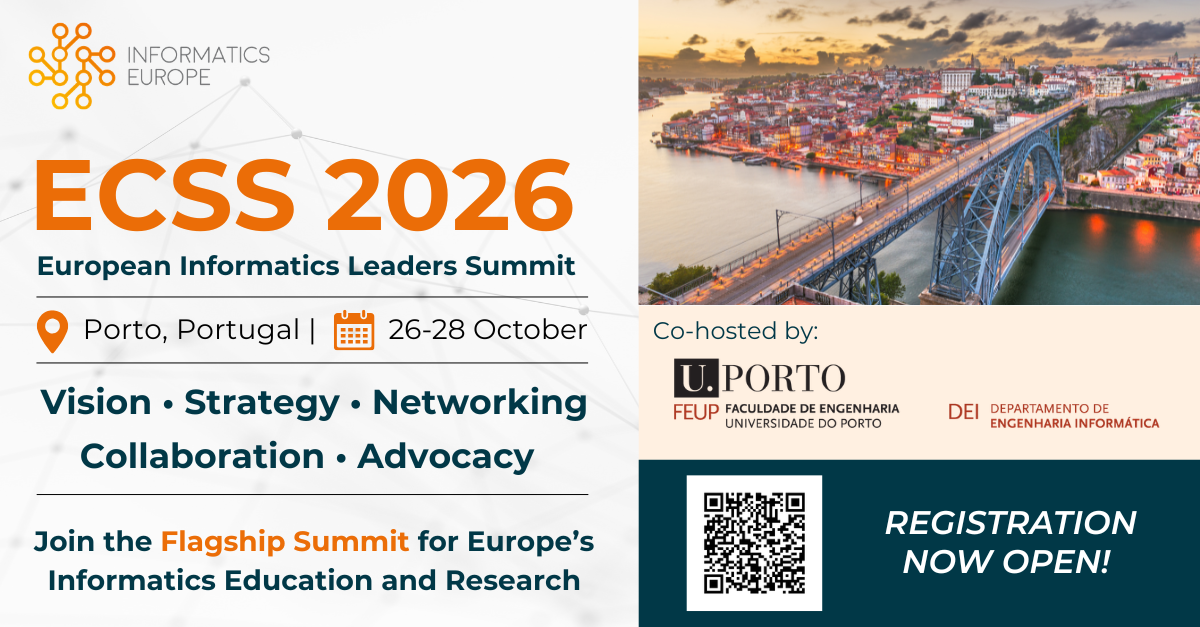
ECSS 2026: Registration Now Open
Registration is now open for ECSS 2026, a unique summit for Europe’s Informatics community to address timely strategic and policy issues in Informatics research and education.
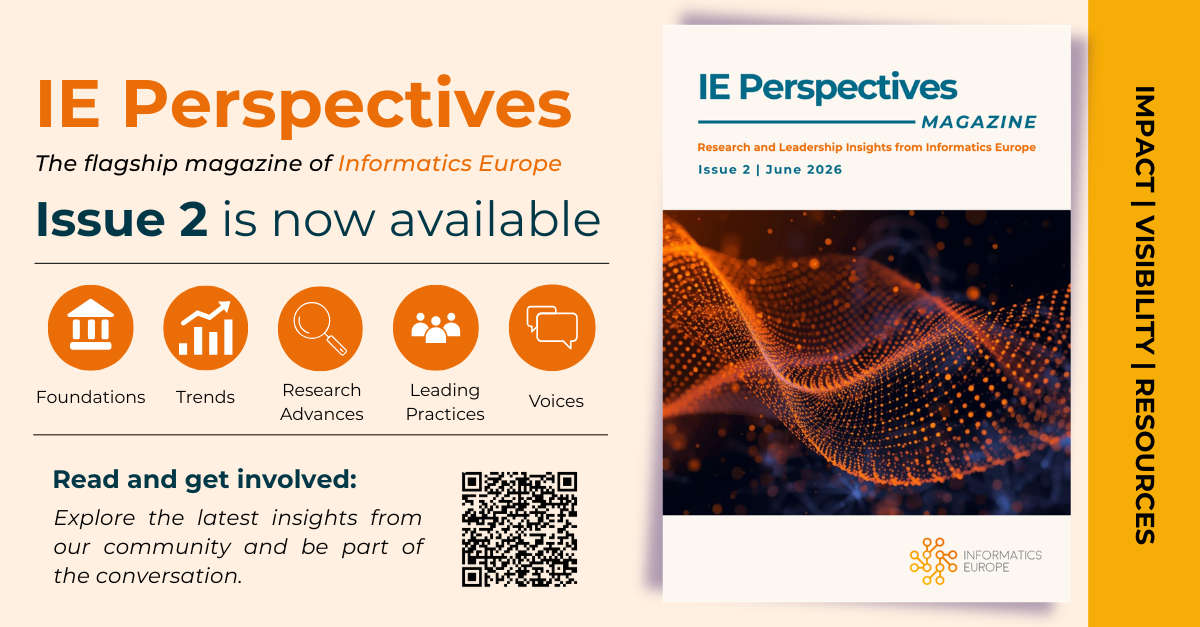
The Second IE Perspectives: Introducing New Section & Co-Editor-in-Chief
Discover the latest IE Perspectives, featuring a new "Foundations" section dedicated to stories of European curiosity-driven Informatics research that has shaped disciplines, technologies and society.
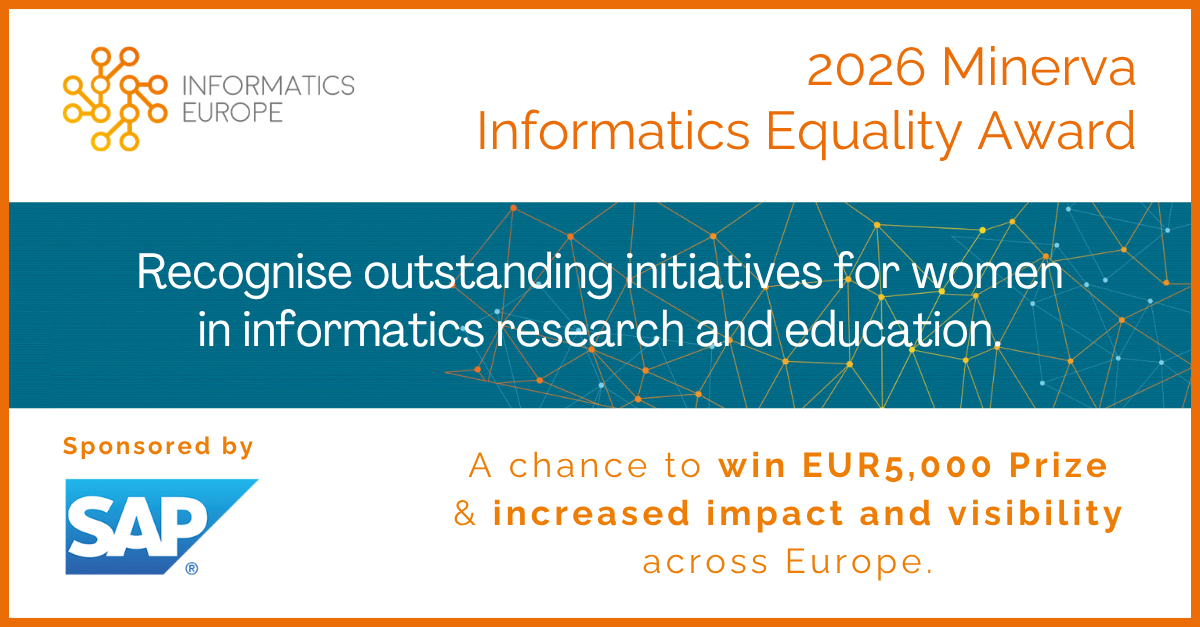
Nominate Now: IE Minerva Informatics Equality Award 2026
The Minerva Informatics Equality Award (MIEA 2026) returns for its 11th year, recognising the inspiring work that pushes forward gender equality in Informatics research and education.
IE Calls for Caution on Mandatory Age Assurance for Online Services
The Board of Informatics Europe urges policymakers to focus on the sources of harm rather than the identity of online service users.
Informatics Europe Reports
Reports, publications and presentations from working groups and initiatives promoted by Informatics Europe are available here for download.
Informatics Education in Europe: Institutions, Degrees, Students, Positions, Salaries — Key Data 2009-2014
This is the third edition of a report series on Informatics higher education in Europe. Encouraged by the community's enthusiastic reception of the first two editions, we have continued, updated, improved and enlarged the report's scope. As in the first editions we present a wealth of fundamental data, starting from a list of institutions awarding degrees in the field and continuing with student enrollments, degrees awarded, gender information, academic titles, as well as precise and much-needed data about academic salaries across European countries. This third edition has added a number of countries to those already covered. Thanks to the active participation of new collaborators the report now covers Greece, Latvia and Spain in addition to the countries in the previous edition (Austria, Denmark, Germany, Ireland, Italy, Netherlands, Switzerland, UK, Turkey, and France for salaries). As in the second edition we also present data about Universities of Applied Sciences for countries where such institutions exist distinct from traditional Universities.
We continue to provide the community with the precise and objective information that is indispensable for understanding the field and making informed, effective policy decisions. You can download the report by clicking on the link below:
Informatics Education in Europe: Institutions, Degrees, Students, Positions, Salaries — Key Data 2008-2013
This is the second edition of a report series on Informatics higher education in Europe. Encouraged by the community's enthusiastic reception of the first edition, we have continued, updated, improved and enlarged the report's scope. As in the first edition we present a wealth of fundamental data, starting from a list of institutions awarding degrees in the field and continuing with student enrollments, degrees awarded, gender information, academic titles, as well as precise and much-needed data about academic salaries across European countries. The second edition has added a number of countries including now Austria, Ireland and Turkey in addition to the original countries (Denmark, Germany, Italy, Netherlands, Switzerland, and France for salaries). Data from University of Applied Sciences, for the countries where such institutions exist distinct from traditional Universities, is also now included and a new section with detailed description of the different education systems creates a even richer picture of the status of Informatics higher education in Europe.
We continue to provide the community with the precise and objective information that is indispensable for understanding the field and making informed, effective policy decisions. You can download the report by clicking on the link below:
More Women in Informatics Research and Education
This booklet is a first concrete outcome of the Informatics Europe Working Group focusing on gender balance in Information and Communication Sciences and Technologies.
Endorsed by the European Commission, this handy guide is a compact resource for deans and heads of departments with clear and simple best practices to increase the participation of women in their institutions, both as students and as employees. Many tips were gathered directly from colleagues in leading academic positions who have successfully implemented actions that attract more women and ensure their continued participation in their organisation.
Informatics Education in Europe: Institutions, Degrees, Students, Positions, Salaries — Key Data 2008-2012
This report is the first comprehensive attempt to document the state of higher education in informatics (computer science) in Europe. Based on information from representative countries, it presents a wealth of fundamental data, starting from a list of institutions awarding degrees in the field and continuing with student enrollments, degrees awarded with gender information, academic titles, as well as precise and much-needed data about academic salaries across European countries. You can download the report by clicking on the link below:
The Role and Relevance of Experimentation in Informatics
This paper is based on the contributions to the Workshop on the Role and Relevance of Experimentation in Informatics, collocated with the 8th European Computer Science Summit (ECSS 2012) of Informatics Europe, November 19th 2012, Barcelona.
What does it mean to do experiments in informatics? Does it make sense to 'import' traditional principles of experimentation from classical disciplines into the field of computing and information processing? How should experiments be documented? These and other questions and recommendations are carefully discussed in the report. To download it click on the link below:
Informatics Doctorates in Europe - Some Facts and Figures
This report describes the findings and conclusions of an investigation, carried out for the ECSS 2012 in Barcelona, where the quality of Informatics doctorates in Europe was discussed.
Joint Informatics Europe and ACM Europe Report on Informatics Education in Europe
A joint working group by Informatics Europe and ACM Europe produced in April 2013 a landmark report on Informatics Education in Europe: "Europe cannot afford to miss the boat". As Michael Gove, the UK Education Secretary, declared on 11 January 2012: Imagine the dramatic change which could be possible in just a few years... Instead of children bored out of their minds being taught how to use Word and Excel by bored teachers, we could have 11-year-olds able to write simple 2D computer animations… By 16, they could have an understanding of formal logic previously covered only in university courses and be writing their own apps for smartphones.
This report identifies problems and suggest operational recommendations for policy and decision makers to make this dream a reality.
You can download the report by clicking on the link below.
Future of the European Scientific Societies in Informatics
At the ECSS 2010 in Prague a panel with representatives from ACM Europe, CEPIS, EAI, ERCIM, EAPLS, EATCS and Informatics Europe was convened to discuss the current situation and future prospects of the European scientific societies in Informatics. The panel decided to move from vision to action and extend the discussion on the actual form, mission and realization of a "strong but low overhead" platform for cooperative activity among the ICST societies. On March 17, 2011 the panel reconvened in extended form to discuss the options for an actual format for the cooperative activity among ICST societies and for possible concrete steps towards the creation of a platform for collaboration. A task group was formed to study and develop a blueprint for an "open" platform organization for closer contact and cooperation among these societies in Europe. Here you can dowload the reports with all the details of this important strategic activity lead by Informatics Europe:
Research Evaluation for Computer Science
Report published in the Communications of the ACM detailing the evaluation of research in computer science. There are two versions of the report available:
- Article in the Communications of the ACM published in April 2009 (registration required).
- A longer version of the report
Student Enrollment and Image of the Informatics Discipline
Report describing the results of the working group on "Student Enrollment and Image of the Discipline" created to collect insights on these issues and to come up with a document that advises the Informatics community on the state of the problem and on possible measures that could be taken to resolve it.
European Computer Science Takes its Fate in its Own Hands
Report on the first ECSS and the background behind Informatics Europe published in the Communications of the ACM. There are two versions of the report available:
- Article in the Communications of the ACM published in March 2006 (registration required)
- A longer version of the report
Presentations
- What type of Computer Scientist do we need for the future
- Attracting (more) students to the Informatics discipline




 Netlogica