Ethical/Social Responsibility Issues in Social Robots
Abstract
Social robots are poised to be the next revolution in robotics: while in the past developments in robotics mainly focused on manipulating the physical environment at a safe distance from people, new applications will require robots to operate amongst people. This will require these robots to be sensitive to the social environment in order to respond appropriately to us, humans. From self-driving cars assessing the intentions of human road users to social robots operating in the home, all will need revolutions in AI in order to correctly operate in a dynamic and human-first environment. With this come ethical and social responsibilities. These artificial systems will not just take in a neutral position in our daily lives, they will either by design or by their mere presence influence our beliefs and actions. This talk will give examples of the use of social robots in health care and education, and will show how simple social robots already can influence on us.
Short Bio
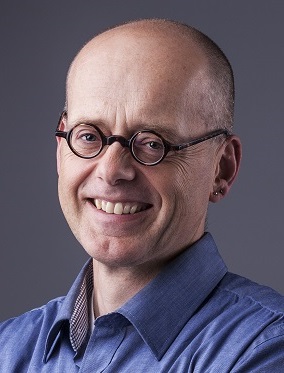
Tony Belpaeme is Professor at the University of Ghent and Professor in Robotics and Cognitive Systems at Plymouth University, UK (20%). He is a member of the IDLab at Ghent, of imec, and of the Centre for Robotics and Neural Systems at Plymouth. At Ghent and Plymouth he leads a team studying the science and technology of cognitive robotics and human-robot interaction. He was the coordinator of the H2020 L2TOR project, a large-scale European project bringing 7 partners together to study how robots can be used to support the learning of a second language to children. He coordinated the FP7 ALIZ-E project, which studied long-term human-robot interaction and its use in paediatric applications. And he is PI in the FP7 DREAM project, studying how robots can be used to support Autism Spectrum Disorder therapy.
Starting from the premise that intelligence is rooted in social interaction, Belpaeme and his research team try to further the science and technology behind artificial intelligence and social robots. This results in a spectrum of results, from theoretical insights to practical applications. The theoretical insights, in which he argues that interaction is central to natural and artificial cognition and that robots and machines should be sensitive to language and paralinguistic social mechanisms used by people, has drawn considerable academic attention. He complements this work by applying these insights in the design and implementation of robots and robotic applications. This work has been picked up by industry and has been taken up in clinical and educational practice, where robots are used to support and tutor children.
His research is used as a showcase of research success by various funding agencies, most recently the Research Councils UK, Engineering and Physical Sciences Research Council (EPSRC) and the European Commission. Belpaeme’s research was exhibited at the Wellcome Trust, the London Science Museum, the Natural History Museum and the National Space Centre. His work often features in the international press (Le Monde, the Guardian, Sunday Times, Scientific American …) and media. In 2013, Research Councils UK chose his work as one of “ten life changing ideas under research at UK universities”, and in 2014 the Big Ideas for the Future report of RC UK and Universities UK mentioned his research as “20 new ideas from UK universities that will change the world”.



















 Netlogica