
Green ICT and ICT for Green Workshop
As part of the ECSS 2023 program, Informatics Europe organised the Workshop with the theme "Green ICT and ICT for Green" on Wednesday afternoon, 25 October, open to all participants and chaired by Marco Aiello, University of Stuttgart.
ICT is responsible for a considerable amount of global energy usage and consequent emissions, at the same time, ICT solutions can help make systems more sustainable and efficient. In this session, which was organized as a panel and following open discussion, the panellists addressed both technical and societal issues related to Green ICT, with a particular focus on what are relevant research directions and what Europe could do at the policy level to improve on Green ICT and take advantage of it.
Workshop Rundown
Chair: Marco Aiello, University of Stuttgart (Germany) [Slides]
14:00 - 14:30 Panellists' sharing
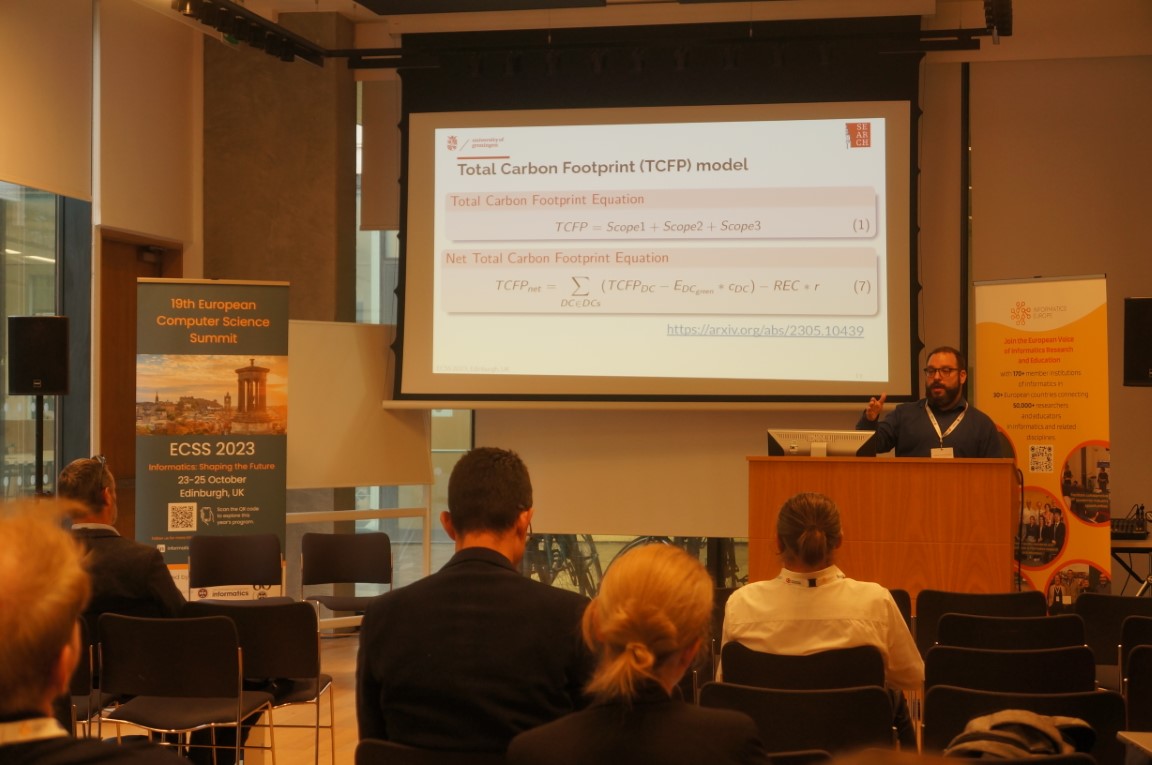
- "Software as a Service through the Cloud: who is responsible for what emissions?" by Vasilios Andrikopoulos, University of Groningen (the Netherlands) [Slides]
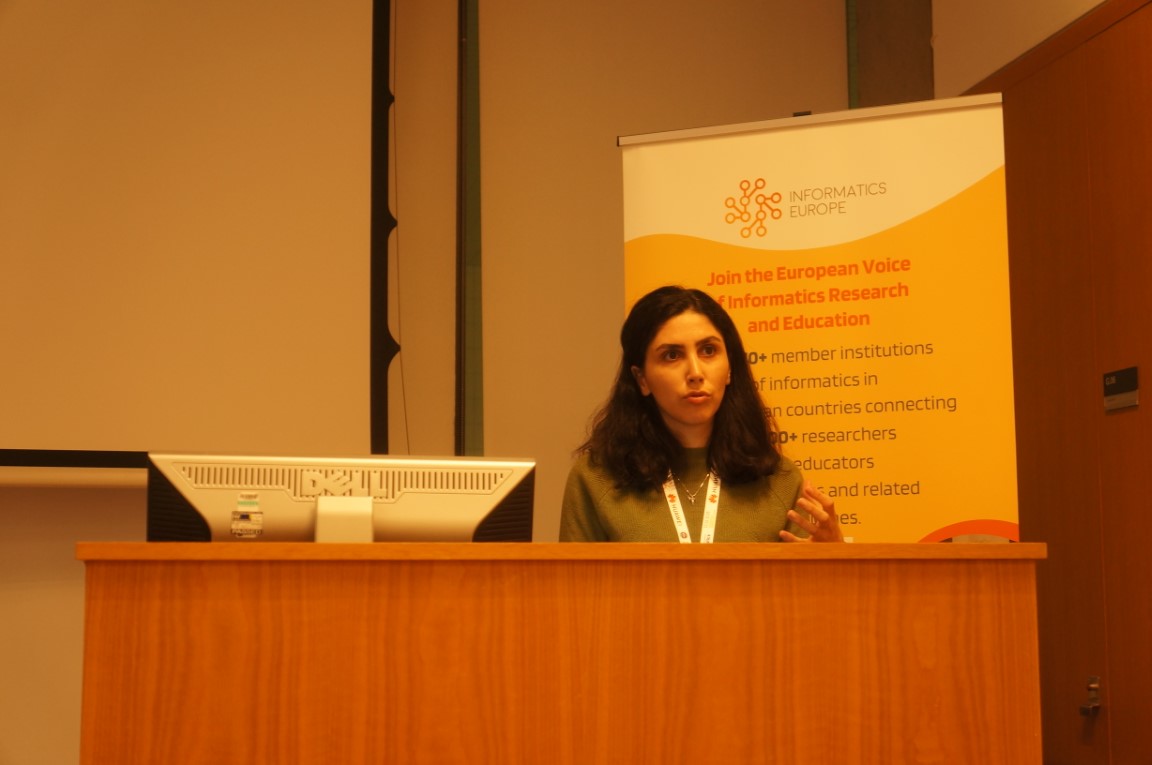
- “Environmental Impact of Deep Neural Network Training” by Kawsar Haghshenas, University of Groningen (the Netherlands) [Slides]
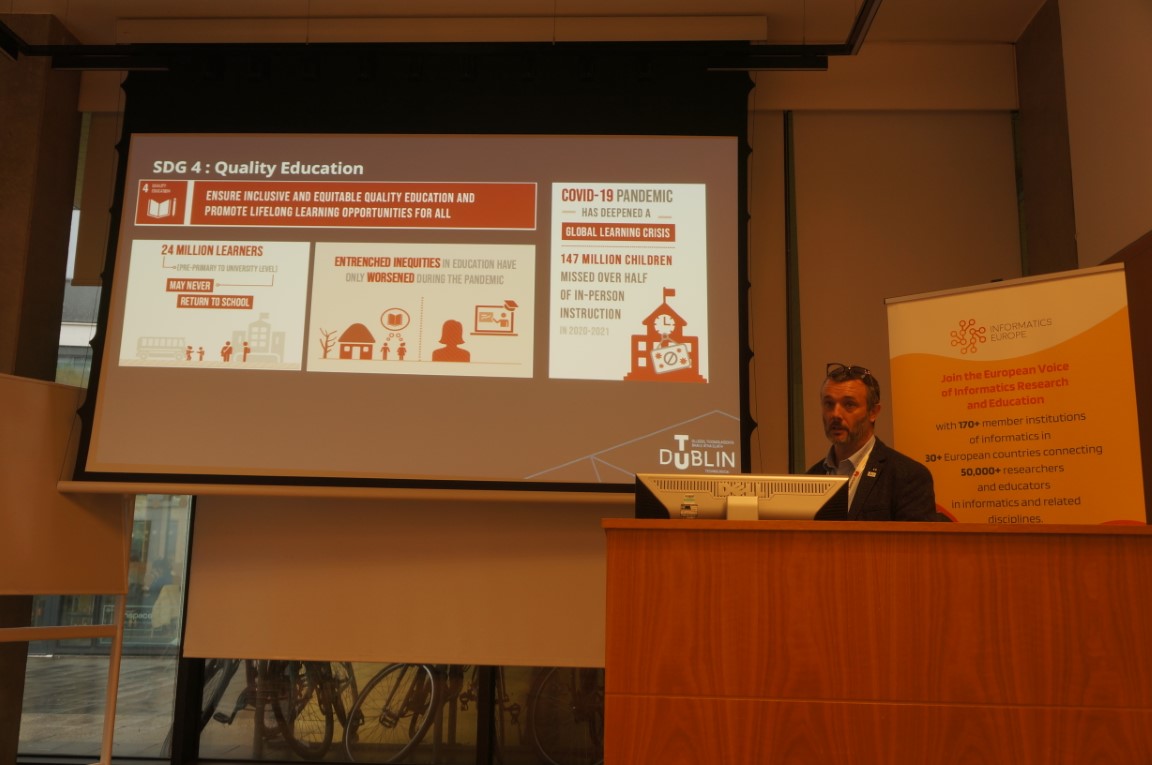
- "Embedding Sustainability into Third Level Education to meet Sustainable Development Goals" by Brian Keegan, TU Dublin (Ireland) [Slides]
14:30 - 15:30 Open discussion with panellists, moderated by Marco Aiello, University of Stuttgart
with additional contributions from Green ICT Working Group member: Rafael Capilla, Rey Juan Carlos University, Spain. [Slides]
15:30 - 16:00 Wrap up and next steps towards a green ICT agenda
*Please note that the photos below are better viewed when applying zoom out.
-
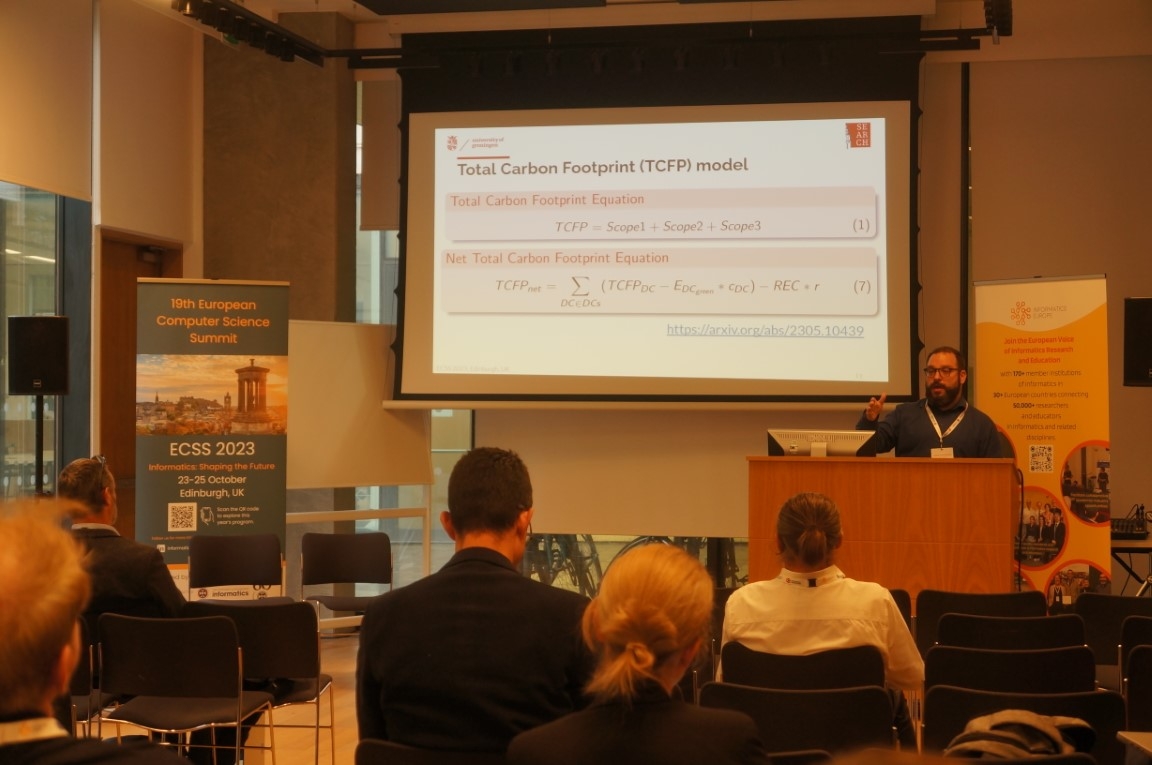
Vasilios Andrikopoulos, University of Groningen, the Netherlands
-
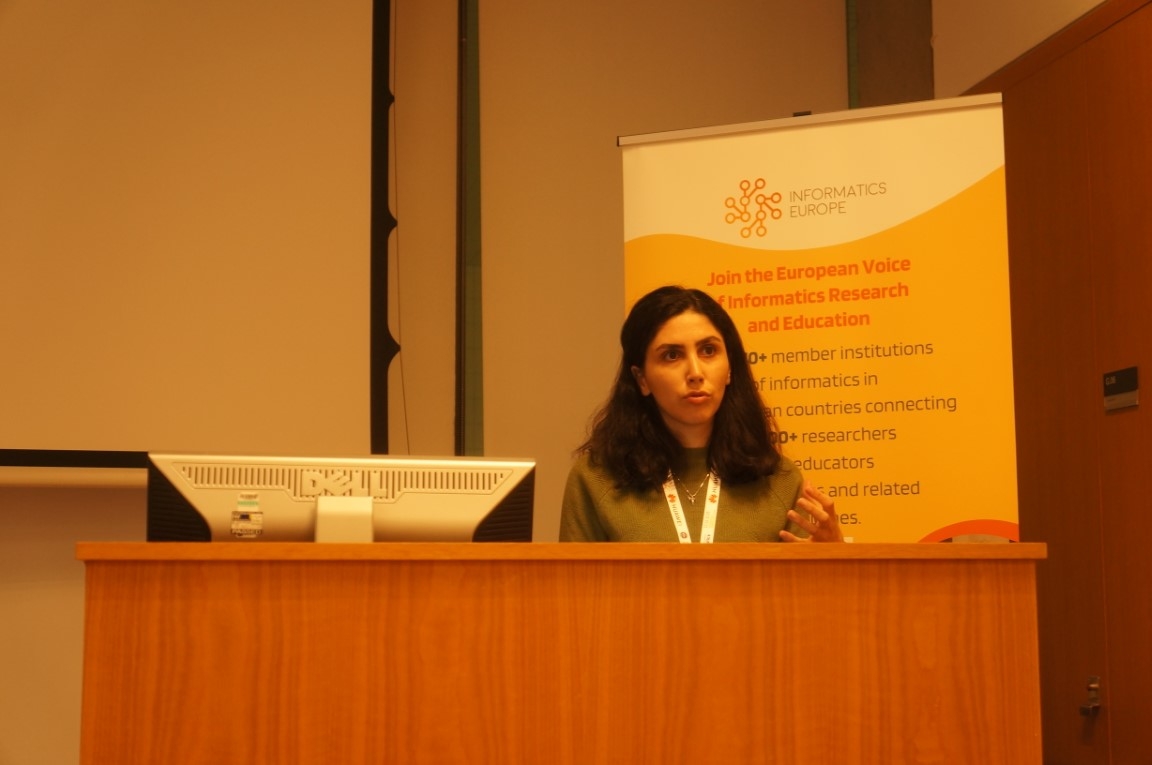
Kawsar Haghshenas, University of Groningen, the Netherlands
-
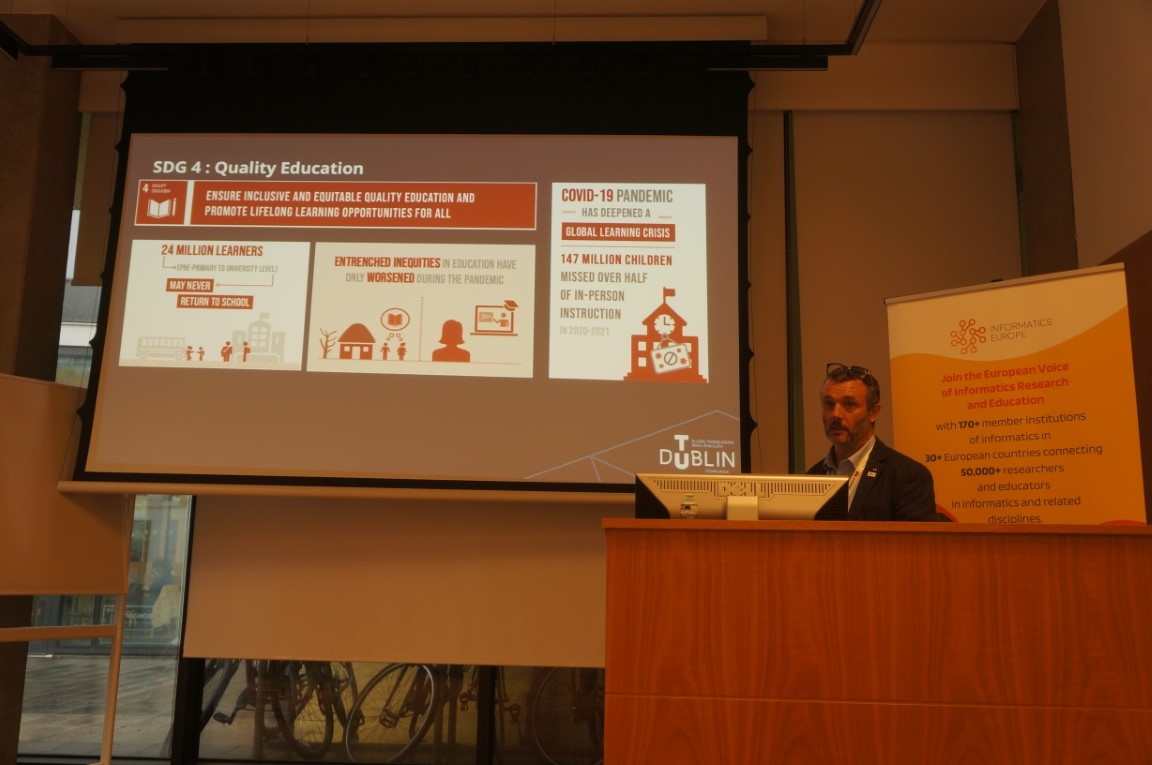
Brian Keegan, TU Dublin, Ireland
-
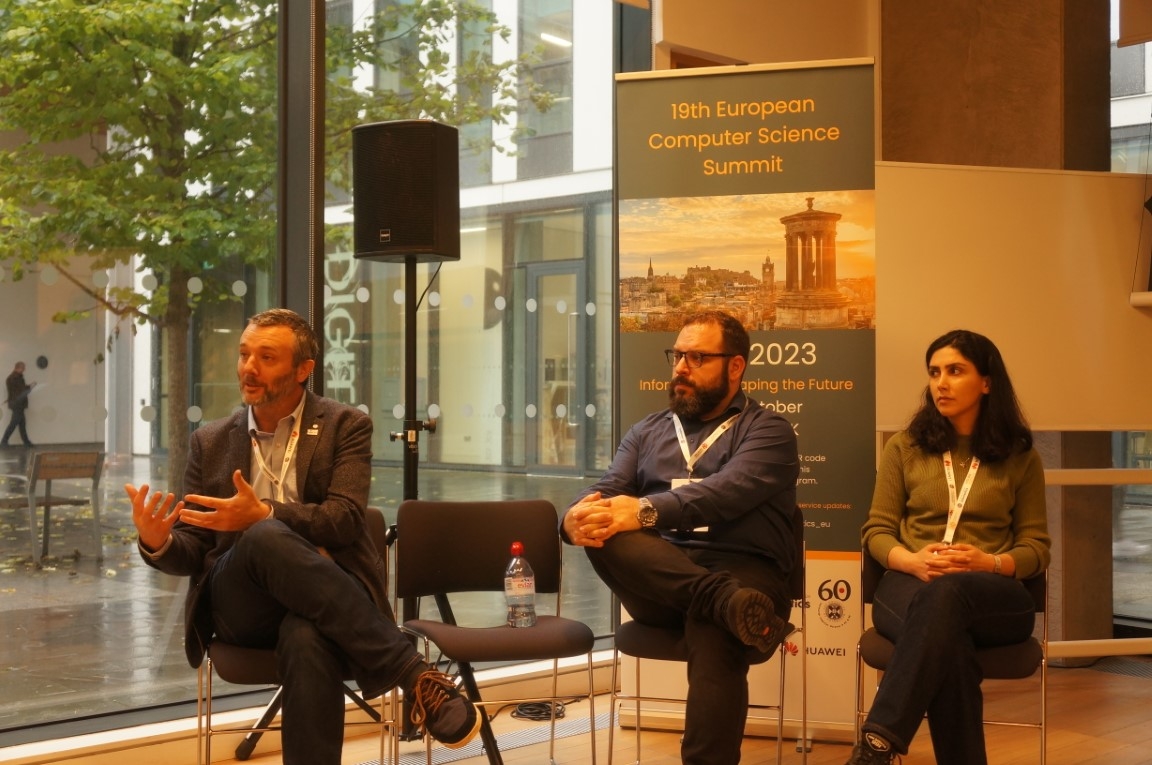
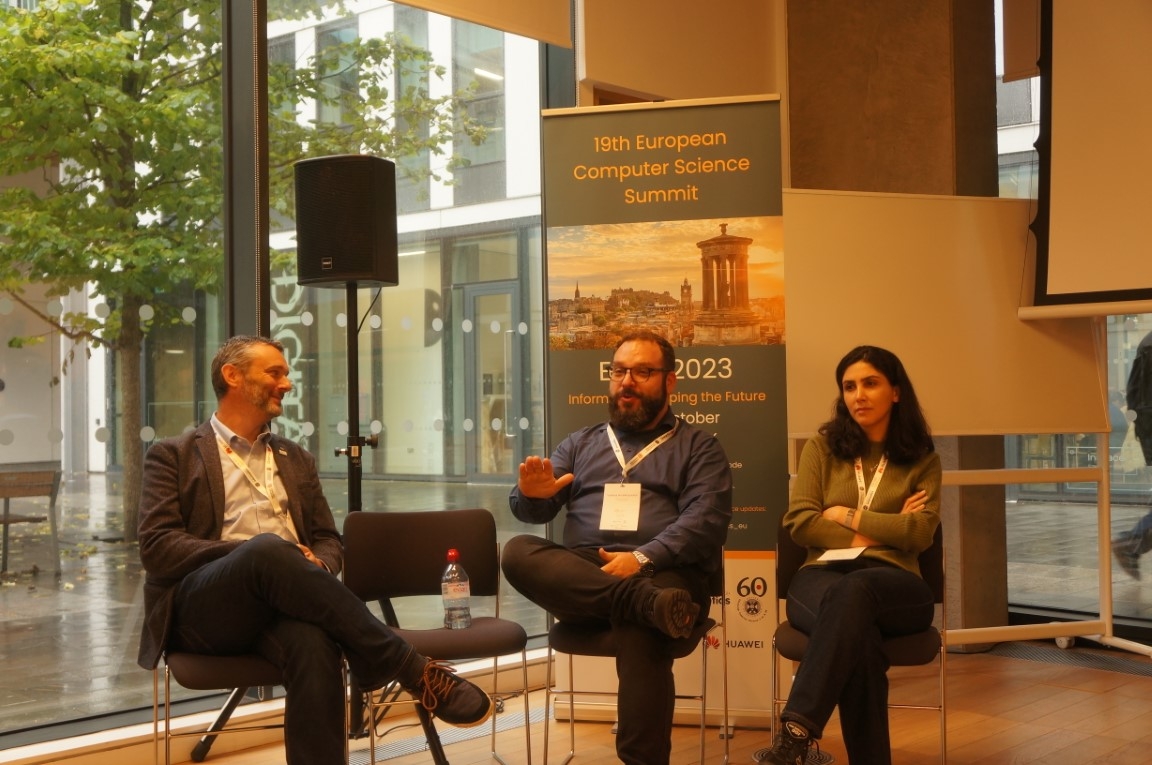
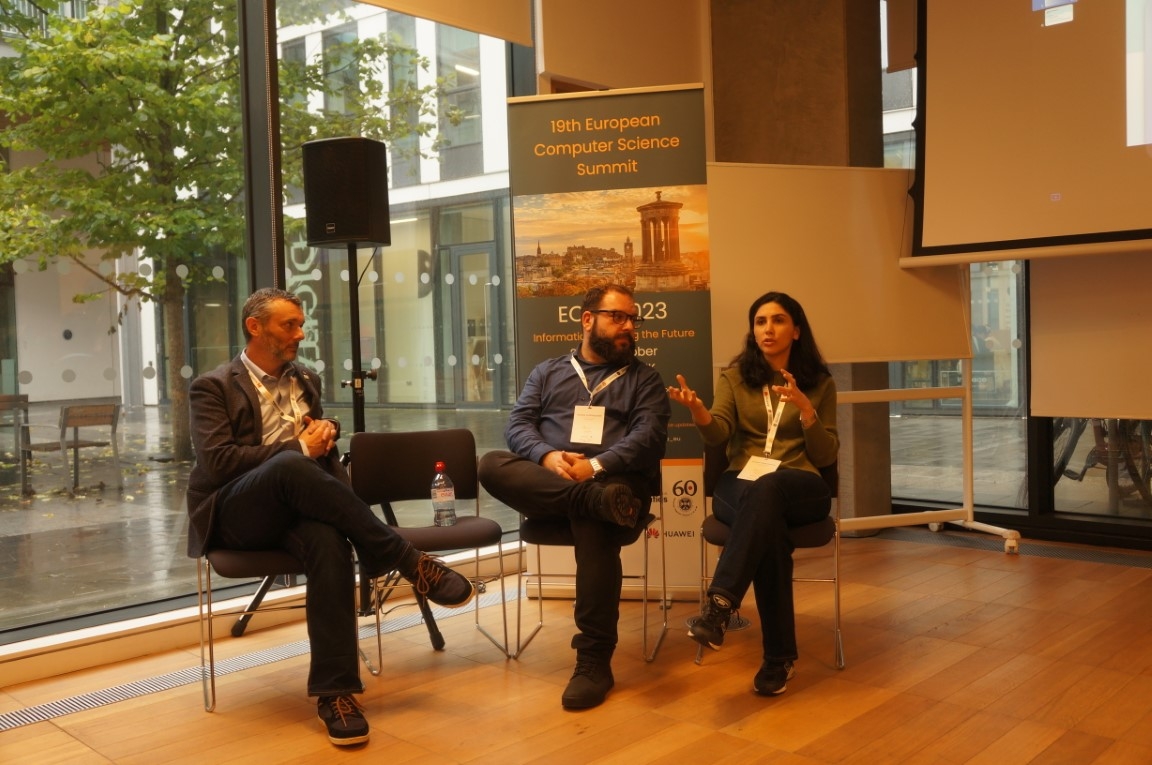
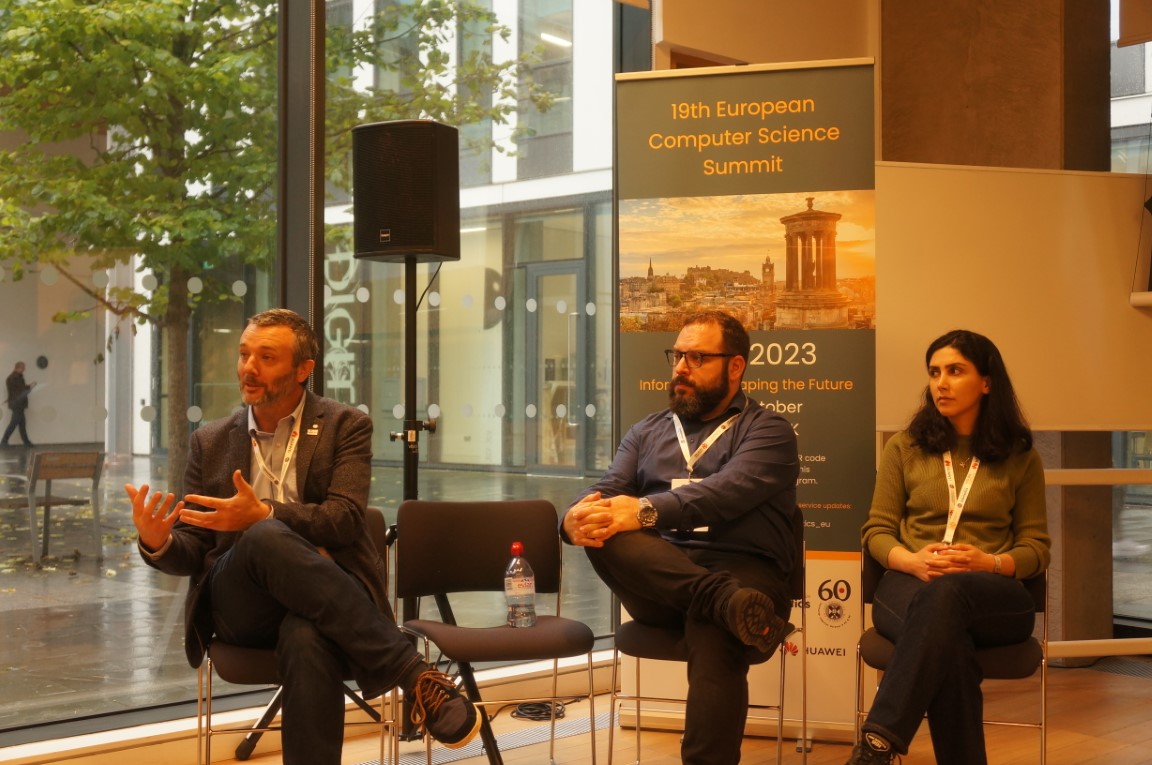
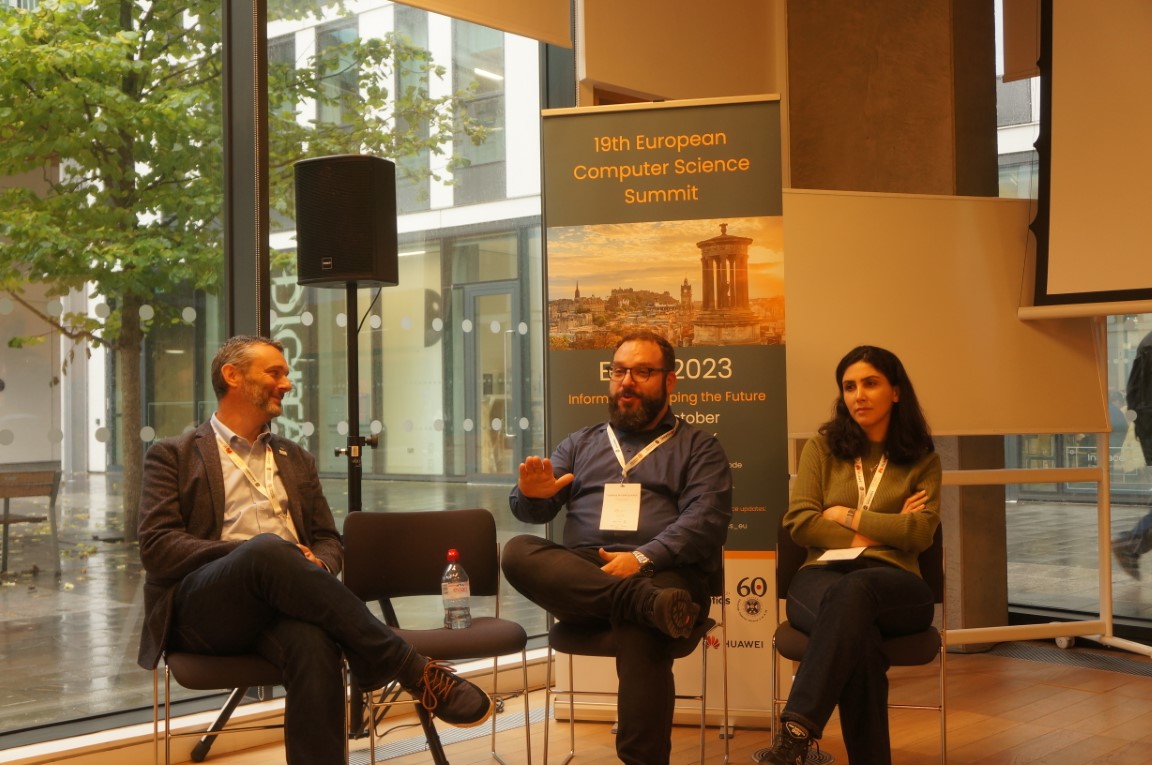
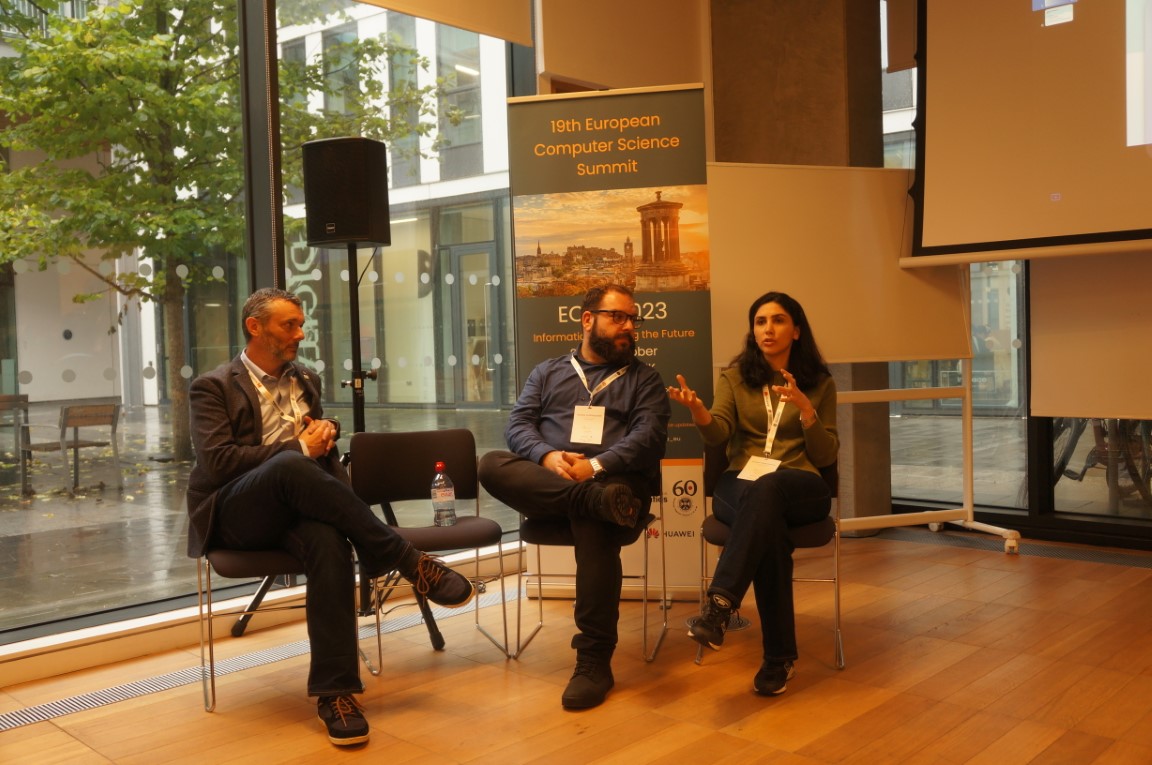
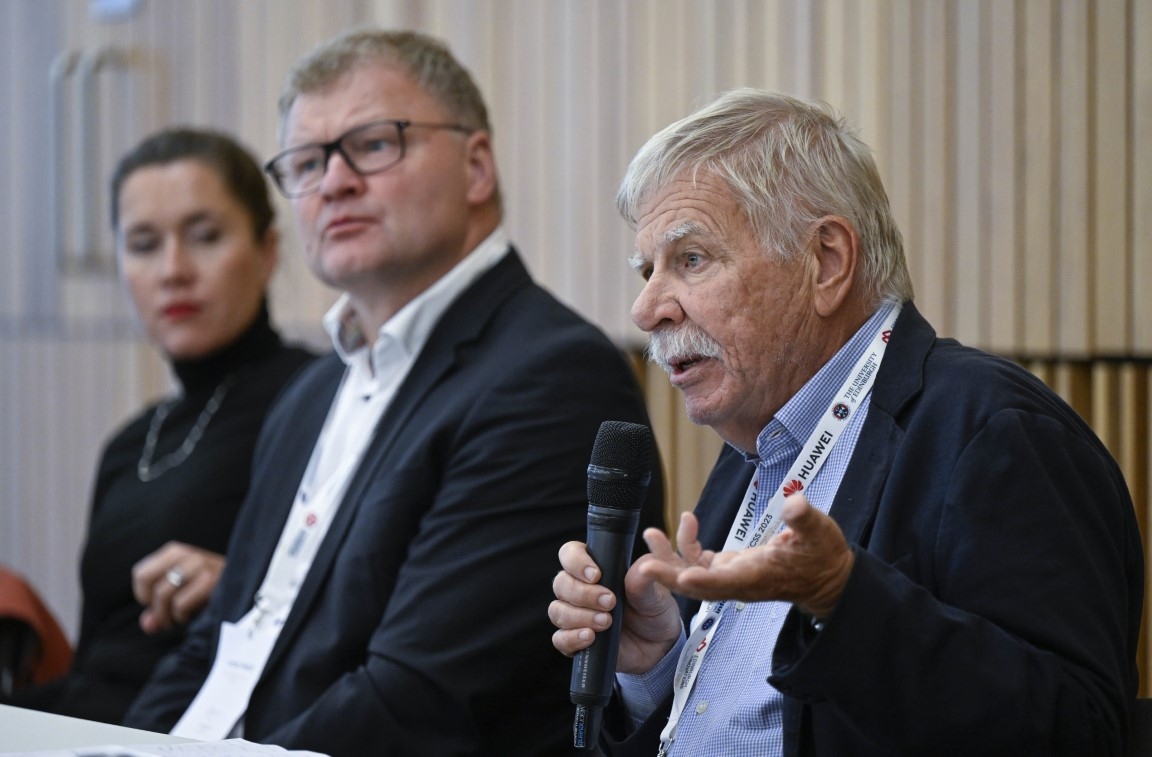
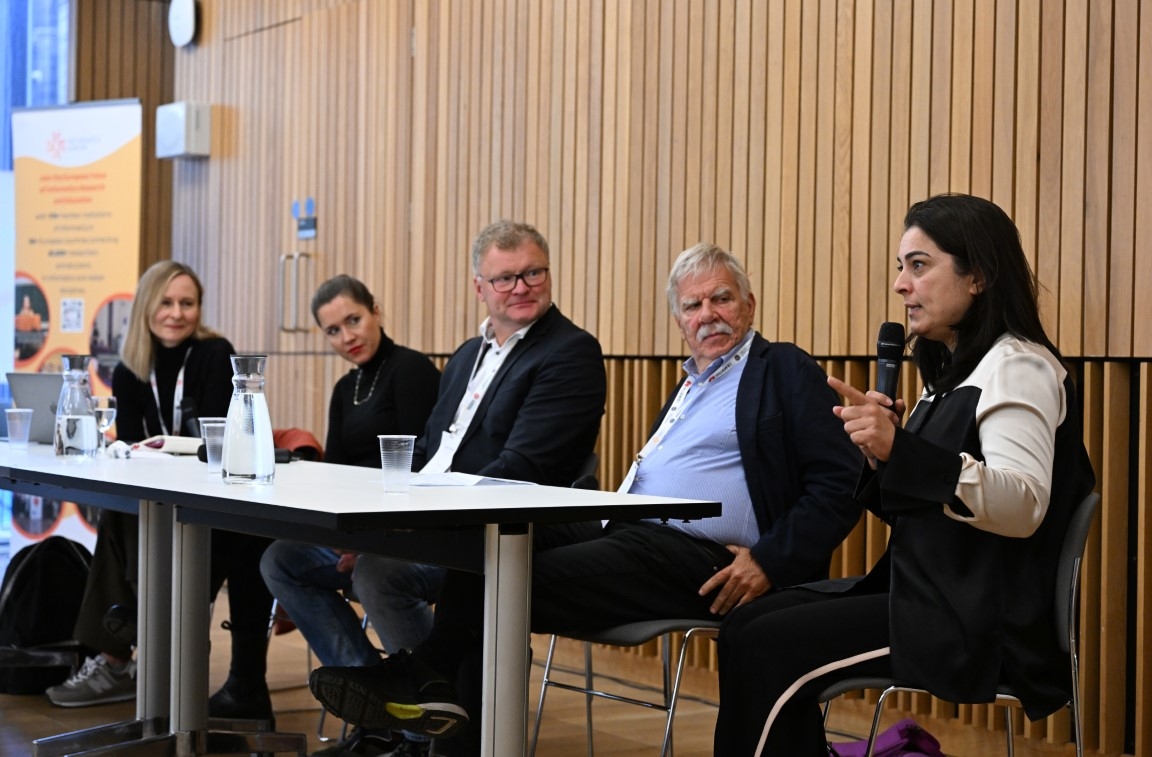
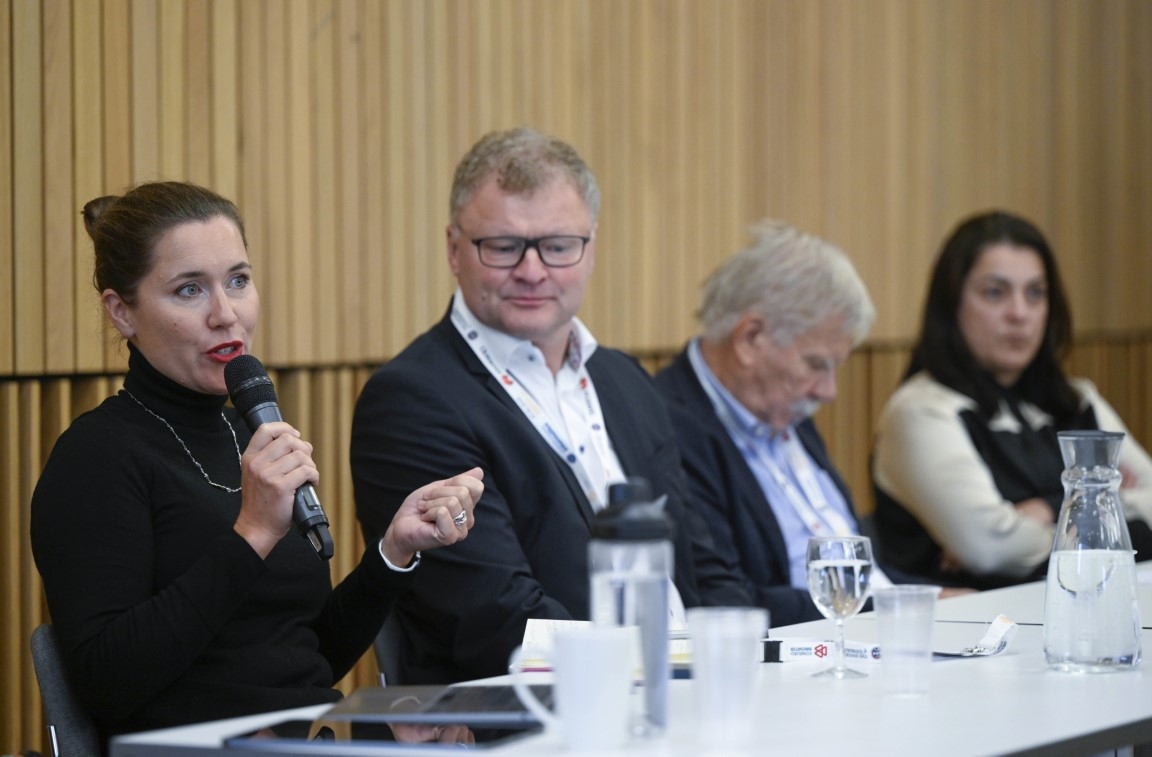
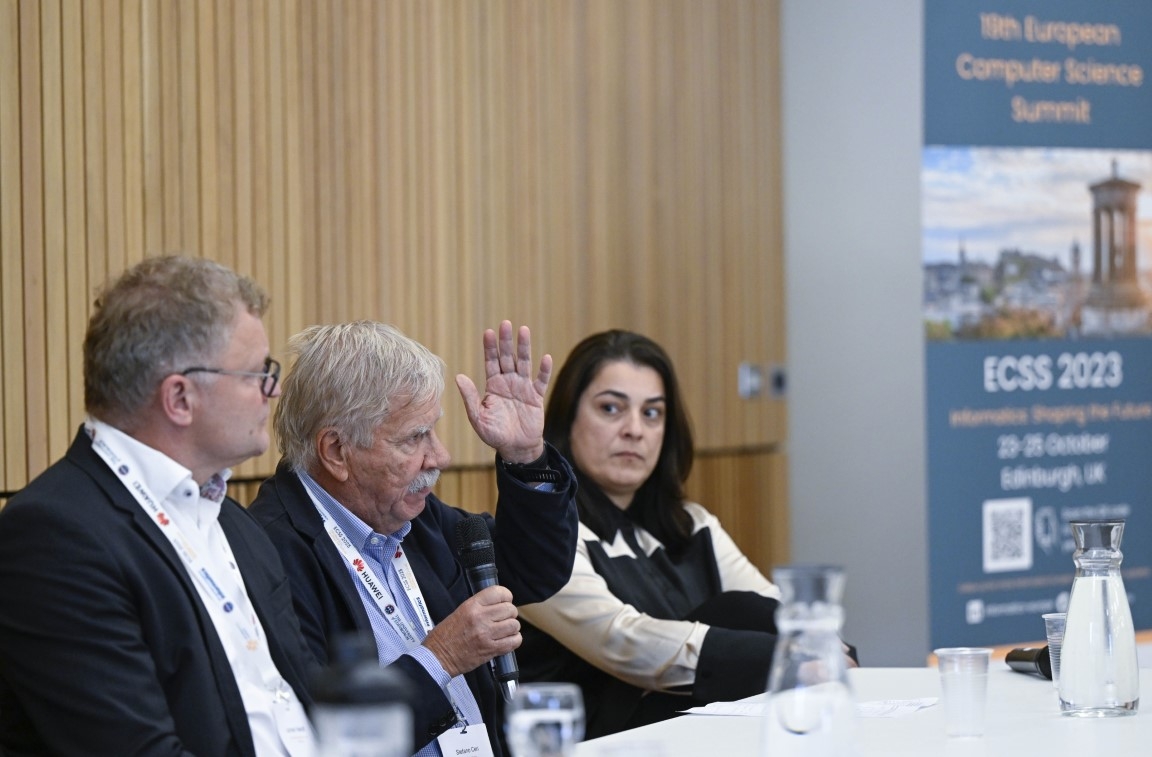
Open discussion with panellists at Green ICT and ICT for Green Workshop
-
Open discussion with panellists at Green ICT and ICT for Green Workshop
-
Open discussion with panellists at Green ICT and ICT for Green Workshop


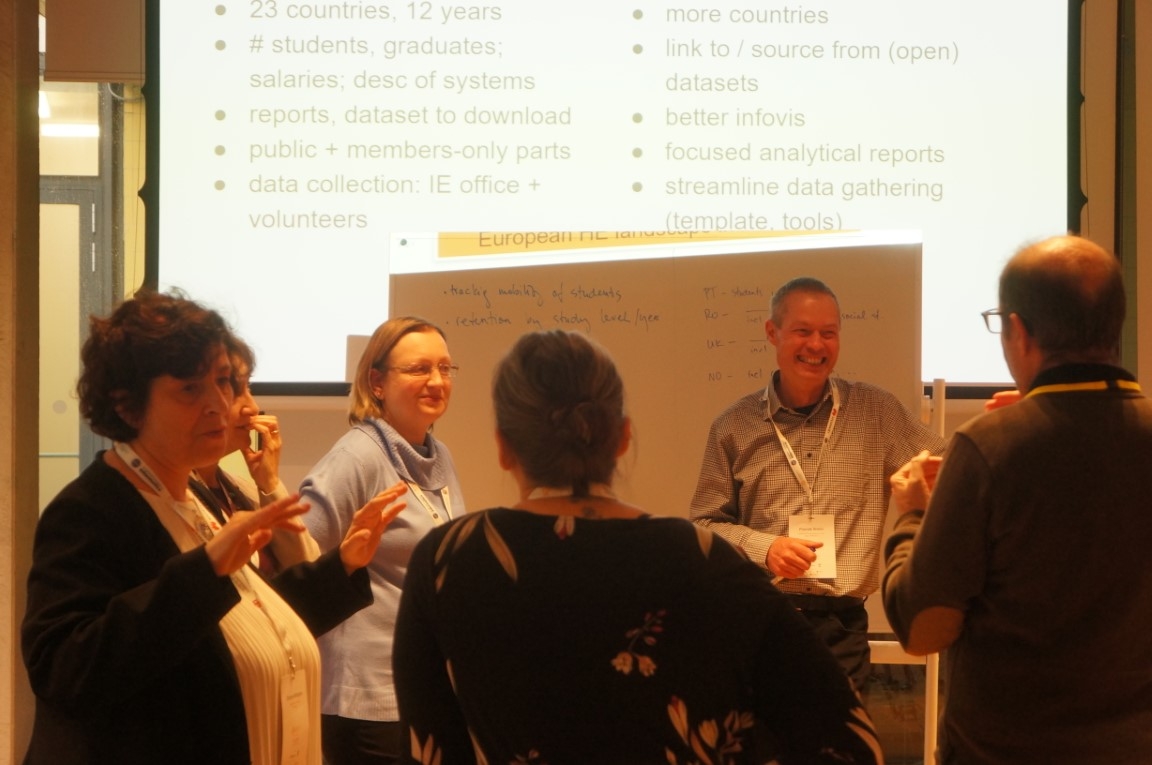
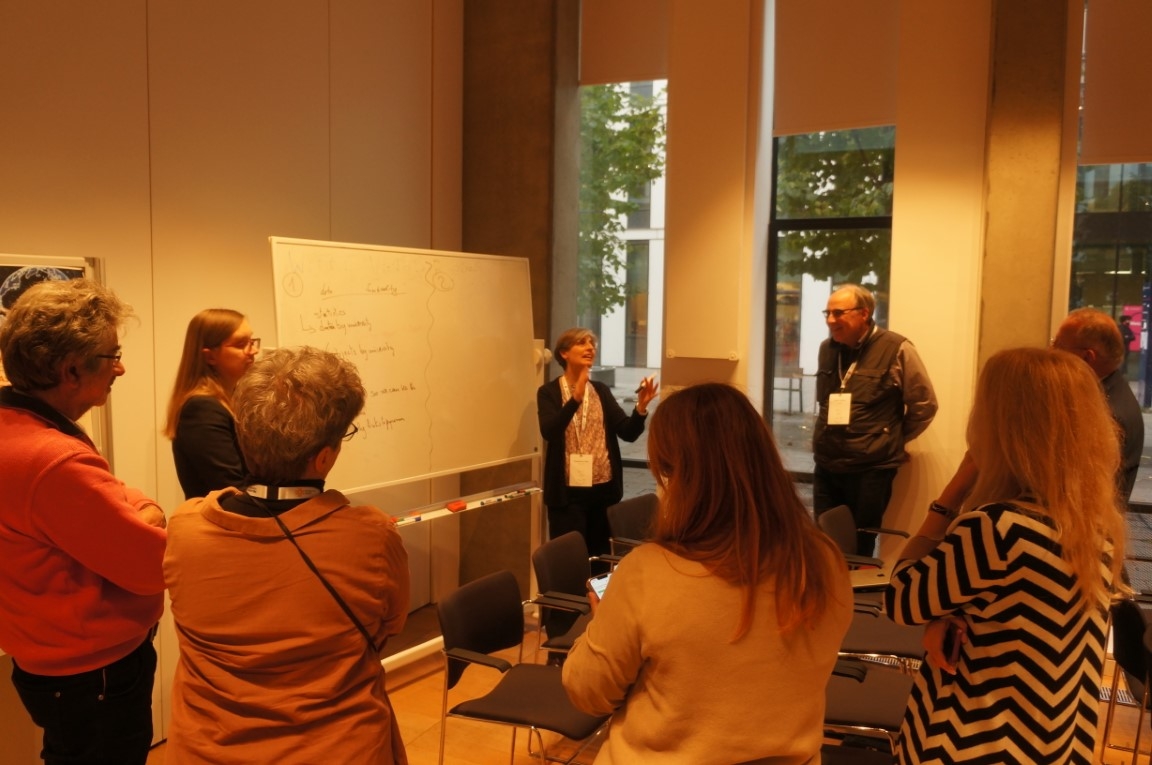
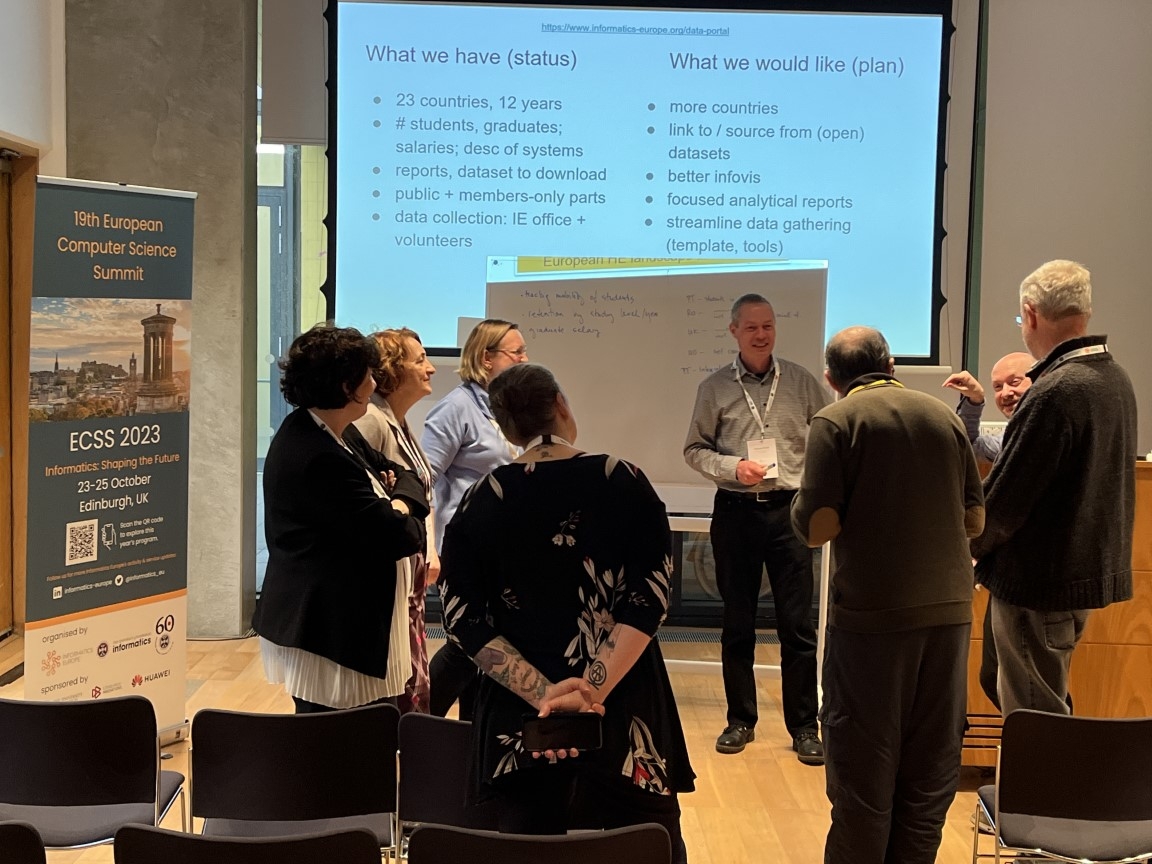
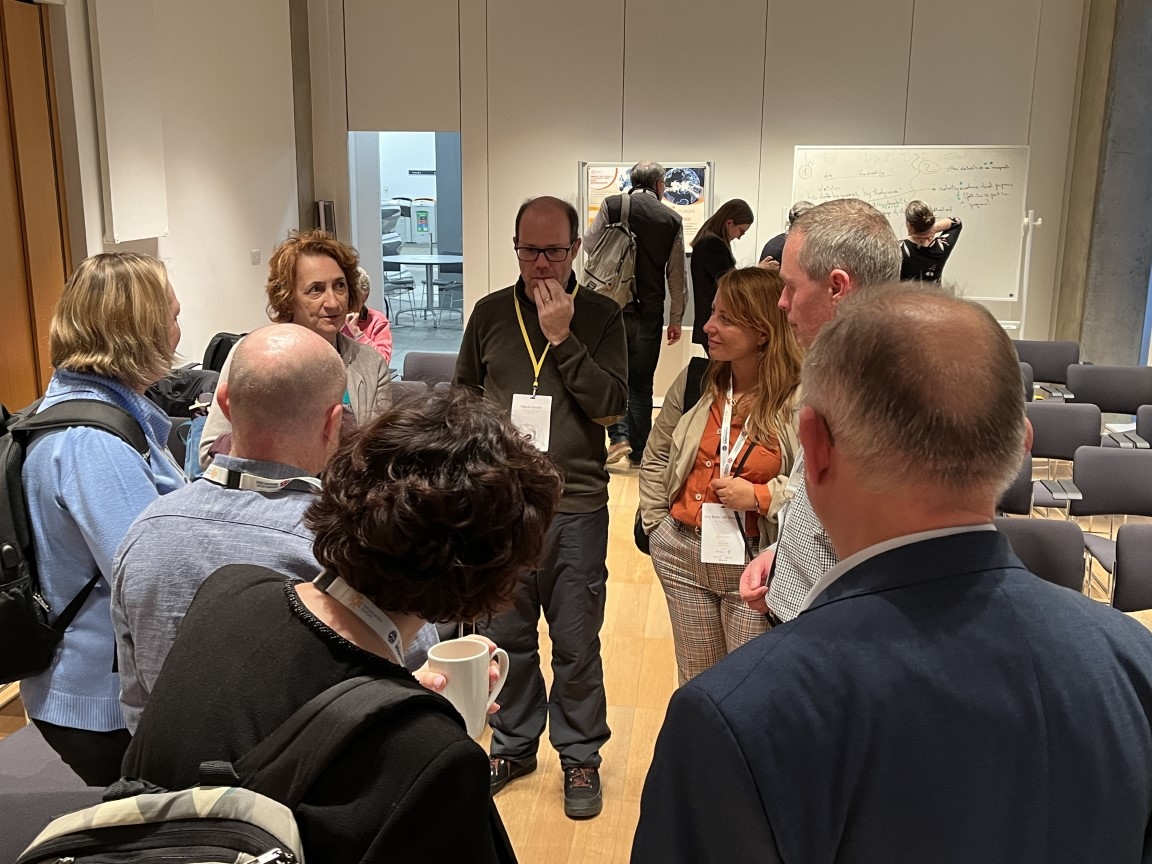
Higher Education Data Workshop
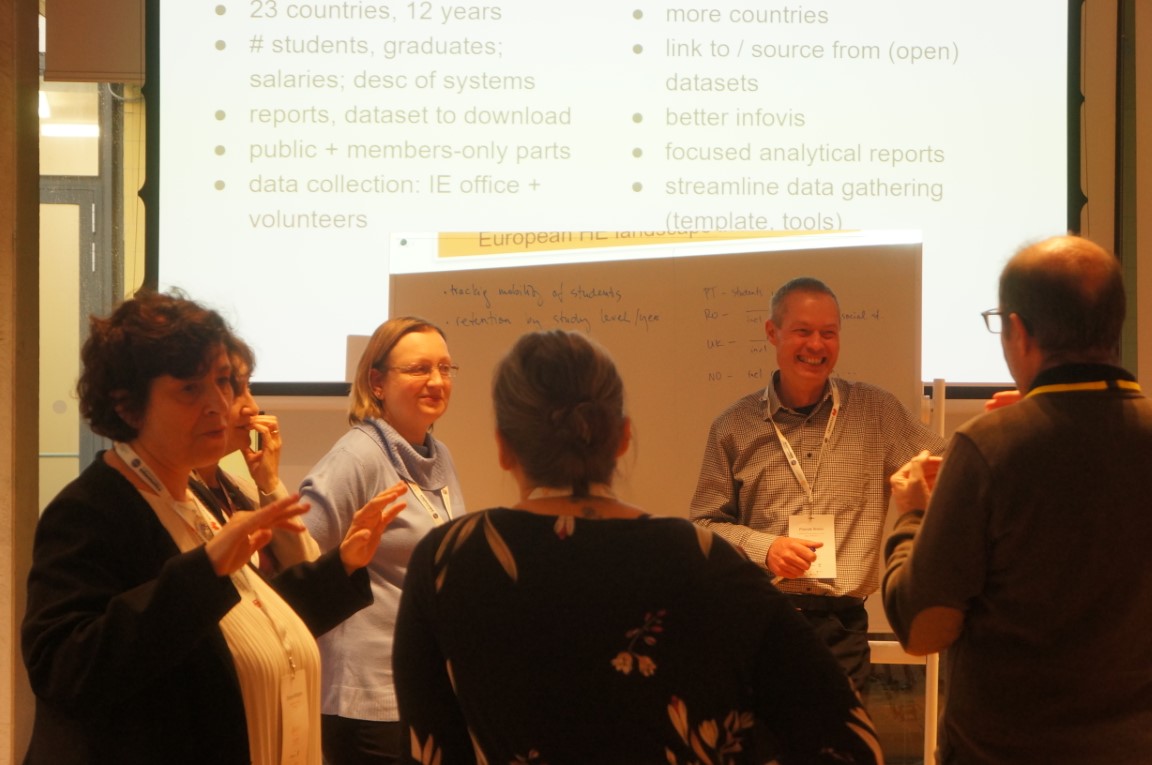
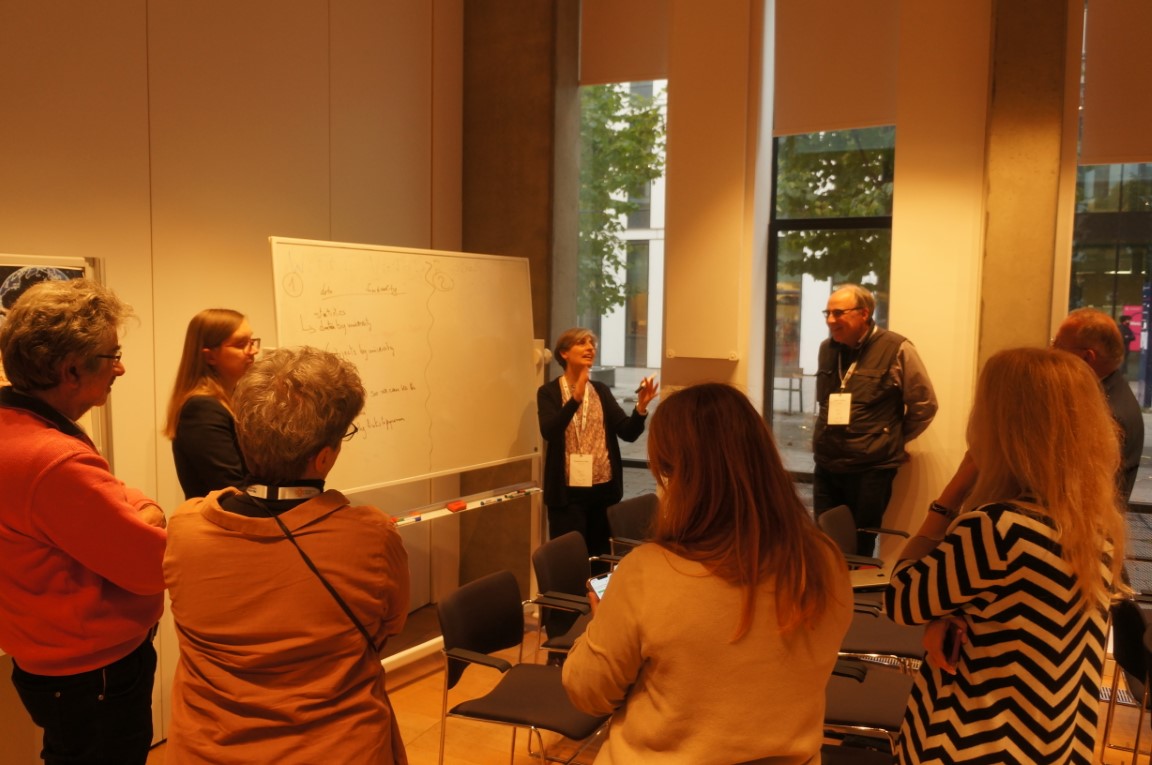
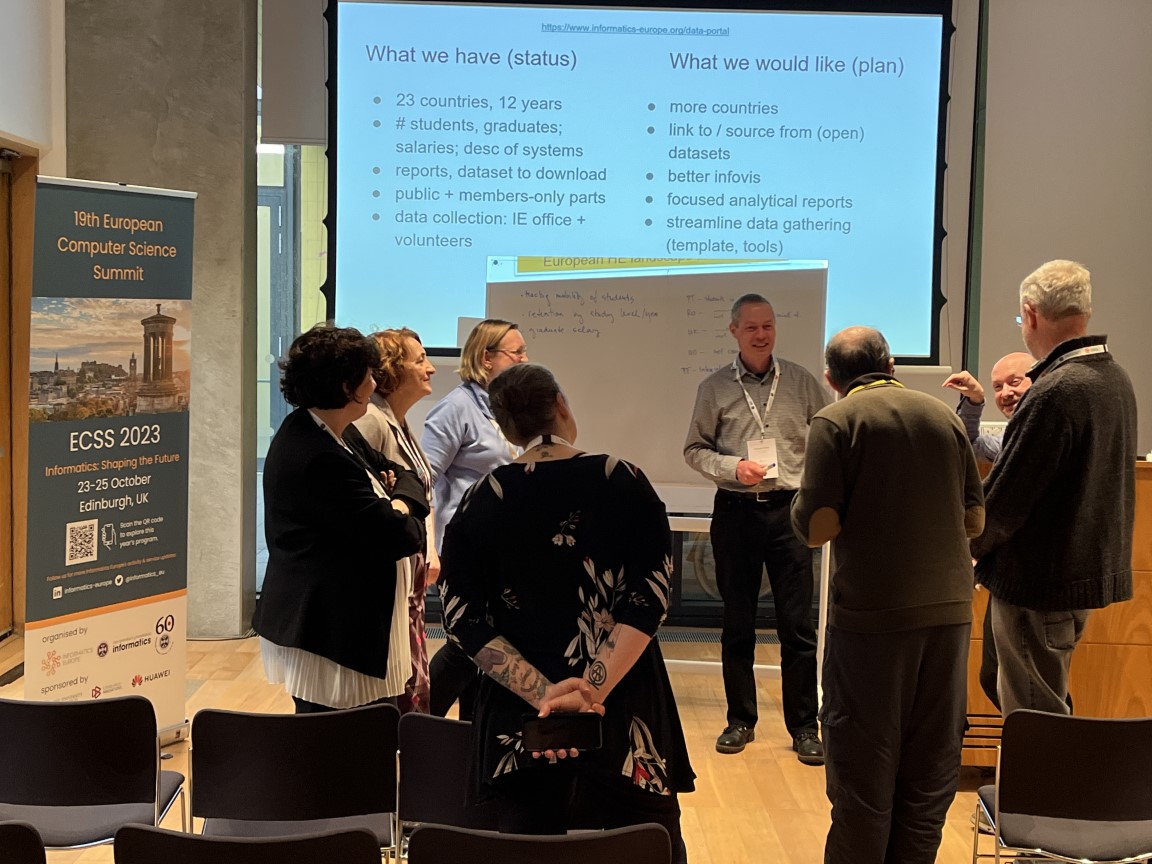
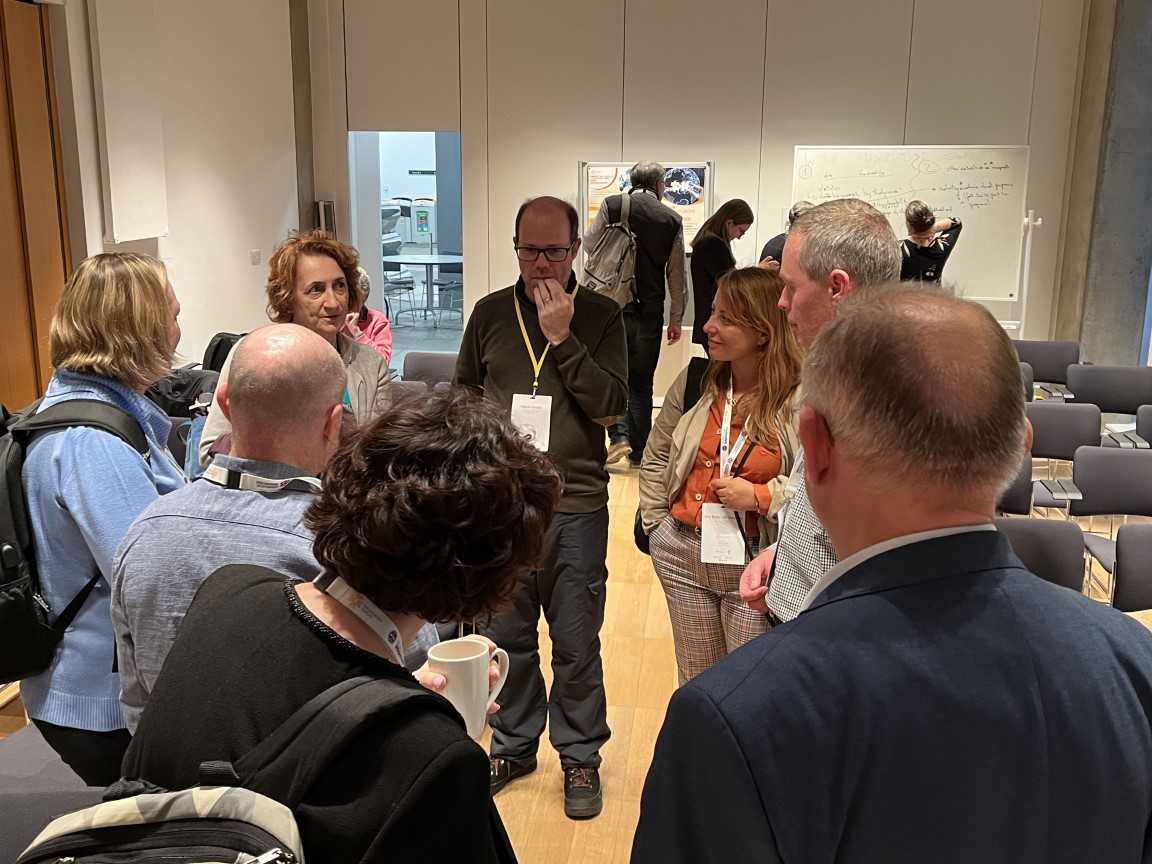
As part of the ECSS 2023 program, Informatics Europe organised the Higher Education Data Workshop with the theme “Analysis of Data in European Informatics Higher Education Landscape” on Tuesday afternoon, 24 October, open to all participants, co-organised by Informatics Europe's Data Analysis and Reporting working group and chaired by Přemek Brada, University of West Bohemia.
The landscape of higher education in Europe is as varied as its culture and regions. To help the departments and faculties get oriented in this landscape, and to promote serious, comprehensive and beneficial policy work for research and education in the field, Informatics Europe runs its Data Portal. The platform contains valuable study programme statistics and information about European higher education systems, but there are certainly other indicators to report on and other ways of presenting and analysing what is already available. Various stakeholders may have various needs and questions that the data could help answer.
In this workshop, we shared some of the usages and behind-the-scenes work of the Data Portal and the Data and Analysis and Reporting working group. Based on those examples, we discussed with all workshop participants the potential of the Higher Education Data Portal and the data analysis and reporting work of Informatics Europe to support as key drivers in shaping university management and policy makers with solid, accurate facts and figures about Informatics research and education in Europe.
Workshop Rundown
16:05 - 17:20 Turning Data into Information: driving changes with IE Data Portal
- "Informatics Higher Education in Europe: A Data Portal and Case-Study", Elisabetta di Nitto, Politecnico di Milano (Italy) [Slides]
- “Behind-the-scenes of the IE Data Portal”, Svetlana Tikhonenko, Informatics Europe (Switzerland) [Slides]
17:20 - 17:50 Joint work by participants
17:50 - 18:00 Wrap up and next steps
*Please note that the photos below are better viewed when applying zoom out.


Academia-Industry Sessions
As part of the ECSS 2023 program, Informatics Europe organised sessions with Industry on Tuesday afternoon, 24 October, and Wednesday morning, 25 October, open to all participants, and chaired by Lenuta Alboaie, Alexandru Ioan Cuza University of Iași and Jim Ashe, University of Edinburgh. A Tuesday afternoon session was dedicated to informatics life-long learning challenges, while a Wednesday session to entrepreneurship and commercialisation of research.
In a world undergoing accelerated technological evolution, it is evermore important that students have the ability to adapt to new technology landscapes. While academia is concerned with continuous learning, in industry this does not always hold true. Tuesday aftern0on session "Plugging the Informatics Skills Gap" addressed the importance of upskilling and reskilling in the Computer Science ecosystem and offered the opportunity to explore together ways to improve the skills gap issue.
Computer Science and related informatics courses in academia focus on providing students with the technical background and best practices to write elegant and efficient algorithms. While it is essential to equip students with these technical abilities, we must also raise students’ awareness of how they may use their intellectual property to form innovative companies and equip them with the tools and knowledge they need to bring their technologies to market. In the Wednesday morning session "The Journey from Higher Education to Entrepreneurship", the University of Edinburgh and other universities shared their experiences. We also heard from some successful entrepreneurs about their learnings.
October 24th (Tue) "Plugging the Informatics Skills Gap" Session Rundown
16:00 - 16:05 Welcome by the session chairs
16:05 - 17:25 Informatics Life-long learning: the industry perspective
- "Industry and Academia Collaboration - from a Sony Perspective" by Faisal Kamran, Principal Technology Analyst, SONY [Slides]
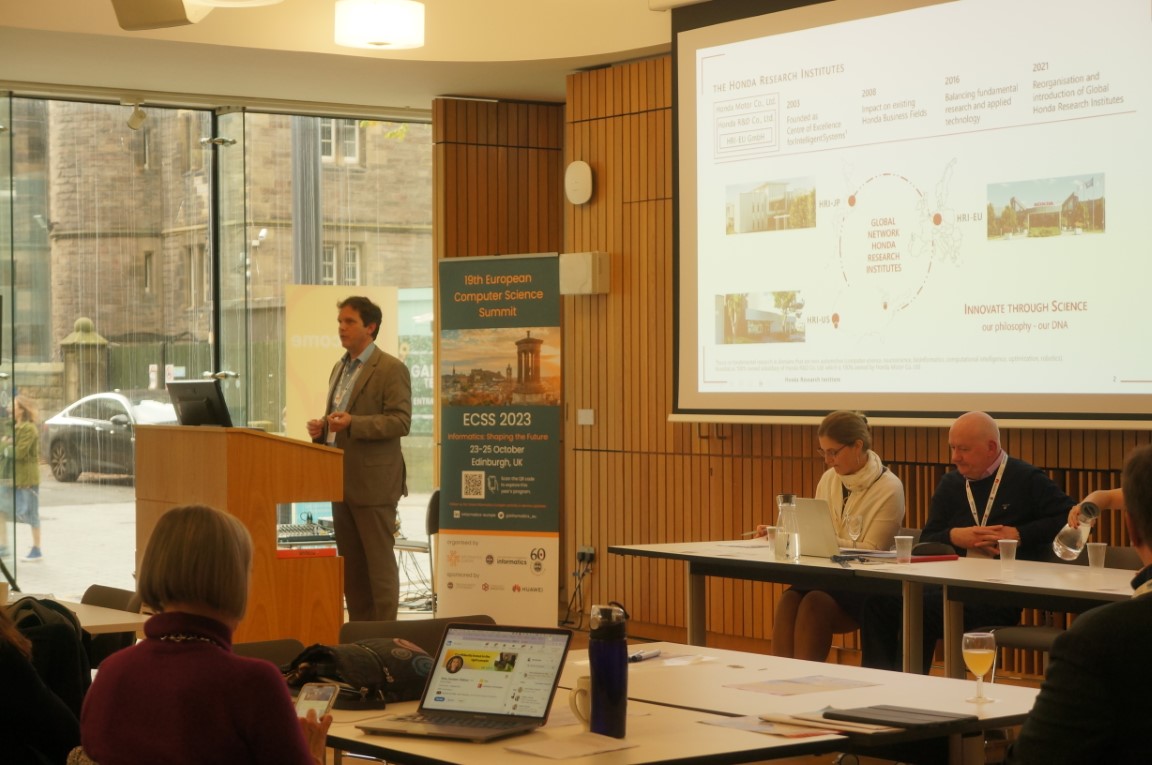
- "Innovate Through Science – Life-long Learning in Company Research" by Michael Gienger, Chief Scientist, Honda Research Institute [Slides]
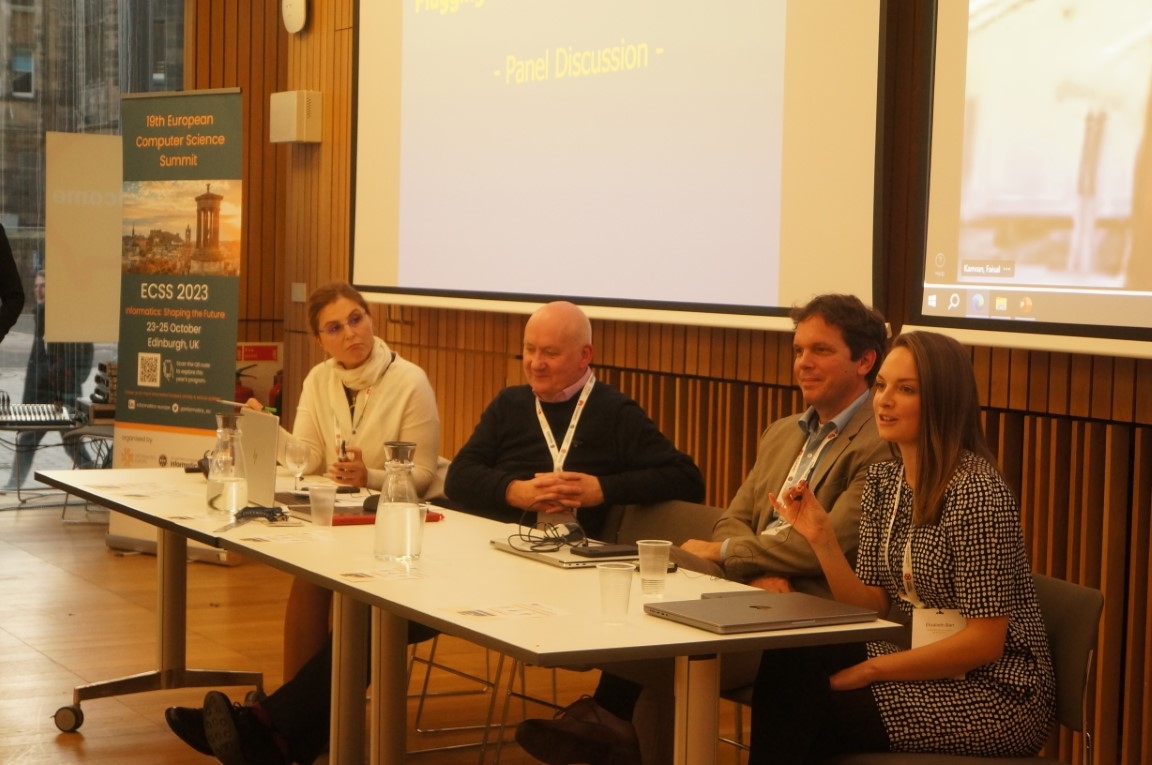
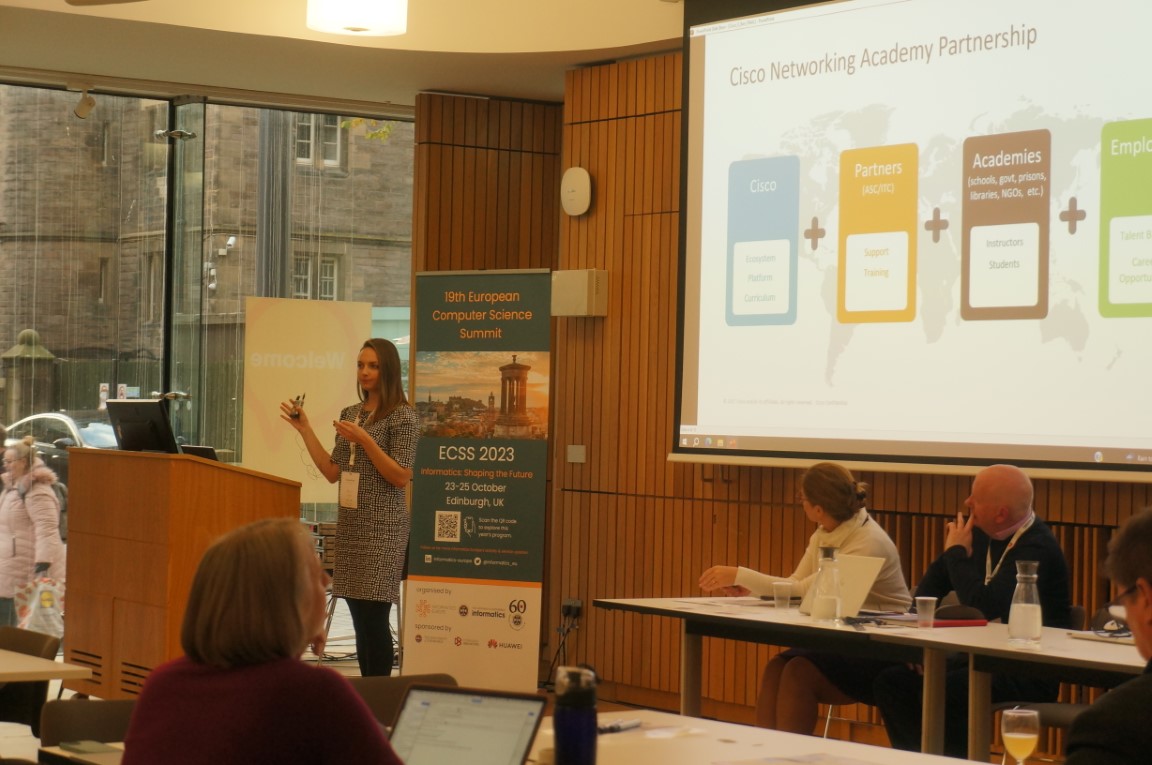
- "The Cisco Networking Academy: Powering an Inclusive Future for All" by Elizabeth Barr, Business Development Manager, CISCO Networking Academy, UK&I, CISCO [Slides]
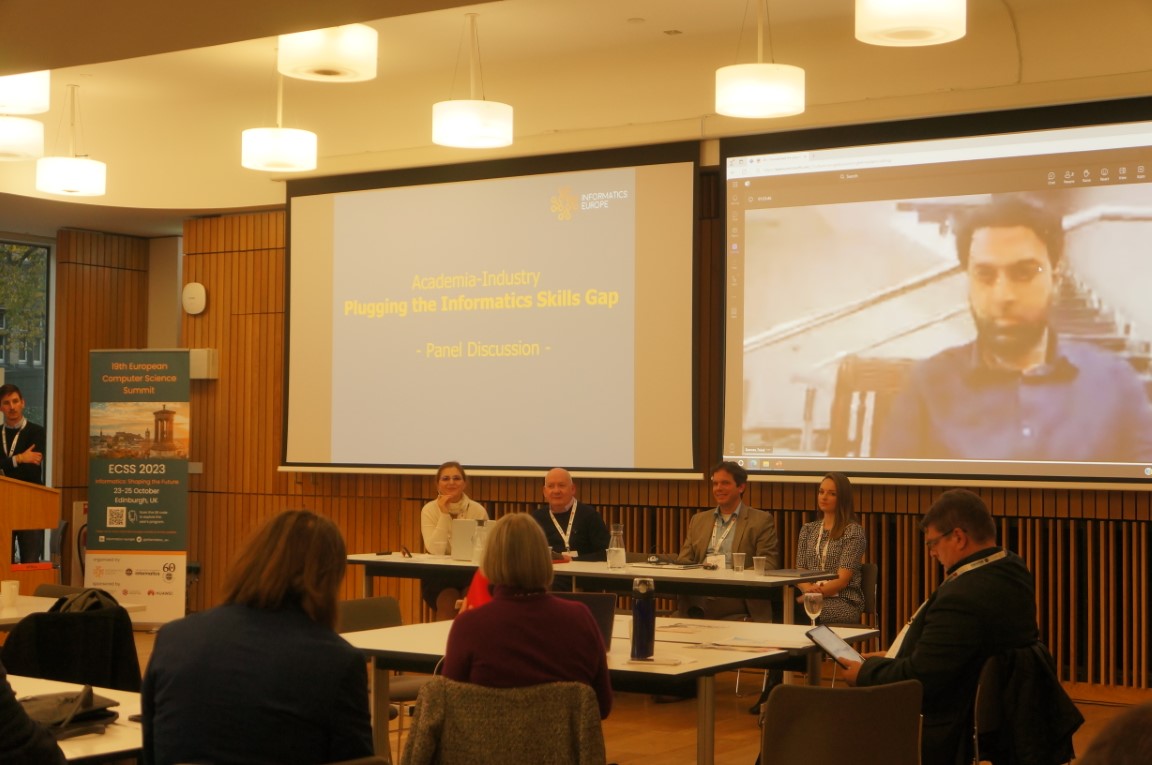
17:25 - 17:55 Academia-Industry way forward - panel discussion
17:55 - 18:00 Closing
October 25th (Wed) "The Journey from Higher Education to Entrepreneurship" Session Rundown
09:00 - 09:05 Welcome by the session chairs
09:05 - 10:30 Fostering & Supporting Data-Driven Start-ups in Academia
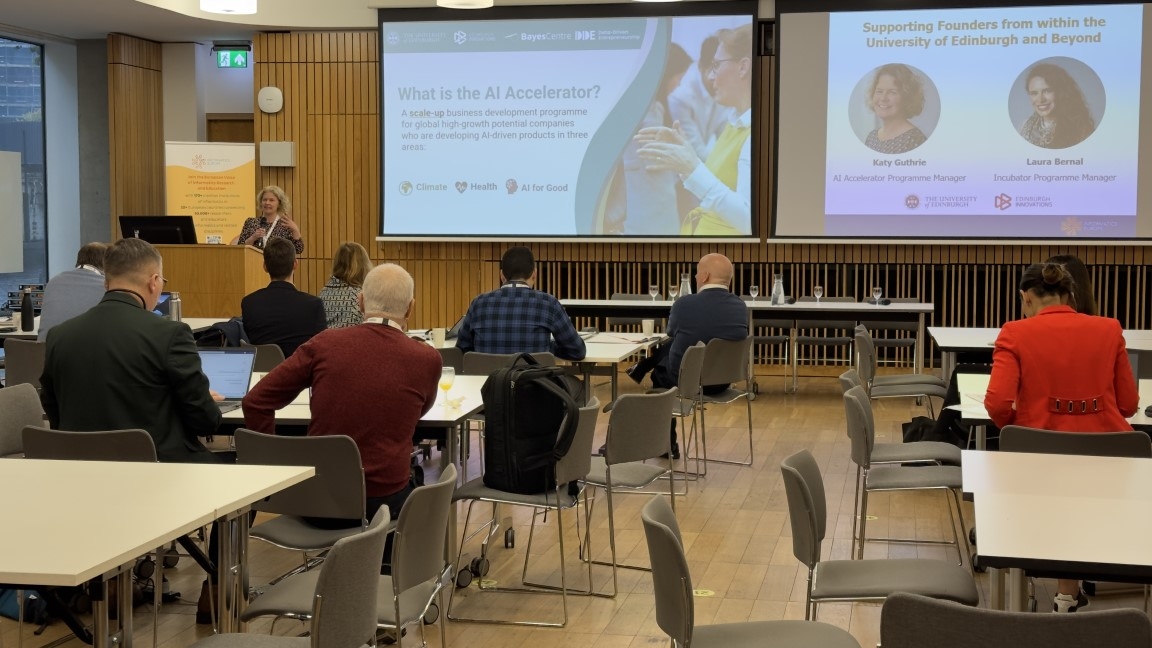
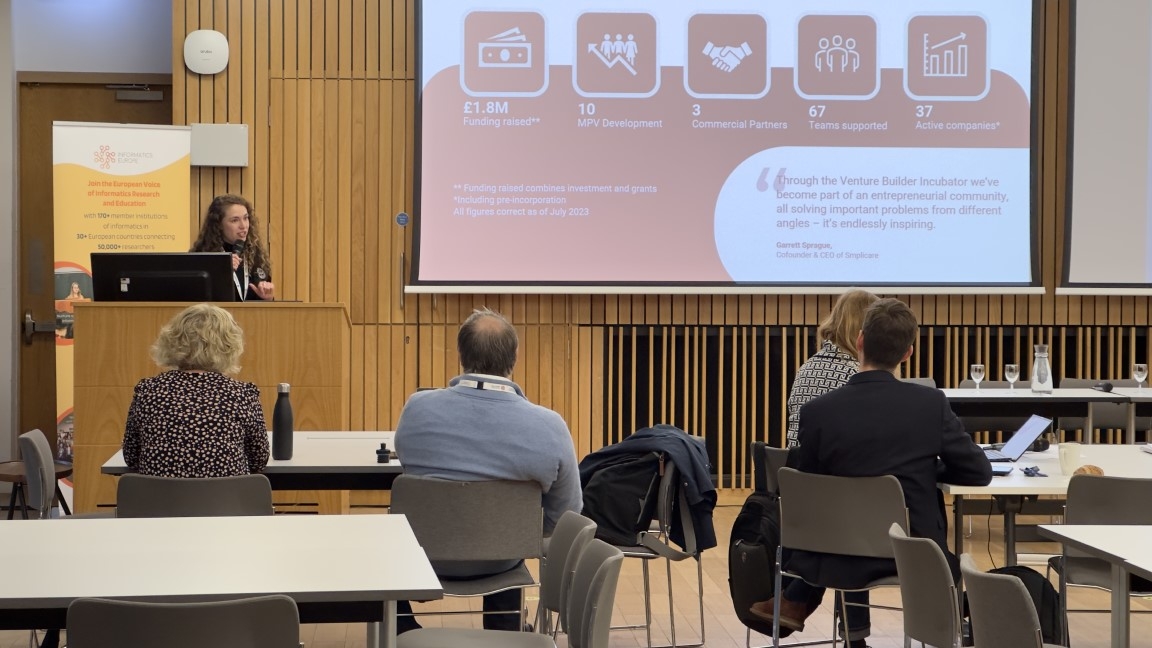
- "Creating and nurturing data science-based and AI-driven businesses" by Laura Bernal & Katy Guthrie, Edinburgh Innovations (UK) [Slides]
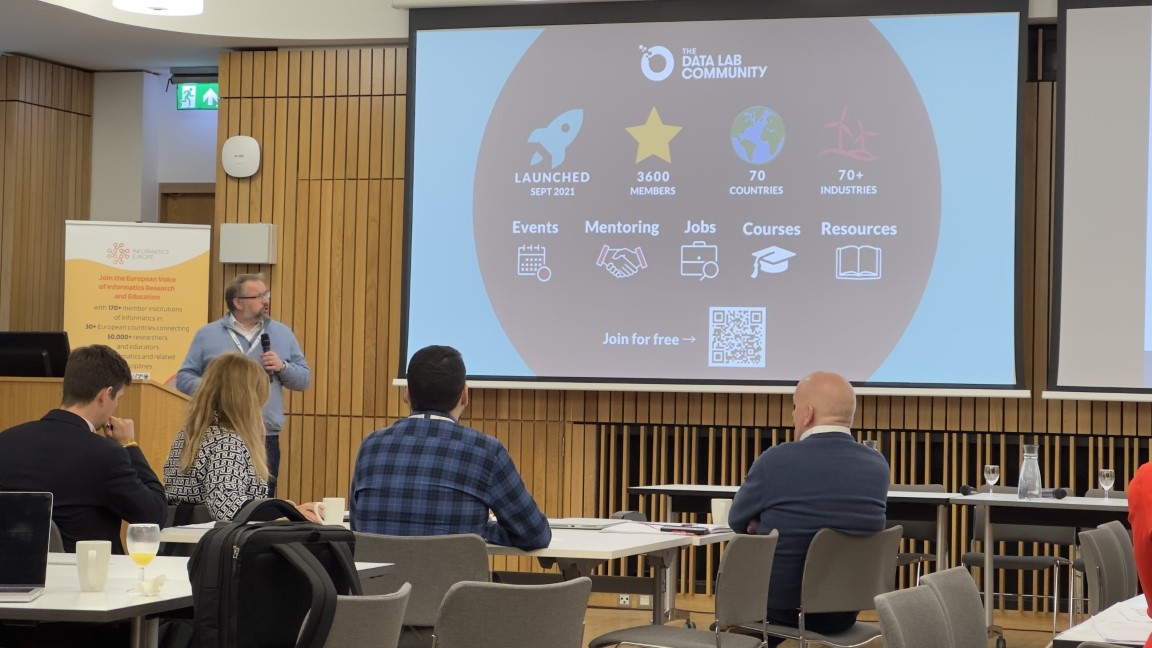
- "From research lab to startup: Navigating the ethical AI journey" by Brian Hills, The DataLab [Slides]
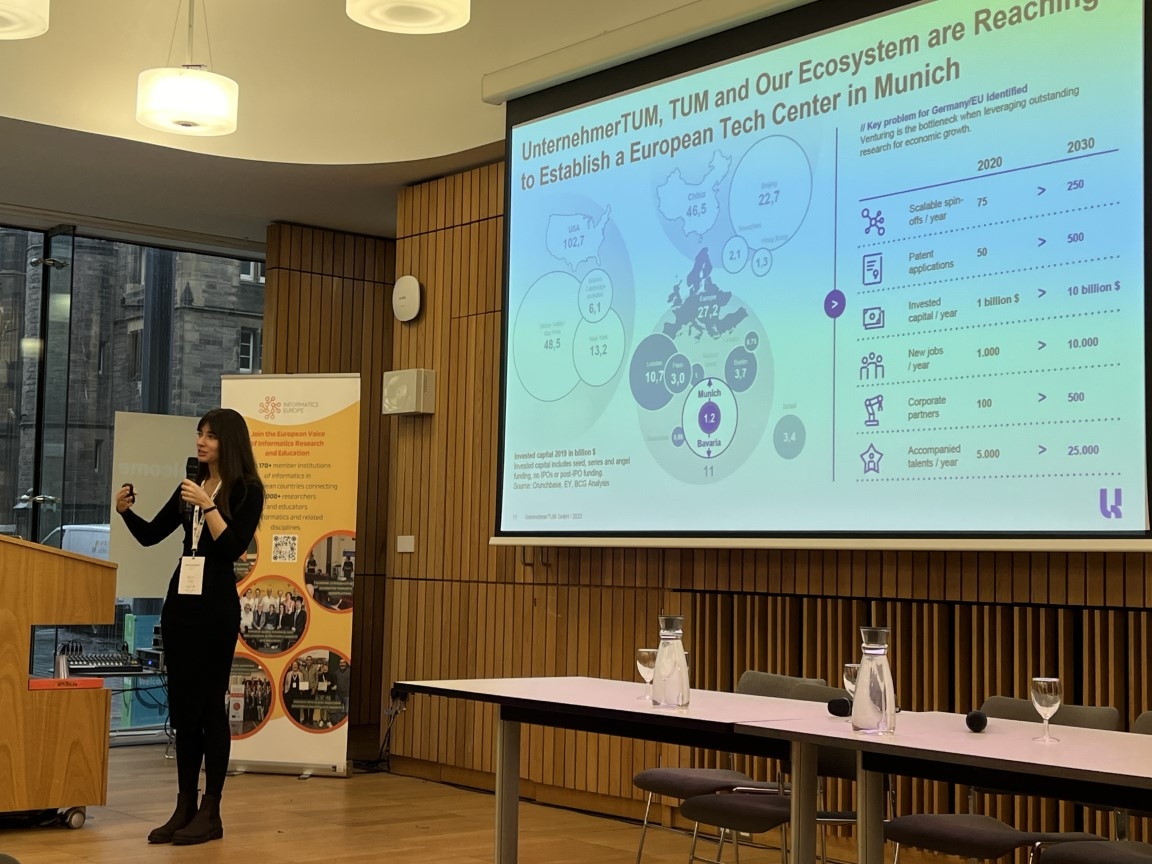
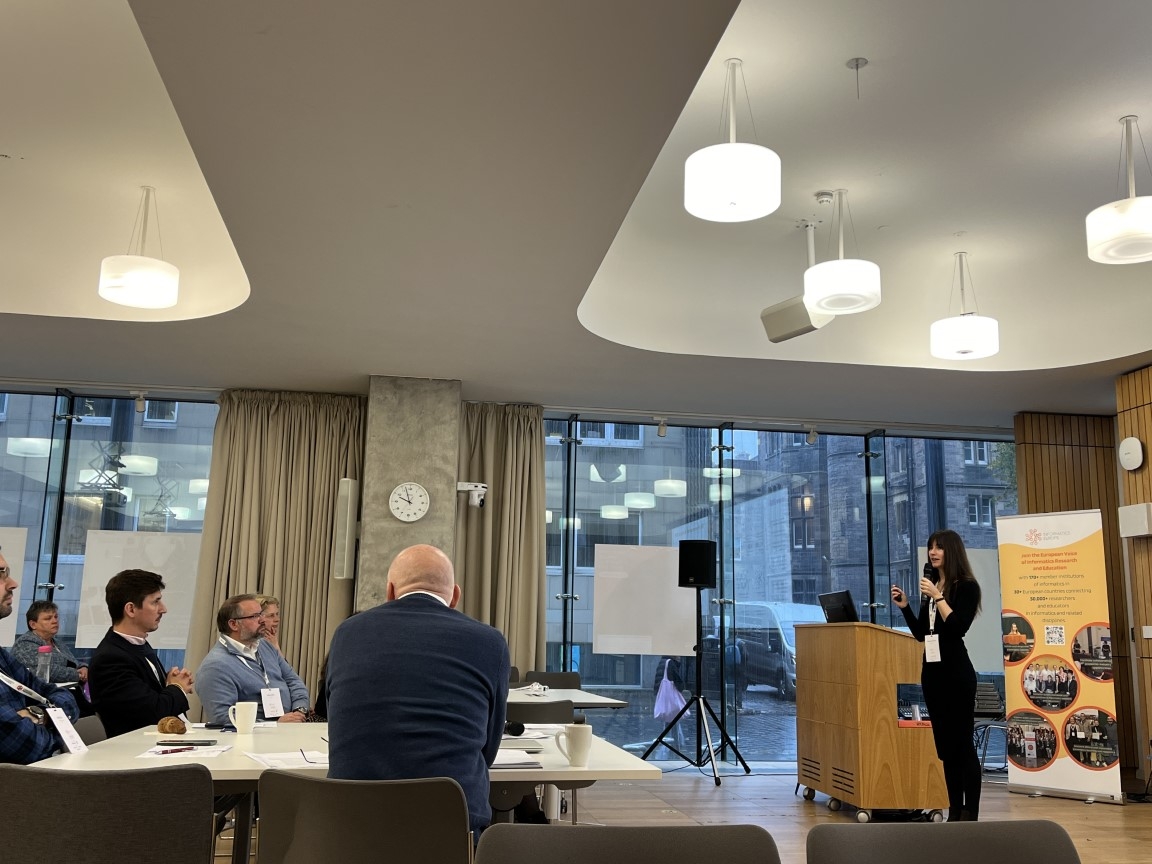
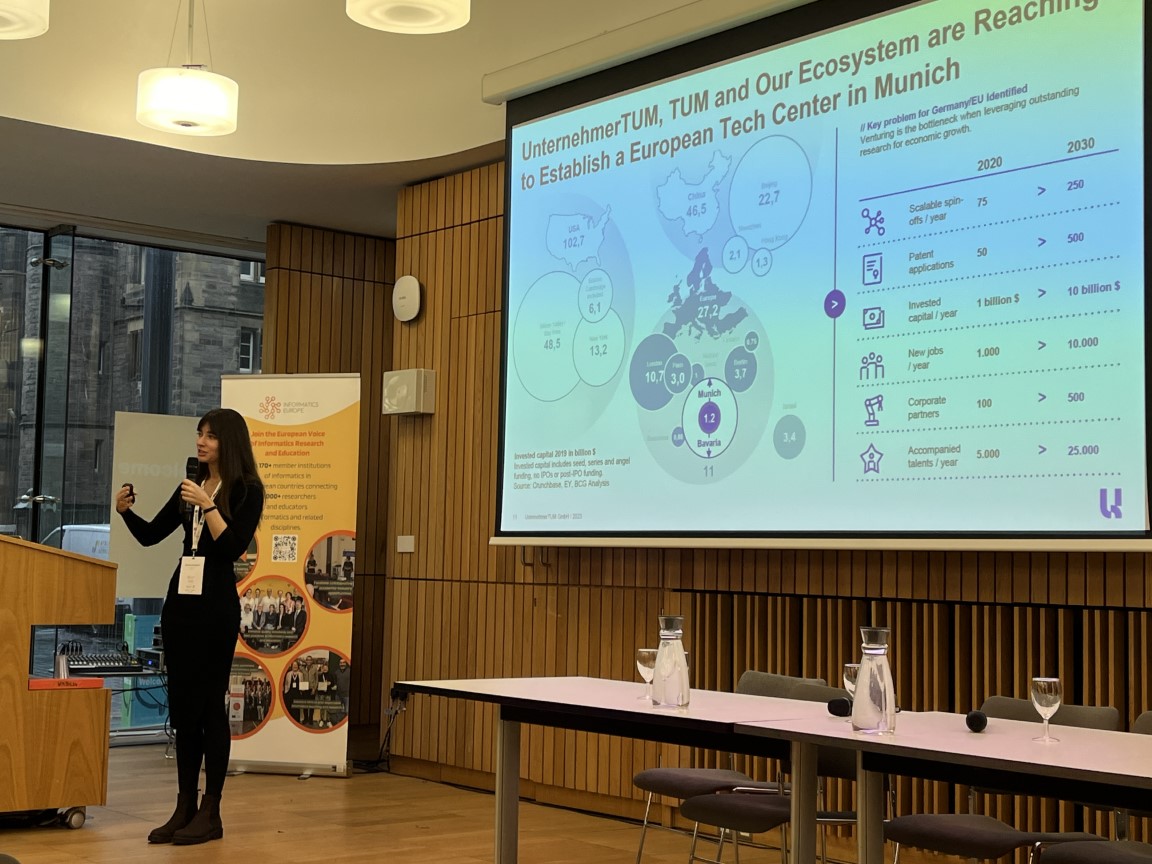
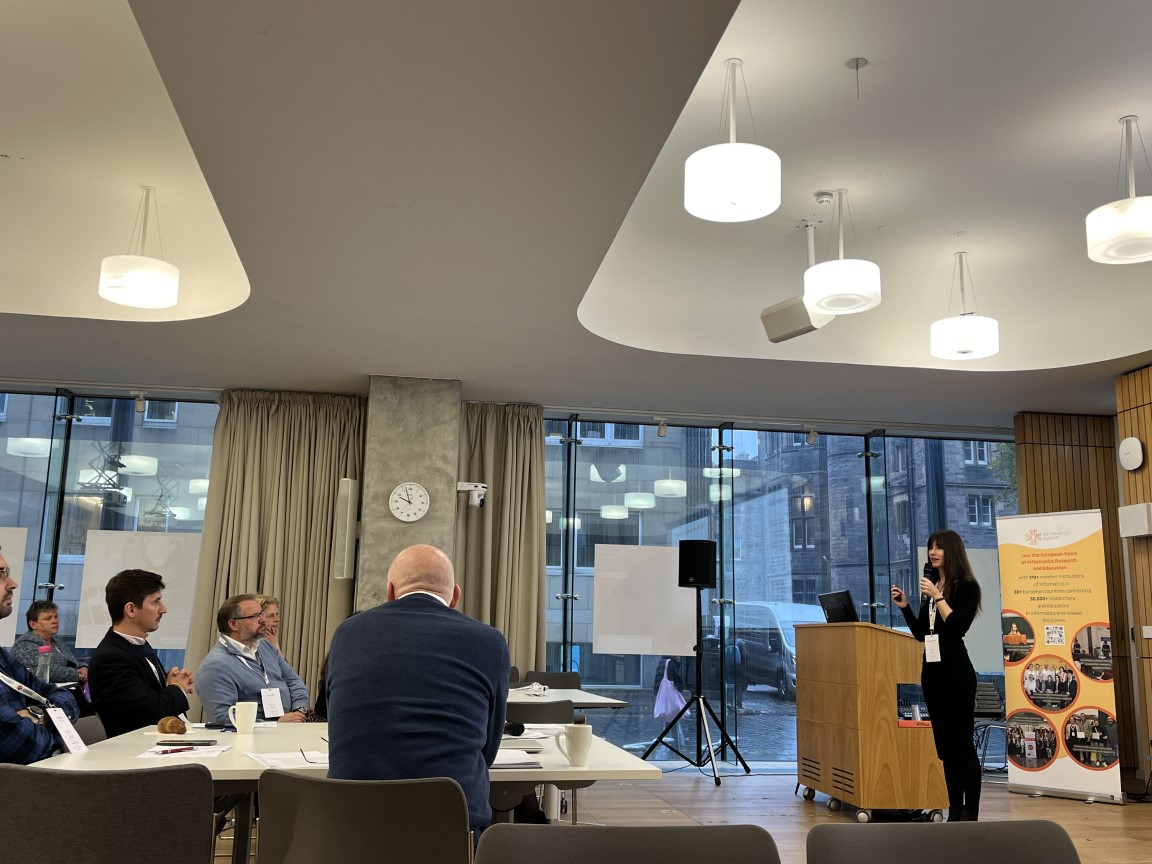
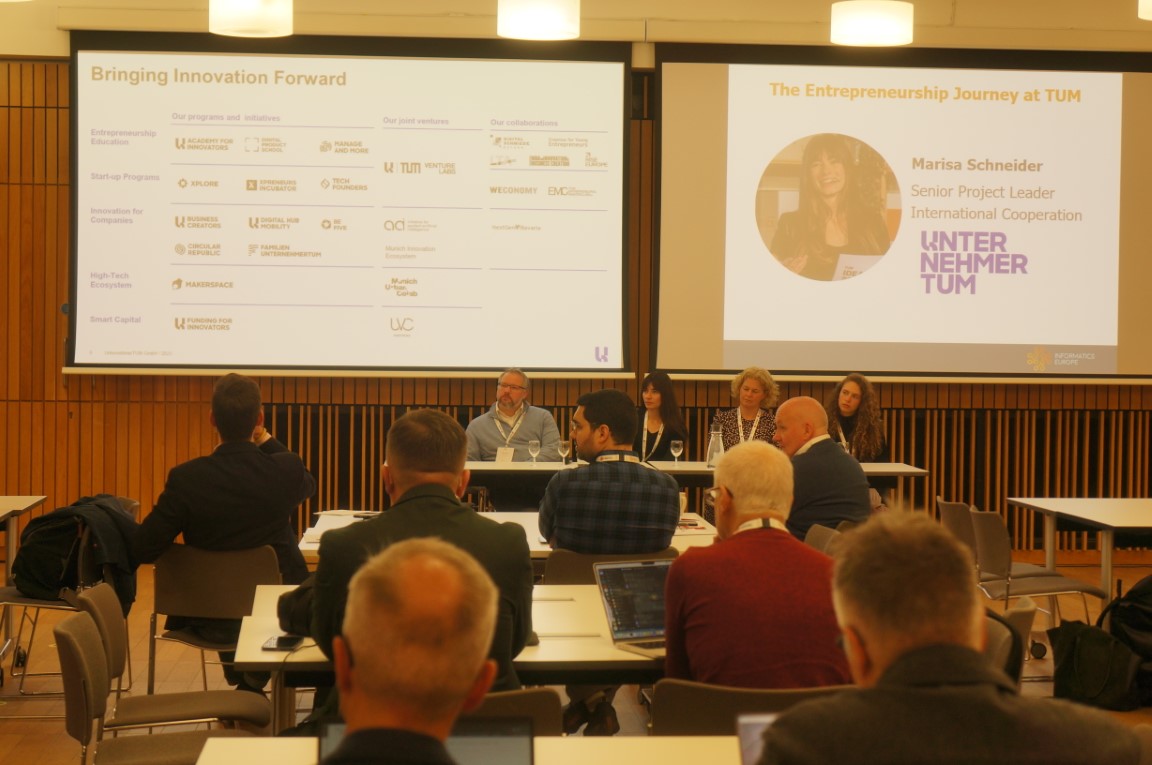
- "The entrepreneurship journey at TUM" by Marisa Schneider, UnternehmerTUM GmbH (Germany) [Slides]
- Q&A Session
10:30 - 11:00 Coffee Break
11:00 - 11:40 Successful Stories
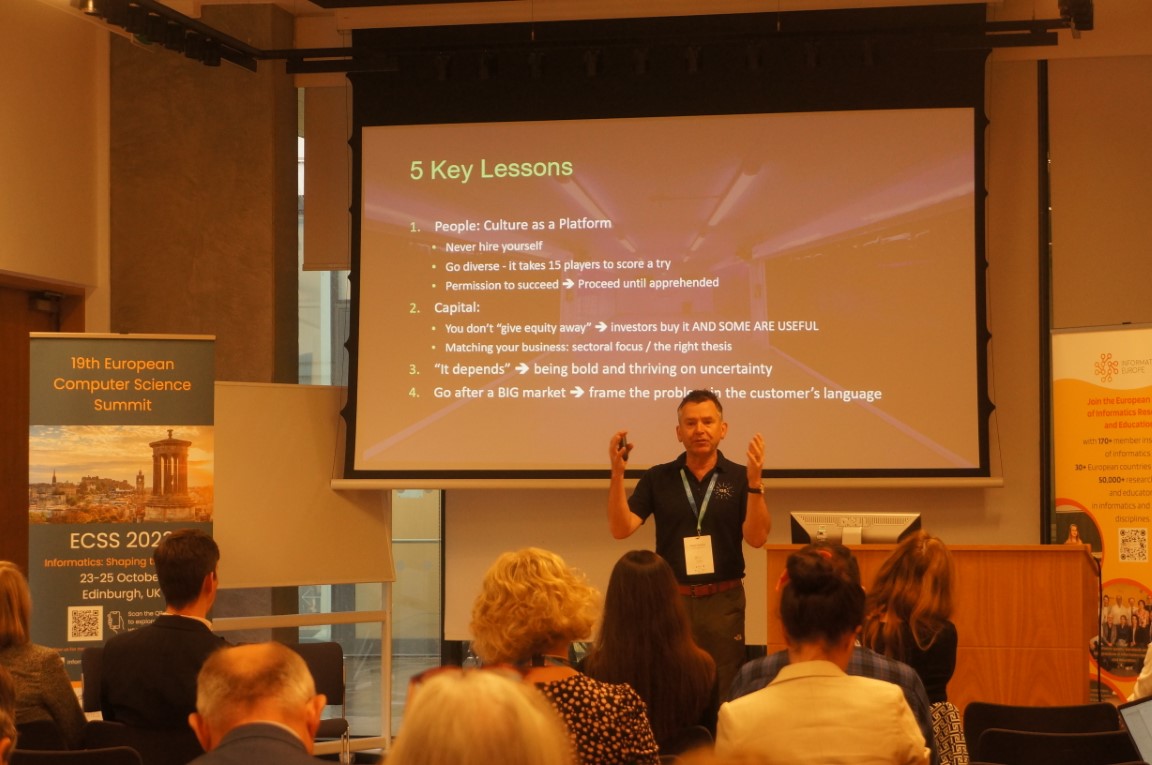
- "From start-up to scale-up and exit: lessons learned from 30 years of building and selling technology companies in transactions round the world" by David Farquhar, Intelligent Growth Solutions Limited (UK) [Slides]
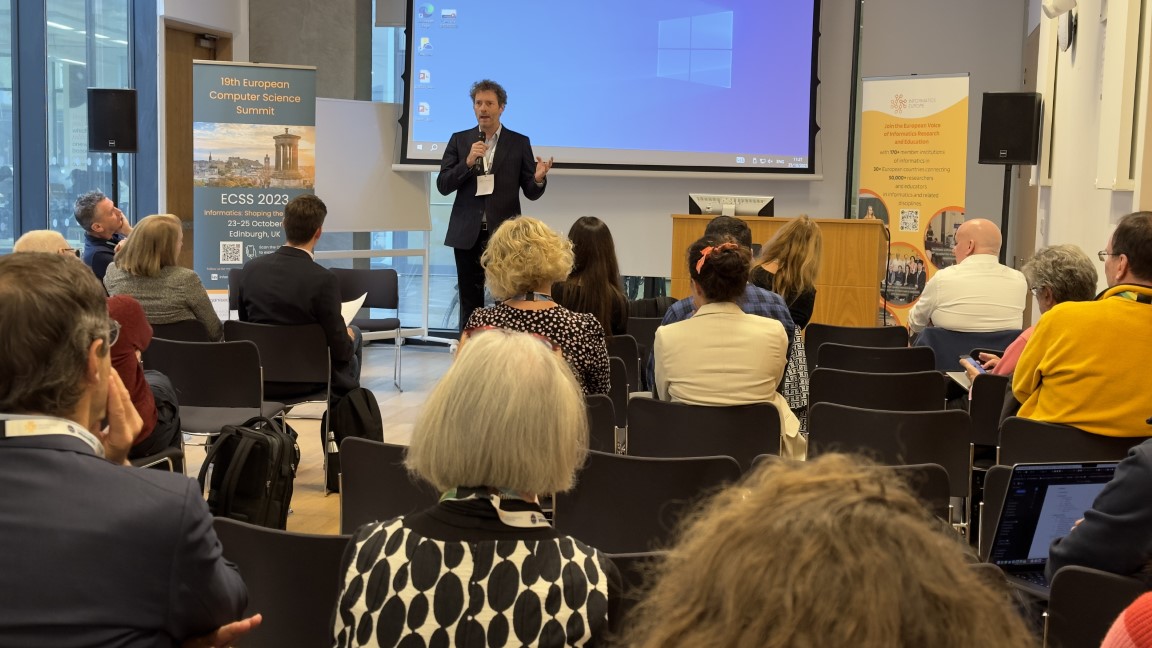
- "Minecraft and other stories: The story of building 4J Studios" by Chris Van der Kuyl, 4J Studios (UK)
11:40 - 12:10 The Role of Investment & Fundraising
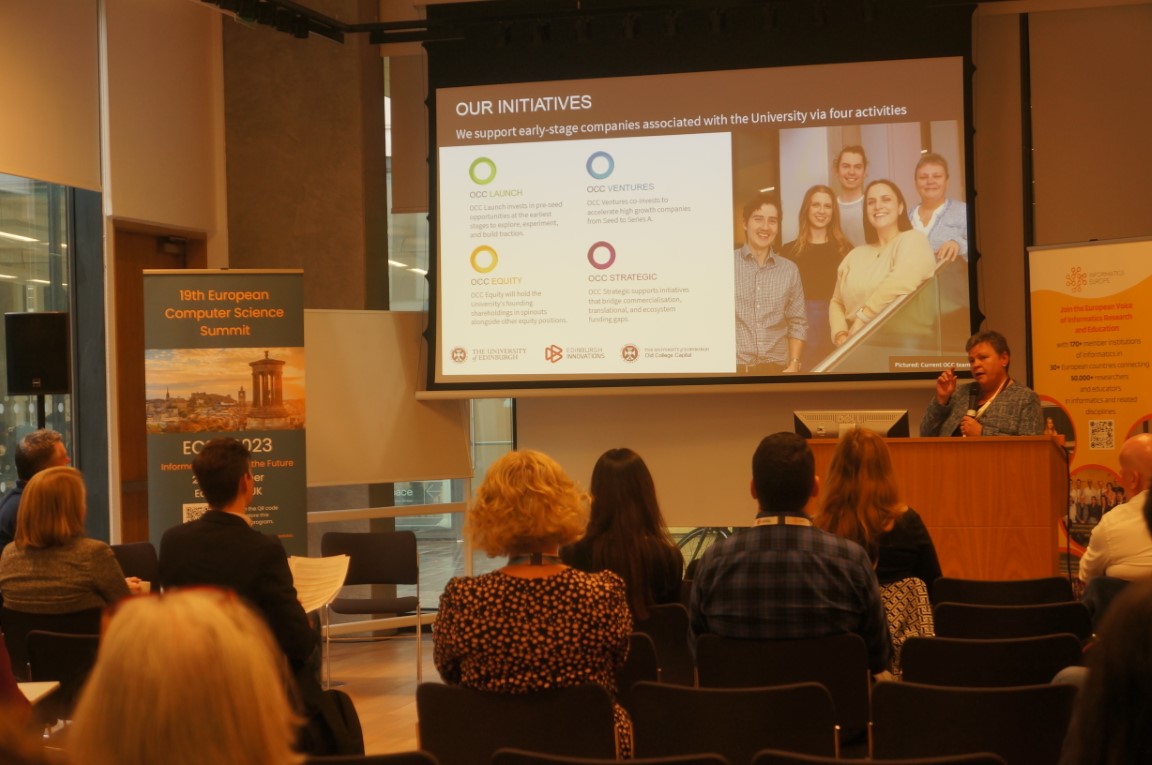
- "Why investment matters - from an Edinburgh perspective" by Andrea Young, Old College Capital (UK) [Slides]
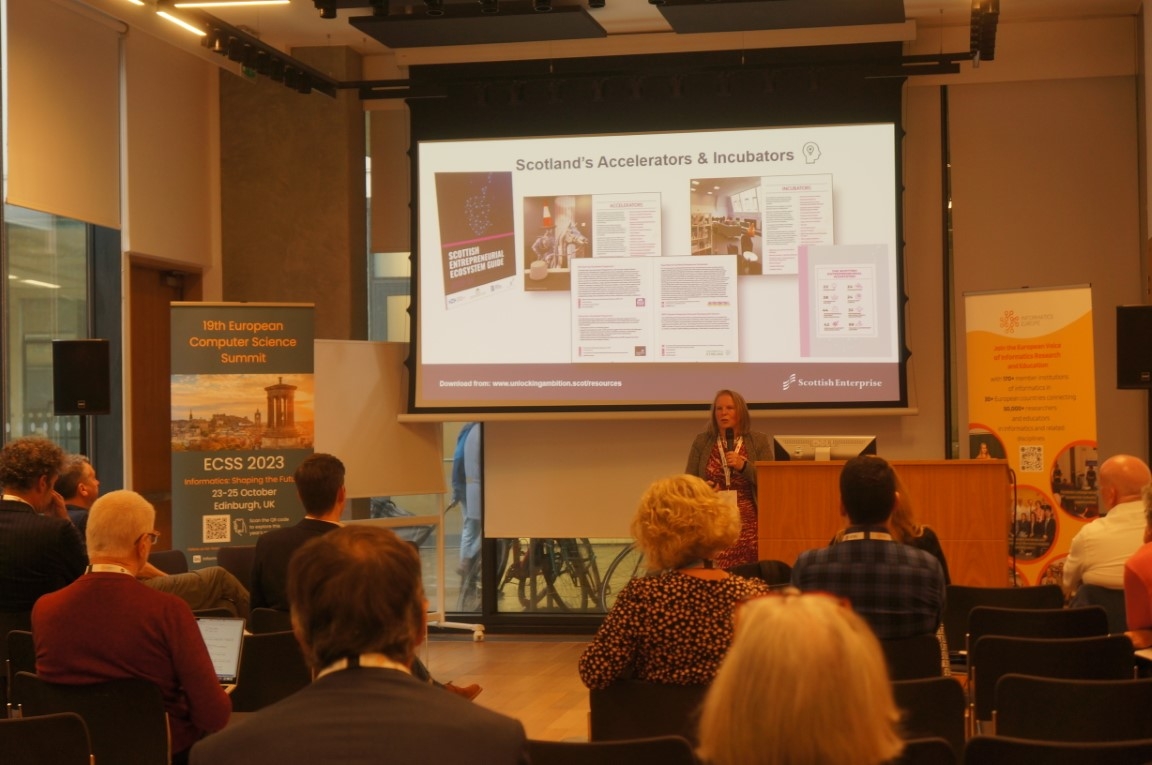
- "Why investment matters - from a Scotland perspective" by Kerry Sharp, Scottish Enterprise (UK) [Slides]
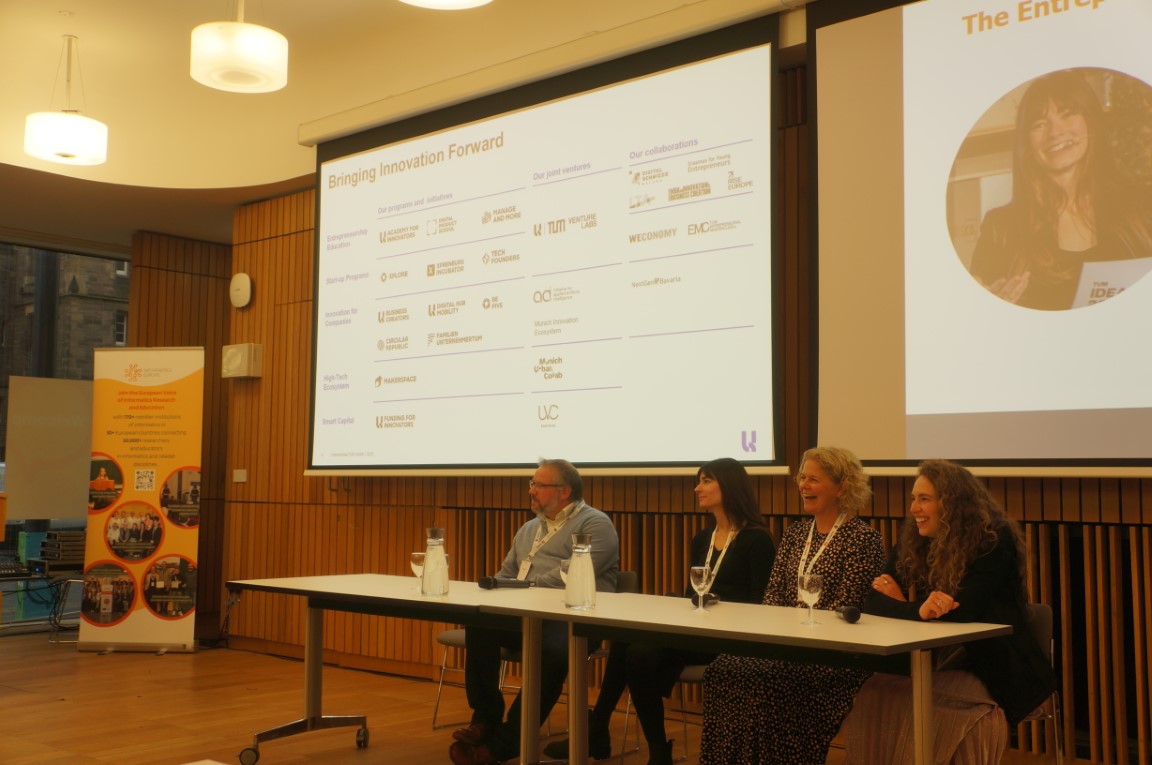
12:10 - 12:40 Panel discussion
12:40 - 12:45 Closing
12:40 - 13:30 Lunch
*Please note that the photos below are better viewed when applying zoom out.
-
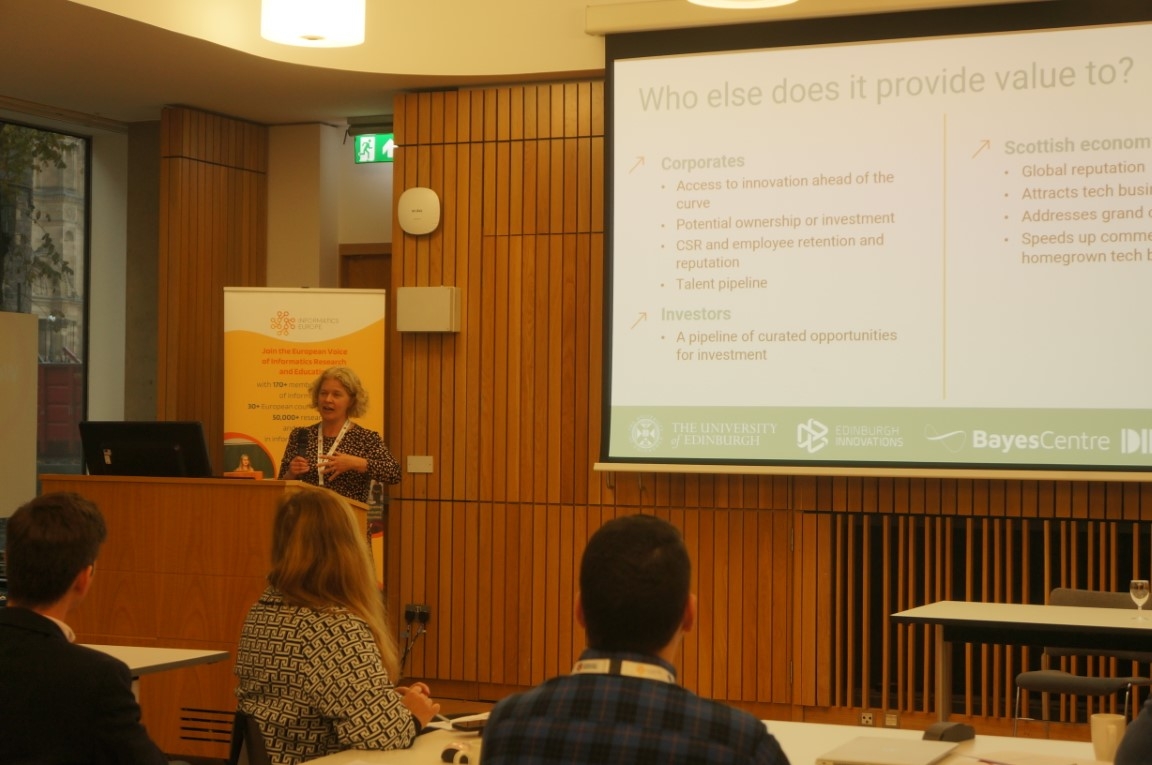
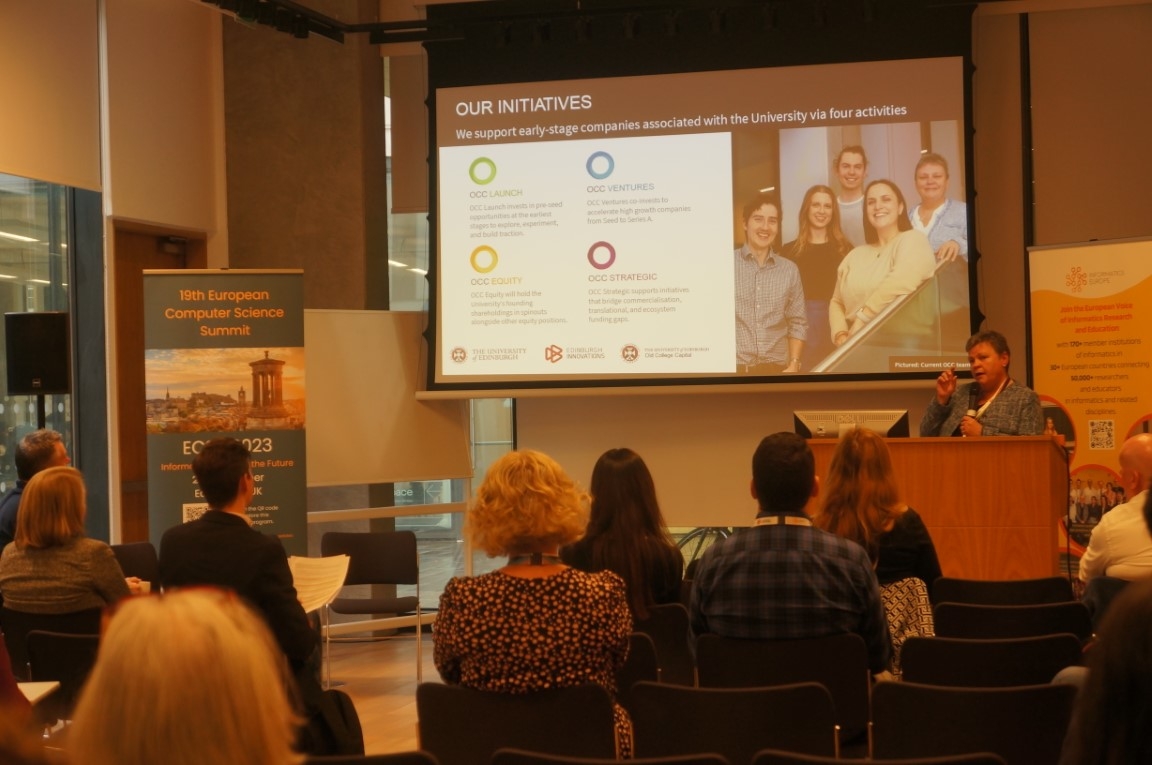
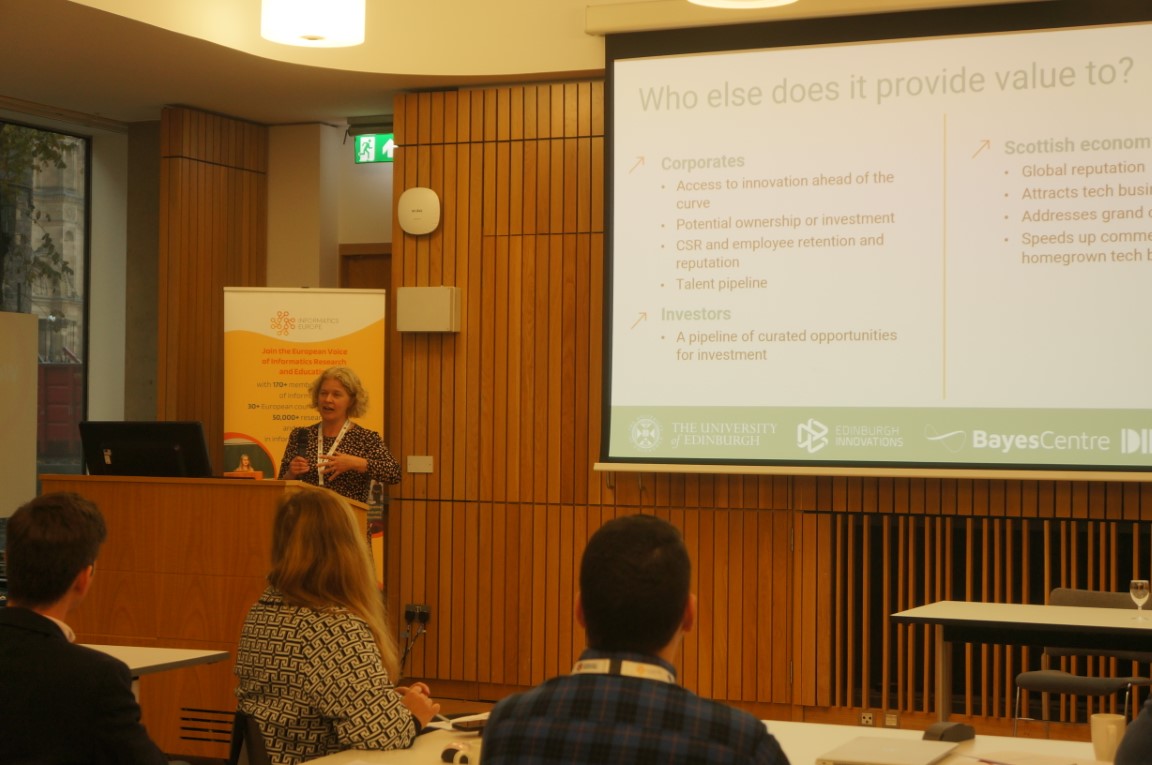
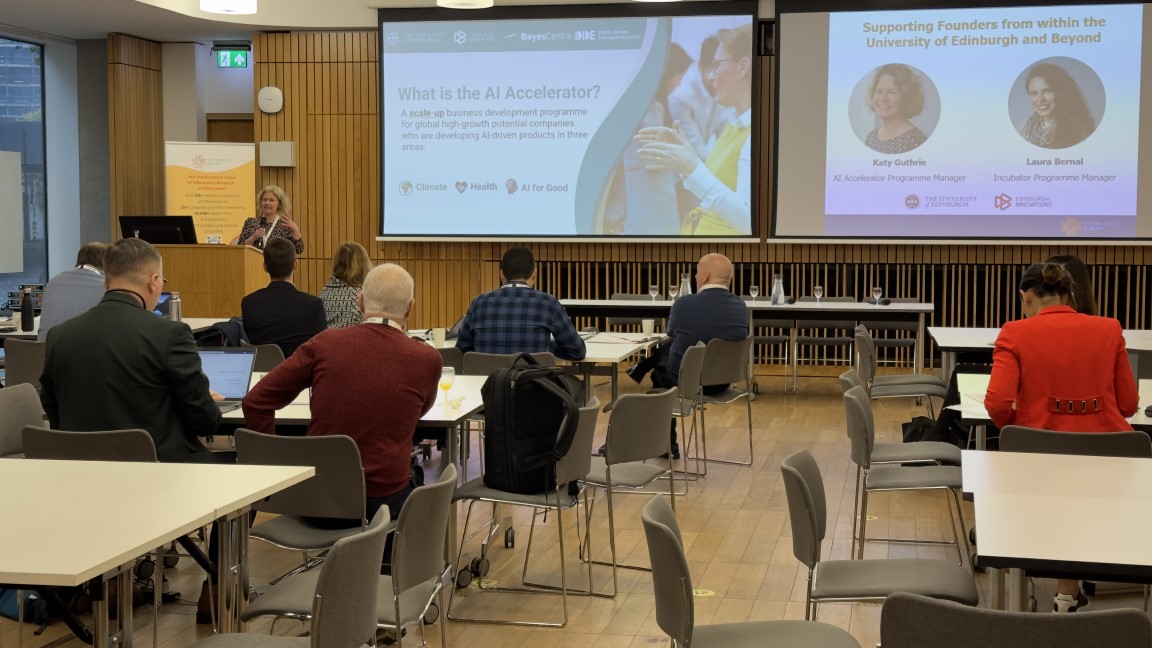
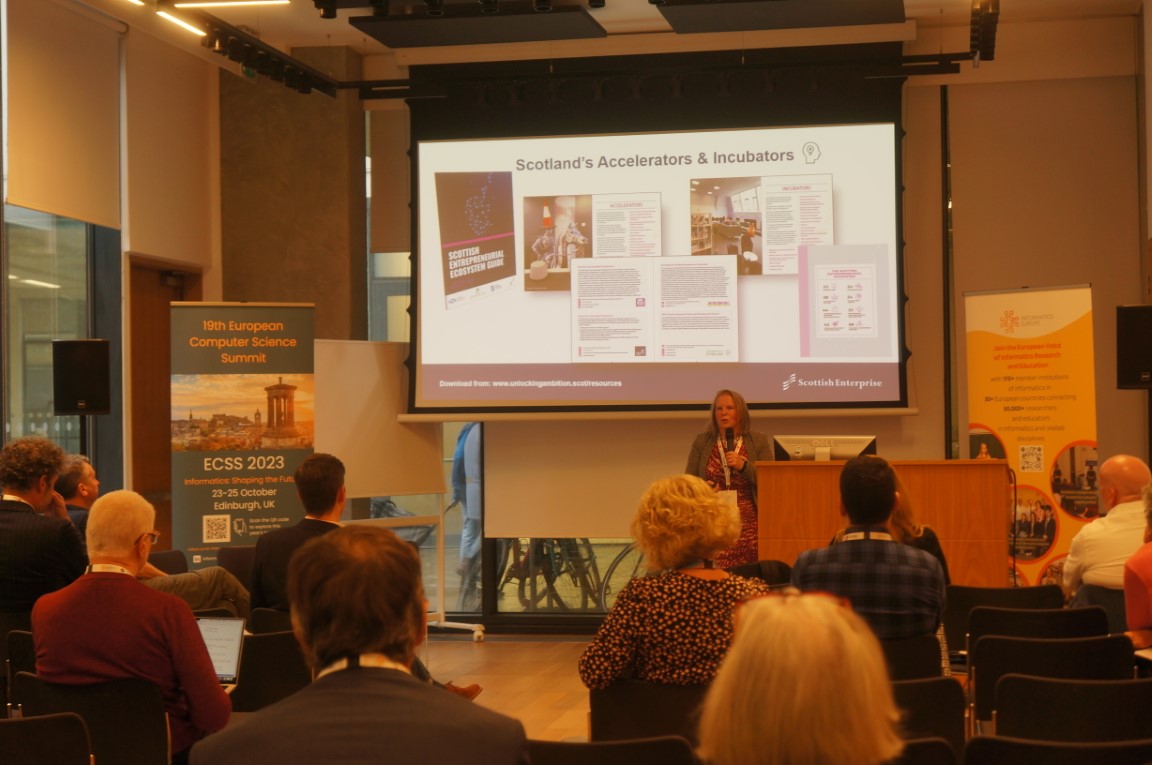
Katy Guthrie (Edinburgh Innovations) at Academia-Industry Session
-
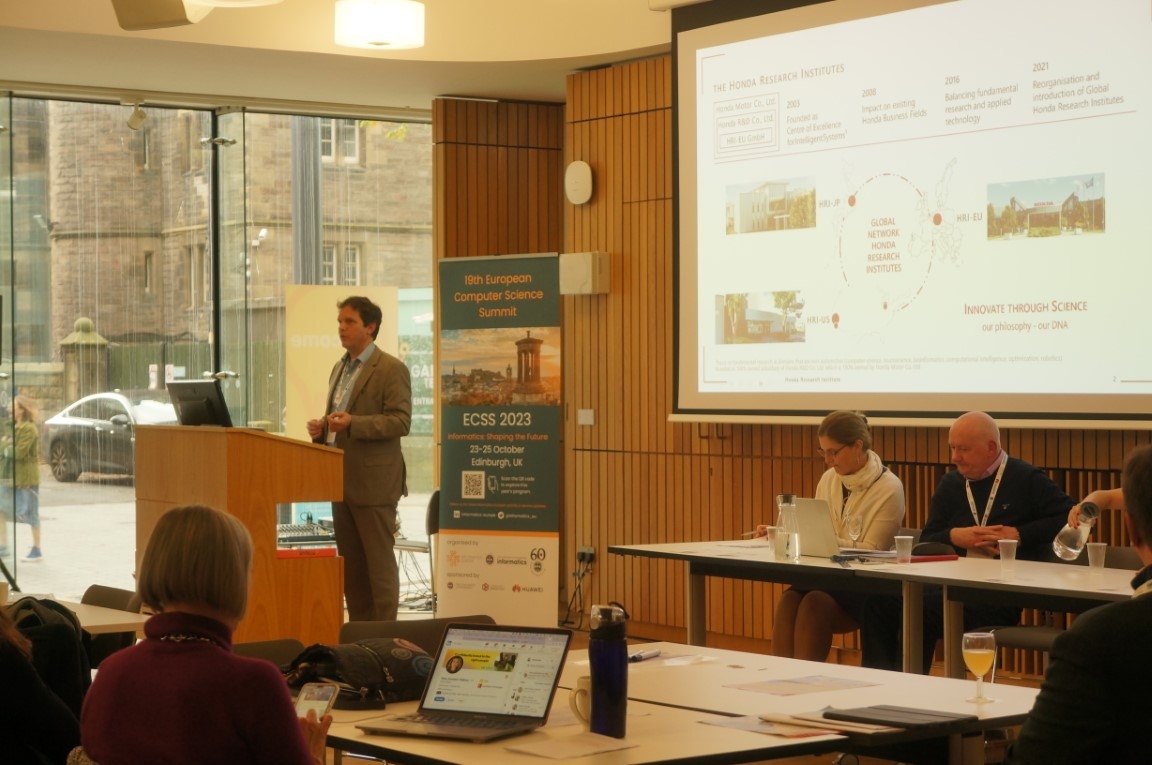
Michael Gienger (Chief Scientist, Honda Research Institute) at Academia-Industry Session
-
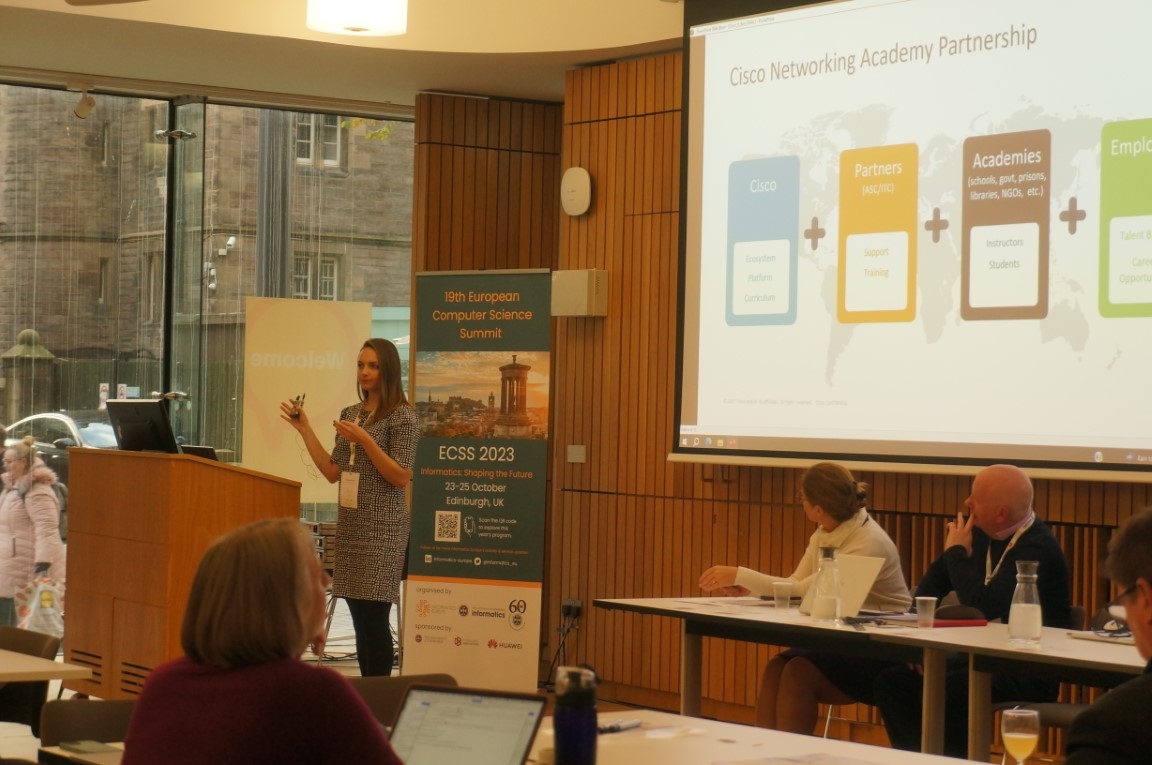
Elizabeth Barr (Business Development Manager, CISCO Networking Academy, UK&I, CISCO) at Academia-Industry Session
-
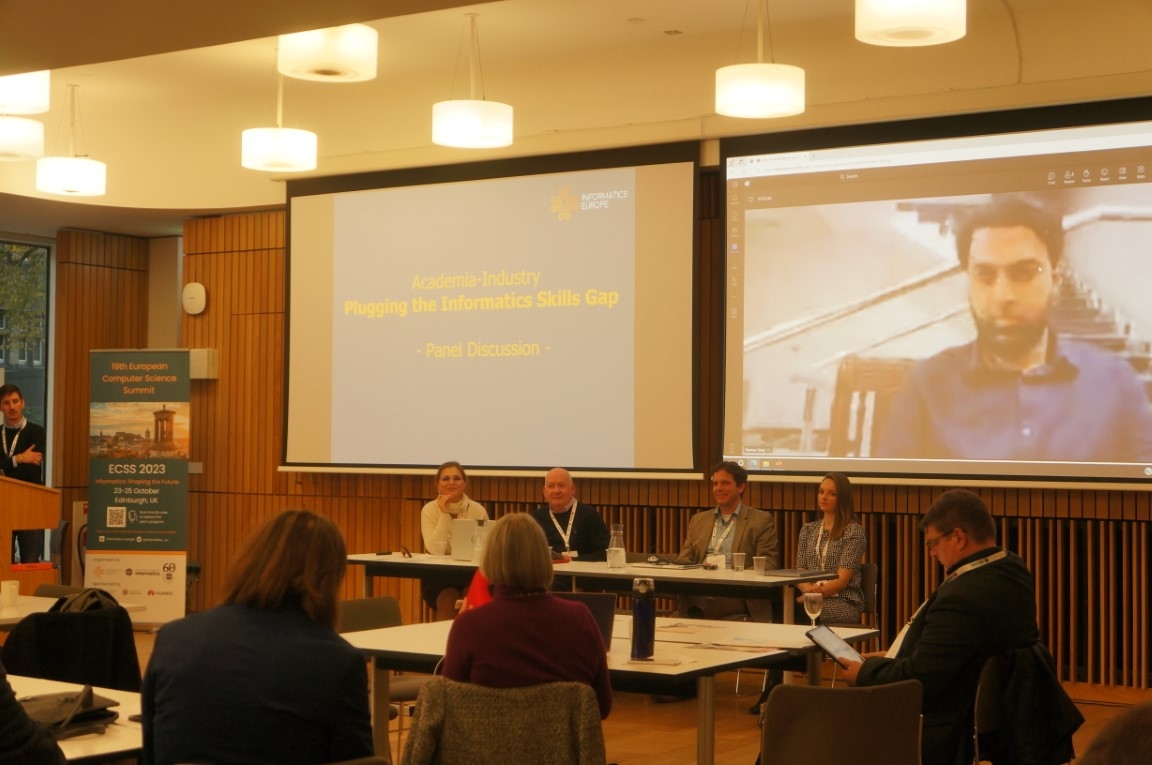
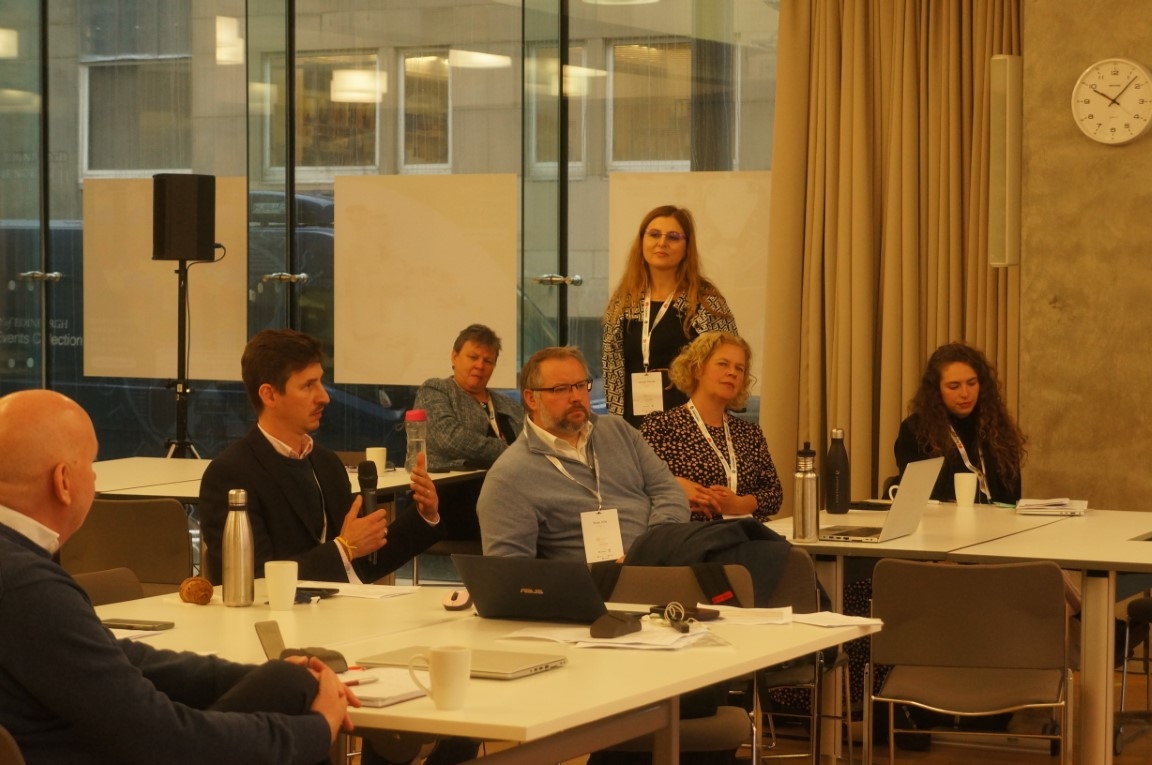
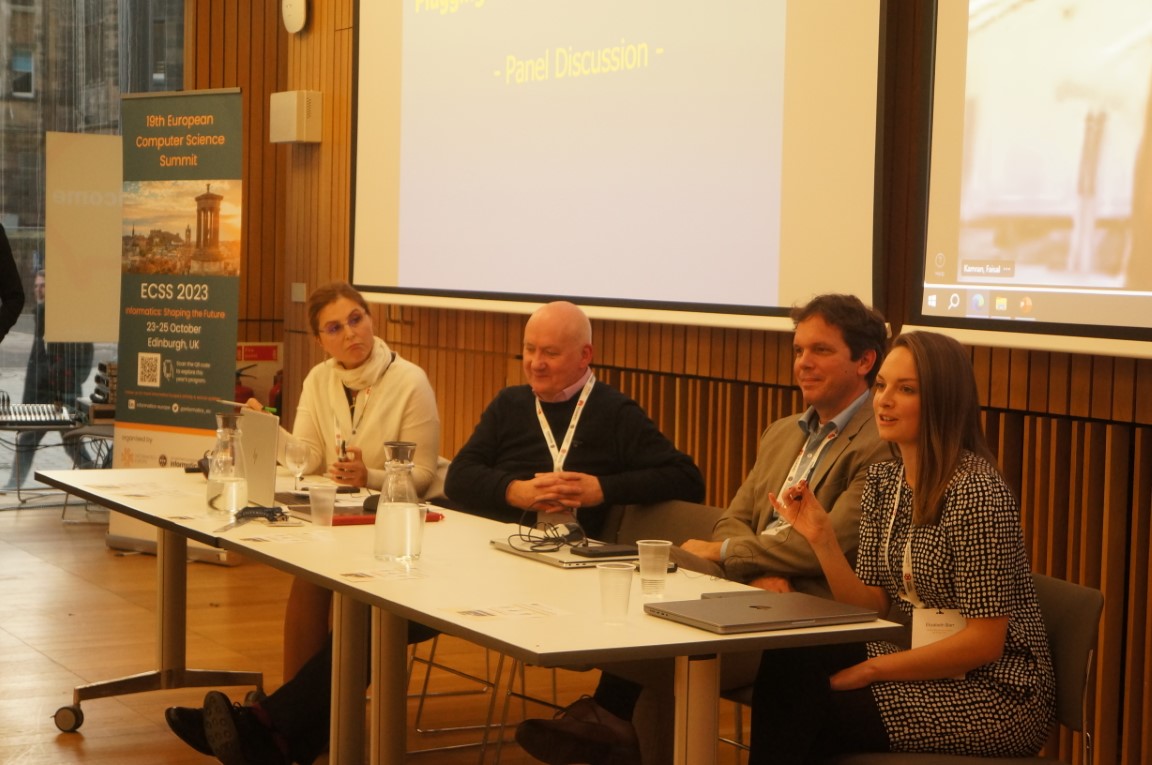
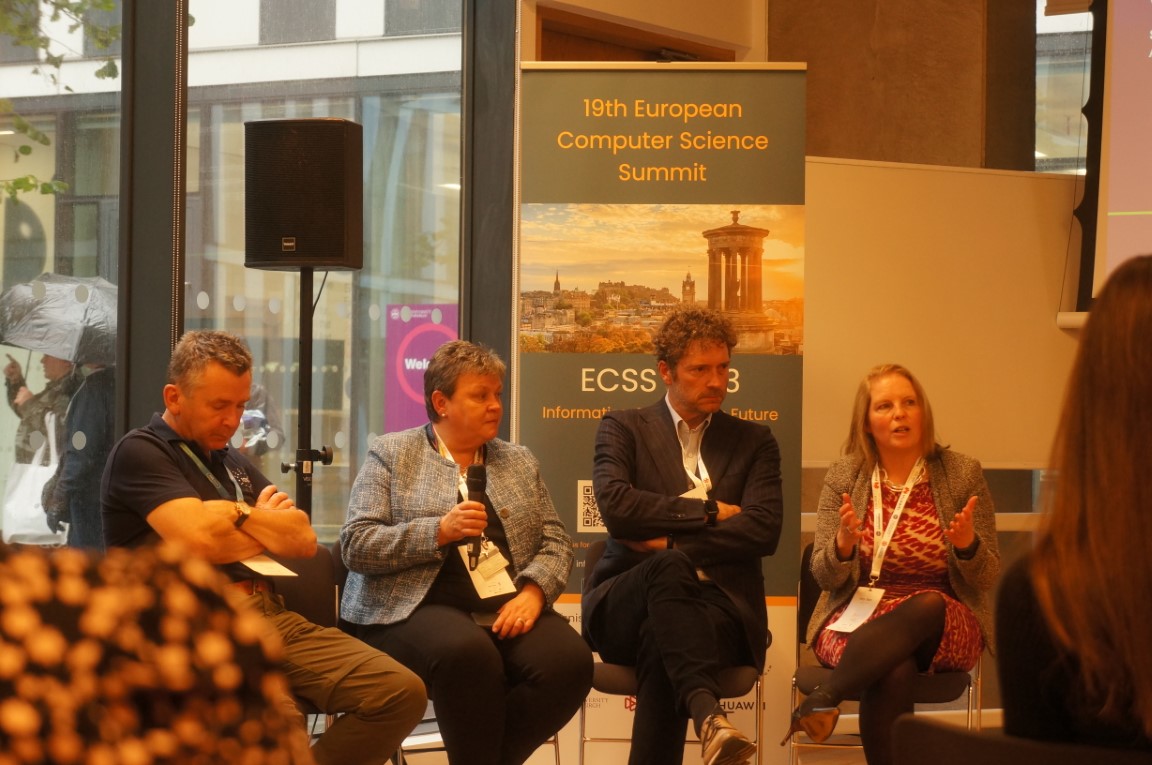
Academia-Industry Way Forward - Panel Discussion
-
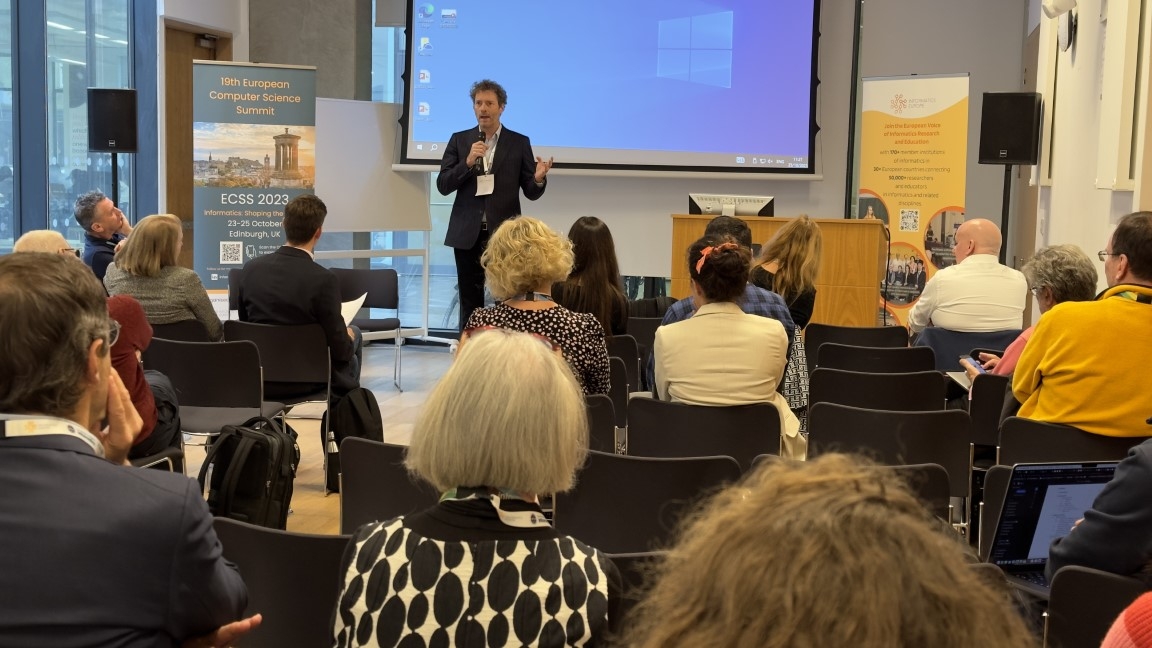
Academia-Industry Session
-
Academia-Industry Way Forward - Panel Discussion
-
Katy Guthrie (Edinburgh Innovations) at Academia-Industry Session
-
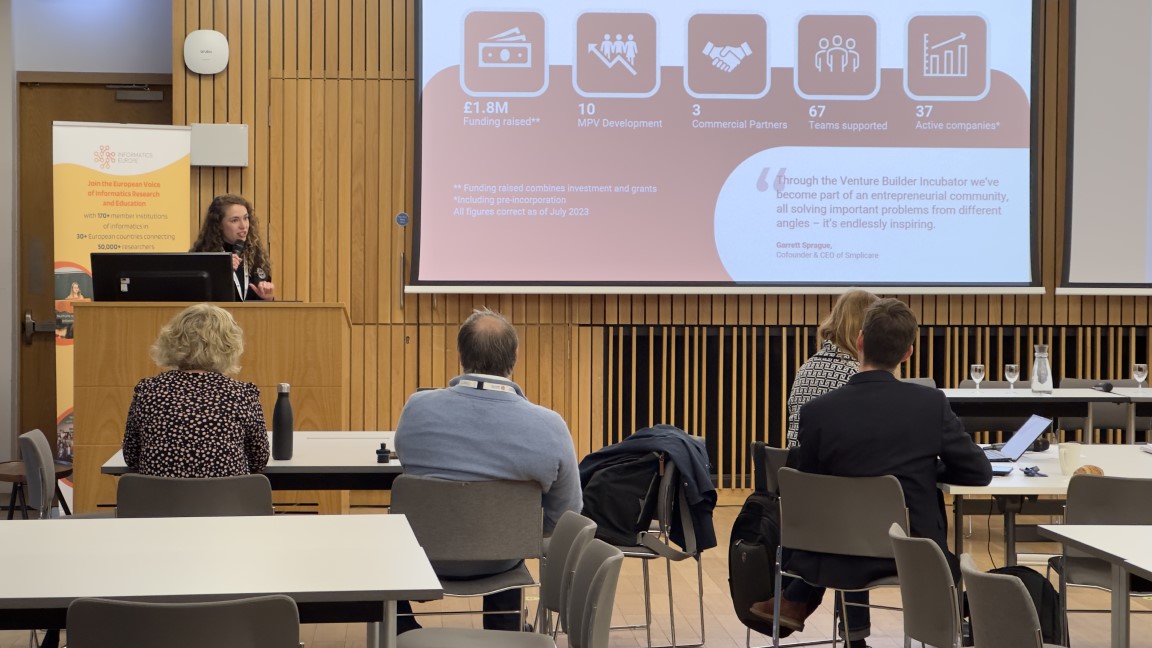
Laura Bernal (Edinburgh Innovations) at Academia-Industry Session
-
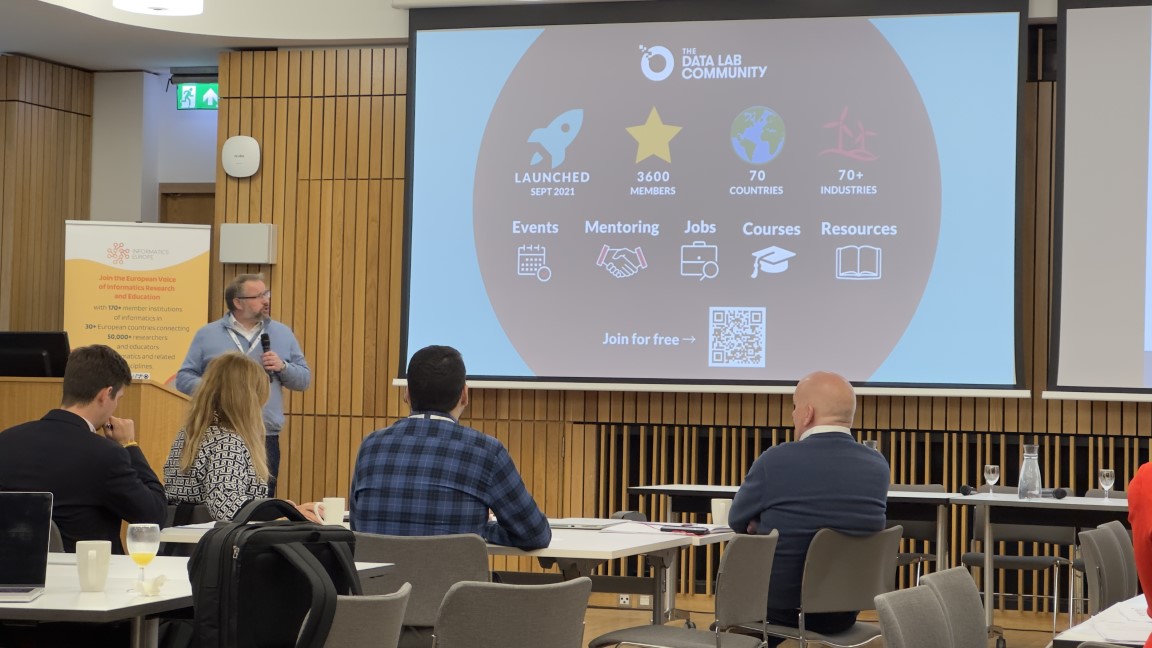
Brian Hills (The DataLab) at Academia-Industry Session
-
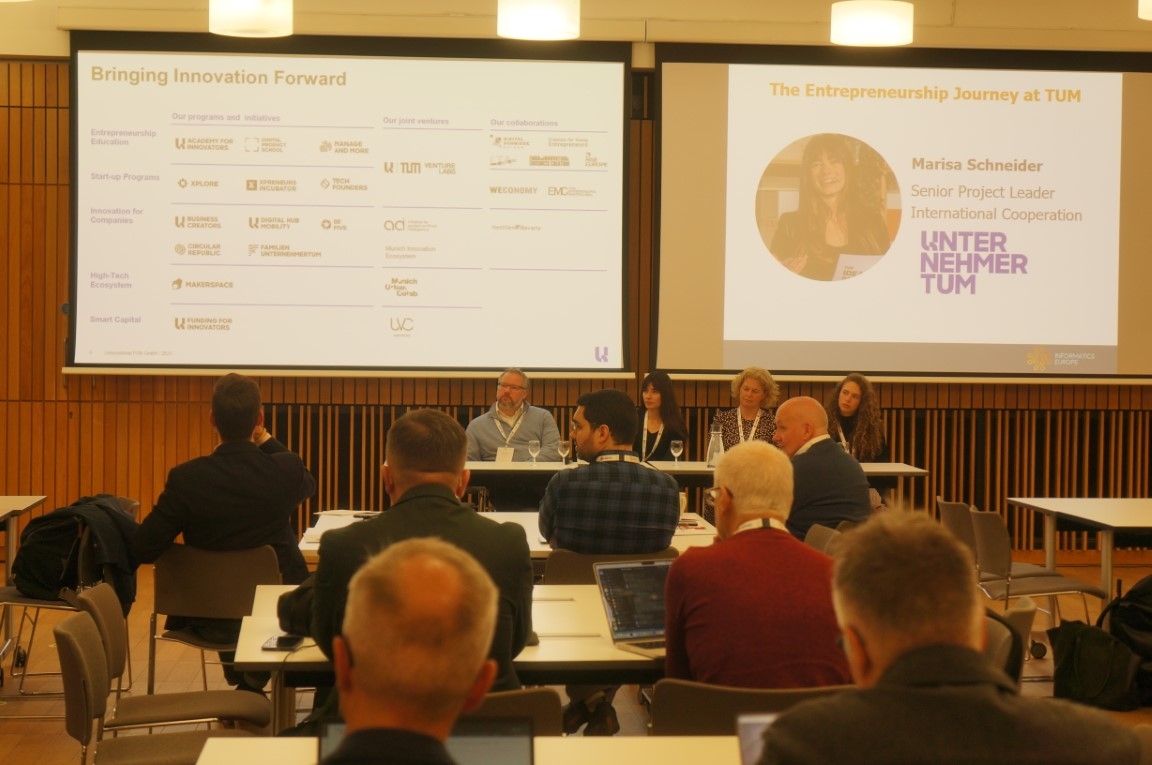
Marisa Schneider (UnternehmerTUM GmbH, Germany) at Academia-Industry Session
-
"Fostering & Supporting Data-Driven Start-ups in Academia" Session
-
"Fostering & Supporting Data-Driven Start-ups in Academia" Q&A Session
-
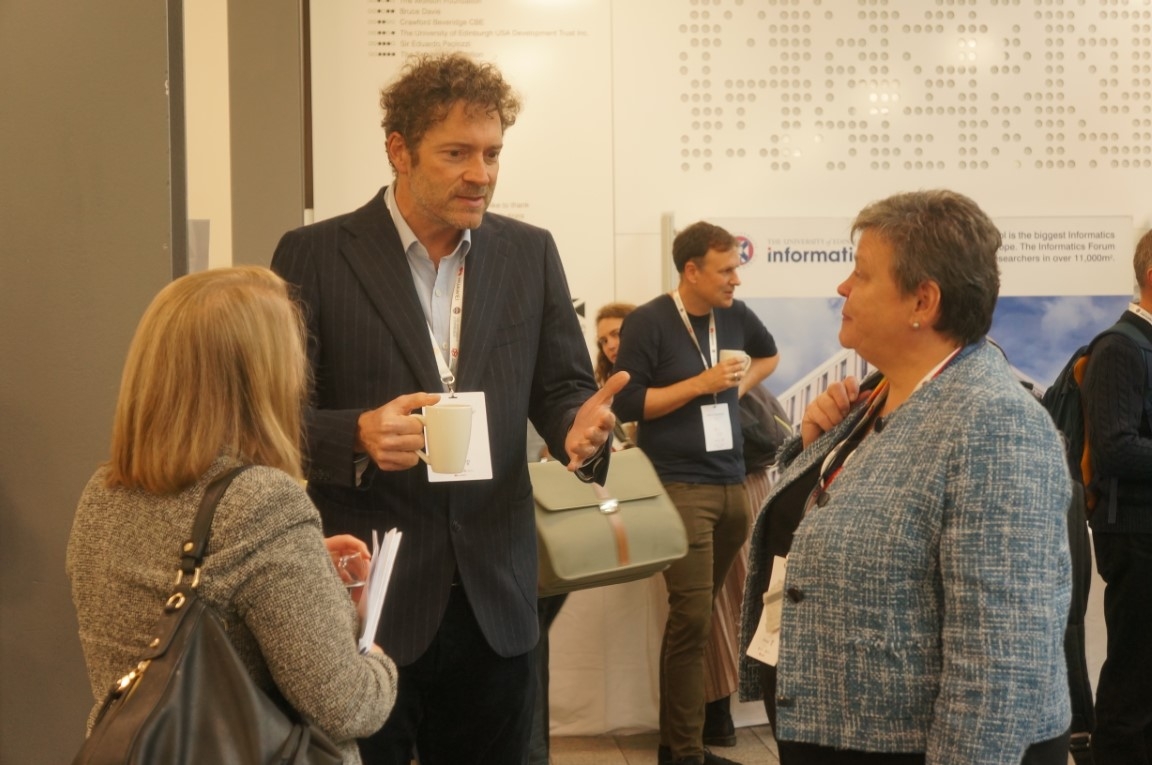
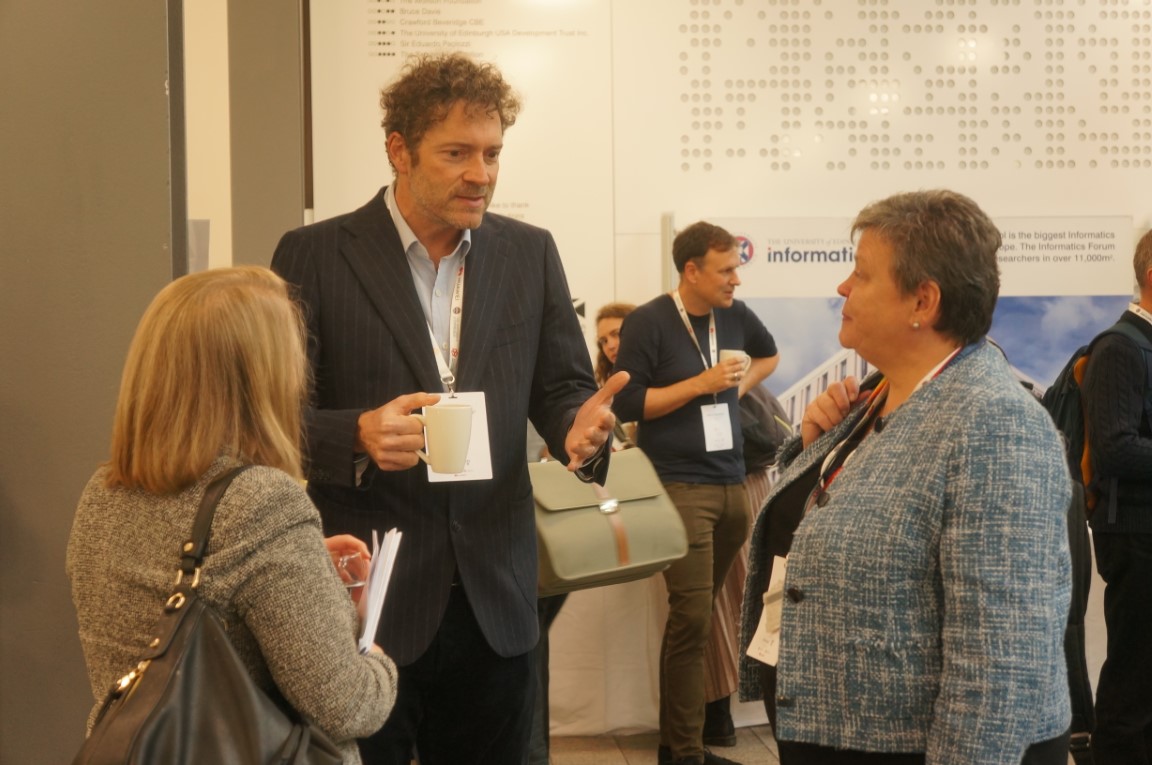
Coffee Break Networking at Academia-Industry Session
-
"Fostering & Supporting Data-Driven Start-ups in Academia" Q&A Session
-
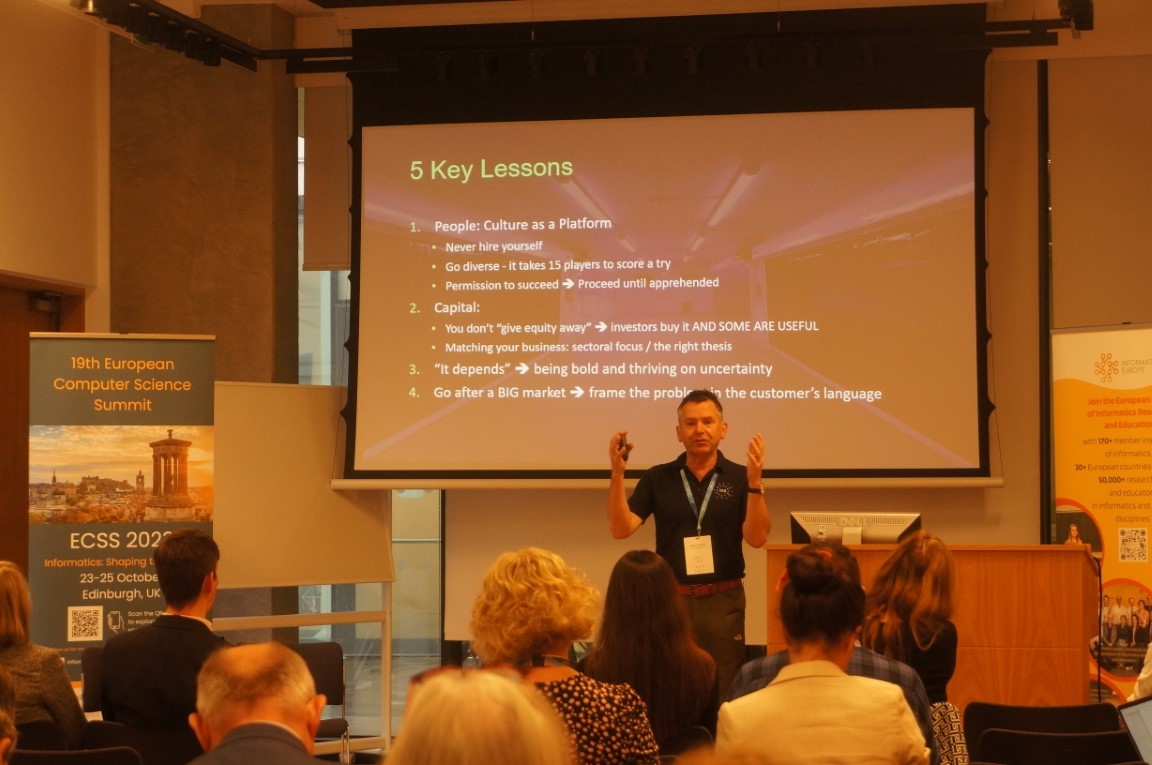
David Farquhar (Intelligent Growth Solutions Limited) at Academia-Industry Session
-
Chris Van der Kuyl (4J Studios) at Academia-Industry Session
-
Andrea Young (Old College Capital, UK) at Academia-Industry Session
-
Kerry Sharp (Scottish Enterprise, UK) at Academia-Industry Session
-
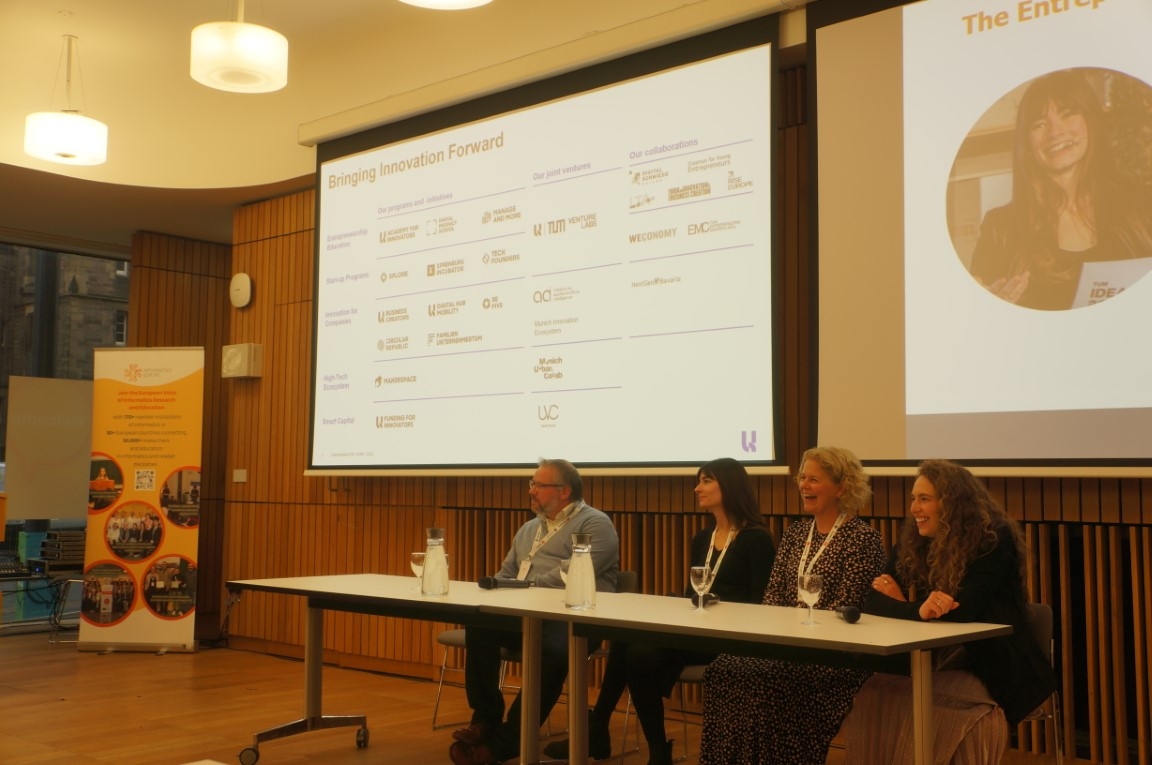
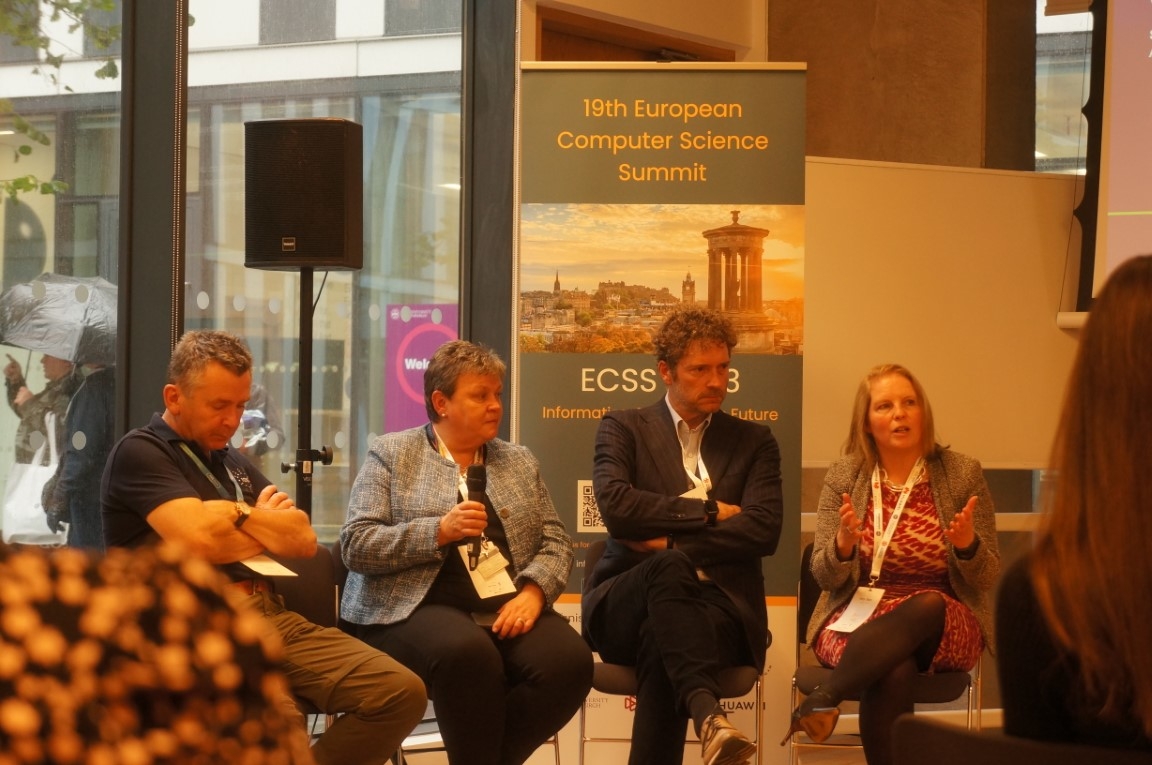
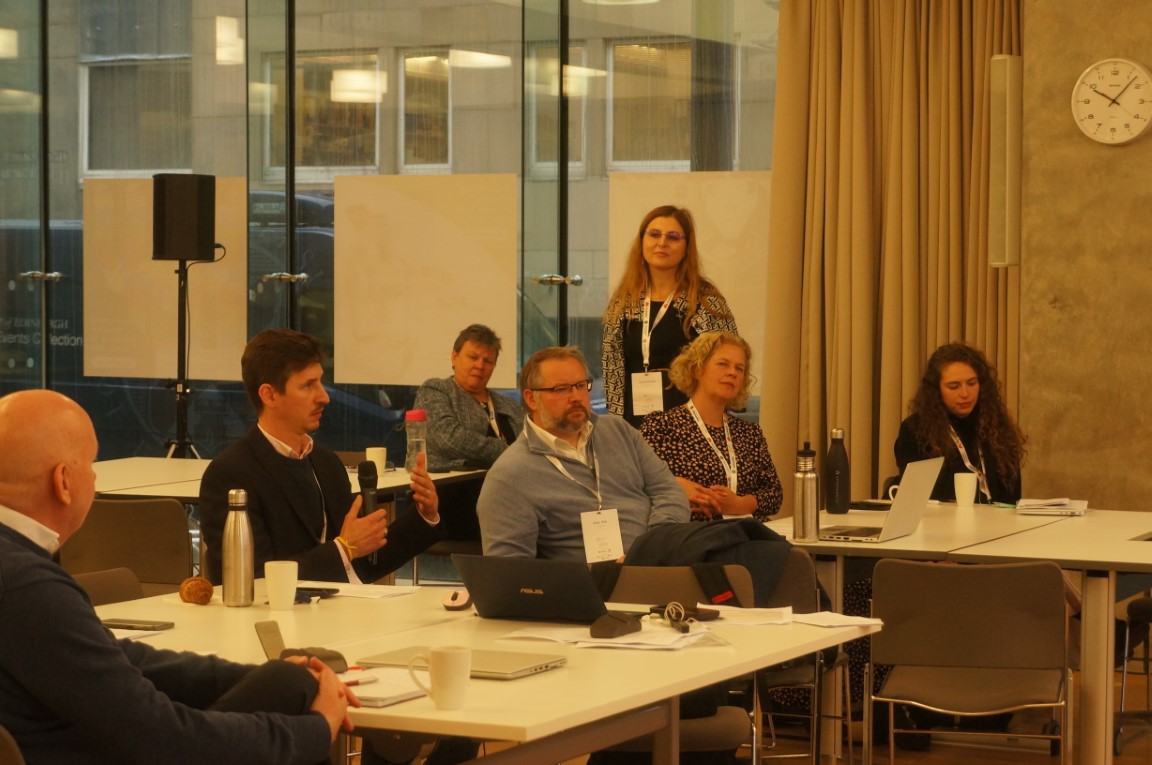
Panel Discussion at Academia & Industry Session


Members Spotlight '23 Submission Requirements
As an exclusive benefit to our members, we offer the possibility to distribute printouts about your institution free-of-charge at the ECSS reception desk. We also offer members the possibility to publish these materials virtually on a special section of our ECSS 2023 website, called Members Spotlight.
Examples of materials include:
- a flyer describing an academic program
- an announcement of a conference, seminar series, summer school...
- a call for papers
- an announcement of a new book or other publication
- a call for joint proposals
- generally anything that fits within the mission and goals of Informatics Europe and can be of interest to ECSS participants.
In order to take advantage of this benefit, we accept submission via
(for virtual materials, by Oct 15th)
- a PDF document, for publish and download on our ECSS website section Members Spotlight, AND
- a JPG/PNG image of the cover, as the front image of your document on the gallery; it must have the following dimensions: 500 (horizontal) x 625 (vertical) pixels.
Important note: these two files must have a concise self-referring name consisting of maximum 7 words (e.g.UZH-Informatics-Department-Flyer; UCLouvain-CS-Master-Program-Flyer, etc.)
(for physical materials to be distributed at the ECSS 2023 venue in Edinburgh)
- By Oct 2nd: an electronic copy (PDF/JPG) of the material you’d like to include. The materials should be a single sheet, A4 or smaller unless otherwise agreed.
- By mid October: no more than 100 printed copies of the document delivered to UK by post, with exact amount required and delivery address confirmed by email.
Seize the opportunity to promote your activities to the ECSS 2023 participants now!
Health & Safety Measures
The ECSS 2023 Committee follows all the Scottish government regulations related to the organization of public conferences. Neither the organizers (Informatics Europe together with the University of Edinburgh) accept any responsibility derived from participants getting sick or injured in any manner during any of the activities organized around ECSS 2023.
Covid-19 Safety and Health Measures in Scotland
There are no covid travel rules in place for people arriving in Scotland from abroad. Please note that it is the responsibility of each participant to check regularly the entry and re-entry regulations for their countries of origin as well as for Scotland (e.g. Scottish government webpage). In addition, we recommend obtaining valid health insurance and if applicable a travel cancellation insurance. If anyone has COVID symptoms, they should not attend the conference.
Grants for Early Career Researchers
Informatics Europe offered a limited number of grants, waiving the ECSS 2023 registration fee, for PhD students who participate in ECSS 2023, in its totality (23-25 October) or just at the Early Career Researchers (ECR) Workshop (23 October), in Edinburgh, UK.
Grants were assigned based on a first-come, first-served basis and exclusively to those who have submitted a short statement to participate in the ECSS 2023’s poster session (more details here) and resided out of the UK, thus bearing higher travel costs.
Interested PhD students should indicate their grant request in the statement of interest (see instructions under "Poster Session" here), mentioning if they intend to attend only the ECR Workshop or the complete ECSS.
Submitting a short description of your poster/draft poster no later than one month before the Summit (on or before 22 Sep) and attending the ECR Workshop and evening poster session with the finalized poster were necessary conditions to be granted free ECSS admission.
Important dates:
Grant application period: From 15 June 2023 and as long as available
Grant acceptance: up to 2 weeks after receiving the application
Deadline for submitting any missing materials requested by workshop chairs: 22 Sep 2023
For enquiries, please contact
Members Spotlight
The Members Spotlight is offering an overview of the activities, programs and news from our Informatics Europe members to the broader Informatics Community. Would you like to get in the spotlight? Follow the instructions here.
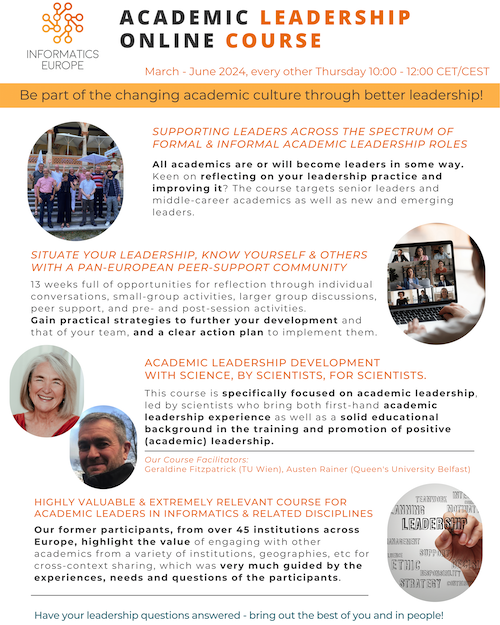
Academic Leadership Online Course 2024
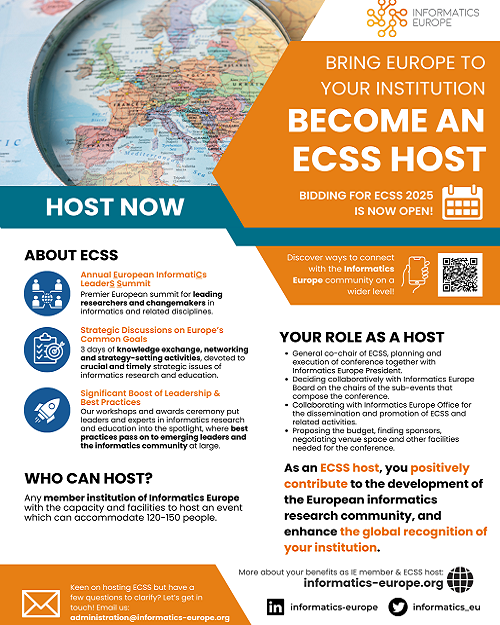
Become an ECSS Host
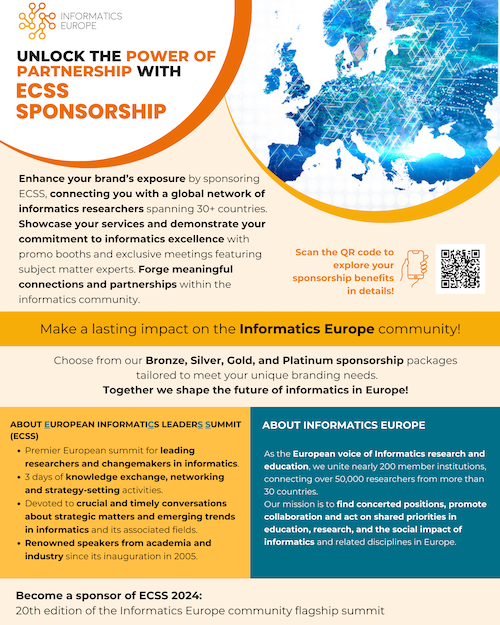
Become a Sponsor of ECSS
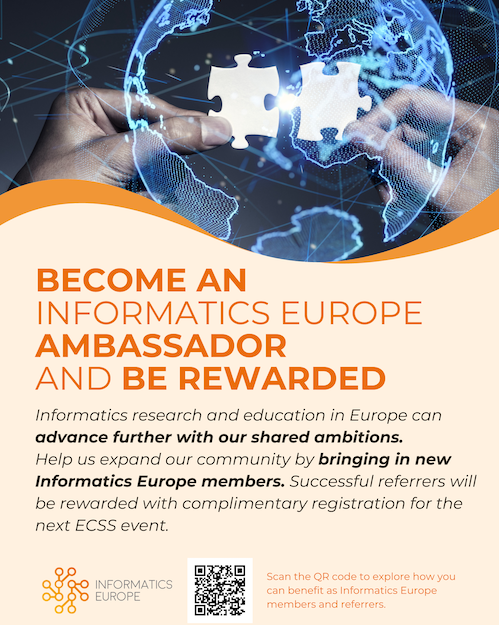
Informatics Europe Ambassador - We Want YOU!
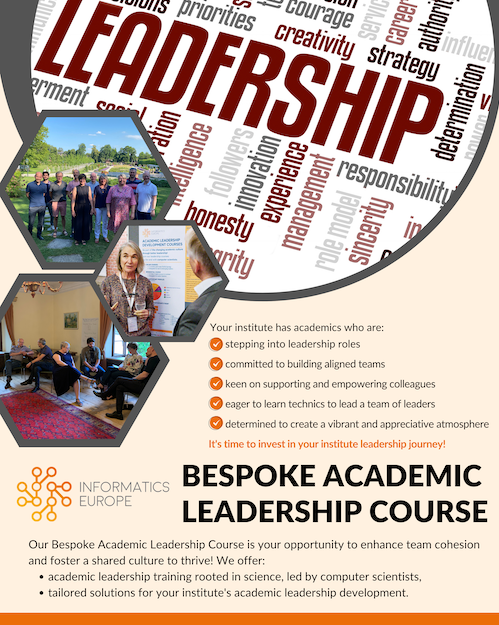
Bespoke Academic Leadership Course
EUGAIN - Best Practices from PhD to Professor
EUGAIN - Best Practices from School to University
EUGAIN - Reasons to Become an Informatics Student
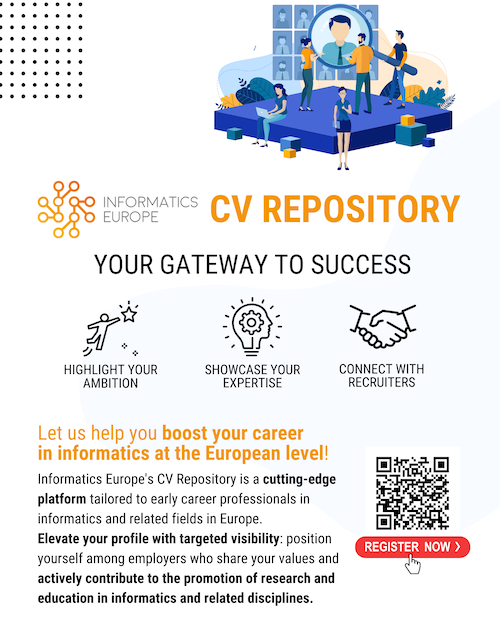
Informatics Europe CV Repository for Applicants
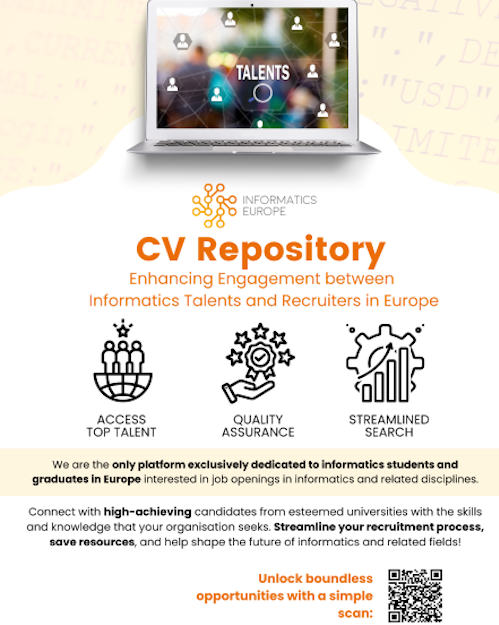
Informatics Europe CV Repository for Recruiters
Informatics Europe - Open Access: Status and Recommendations
Informatics Europe - Recommendations on the Use of AI in Informatics Education
Informatics for All Coalition - Informatics Reference Framework for School


Main Theme Sessions
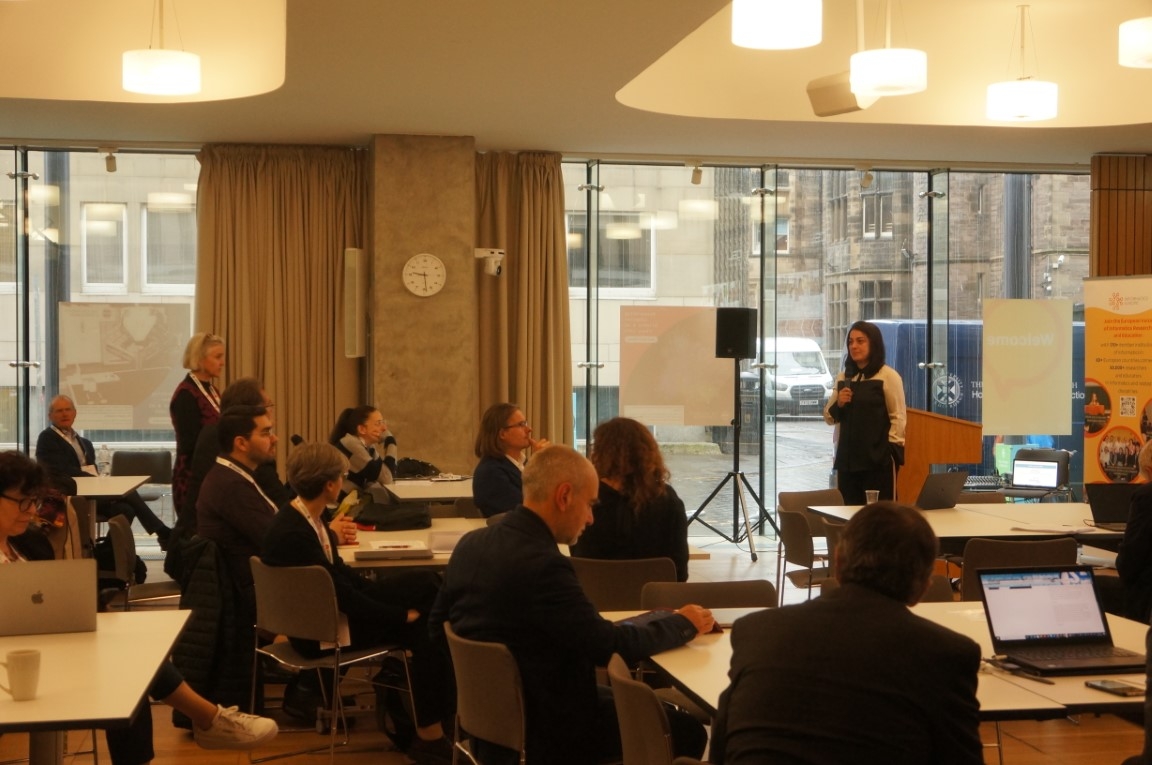
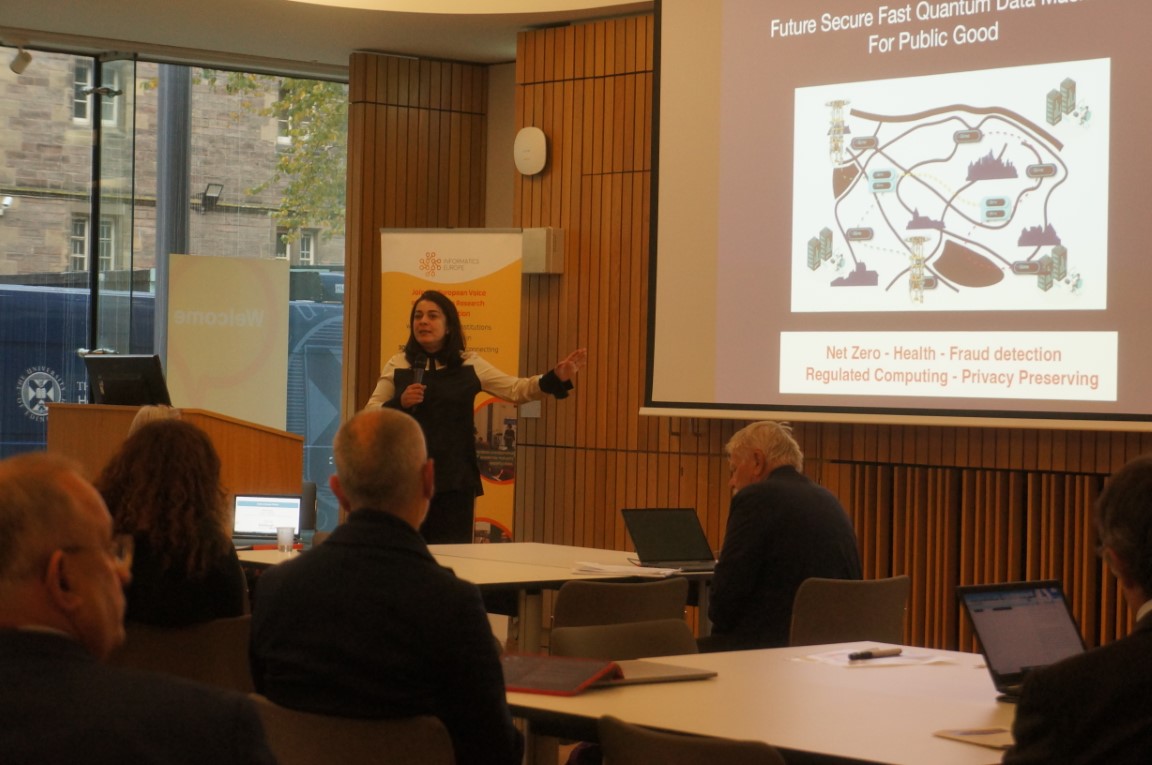
The main theme of the ECSS 2023 was "Informatics: Shaping the Future". The main theme session was chaired by Jane Hillston, University of Edinburgh, and Gregor Engels, SICP - Software Innovation Campus Paderborn.
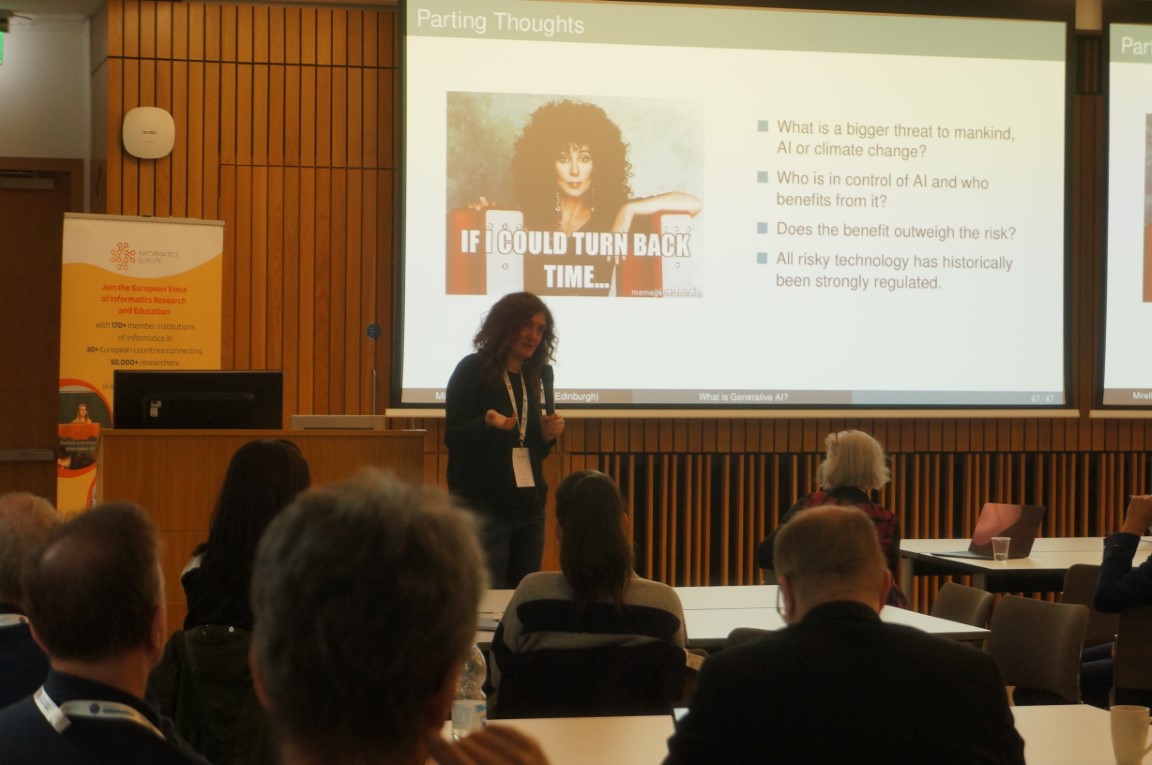
Over the last sixty years and more, Informatics has made incredible advances and as a result has had profound impact on the way that we all live our lives. It is hard to think of an aspect of society that has not been touched by digital technologies and it is impossible to imagine getting through the pandemic without it. And as we look forward neither the impact nor the pace of change is likely to decrease, which places great responsibility on us as leaders and researchers in Informatics. In this session, we learnt about some current hot topics, which looked likely to have profound and wide-reaching impacts, ranging from quantum computing to large language models. The speakers also took part in a panel discussion considering the question “How do we ensure that Informatics shapes the future that we hope for?”.
Session Rundown
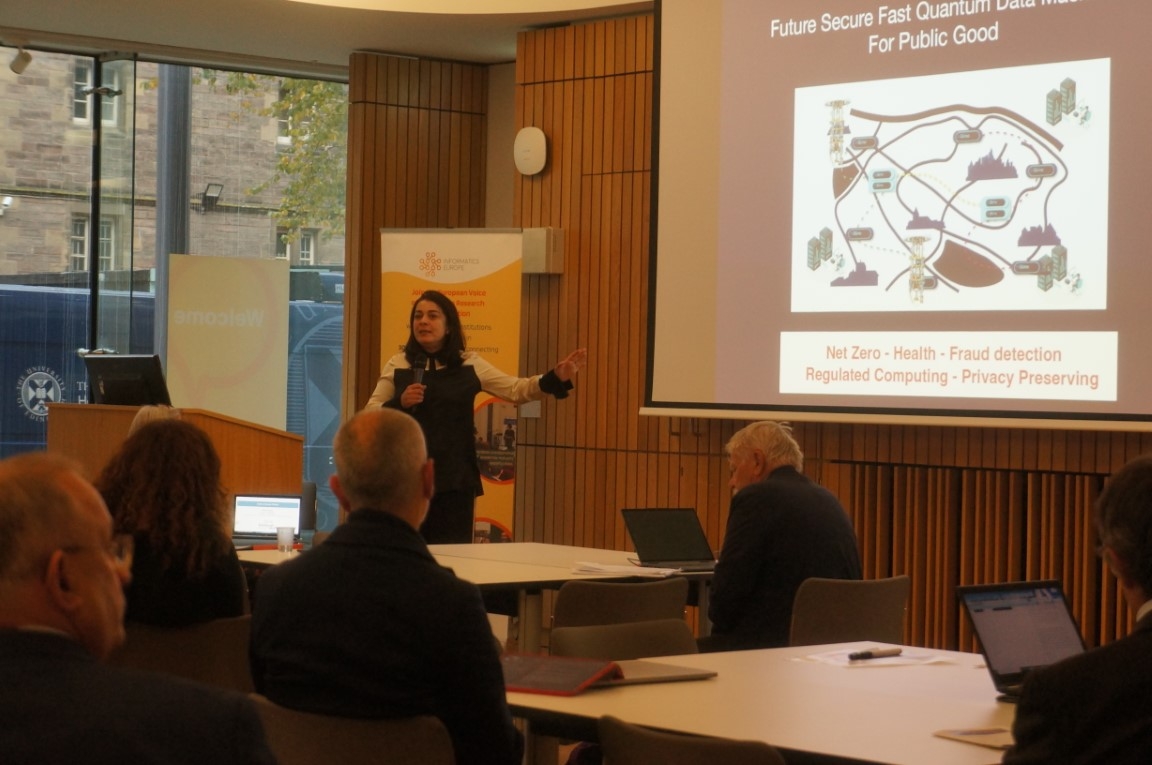
09:00 - 09:30 "Finding the Quantum Advantage" by Elham Kashefi, The National Quantum Computing Centre (UK) [Slides]
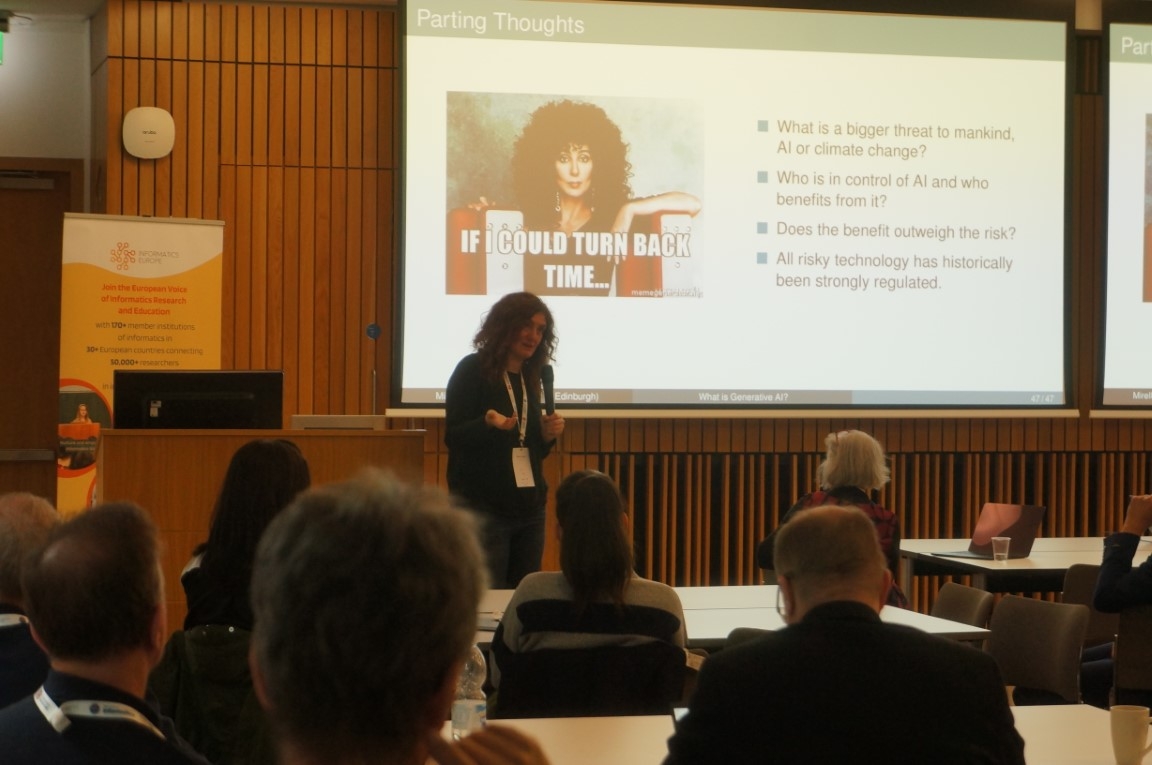
09:30 - 10:00 "Large Language Models" by Mirella Lapata, University of Edinburgh (UK) [Slides]
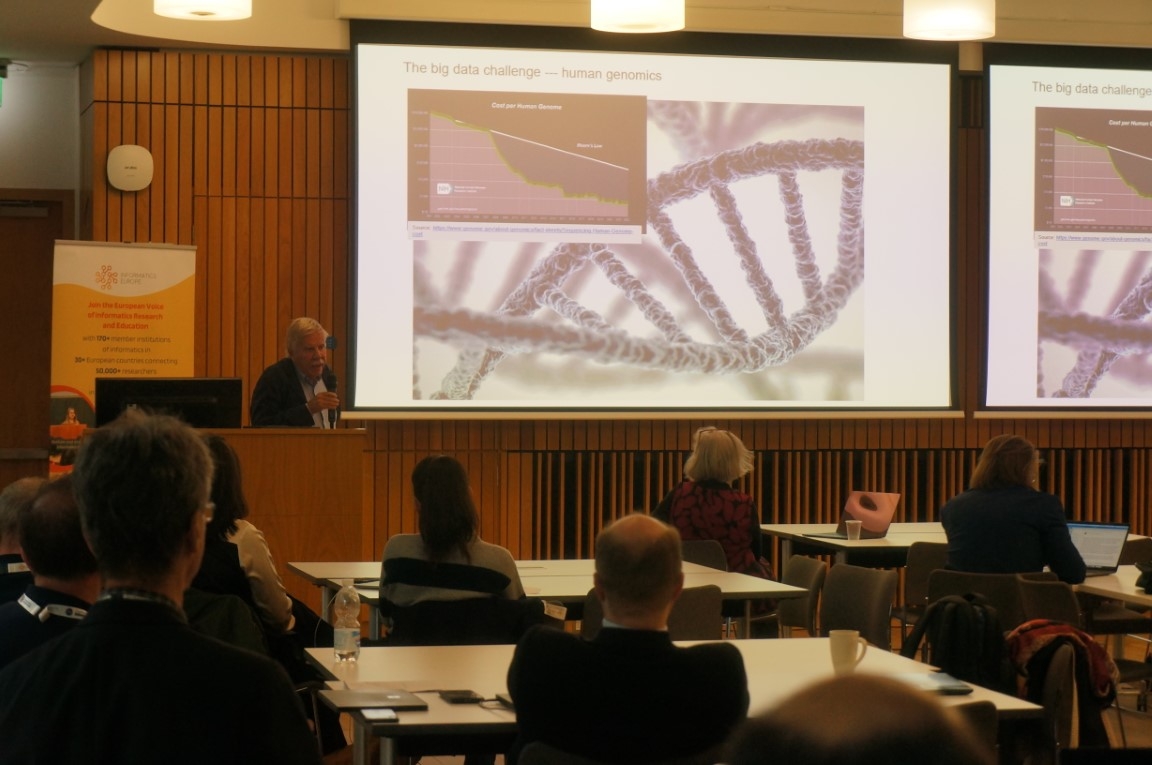
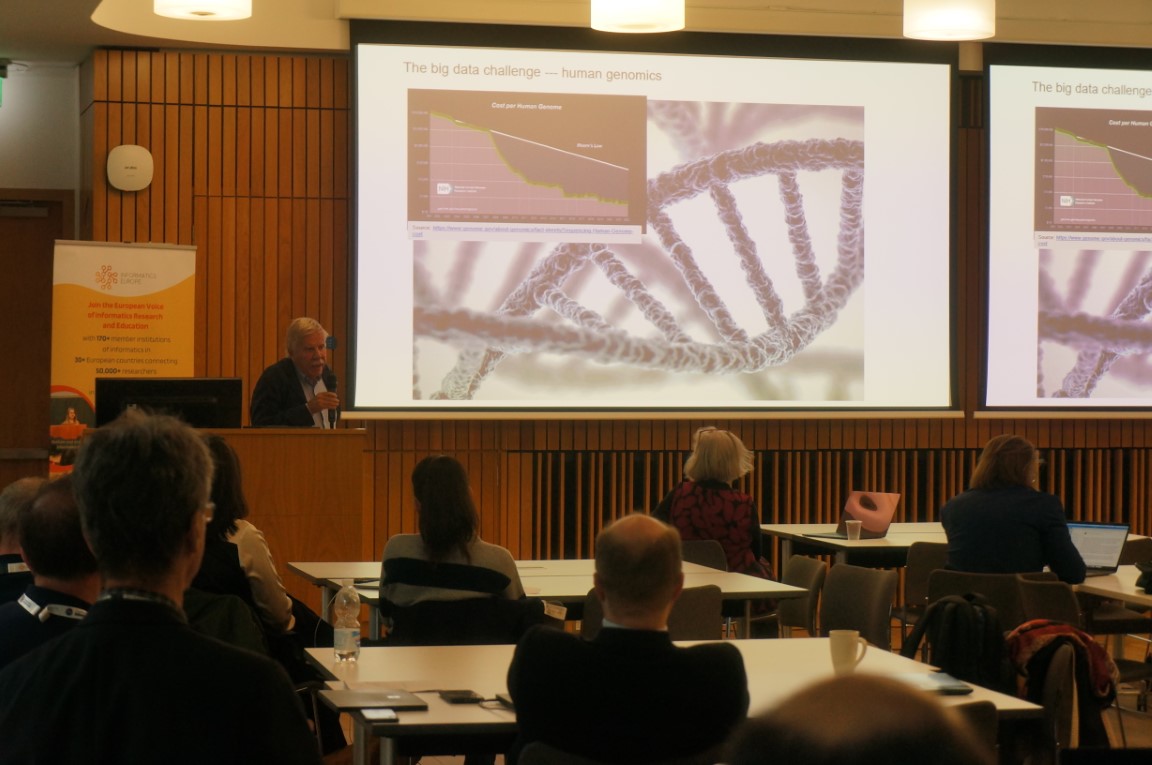
10:00 - 10:30 "Big data in life sciences, from theory to applications" by Stefano Ceri, Politecnico di Milano (Italy) [Slides]
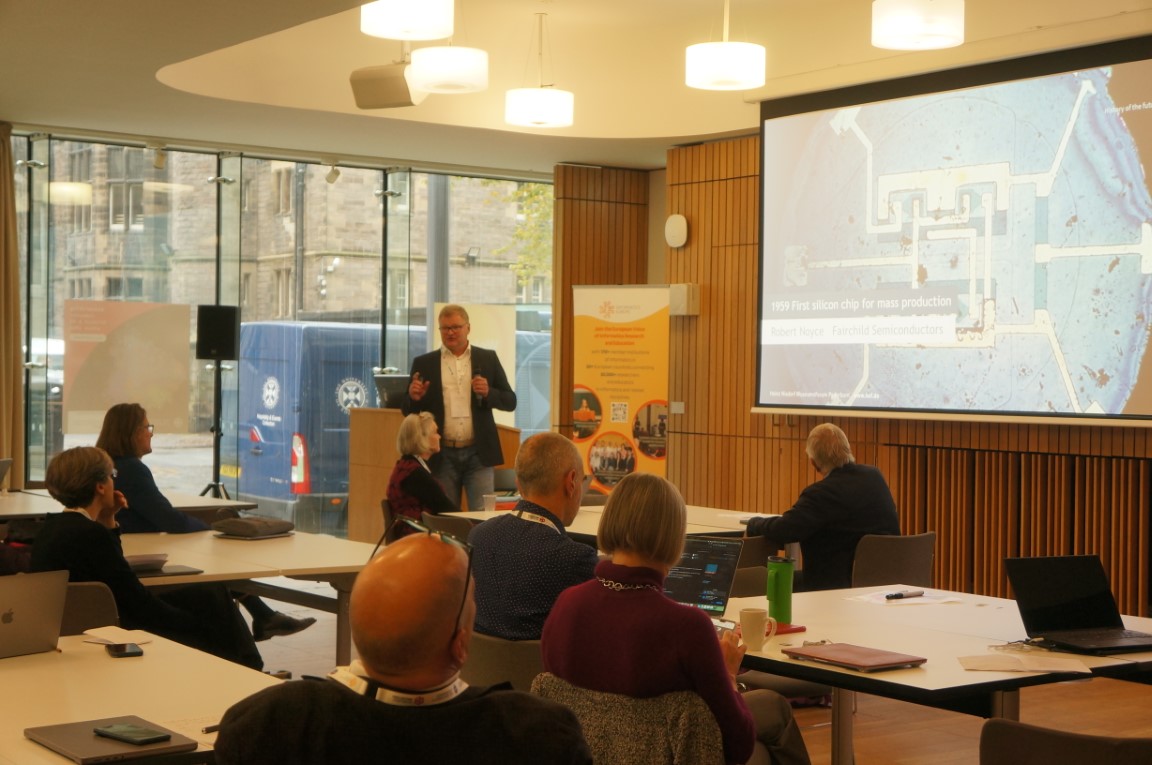
10:30 - 11:00 "Beyond common Computing – Does Sustainability require new (and old) Alternatives to “classical” Digital Computing Machines?" by Jochen Viehoff, Heinz Nixdorf MuseumsForum (Germany) [Slides]
11:00 - 11:30 Coffee break
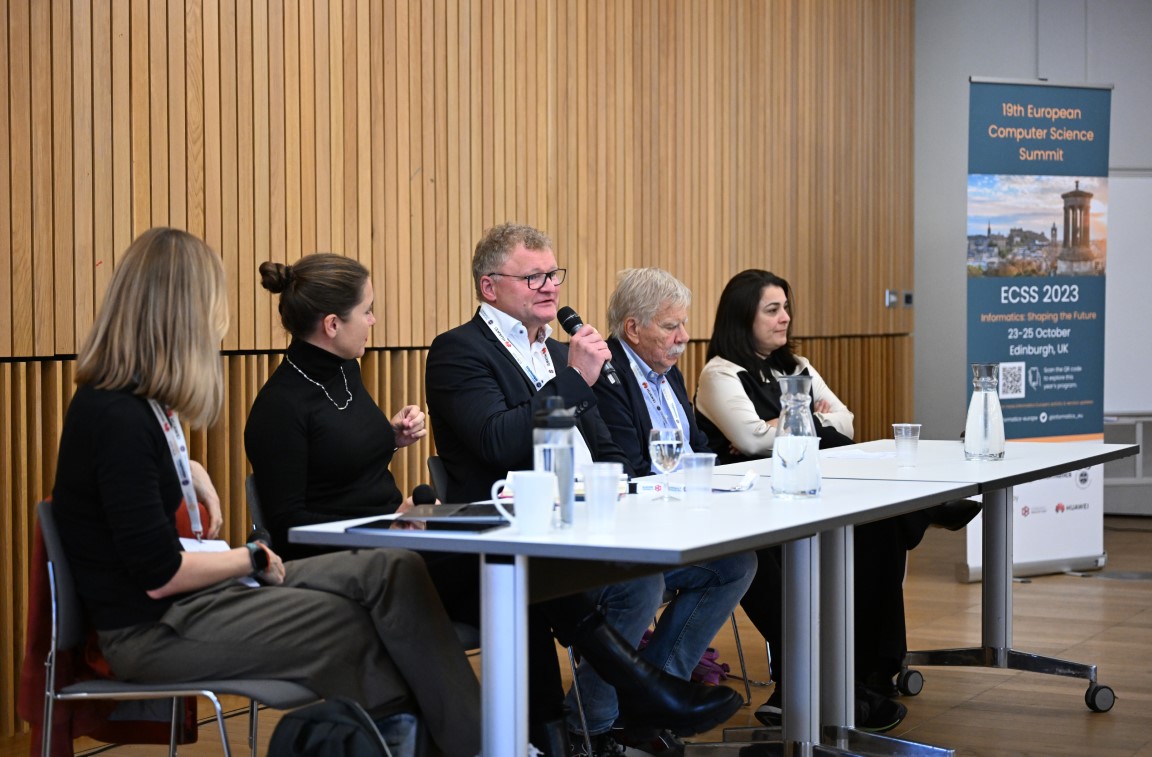
11:30 -12:30 Panel Discussion: "How do we ensure that informatics shapes the future that we hope for?"
Panel chair: Ewa Luger, University of Edinburgh (UK)
- Elham Kashefi, The National Quantum Computing Centre (UK)
- Jochen Viehoff, Heinz Nixdorf MuseumsForum (Germany)
- Mira L. Wolf-Bauwens, IBM Research Europe
- Stefano Ceri, Politecnico di Milano (Italy)
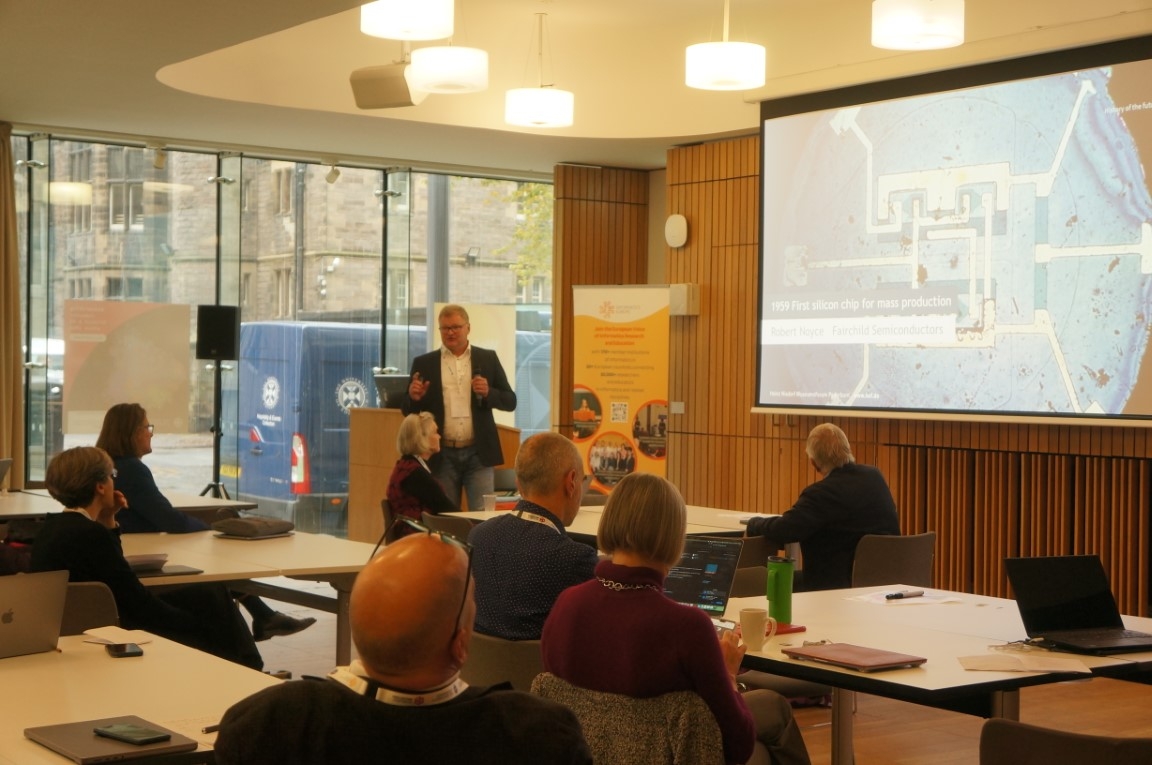
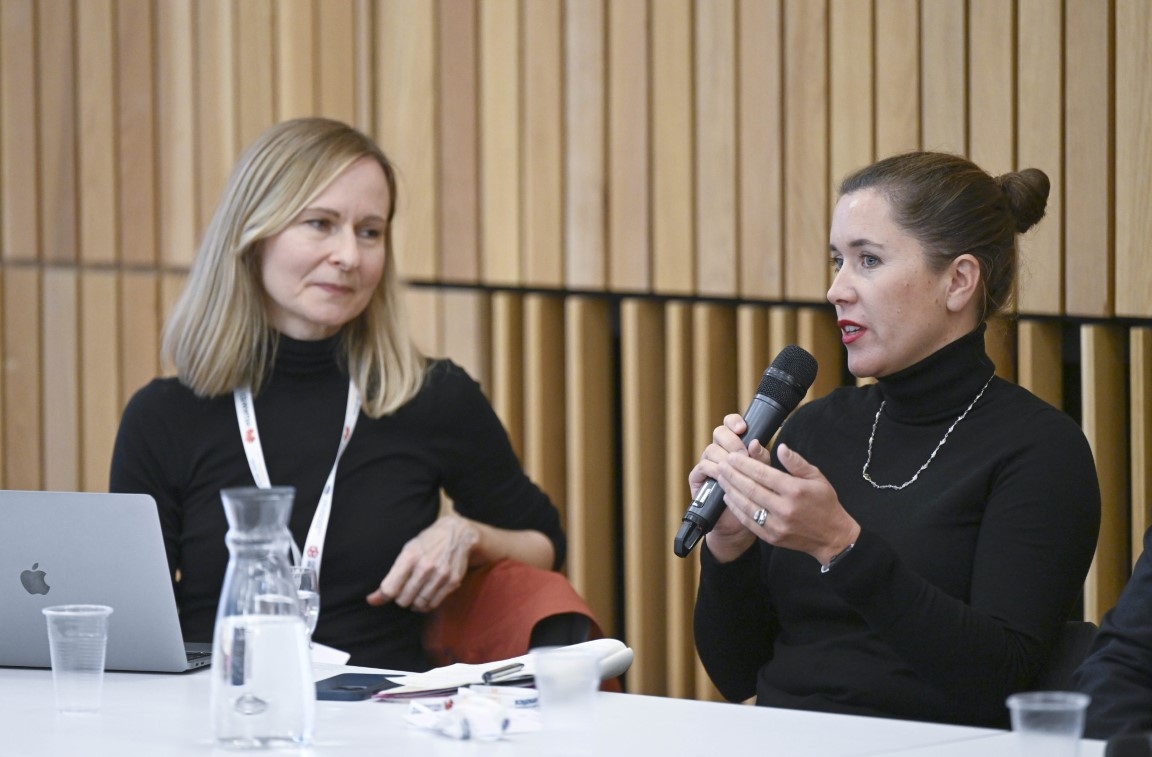
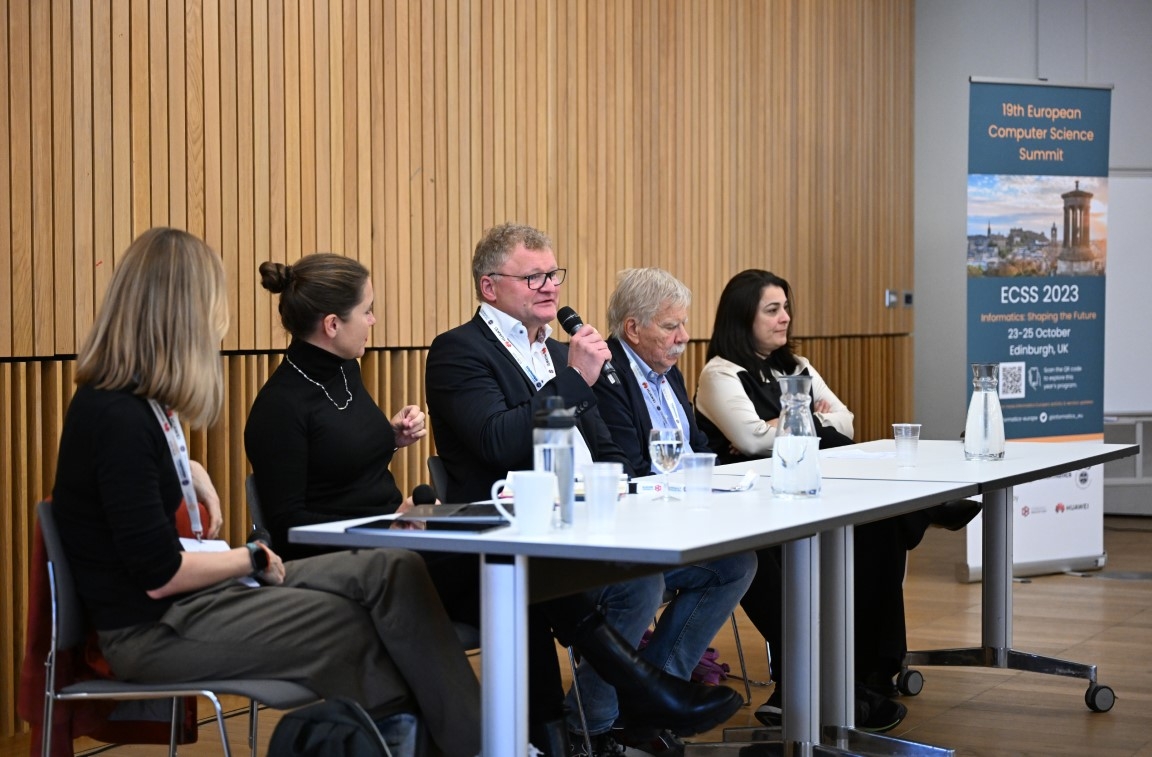
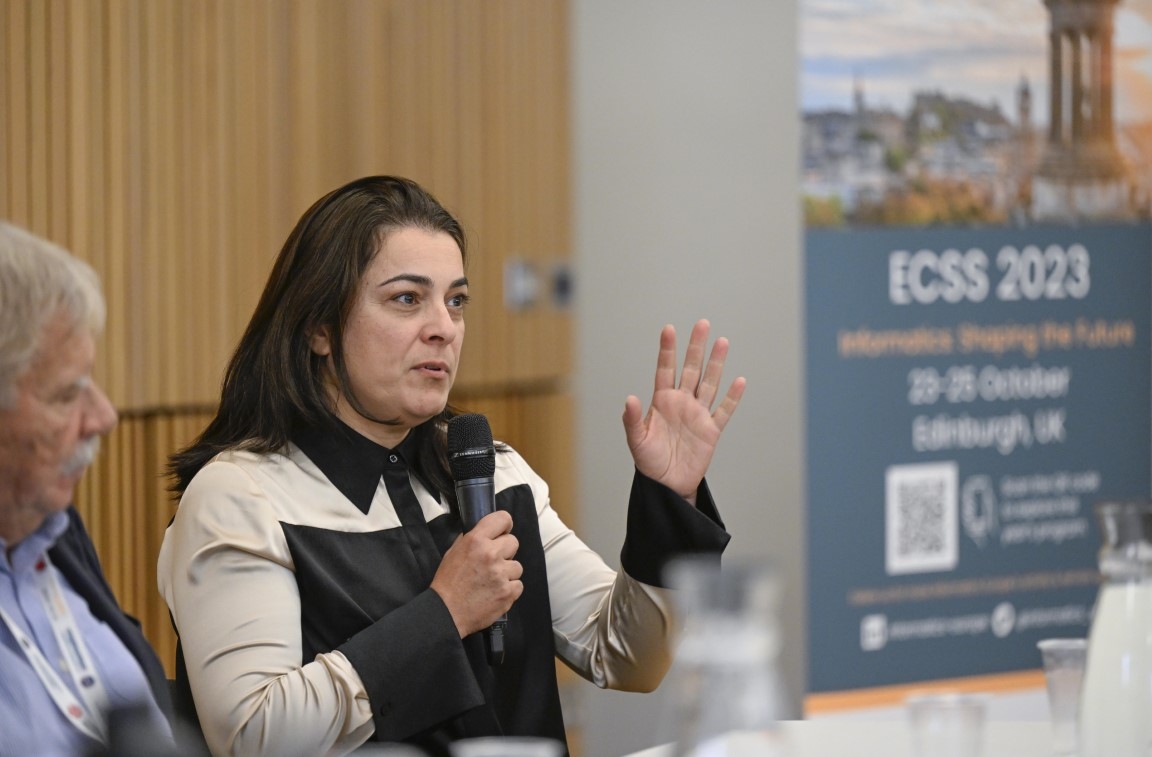
*Please note that the photos below are better viewed when applying zoom out.
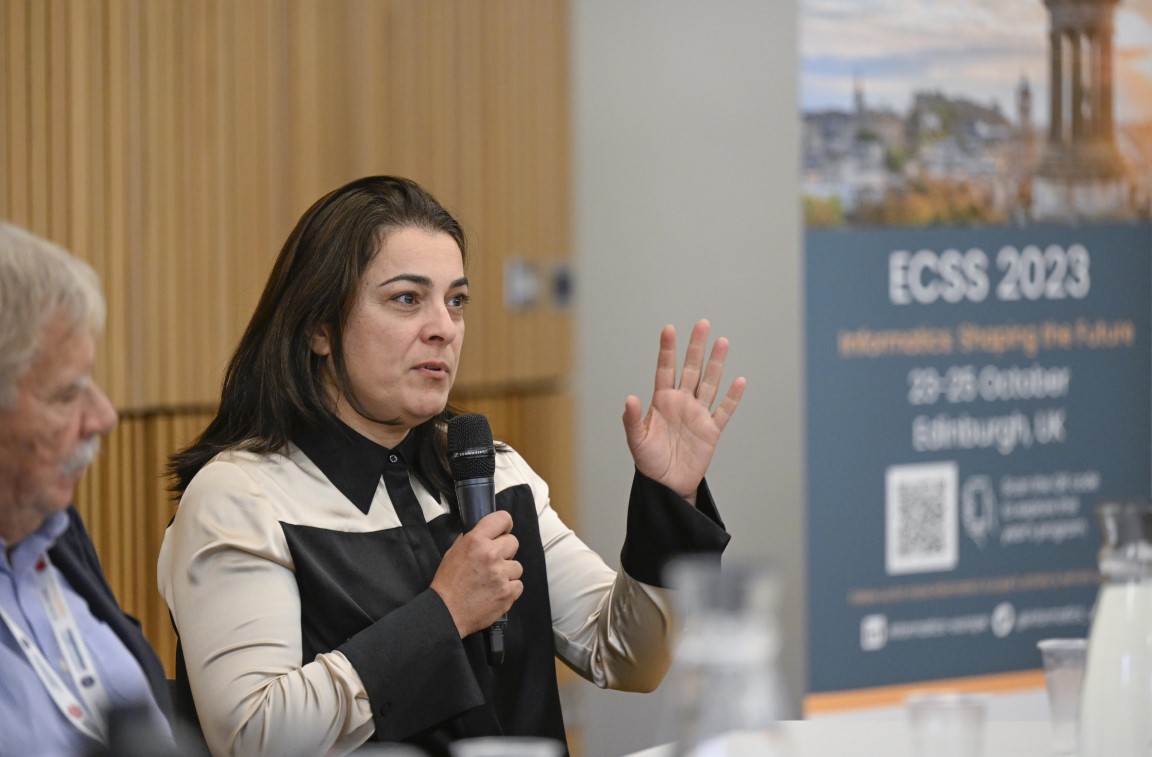
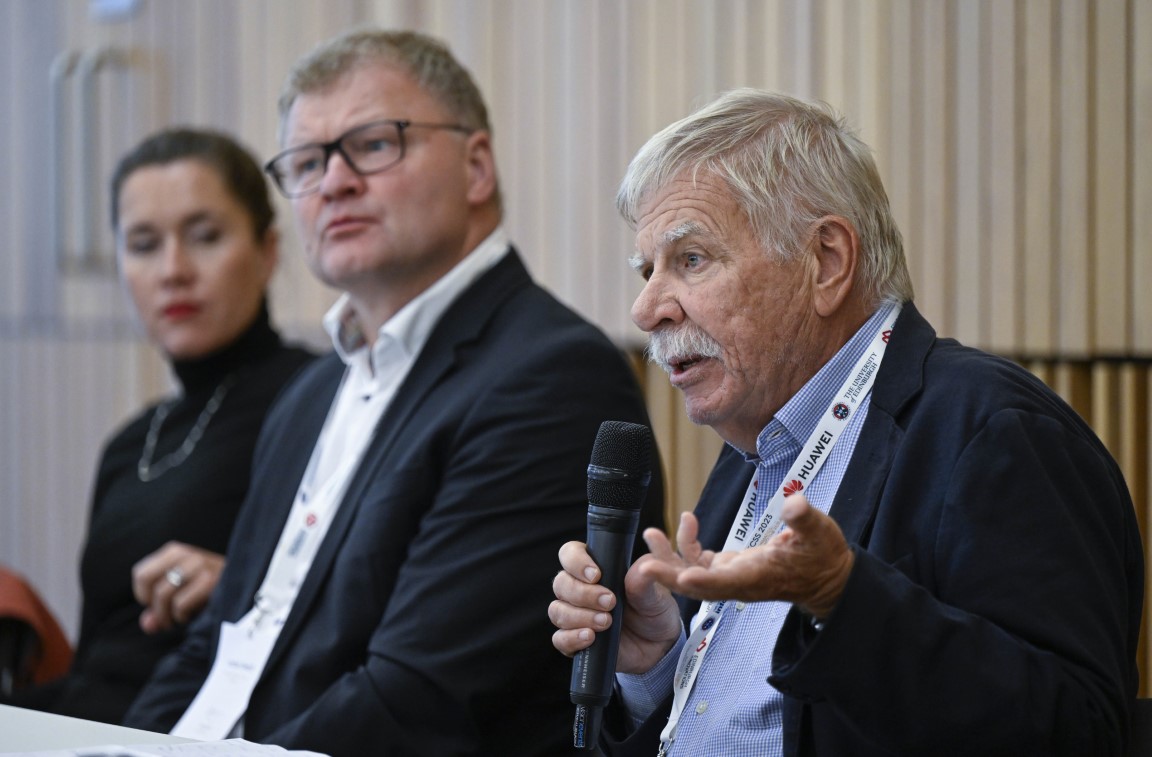
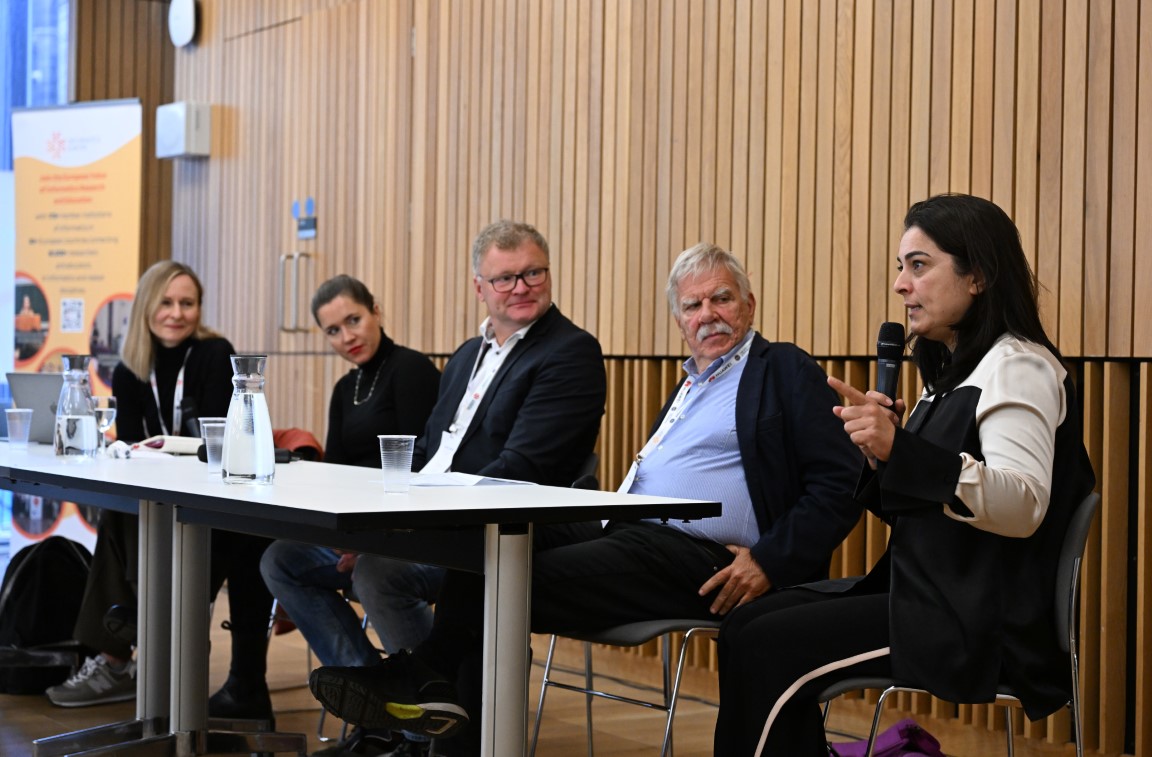
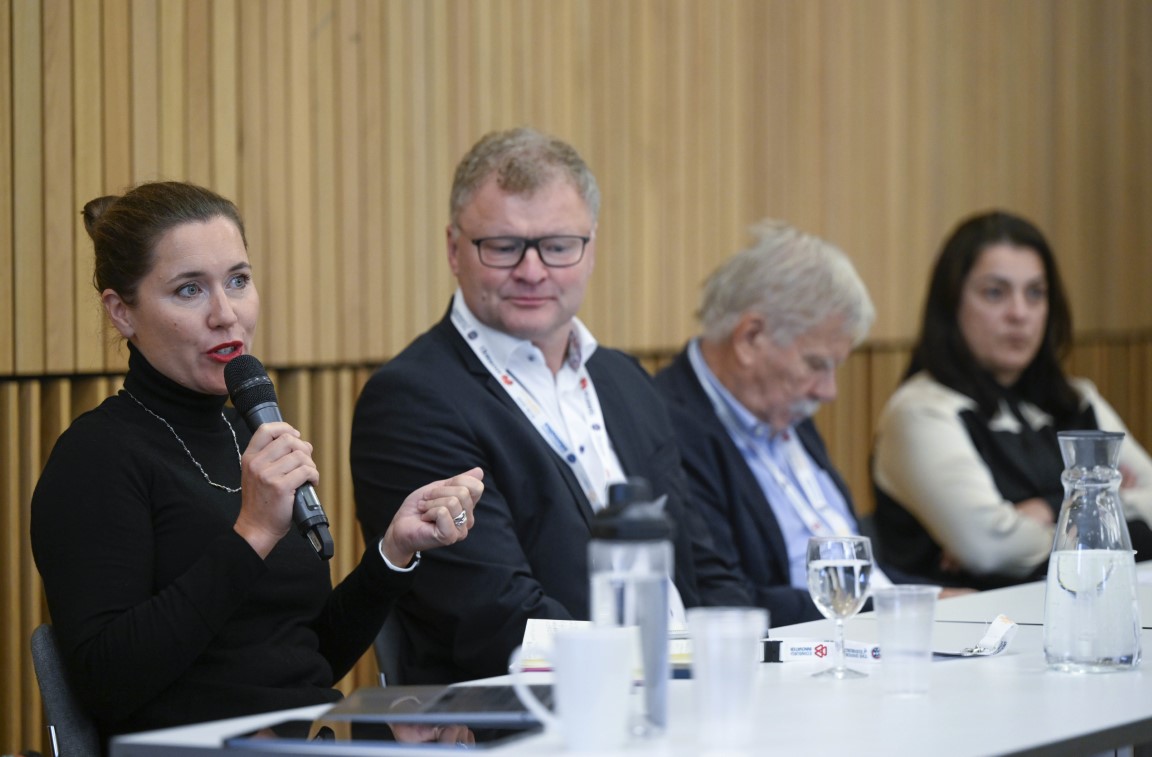
-
Elham Kashefi, The National Quantum Computing Centre, UK
-
Main Theme Session Q&A
-
Mirella Lapata, University of Edinburgh, UK
-
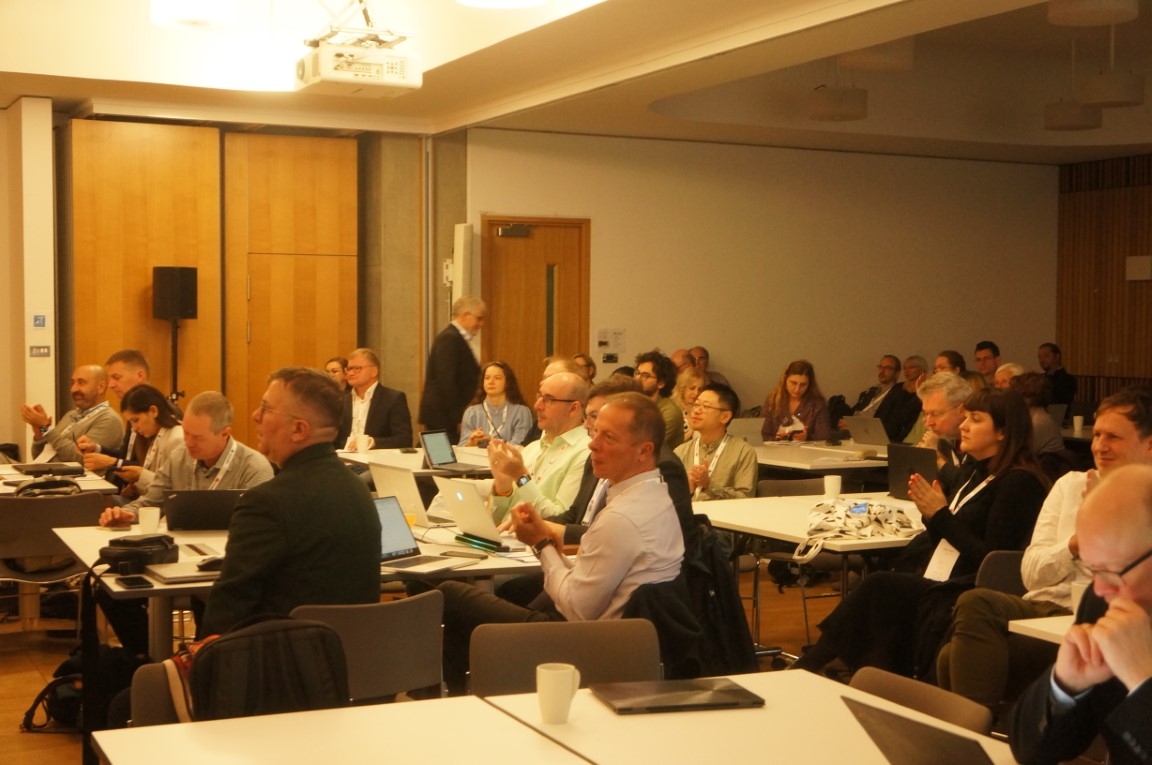
Main Theme Session - Informatics: Shaping the Future
-
Stefano Ceri, Politecnico di Milano, Italy
-
Jochen Viehoff, Heinz Nixdorf MuseumsForum, Germany
-
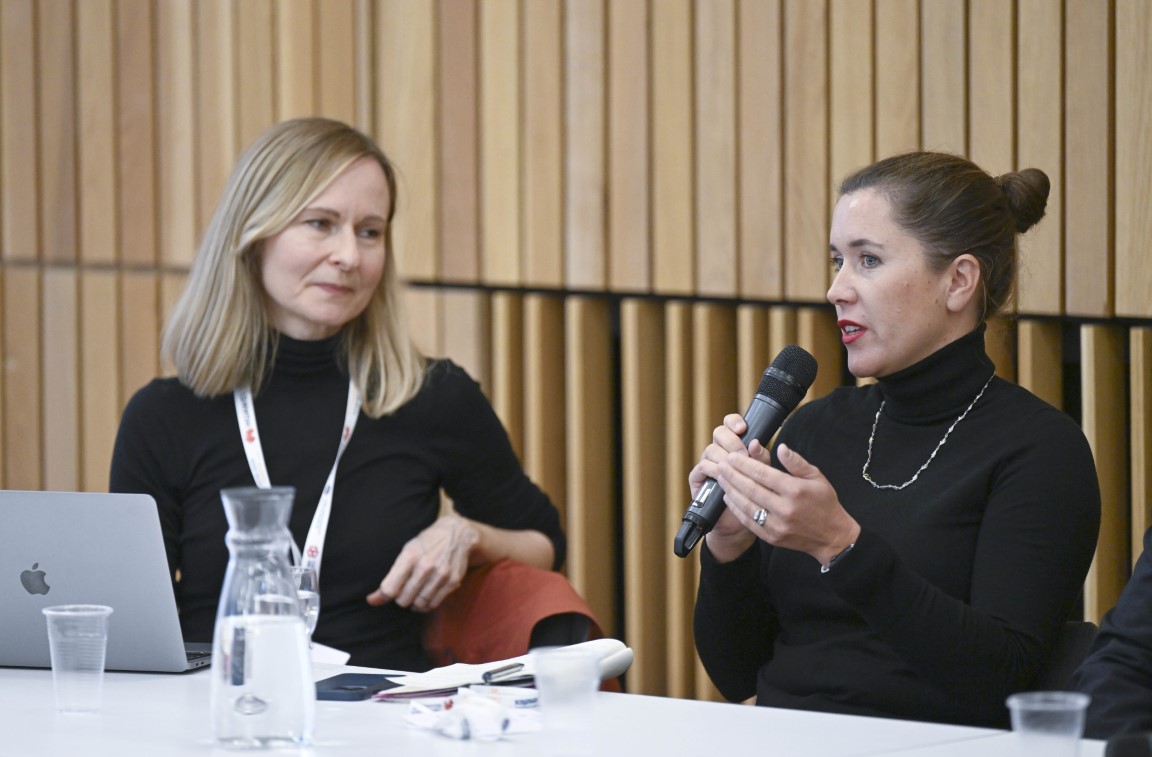
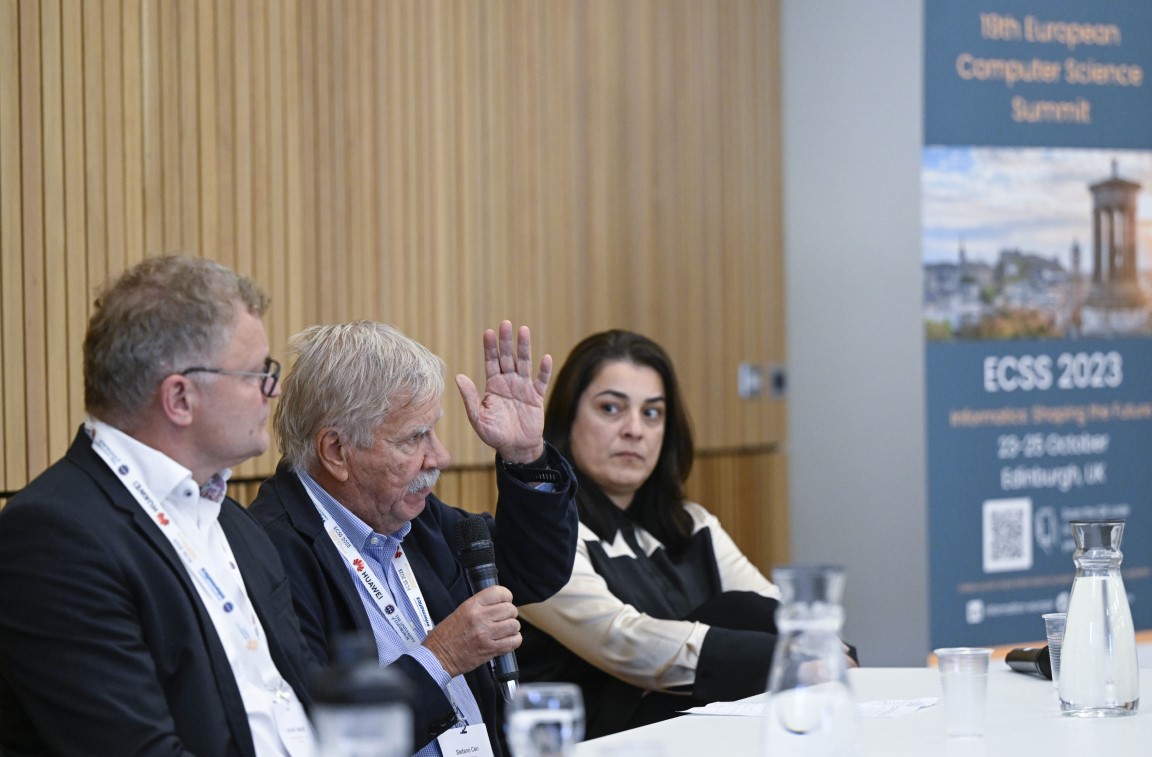
Panel Discussion with Main Theme Keynote Speakers
-
Panel Discussion with Main Theme Keynote Speakers
-
Elham Kashefi, The National Quantum Computing Centre, UK
-
Panel Discussion with Main Theme Keynote Speakers
-
Panel Discussion with Main Theme Keynote Speakers
-
Panel Discussion with Main Theme Keynote Speakers
-
Panel Discussion with Main Theme Keynote Speakers


Early Career Researchers Workshop
One of Informatics Europe's goals is to nurture talent, assuring a pipeline of diverse leaders with a broad understanding of the discipline. It is in this context that we organised again the "Professional Development Workshop for Early Career Researchers". It was held on Monday, 23 October, chaired by Dimka Karastoyanova, University of Groningen, and Tobias Grosser, University of Edinburgh. The goal of the workshop was to support early career researchers (PhD students and Postdocs) in the development of their soft skills related to presentation abilities, networking and developing a research plan. We supported networking among like-minded peers, mentors, and industry leaders passionate about advancing the field of informatics in Europe. We invited participants to expand their professional network and cultivate valuable relationships that will shape the future!
Workshop Goals
This year’s workshop focused on the skills and knowledge needed to turn your research career into a success story. The workshop program covered subjects like leadership styles, vision and best practices for planning sustainable growth in research careers, as well as different perspectives on success and the importance of networking. Furthermore, we gave attendees the opportunity to learn from established researchers from different career paths about the knowledge and skills that supported their successful trajectory of development and growth, throughout all stages of their careers. As a result of the workshop, we expected participants to devise a research career plan. This happened in two stages:
- before the workshop: the ECR attendees received reading material and be asked to prepare a description of their current vision of a research career, throughout all its stages;
- during the workshop: participants had the opportunity to update their vision board based on what they learned during the sessions from the interactions with the panellists and peers.
Poster Session
Attendees of the workshop also had the chance to participate in the traditional ECSS poster session, the place to share and highlight your research with all ECSS participants and broaden your research network. Participants received a certificate of attendance at the end of the workshop and poster presenters be listed in the dedicated section of the program.
Important Dates
- Submission of statement of interest to poster session: on or before 22 September 2023
- Notification of poster acceptance: up to two weeks once submission received via EasyChair
Grants for PhD students
A limited number of grants, waiving the ECSS 2023 registration fee, were available for PhD students who participate in the ECSS 2023, in its totality (23-25 October) or just at the Early Career Researchers Workshop. Grants were assigned based on a first-come, first-served basis to non-UK residents who submitted their statements to participate in the ECSS 2023’s poster session. Read more about the grant here.
Workshop Rundown
11:00 - 11:05 Welcome and Introduction
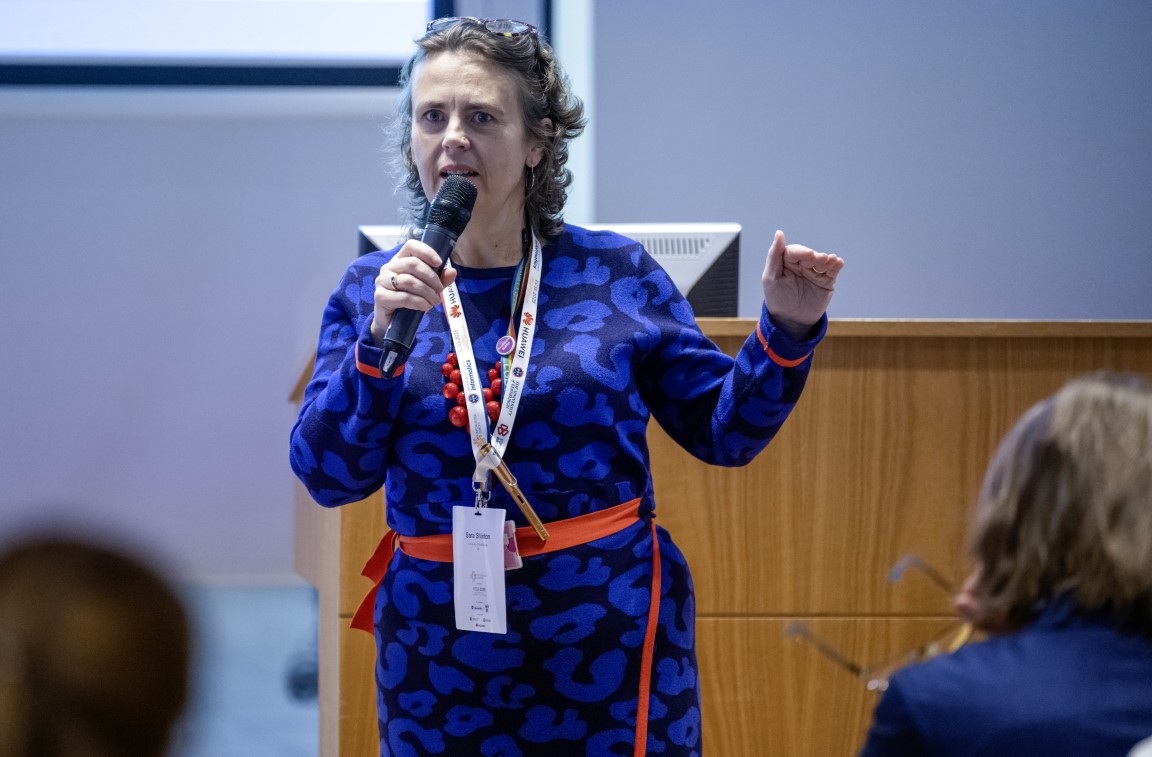
11:05 - 12:30 Session 1: “A Fresh Approach to Research Leadership" by Sara Shinton, University of Edinburgh (UK) [Slides]
12:30 - 13:30 Lunch
13:30 -15:30 Session 2: "How to turn a research career into a success"
A panel of established researchers from academia and industry shared their insights on the reasons for their successes in research, research funding, their research career, or their company/start-up. The session also included a discussion between the audience and the following panellists.
- Marco Aiello, University of Stuttgart (Germany) [Slides]
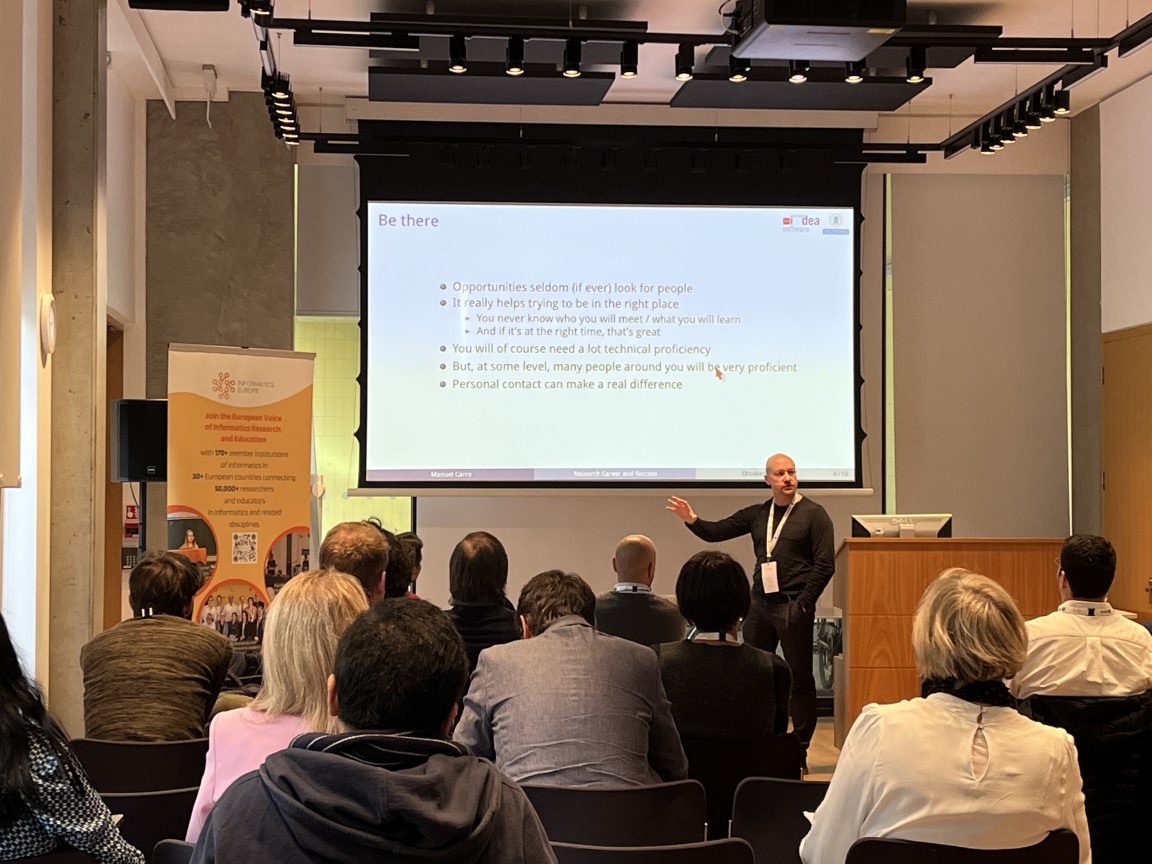
- Manuel Carro, Technical University of Madrid/IMDEA Software Institute (Spain) [Slides]
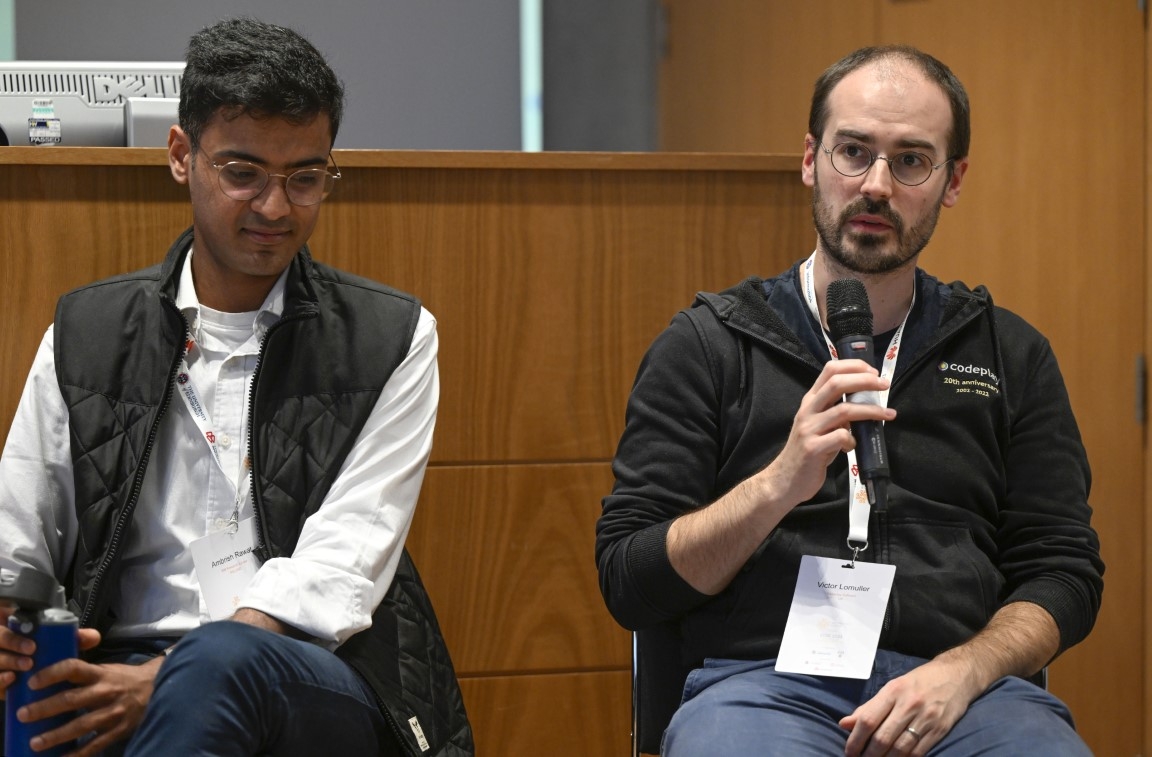
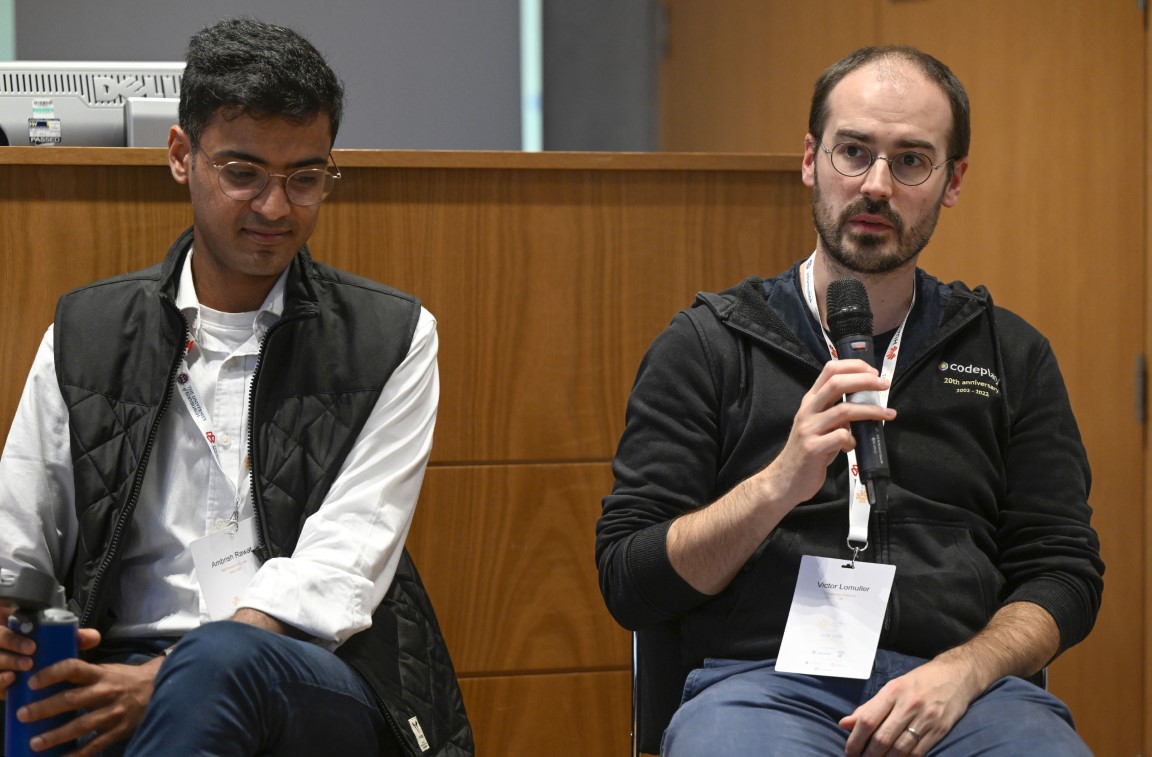
- Victor Lomüller, CodePlay (UK)
- Dympna O'Sullivan, TU Dublin (Ireland) [Slides]
- Ambrish Rawat, IBM Research Europe (Ireland)
15:30 - 16:00 Coffee break
16:00 - 17:30 Session 3: "Sustainable growth in research career"
Round table discussions between the workshop participants and the panel speakers were held in small groups. During these discussions, participants had the opportunity to review their career vision board in interaction with both the panellists and peers.
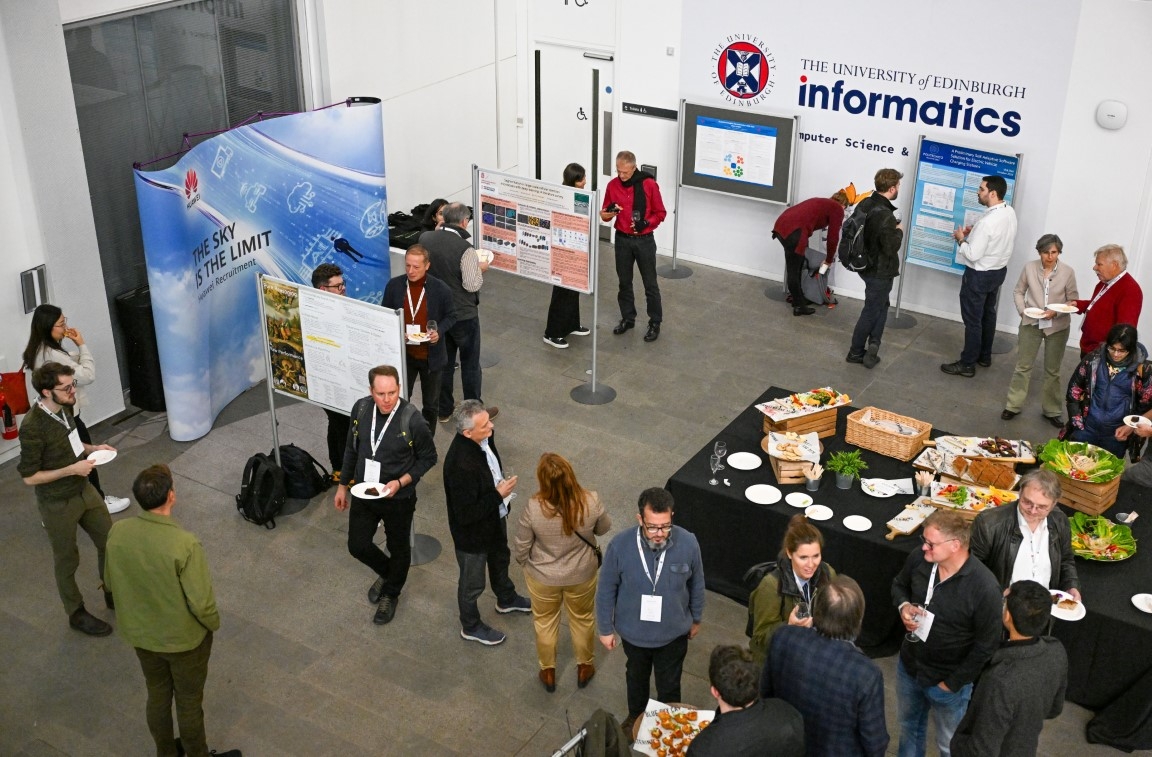
18:15 - 20:30 Welcome Cocktail including the Early Career Researchers Poster Session
Featured Posters:
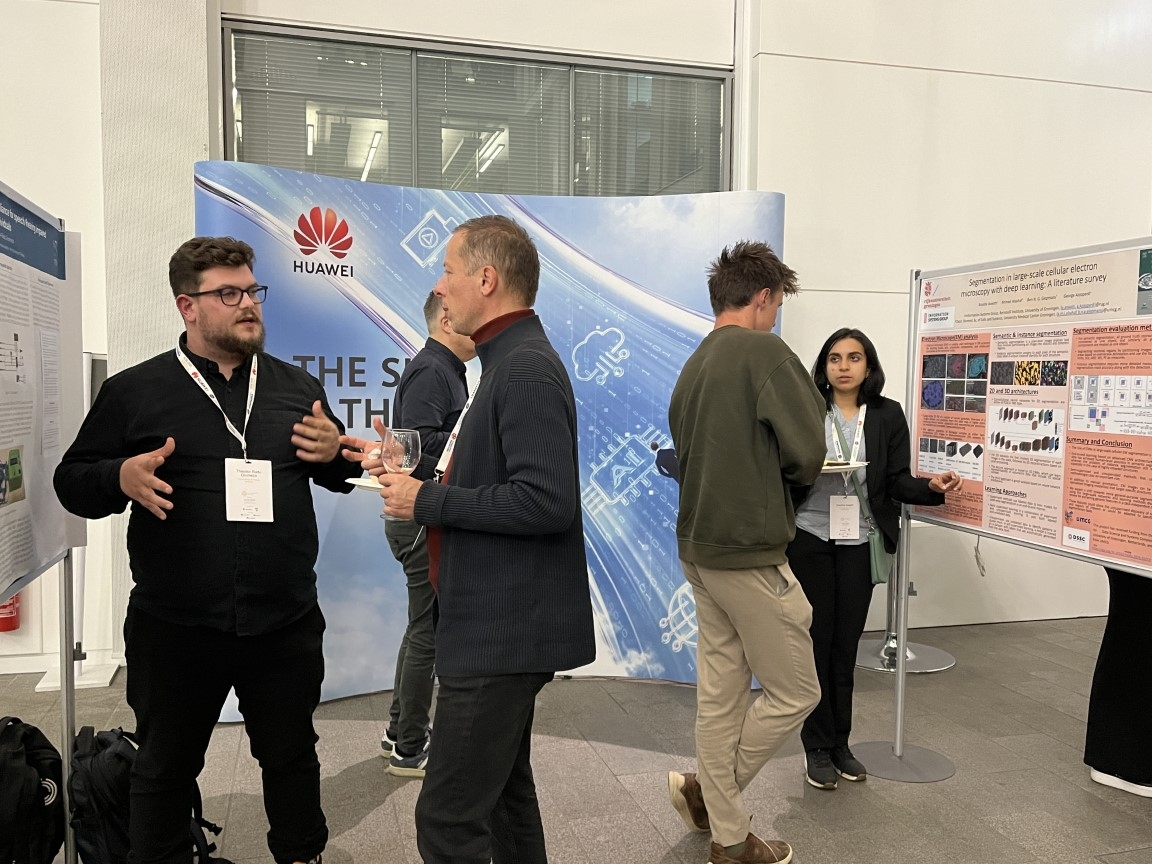
- "Automated Identification and Analysis of Structures in Large-scale Electron Microscopy Images" by Anusha Aswath, University of Groningen (the Netherlands) [Poster]
- "Machine Learning Predictive Models Applied to COVID-19 Datasets to Estimate the Infection Risk in Specific Geographic Regions" by Diogen Babuc, West University of Timisoara (Romania) [Poster]
- "Qualitative insights into abstraction skills from exam scripts" by Julia Crossley, City University of London (UK) [Poster]
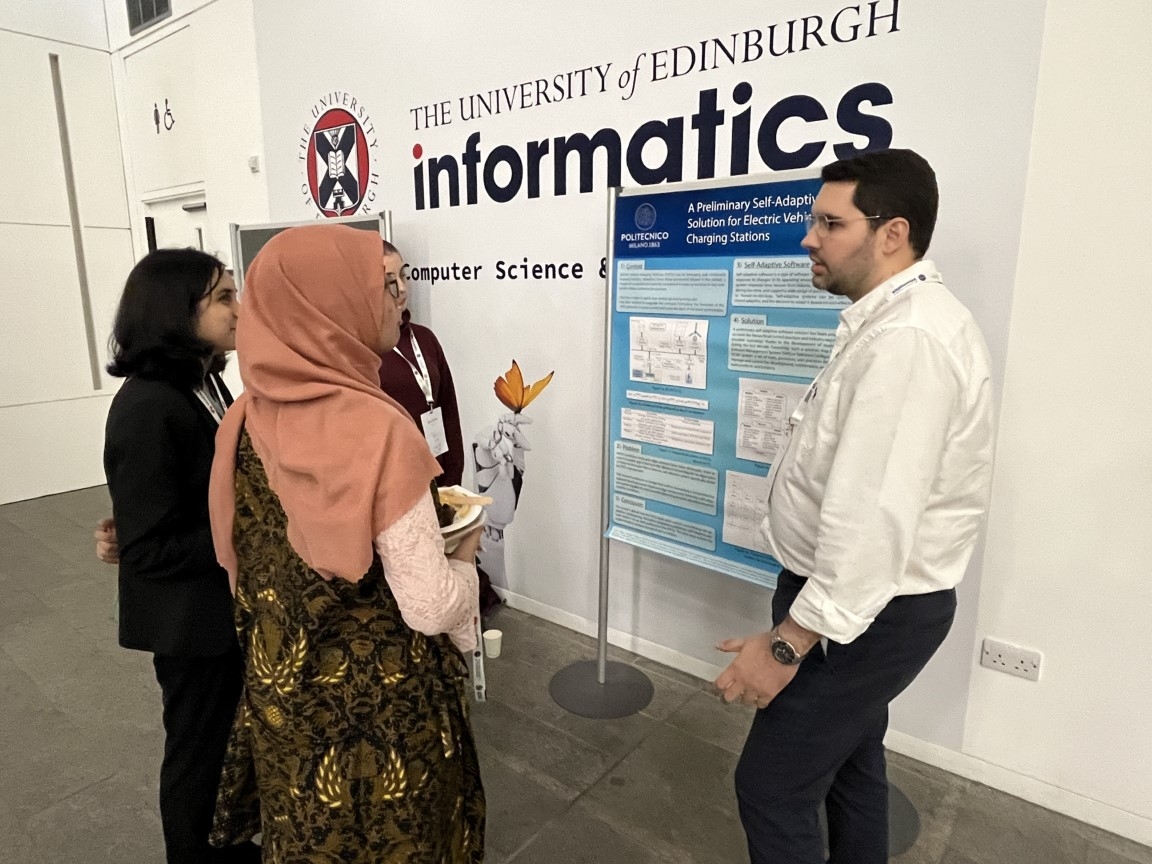
- "Self-Adaptive Smart Grids: A Case Study on EV Charging Stations" by Vick Dini, Politecnico di Milano (Italy) [Poster]
- "ChatterGlove - A healthcare appliance for speech/hearing impaired individuals" by Theodor-Radu Grumeza, West University of Timisoara (Romania) [Poster]
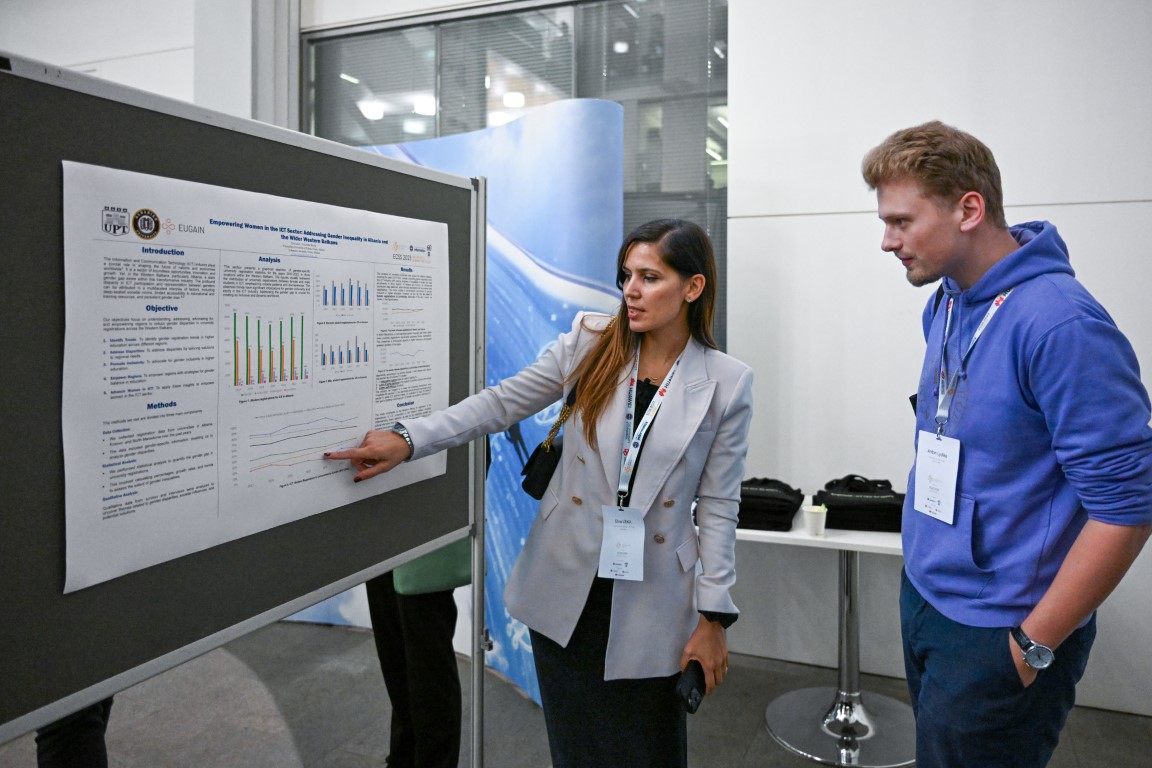
- "Empowering Women in the ICT Sector: Addressing Gender Inequality in Albania and the Wider Western Balkans" by Elva Leka, Polytechnic University of Tirana (Albania) [Poster]
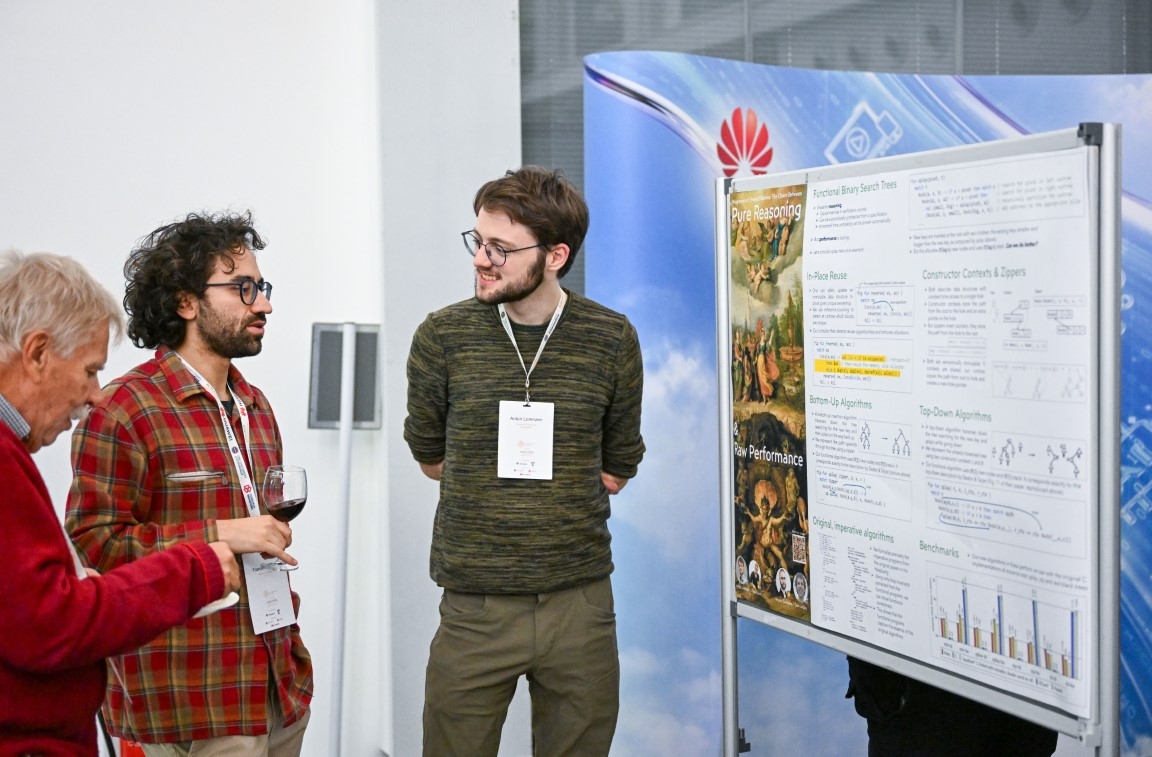
- "An Eternal Dilemma Resolved: The Choice Between Pure Reasoning and Raw Performance" by Anton Lorenzen, University of Edinburgh (UK) [Poster]
- "Challenges and Strategies of Women in STEM. Gender Balance - Albanian Case." by Olgerta Idrizi, Mediterranean University of Albania (Albania) & Miranda Harizaj, Polytechnic University of Tirana (Albania) [Poster]
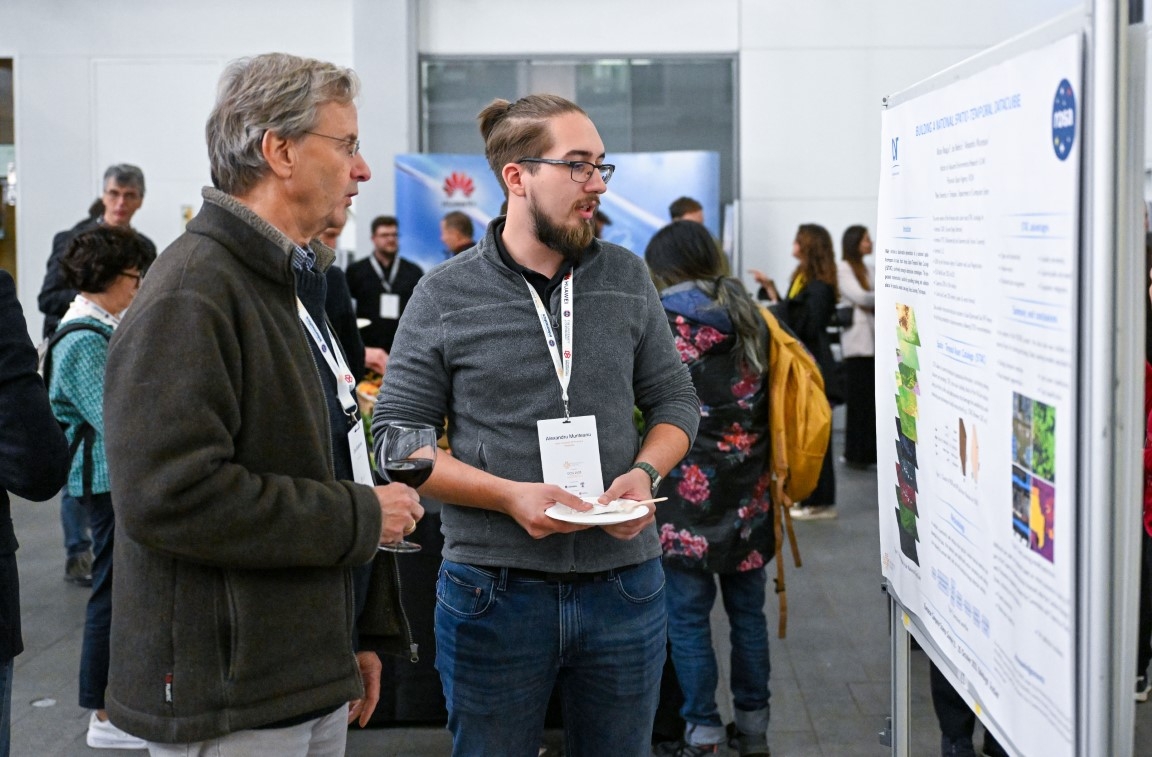
- "Building A National Spatio-Temporal Datacube" by Alexandru Munteanu, West University of Timisoara (Romania) [Poster]
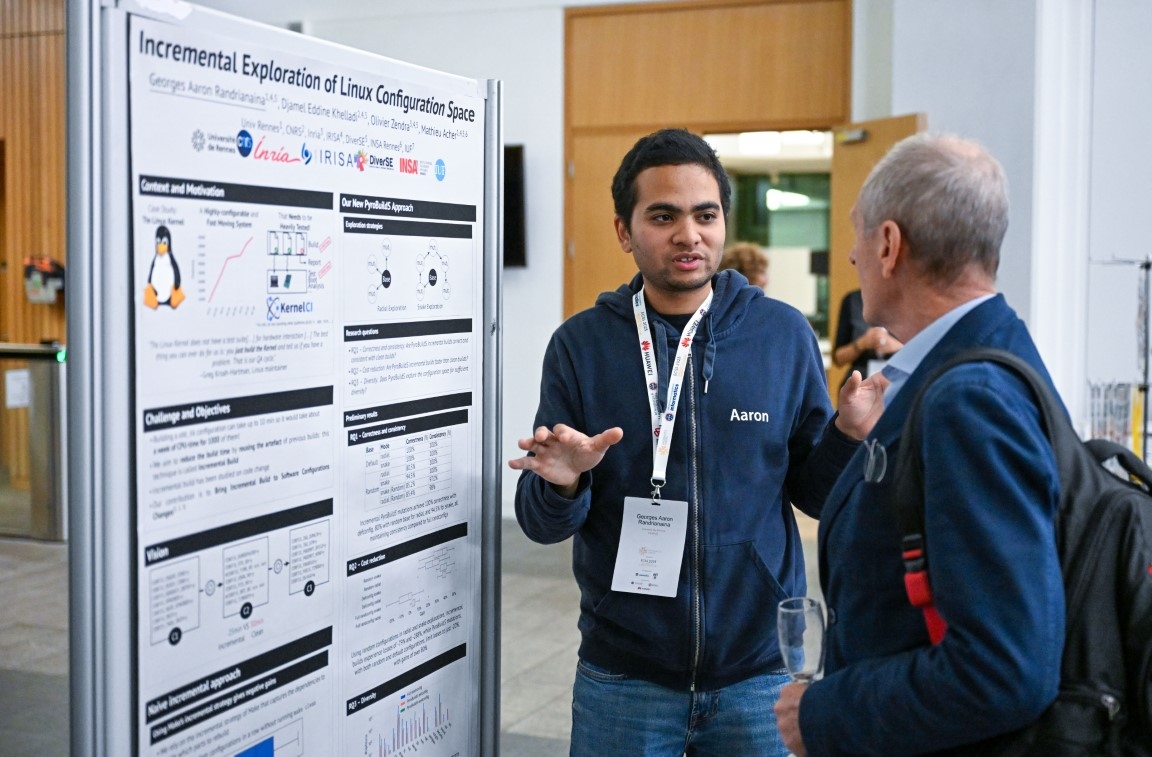
- "Enabling Efficient Exploration of Linux Configuration Space with Incremental Build" by Georges Aaron Randrianaina, IRISA Rennes (France) [Poster]
*Please note that the photos below are better viewed when applying zoom out.
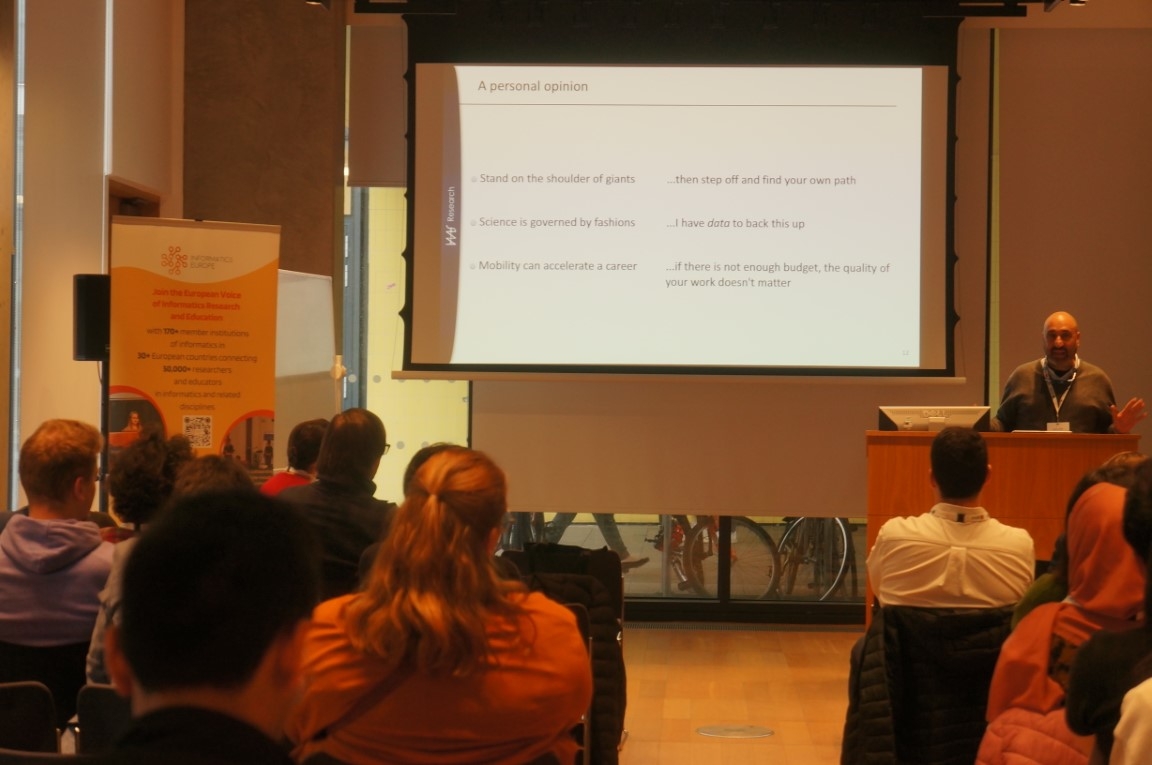
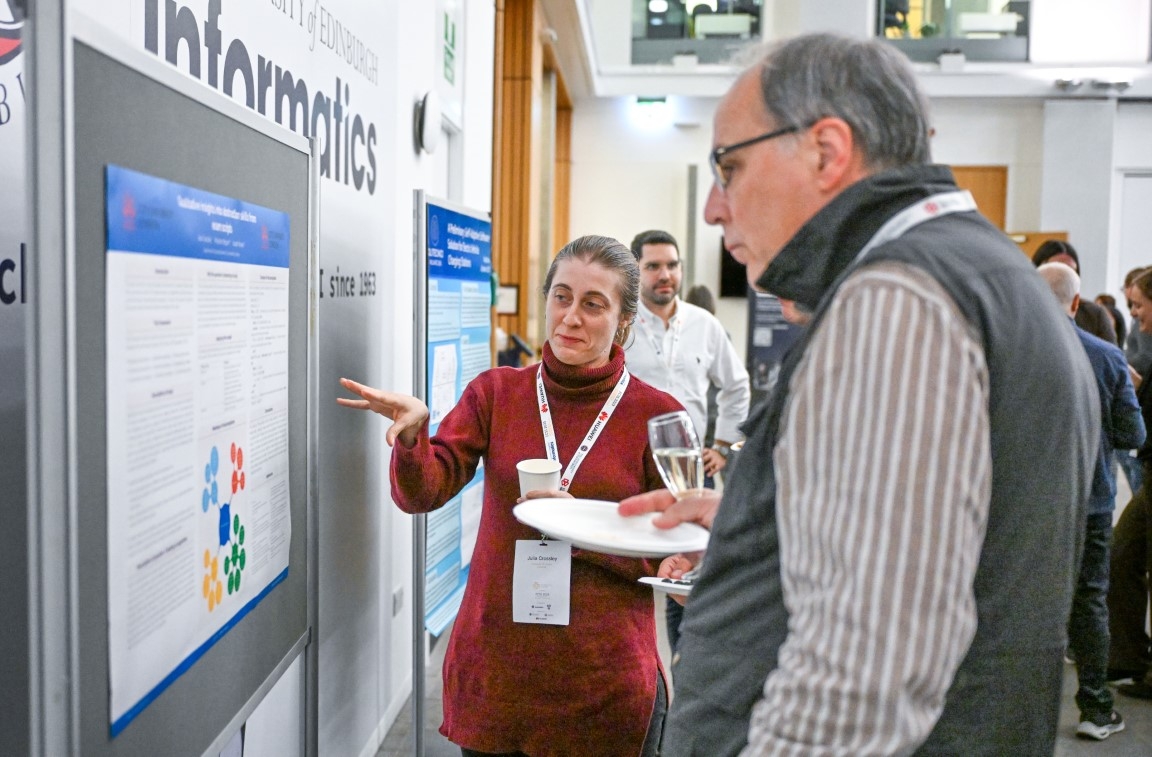
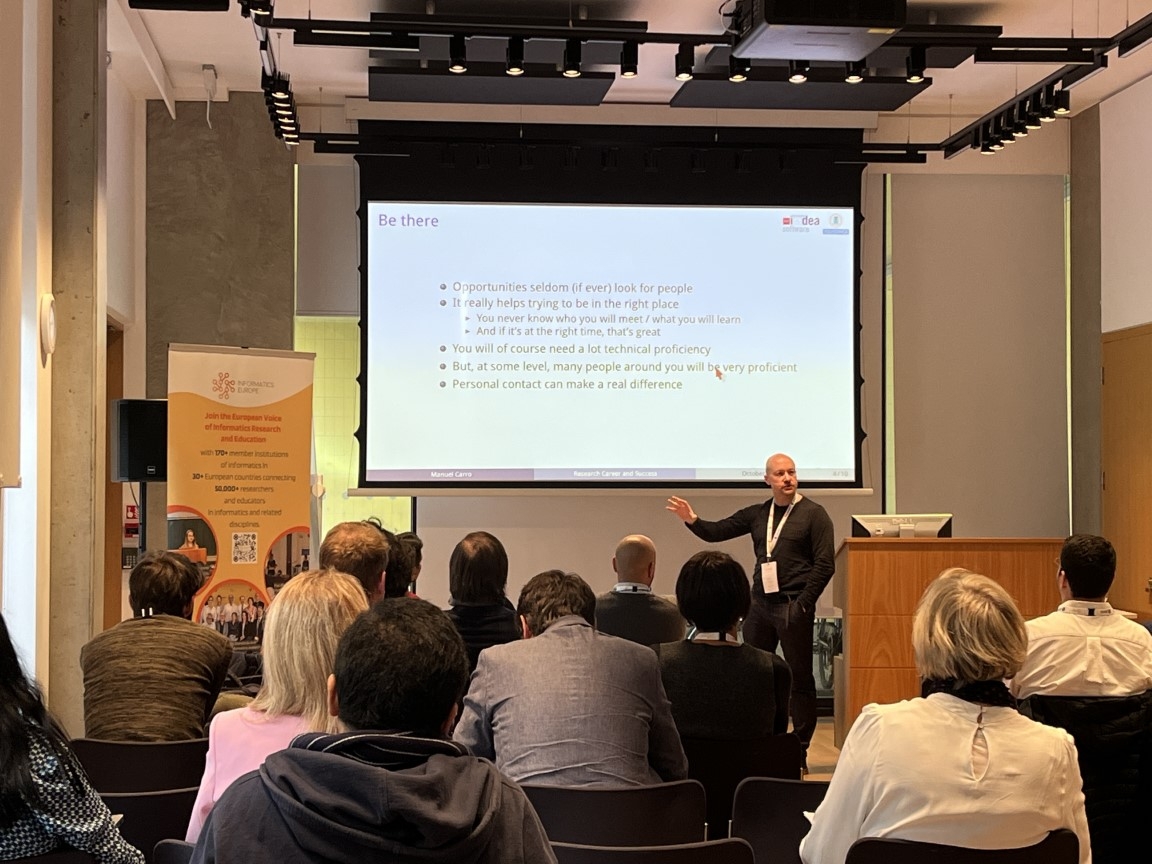
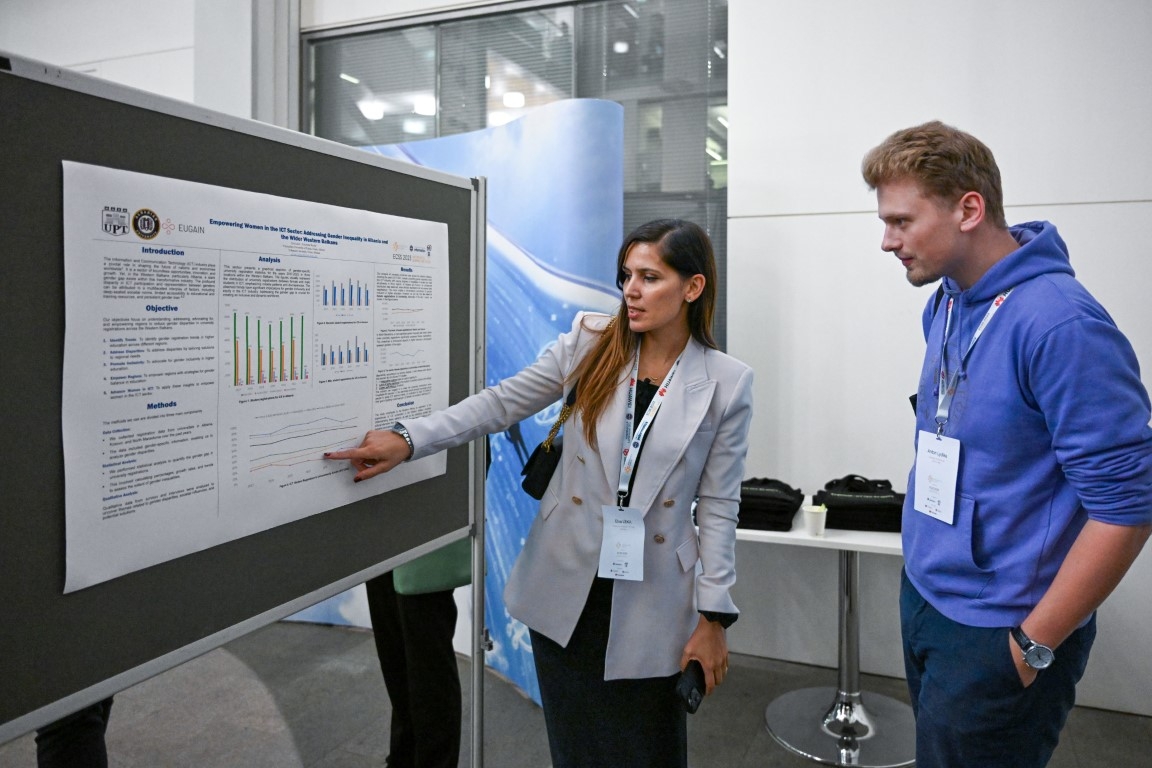
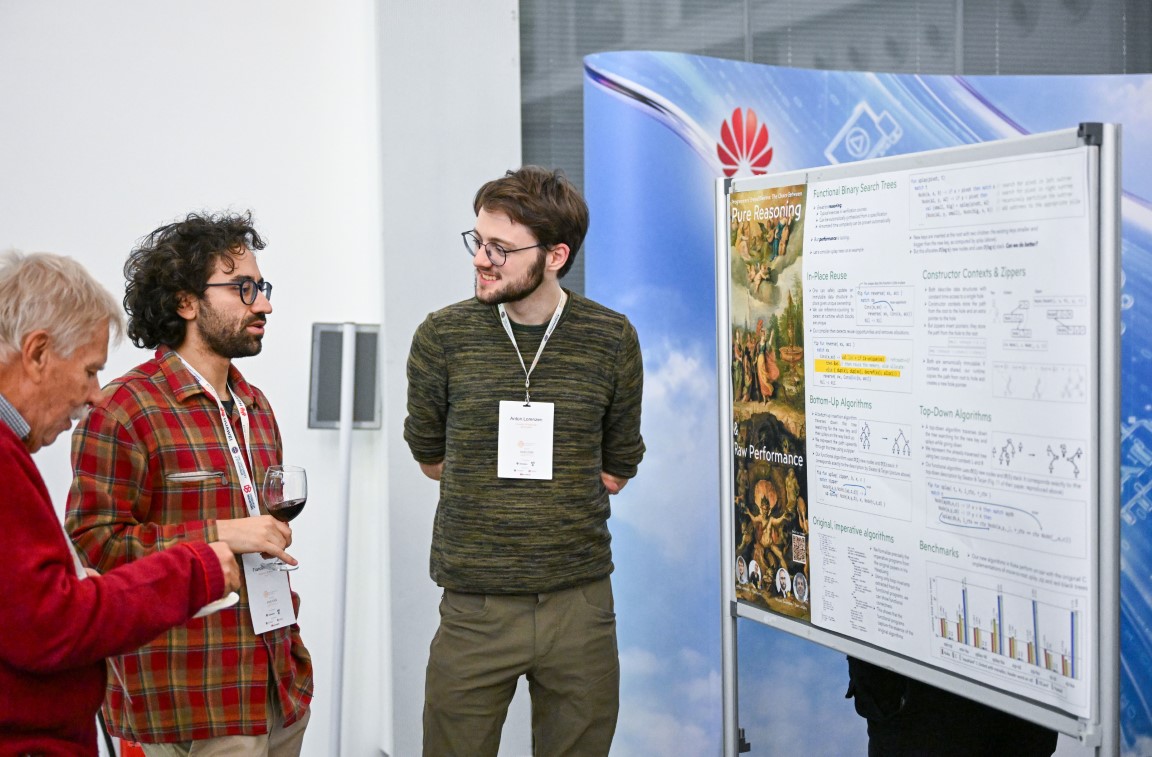
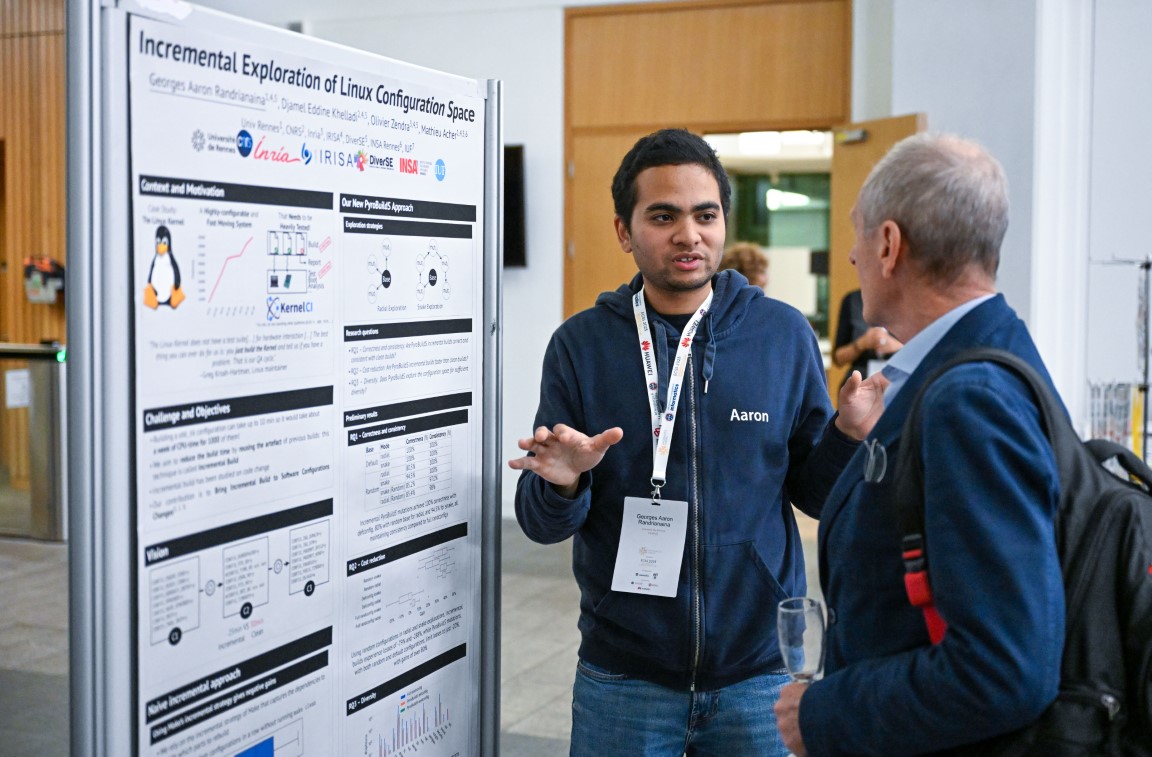
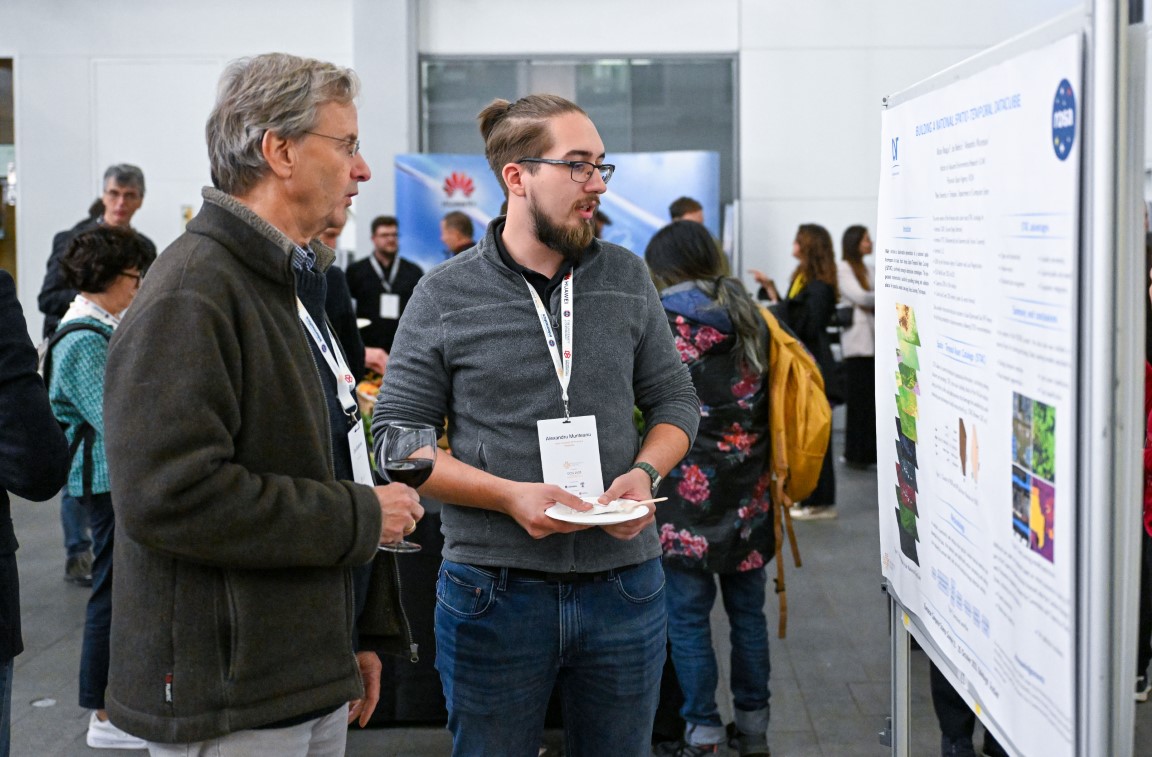
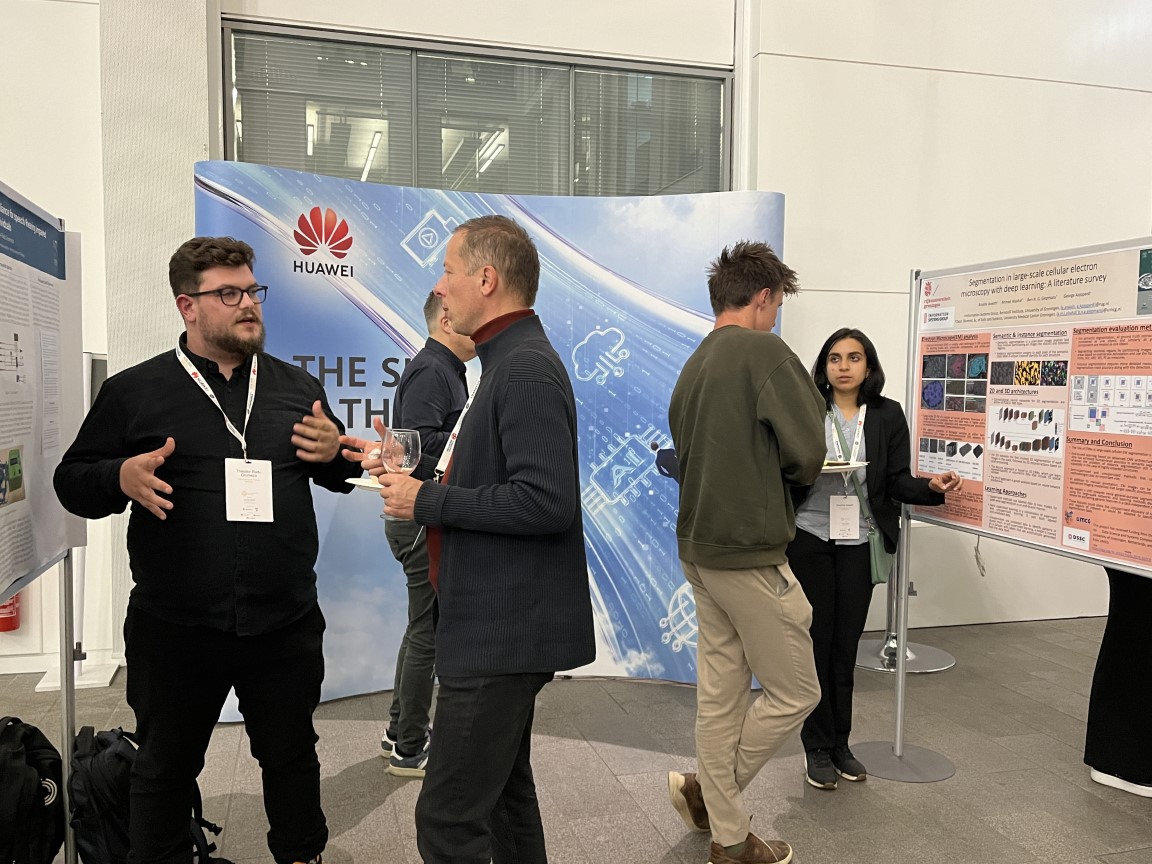
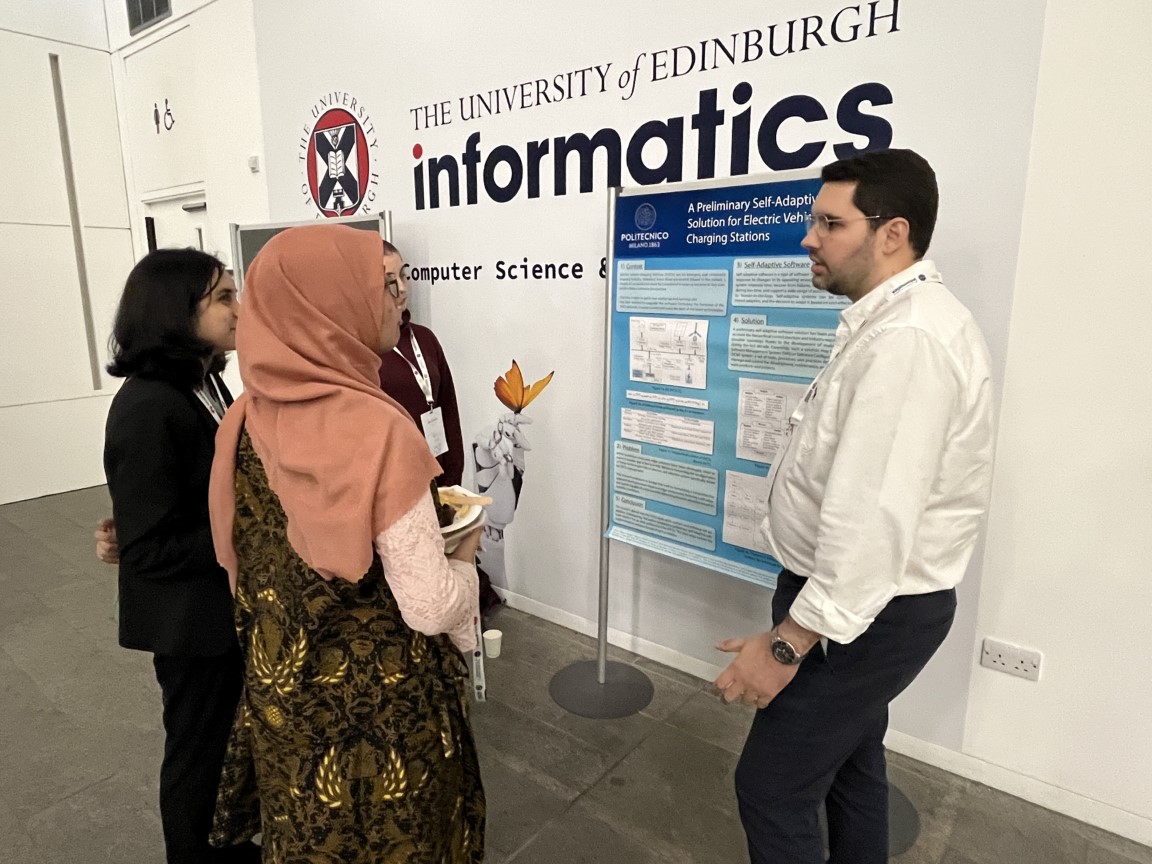
-
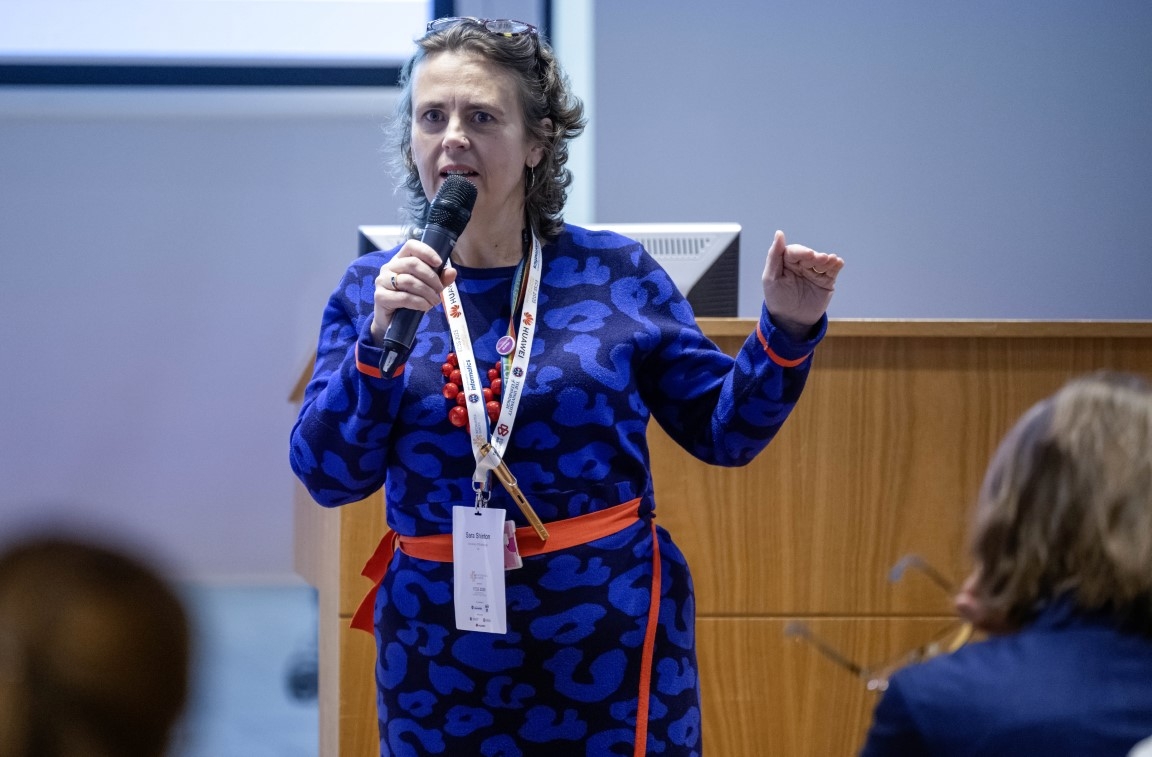
Sara Shinton, University of Edinburgh (UK) on “A Fresh Approach to Research Leadership"
-
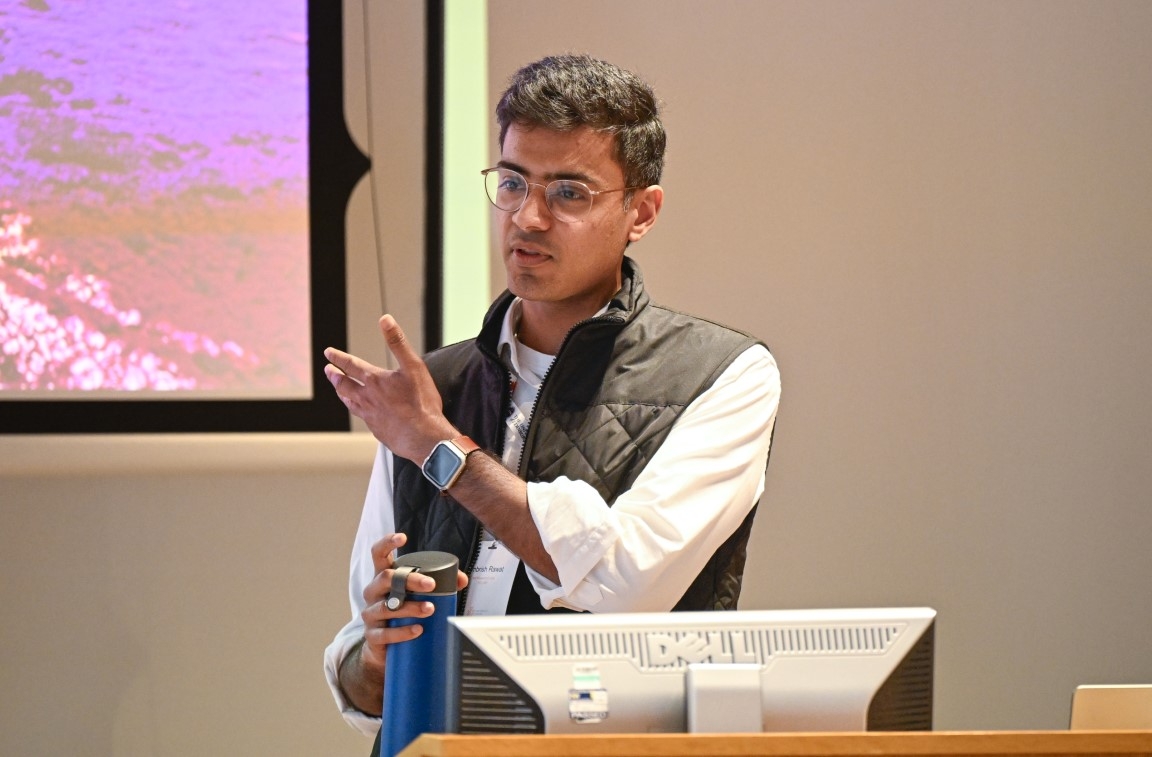
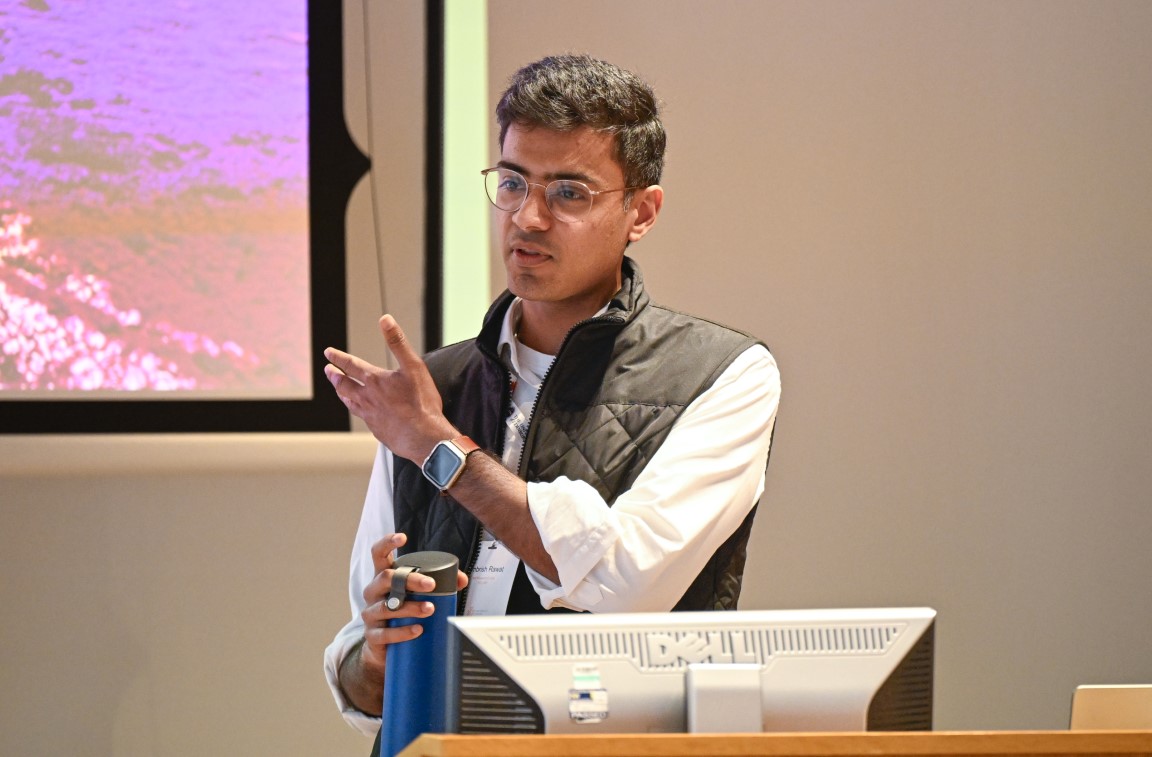
Early Career Researchers Workshop Panelist: Ambrish Rawat, IBM Research Europe (Ireland)
-
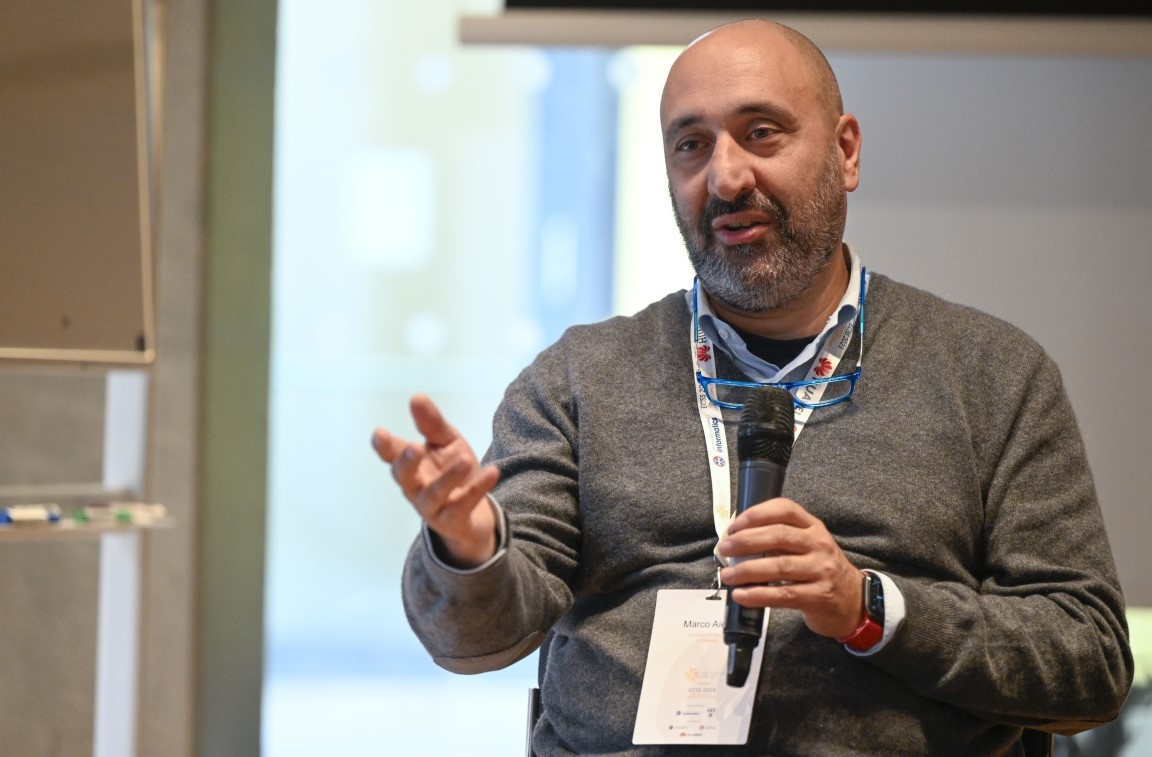
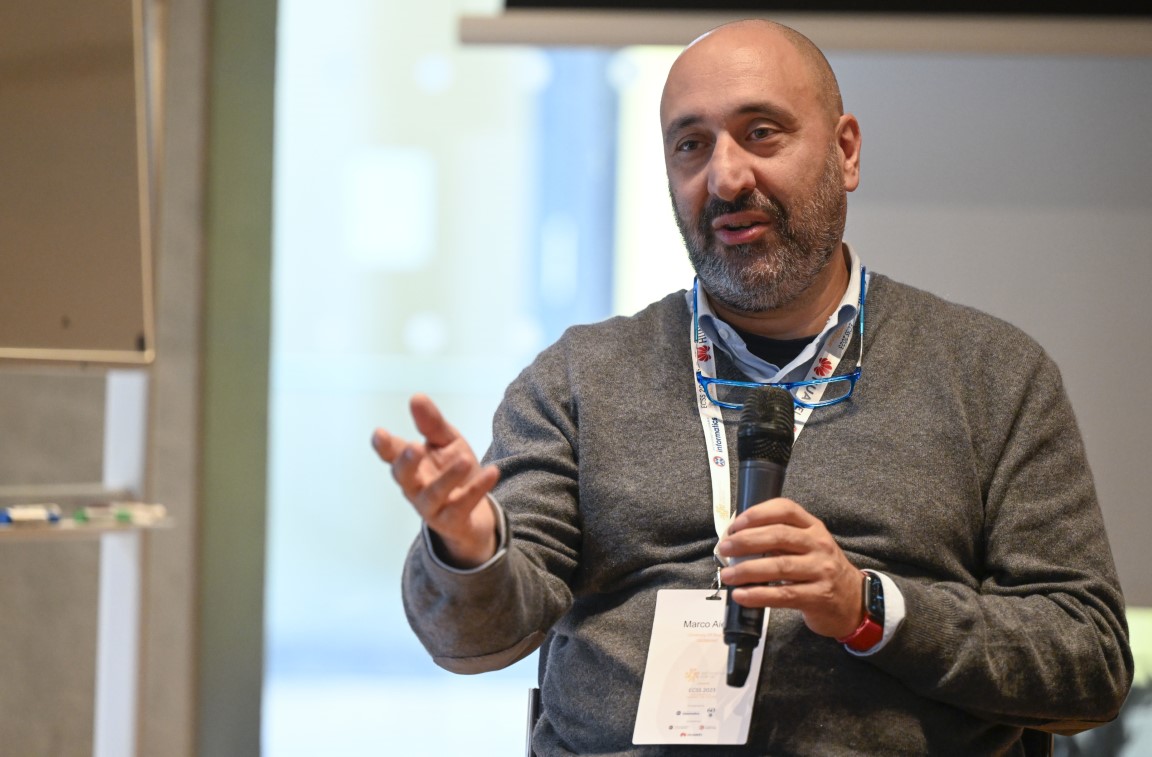
Early Career Researchers Workshop Panelist: Marco Aiello, University of Stuttgart (Germany)
-
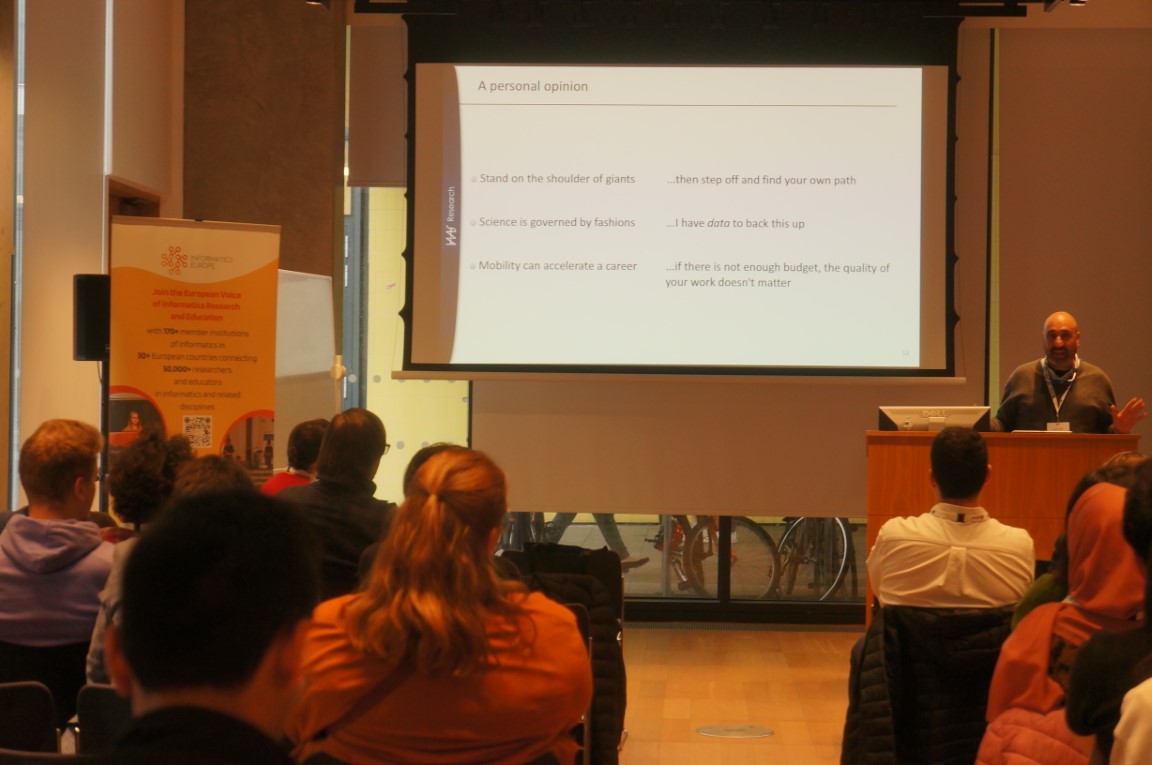
Early Career Researchers Workshop
-
Early Career Researchers Workshop Panelist: Dympna O'Sullivan, TU Dublin (Ireland
-
Early Career Researchers Workshop
-
Early Career Researchers Workshop Panel Discussion
-
Early Career Researchers Workshop Panel Discussion
-
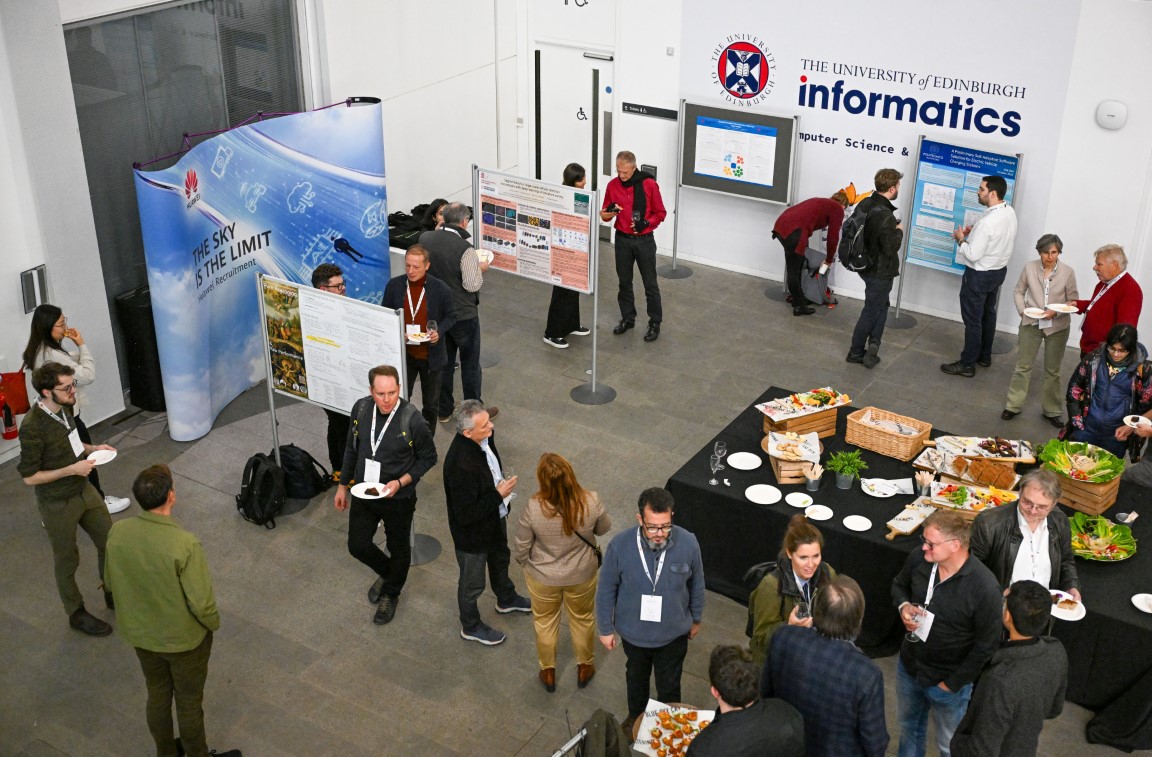
Welcome Cocktail including the Early Career Researchers Poster Session
-
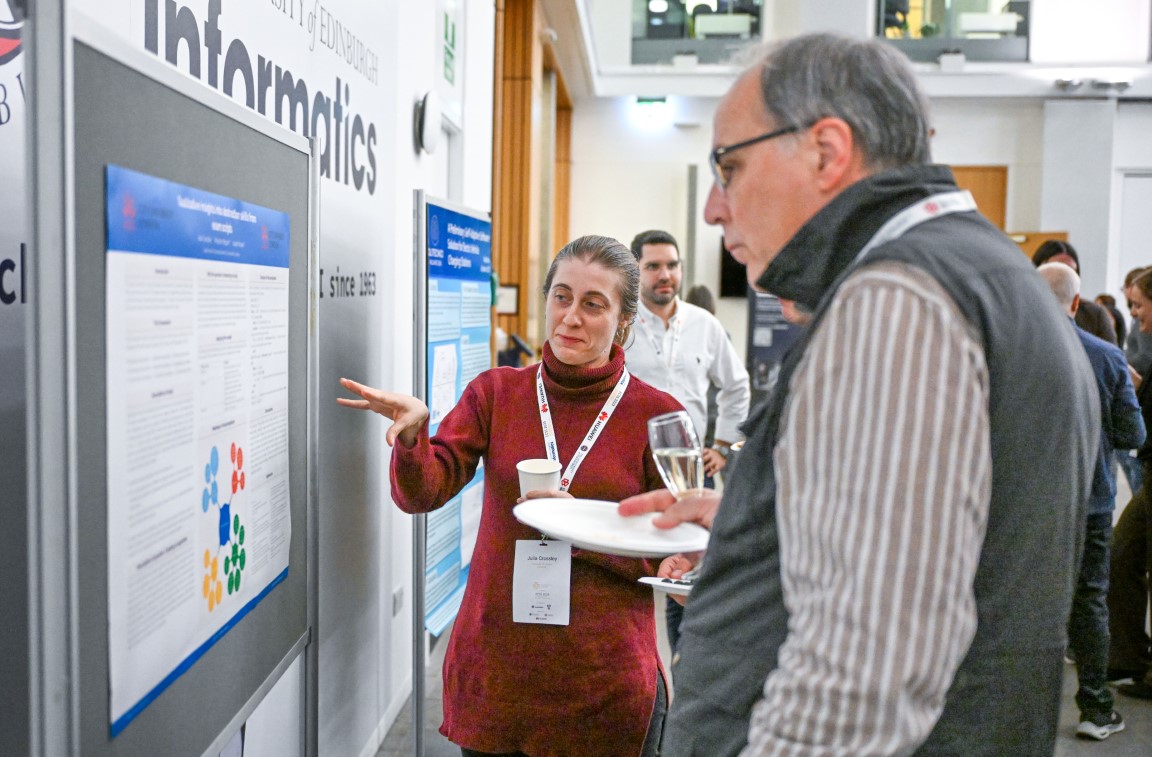
Early Career Researchers Workshop's Poster Session
-
Early Career Researchers Workshop's Poster Session
-
Early Career Researchers Workshop's Poster Session
-
Early Career Researchers Workshop Poster Session
-
Early Career Researchers Workshop Poster Session


AI and the Future of Informatics Education
Informatics Europe annually organises a workshop in collaboration with the National Informatics Associations (NIAs) in Europe. This year it was held on Wednesday, 25 October and chaired by Pekka Orponen, Aalto University (Finland) and Manuel Carro, Technical University of Madrid/IMDEA Software Institute (Spain).
This year’s workshop addressed the effects of the recent developments in AI on the future of informatics education. One of the sessions focused specifically on the impact on the practice of software engineering education, with case studies from our member associations. A second session considered the broader impacts on the Informatics curriculum and educational practices: the shifting balance of core areas, teaching critical thinking and social responsibility, emerging AI-supported tools and their proper use. A third session reviewed the progress of the Open Science initiatives discussed at last year’s ECSS. The workshop was open to all ECSS participants.
Workshop Rundown
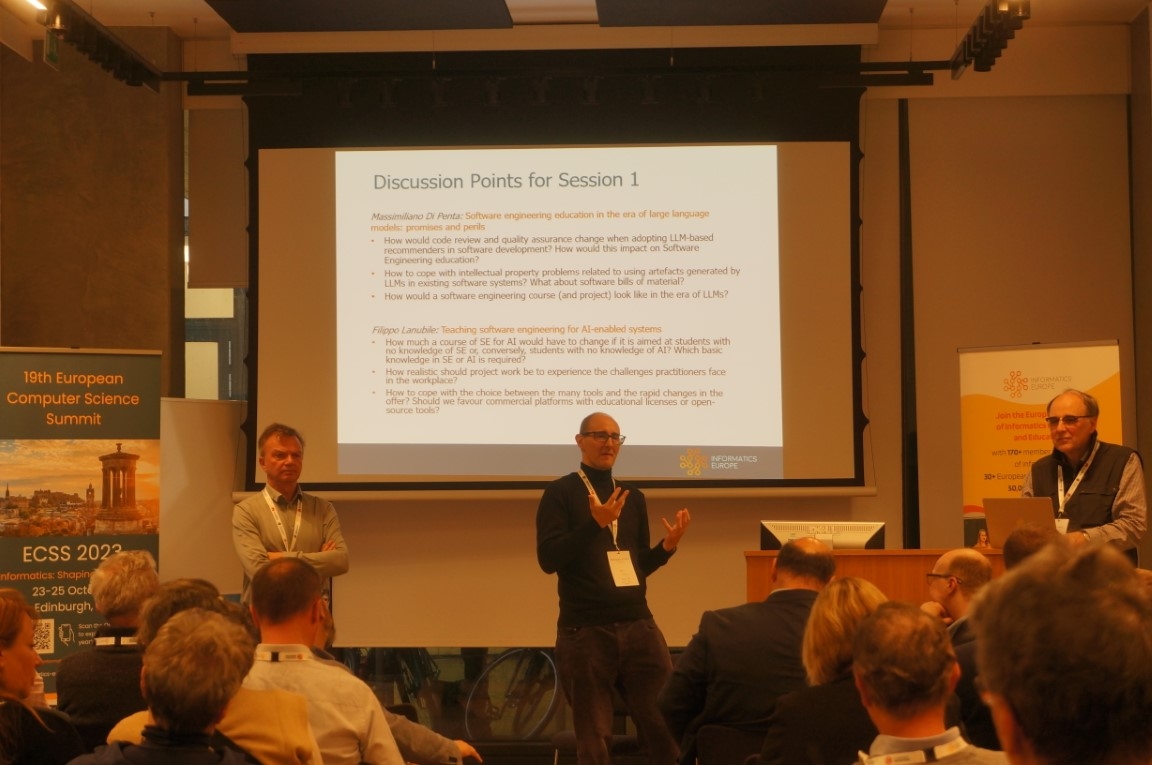
09:00 - 10:30 Session 1: AI and the practice of teaching Software Engineering
- "Software Engineering Education in the Era of Large Language Models: Promises and Perils"
by Massimiliano Di Penta, University of Sannio (Italy) [Slides] - "Teaching software engineering for AI-enabled systems" by Filippo Lanubile, University of Bari (Italy) [Slides]
10:30 - 11:00 Coffee break
11:00 - 12:30 Session 2: The impact of AI on Informatics curricula and educational practices
- "Benefits, risks, and challenges of AI in informatics education" by David López, Scientific Society of Computing of Spain/Universitat Politècnica de Catalunya (Spain) [Slides]
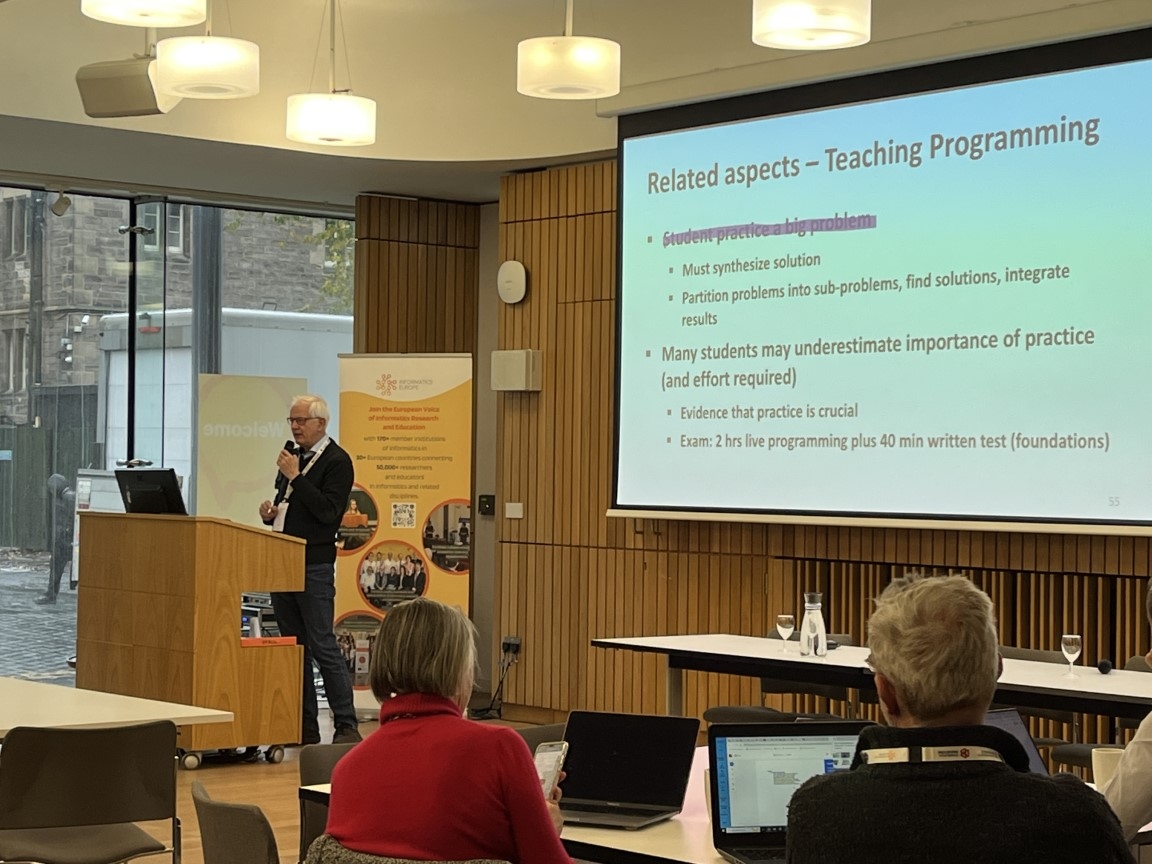
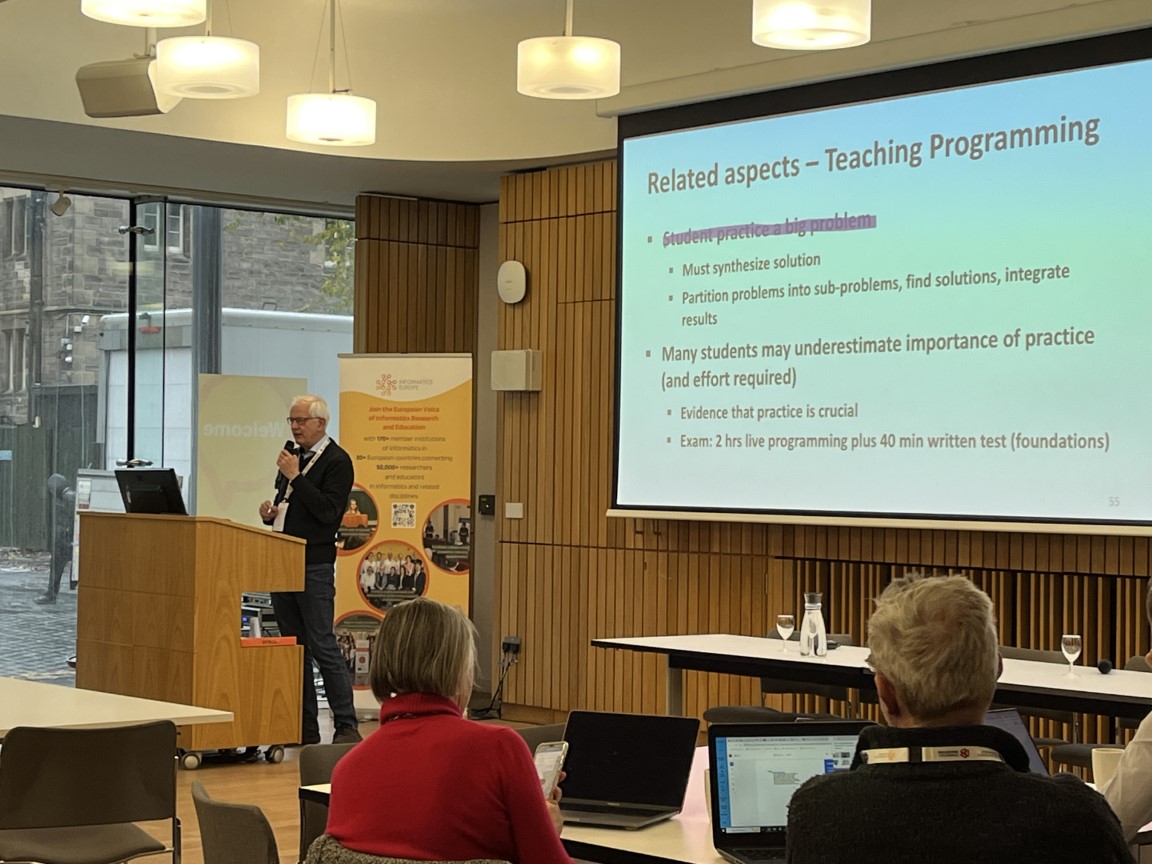
- "Should We Still Teach 'Programming'?" by Thomas Gross, ETH Zurich (Switzerland) [Slides]
12:30 - 14:00 Lunch
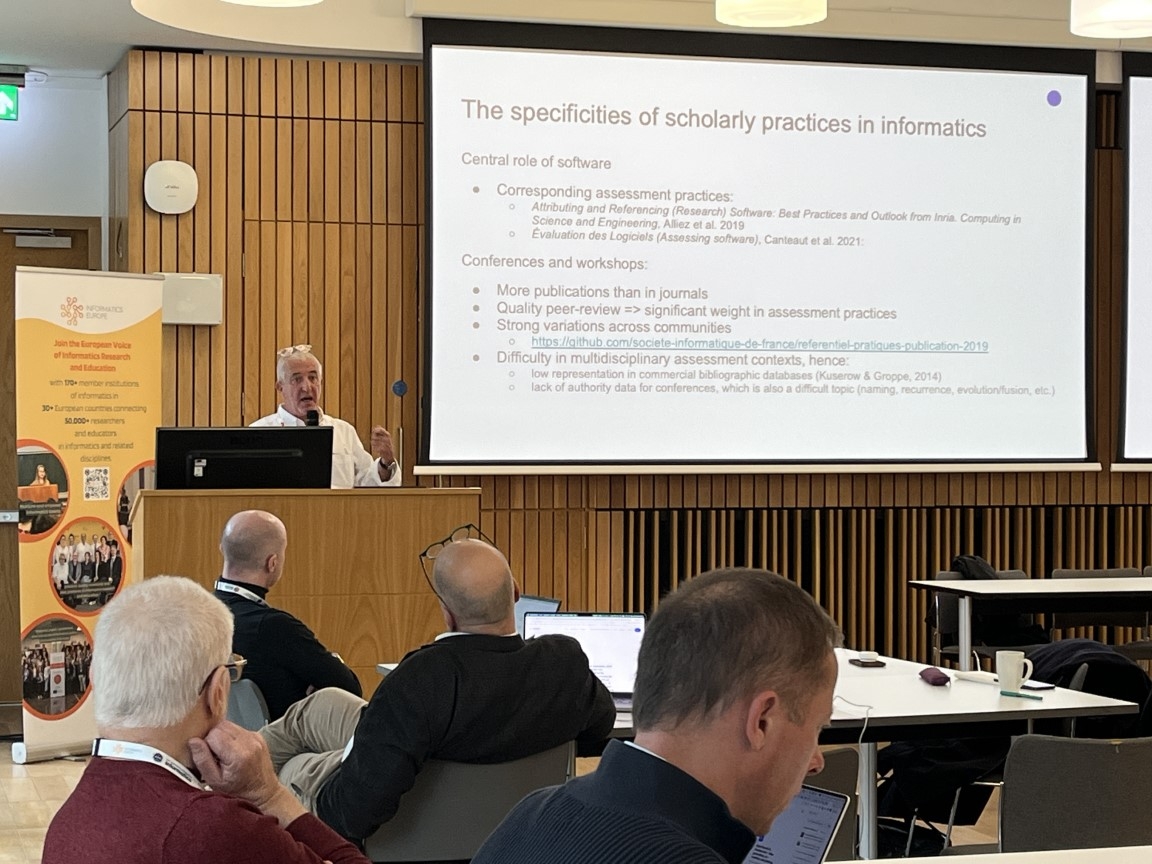
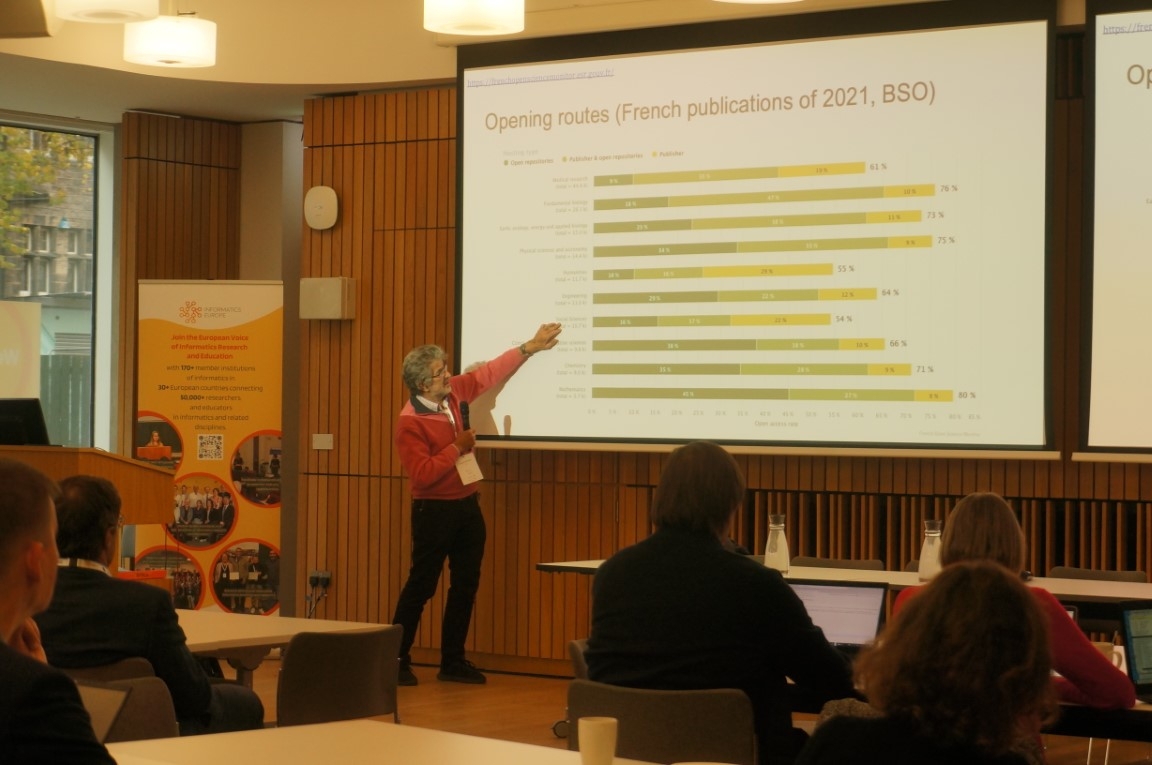
14:00 - 15:30 Session 3: The future of Informatics research evaluation
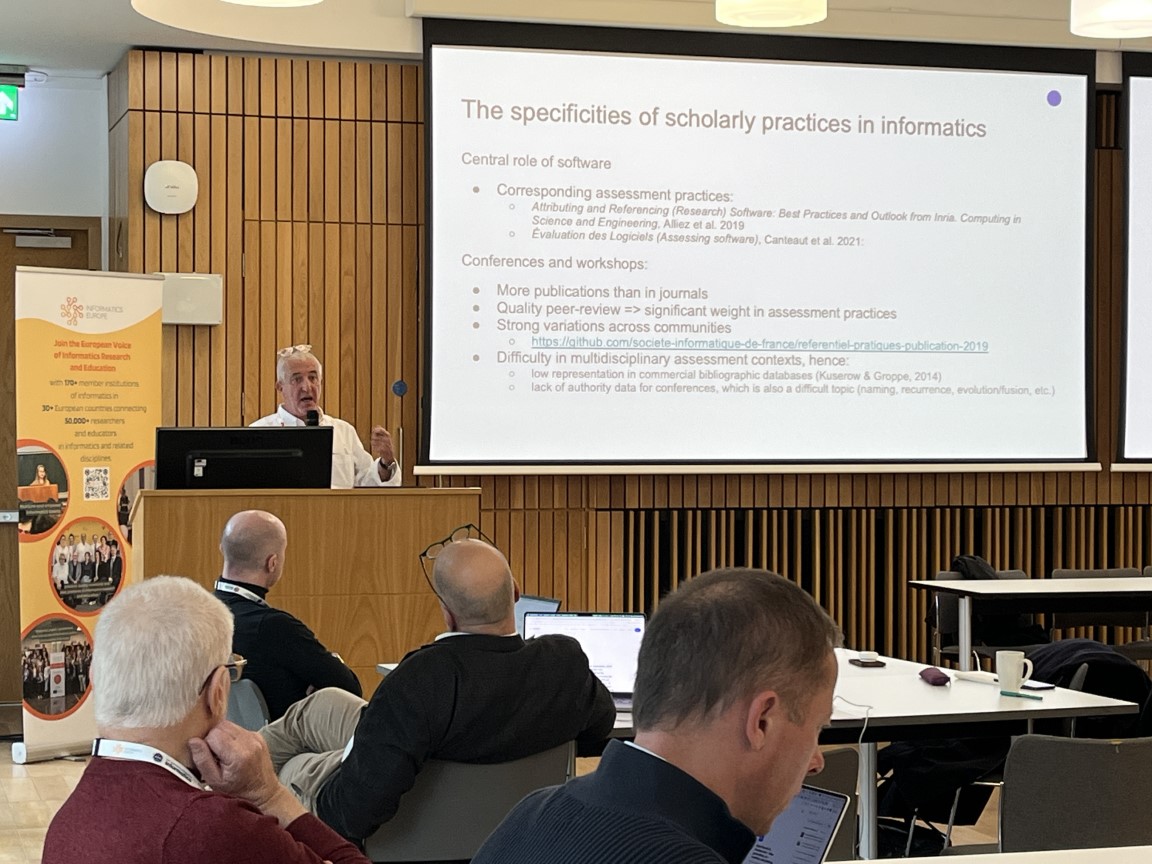
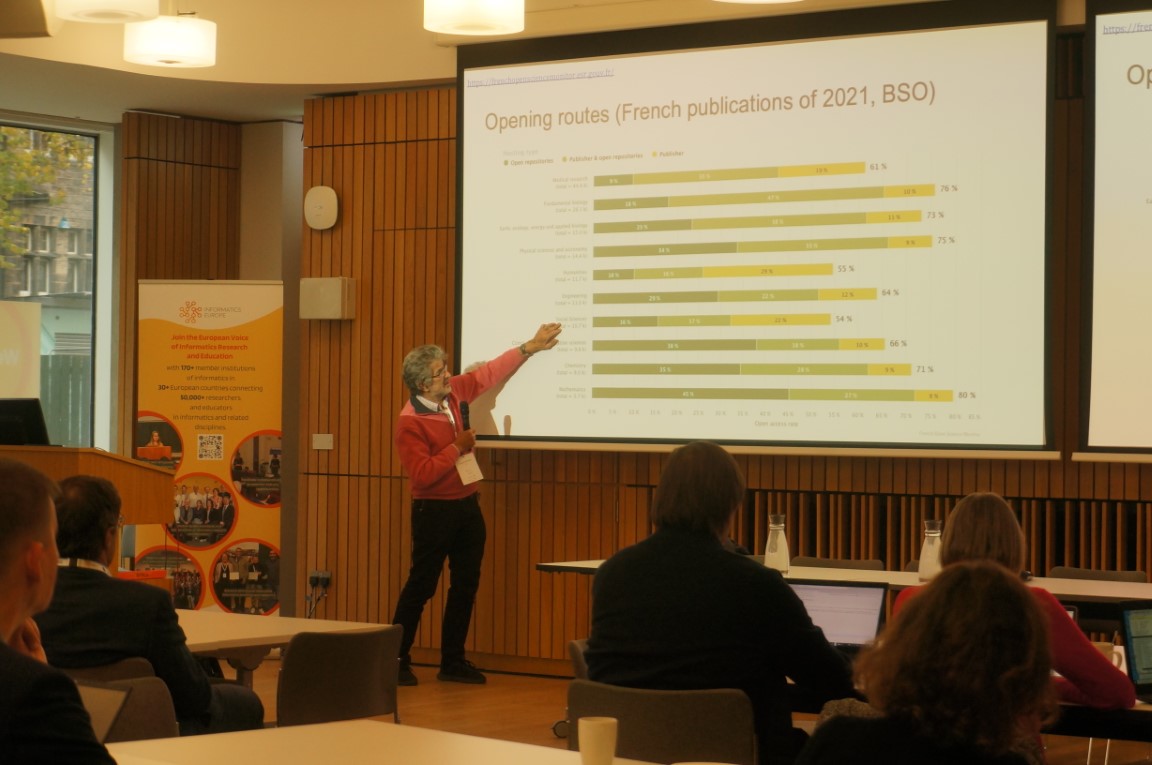
- "Open science and research assessment: Which agenda should the informatics community push forward?"
by Pierre Paradinas, CNAM/SIF (France) & Laurent Romary, Inria (France) [Slides]
15:30 - 16:00 Summary and next steps
Further Readings
-
Angela Fan, Beliz Gokkaya, Mark Harman, Mitya Lyubarskiy, Shubho Sengupta, Shin Yoo, Jie M. Zhang: Large Language Models for Software Engineering: Survey and Open Problems https://doi.org/10.48550/arXiv.2310.03533
-
Xinyi Hou, Yanjie Zhao, Yue Liu, Zhou Yang, Kailong Wang, Li Li, Xiapu Luo, David Lo, John C. Grundy, Haoyu Wang: Large Language Models for Software Engineering: A Systematic Literature Review. https://doi.org/10.48550/arXiv.2308.10620
-
Trevor Stalnaker, Nathan Wintersgill, Oscar Chaparro, Massimiliano Di Penta, Daniel M. Germán, Denys Poshyvanyk: BOMs Away! Inside the Minds of Stakeholders: A Comprehensive Study of Bills of Materials for Software Systems. CoRR abs/2309.12206 (2023) (to appear at ICSE 2024) https://doi.org/10.48550/arXiv.2309.12206
Provided by Filippo Lanubile for Session 1:
- D. Sculley, et al. (2015). Hidden technical debt in machine learning systems. Advances in neural information processing systems, 28. https://proceedings.neurips.cc/paper_files/paper/2015/hash/86df7dcfd896fcaf2674f757a2463eba-Abstract.html
- A. Saleema, et al. “Software engineering for machine learning: A case study.” Int. Conf. on Software Engineering (ICSE), 2019. https://doi.org/10.1109/ICSE-SEIP.2019.00042
- C. Kästner and E. Kang, "Teaching software engineering for Al-enabled systems", 2020 IEEE/ACM 42nd International Conference on Software Engineering: Software Engineering Education and Training (ICSESEET), pp. 45-48, 2020. https://doi.org/10.1145/3377814.3381714
- F. Lanubile, S. Martínez-Fernández and L. Quaranta, "Teaching MLOps in Higher Education through Project-Based Learning," 2023 IEEE/ACM 45th International Conference on Software Engineering: Software Engineering Education and Training (ICSE-SEET), Melbourne, Australia, 2023, pp. 95-100, https://doi.org/10.1109/ICSE-SEET58685.2023.00015
Provided by David López for Session 2:
- F.J. García-Peñalvo, F. Llorens-Largo, and J. Vidal. (2024). The new reality of education in the face of advances in generative artificial intelligence. RIED-Revista Iberoamericana de Educación a Distancia, 27(1). Online first: https://revistas.uned.es/index.php/ried/article/view/37716/27914
- T. Wang and E. C. K. Cheng, "An investigation of barriers to Hong Kong K-12 schools incorporating Artificial Intelligence in education," Computers and Education: Artificial Intelligence, vol. 2, art. 100031, 2021. doi: 10.1016/j.caeai.2021.10003
Workshop Discussion Points
-
How would code review and quality assurance change when adopting LLM-based recommenders in software development? How would this impact on Software Engineering education?
-
How to cope with intellectual property problems related to using artefacts generated by LLMs in existing software systems? What about software bills of material?
-
How a software engineering course (and project) would look like in the era of LLMs?
Suggested by Filippo Lanubile for his talk "Teaching software engineering for AI-enabled systems" in Session 1:
-
How much a course of SE for AI would have to change if it is aimed at students with no knowledge of SE or, conversely, students with no knowledge of AI? Which basic knowledge in SE or AI is required?
-
How realistic should project work be to experience the challenges practitioners face in the workplace?
-
How to cope with the choice between the many tools and the rapid changes in the offer? Should we favour commercial platforms with educational licenses or open-source tools?
To be covered by David López for his talk "Benefits, risks, and challenges of AI in informatics education" in Session 2:
-
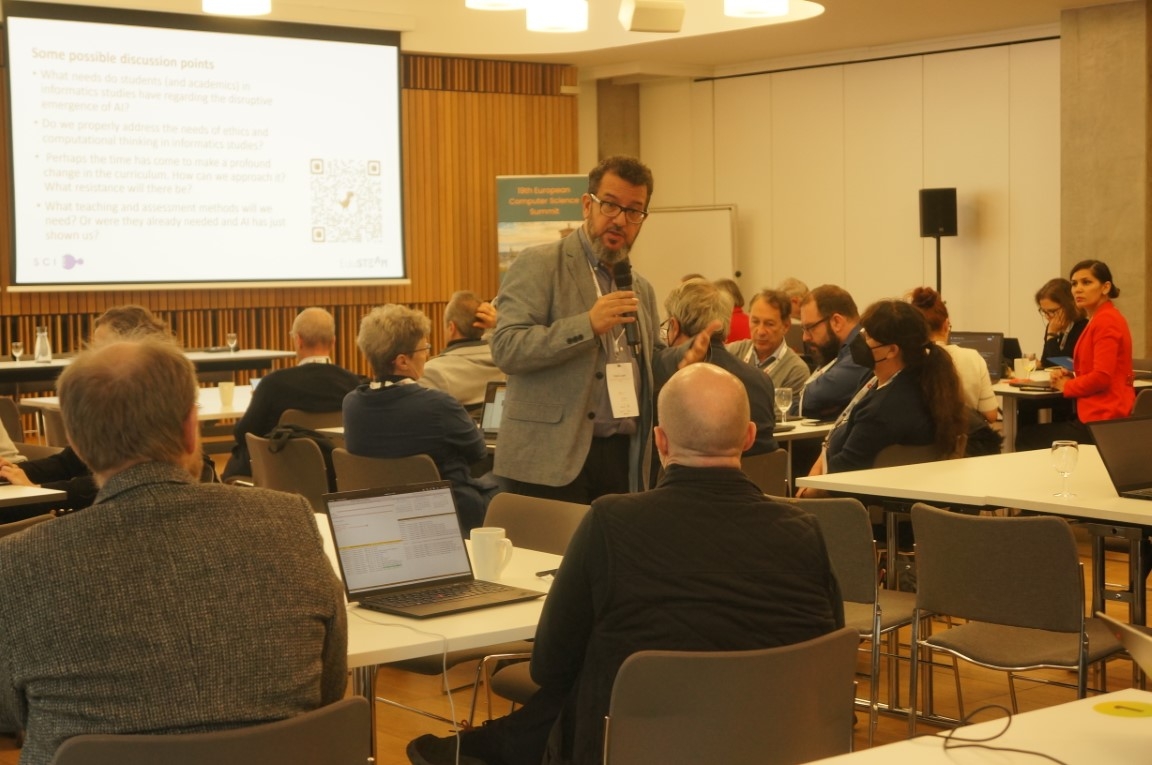
What needs do students (and academics) in informatics studies have regarding the disruptive emergence of AI?
-
Do we properly address the needs of ethics and computational thinking in informatics studies?
-
Perhaps the time has come to make a profound change in the curriculum. How can we approach it? What resistance will there be?
-
What teaching and assessment methods will we need? Or were they already needed and AI has just shown us?
- See full presentation abstract here.
*Please note that the photos below are better viewed when applying zoom out.
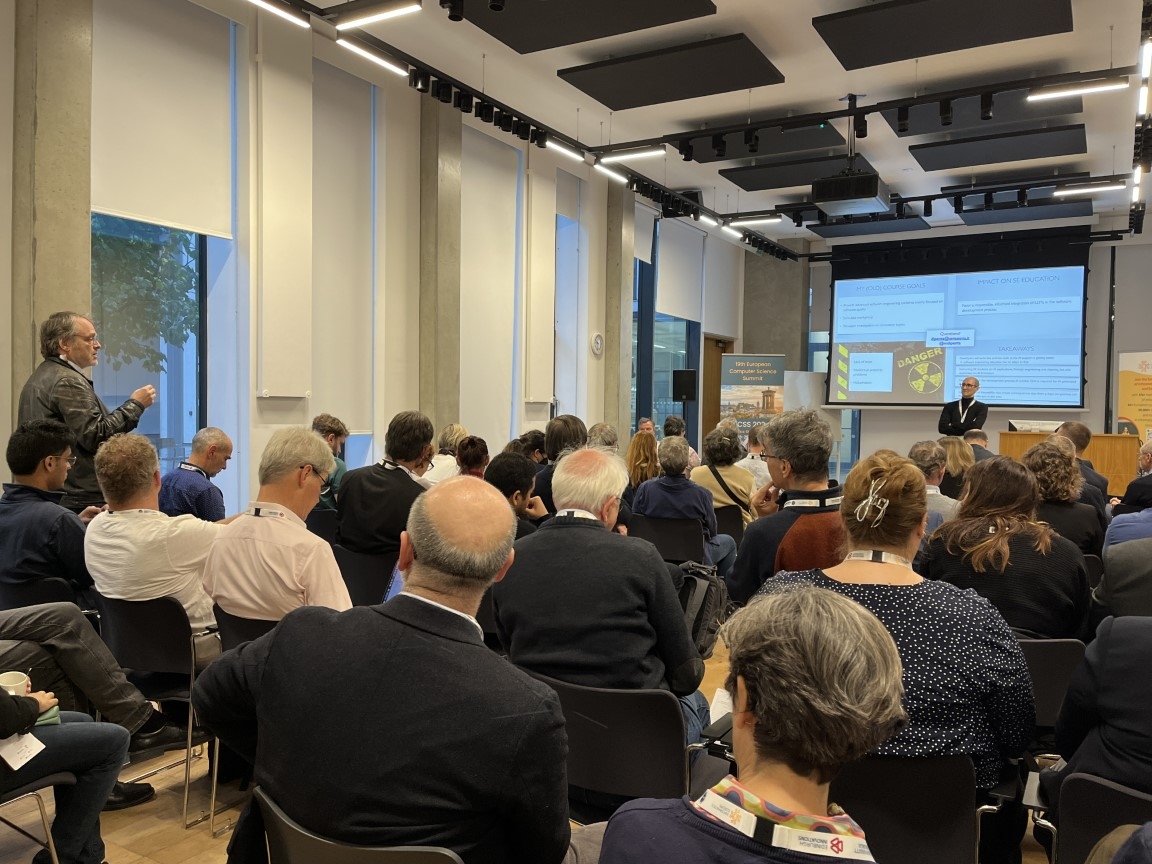
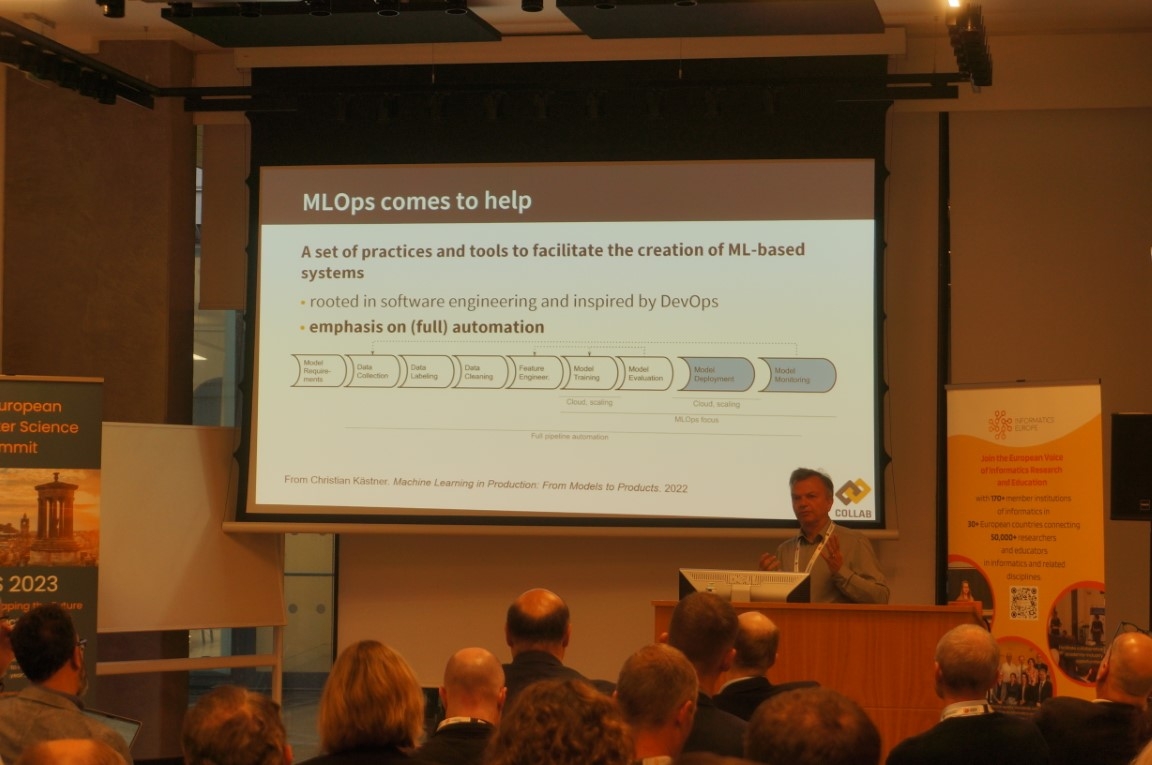
-
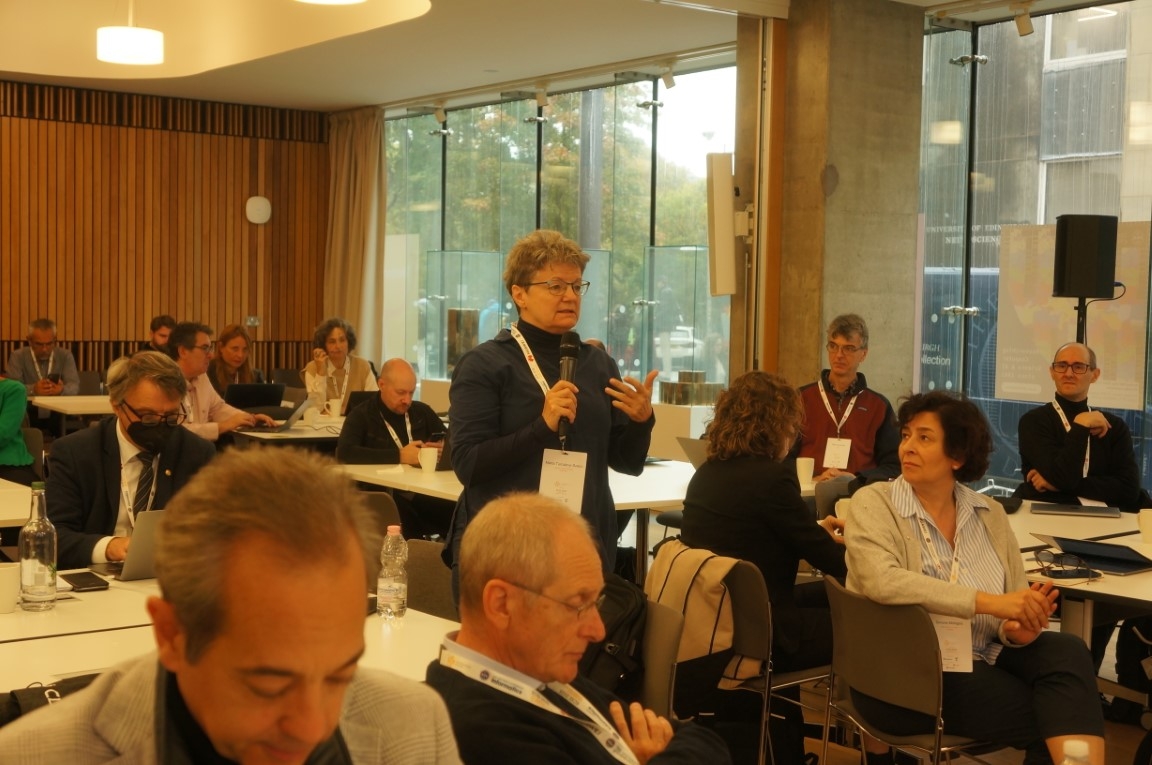
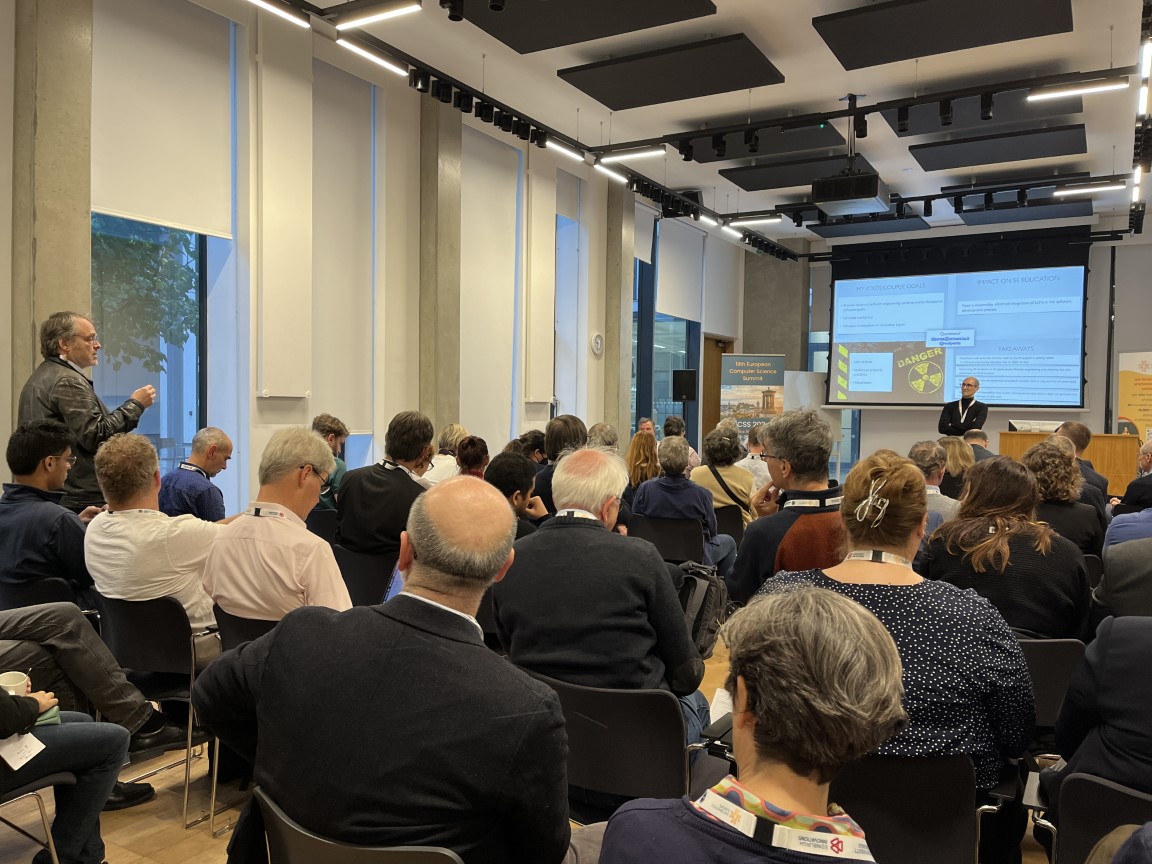
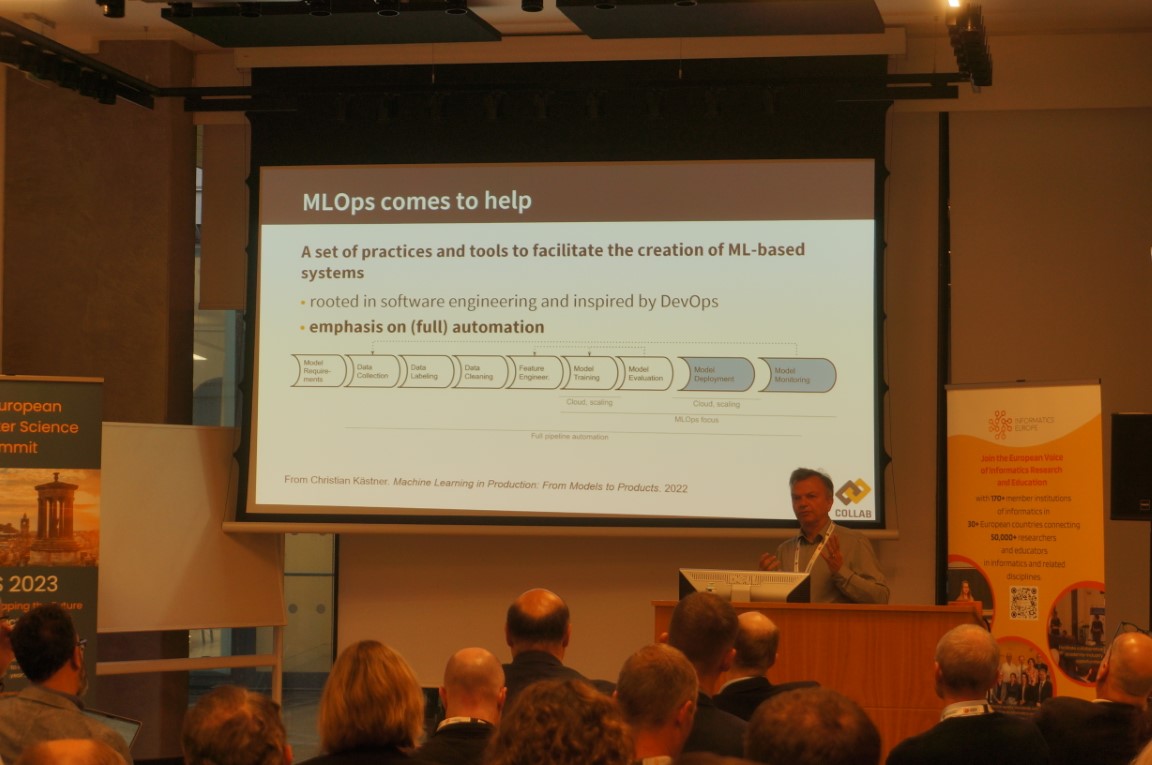
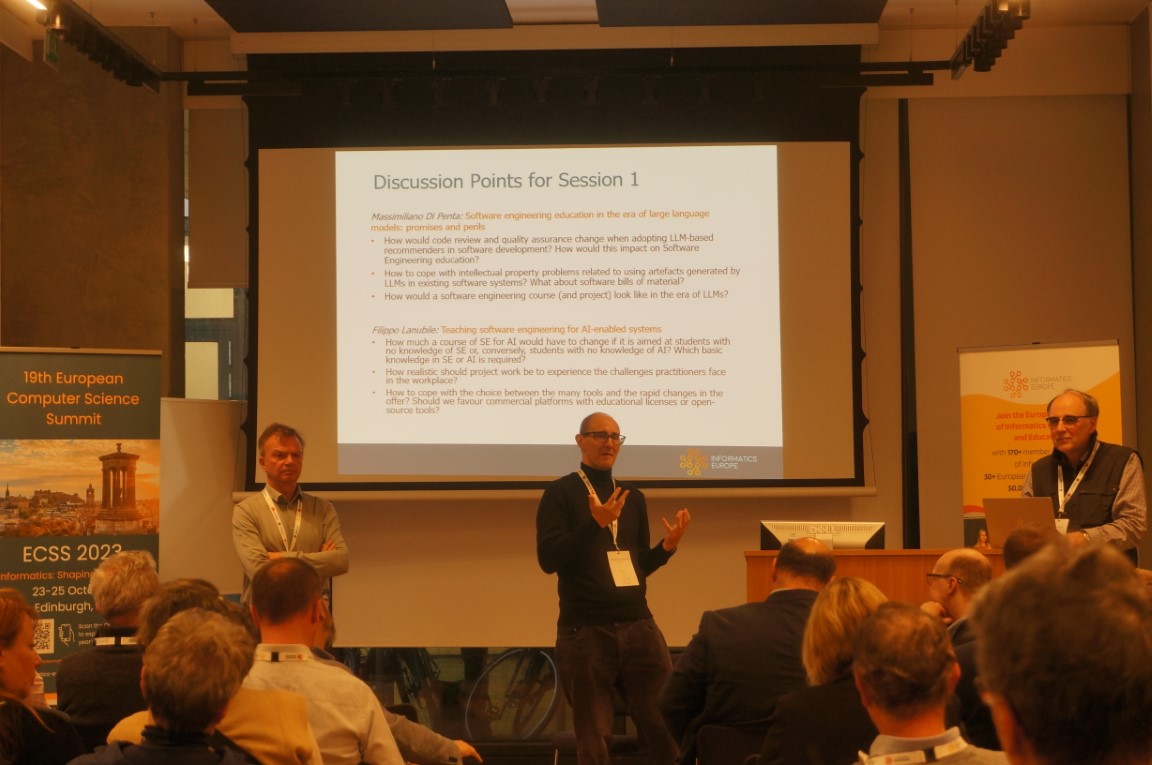
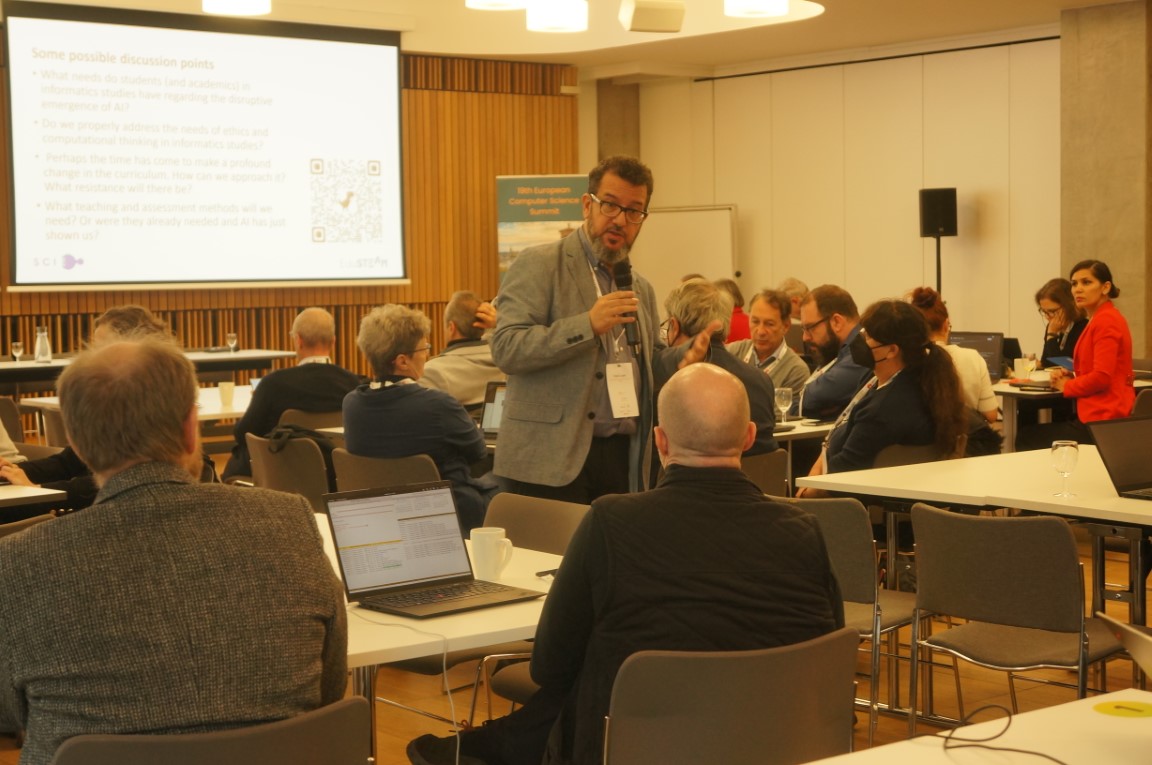
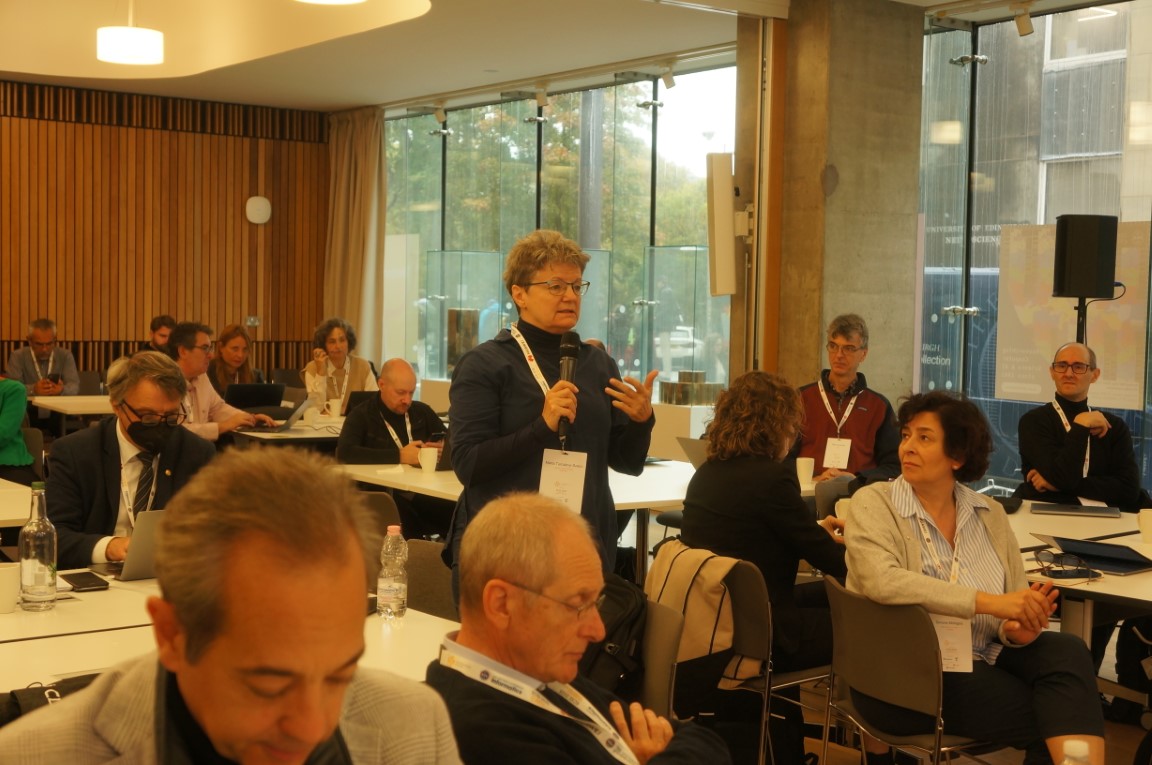
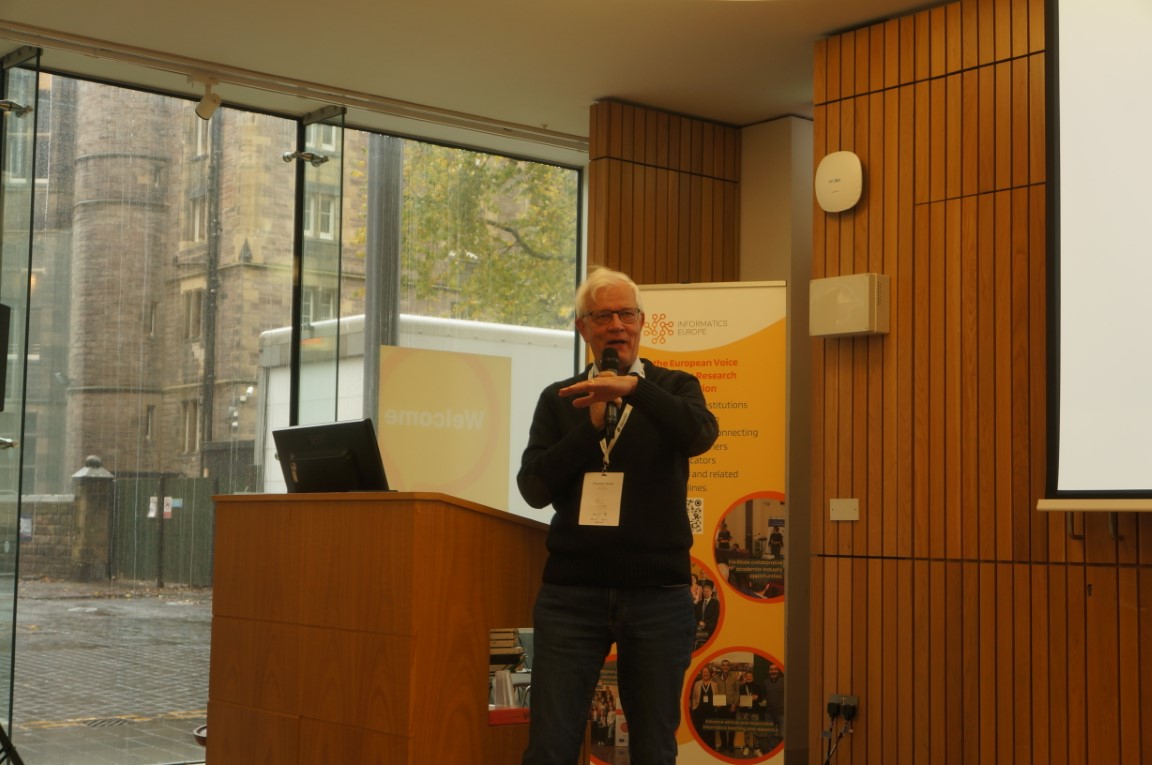
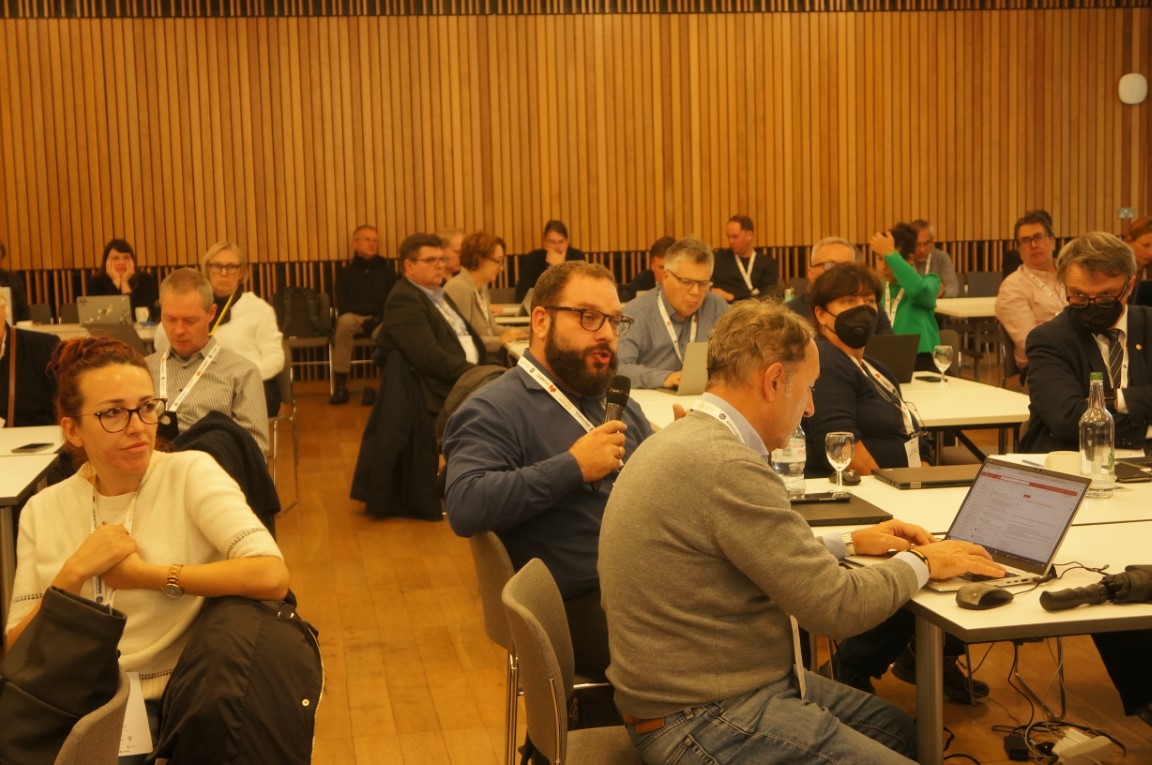
AI and the Future of Informatics Education Workshop
-
Filippo Lanubile, University of Bari, Italy
-
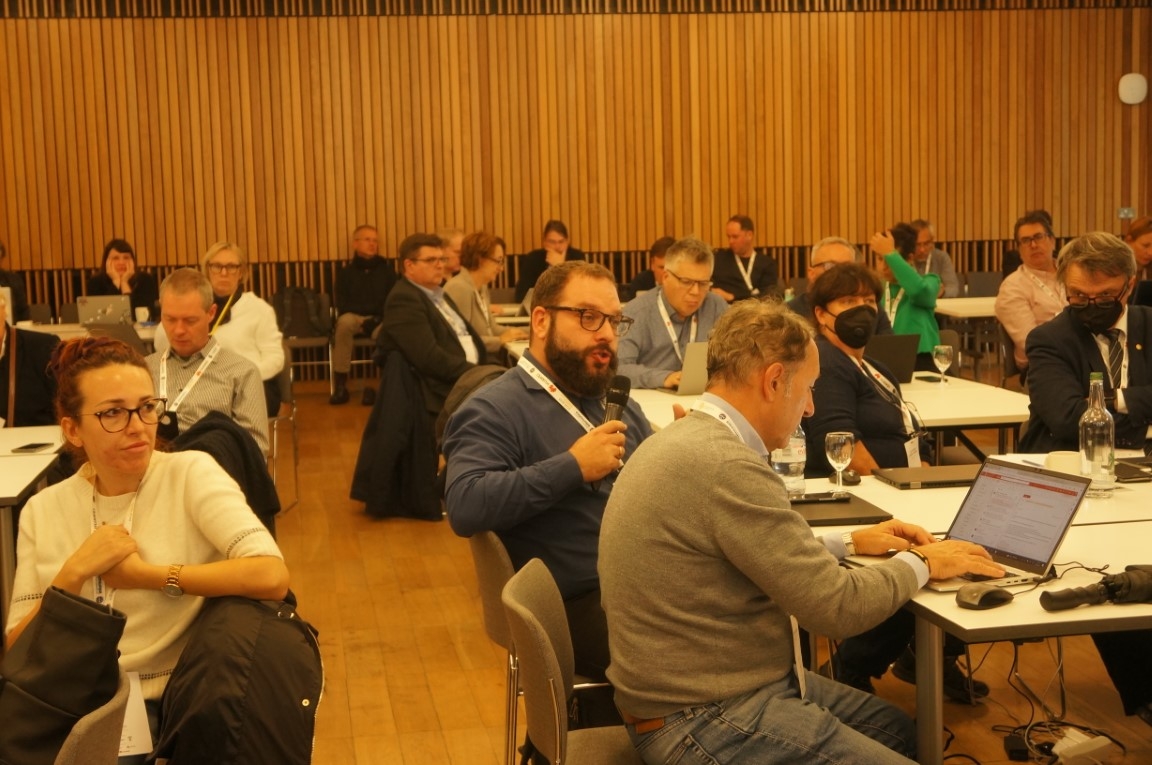
Discussion Session of "AI and the practice of teaching Software Engineering"
-
"The impact of AI on Informatics curricula and educational practices" Session
-
AI and the Future of Informatics Education Workshop
-
AI and the Future of Informatics Education Workshop
-
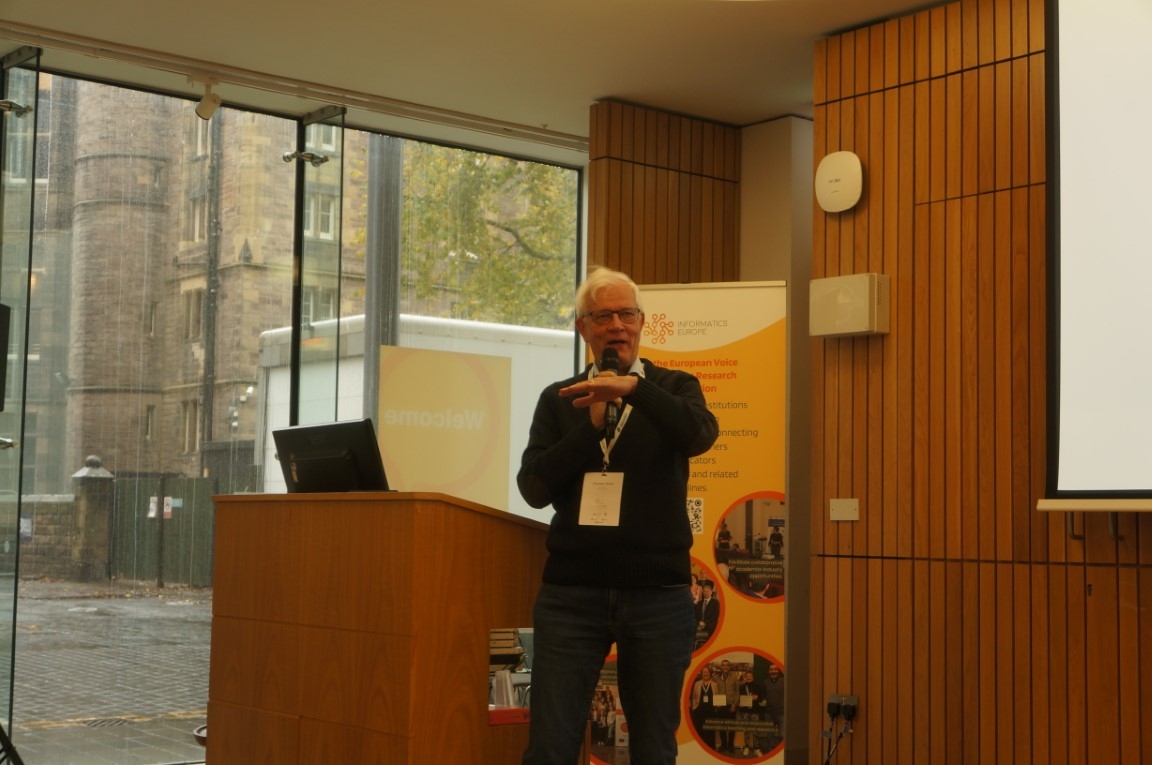
Thomas Gross, ETH Zurich, Switzerland
-
AI and the Future of Informatics Education Workshop
-
Pierre Paradinas, CNAM/SIF, France
-
Laurent Romary, Inria, France
-
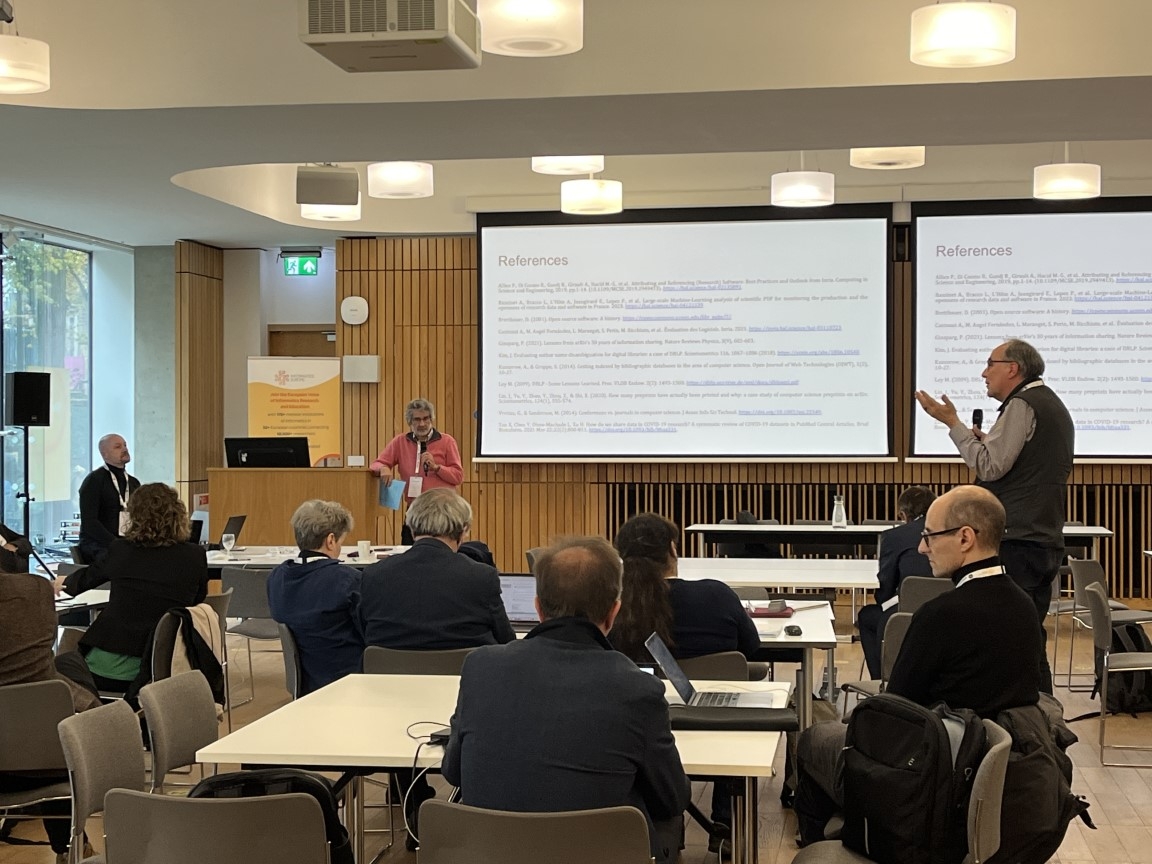
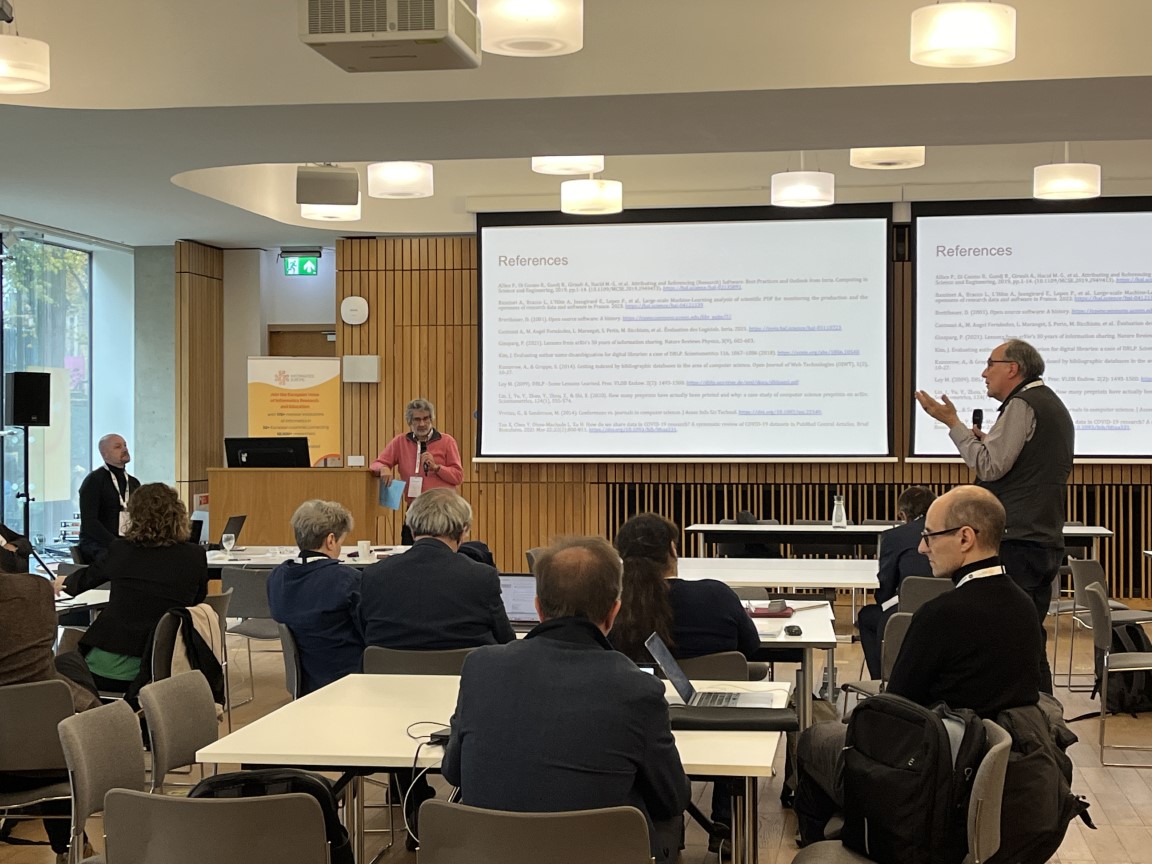
Discussion Session on "The future of Informatics research evaluation"


ECSS 2025 is organised by
 |
 |
Sponsored by
 |
 |
 |
 |
|
 |
  |
 |
Support ECSS
What's New
ECSS 2025, 27-29 Oct, Rennes. France
Save the dates for ECSS 2026:
26-28 Oct in Porto, Portugal



 Netlogica