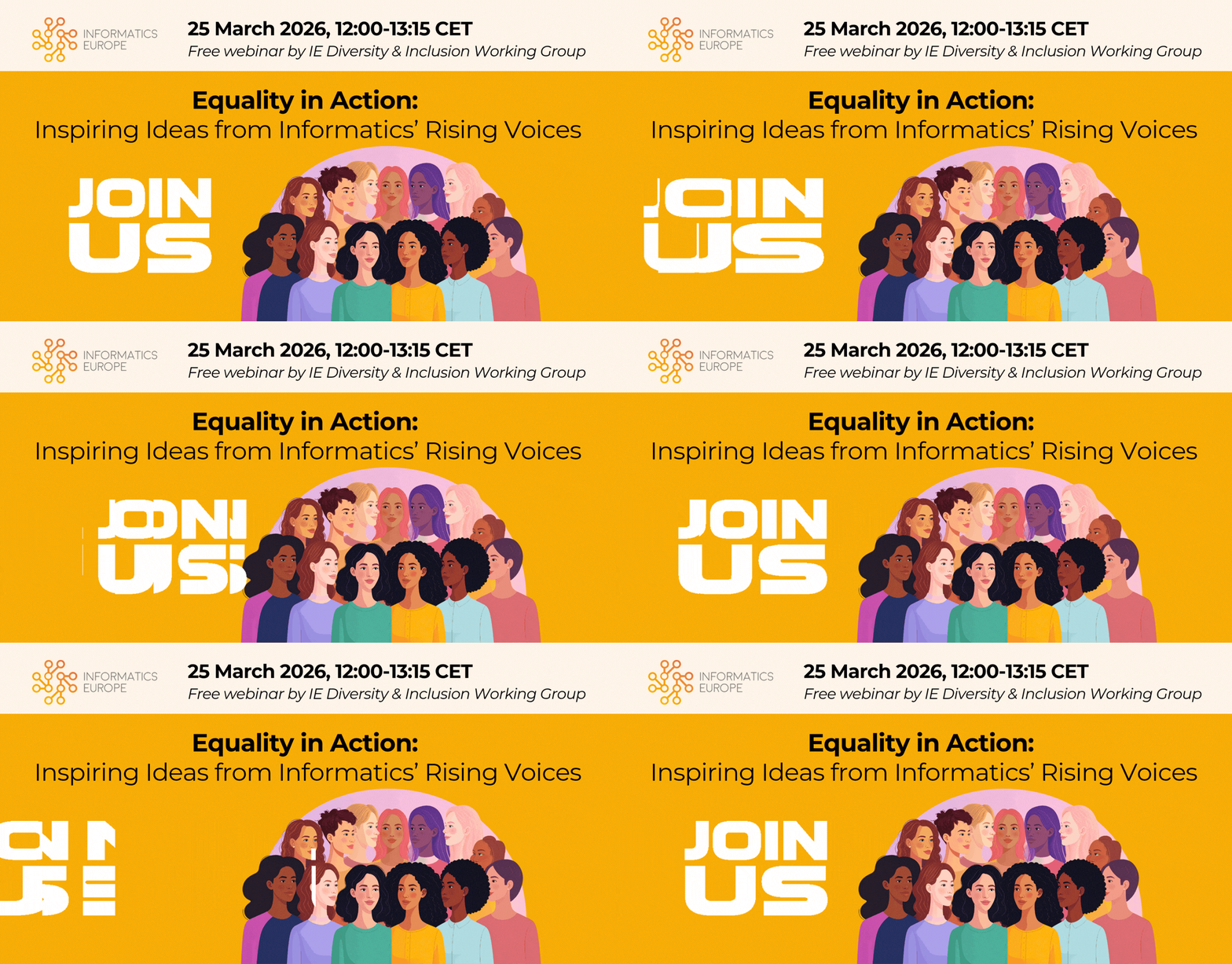
IE’s Diversity and Inclusion Working Group invites you to our webinar, “Equality in Action: Inspiring Ideas from Informatics’ Rising Voices”.
When: 25 March 2026, 12:00-13:15 CET
How: via Zoom (no registration required)
At Informatics Europe, promoting gender equality in Informatics is one of our core priorities. We are pleased to invite three early-career researchers to our webinar, showcasing how the young generation tackles gender gaps in the discipline:
- TechMate: A Best Practice Toolkit for Gender Quality in Computing Education by Alina Berry (TU Dublin)
Abstract: Women remain underrepresented in computing higher education globally, yet the research evidence on effective interventions is scattered across publications, reports, and grey literature — leaving educators without a practical, accessible starting point for action. This talk presents TechMate, an open-access web-based toolkit that consolidates over 25 research-driven gender equality initiatives into discrete, actionable guidance for computing educators, programme leaders, and diversity champions.
The talk will cover how TechMate organises initiatives across four strands — Policy, Pedagogy, Influence & Support, and Promotion & Engagement — which are presented with implementation guidance, supporting evidence, case studies, and ready-to-use resources. It will demonstrate how educators can discover and select relevant initiatives based on their interest, preference and context. - Who Builds Open Source? Measuring Women’s Participation in Key Roles by Monica Homescu (University of Groningen)
Abstract: Open-source software is often seen as open and inclusive, but gender representation in these communities tells a different story. Women still remain underrepresented in many projects, especially in more influential roles. The motivation was to go beyond general statistics and give developers a practical way to see representation in their own projects firsthand.
To address this, Monica built a GitHub plugin (Chrome extension) that helps visualize gender representation in repositories. The tool separates contributors into core and non-core roles based on commit activity and shows how gender diversity differs between them. Developers, maintainers and researchers can use it to explore diversity in their own projects, compare with others, and reflect on where their repositories stand.About Monica Homescu
Monica is a final-year Master’s student in Computing Science at the University of Groningen. Her academic path has inspired her to create practical tools for real-world challenges, and she hopes to continue developing software that makes a positive impact in the industry. She enjoys building full-stack, end-to-end applications and coming up with creative solutions that bring ideas to life.
- Finding My Place in Data Science by Catriona McPheat (University of Glasgow/BBC)
Abstract: After working in the male-dominated world of football, Cat made a career change in 2023 to begin a graduate apprenticeship studying Software Engineering and Data Science. Moving into tech meant entering another industry where women are underrepresented, so finding community became a priority.
In this talk, she will share her journey into data science, why community matters when navigating gender-imbalanced fields, and how getting involved in WiSTEM initiatives has helped her build confidence, connection, and a sense of belonging in tech.About Catriona McPheat
Catriona McPheat is a third-year graduate apprentice studying Software Engineering and Data Science at the University of Glasgow whilst working at the BBC.
So far in her apprenticeship, she has worked on integrating machine learning tools into journalistic workflows and producing predictive models and growth metrics in BBC products. She is excited by the potential of data and technology to transform industries, and she enjoys translating complex data into actionable insights that drive real-world impact.
About Alina Berry
Alina is a PhD candidate at the School of Computer Science at TU Dublin. Her academic background includes engineering, as well as media and communication studies at universities in Ukraine (National Technical University of Ukraine), Germany (Freie University Berlin) and Ireland (Trinity College Dublin). Her professional background is in marketing and technical project management in the private and public sectors.
Alina is currently working on her PhD project, developing TechMate, a best practice toolkit to address gender imbalance in technical higher education. The project is co-funded by the Higher Education Authority, Huawei Ireland, and TU Dublin.
We look forward to welcoming you to a dynamic discussion on advancing gender equality in Informatics.




 Netlogica