
2017 Best Practices in Education Award
Informatics Europe proudly announces its 2017 Best Practices in Education Award devoted to initiatives making Informatics education available to all.
The Informatics Europe Best Practices in Education Award recognizes outstanding European educational initiatives that improve the quality of informatics teaching and the attractiveness of the discipline, and can be applied and extended beyond their institutions of origin.
The Award will reward a successful teaching/dissemination effort in Europe that:
- has made a measurable difference in Informatics education
- is widely applicable and useful for the teaching community
- has made a measurable impact in its original institution(s) and beyond
Examples of impact include course results, traditional and online courses, learners’ projects, textbooks, professional development, and influence on the curriculum of other institutions/countries.
The 2017 Award is devoted to curriculum and professional development initiatives for making Informatics education available to all, The Award will honour original contributions that emphasize successful initiatives for teaching of informatics fundamentals in one of the following areas:
- Reaching out to non-traditional audiences, e.g., in continuing professional development or to senior citizens.
- Educating the general public, e.g., with respect to data security and privacy.
- Including Informatics education in other curricula, e.g., in general teacher training.
Experiences and reports showing how to use software or hardware tools in order to improve learning in other disciplines than Informatics will not be considered.
The Award is sponsored by Microsoft and carries a prize of EUR 5,000.
The Award can be given to an individual or to a group. To be eligible, participants must be located in one of the member or candidate member countries of the Council of Europe (www.coe.int), or Israel. Members of the Informatics Europe Board and of the Award Committee are not eligible.
The Award Committee will review and evaluate each proposal. It reserves the right to split the prize between at most two different proposals (individuals or teams).
The proposal should include:
- Names and addresses of the applicant or applicants;
- Indication of whether the submission is on behalf of an individual or a group;
- Description of the achievements (max 5 pages);
- Evidence of availability of the curricula materials to the teaching community (max 2 pages);
- Evidence of impact (max 5 pages);
- A reference list (which may include URLs of supporting material);
- One or two letters of support. The letters of support may come for example from school or university management, associations, or colleagues in the same or another institution.
Deadlines:
- Proposal: June 1, 2017
- Notification of winner(s): August 1, 2017
The Award will be presented at the 13th European Computer Science Summit, in Lisbon, 23-25 October 2017, where the winner or winners (one representative in the case of an institution) will be invited to give a talk on their achievements.
Award Committee:
- Jan Vahrenhold, Westfälische Wilhelms-Universität Münster (Chair)
- Mordechai Ben-Ari, Weizmann Institute of Science
- Michael E. Caspersen, Aarhus University
- Kathi Fisler, Brown University
- Lisa Kaczmarczyk, Lisa Kaczmarczyk PhD Consulting LLC
- Aiko Pras, University of Twente
Further inquiries:
2016 Best Practices in Education Award
Informatics Europe proudly announces its 2016 Best Practices in Education Award devoted to initiatives promoting Informatics education in primary and secondary schools.
The Informatics Europe Best Practices in Education Award recognizes outstanding European educational initiatives that improve the quality of informatics teaching and the attractiveness of the discipline, and can be applied and extended beyond their institutions of origin.
The Award will reward a successful teaching/dissemination effort in Europe that:
- has made a measurable difference in Informatics education
- is widely applicable and useful for the teaching community
- has made a measurable impact in its original institution(s) and beyond
Examples of impact include course results, traditional and online courses, learners’ projects, textbooks, professional development, and influence on the curriculum of other institutions/countries.
The 2016 Award is devoted to curriculum and professional development initiatives for promoting Informatics in schools as a mandatory subject for all students, initiatives at the (upper) secondary level are particularly encouraged. The Award will honor original contributions that emphasize successful initiatives for teaching of Informatics fundamentals in schools. Experiences and reports showing how to use software or hardware tools in order to improve learning in other disciplines than informatics will not be considered.
The Award is sponsored by Microsoft and carries a prize of EUR 5,000.
The Award can be given to an individual or to a group. To be eligible, participants must be located in one of the member or candidate member countries of the Council of Europe (www.coe.int), or Israel. Members of the Informatics Europe Board and of the Award Committee are not eligible.
The Award Committee will review and evaluate each proposal. It reserves the right to split the prize between at most two different proposals (individuals or teams).
The proposal should include:
- Names and addresses of the applicant or applicants;
- Indication of whether the submission is on behalf of an individual or a group;
- Description of the achievements (max 5 pages);
- Evidence of availability of the curricula materials to the teaching community (max 2 pages);
- Evidence of impact (max 5 pages);
- A reference list (which may include URLs of supporting material);
- One or two letters of support. The letters of support may come for example from school or university management, associations, or colleagues in the same or another institution.
Deadlines:
- Proposal: June 1, 2016
- Notification of winner(s): August 1, 2016
The Award will be presented at the 12th European Computer Science Summit (ECSS 2016) in Budapest, Hungary, October 2016, where the winner or winners (one representative in the case of an institution) will be invited to give a talk on their achievements.
Award Committee:
- Michael E. Caspersen, Aarhus University (Chair)
- Gerard Berry, Collège de France
- Muffy Calder, University of Glasgow
- Judith Gal-Ezer, The Open University of Israel
- Mark Guzdial, Georgia Institute of Technology
- Lauri Malmi, Aalto University
- Carsten Schulte, Paderborn University
- Letizia Tanca, Politecnico di Milano
Further inquiries:
2020 Best Practices in Education Award
Informatics Europe proudly announces its 2020 Best Practices in Education Award devoted to educational initiatives that promote lifelong education in Informatics as a mean to reduce the talent gap.
The Informatics Europe Best Practices in Education Award recognises outstanding European educational initiatives that improve the quality of Informatics teaching and the attractiveness of the discipline, and can be applied and extended beyond their institutions of origin.
The Award will reward a successful teaching effort in Europe that:
- has made a measurable difference in Informatics education;
- is widely applicable and useful for the teaching community;
- has made a measurable impact in its original institution(s) and beyond.
Examples of impact include course results, traditional and online courses, learners’ projects, textbooks, professional development, and influence on the curriculum of other institutions/countries.
The 2020 Education Award Theme is Lifelong Education and Talent Gap in Informatics. The winner will be an outstanding European Informatics educational initiative that promotes lifelong education in Informatics as a mean to reduce the talent gap. Experiences in this area, as well as new educational approaches with some evidence of their effectiveness, are welcomed.
The Award is sponsored by Microsoft and carries a prize of EUR 5,000.
The Award can be given to an individual or to a group. To be eligible, participants must be located in one of the member or candidate member countries of the Council of Europe (www.coe.int), or Israel. Members of the Informatics Europe Education Working Group and of the Award Committee are not eligible.
The Award Committee will review and evaluate each proposal. It reserves the right to split the prize between at most two different proposals (individuals or teams). Moreover, noteworthy runners up may also be included as exemplars of best practice in future Informatics Europe publications.
Proposals should be submitted only at:
https://easychair.org/conferences/?conf=iebpea2020
The proposal should include:
- Names and addresses of the applicant or applicants;
- Indication of whether the submission is on behalf of an individual or a group;
- Description of the achievements (max 5 pages);
- Evidence of availability of the outcomes of the initiative to the teaching community (max 2 pages);
- Evidence of impact (max 5 pages);
- A reference list (which may include URLs of supporting material);
- One or two letters of support. The letters of support may come for example from school or university management, associations, or colleagues in the same or another institution.
Deadlines:
- Proposal: 15 June 2020
- Notification of winner(s): 1 August 2020
The Award will be presented at the 16th European Computer Science Summit, which will be held online on 26-28 October 2020, where a representative of the winning institution(s) will be invited to give a talk on their achievements.
Award Committee:
- Elisabetta Di Nitto, Politecnico di Milano, Italy (Chair)
- Ismael García-Varea, Universidad Castilla-La Mancha, Spain
- Jean-Marc Jézéquel, IRISA / University of Rennes, France
- Michael Kölling, King's College London, UK
- Monica Landoni, Università della Svizzera italiana, Switzerland
- Gabriela Marcu, University of Michigan, US
Further inquiries:
2021 Best Practices in Education Award
Informatics Europe proudly announces its 2021 Best Practices in Education Award devoted to educational initiatives in the domain of cybersecurity, understood in a broad sense, including related questions such as user empowerment and control of personal data, and digital legal education.
The Informatics Europe Best Practices in Education Award recognises outstanding European educational initiatives that improve the quality of Informatics teaching and the attractiveness of the discipline, and can be applied and extended beyond their institutions of origin.
The Award will reward a successful teaching effort in Europe that:
- has made a measurable difference in Informatics education;
- is widely applicable and useful for the teaching community;
- has made a measurable impact in its original institution(s) and beyond.
Examples of impact include course results, traditional and online courses, learners’ projects, textbooks, professional development, and influence on the curriculum of other institutions/countries.
The 2021 Education Award Theme is Cybersecurity. The winner will be an outstanding European Informatics educational initiative in the domain of cybersecurity, understood in a broad sense, including related questions such as user empowerment and control of personal data, and digital legal education (right to be forgotten, freedom of speech, anonymity versus trust and security, crowdsourcing versus legacy manufacturing, etc.). This concerns not only students, but also teachers, industry and service providers, citizens of all ages. Experiences in this area, as well as new educational approaches with some evidence of their effectiveness, are welcomed.
The Award is sponsored by Microsoft and carries a prize of EUR 5,000.
The Award can be given to an individual or to a group. To be eligible, participants must be located in one of the member or candidate member countries of the Council of Europe (www.coe.int), or Israel. Members of the Informatics Europe Education Working Group and of the Award Committee are not eligible.
The Award Committee will review and evaluate each proposal. It reserves the right to split the prize between at most two different proposals (individuals or teams). Moreover, noteworthy runners up may also be included as exemplars of best practice in future Informatics Europe publications.
The proposal should include:
- Names and addresses of the applicant or applicants;
- Indication of whether the submission is on behalf of an individual or a group;
- Description of the achievements (max 5 pages);
- Evidence of availability of the outcomes of the initiative to the teaching community (max 2 pages);
- Evidence of impact (max 5 pages);
- A reference list (which may include URLs of supporting material);
- One or two letters of support. The letters of support may come for example from school or university management, associations, or colleagues in the same or another institution.
Deadlines:
- Proposal: 1 June 2021
- Notification of winner(s): 1 August 2021
The Award will be presented at the 17th European Computer Science Summit, which will be held 25-27 October 2021 in Madrid (if the COVID-19 situation allows), where a representative of the winning institution(s) will be invited to give a talk on their achievements.
Award Committee:
- Jean-Marc Jézéquel, IRISA / University of Rennes, France (Chair)
- Ismael García-Varea, Universidad Castilla-La Mancha, Spain
- Gabriela Marcu, University of Michigan, US
- Elisabetta Di Nitto, Politecnico di Milano, Italy
- Alexander Pretschner, TU Munich, Germany
- Lili Nemec Zlatolas, University of Maribor, Slovenia
Further inquiries:
2018 Best Practices in Education Award
Informatics Europe proudly announces its 2018 Best Practices in Education Award devoted to initiatives transforming Informatics education.
The Informatics Europe Best Practices in Education Award recognizes outstanding European educational initiatives that improve the quality of Informatics teaching and the attractiveness of the discipline, and can be applied and extended beyond their institutions of origin.
The Award will reward a successful teaching effort in Europe that:
- has made a measurable difference in Informatics education;
- is widely applicable and useful for the teaching community;
- has made a measurable impact in its original institution(s) and beyond.
Examples of impact include course results, traditional and online courses, learners’ projects, textbooks, professional development, and influence on the curriculum of other institutions/countries.
The 2018 Award is devoted to European educational innovation that transforms Informatics teaching in the classroom or beyond, at school or university level, or outside of institutions. Innovation may be technology-based (for example using instructional technologies, MOOCs, learning analytics, etc.) or pedagogical. The Award will honour original contributions that focus on innovative Informatics teaching practice.
Experiences and reports showing how to use software or hardware tools in order to improve learning in other disciplines than Informatics will not be considered.
The Award is sponsored by Microsoft and carries a prize of EUR 5,000.
The Award can be given to an individual or to a group. To be eligible, participants must be located in one of the member or candidate member countries of the Council of Europe (www.coe.int), or Israel. Members of the Informatics Europe Board and of the Award Committee are not eligible.
The Award Committee will review and evaluate each proposal. It reserves the right to split the prize between at most two different proposals (individuals or teams).
The proposal should include:
- Names and addresses of the applicant or applicants;
- Indication of whether the submission is on behalf of an individual or a group;
- Description of the achievements (max 5 pages);
- Evidence of availability of the outcomes of the initiative to the teaching community (max 2 pages);
- Evidence of impact (max 5 pages);
- A reference list (which may include URLs of supporting material);
- One or two letters of support. The letters of support may come for example from school or university management, associations, or colleagues in the same or another institution.
Deadlines:
- Proposal: June 1, 2018
- Notification of winner(s): August 1, 2018
The Award will be presented at the 14th European Computer Science Summit, in Gothenburg, Sweden, 8-10 October 2018, where the winner or winners (one representative in the case of an institution) will be invited to give a talk on their achievements.
Award Committee:
- Michael Kölling, King's College London, UK (Chair)
- Michal Armoni, Weizmann Institute of Science, Israel
- Tim Bell, University of Canterbury, New Zealand
- Peter Hubwieser, Technische Universität München, Germany
- Peter McOwen, Queen Mary University of London, UK
- Arnold Pears, Uppsala Universitet, Sweden
- Jan Vahrenhold, Universität Münster, Germany
Further inquiries:
2022 Best Practices in Education Award
Informatics Europe proudly announces its 2022 Best Practices in Education Award devoted to initiatives educating the workforce for the digital transformation.
The Informatics Europe Best Practices in Education Award recognises outstanding European educational initiatives that improve the quality of informatics teaching and the attractiveness of the discipline, and can be applied and extended beyond their institutions of origin.
The Award will reward a successful teaching effort in Europe that:
- has made a measurable difference in Informatics education;
- is widely applicable and useful for the teaching community;
- has made a measurable impact in its original institution(s) and beyond.
Examples of impact include course results, traditional and online courses, learners’ projects, textbooks, professional development, and influence on the curriculum of other institutions/countries.
The 2022 Education Award Theme is educating the workforce for the digital transformation. The winner will be an outstanding European informatics educational initiative that prepares the workforce for the digital transformation in the classroom or beyond, at school or university level, or outside of institutions. Educational initiatives may be technology-based (for example, using instructional technologies, MOOCs, learning analytics, etc.) or pedagogical. Experiences in this area, as well as new educational approaches with some evidence of their effectiveness, are welcomed.
The Award is sponsored by Microsoft and carries a prize of EUR 5,000.
The Award can be given to an individual or to a group. To be eligible, participants must be located in one of the member or candidate member countries of the Council of Europe (www.coe.int), or Israel. Members of the Informatics Europe Education Task Force and of the Award Committee are not eligible.
The Award Committee will review and evaluate each proposal. It reserves the right to split the prize between at most two different proposals (individuals or teams). Moreover, noteworthy runners-up may also be included as exemplars of best practice in future Informatics Europe publications.
The proposal should include:
- Names and addresses of the applicant or applicants;
- Indication of whether the submission is on behalf of an individual or a group;
- Description of the achievements (max 5 pages);
- Evidence of availability of the outcomes of the initiative to the teaching community (max 2 pages);
- Evidence of impact (max 5 pages);
- A reference list (which may include URLs of supporting material);
- One or two letters of support. The letters of support may come for example from school or university management, associations, or colleagues in the same or another institution.
Deadlines:
- Proposal: 30 June 2022
- Notification of winner(s): August 2022
The Award will be presented at the 18th European Computer Science Summit, which will be held between 24 and 26 October 2022 in Hamburg where a representative of the winning institution(s) will be invited to give a talk on their achievements.
Award Committee:
-
Ismael García-Varea, Universidad Castilla-La Mancha, Spain (Chair)
-
Letizia Jaccheri, Norwegian University of Science and Technology, Norway
-
Jean-Marc Jézéquel, IRISA / University of Rennes, France
-
Kim Mens, Université Catholique de Louvain, Belgium
-
Lili Nemec Zlatolas, University of Maribor, Slovenia
-
Violetta Lonati, University of Milan, Italy
Further inquiries:
2019 Best Practices in Education Award
Informatics Europe proudly announces its 2019 Best Practices in Education Award devoted to initiatives targeting Inclusive Education of different student groups such as the elderly, immigrants or people with functional diversity.
The Informatics Europe Best Practices in Education Award recognises outstanding European educational initiatives that improve the quality of Informatics teaching and the attractiveness of the discipline, and can be applied and extended beyond their institutions of origin.
The Award will reward a successful teaching effort in Europe that:
- has made a measurable difference in Informatics education;
- is widely applicable and useful for the teaching community;
- has made a measurable impact in its original institution and beyond.
Examples of impact include course results, e-accessibility frameworks and techniques, such as guidelines or frameworks based on robotics; traditional and online courses, learners’ projects, textbooks, professional development, and influence on the curriculum of other institutions/countries. The initiatives are not limited to programming but include design and use of technology.
The 2019 Award is devoted to outstanding European educational innovations that address Inclusion in Informatics teaching in the classroom or beyond, at school or university level, or outside of institutions. Innovation maybe technology-based (for example using instructional technologies, MOOCs, learning analytics, etc.) or pedagogical. The Award honours original contributions that focus on innovative Informatics teaching practice toward Inclusion.
Experiences and reports showing how to use software or hardware tools in order to improve inclusion and learning in other disciplines than informatics will not be considered.
The Award is sponsored by Microsoft and carries a prize of EUR 5,000.
The Award can be given to an individual or to a group. To be eligible, participants must be located in one of the member or candidate member countries of the Council of Europe (www.coe.int), or Israel. Members of the Informatics Europe Education Working Group and of the Award Committee are not eligible.
The Award Committee will review and evaluate each proposal. It reserves the right to split the prize between at most two different proposals (individuals or teams).
The proposal should include:
- Names and addresses of the applicant or applicants;
- Indication of whether the submission is on behalf of an individual or a group;
- Description of the achievements (max 5 pages);
- Evidence of availability of the outcomes of the initiative to the teaching community (max 2 pages);
- Evidence of impact (max 5 pages);
- A reference list (which may include URLs of supporting material);
- One or two letters of support. The letters of support may come for example from school or university management, associations, or colleagues in the same or another institution.
Deadlines:
- Proposal: June 1, 2019
- Notification of winner(s): August 1, 2019
The Award will be presented at the 15th European Computer Science Summit, in Rome, October 28-30, 2019, where a representative of the winning institution will be invited to give a talk on their achievements.
Award Committee:
- Letizia Jaccheri, Norwegian University of Science and Technology, Norway (Chair)
- Michal Armoni, Weizmann Institute of Science, Israel
-
Tone Bratteteig, University of Oslo, Norway
-
Sharon Lynn Chu, University of Florida, US
-
Michael Kölling, King's College London, UK
-
Monica Landoni, Università della Svizzera italiana, Switzerland
-
Gabriela Marcu, University of Michigan, US
- Jan Vahrenhold, University of Münster, Germany
Further inquiries:
Best Practices in Informatics Education
How can we advance Informatics education and inspire the next generation of learners? This online collection of winning submissions from the Best Practices in Education Award highlights innovative approaches that enhance teaching and learning in Informatics. Aligned with our mission to foster knowledge exchange, the following exemplary projects provide inspiration and practical ideas to drive continuous improvement in Informatics and related fields.
To learn more about Informatics Europe’s efforts to enhance Informatics education and the attractiveness of the discipline, explore our Education Overview page.
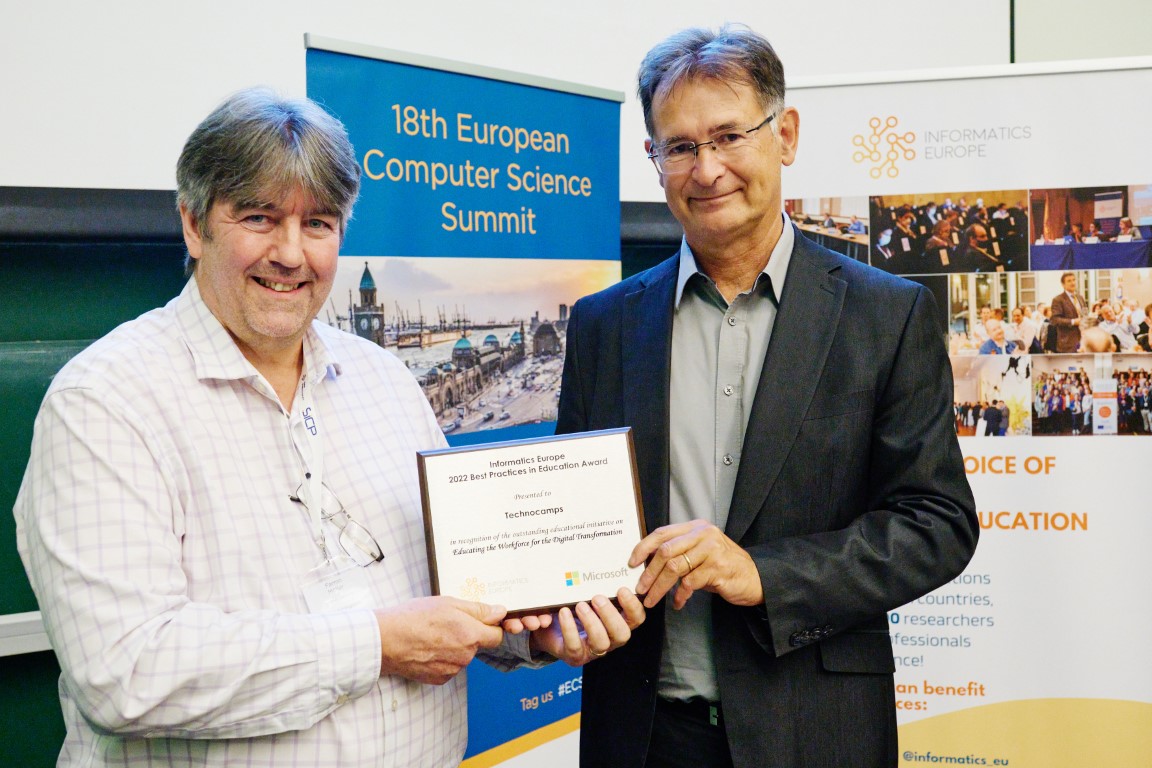
Educating the Workforce for the Digital Transformation - Technocamps
Submitted on behalf of Technocamps, Singleton Campus, Swansea University, Wales, UK, 2022
Read More
Technocamps is a pan-Wales STEM outreach programme founded and based at Swansea University and with hubs in every university in Wales, UK. Established in recognition of the challenges to keep up with advances in digital education, it engages with the nation’s primary and secondary schools, teachers, school leavers, adult learners, and businesses.
Summary of achievements:
- Led in reforming the ICT subject, defining and implementing a new statutory bilingual Digital Competence Framework (DCF) for all pupils in Wales aged 3 to 16.
- Led on embedding the DCF in schools by delivering over 10 hours of workshops in each of 97% of the nation’s secondary schools.
- Supported a major 2018 sector review of ICT qualifications in Wales and assisted in creating innovative General Certificate of Secondary Education (GCSE) and A-Level qualifications in Digital Technology.
- Developed the new Science & Technology Area of Learning and Experience in the new Curriculum for Wales, which brings together biology, chemistry, computer science, design & technology, and physics for all learners aged 3 to 16.
- Engaged deeply with over 65,000 young people since 2011, with a nearly-even gender balance, to create an interest in the subject, particularly amongst young girls.
- Trained to accredited award level over 100 teachers across Wales who lack a formal ICT/Computing background yet teach these subjects due to the shortage of qualified teachers.
- Technocamps' Institute of Coding in Wales drives business innovation through fully-funded CPD opportunities like trailblazing Degree Apprenticeships and micro-credentials, saving companies money—one project saved £400,000 annually.
View full submission and measures of impact:
Cybersecurity - CyberChallenge.IT
Submitted on behalf of the CINI Cybersecurity National Laboratory, Italy, 2021
Read More
CyberChallenge.IT is a training program designed to address the IT workforce shortage by identifying, attracting, recruiting and placing the next generation of cybersecurity professionals in Italy.
The project aims to create and grow the cyberdefender community by investing in young talent. In particular, it aims at:
- stimulating interesting technical-scientific subjects and, in particular, in information technology topics;
- presenting the professional opportunities offered by the training courses on information security;
- putting young people in direct contact with companies;
- identifying young cyber talents and contributing to their orientation and professional training.
The program combines traditional training activities with a gamified approach that translates into participation in competitions in simulated networks and work environments. The proposed model leverages gaming to attract young talent while offering a significant multidisciplinary training on technical, scientific and ethical issues related to information security, alternating theoretical lectures and hands-on experiences on various topics such as cryptography, malware analysis, and web security.
View full submission and measures of impact:
Lifelong Education and Talent Gap in Informatics - Master of IT
Submitted on behalf of the Coordination Committee for Master of IT offered by Aalborg University, Aarhus University and University of Southern Denmark, Denmark, 2020
Read More
Master of IT is an educational cooperation between three universities in Denmark, offering a lifelong learning part-time master’s degree programme for IT professionals to help close the digital talent gap. With 30 courses (15 ECTS each), students can customize their degree or focus on specific subjects at their own pace, which they find relevant for their lifelong learning. The Master of IT attracts students from various age and experience in the educational path, with 55% of them aged 40-60. From 2006 to 2024, over 2000 IT professionals from diverse sectors, including business, public sectors, finance, healthcare and education, participated in courses covering IT teaching, development, management, security and implementation.
View full submission and measures of impact:
Inclusive Education - Welcome.TU.code
Submitted on behalf of the Faculty of Informatics, TU Wien, Austria, 2019
Read More
Founded in 2015, Welcome.TU.code offers refugees and individuals without access to computer science an opportunity to further their education and improve future prospects. Originally offering free Informatics courses to unaccompanied adolescent refugees aged between 14 and 18, the program has developed to cater to all people, mainly from migrant or financially disadvantaged backgrounds. Welcome.TU.code offers basic informatics workshops, an introduction to software and hardware, and programming, with formats and tracks ranging from beginners to advanced coding.
Welcome.TU.code courses and workshops are led by students who are supported by tutors and supervisors. On the one hand, students have greatly profited from these courses by learning more about different cultures and being exposed to heterogeneity in terms of language, education level and country of origin, which they otherwise would not experience in everyday life. On the other hand, the participants benefit from exposure to diverse cultures and backgrounds, fostering mutual learning and inclusion.
View full submission and measures of impact:
Inclusive Education - Erasmus+ InventEUrs project
Submitted on behalf of University of Girona, Spain, London South Bank University, UK, University of Perugia, Italy, 2019
Read More
InventEUrs, a European Erasmus+ project, promotes Global Citizenship Education and social inclusion by using Collaborative Digital Storytelling and Creative Computing in schools with high percentages of newly arrived migrant children. The project aims to replicate the success of “Inventors4Change”, which has been carried out with underprivileged schools in Catalonia, India and Colombia.
Through InventEUrs and its GlobalChangemakers platform, thousands of children worldwide have connected, discussed Sustainable Development Goals, learned coding, and co-created digital stories and animations about the topics they researched.
View full submission and measures of impact:
Transforming Informatics Education - Tinkering in Informatics as a Teaching Method
Submitted on behalf of the Faculty of Electrical Engineering, Mathematics and Computer Science, University of Twente, Netherlands, 2018
Read More
Tinkering is a playful and experimental approach, characterised by iterative engagement in which makers continually reassess goals, explore new paths and imagine new possibilities. This approach was used to teach programming for students enrolled at “Creative Technology” Bachelor’s programme, allowing students to choose their own design goals and path, within a provided context. Ownership and responsibility are key factors in motivating students, from beginners to advanced learners. In addition to programming skills, Tinkering supports basic scientific activities such as questioning, observing, reflecting, and hypothesizing, making it an effective academic teaching method.
View full submission and measures of impact:
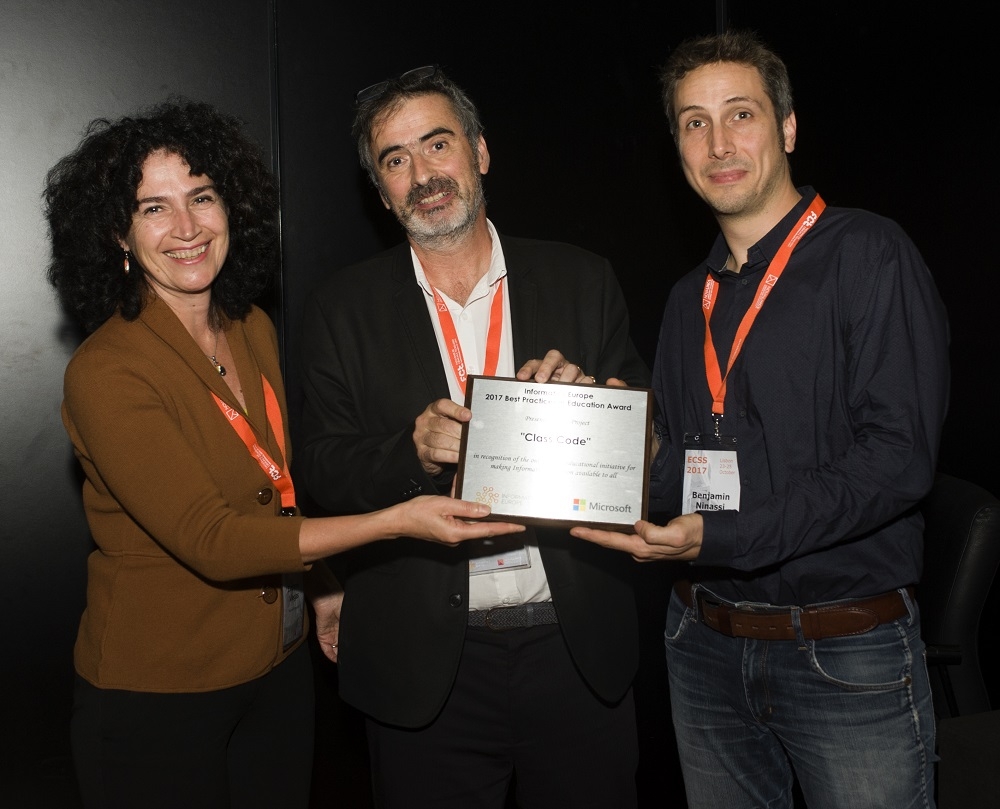
Informatics Education Available to All - Class’Code
Submitted on behalf of the Class’Code Consortium, France, 2017
Read More
Class’Code is a free blended learning program for teachers, educators and children activity organizers to introduce Informatics to children aged 8 to 14. Topics include creative programming, information coding, familiarization with networks, fun robotics, and the societal impacts of technology. Since September 2016, the program has reached 15,000 subscribers and around 3.200 learners attended the meetings regularly across France through over 40 local structures.
The project is supported by academic and industrial federations in computer science, led by the SIF (Société informatique de France) and managed by INRIA (the French Research Institute in Computer Science and Applied Mathematics). Magic Makers oversees pedagogy, Open Classrooms drives the production while the deployment on the territories is under the leadership of Les Petits Débrouillards association.
View full submission and measures of impact:
Informatics Education in Primary and Secondary Schools - ALaDDIn project
Submitted on behalf of the ALaDDIN team, Università degli Studi di Milano, Italy, 2016
Read More
Initiated in 2008, the ALaDDIn project (LAboratory for Dissemination and Didactics of INformatics) aims to transform how Informatics is taught and perceived, with special attention to K-12 non-vocational schools. Since 2011, it has promoted Informatics in schools through playful activities via the so-called algomotricity teaching methodology, which has a solid theoretical foundation in experiential learning theory and problem-based learning and standing out by its clear didactical design. An important aspect of the approach is the focus on exploration and scientific inquiry applied to computing topics. By 2016, almost 3,000 pupils have participated in ALaDDIn's workshops, and more than 500 teachers have been exposed to the methodology.
View full submission and measures of impact:
Informatics Education in Primary and Secondary Schools - Bebras International Contest on Informatics and Computer Fluency
Submitted on behalf of the Bebras community, 2015
Read More
The Bebras International Contest on Informatics and Computer Fluency (Bebras) is an international initiative to promote Informatics and computational thinking among school teachers and students as well as the public at large. Bebras members organize easily accessible and highly motivating online contests in many countries. Participants are usually supervised by teachers who may integrate the Bebras challenge into their teaching activities. The challenge is performed at schools using computers or mobile devices.
Founded in Lithuania in 2004, Bebras has grown rapidly to attract over 2.5 million participating students in 2024 in 87 member countries and is considered as the largest computer science competition in the world. In addition, Bebras members provide contest-related teaching material to schools, and are engaged in teacher education and promotion of Informatics education in general. Typically, national Bebras activities are supported by the government, universities, research institutes, or computer societies.
View full submission and measures of impact:
Informatics Education in Primary and Secondary Schools - Computing At School initiative
Submitted on behalf of Computing At School, UK, 2014
Read More
Computing At School was formed in 2008 by a small group of individuals from a range of sectors concerned about the inadequate teaching of Computer Science (Informatics) in schools. Its mission is to provide leadership and strategic guidance to all those involved in Computing education in schools, with a significant but not exclusive focus on the Computer Science theme within the wider Computing curriculum.
Six years after its inception, the landscape has been transformed by CAS’s efforts:
- The English National curriculum for ICT (Information and Communication Technology) has been completely reformed, and now explicitly embodies Computer Science as a foundational part of the curriculum, starting from primary school.
- In 2008 there were no General Certificates of Secondary Education (GCSEs) (age-16 national examinations) in Computer Science. Now every awarding body offers such a GCSE.
- CAS is now an online community of over 12,000 members. It supports over 100 face-to-face teacher “hubs” that meet regularly to share best practice.
- The government is funding CAS to run a national programme of training for Computing teachers, to give them the knowledge and skills they need to deliver the new curriculum with confidence.
CAS membership is open to everyone, and includes teachers, parents, governors, exam boards, industry, professional societies, and universities. CAS is now recognised as an influential organisation in terms of policy and decision-making at a statutory level. In addition, CAS is the UK national subject association for teaching computing.
View full submission and measures of impact:
Informatics Education in Primary and Secondary Schools - Informatyka +
Outreach to Prospective Informatics students
Submitted on behalf of Warsaw School of Computer Science, Poland, 2013
Read More
Informatyka + is one of the largest outreach projects in Poland, run by the Warsaw School of Computer Science (WWSI) and funded by the EU. It was addressed to high school students in five regions in Central and Eastern Poland and more than 1000 high schools, 17.000 students, and 300 teachers participated in this project in 2008-2012. The project’s main goals were to:
- elaborate and implement innovative methods of teaching and learning key competencies in Informatics and its applications;
- improve and extend school students’ activities in developing key competencies in Informatics and its applications;
- extend students’ interests in job market expectations and better preparation for their future choices of professional development;
- provide opportunities for talented and gifted students to improve their Informatics interests and competencies, in particular for those students who are interested in taking part in numerous Informatics competitions;
- improve students’ school achievements (measured by school grades) in Informatics and other related subjects;
- provide schools with open education content in Informatics and its applications;
- introduce school students to an academic type of instruction which differs significantly from school lessons;
- develop teachers’ competences in working with students talented in Informatics.
Within the project, students participated in 2-hour lectures, 2-hour lectures with 3-hour computer workshops, 24-hour intensive workshops, competitions like the Informatics Olympiad, Beaver, and 3D graphics/web contests, summer computing camps combining vacation activities with lectures, workshops, and online competitions.
Additionally, in-service courses were provided to help teachers enhance their skills in supporting gifted students interested in advanced Informatics.
View full submission and measures of impact:
Informatics Education in Primary and Secondary Schools - Multi-Sensory Informatics Education
Submitted on behalf of the Sapientia Hungarian University of Transylvania, Romania, 2013
Read More
A new multi-sensory method to improve teaching-learning of recursive algorithms engages students' visual, auditory, and kinesthetic senses. Each algorithm contains a "loop skeleton" representing its loop structure, with loop instructions acting as its core components. The proposed approach consists of two steps: (1) establishing the loop skeleton and (2) filling it with appropriate instructions. A software tool was also developed to automate the creation of program skeletons with various loop structures by defining loop parameters and using keyboard input to simulate rhythm patterns. Additionally, the software integrates piano sounds and delay procedures within loop instructions, functioning as an auditory representation of the loop skeleton. When loops appear in both branches of a selection, different instruments are used for parallel loops. This application enables a multi-sensory learning experience, allowing students to listen to the loop structure, visually track program execution, and perceive the rhythm of the algorithm.
Furthermore, the integration of dance into informatics education, specifically for teaching sorting algorithms, was explored. This approach incorporates multi-sensory elements such as dance, music, rhythm, and theatrical role-playing to create an immersive learning environment engaging visual, auditory, kinesthetic, and tactile senses. Students with an interest in dance participated by representing numbers in a sequence, wearing corresponding labels on their attire. The accompanying music was inspired by Michael Flatley’s compositions, and appropriate dance steps for comparison and swapping operations were selected in consultation with a eurhythmics teacher. Recorded performances were later enhanced with graphical elements to illustrate the array structure and highlight the active dancer pairs.
The presented method and multimedia software-tool may improve informatics education and bring teachers/students closer to the concept that teaching/learning should be entirely practical, entirely pleasurable, and such as to make school a real game.
View full submission and measures of impact:
Paving the whole path – Teaching Embedded Systems from Theoretical Foundations to Interdisciplinary Team Skills
Submitted on behalf of the Department of Computer Science, RWTH Aachen University, 2012
Read More
To prepare for these demands, the Computer Science Department at RWTH Aachen University developed a tailored curriculum for embedded systems teaching. Its focus is to teach the different disciplines together with their interconnections from the first semester on. This way the students do not get a tunnel vision for each single discipline, but from an early stage on remain aware of the context, chances and boundaries of each single area. This approach reaches over both, the Bachelor and Master program in CS and consists of the three phases:
- The first phase provides the fundamentals of embedded computing which every CS student should know. It consists of the lecture Computer Engineering and a lab course in Systems Programming. Both courses are compulsory for CS Bachelor students.
- The second phase allows Master students interested in embedded systems to delve into selected embedded systems topics.
- In the final phase, the students have the possibility to join interdisciplinary teams which take part in competitions organized by third parties.
View full submission and measures of impact:
Embedded and Mobile Computing - Pervasive Computing Curriculum
Submitted on behalf of the IT University of Copenhagen, Denmark, 2012
Read More
The Danish Pervasive, Embedded, and Mobile Computing Curriculum consists of four main parts:
- a pervasive computing course that introduces graduate students to theoretical and technological aspects of pervasive, mobile, and embedded computing;
- a pervasive computing project where students identify and solve real-world problems using state-of-the-art pervasive computing technologies and concepts;
- a Master of Science (MSc) thesis program which allows students to pursue a specialization within pervasive computing for their graduation;
- a PhD program and course that introduces and guides PhD students within pervasive computing.
All teaching and curriculum material is widely available for public reuse, including course blogs, recommended reading lists, lectures, slides, lab classes, assignments, project proposals, former student projects for inspiration, videos, and pictures.
View full submission and measures of impact:
Parallelism and Concurrency - Teaching High Performance Computing to Scientists and Engineers: A Model-Based Approach
Submitted on behalf of HPC Services group, Erlangen Regional Computing Center, Germany. 2011
Read More
During 2000–2010, a course "Programming Techniques for Supercomputers" was developed to make students of computational sciences and engineering familiar with the concepts and dominant programming paradigms of high-performance computing (HPC). The teaching concept begins with a coverage of modern computer architecture, emphasizing performance-critical features like pipeline stalls, latency, bandwidth bottlenecks, interconnect topologies in shared and distributed memory parallel computers, and the properties of modern multicore processors. Students also learn basic scalability models, the dominant HPC programming paradigms (OpenMP, MPI), and hybrid MPI+OpenMP programming with attention to performance implications.
Starting from the lecture, the four following follow-up branches were developed:
- Tutorials delivered at major conferences (e.g., SC10, ISC10), widely attended and well-received.
- A textbook (Introduction to High-Performance Computing for Scientists and Engineers, CRC Press), adopted in numerous courses and supported by online materials.
- Industry collaborations, expanding HPC training into new fields like medical applications and reactor physics, addressing a growing need for industry-specific HPC training.
- A spin-off company, Likwid High Performance Programming, provides HPC consulting, training, and services.
View full submission and measures of impact:
Parallelism and Concurrency - Changing the Landscape of IT-Education
Submitted on behalf of the Moscow State University (MSU) and Nizhny Novgorod State University (NNSU), Russia, 2011
Read More
The shift to multi-core processors and their use in high-performance systems has created a need for widespread adoption of Parallelism and Concurrency (P&C). This poses a significant challenge for higher education to rapidly scale training in parallel computing. Guided by international recommendations (ACM/IEEE and UNESCO/IFIP), a comprehensive P&C curriculum was developed which promoted an integrated approach to P&C education across all levels of parallelism, combining foundational theory with modern technological advances. The curriculum was organized into thematic areas, further divided into modular units. Key areas included:
- Mathematical foundations of parallel computing.
- Parallel computing systems.
- Technologies of parallel programming (parallel software engineering foundations),
- Parallel methods and algorithms.
- Parallel computations, large-scale problems and problem-oriented applications.
View full submission and measures of impact:
Best Practices in Education Award
Established in 2011
Informatics Europe presents the Best Practices in Education Award annually to promote teaching quality in informatics. The Award recognises outstanding European educational initiatives that improve the quality of Informatics teaching and the attractiveness of the discipline. Each year the Award has a different theme, and the winning initiatives demonstrate their applicability beyond their original institutions. Previous award themes have covered a range of topics, including:
- educational efforts in various informatics domains: cybersecurity; embedded and mobile computing; parallelism and concurrency,
- lifelong education and talent gap in informatics,
- inclusive education,
- transforming informatics education,
- informatics education for all,
- informatics education in primary and secondary schools.
Our last Award, in 2022, was about exceptional European informatics educational initiatives that prepare the workforce for digital transformation in the classroom or beyond, at the school or university level, or outside of institutions. On the the right of this webpage, you can find a list of previous awards, featuring the best practices of each year's winning proposal(s).
Call for Sponsorship
The Best Practices in Education Award is currently on hold as we search for a new sponsor. Sponsoring the Award demonstrates your commitment to promoting excellent informatics education initiatives that benefit society. This provides your brand with exposure and opportunities to build rewarding relationships and make a positive impact in the European informatics community. Please
Check out some snapshots from our previous Award ceremonies!
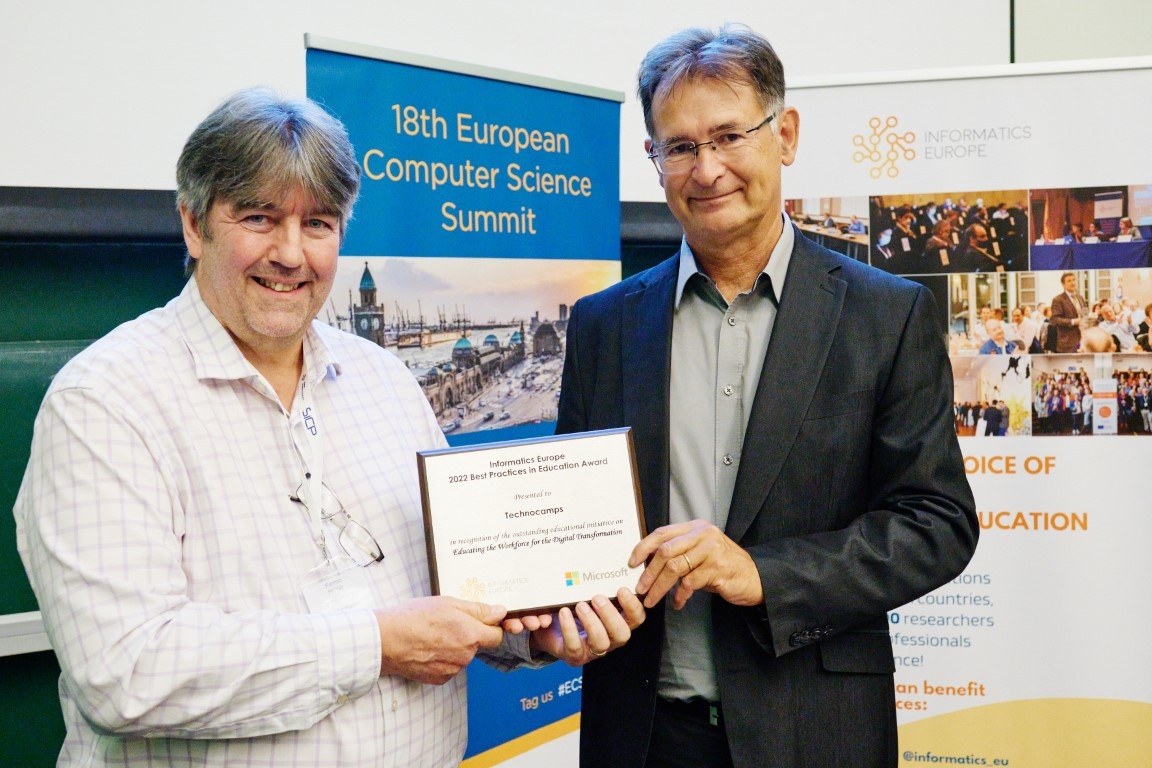
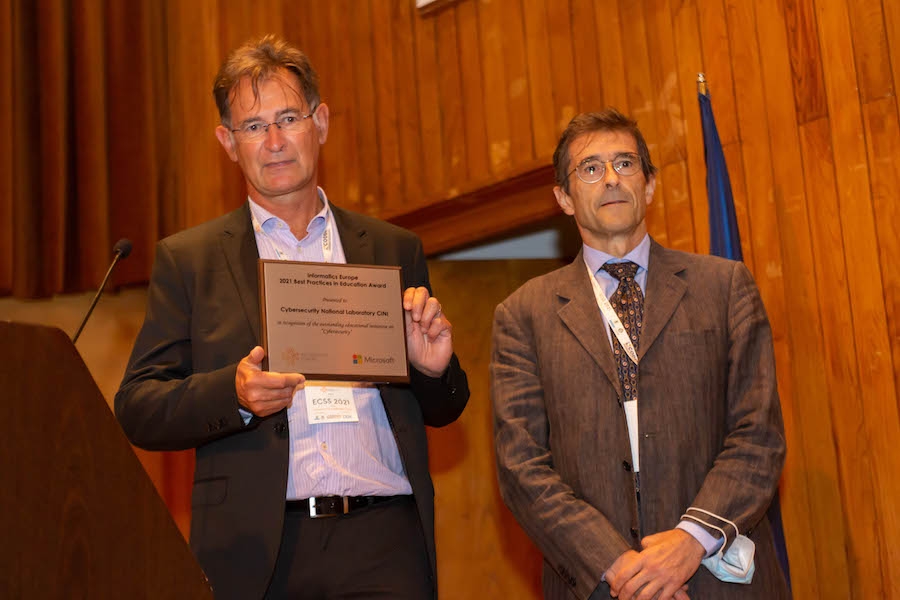
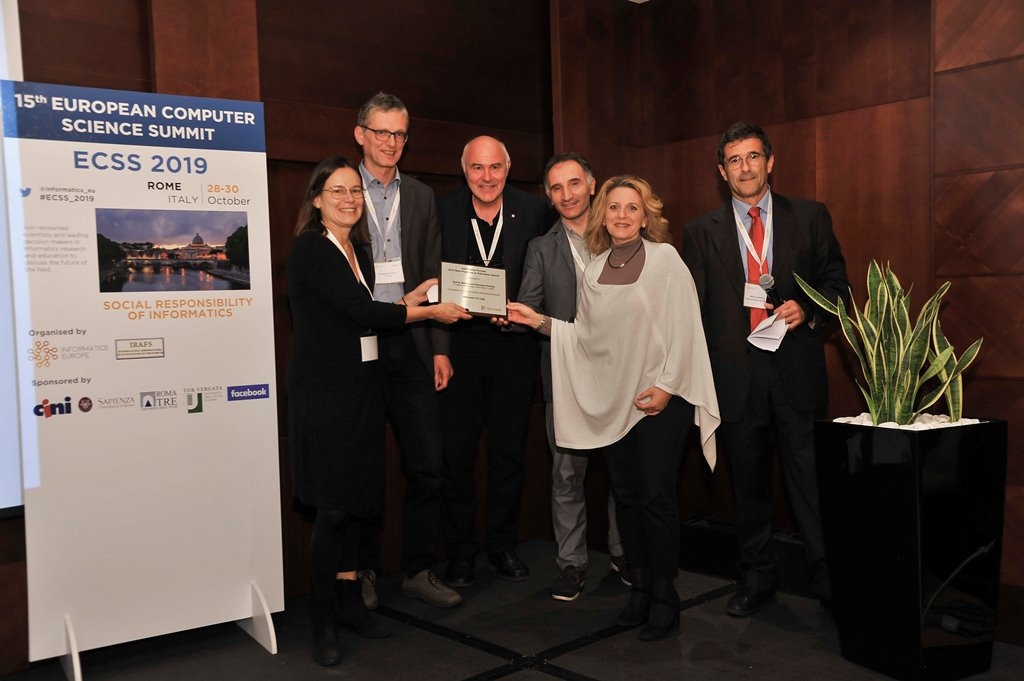
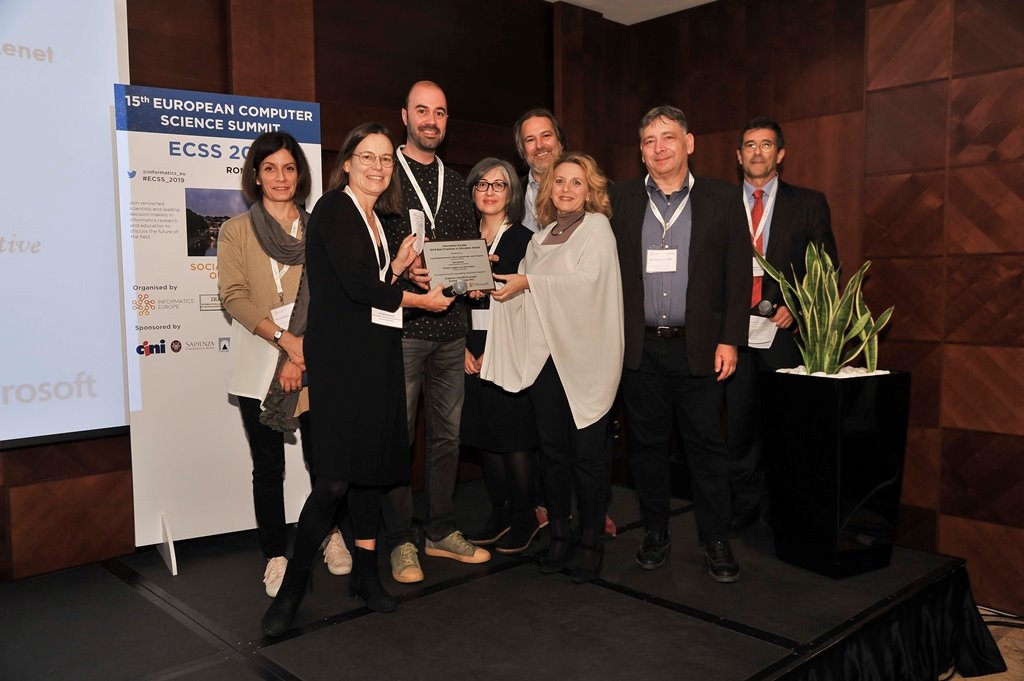
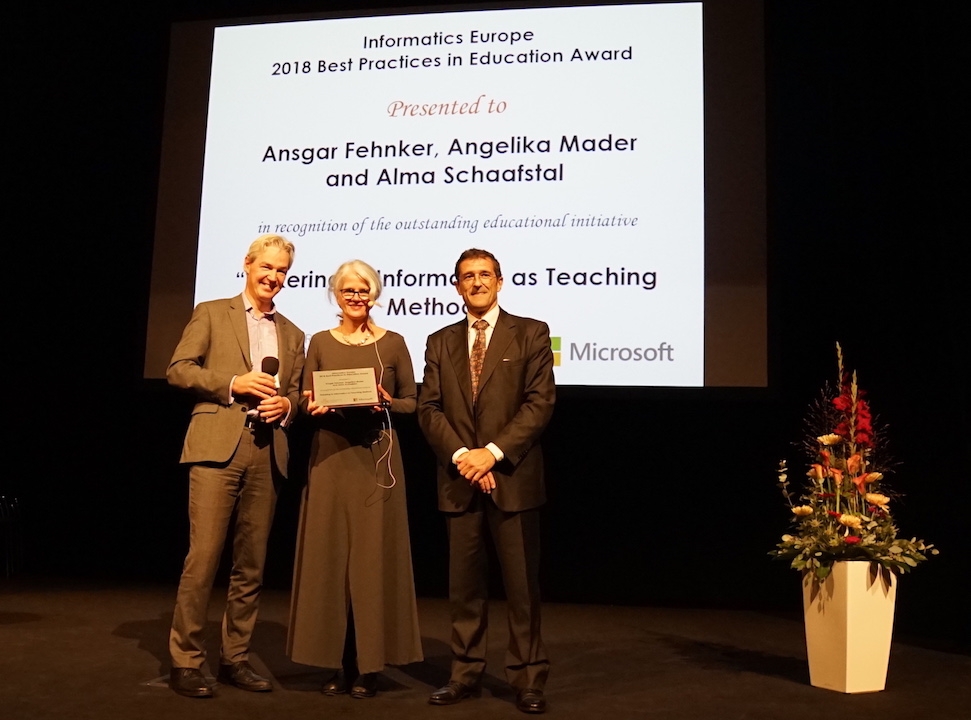
Best Practices in Education Award 2022 Award Ceremony
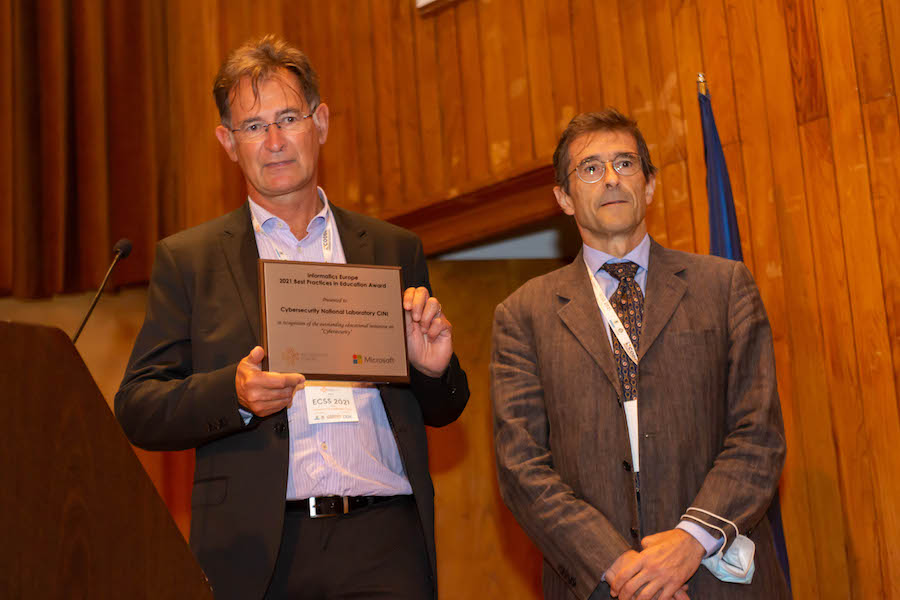
Informatics Europe presented the Best Practices in Education Award 2021 virtually to the winning "CINI Cybersecurity National Laboratory".
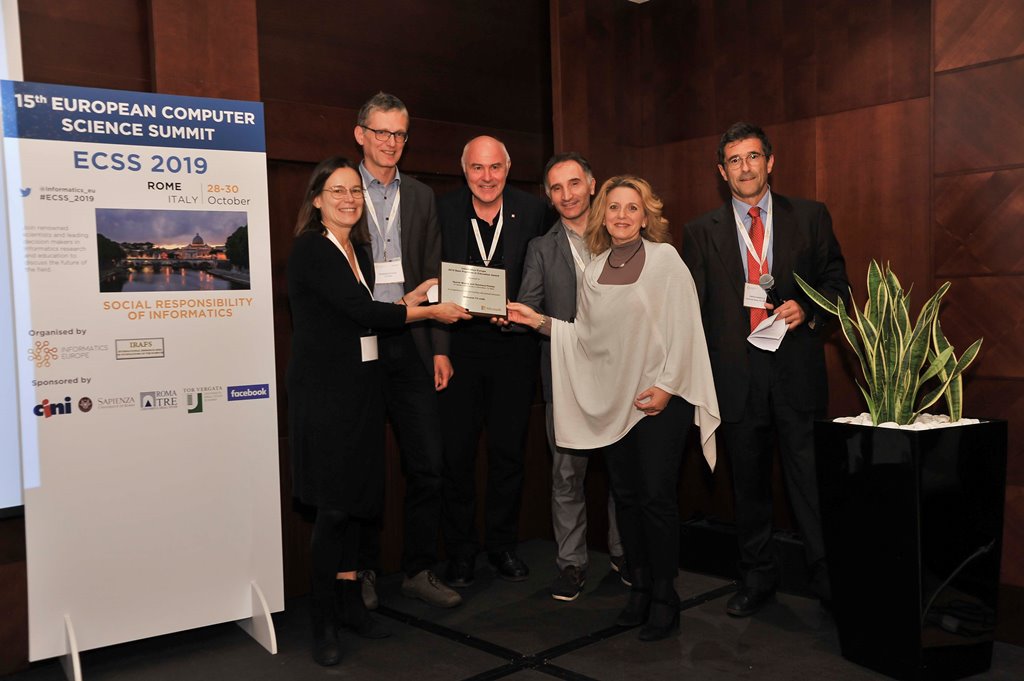
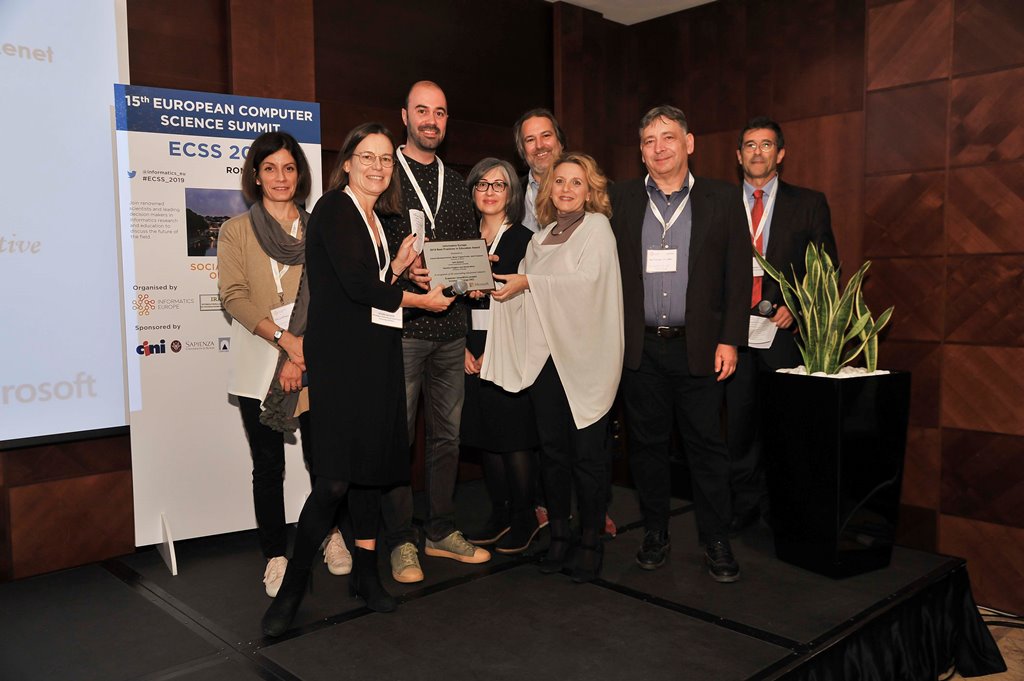
Winners of the 2019 Best Practices in Education Award from TU Wien with Letizia Jaccheri (Award Chair), Alessandra Migliore (Microsoft) and Enrico Nardelli (Informatics Europe President).
Winners of the 2019 Best Practices in Education Award from Erasmus+ InventEUrs project - Inventors4Change (I4C) with Letizia Jaccheri (Award Chair), Alessandra Migliore (Microsoft) and Enrico Nardelli (Informatics Europe President).
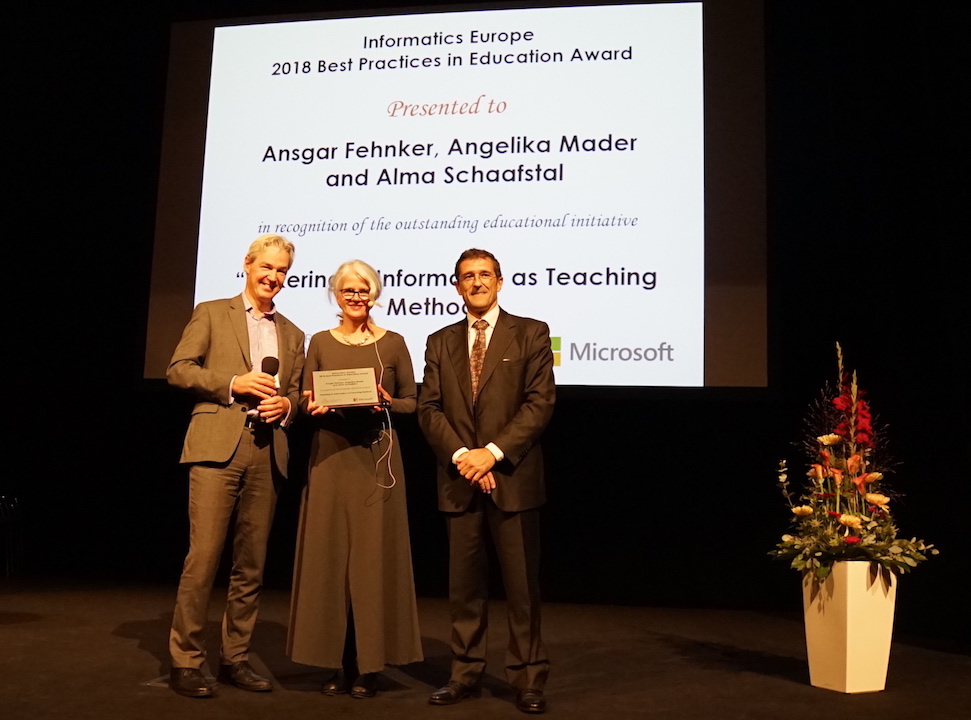
Angelika Mader (Winner of 2018 Best Practices in Education Award) with Michael Kölling (Award Chair) and Enrico Nardelli (Informatics Europe President).
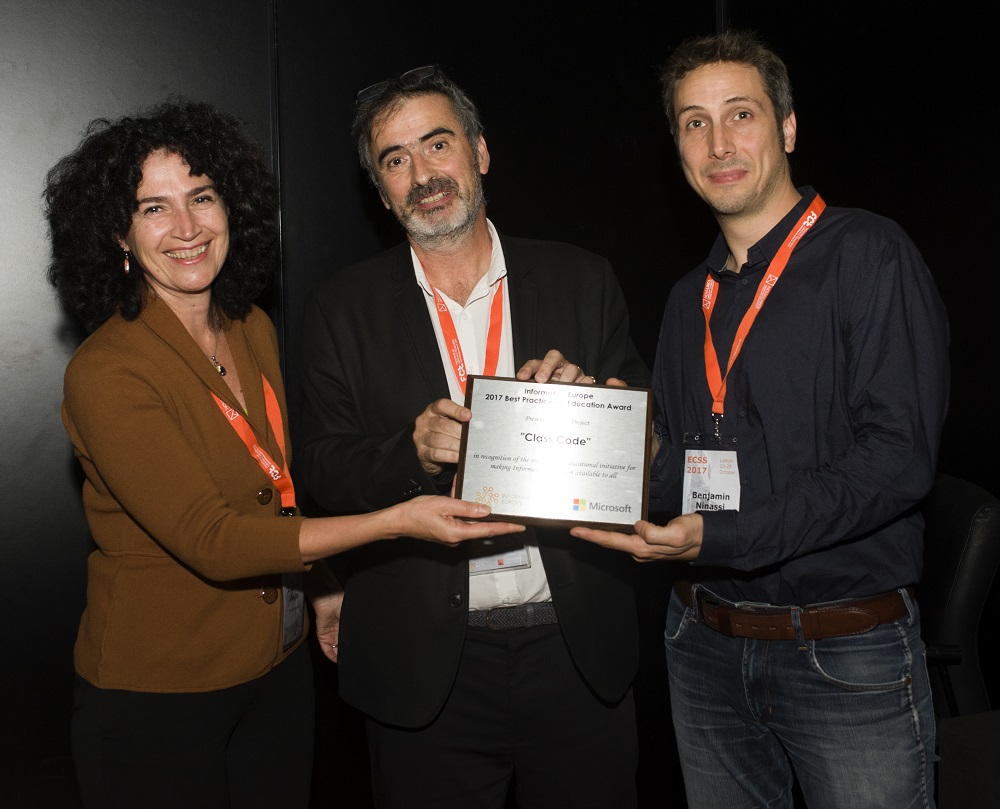
2017 Best Practices in Education Award Winners (Class’Code, France) with Evelyne Viegas (Award Sponsor representative from Microsoft).


*You may need to apply zoom out for a better view of the photos.
Subcategories
Minerva Informatics Equality Award 2026

Past Winners & Award Committees
Best Practices in Supporting Women
MIEA has been recognized as a Best Practice by Connecting Women in Digital, an initiative funded by the European Union. Discover the diverse contributions from past MIEA participants.




 Netlogica