
2016 Minerva Informatics Equality Award
Informatics Europe proudly announces the first Minerva Informatics Equality Award devoted to initiatives which seek to encourage and support the careers of women in Informatics research and education. The first of this annual award will be made in October 2016 and will be sponsored by Google.
The Informatics Europe Minerva Informatics Equality Award recognizes best practices in Departments or Faculties of European universities or research labs that have been demonstrated to have a positive impact for women. On a three-year cycle the award will focus each year on a different stage of the career pipeline:
- Developing the careers of female faculty, including retention and promotion;
- Supporting the transition for PhD and postdoctoral researchers into faculty positions;
- Encouraging female students to enroll in Computer Science/Informatics programmes and retaining them.
The 2016 Award is devoted to gender equality initiatives and policies to develop the careers of female faculty.
The Award seeks to celebrate successful initiatives that have had a measurable impact on the careers of women within the institution. Such initiatives can serve as exemplars of best practices within the community, with the potential to be widely adopted by other institutions. Nominations will need to demonstrate the impact that has been achieved.
For 2016 examples of impact could include an improved success rate in recruiting, retaining and promoting female staff, increased satisfaction scores from objective surveys of staff experience, achievement of “beacon” status (i.e. being used as an exemplar within national or regional initiatives).
The Award carries a prize of EUR 5,000
The Award will be given to a Department or Faculty to be used for further work on promoting gender equality. To be eligible, nominated institutions must be located in one of the member or candidate member countries of the Council of Europe, or Israel. Institutions associated with members of the Informatics Europe Board and of the Award panel are not eligible.
The Award panel will review and evaluate each proposal. It reserves the right to split the prize between at most two different proposals. Moreover, noteworthy runners up may also be included as exemplars of best practice in future Informatics Europe publications.
The proposal should include:
- Contact information for the Head of the nominated Department or Faculty and the nominator (who can be the same);
- A brief summary or abstract (100 words or less) which can be made public.
- Description of the initiative (max 2 pages);
- Evidence of its impact (max 2 pages);
- An optional reference list (which may include URLs of supporting material);
- Optionally, one or two letters of support. The letters of support may come, for example, from female staff members who have benefited from the scheme.
Deadlines:
- Public summary: May 1, 2016
- Full nominations: June 1, 2016
- Notification of winner(s): August 1, 2016
The Award will be presented at the 12th European Computer Science Summit (ECSS), in Budapest, October 24-26, 2016, where a representative of the winning institution will be invited to give a talk on their achievements.
Award Panel:
- Micheline Beaulieu, Emeritus Professor of Information Science, University of Sheffield, UK (Chair)
- Erika Abraham, Professor of Hybrid Systems, RWTH Aachen University, Germany
- Luca Aceto, Professor of Computer Science, Reykjavik University, Iceland
- Christine Choppy, Professor of Logic, Calculi and Reasoning, University of Paris Nord, France
- John Clark, Professor of Critical Systems, University of York, UK
- Dunja Mladenic, Professor of Artificial Intelligence, Jozef Stefan Institute, Slovenia
- Pierangela Samarati, Professor of Information Technologies, University of Milan, Italy
Further inquiries:
2026 Minerva Informatics Equality Award
The Minerva Informatics Equality Award (MIEA) recognises outstanding European initiatives and best practices that encourage and support women's careers in Informatics research and education.
This year, the Award enters its 11th edition, welcoming SAP as our new Award sponsor.
The Award annually recognises impactful initiatives that have successfully supported women's careers at all stages in Informatics research and education. These initiatives serve as best practice exemplars, inspiring broader adoption across institutions.
Until 2022, the Award followed a three-year cycle, each year focusing on a different career stage. As of 2023, the Award considers initiatives at any stage of the career pipeline, including but not limited to:
- Encouraging female students to enrol and persist in Informatics/Computer Science programmes;
- Supporting PhD and postdoctoral researchers in transitioning to faculty positions;
- Advancing the careers of female faculty through retention and promotion.
The Award carries a prize of 5,000 EUR.
Nominations for the Award are open to individuals or groups. Eligible nominees should be affiliated with institutions located in one of the European countries. Members of the Award Committee are not eligible as Award recipients.
The Award Committee will review all nominations received and reserves the right to divide the prize between up to two winners. Additionally, to encourage the broader adoption of gender equality initiatives, all nominated entries will be showcased as best practice exemplars on our webpage here and may be featured in future Informatics Europe publications.
Key Dates
- Abstract Submission Deadline: 22 June 2026 (indication of interest)
- Full Submission Deadline: 29 July 2026 (required for Award consideration)
- Notification of winner(s): late August 2026
- Award Ceremony: 27 October 2026
The Award will be presented during the 22nd European Informatics Leaders Summit (ECSS 2026) in Porto (Portugal), between 26th and 28th of October, where a representative of the winning proposal(s) may be invited to give a short talk on their achievements.
How to Submit
Submission for the 2026 Award is now closed. Thank you for your interest!
2026 Award Committee
- Ana Belén Gil, University of Salamanca, Spain (Chair)
- Anca Dobrovat, University of Bucharest, Romania
- Malvina Latifaj, Mälardalen University, Sweden
- Lili Nemec, University of Maribor, Slovenia
- Eirini Ntousi, Fakultätentag Informatik, Germany
- Ileana Ober, IRIT, Université de Toulouse, France
- Ayushi Rastogi, University of Groningen, the Netherlands
- Sirja Sulakatko, Tallinn University of Technology, Estonia
- Claudio Zandron, University of Milano-Bicocca, Italy
Further Inquires
Minerva Informatics Equality Award
The Minerva Informatics Equality Award (MIEA) recognises outstanding European initiatives and best practices that encourage and support women's careers in Informatics research and education.
The Award marks its 10th anniversary in 2025! To mark this occasion, the Minerva Informatics Equality Award Catalogue, prepared by the Informatics Europe Working Group on Diversity and Inclusion,has been published, bringing together a decade of best practices submitted to the Award and celebrating European initiatives that advance gender equality in Informatics research and education.
[Read the 2025 Award Results Press Release]
The Award annually recognises impactful initiatives that have successfully supported women's careers at all stages in Informatics research and education. These initiatives serve as best practice exemplars, inspiring broader adoption across institutions.
Until 2022, the Award followed a three-year cycle, each year focusing on a different career stage. As of 2023, the Award considers initiatives at any stage of the career pipeline, including but not limited to:
- Encouraging female students to enrol and persist in Informatics/Computer Science programmes;
- Supporting PhD and postdoctoral researchers in transitioning to faculty positions;
- Advancing the careers of female faculty through retention and promotion.
Since its launch in 2016, the Award was presented annually, carrying a minimum prize of 5,000 EUR.
Nominations for the Award are open to individuals or groups. Eligible nominees should be affiliated with institutions located in one of the European countries. Members of the Award Committee are not eligible as Award recipients.
The Award Committee reviews all nominations received each year and reserves the right to divide the prize between up to two winners. Additionally, to encourage the broader adoption of gender equality initiatives, all nominated entries will be showcased as best practice exemplars on our webpage here and may be featured in future Informatics Europe publications.
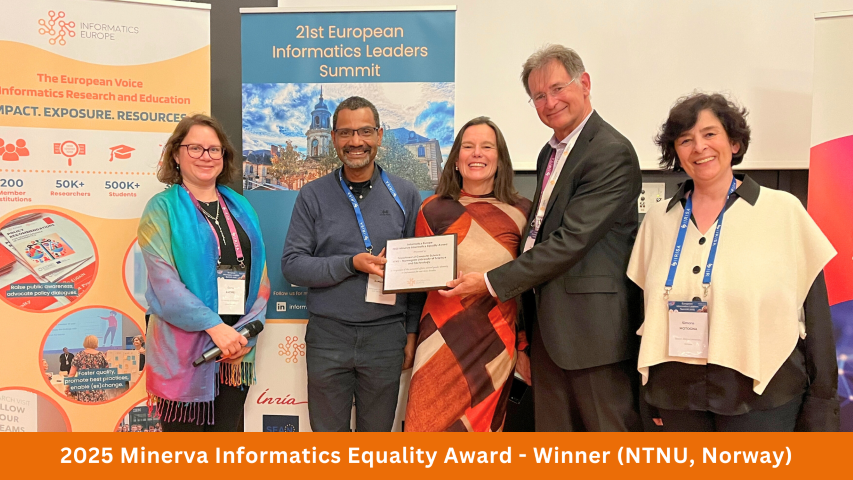
The 2025 Award was presented at the 21st European Informatics Leaders Summit (ECSS) in Rennes (France), between October 27-29, where a representative of the winning proposal was invited to give a short talk on their achievements.
We would like to express our gratitude to the 2025 Award Committee:
- Sarah Jane Delany, TU Dublin, Ireland (Chair)
- Erika Abraham, RWTH Aachen University, Germany
- Oana Andrei, University of Glasgow, UK
- Elisabetta Fersini, University of Milano-Bicocca, Italy
- Luca Forlizzi, University of L’Aquila, Italy
- Ana-Belén Gil-González, University of Salamanca, Spain
- Jose David Patón-Romero, Simula Metropolitan Center for Digital Engineering (SimulaMet), Norway
- Marta Turcsanyi-Szabo, ELTE Budapest, Hungary
Call for Sponsorship
The Minerva Informatics Equality Award is calling for a new sponsor. Sponsoring the Award demonstrates your commitment to promoting gender equality in Informatics research and education. This provides your brand with exposure and opportunities to build rewarding relationships and make a positive societal impact with the European Informatics community. Please
Further inquires:
Best Practices in Supporting Women
All entries to the Minerva Informatics Equality Award are shared below as a source of ideas for all. They are listed under the respective award categories:
- Female careers at all stages (2023-2025):
- Developing the careers of female faculty (2022, 2019, 2016)
- Encouraging female students to enrol in Informatics programmes and retaining them (2021, 2018)
- Supporting the transition for female PhD and postdoctoral researchers into faculty positions (2020, 2017)
These entries can also be found in the Minerva Informatics Equality Award Catalogue, prepared by the Informatics Europe Working Group on Diversity and Inclusion. The catalogue brings together a decade of best practices and celebrates European initiatives advancing gender equality in Informatics research and education.
For more best practices for attracting, retaining and developing women in Informatics research and education: check out Informatics Europe's best practice booklet: More Women in Informatics Research and Education, EUGAIN best practice booklets: From Schools to University, Reasons to Become an Informatics Student, From Bachelor/Master Studies to Ph.D., From Ph.D. to Professor and EUGAIN Policy Recommendations booklet.
- Female careers at all stages
- Develop female faculty
- Enrol and retain female students
- Transition into faculty
Sustaining Gender Diversity Over Three Decades - NTNU (2025 Winner)
Submitted by Department of Computer Science, Norwegian University of Science and Technology (NTNU), Norway, 2025
Initiatives taken:
- ADA (1997-present) is a long-standing initiative dedicated to increasing the representation of women in software engineering and computing through mentorship, networking, and advocacy. Launched in the Department of Computer Science and later expanded to the entire Faculty of Information Technology and Electrical Engineering, the program strongly emphasizes collaboration with industry partners and has positively impacted 27,000 students.
- Kodeløypa (2014-present) is a program designed to introduce young students, especially girls, to coding and computational thinking, inspiring the next generation of women in technology. The program has engaged around 1,000 school students from the Trondheim region and is funded by NTNU along with various national and European projects.
- IDUN (2019-2022) was a strategic initiative addressing the underrepresentation of women in ICT by fostering an inclusive academic environment and supporting career transitions from PhD to faculty. Through a mentoring program for female faculty, funded with €1 million from NTNU and the Research Council of Norway, IDUN contributed to a 20% increase in female professors in the Faculty.
- ACM Women Encourage Conference (WomENcourage) 2023 was a prestigious event that fosters collaboration and networking among women in computing to promote networking and career advancement.
View full submission and measures of impact:
Diversifying IT – TalTech (2025 Runner-Up)
Submitted by Tallinn University of Technology (TalTech), Estonia, 2025
Initiatives taken:
- Reskilling Programs for Women in IT (Work in Tech, Women in Tech | Telia, WoTech, etc.) provided foundational IT knowledge via platforms like Coursera, helping women enter IT studies or transition into the field professionally. Over 700 women participated, with 500+ positive placements and opportunities to continue into university studies, increasing female representation among IT lecturers.
- Showcasing Female Role Models and Outreach: Collected 59 personal stories highlighting diverse IT career paths and experiences. Organized awareness lectures for schools and launched the “TechCast” podcast in 2024, featuring female IT professionals to inspire women to pursue IT careers.
- Inclusive CS Game on Gender Equality to teach IT concepts while raising awareness of inclusion and gender equality.
- Research on IT Students at TalTech: Examined bachelor’s and master’s IT students, revealing how women enter IT differently, the effects of socioeconomic factors, and the role of prejudices. Findings informed university strategies to support disadvantaged groups, promote diversity, and increase women’s representation in IT and cybersecurity programs.
View full submission and measures of impact:
The International Women´s Degree Programme in Computer Science - Hochschule Bremen (2024 Winner)
Submitted by the Hochschule Bremen – City University of Applied Sciences, Germany, 2024
Initiatives taken: The International Women´s Degree Program in Computer Science (IFI) at Hochschule Bremen, University of Applied Sciences, Germany, has been working for nearly 25 years on the recruitment and successful retainment of young women in a single-sex bachelor´s study program in computer science. Since 2016 the study program has been complemented by a dual study offer. The program emphasizes an interactive teaching approach and offers best individual support by professors, tutors and IT experts from companies.
View full submission and measures of impact:
“Alice & Eve: a celebration of women in computing” initiative - Joint effort among several Dutch universities (2024 Runner-up)
Submitted by the Steering Committee of “Alice & Eve: a celebration of women in computing” initiative, the Netherlands, 2024
Initiatives taken: Alice & Eve is the Dutch initiative that tackles the gender disparity problem in Computer Science in the Netherlands. The ambitious goal of Alice & Eve is to change this by celebrating the achievements of women in computing, from Ada Lovelace to upcoming stars, such as Felienne Hermans. Since 2020, through various activities, Alice & Eve presents inspiring women in computing to the public, students, and professionals:
- through yearly physical Alice & Eve events (symposium, poster competition),
- through the Alice & Eve exhibition, and
- through an Alice & Eve digital platform.
View full submission and measures of impact:
The Women in Information and Computing Sciences (WICS) network and the ICS diversity committee - Utrecht University (2024 Runner-up)
Submitted by Department of Information and Computing Sciences, Utrecht University, the Netherlands, 2024
Initiatives taken: The department initiated informal lunches for female staff members in 2017, and founded the Women in Information and Computing Sciences (WICS) network, fostering activities to increase career opportunities for women in informatics. WICS successfully received funding for various activities, including an outreach program where women are role models, and won the university-wide diversity award in 2020. WICS helped founding of the departmental diversity committee, which broadens the aspects of diversity, including, ethnicity, sexuality, gender identities, and neurodiversity.
View full submission and measures of impact:
Gender-equality and anti-harassment committee - LIS (Computer Science Lab) Aix Marseille University (2023 Winner)
Submitted by the LIS research lab in Computer Science of Aix Marseille University, France, 2023
Initiatives taken: The gender-equality and anti-harassment committee was created in 2018. In order to raise awareness on the gender stereotypes, to prevent harassment and accompany victims, to boost career of women and to encourage high-school girls to consider science among their possible higher education and career choices, the committee carries out different types of actions grouped into 5 themes:
- The equality observatory, performing qualitative and quantitative gendered analyses.
- Actions to encourage young girls to pursue scientific careers.
- Awareness on gender discrimination through communication and training.
- Listening and support for victims of discrimination via the creation of a specific unit within the committee.
- Research work on gender stereotypes and discrimination, and participation in international research initiatives for gender equality.
View full submission and measures of impact:
FemTech.dk research program – Department of Computer Science, University of Copenhagen (2023 Winner)
Submitted by the FemTech.dk research program - University of Copenhagen, Denmark, 2023
Initiatives taken: The FemTech.dk action research program was initiated in 2016 at the University of Copenhagen to increase gender diversity and equity within the Department of Computer Science for both students and faculty. FemTech is fundamentally about combining research and interventions with a focus on making long-term change. The program follows two main interlinked paths: (1) unpacking and understanding the challenges related to unbalanced gender representation in computer science, and (2) intervening and extending the field of computer science to allow for multiple, diverse agendas. The main actions are;
- The creation of FemTech workshops, organized as interventionist activities with the creation of Cyberbear (a hacked IKEA soft toy transformed into an IOT artefact). The intention is to produce an alternative narrative depicting computer science as reaching beyond the computer screen.
- The creation of AtariWomen artefacts (re-mixed PACMAN game, cosplay costumes, vintage Atari games with 3D printed frames created by women), allows the re-writing of the history of Computer-Science to make women’s achievements more visible.
- A third digital artefact (a norm-critical, story-telling game) was created to challenge organization and systemic barriers within computer science departments.
View full submission and measures of impact:
Girls Club Code - Department of Computer Science and Engineering, Chalmers | Gothenburg University
Submitted by Department of Computer Science and Engineering, Chalmers University of Technology | Gothenburg University, Sweden, 2025
Initiatives taken: Launched in 2021 by the Department of Computer Science and Engineering at the University of Gothenburg and Chalmers University of Technology, Girls Code Club (GCC) is a three-week summer bootcamp for high school girls and non-binary students (aged 15–18). The bootcamp involves:
- Daily 4-hour in-person sessions over 3 weeks.
- Hands-on Python programming and data analysis exercises.
- A final group project where participants analyse Wikipedia access logs using Python and present findings to the public.
- A small stipend awarded upon completion of the curriculum.
To broaden exposure, GCC includes guest lectures from researchers and professionals on topics such as human-robot interaction, cryptography, sustainability in IT, cybersecurity, and drug development. Industry visits to local tech companies such as Volvo and Ericsson.
View full submission and measures of impact:
HK Unicorn Squad
Submitted by NGO HK Unicorn Squad, Estonia, 2025
Initiatives taken: HK Unicorn Squad is an educational initiative founded in 2018 in Estonia by engineer and entrepreneur Taavi Kotka, offering engaging, girls only hobby education in technology, engineering, and science. Aimed at girls aged 8-14, it combats gender imbalance in ICT by replacing fear with curiosity and confidence through hands-on learning. Since 2018, it has reached over 5 000 girls, with demand growing rapidly. The initiative operates by:
- Creating localized, small-group learning environments with free toolkits and detailed lesson guides;
- Encouraging peer-to-peer learning and mentorship;
- Working closely with volunteers and schools to scale impact;
- Keeping participation fun and non-competitive, focusing on confidence and creativity.
View full submission and measures of impact:
Educational Technology Laboratory - NTNU
Submitted by Educational Technology Laboratory, Norwegian University of Science and Technology (NTNU), Norway, 2025
Initiatives taken: Established in 2021, Educational Technology Laboratory conducts research related to the application of social robots in the fields of education and health, and encourages and supports female students through various activities, such as:
- Social-robot workshops at Gjøvik International School with 6th and 7th graders to foster interest in mathematics and programming, with a focus on encouraging girls.
- Pilot study using the social robot NAO conducted with Grade 1 and 2 students, led by a female master’s student, where storytelling was used to improve language skills and encourage reading habits in young children.
- Participation in TENK Tech Camp 2025 for girls aged 13–19, where the predominantly female lab team led workshops and open the Tech-BAZAR by sharing their experiences as role models.
- Recruitment and mentorship of female doctoral and postdoctoral fellows, resulting in numerous publications with female researchers and master’s students, successful career advancement of a postdoctoral fellow to Associate Professor.
View full submission and measures of impact:
Promoting High School Girls in a Computer Science Summer Camp - University of Passau
Submitted by Department of Computer Science, TU Darmstadt, and Department of Computer Science and Mathematics, University of Passau, Germany, 2025
Initiatives taken: The University of Passau’s Computer Science Summer Camp is a five-day program introducing high school students to computer science through hands-on projects, lectures, and student insights. Female participation has historically been low (~18%), reflecting Germany’s broader gender imbalance. In 2022, a new team implemented a research-informed strategy drawing on psychology, semiotics, and educational studies, including:
- Visual Identity & Marketing: Redesigned materials to feature girls, highlight collaboration, and state that no prior knowledge or exceptional math skills are needed.
- Project Content: Introduced creative, relatable projects like #programmable (social media platform) and AppSpark (mobile apps with MIT App Inventor and Design Thinking).
- Financial Support: Created a girls’ scholarship covering fees, travel, and accommodation, ensuring accessible participation with a simple application process.
View full submission and measures of impact:
Gender Equality, Inclusion, and Diversity Initiatives - Escuela Técnica Superior de Ingeniería Informática, University of Seville
Submitted by Escuela Técnica Superior de Ingeniería Informática, University of Seville, Spain, 2025
Initiatives taken:
- Participation in the Volunteer Network for Supporting Victims of Gender Violence and in the Equality and Respect Network; Implementation of the University’s III Equality Plan.
- Awareness and Empowerment Programs such as:
- EmpoderaTIC (2021–2024) program supporting and connecting women in tech through peer mentoring, leadership workshops, and events addressing AI bias and representation. It also fosters community via the Telegram network “Women at ETSII” and the Feminine Informatics Society (SOFI), providing a safe and supportive environment for female students and staff.
- STEAM_Womenrang (2024–2025) gamified program fostering computational and critical thinking to detect early signs of gender-based violence among teenagers.
- Outreach and Educational Campaigns promoting computing as a career path for girls through school visits, awareness talks on key dates like International Day of Women and Girls in Science and Women’s Day, digital health workshops promoting responsible online behavior.
- Highlighting female role models through initiatives such as “Científicas: Pasado, Presente y Futuro”, a theatrical science outreach project with over 50 performances and 12,000 attendees, earning multiple national awards. Additional efforts include guest lectures by women professionals in AI as well as showcasing the achievements of ETSII’s own female graduates and researchers.
View full submission and measures of impact:
INSPIRA mentoring program - Department of Informatics Engineering, University of Coimbra
Submitted by the Department of Informatics Engineering, University of Coimbra, Portugal, 2024 & 2025
Initiatives taken: INSPIRA is an individual and group mentoring program launched in April 2022 with the overarching goal to attract, support, and retain female talent, from students to researchers, and academics, in Informatics. It aims to:
- mentor female students, researchers, and professors in Informatics,
- foster an academic environment that includes everyone,
- create a space for sharing experiences, acquiring skills, and connecting with mentors and peers.
INSPIRA organizes different types of events and activities such as public events (roundtables, talks, panel discussions, and workshops) open to everyone, general meetings, mentees’ and mentors’ meetings.
View full submission and measures of impact:
GENIE: GEnder INitiative for Excellence, Informatics – Department of Computer Science and Engineering, Chalmers | Gothenburg University
Submitted by the Department of Computer Science and Engineering, Chalmers University of Technology | Gothenburg University, Sweden, 2024
Initiatives taken: The GEnder INitiative for Excellence (Genie) is a Foundation initiative that started in 2019. The overall goals set at the start were to reach at least 40% females among full professors and at levels below, remove structural and cultural barriers that hamper women’s careers, and create systems and processes that are fair. As part of this initiative, the Computer Science and Engineering Department committed to:
- improving and supporting academic hiring,
- providing targeted support for visiting researchers,
- offering inclusive leadership education,
- analyzing the yearly employee work environment survey according to gender and academic seniority to better understand specific needs,
- contributing to the EUGAIN project and promoting the recommended actions across the department,
- establishing an LGBTQIA+ student group.
View full submission and measures of impact:
Women+ in IC – Informatics and Communication (IC) Faculty, EPFL
Submitted by the Women+ in IC committee, Informatics and Communication Faculty, EPFL, Switzerland, 2024
Initiatives taken: Women+ in IC is an association founded in 2022 aiming at promoting the representation of women, non-binary and agender peers (denoted women+) within the informatics and communication (IC) faculty of EPFL. It done through a wide range of events (such as monthly lunchtime seminars, sign and skill-based workshops, exhibitions celebrating the impact of women+’s research, speed-chatting events pairing up senior members of the faculty with junior ones, etc.) which:
- promote the research of women+ in IC;
- foster solidarity, help women+ network across all academic bodies (students, PhDs, staff members, professors), and encourage the entire faculty to take part in (inter)national feminist initiatives;
- offer a dedicated space for women+ to safely and freely express themselves, helping them grow both academically and personally.
View full submission and measures of impact:
RockStartIT project – Department for Interdisciplinary Didactics & Department for Informatics, Karlsruhe Institute of Technology (KIT)
Submitted by the Department for Interdisciplinary Didactics & Department for Informatics, Karlsruhe Institute of Technology (KIT), Germany, 2024
Initiatives taken: Since its establishment in 2018, the RockStartIT initiative focuses on increasing the representation of girls in computer science (CS). Through the initiative, innovative and engaging online interdisciplinary courses are offered that connect CS with students’ individual interests and passions, providing a platform for problem-solving within their chosen areas. The courses are designed using the IDEA (Interdisciplinary, Diverse, Exploratory, Active) concept explained below:
- All courses are interdisciplinary, connecting topics from different domains to provide students with authentic and meaningful learning contexts.
- By incorporating a variety of didactic principles, the courses provide a tailored learning experience that caters to the unique needs and preferences of each student.
- The exploratory nature of the courses empowers students to embrace curiosity, take intellectual risks, and delve into uncharted territories to look for innovative solutions.
- By fostering active learning in our courses students are empowered to actively apply their knowledge and skills, cultivate critical thinking abilities, and develop practical expertise in their chosen fields.
View full submission and measures of impact:
F+Cube Future Female+ Faculty Mentorship Program - TU Delft
Submitted by the Faculty of Electrical Engineering, Mathematics and Computer Science, TU Delft, the Netherlands, 2024
Initiatives taken: F+Cube is a Future Female+ Faculty mentorship program that matches senior PhD students and postdocs from under-represented groups in STEM internationally with faculty members at TU Delft. Mentors guide the mentees in preparing their academic portfolio and navigating academic job market. The F+Cube program rests on three pillars:
- Initial information session
- Regular mentorship
- On-campus visit
View full submission and measures of impact:
Workshops on Women & Engineering - Faculty of Computer Science, UNED
Submitted by the Faculty of Computer Science, Universidad Nacional de Educación a Distancia (UNED), Spain, 2024
Initiatives taken: In 2022/23 the Faculty of Computer Science of the UNED began to develop a series of workshops in the context of Women and Engineering to encourage STEM vocations. The activities have been held in five different cities around the country hosted by the university's partner centers in Albacete, Calatayud, Madrid, Ponferrada and Valencia. The general objectives of the workshops were to:
- motivate and tray to grow interest in women and teenagers over STEM vocations, with special emphasis on the different branches of Engineering,
- disseminate and highlight the professional careers of relevant women engineers in the geographic areas of the selected Autonomous Regions,
- highlight the potentiality of some productive sector in each Spanish region,
- commit to the achievement of the 17 SDGs of the 2030 Agenda of the United Nations.
View full submission and measures of impact:
The Centre for Doctoral Training (CDT) in Natural Language Processing (NLP) - University of Edinburgh, UK
Submitted by the Centre for Doctoral Training in Natural Language Processing, University of Edinburgh, UK, 2024
Initiatives taken: The Centre for Doctoral Training (CDT) in Natural Language Processing (NLP) is a doctoral training programme for over 60 PhD students at the University of Edinburgh. The programme has successfully taken a range of measures to improve the recruitment and retention of female students, such as:
- inclusive and targeted advertising,
- open days and recruitment ambassadors,
- mandatory unconscious bias training,
- regular meetings with the management team, including the Equity, Diversity & Inclusion (ED&I) Champion,
- cohort induction of new PhD students,
- student-organised pride picnics, ED&I bookclub, reading group, student-led CDT conference, etc.
View full submission and measures of impact:
Hack4Her: Hackathon for Female Students in the Netherlands – Department of Computer Science, Vrije University Amsterdam
Submitted by the Department of Computer Science, Vrije University Amsterdam, The Netherlands, 2024
Initiatives taken: Too many female students drop out of computer science disciplines early-on in the Netherlands, which has a propagating negative effect on the proportion of women in academic positions and modern paths to wealth such as pursuing high-tech careers in computer science. Hack4Her is the the only female-focused student hackathon in the Netherlands in the past 5 years and was created to;
- Retain female students in Computer Science careers;
- Provide a safe space for women to showcase their technical problem-solving skills;
- Give recognition in the form of prizes.
View full submission and measures of impact:
Women in Cryptography
Submitted by the Women in Cryptography (WinC) Community, 2024
Initiatives taken: Women in Cryptography (WinC) is an initiative founded in 2022 to provide a space for those who identify as women in the cryptography community. Its goals are to promote diversity, integrate more women into the community, provide a safe and inclusive space for discussion and growth, offer mentorship and role models, as well as actively participating in the organization of our research community. The Discord server with more than 200 members serves as a main platform for communication and organization (including sharing job offers and promotion of other diversity-related events). Within the initiative, several in-person and online events (such as seminar and coffee-break series, workshops and meet-ups) have been organized and received positive feedback from the community.
View full submission and measures of impact:
Innochange: Promoting Gender Equality and Equity – Faculty of Informatics, Eötvös Loránd University
Submitted by the Faculty of Informatics, Eötvös Loránd University, Hungary, 2023
Initiatives taken: As part of the challenge is to align with EU gender equality strategy, the project "Innochange" developed a self-paced course for students, academic and non-academic staff to better understand the notions and policies of such a plan and ultimately act accordingly to support the integration of gender dimension into education and research in informatics and other STEM fields. The course consists of 9 chapters and aims to raise awareness of global issues and local specificities and their implications from a broader perspective.
View full submission and measures of impact:
We, Gen Z Girls in IT – International University of Sarajevo, Bosnia & Herzegovina
Submitted by the Faculty of Computer Sciences and Engineering, International University of Sarajevo, Bosnia & Herzegovina, 2023
Initiatives taken: The "We, GEN Z Girls in IT" initiative aims to empower students and improve the environment for women in computing in Bosnia and Herzegovina by organizing various events such as workshops, panel discussions, inspirational talks, and lectures. It has three main categories of the actions supporting the aim of this initiative:
- Introducing and promoting the STEM and ICT topics via workshops, seminars and events includes the role models from the field.
- Encouraging the existing (bachelor, master) students to be organizers and designers of the workshops for younger generation.
- Focusing on the professional development of the team to gain insights on how to implement diversity, equity, and inclusion in the academic environment.
View full submission and measures of impact:
IDUN Project: From PhD to Profess or (and Beyond!) – Faculty of Information Technology and Electronic Engineering, Norwegian University of Science & Technology (NTNU)
Submitted by the Faculty of Information Technology and Electronic Engineering, NTNU, Norway, 2023
Initiatives taken: The IDUN Project was started in 2019 and focused on supporting women in leadership in Informatics and related subjects. This was done by improving the recruitment of women to all levels from Ph.D to professor, helping to limit the dropout of women, and increasing the number of female scientists involved in international research projects.
- Creation of a local mentoring program for women at master level to associate professor level.
- Formalization and development of existing networks allowed the project to contribute to international mentoring schemes between women in scientific positions at different levels.
- Founding of ACM Women Trondheim in 2020 to create an umbrella for specialisation clusters to allow expanded networking and increased visibility of gender balance initiatives.
View full submission and measures of impact:
Women in CS@TUM: Female Students Support, Encouragement and Retention Initiatives – Department of Informatics, Technical University of Munich (TUM)
Submitted by the School of Computation, Information and Technology, TUM, Germany, 2023
Initiatives taken: Women in CS@TUM is a group of members from the department of Informatics at TUM, working towards equal participation and the support of women and of other underrepresented groups in the department. It is a community that is mainly driven and shaped by female students who are dedicated to improving the conditions for all the female students. Activities included:
- Events such as workshops, speaker sessions, mentoring events and other community-building activites are a great opportunity to encourage female students to be inspired, motivated and empowered.
- Scholarships and Travel Grants Program, giving opportunities to female students to attend the world’s most prominent conferences that bring career interests and the prospects of women in computing to the forefront.
- Kinderzimmer, providing childcare facilities in the faculty building for short limited periods in addition to the regular childcare services provided by the university.
- Unconscious Bias Training in the form of a workshop for tutors and teaching assistants.
- Mining the Unconscious Bias at TUM, project to collect data on these problems for the Informatics Department.
View full submission and measures of impact:
In Honour of Rae Harbird – Department of Computer Science, University College London
Submitted by the Department of Computer Science, University College London, UK, 2023
Initiatives taken: In Honour of Rae Harbird (26th March 1963 – 9th June 2023), Lecturer (Teaching) in the Department of Computer Science, UCL, UK, who died after an 18-month battle with ovarian cancer. Rae Harbird was fully aware that women are vastly under-represented in engineering sciences and worked to rectify this situation by inspiring more women and girls into Computer Science through outreach activities nationally and internationally. Activities included:
- Bioinspired Robotics Activities with UK secondary schools started in 2019 including Summer School, Hackathon, 1 day events and on site talks in Secondary Schools with children from disadvantaged backgrounds.
- Supporting Teachers who teach computing in UK secondary schools with teacher training and focus groups.
- Supporting Outreach Activities Internationally, started in 2017 and reaching Norway, Japan, Kazakhstan, St. Lucia and Gibraltar.
View full submission and measures of impact:
Promoting Computer Science among young women – Heudiasyc lab & Computer Science Department, University of Technology Compiegne (UTC) & CNRS
Submitted by the Computer Science Department UTC and Heudiasyc lab UTC & CNRS, France, 2023
Initiatives taken: The promotion campaign started in 2022 and covers different types of activities:
- The “Equality Month” dedicated to raising awareness among administrative and teaching staff, as well as female and male students, about gender equality, organized in March 2023. This project aims to raise awareness within the community about gender equality and promote diversity in higher education.
- The 2nd edition of FAI "Women Future in Computer Science" competition at UTC, which aims to inspire interest in computer science and technology and attract more young women to the computer science program at UTC.
- "PIXELS" a Summer School in Computer Science, organized from June 26th to June 29th at UTC, aimed at 20 high school students from the Hauts-de-France region, including 8 girls and 12 boys.
View full submission and measures of impact:
Foundation of the Women In Computing Sciences (WICS) network and ICS Diversity Committee – Department of Information and Computing Sciences, Utrecht University
Submitted by the WICS network, Department of Information and Computing Sciences, Utrecht University, the Netherlands, 2023
Initiatives taken: The network was found in 2018. The aim was to establish and maintain a network between junior and senior members of the department, to initiate activities to increase career opportunities for women, and to raise awareness on issues faced by women. This was done through various actions:
- Regular monthly lunch meetings;
- Creation of an outreach program where women are active as role models working to change gender-stereotypic attitudes towards technical subjects;
- Project to retain young female talent in academia;
- Series of small events for academic staff members (all levels) to discuss diversity-related topics;
- Creation of the ICS department diversity committee.
View full submission and measures of impact:
Gender equality at the Computer Science Department, Faculty of Mathematics and Computer Science, West University of Timisoara
Submitted by the Computer Science Department, West University of Timisoara, Romania, 2023
Initiatives taken: West University of Timisoara adopted a Gender Equality Plan for the whole of the university. The target is to promote more inclusive perspectives among employees, emphasizing the importance and benefits respecting the principles of gender equality. The Computer Science Department drew up a 4 step action plan to implement this;
- An audit phase;
- A planning stage;
- An implantation period;
- A monitoring and evaluation phase.
View full submission and measures of impact:
Gender-equality and Harassment Prevention Committees of IRISA and Inria Center of University of Rennes (2022 Winner)
Submitted by Directors of IRISA, Inria Center of University of Rennes, France, 2022
Initiatives taken: created in early 2017 at the initiative of a small group of women. The committee has grown and now gathers ca. 25 members and have initiated numerous actions to help women blossom and develop their careers in our 80%-masculine laboratory, including:
- a mentoring programme, coaching for applications, women-only discussions, a library of feminist books, and a series of conferences;
- an anti-harassment committee: a spin-off of the gender-equality committee, whose aim is to propose actions preventing moral and sexual harassment.
View full submission and measures of impact:
Gender-Equality Initiatives at the Faculty of Informatics of the TU Wien (2022 Winner)
Submitted by Faculty of Informatics of the Vienna University of Technology (TU Wien), Austria, 2022
Initiatives taken: starting with 2006, the Faculty has introduced many new measures within its development plan the active support for recruiting, promoting and retaining female academics. They constantly improve the gender-balance in early-career development and faculty positions through:
- dedicated funding,
- career mentoring programs,
- dual-career support,
- family-friendly working environment.
View full submission and measures of impact:
SUCCESS @TU Dublin Computer Science (2019 Winner)
Submitted by TU Dublin Computer Science, Ireland, 2019
Initiatives taken: the SUCCESS initiative is a seven-year programme, started in 2012, which had a four strand approach:
- The Source strand explicitly encouraged females to apply for each recruitment drive;
- Career focused on female career and skills development initiatives;
- Environment created a female-friendly culture and reputation, both within the School, across the organisation and across the third level sector in Ireland;
- Support addressed practical supports for the specific difficulties experienced by female staff.
View full submission and measures of impact:
Increase the number of female academics and promotions (2016 Winner)
Submitted by University College of London, UK, Department of Computer Science, 2016
Initiatives taken: the ADVANCE initiative is a structured programme for career progression focussing on
- the transition from contract research positions to permanent lectureships
- addressing life-work balance issues
- improving promotion procedures
- awareness training for all staff
- providing support for informal networking and mentoring.
View full submission and measures of impact:
WE-CARE (Women Empowerment - CAreers and REcognition) @ Brunel Computer Science
Submitted by: Department of Computer Science, Brunel University London, UK, 2022
Initiatives taken: The WE-CARE programme started as a response to the following issues recognised by the department:
- advertised academic posts receive far fewer numbers of women applicants than men.
- women may seek leadership opportunities less or take on higher administrative loads, leaving less time for career-enhancing research.
- women apply for promotion less and do not progress in equal proportions as men to professor grades and feel less supported in their career progression.
To address these challenges, the initiatives have focused on three strategic aims – “Improve Recruitment,” “Improve Work Experience,” and “Support Career Development.”
View full submission and measures of impact:
Equality, Diversity and Inclusion Programme
Submitted by: Genome Research Limited, Equality, Diversity and Inclusion Forum, UK, 2019
Initiatives taken: The Equality, Diversity and Inclusion Programme at Genome Research Limited catalyses organisational culture change, develops partnerships, communicates activities and champions their women in science work at a national and international level. The activities focus on:
- Representation - increasing the proportion of female applications for scientific leadership positions and the levels below this that can feed into the scientific pipeline;
- Perceptions - dispelling myths and challenging misconceptions;
- Achievement - ensuring that there are no gender barriers;
- Progression - inspiring women and men at different stages of their scientific careers to progress to senior levels;
- Pay - conducting gender pay gap analyses and working towards abolishing the gender pay gap.
View full submission and measures of impact:
Gender equality initiatives for the recruitment of female staff
Submitted by: University of Limerick, Department of Computer Science and Information Systems, and Lero – the Irish Software Research Centre, Ireland, 2019
Initiatives taken: Gender Action Plan containing following initiatives supporting the recruitment of female staff:
- Gender Balance on recruitment and promotion boards;
- Unconscious Bias training for all recruitment and promotion board members;
- Actively encouraging women to apply for positions.
View full submission and measures of impact:
Ladies in Informatics
Submitted by: University of Maribor, Institute of Informatics, Slovenia, 2019
Initiatives taken: Ladies in Informatics initiative uniting female scientists with related research interests in the domains of Computer Science and Informatics. The initiative:
- encourages the exchange of opinions and forming different research collaborations;
- promotes mentoring practices.
View full submission and measures of impact:
Block the perception of the glass ceiling
Submitted by Abo Akademi University, Turku, Finland, Department of Computer Science, 2016
Initiatives taken: Equality and Equal Treatment action plan to:
- improve the participation and visibility of women
- develop female role models and mentors
- develop working conditions that suit both genders
- allow for positive discrimination in case of gender representation under 40%
Boost female recruitment and careers
Submitted by Radboud University, the Netherlands, Institute for Computing and Information Sciences, 2016
Initiatives taken:
- appointment of at least one female staff in the advisory appointment committee, equal or senior to the position advertised.
- run EGERA (Effective Gender Equality in Research and Academia) workshop in the Institute , resulting in a Gender Awareness Training with recommendations for recruitment, support and promotion
- women mentoring program
- creation of the Women in Computing Science Group
- creation of the Working Group Gender Policy
View full submission and measures of impact:
Support teaching-focused female staff to become research-active
Submitted by: University of Sunderland, UK, Department of Computing, Engineering and Technology, 2016
Initiatives taken:
- Funding of part-time PhD study
- Funding small-scale research projects in new areas of informatics
- Provide support of a female research mentor
Female Recruitment and Retention Initiatives & Female Mentorship Programme (2021 Winner)
Submitted by the EPSRC Centre for Doctoral Training in Robotics and Autonomous Systems (CDT-RAS), UK, 2021
Initiatives taken:
- Student Recruitment - ensuring diversity on interview panels; monitoring marketing materials and website to ensure that they include female students; improving the recruitment strategy to include visits to universities by female staff, and female-only student open days; attracting students from various backgrounds such as psychology and cognitive sciences.
- Training - Inclusive Recruitment Practice Training for Directors, lead and the Administration team, unconscious Bias Training for academics and professional support staff; mandatory online Diversity in the Workplace training course for PhD students; reflection on the commitment to diversity, balance of gender within the Advisory Board.
- Student Retention and Support - Female Mentorship Programme; improving the curriculum by including courses on subject areas such as human-robot interaction into the teaching component; supporting cross-cohort activities, events and links to the wider PhD student communities to overcome the issue of isolation; providing female-only events such as hackathons, and support groups; implementing a personalised Technical Learning Portfolio approach to provide students with a flexible working pattern.
View full submission and measures of impact:
Enrolment and retention of female students in Computer Science programmes (2018 Winner)
Submitted by the Faculty of Information Systems and Applied Computer Sciences of the University of Bamberg, Germany, 2018
Initiatives taken: The Bamberg CS30 Strategy to reach a female/male ratio of at least 30% across all CS programmes contains 12 actions, among them:
- Several mono- and co-educational programmes encouraging girls from 5 years (preschool) up to 18 years (senior high schoolers) to enroll in CS programmes;
- Web-site providing online information about female role models;
- Master degree “Computing in the Humanities" targeting students of both gender who choose CS later in their career;
- Various mentoring and coaching programmes (e.g. "Frauennetzwerk", "CoachNet" ) , seminar course "Gender Aspects of Computer Science" aiming at retaining female students after enrollment in a CS programme and helping them to graduate successfully.
View full submission and measures of impact:
International Women´s Degree Program in Computer Science (2021 Runner-up)
Submitted by the Hochschule Bremen, Germany, 2021
Initiatives taken:
- Bachelor´s study programme in Computer Science (CS) which is strictly single-sex during the first 3 semesters. No prior knowledge in CS is required.
- The programme, which accepts only 36 students per year, emphasizes an interactive teaching approach and offers best individual support by professors, tutors and IT experts from companies.
- Serious attention is paid to soft skills: teamwork, support in the labs by elder students, get-together-meetings, informal events with alumni.
- The program provides the opportunity for a guided (in the dual option) or a self-made (in the non-dual option) career.
View full submission and measures of impact:
Computer Science for All (CS4All) - A Gender Balance Initiative (2018 Runner-up)
Submitted by the School of Computing of the Dublin Institute of Technology, Ireland, 2018
Initiatives taken: CS4All initiative - a five year strategy to address recruitment and retention issues of female undergraduate Computer Science students including:
- Actions to tackle retention (random attendance monitoring, weekly grading of practical lab work, written exam thresholds, revised module sequences to balance practical vs theory modules, etc.);
- Actions to boost recruitment (new hybrid Bachelor's programme, free coding courses for non-tech female students, annual "Computing academy" for transition year students, etc.);
- Actions to improve the Female Student experience (introducing student lab assistants into first year programming labs, creation of a female student community, etc.);
- Strategic actions with a long term return.
View full submission and measures of impact:
The Girl Project Ada (2018 Runner-up)
Submitted by the Faculty of Information Technology and Electrical Engineering of the Norwegian University of Science and Technology, Norway, 2018
Initiatives taken:
- Recruitment initiatives targeting girls from upper secondary schools (Technology Camp and Girl's Day);
- Academic and social events to increase students' enjoyment and help them to build a good network (e.g. welcome days, networking lunches, film-viewing, excursions, game-evenings, etc.);
- Activities to promote networking between female students and relevant business associates in the private sector (career network gatherings, company visits, etc.)
- Organizing a computer study room reserved for female students.
View full submission and measures of impact:
PinKamP
Submitted by Department of Information Engineering, Computer Science and Mathematics of the University of L’Aquila, Italy, 2021
Initiatives taken:
- PinKamP, a 2-weeks intensive summer camp for girls of 3rd and 4th classes of high schools, with the twofold objective of 1) guiding young girls towards STEM careers and 2) removing possible barriers that prevents girls to choice STEM topics in university studies.
- Three technological platforms are chosen (this year, drones, biomath, web site design) and related STEM subjects (problem solving, programming principles, mathematics fundamentals, graph theory) are selected within a hands-on project-based integrated system.
View full submission and measures of impact:
Student Association “We are Computer Science”
Submitted by the Department of Mathematics and Computer Science of the University of Basel, Switzerland, 2021.
Initiatives taken:
- The goal of the association is to promote an unbiased and fair future for females in Computer Science and technology and to encouraging female students to pursue higher education and future career in academia.
- Inviting renowned diverse speakers from universities, research institutes, and the private sector to offer insight into and discuss how they face diversity, equity, and inclusivity-related challenges in their respective communities.
- Social networking, regular meetings, and book reading clubs for members of the association.
- Workshops and coaching sessions for members of the association to equip them with the knowledge and skills to feel more confident in the CS field.
View full submission and measures of impact:
Campus Tech Chicas UMA - Informática
Submitted by the School of Computer Science and Engineering of the University of Malaga, Spain, 2021
Initiatives taken:
- Technological campus for girls at the Compulsory Secondary Education level (CSE) between 12 and 16 offered every summer during two weeks;
- The campus includes a series of training and divulgation activities aimed at CSE girls and supported by university female students who act as mentors.
- The campus also counts on the participation of young female engineers who are already working in technological companies, who can share their own career path and work experiences.
- Young female mentors can apply for internships in some of the companies collaborating with the initiative.
View full submission and measures of impact:
Séphora Berrebi Scholarships for Women in Computer Sciences
Submitted by Séphora Berrebi Foundation, France, 2021
Initiatives taken:
- Annual Award given to young female researchers, postgraduates or post-doctoral students in Computer Science enrolled in a French or Israeli doctoral school or research laboratory/institute.
- Beyond the selection of the winners by a prestigious jury and a 2000€ grant to incentivize female students to pursue their work at the best levels whatever the obstacles are, the objective of the Award is to put light on role models associated with excellence.
View full submission and measures of impact:
Girls4STEM project
Submitted by School of Engineering of the University of Valencia, Spain, 2021
Initiatives taken:
- The project targeting students from 6 to 18, as well as their environment (family, teachers/professors) builds on the interaction between female STEM experts and the participating students.
- Sessions for the pre-university students and their families (‘Girls4STEM Family’) who are sharing their knowledge about the STEM area in a leisure environment.
- Sessions (‘Girls4STEM Professional’) targeting an adult audience, mainly professionals and teachers where STEM experts give a talk with the aim of including the gender perspective into the research and professional environments, rising awareness of the gender gap.
View full submission and measures of impact:
Summer camp ‘Ragazze Digitali’
Submitted by the Department of Engineering ‘Enzo Ferrari’ of the University of Modena and Reggio Emilia, Italy, 2021, 2018
Initiatives taken:
- “Ragazze Digitali” is a free summer camp for girls of the third and forth high school grades organized in collaboration with the association of European Women Management and Development;
- During the camp, girls are engaged in laboratory activities based on a learning-by-doing and project-based approach (e.g. video-games development in Python, program Arduino robots);
- The camp programme also offers seminars and talks of experts and entrepreneurs from local ICT companies promoting existing female role models.
View full submission and measures of impact:
Enrolment and retention of female students and members of Computer Science Department
Submitted by the Department of Computer Science of the Babeș-Bolyai University (UBB), Romania, 2018
Initiatives taken:
- Events for high school students to encourage them to pursue a career in Computer Science (contests, lectures, non-formal education weeks);
- Awards and fellowships to motivate students to continue their studies in CS Master's and PhD programmes;
- Strategies to retain Master and PhD female students (support for return to work after the maternity leave, flexible teaching timetable, team building activities, supporting females to gain managerial and get leadership positions, etc.)
View full submission and measures of impact:
Attracting female students to Bachelor's Programme in Software Development
Submitted by the IT University of Copenhagen, Denmark, 2018
Initiatives taken:
- IT camp for female high school students;
- Offering high school students an opportunity to become a 'University student for a day';
- Participation in educational fairs at high schools;
- Providing learning support for first year students (introductory courses before the start of the studies, learning and experience exchange meetings between first year and older students, etc.)
View full submission and measures of impact:
Recruiting and Supporting Female Students
Submitted by the School of Electronics, Electrical Engineering & Computer Science of the Queen’s University Belfast, Northern Ireland, 2018
Initiatives taken:
- Programmes of Teacher Upskilling;
- Series of Code Schools to encourage pupils aged 11-14 to study computing with a focus on female students;
- Grit & Grace Leadership programme to upskill female scientists and expand their leadership capabilities.
View full submission and measures of impact:
Recruiting and Supporting Female Students
Submitted by Radboud Women of Computing Science, Institute for Computing and Information Sciences of the Radboud University, the Netherlands, 2018
Initiatives taken:
- Outreach programme offering introductory classes to different fields of CS to high school students aged 12-18;
- Organizing the CS programme at the country-wide Girls Day and teaching Robotics module in the Dutch high school course NLT (Nature, Life and Technology);
- Formal and informal meetings, lunch lectures and workshops for networking and building awareness;
- Travel fellowship to female students or staff for Ada Lovelace Festival, a conference intended for connecting women in computing and technology.
View full submission and measures of impact:
Women in Music Information Retrieval (WiMIR) initiative
Submitted by the Department of Information and Computing Sciences of the Utrecht University, the Netherlands, 2018
Initiatives taken:
- Mentoring programme for female students, postdocs, early-stage researchers, industry employees, and faculty in the field of Music Information Retrieval;
- Travel grants to attend the yearly ISMIR conference and meet mentors;
- WiMIR workshop including a poster session, networking lunch and small-group prototyping sessions mentored by senior women and allies in the WiMIR community.
View full submission and measures of impact:
Recruiting and supporting Female Students
Submitted by the Faculty of Electrical Engineering and Computing of the University of Zagreb, 2018
Initiatives taken: #FERgirl - set of informal policies - including:
- Promoting female professional role models;
- Organization of special promotional activities for girls;
- Organization of programming workshops for children with topics that are more appealing to girls;
- Development of gender neutral promotional materials.
View full submission and measures of impact:
Summer week of Computer Science for girls
Submitted by the Department of Computer Science and Engineering of the University of West Bohemia, Czech Republic, 2018
Initiatives taken: Summer week of CS for female students of grammar and technical high schools, consisting of:
- Lectures and practical workshops on a wide range of technical topics from programming in general to more specific topics such as AI, digital photography, computer networks, etc.;
- Excursions (e.g. visit to the Techmania science centre);
- Panel discussion with female CS professionals and current female CS students of the university on gender-related topics.
View full submission and measures of impact:
Encourage and support the careers of women in Computer Science (2020 Winner)
Submitted by the Department of Computer Science of the University College London, United Kingdom, 2020
Initiatives taken:
- Workshops and mentoring for fellowship applications for PhD students and Postdocs
- the Proleptic Fellowships scheme to encourage women to remain within academia in permanent careers
View full submission and measures of impact:
Stimulation and promotion of female careers (2017 Winner)
Submitted by the Institute for Computing and Information Sciences (iCIS) of the Radboud University in Nijmegen, The Netherlands, 2017
Initiatives taken:
- Gender awareness training and recommendations
- At least one female research staff member in every selection committee
- Creation of a Gender and Diversity working group at faculty level
-
Women mentoring program
View full submission and measures of impact:
The Ladies in Informatics Initiative
Submitted by the Institute of Informatics, Faculty of Electrical Engineering and Computer Science, University of Maribor, Slovenia, 2020
Initiatives taken:
- Advertise openly for all positions, stating that you are an equal opportunity employer
- Balance the didactic and scientific responsibilities of all staff and make explicit the priorities for evaluating an individual’s performance
- Monitor the percentage of women at all levels in the organisation
- Look for and propose suitable women when asked to nominate candidates for prizes, awards or prestigious tasks
View full submission and measures of impact:
Support and increase the female representation at a faculty level
Submitted by the School of Electronics, Electrical Engineering and Computer Science at Queen’s University, Belfast, 2017
Initiatives taken:
- Support for career planning and progression including funding part-time study
- Build confidence of female staff/students by enhancing communication and supervision skills
- Create a positive working environment and networking opportunities
View full submission and measures of impact:
Efforts for fair hiring procedures and career support
Submitted by the Institute of Artificial Intelligence and Cognitive Engineering (ALICE), University of Groningen, 2017
Initiatives taken:
- At least one female research staff member in every selection committee
- Mentoring system with specific attention to female staff
- The ‘Rosalind Franklin Fellowship’ for women researchers holding a PhD and willing to have a tenure-track position leading to a full professorship in a top European university.
Subcategories
Minerva Informatics Equality Award 2026

Past Winners & Award Committees
Best Practices in Supporting Women
MIEA has been recognized as a Best Practice by Connecting Women in Digital, an initiative funded by the European Union. Discover the diverse contributions from past MIEA participants.




 Netlogica