

At Informatics Europe, we are celebrating 2 decades of joint achievements while continuing to shape the discipline's future.
With 200 member institutions in over 30 countries, Informatics Europe connects more than 50,000 researchers, promotes concerted positions, acts on shared priorities and supports policy-making in Informatics Education, Research and its Social Impact across Europe.
Visit the full list of member university departments, research labs and industrial members here.
 |
Our activities address strategic matters and emerging trends in informatics and related fields, fostering unity in the variety of our member institutions and promoting pan-European collaboration. As a non-profit membership association, our work is mainly performed by scientist volunteers who collaborate in working groups and ad-hoc task forces. Outcomes are endorsed by our community through its Board of Directors.
As a community of European leaders in Informatics Research, we empower each other to:
- Create opportunities for joint initiatives and knowledge exchange between academia & industry & society.
- Engage with society on the nature and impact of Informatics.
- Advocate for Informatics in European policy discussions.
- Promote quality standards and best practices in research, education, and knowledge transfer.
- Foster ethical and responsible Informatics teaching and research.
- Nurture talent and assure a pipeline of diverse leaders with a broad understanding of the discipline.
The potential of Informatics Europe can go as far as our collective ambitions take it!
You & your organization are key for IE
We have a common cause and a common interest. This is the reason for university departments, research labs and industrial organizations to join us, for their affiliated researchers to contribute our activities since 2005 and for National Informatics Associations (NIAs) to choose us for engaging in European discussions. This is a call to:
Current & Potential Members
Demonstrate your institute’s support by becoming a member and empower your researchers to engage in our activities for collaborative success in Informatics in Europe. As an Informatics Europe member, gain the opportunity to amplify your presence and influence decisions at the pan-European level, engage in learning and knowledge exchange with peer leaders, and enjoy exclusive IE members-only services. We welcome university departments, research labs and industrial organizations engaged in R&D activities leveraging advances in the field of Informatics.
The greatest membership benefits those who collaborate the most!
Students, PosDocs and recent graduates
Informatics Europe aims to nurture talent and assure a pipeline of diverse Informatics leaders with a broad understanding of the discipline.
Boost your career development with the Early Career Researchers WG and Academic Leadership Courses. Submit your nomination for the Best Dissertation Award. Increase your mobility opportunities with our Job Platform. Join a training school and bring your research to the next level.
More will follow soon!
Companies at large
Looking for a targeted and impactful approach to engage with the leaders in the European informatics research community other than the IE membership? Eager to recruit informatics talent across Europe? Explore our sponsoring opportunities.
Share our flyer with your colleagues to join forces and amplify our impact together as Informatics Europe!
Discover the impact of our initiatives and services first-hand
While some are exclusive to Informatics Europe members, many are open for the benefit of the wider Informatics community. Explore them in a snapshot:
- Utilize our Department Evaluation and Academic Leadership services;
- Access our extensive array of Publications and Policy Recommendations;
- Nominate deserving individuals for Awards celebrating achievements in gender inclusion, informatics education, and ground-breaking research;
- Boost your international visibility by collaborating with us on EU projects, presenting your latest research results in an Informatics-Europe hosted webinar, updating your information in our Research & Education Directory or featuring relevant activities on the ECSS members spotlight section;
- Engage in strategic and trend-setting discussions during our European Informatics Leaders Summit (ECSS).
- Take an active role in Working Group activities, including organizing related training schools and sessions during ECSS.
- Access the only in its kind Higher Education Data Portal, for pan-European benchmarking;
- Enhance your talent pool and career prospects through our Job Platform.
Keep up with IE's latest updates
Follow us on 


 and subscribe to our mailing list and bulletin here.
Latest News

New Strategic Agenda for Europe’s Software Future Presented in Brussels
The SRIA was launched on 23 September and formally presented to Thibaut Kleiner, Director for Future Networks at the European Commission’s DG CONNECT.
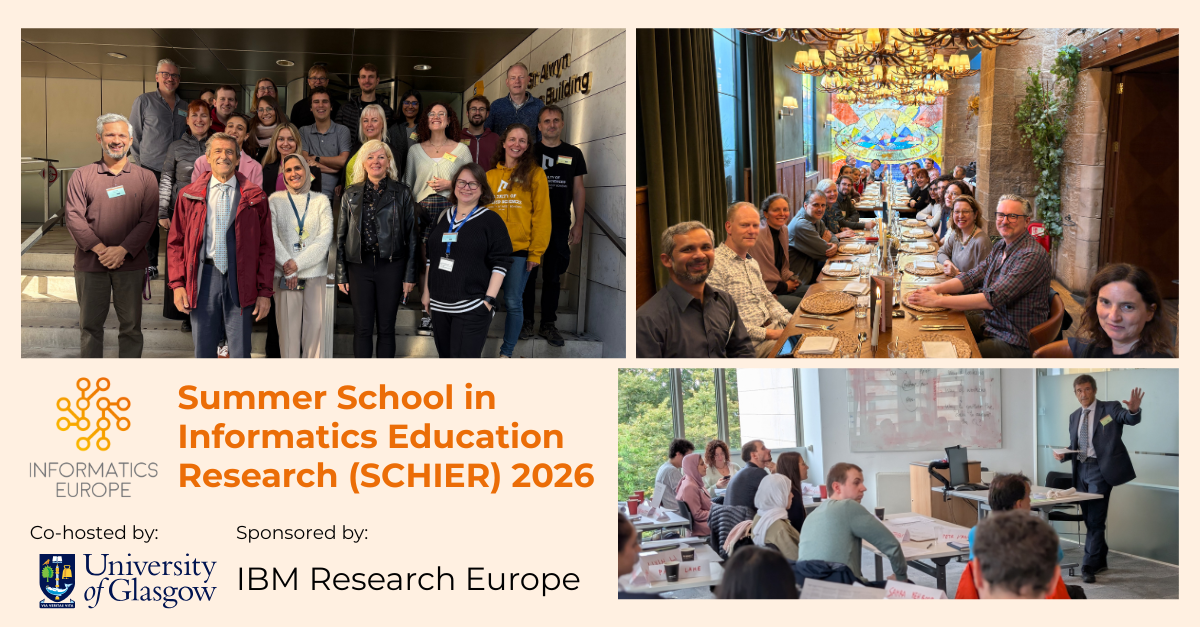
SCHIER 2026: Strengthening the Community of Informatics Education Researchers
Growing the next generation of Informatics Education researchers starts with creating opportunities to learn, exchange and connect.
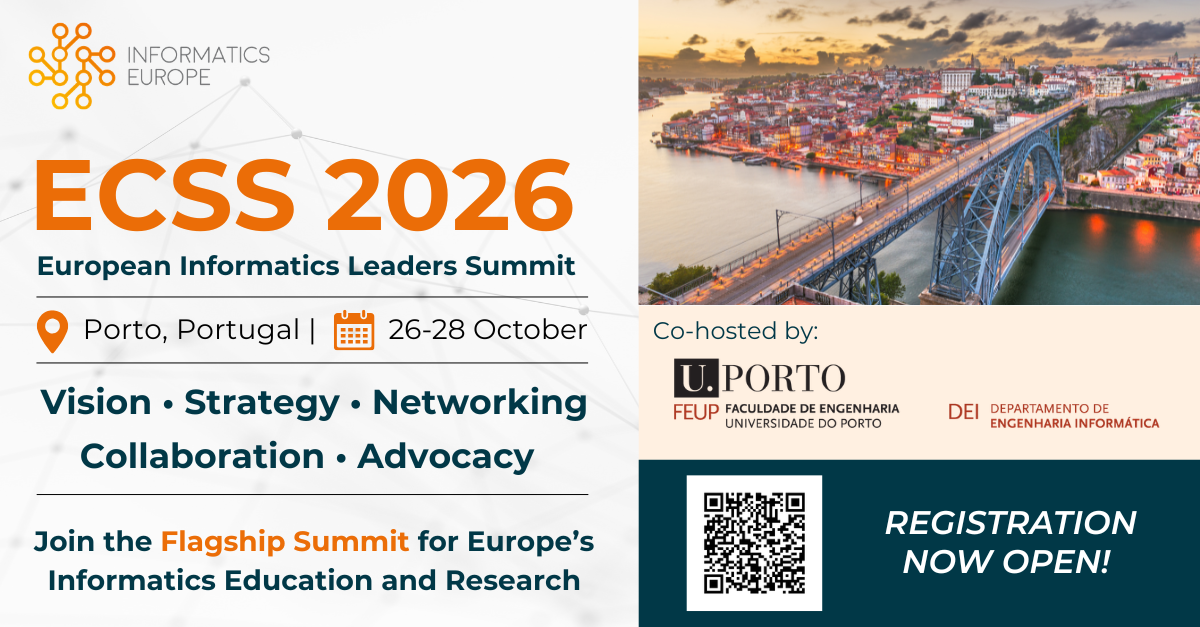
ECSS 2026: Registration Now Open
Registration is now open for ECSS 2026, a unique summit for Europe’s Informatics community to address timely strategic and policy issues in Informatics research and education.
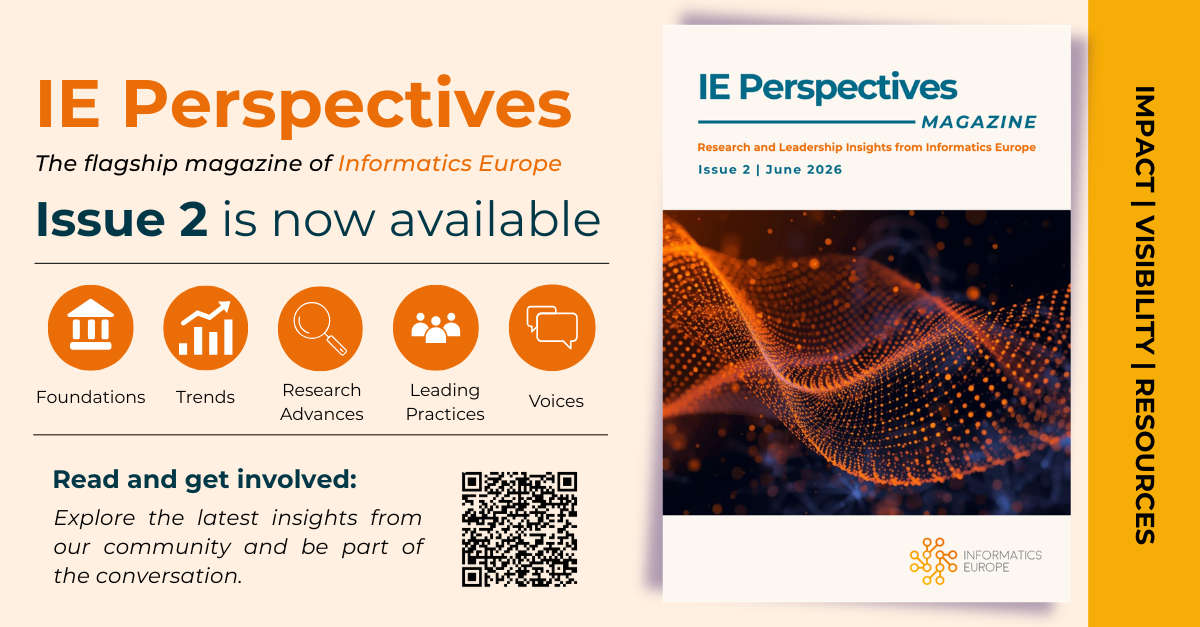
The Second IE Perspectives: Introducing New Section & Co-Editor-in-Chief
Discover the latest IE Perspectives, featuring a new "Foundations" section dedicated to stories of European curiosity-driven Informatics research that has shaped disciplines, technologies and society.
Social Responsibility of Informatics
The last years have clearly shown that Informatics is not anymore only a solid and pervasive scientific discipline with a huge potential for technological innovation, but it is also deeply affecting the fabric of our society. More and more, informatics systems automatically control our lives, regulate our personal and social relations, and take decisions directly affecting ourselves, other people and the whole society. This situation is often perceived completely only when something wrong happens. The literature includes a significant number of situations where technical problems, software bugs in many cases, have caused significant incidents with loss of money and human lives. Moreover, the experience is showing that the more we increase the power and autonomy of our informatics systems, the more the criticality of incidents increase.
Scientists and technologists cannot forget being first of all human beings, and - as such - cannot forget about the social impact of their science and technology. This has been true at least since Hippocrates introduced the Oath which became the reference code of ethics for physicians. Now Computer Scientists find themselves in a similar situation. In fact, while the increasing automation offered by informatics could allow humankind to achieve huge possibilities of progress, it could also dramatically affect not only everybody's quality of life, but also fundamental rights of individuals and society.
It is therefore becoming mandatory that our scientific community reflects on the "Social Responsibility of Informatics" and makes sure that this "social responsibility" perspective is more and more integrated into our teaching and research.
During the ECSS, prominent academics, industry leaders and decision makers discussed the importance of responsibility assigned to us by an unbelievably powerful technology, offering food for thought in state-of-the-art lectures, an engaging panel discussion and examples of successful stories.
Invited Keynote Speakers:
- Tony Belpaeme, Ghent University
- Virginia Dignum, Umeå University
- Mireille Hildebrandt, Vrije Universiteit Brussel
- Luciano Floridi, University of Oxford (remote participation)
- Paola Inverardi, University of L'Aquila
- Bernd Stahl, De Montfort University
Panellists:
- Guglielmo Tamburrini, University of Naples (Panel Chair)
- Philip Larrey, Pontifical Lateran University
- Peggy Valcke, KU Leuven
- Hannes Werthner, TU Vienna




 Netlogica