
Informatics Europe Sessions
Every year special sessions are dedicated to Informatics Europe (IE) members to strengthen their networks and participate actively in the main decisions regarding the strategy for IE's future development. In these special sessions, you can learn about our latest activities and outcomes. This year the IE special sessions was held on Tuesday, 24 October and included:
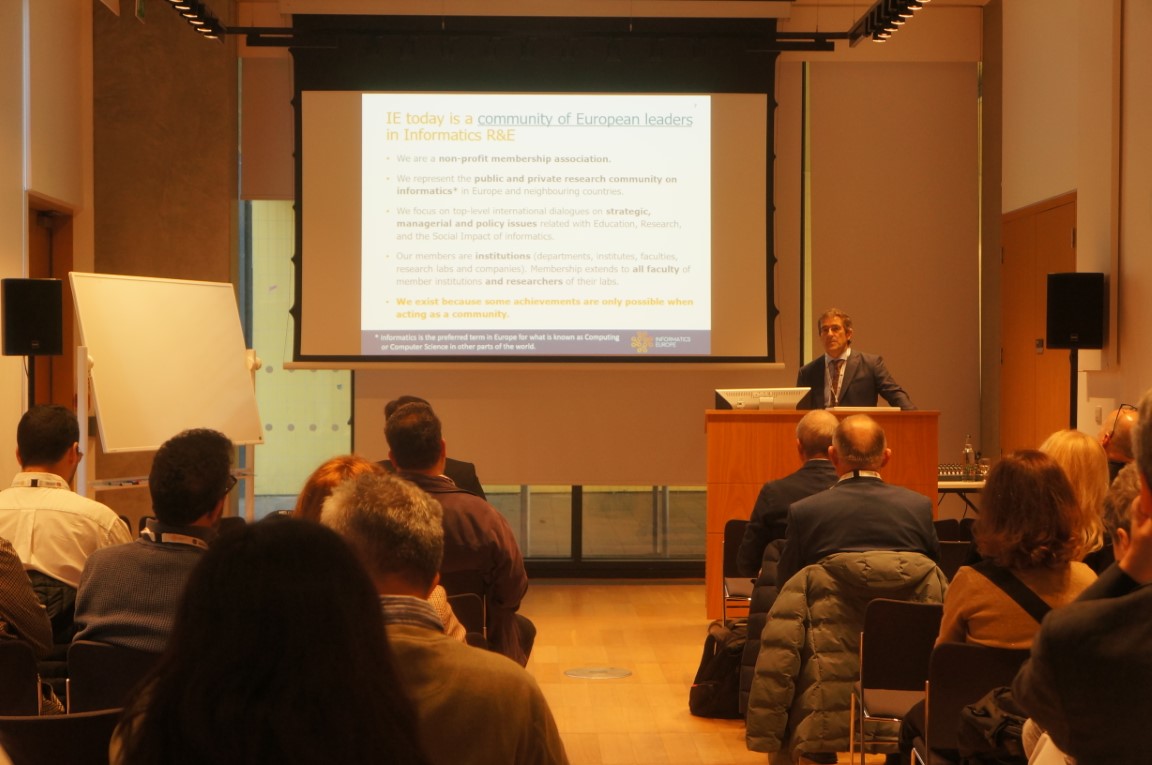
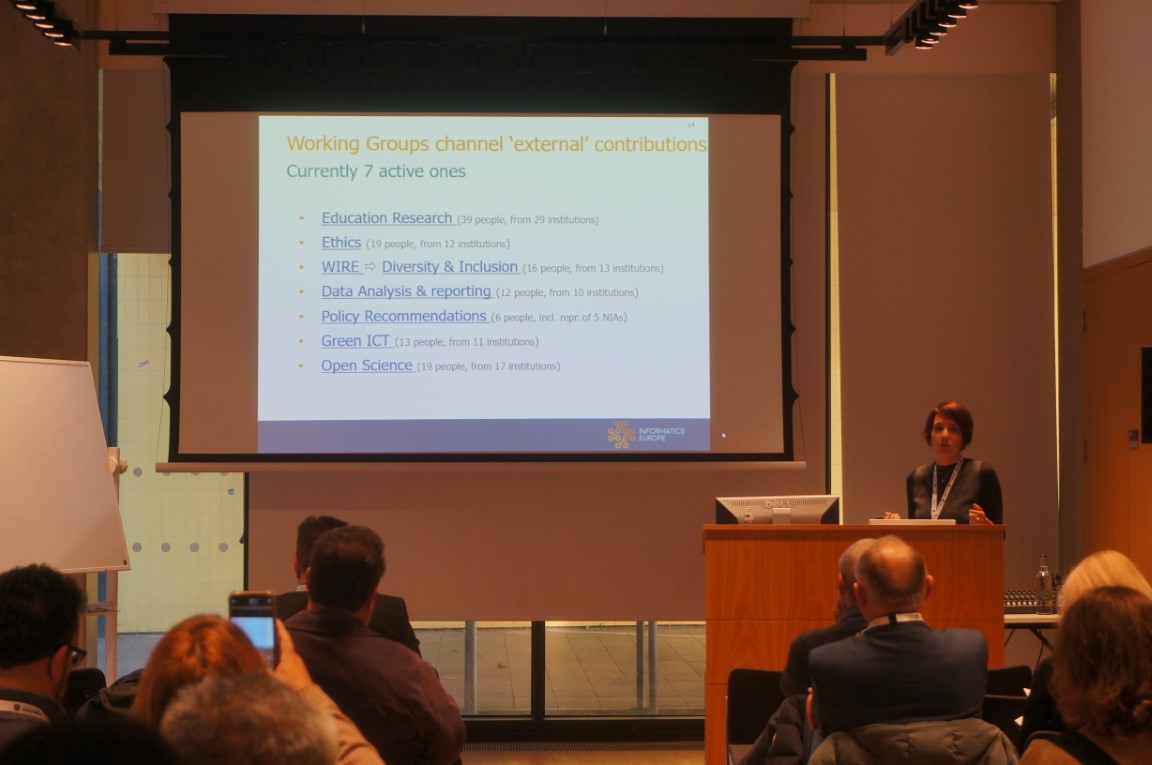
- 14:15 - 15:30 Dialogue with Members - Informatics Europe Activities and Outcomes where the progress and important outcomes of Informatics Europe Working Groups and High-Level activities were presented. [Slides]
- 18:00 - 19:00 Informatics Europe General Assembly, where members voted for Board elections and approval of financial reports and budget.
*Please note that the photos below are better viewed when applying zoom out.


ECSS 2023 - Highlights
The 19th European Computer Science Summit (ECSS 2023) was held from October 23-25 in Edinburgh, UK. Co-organised by the School of Informatics of the University of Edinburgh and sponsored by Huawei and Edinburgh Innovations, the Summit convened all levels of informatics leaders, researchers, policymakers and industry representatives to discuss this year’s main theme “Informatics: Shaping the Future”.
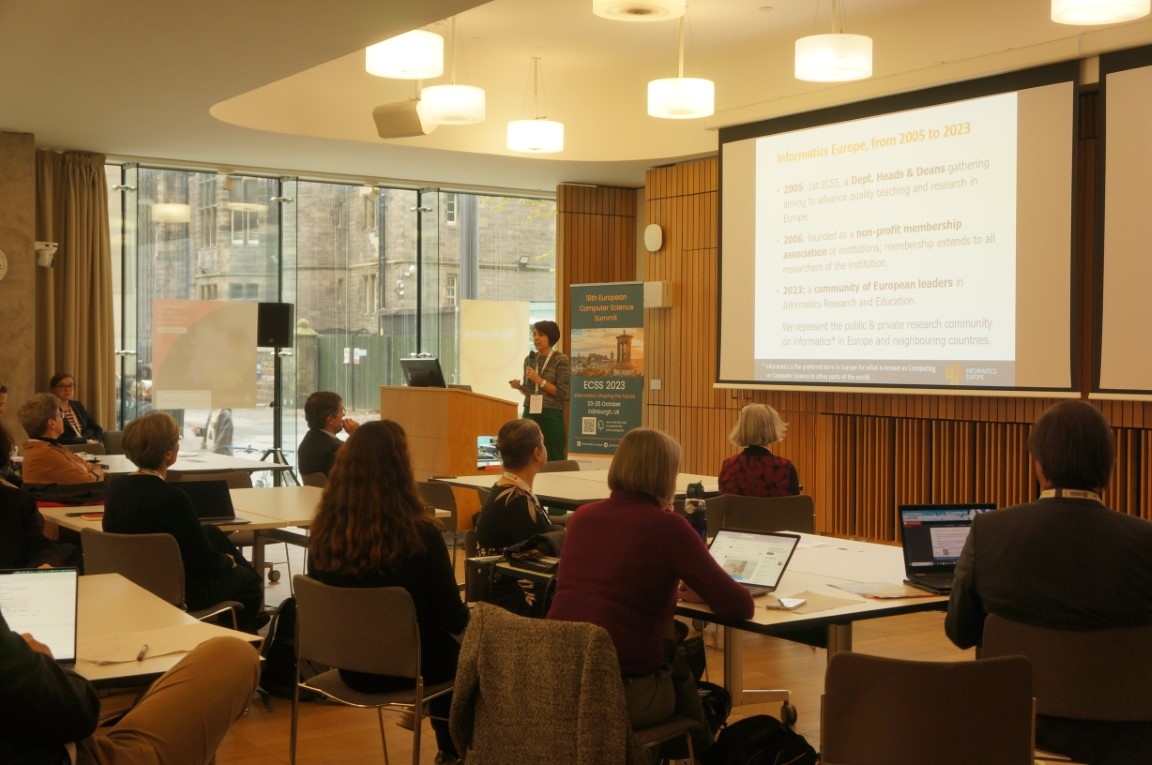
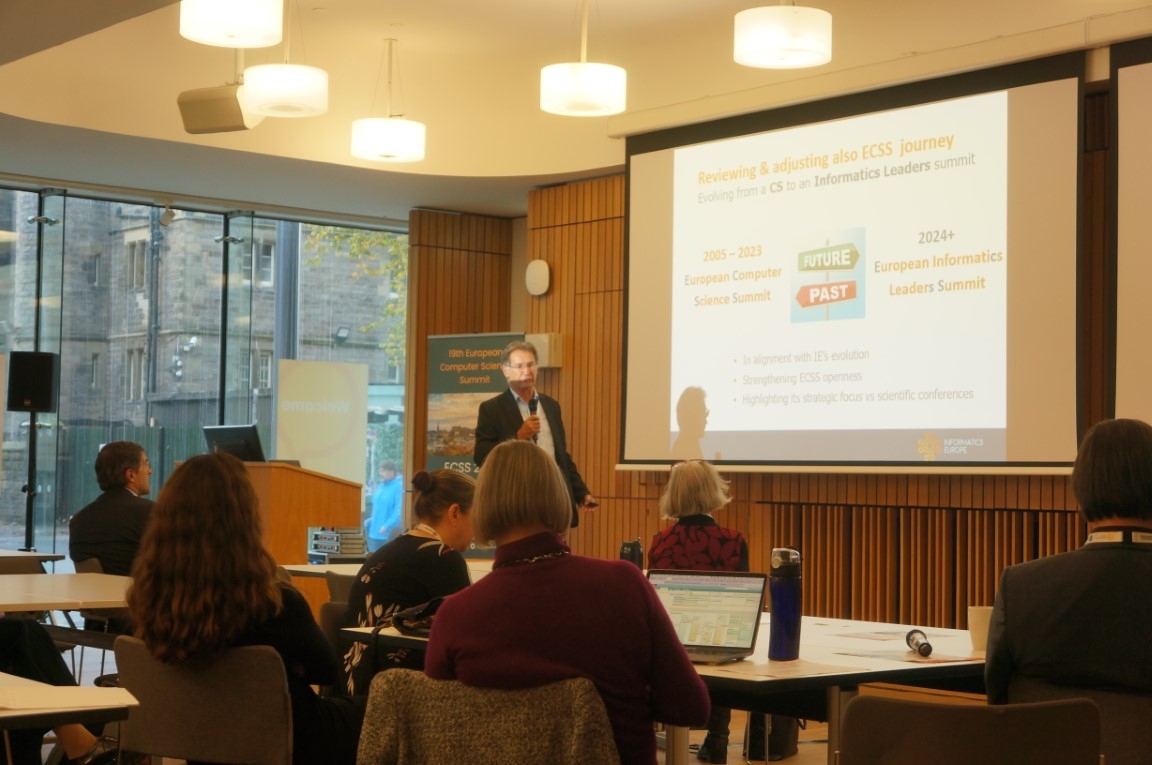
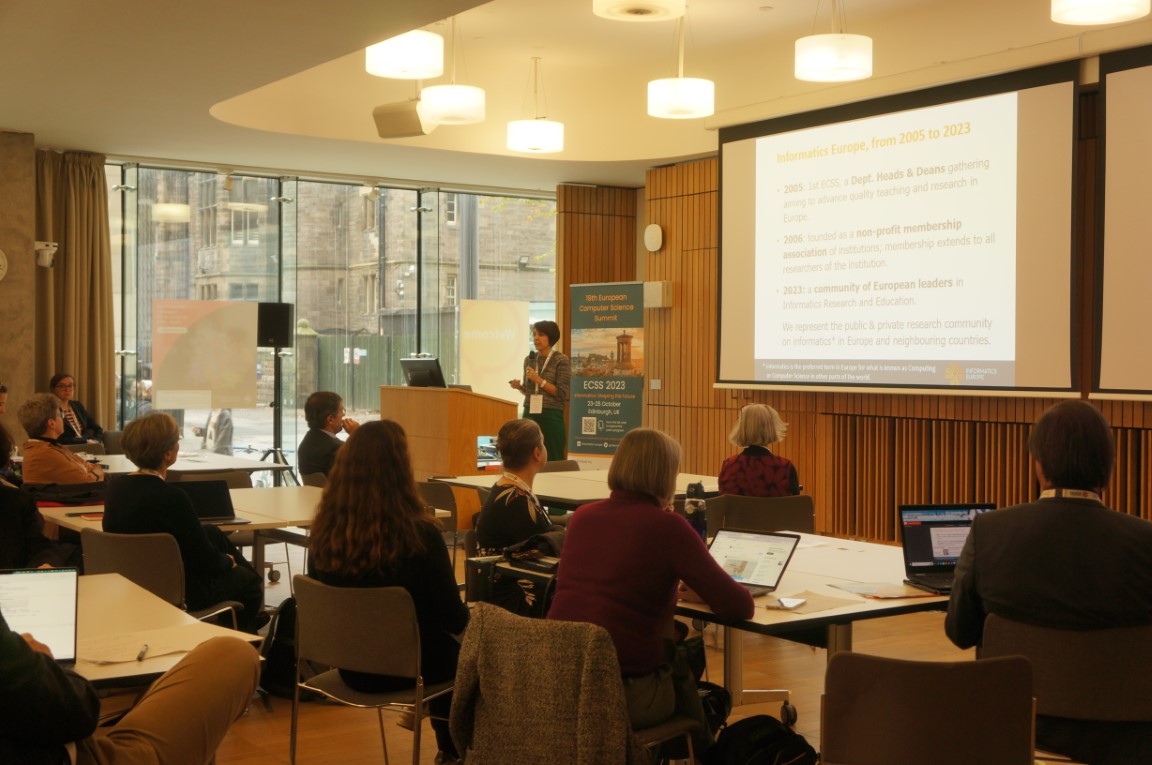
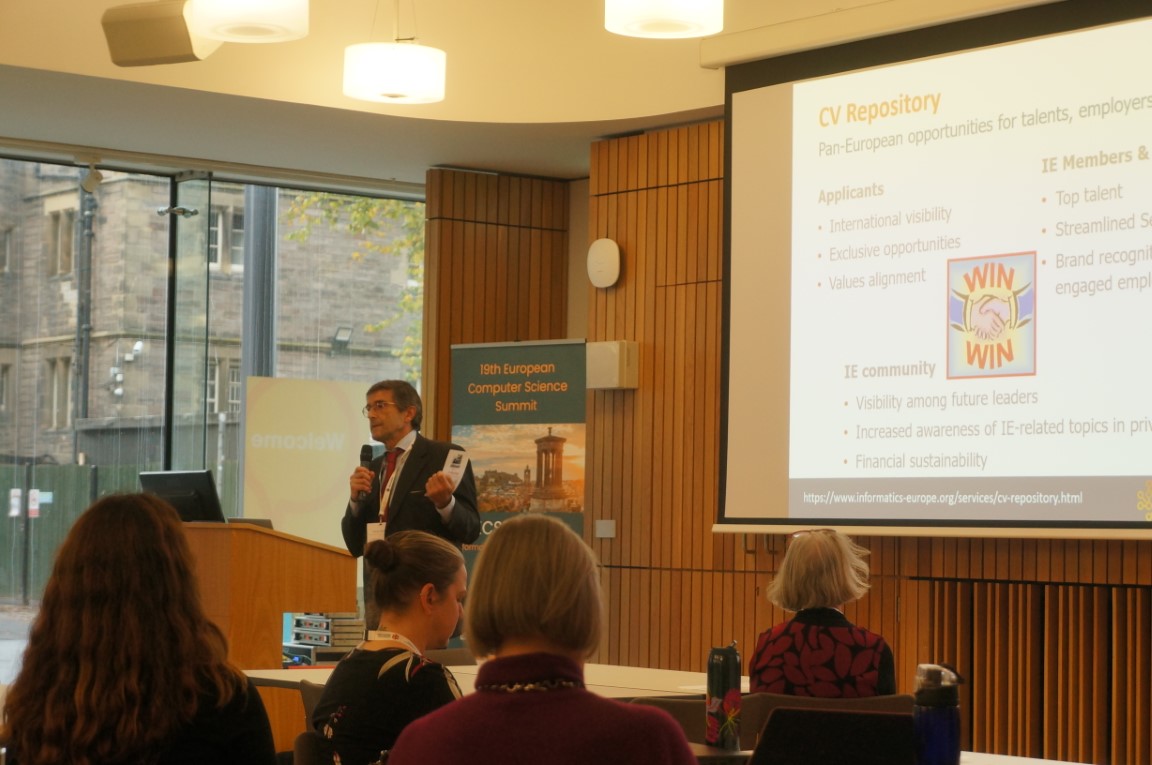
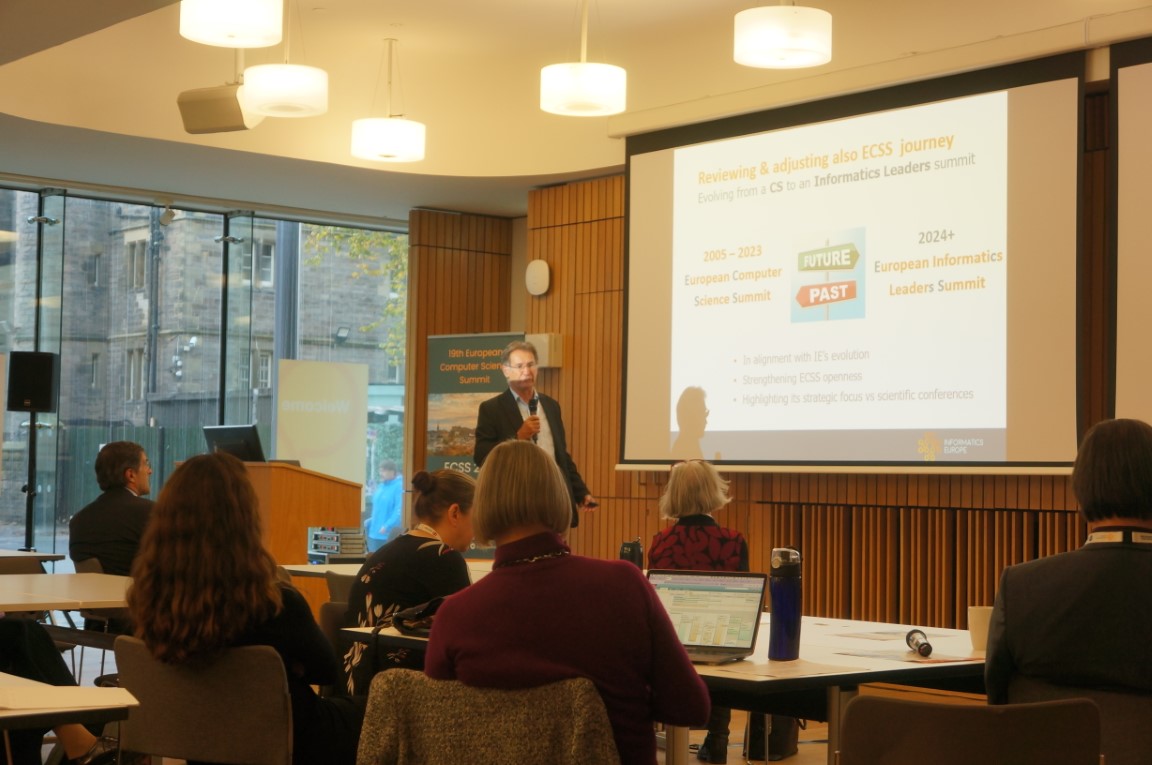
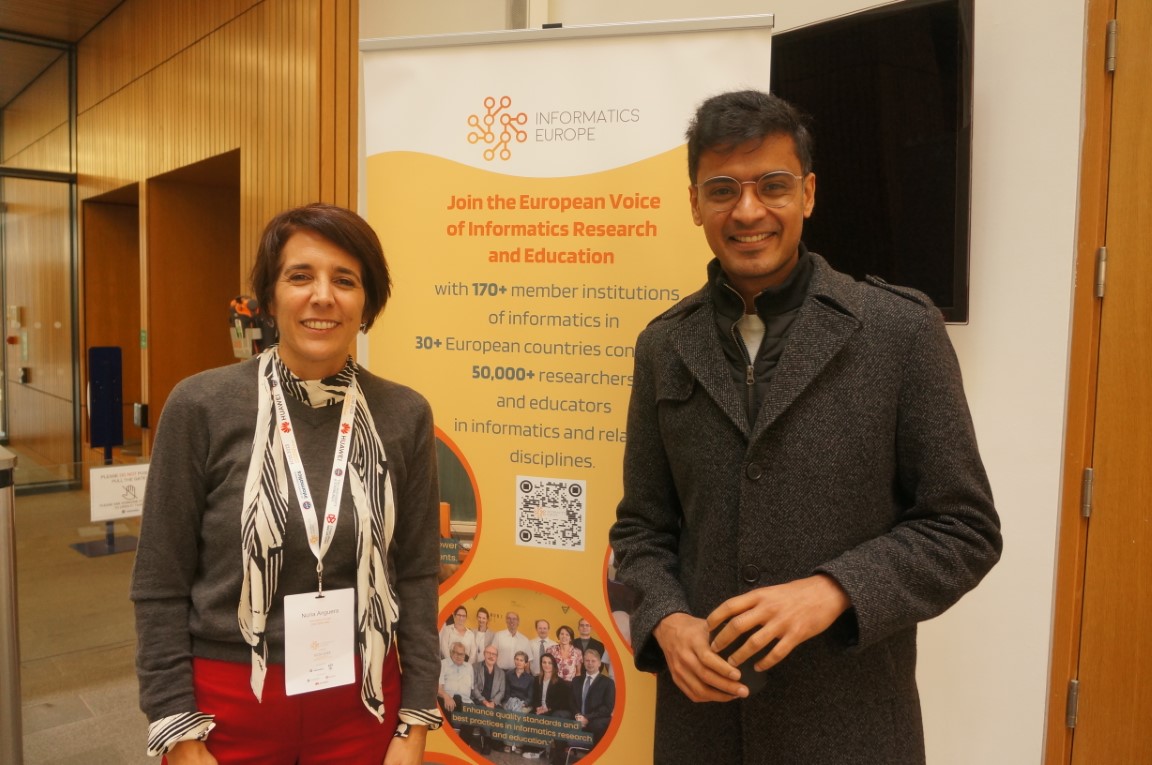
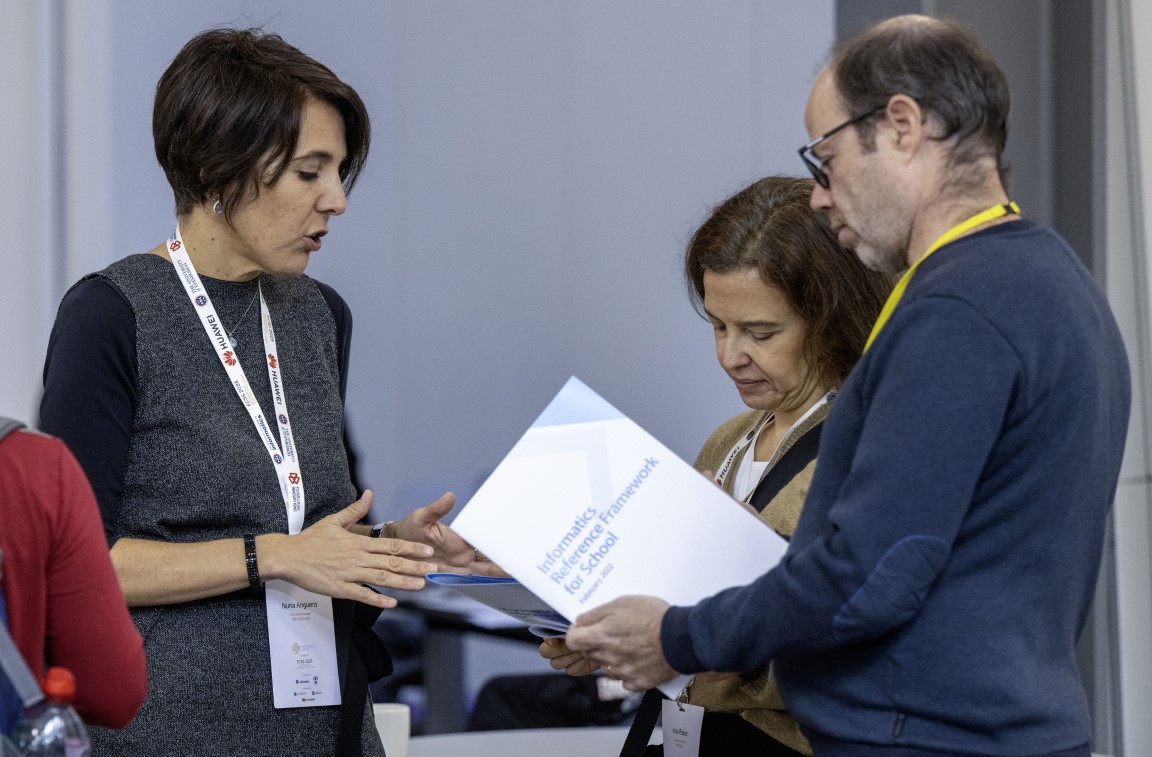
A special Informatics Europe introductory session took place before the official opening of ECSS 2023, where Enrico Nardelli, IE President and Nuria Anguera, IE Executive Director offered insights into IE activities and membership benefits.
Following the special session, Iain Grant Gordon, Vice-Principal at University of Edinburgh and Head of its College of Science and Engineering, Jane Hillston, Conference Co-Chair and Professor of School of Informatics at University of Edinburgh, and Enrico Nardelli, IE President and Conference Co-Chair, officially inaugurated ECSS 2023. The Summit then commenced with two concurrent workshops: Leaders Workshop and Professional Development Workshop for Early Career Researchers.
Leaders Workshop
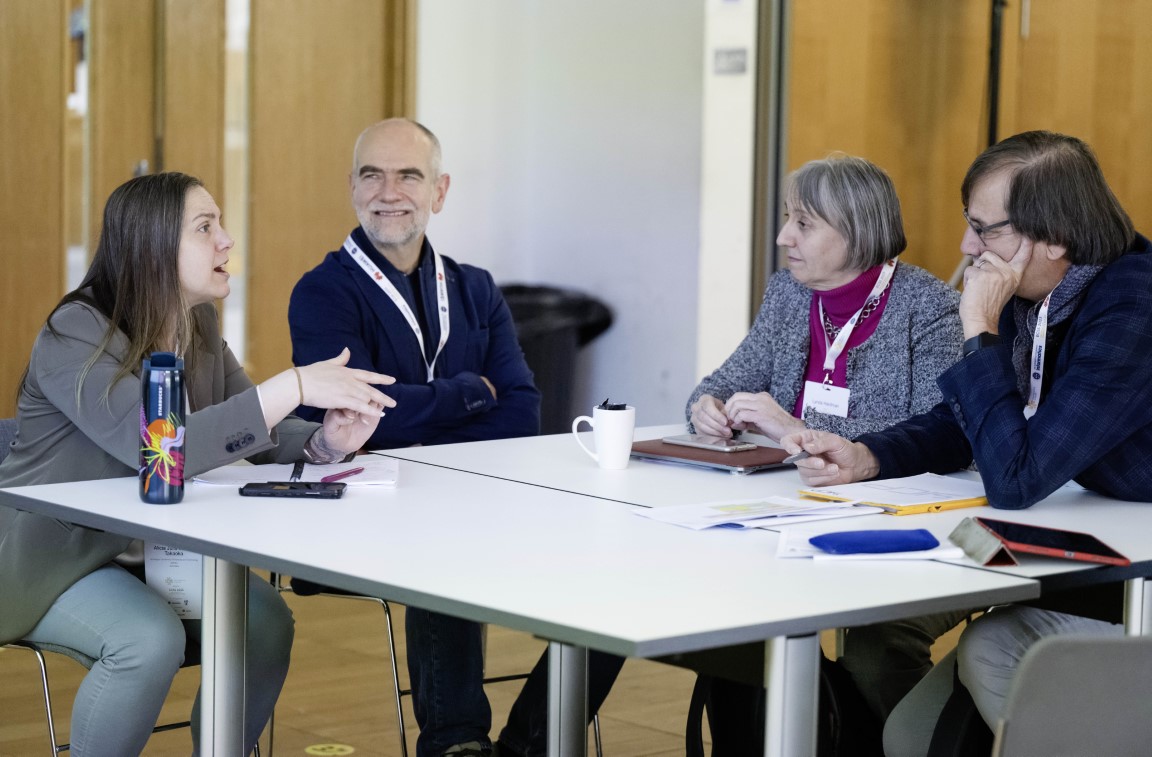
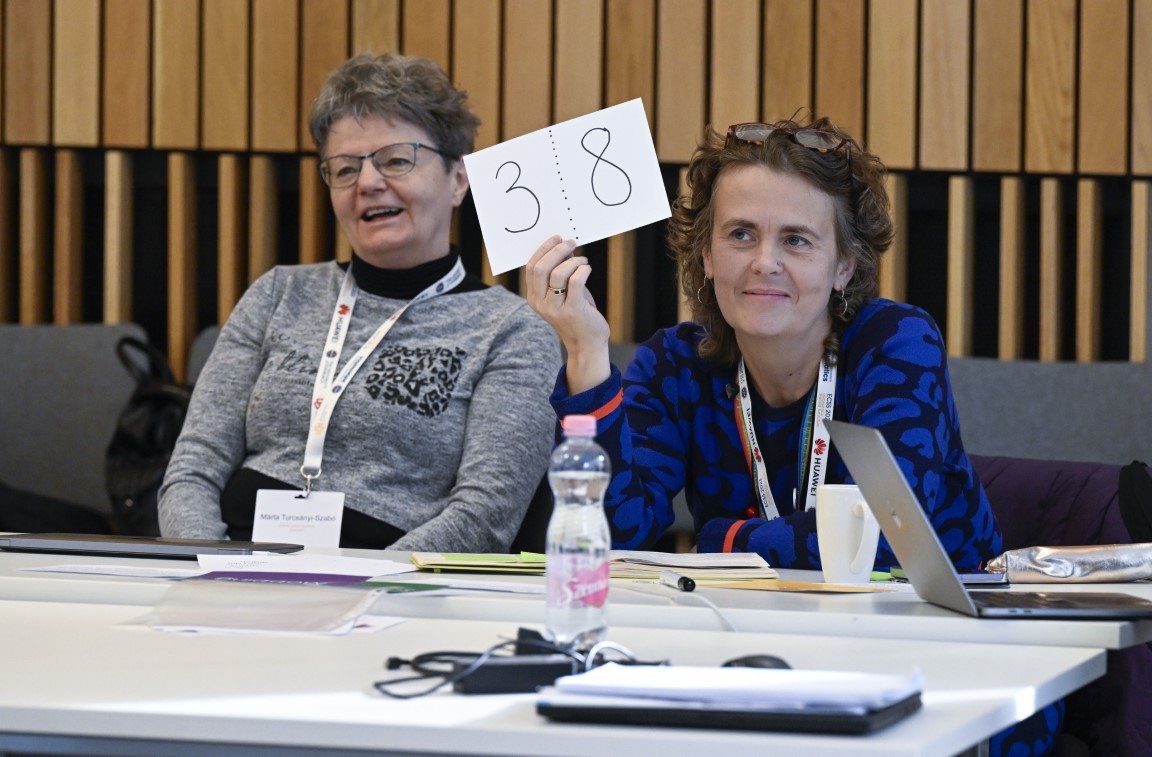
Co-organised with COST Action EUGAIN – European Network For Gender Balance in Informatics, the Workshop brought together leaders from various backgrounds and regions across Europe to discuss critical issues of diversity and inclusion in the field of informatics, including gender equality.
Facilitated by Jane Hillston (University of Edinburgh, UK & EUGAIN COST Action member), the first session encouraged participants to reflect on their journeys in the field of informatics, and share their diverse experiences, perspectives and where they stand today. The session was then followed by a presentation by Marieke Huisman (University of Twente, the Netherlands & EUGAIN COST Action member), who provided valuable insights into promoting diversity and inclusivity, especially in hiring and promoting women within informatics departments, in both academic and professional settings.
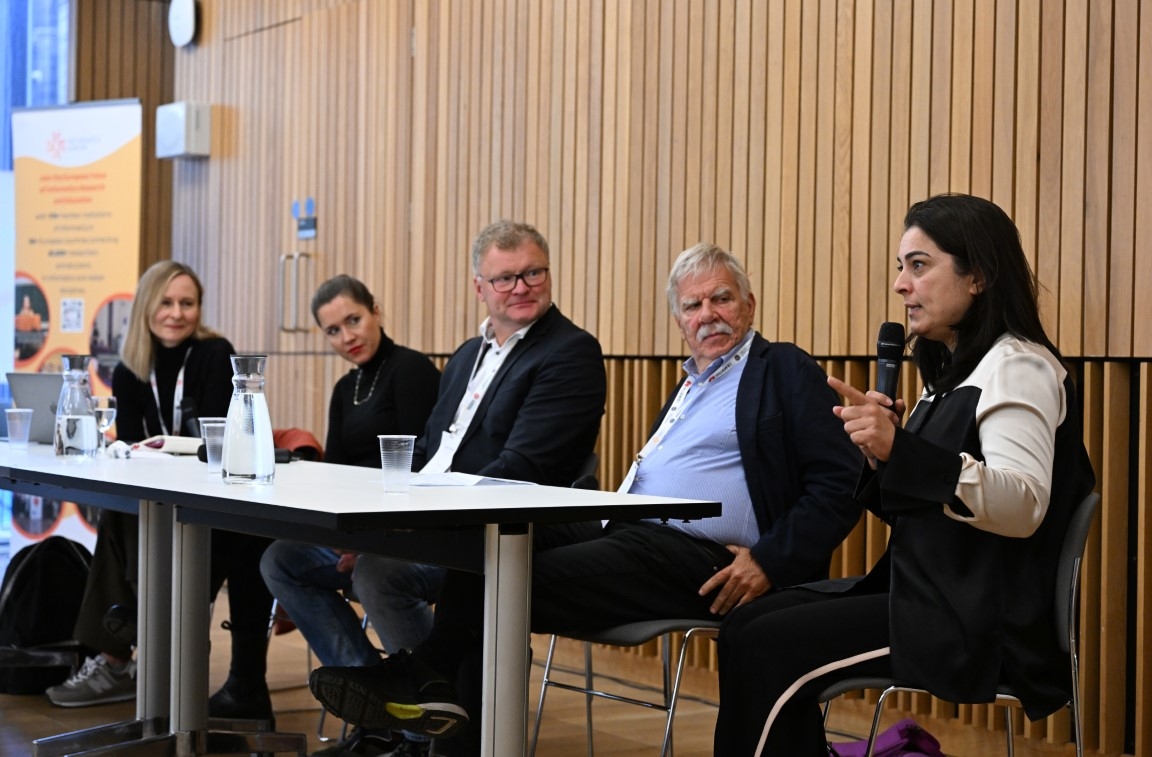
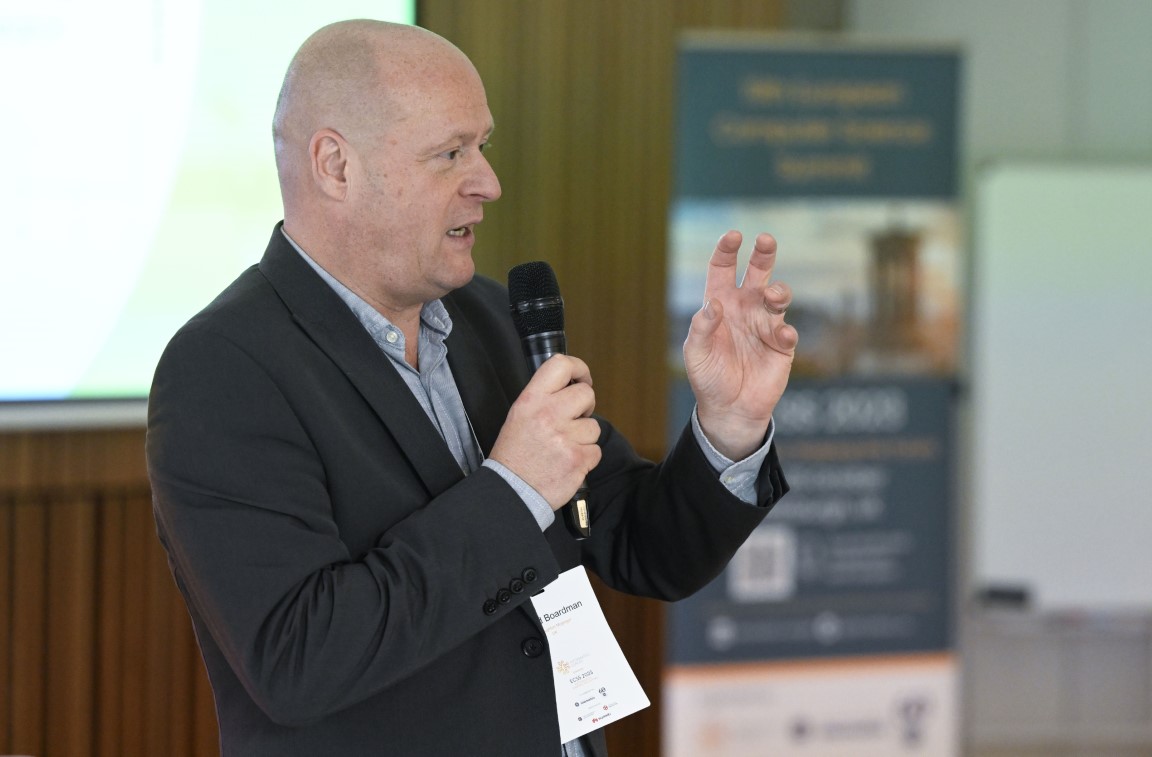
After lunch, Richard Boardman (2Macs, UK) led a thought-provoking workshop with group discussions on weighing the balance between rights and wants, acceptability, and boundaries. Attendees left with actionable insights for promoting inclusivity. The workshop was then followed by a vivid panel discussion with Aurora Constantin, Jacques Fleuriot, and Sara Shinton (University of Edinburgh, UK), on underrepresented groups such as people with disabilities and racial/ethnic minority groups. Their perspectives shed light on the challenges they have faced and the strategies they have employed to thrive in the field of informatics.
The workshop concluded with closing remarks by Jane Hillston and Sara Shinton. Participants left with a sense of purpose and a grasp of necessary actions to drive change and foster a more inclusive future for informatics.
Professional Development Workshop for Early Career Researchers
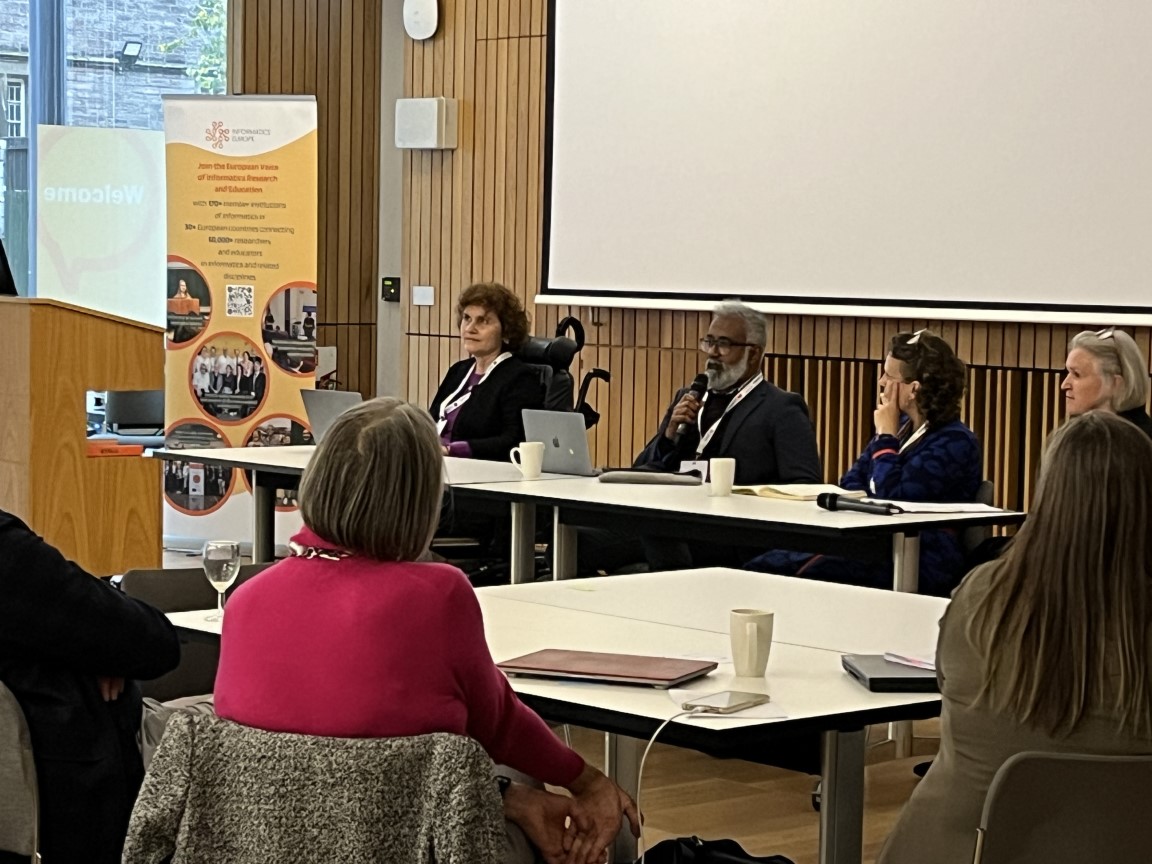
This year’s edition of the Early Career Researchers (ECRs) Workshop, which attracted a big number of participants from different career stages, focused on helping early career researchers plan a successful research career.
Sara Shinton (UKRI Future Leaders Fellowship Development Network, UK) kicked off the workshop with a dynamic presentation on research and innovation leadership. She provided tools to support ECRs seize leadership opportunities and develop the skills necessary to become impactful leaders. She encouraged ECRs to build their networks so as to support their development, and also incorporate leadership training into their plans.
In the afternoon, the workshop continued with a session featuring five panel speakers from academia and industry, who shared with us their experiences and views on the factors that contribute to a successful research career in various sectors:
- Dympna O'Sullivan (TU Dublin, Ireland) outlined crucial factors for ECRs, emphasizing focus on research, effective time management, strategic publication planning, knowing the funding environment and developing leadership skills.
- Marco Aiello (University of Stuttgart, Germany) highlighted the significance of seizing mobility opportunities to expand knowledge, foster collaborations, build networks and enrich experiences with diverse academic cultures as these would help ECRs thrive in academic environments.
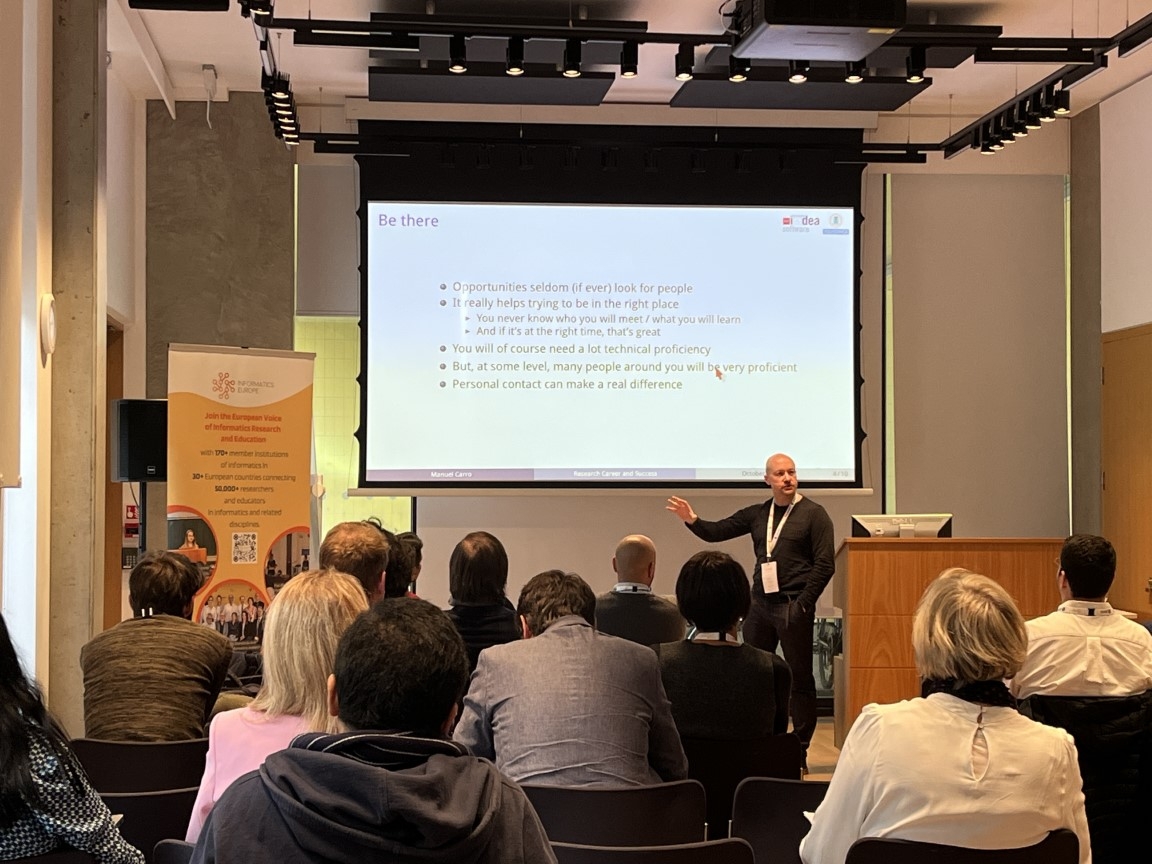
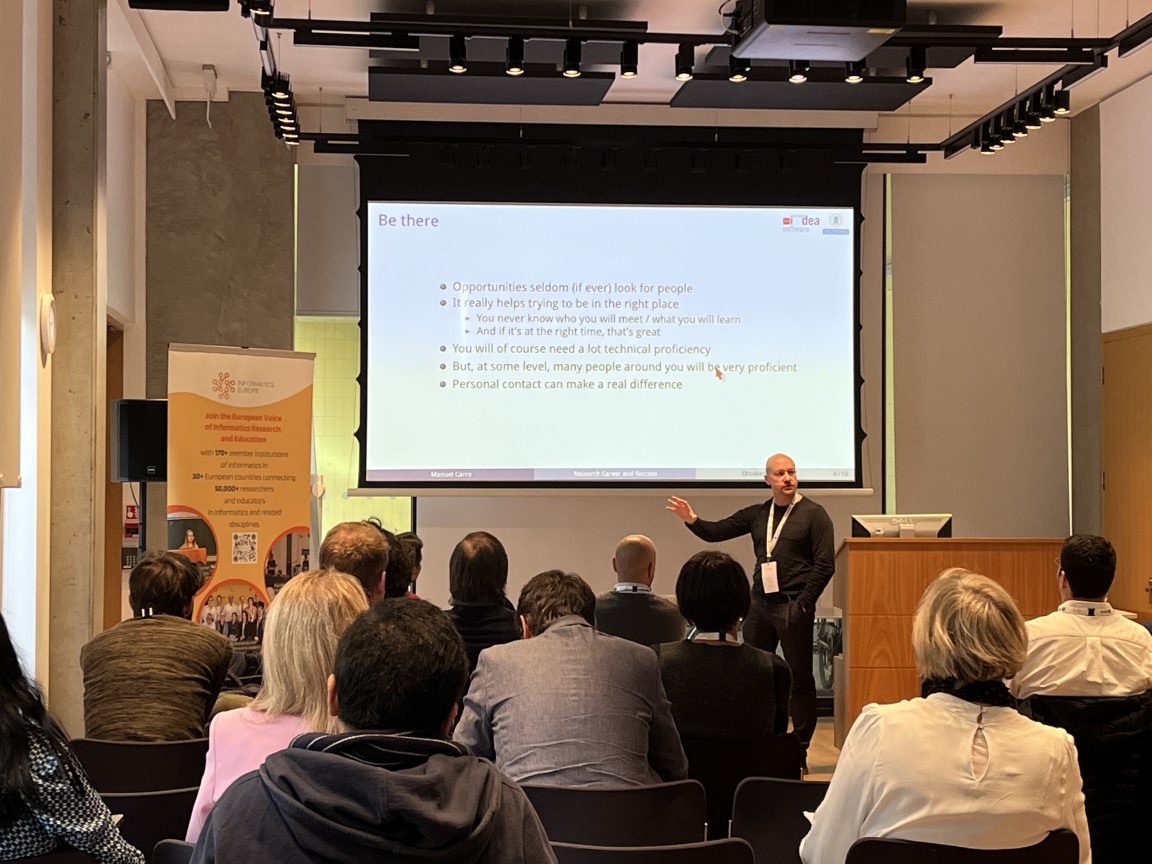
- Manuel Carro (Technical University of Madrid/IMDEA Software Institute, Spain) shared his career insights, including the value of community engagement, trying to be at the forefront of opportunities, being reliable and going the extra mile when collaborating. He encouraged ECRs to surround themselves with a network of excellent people, and emphasize the importance of public speaking skills and maintaining a big-picture perspective.
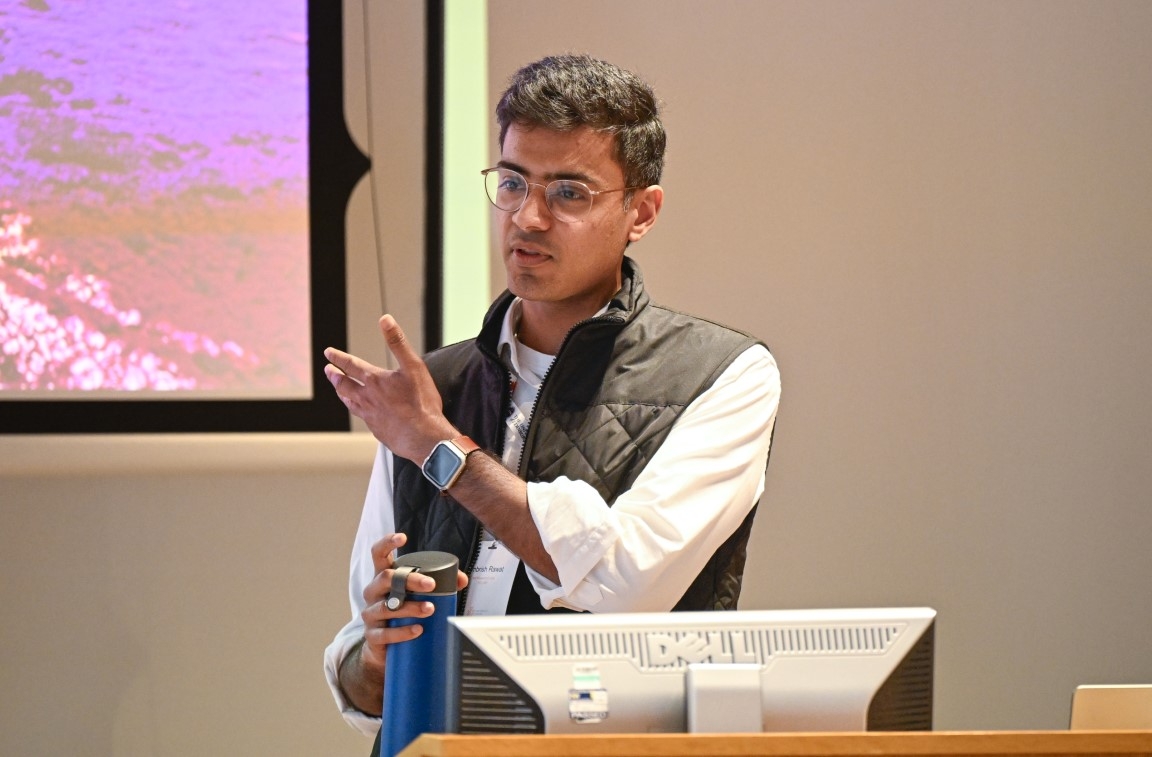
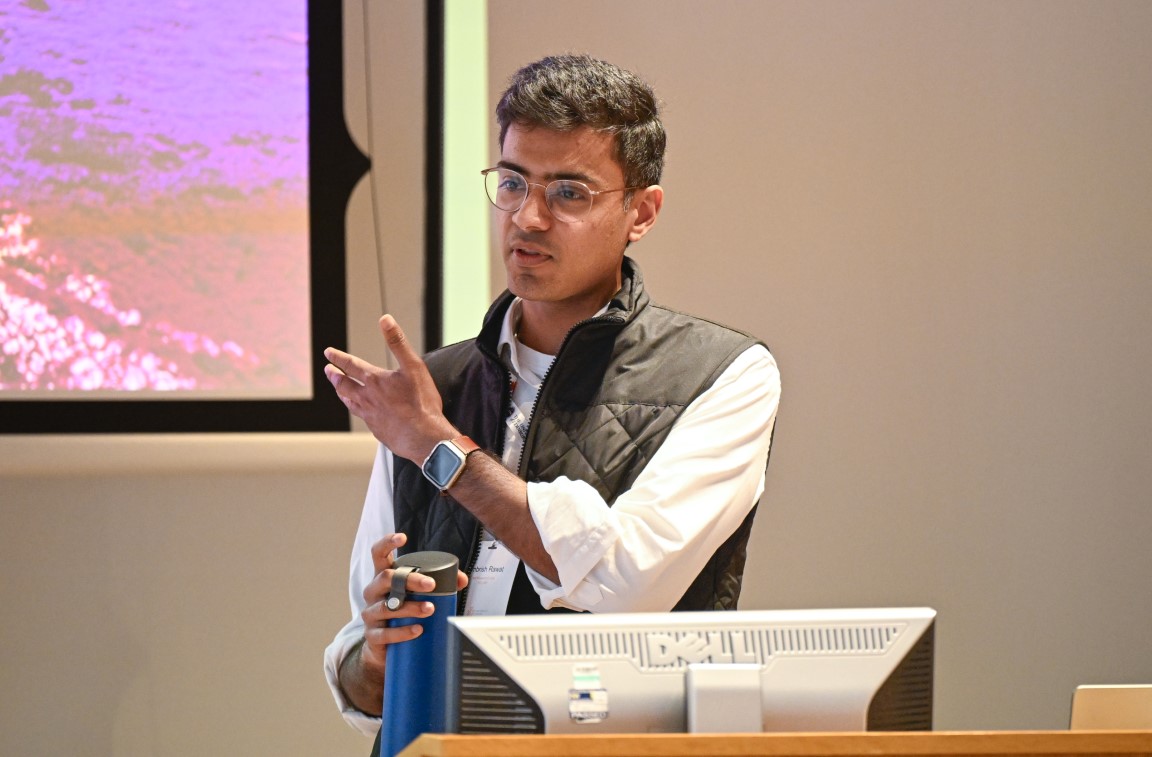
- Ambrish Rawat (IBM Research Europe, Ireland) shared insights as an industry researcher, discussing challenges and opportunities in applied research within the commercial sector. He highlighted the pros and cons of working in hybrid teams, where interesting research challenges needed to be weighed against concrete commercial goals. He highlighted the mindset shift from academia to industry, emphasizing the importance of network support for this transition.
- Victor Lomüler (CodePlay, UK) stressed the significance of passion for research in an industrial setting and developing leadership skills to cope with organizational nuances. He underscored the value of mentors as a crucial support network for enhancing both research and leadership skills.
Participants had the chance to ask questions in a plenary session moderated by Dimka Karastoyanova (University of Groningen, the Netherlands), and joined round table discussions with panelists facilitated by Tobias Grosser (University of Edinburgh, UK).
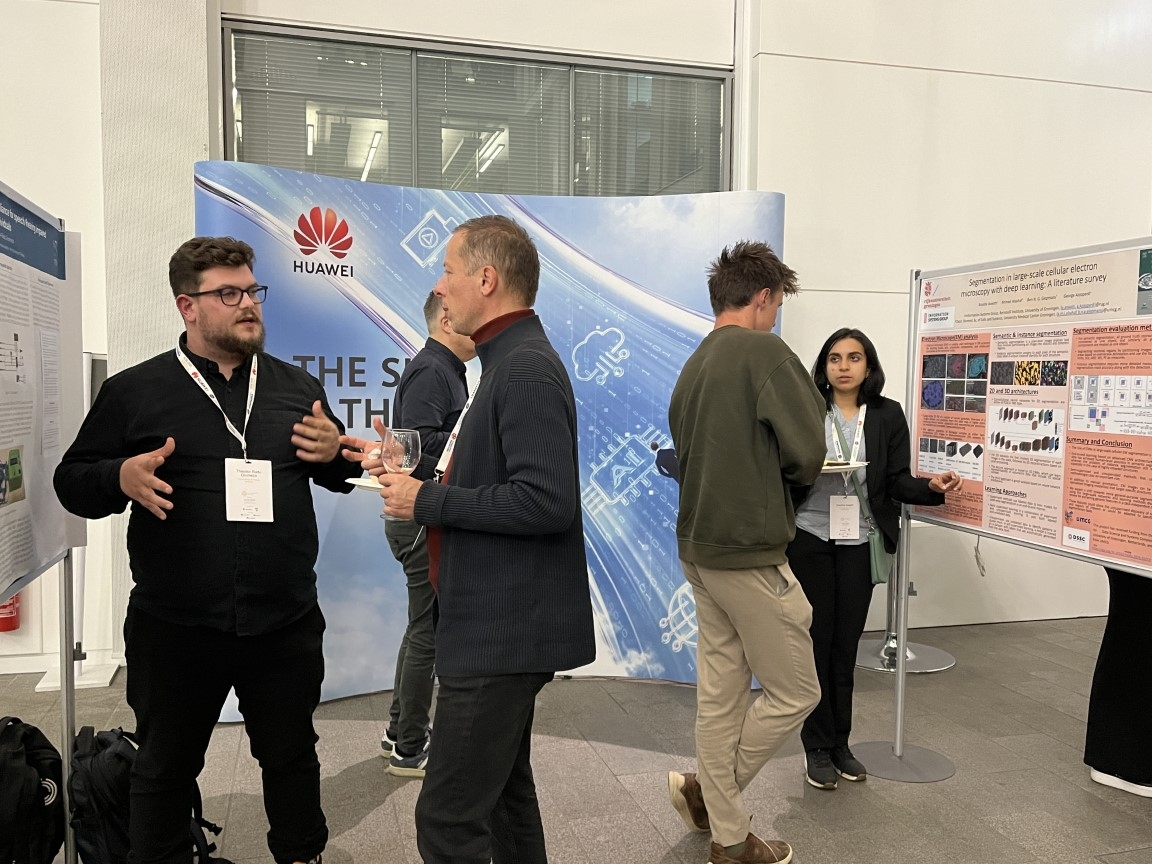
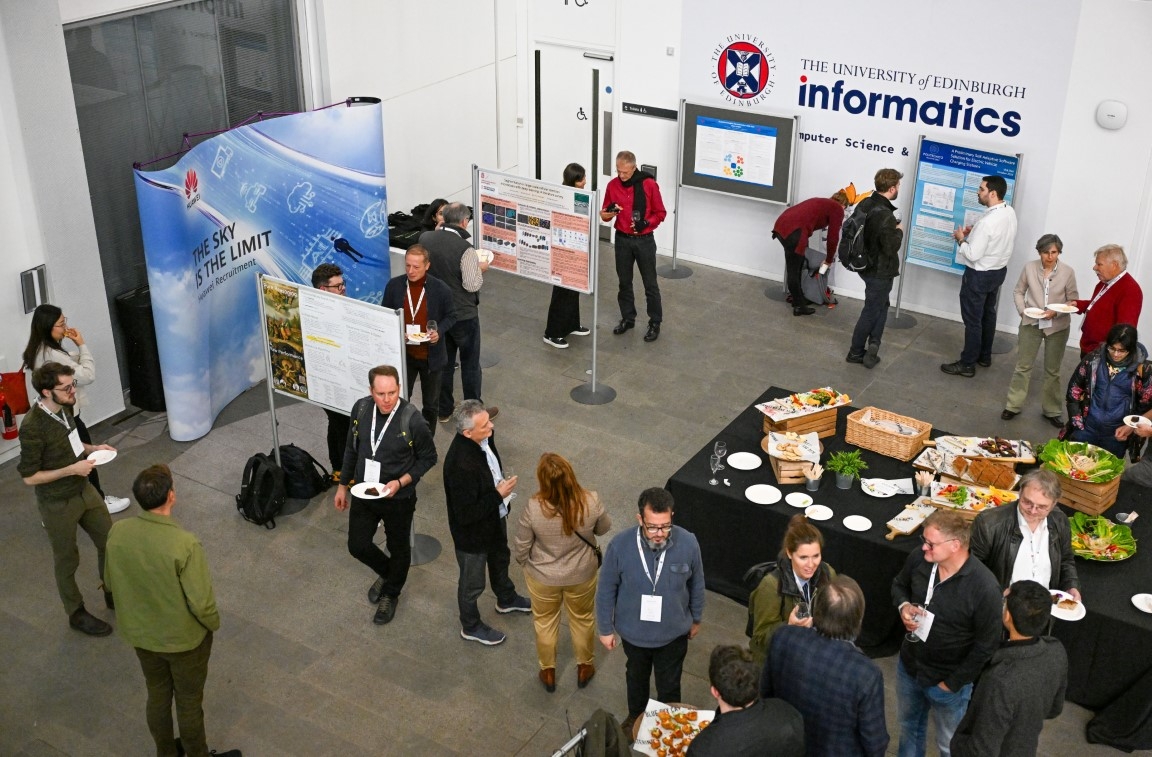
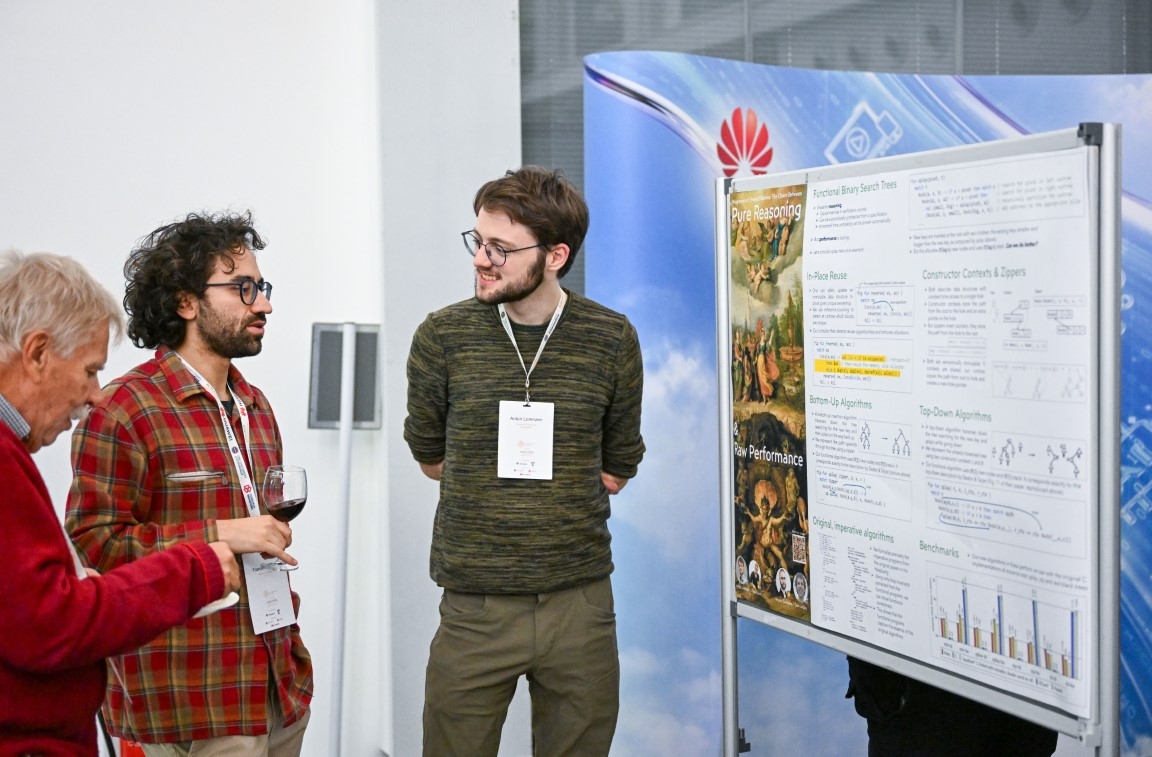
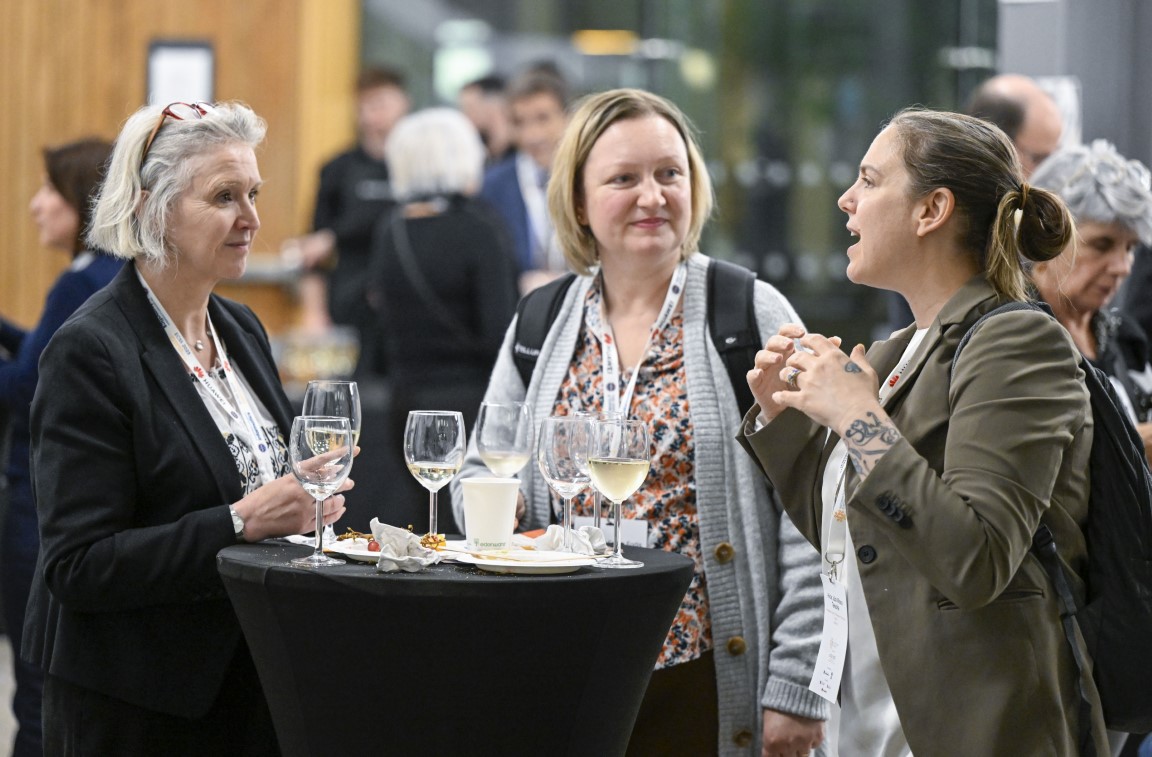
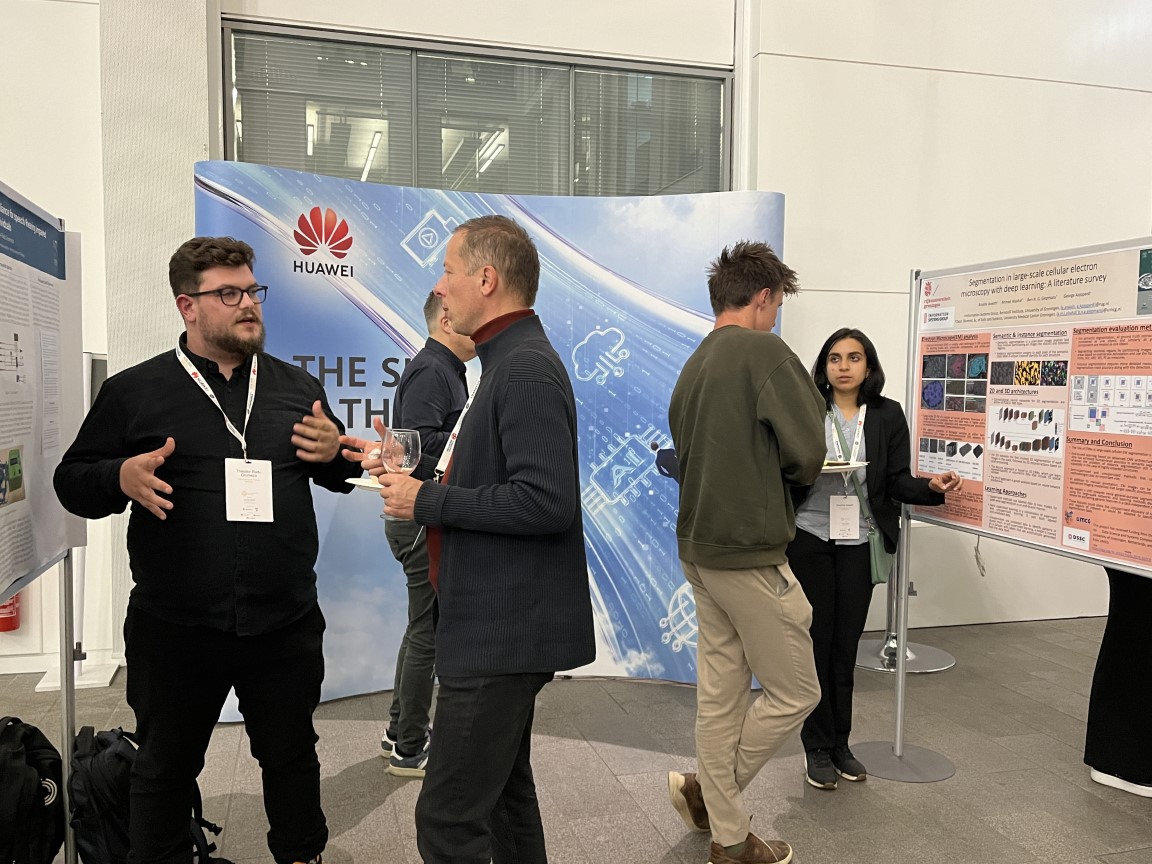
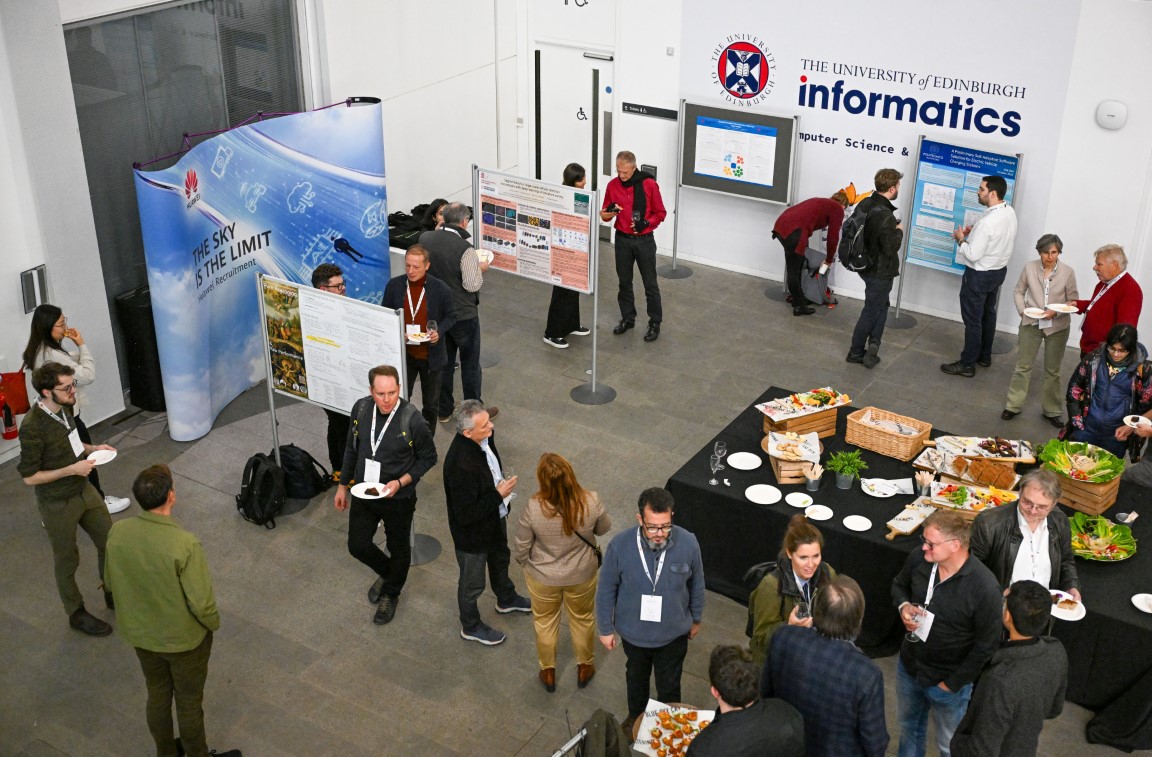
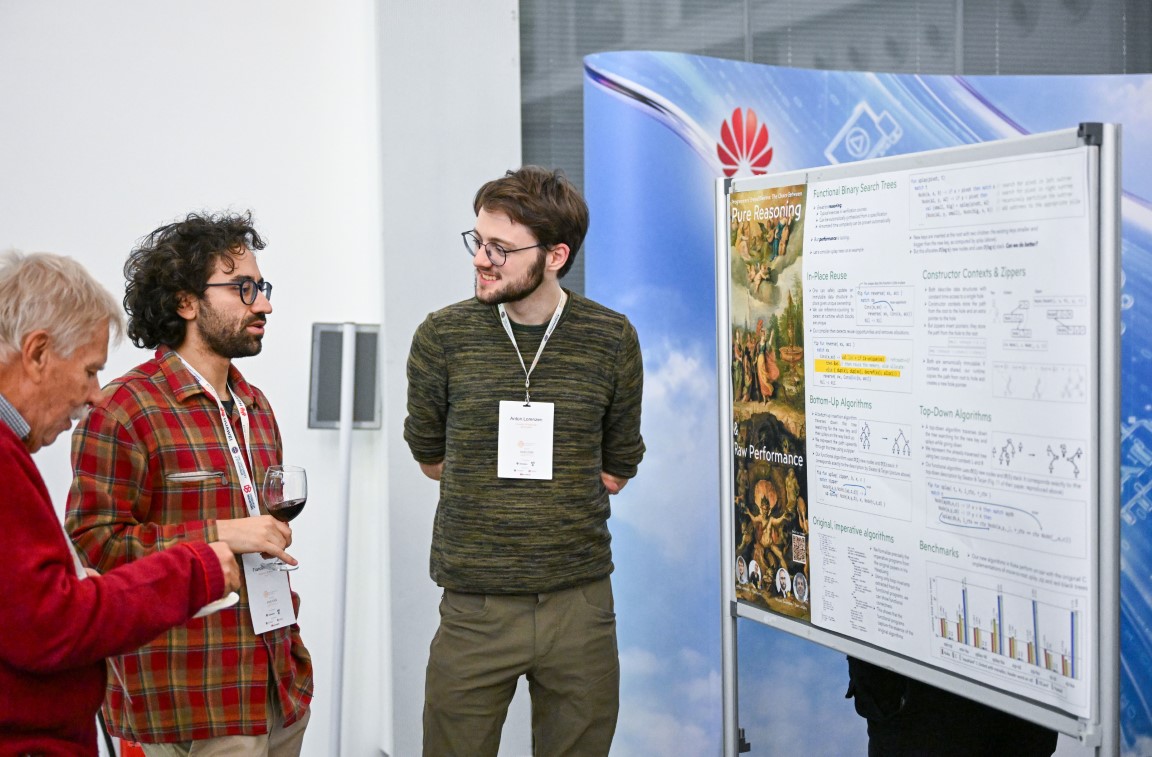
As part of the workshop, a total of 10 research work were presented with posters by informatics PhD students during the ECSS opening reception on Monday evening.
Main Theme – “Informatics: Shaping the Future”
Chaired by Jane Hillston (University of Edinburgh, UK) and Gregor Engels (Paderborn University, Germany), the second day of ECSS 2023 started with the main theme session on the relevance of informatics for shaping the future.
Elham Kashefi (The National Quantum Computing Centre, UK) highlighted characteristics and advantages of quantum computing technology in general and also with a focus on UK initiatives. Mirella Lapata (University of Edinburgh, UK) discussed the central role of large language models in generative AI tools and techniques nowadays, emphasizing the need for human involvement to mitigate risks and ensure unbiased information management. Stefano Ceri (Politecnico di Milano, Italy) delved into data modeling and data analytics techniques in life sciences, demonstrating their effective application in analyzing data during the Covid-19 crisis. Finally, Jochen Viehoff (Heinz Nixdorf MuseumsForum, Germany) addressed diverse computing paradigms, asserting that sustainability demands new (and old) alternatives beyond traditional digital computing to tackle global energy consumption challenges.
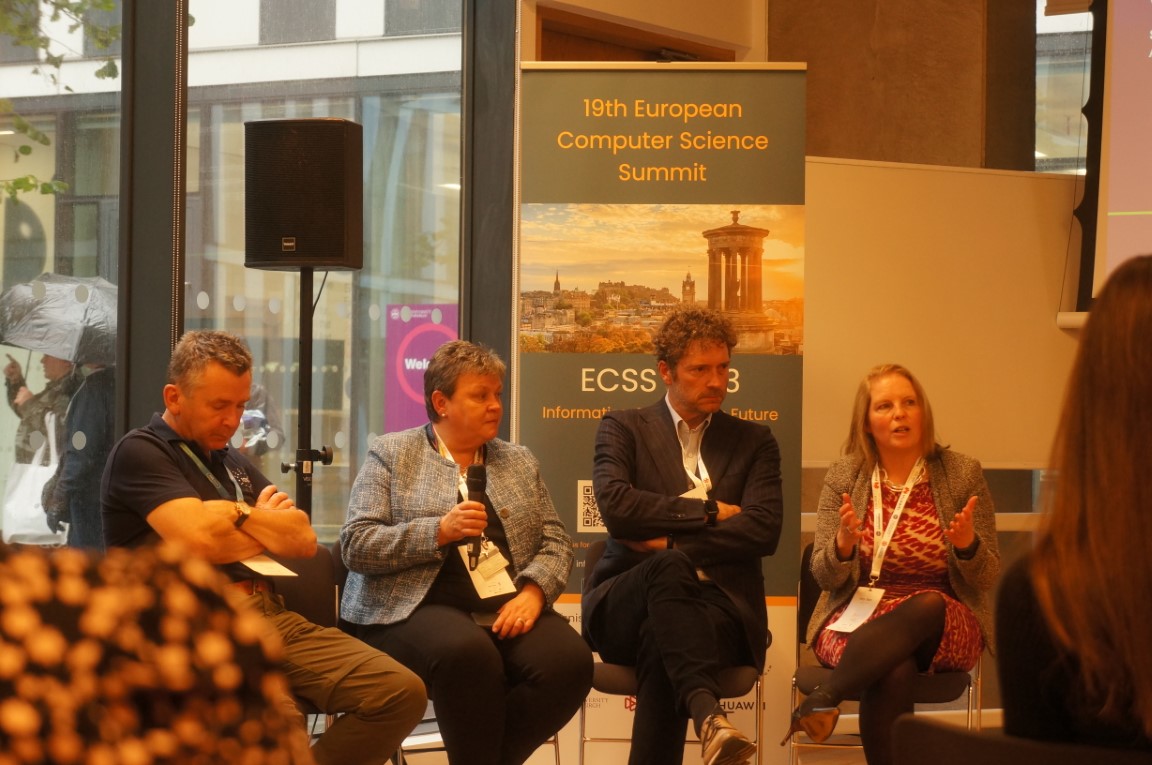
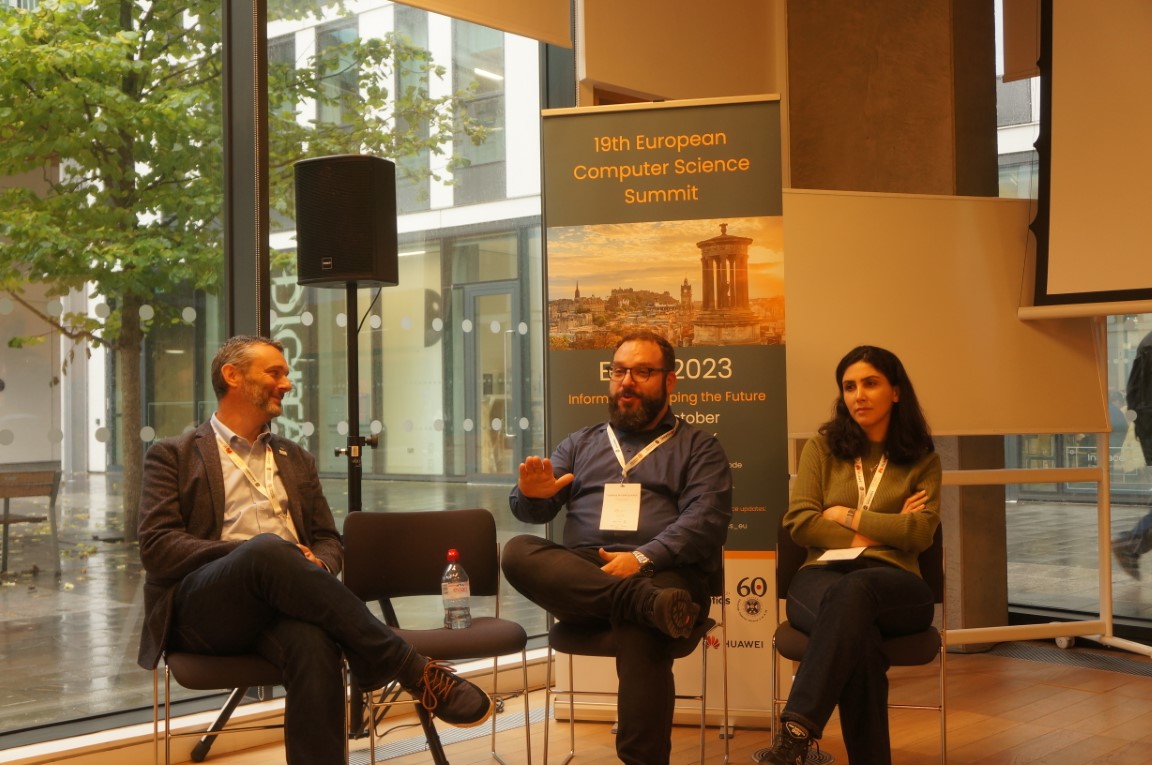
The session continued with a panel chaired by Ewa Luger (University of Edinburgh, UK), where Mira L. Wolf-Bauwens (IBM Research Zurich, Switzerland) also joined the group. Being trained in philosophy, politics and economics, Mira addressed socio-ethical questions that arise with the development of useful quantum computing and quantum-safe technologies. The panelists agreed that it takes the entire classical informatics research to raise useful and reliable quantum computing as well as data science applications. In order to cope with energy consumption and sustainability demands, hybrid approaches combining different computing models aligned with the problem requirements should be the solution in the future. A final take-away was the value of understanding the past to design a reliable and value-based future.
Awards Ceremony
During each ECSS, we celebrate institutions, teams and individuals who have outstanding contributions and performances in the field of informatics.
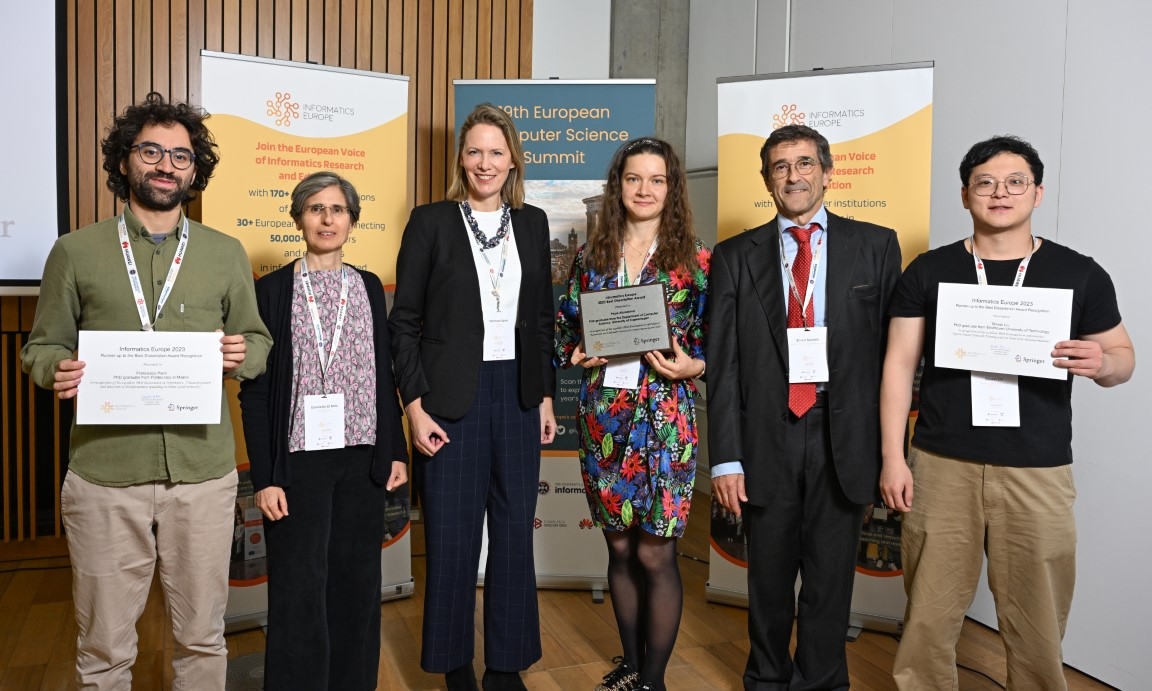
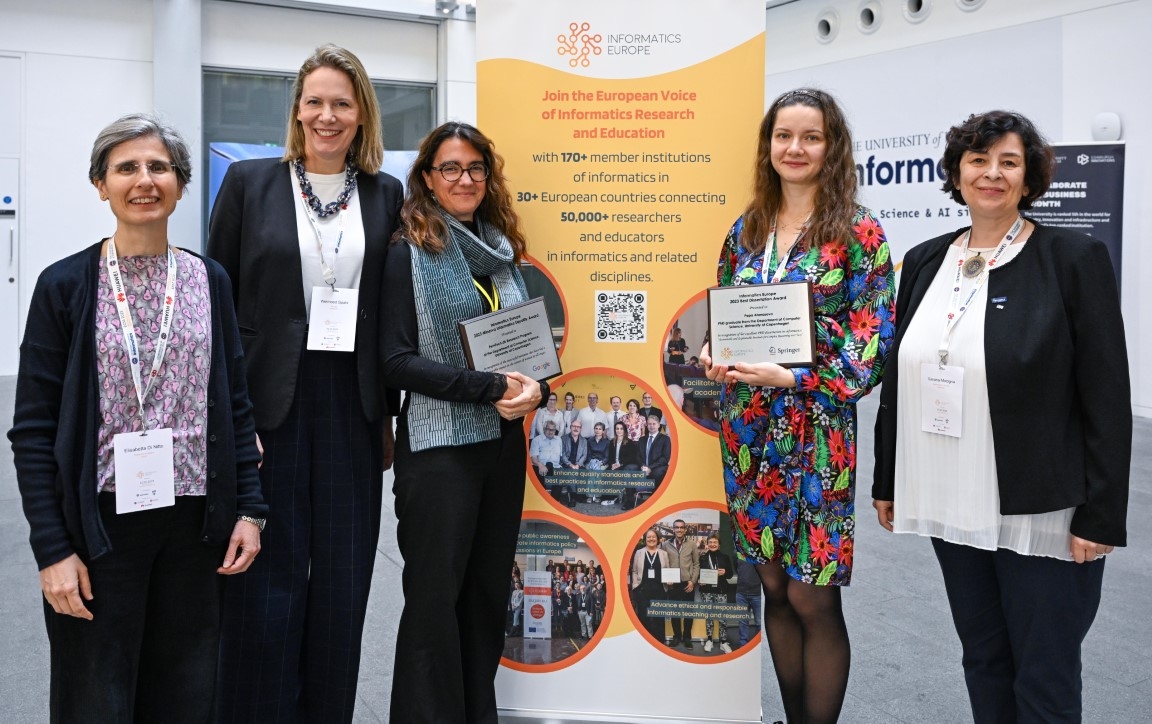
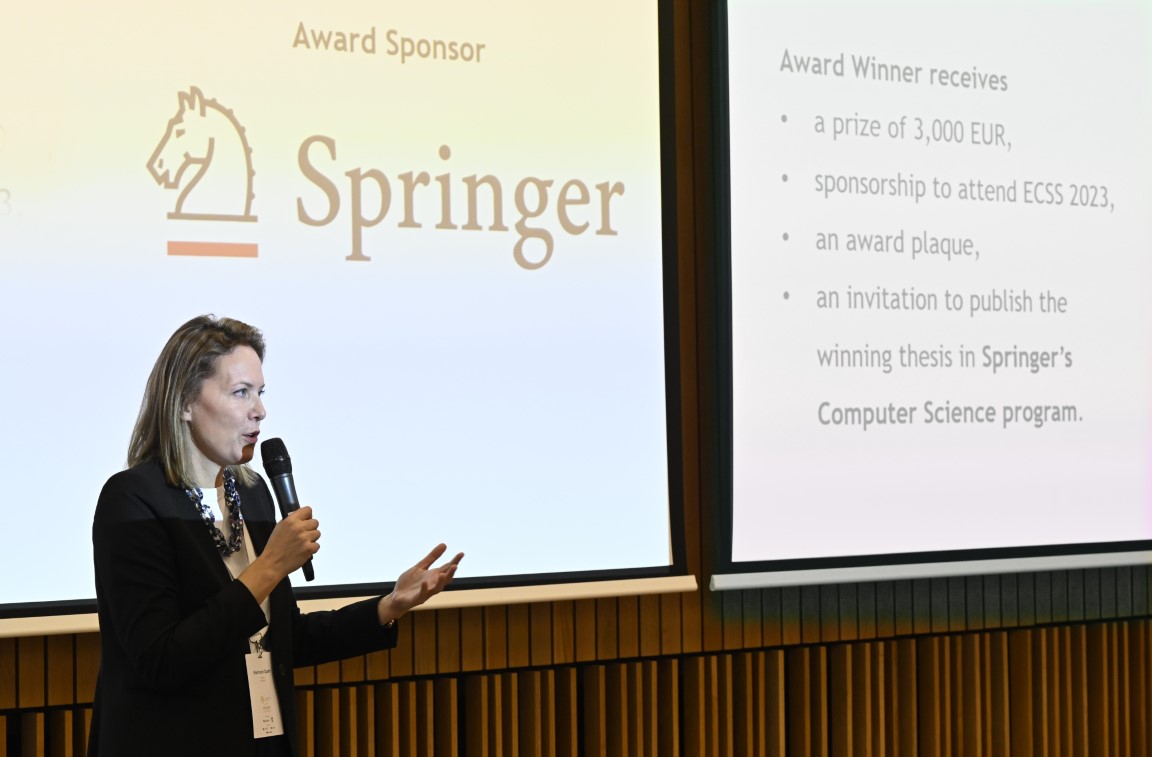
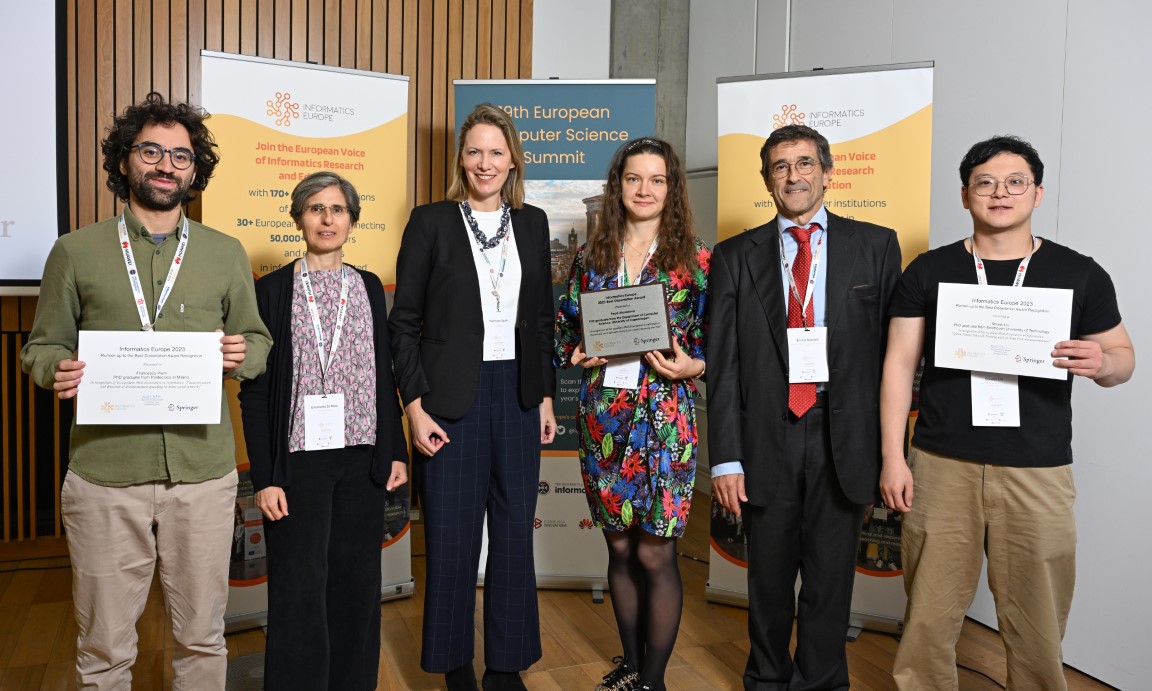
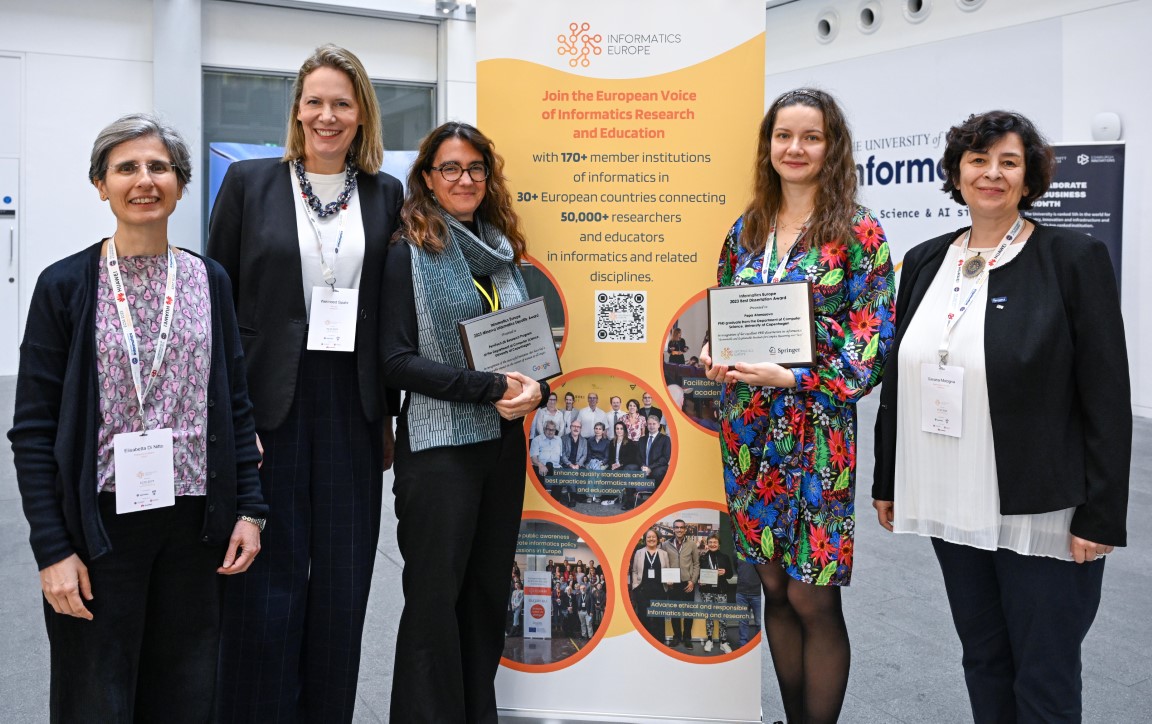
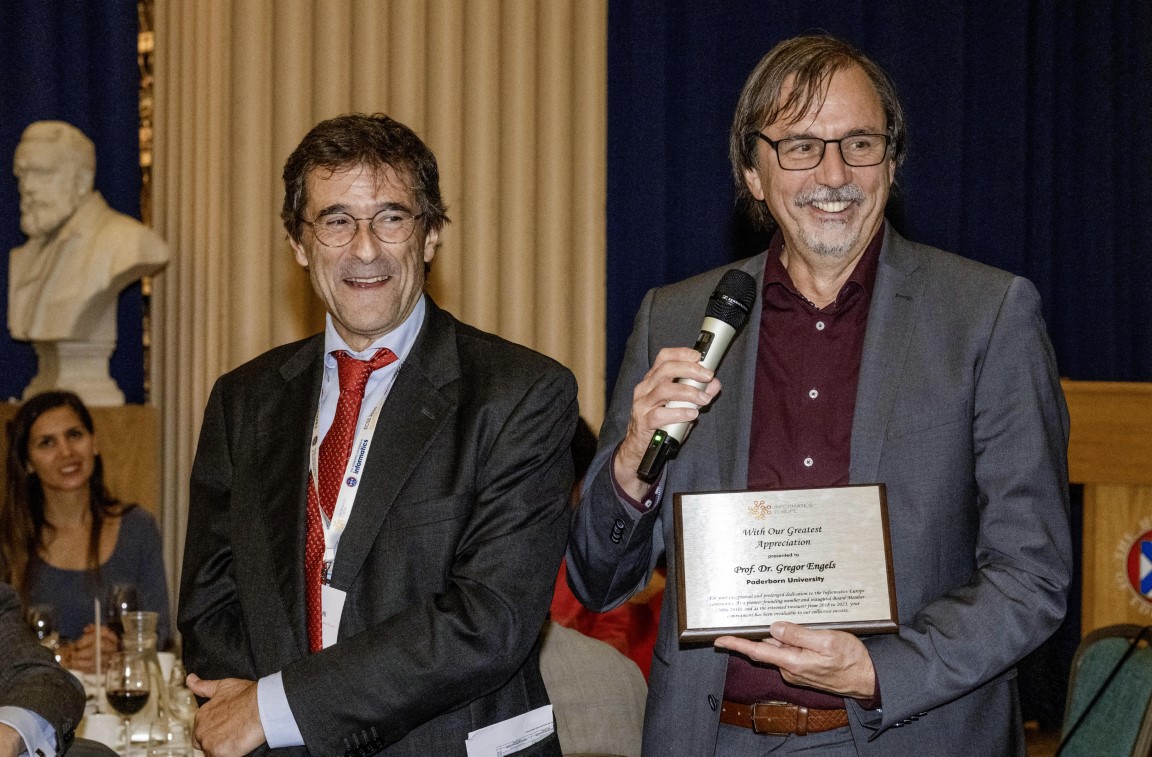
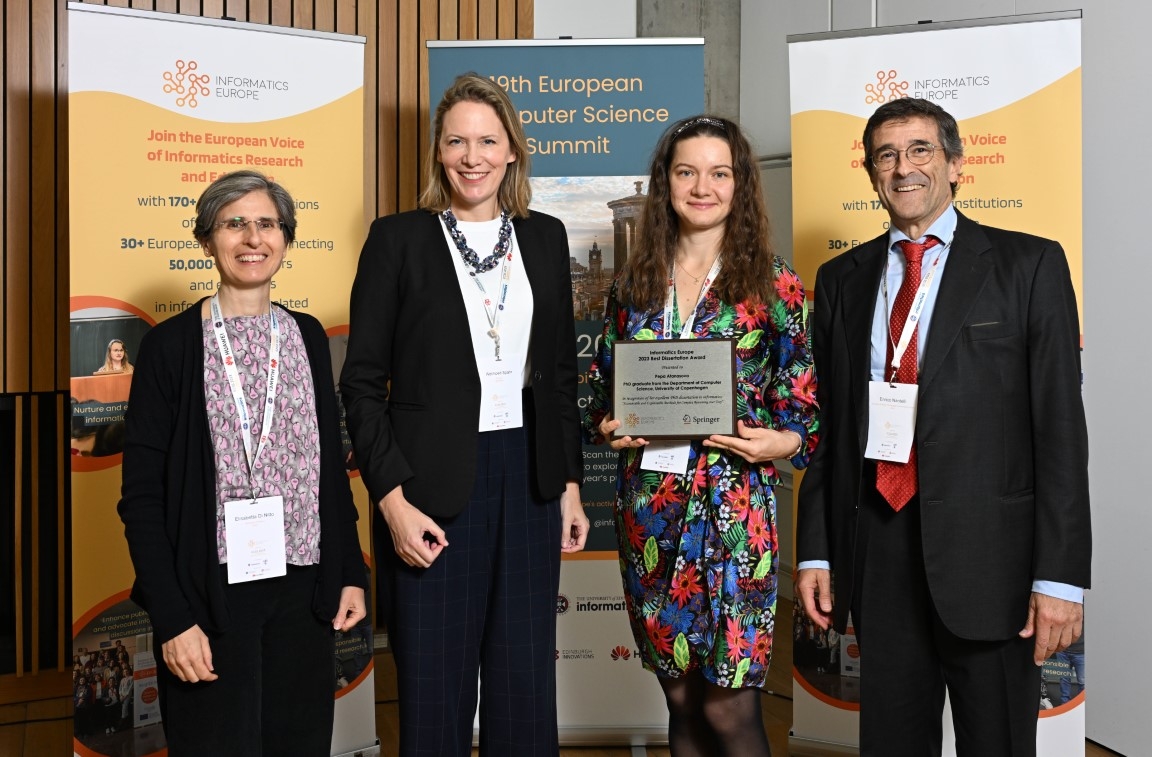
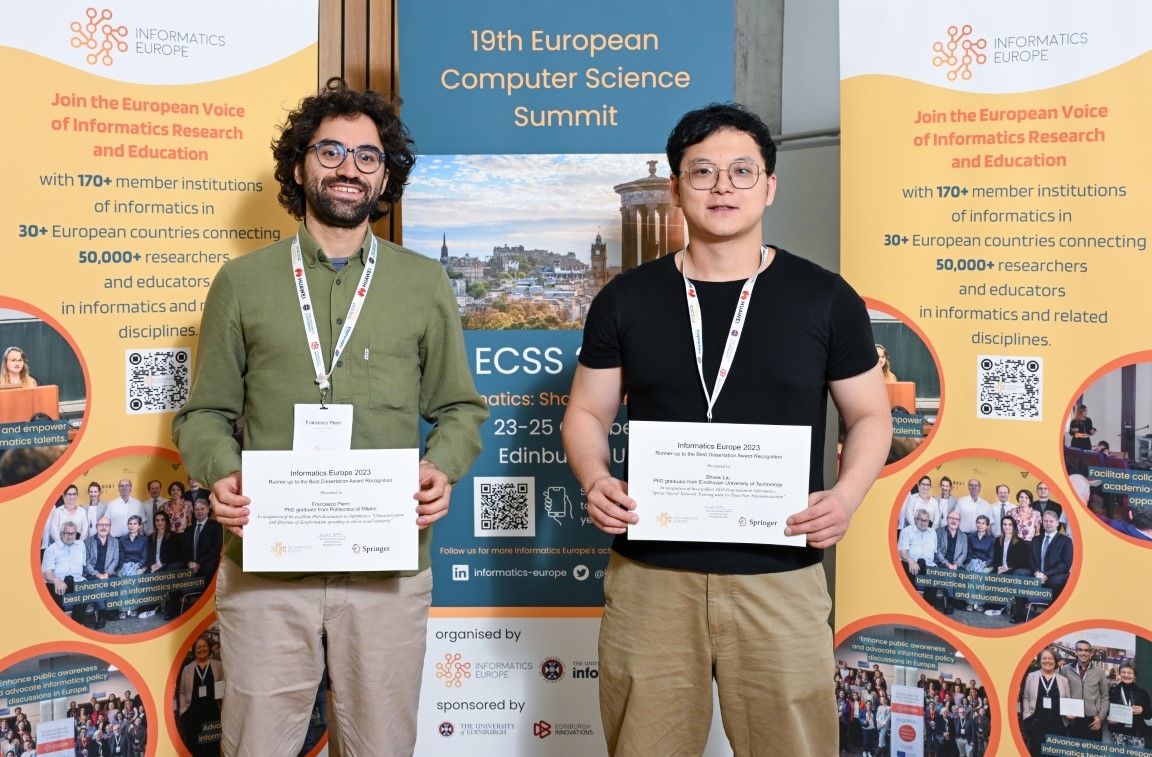
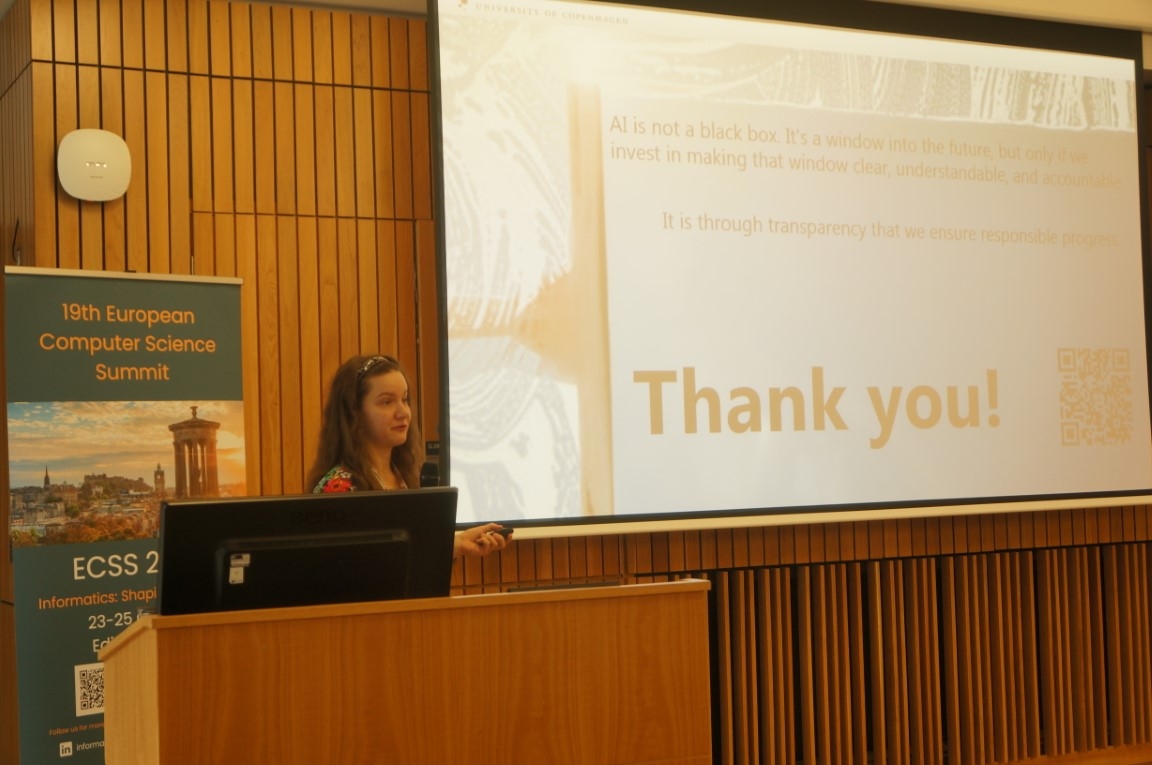
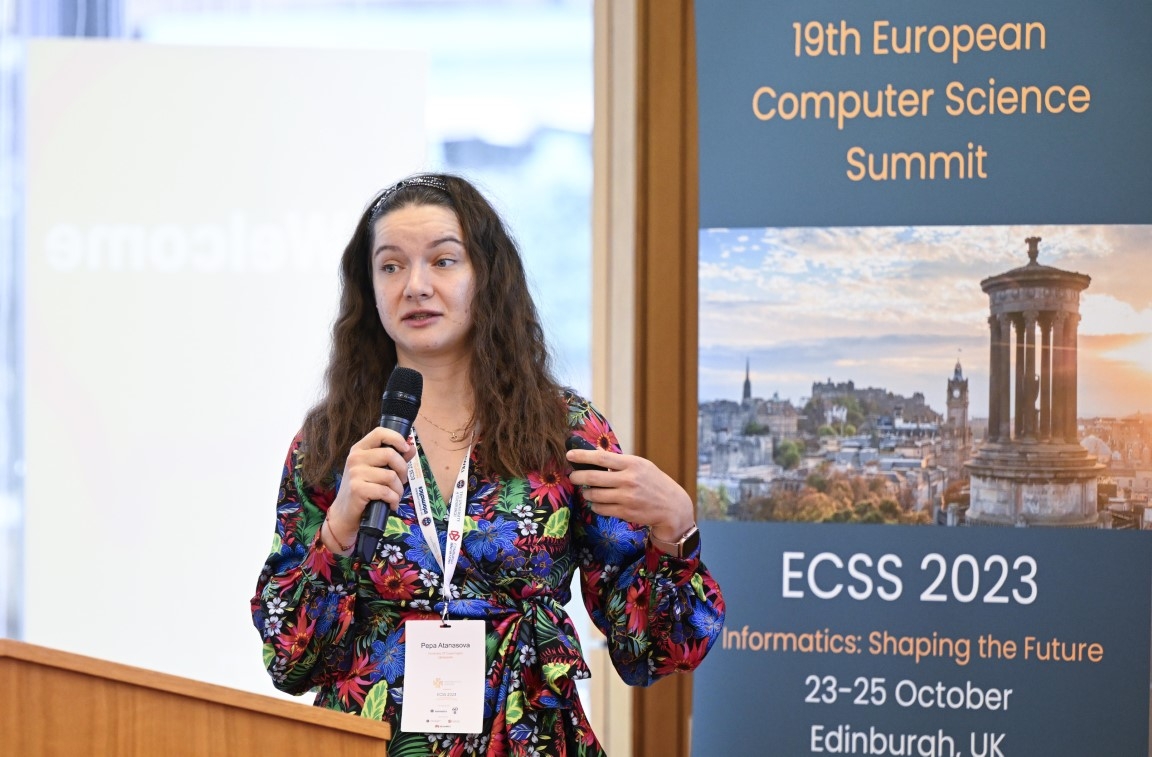
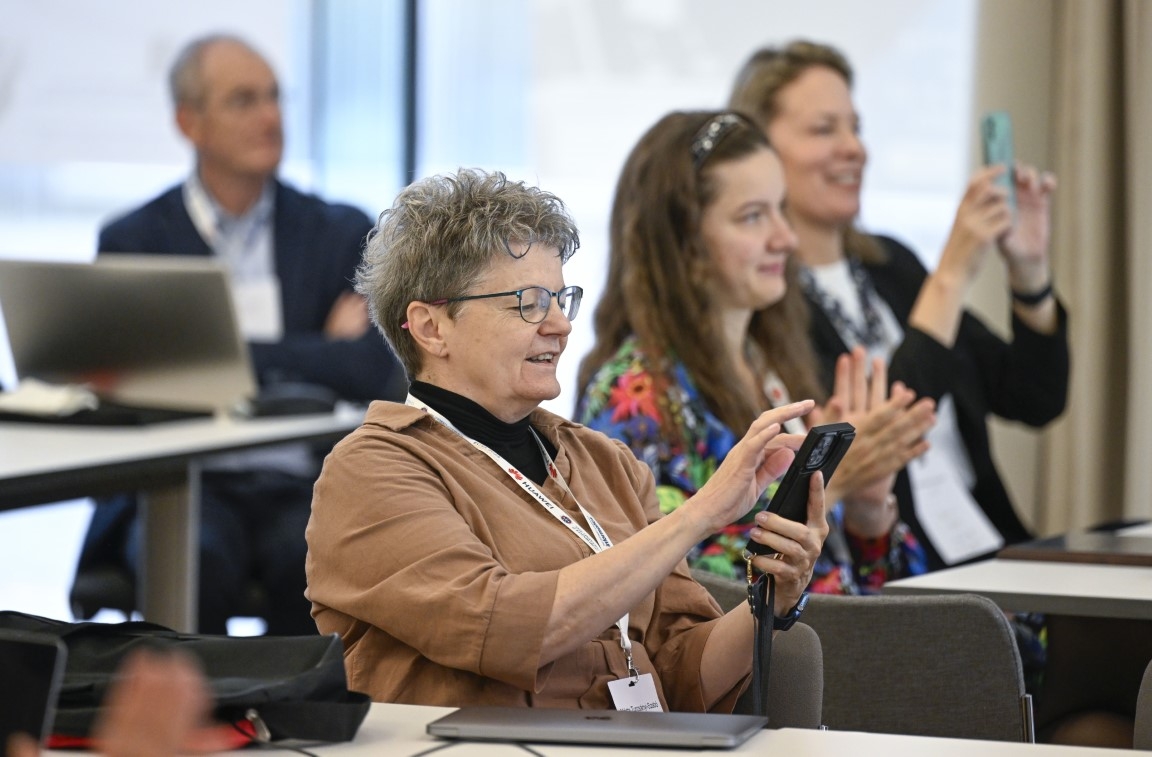
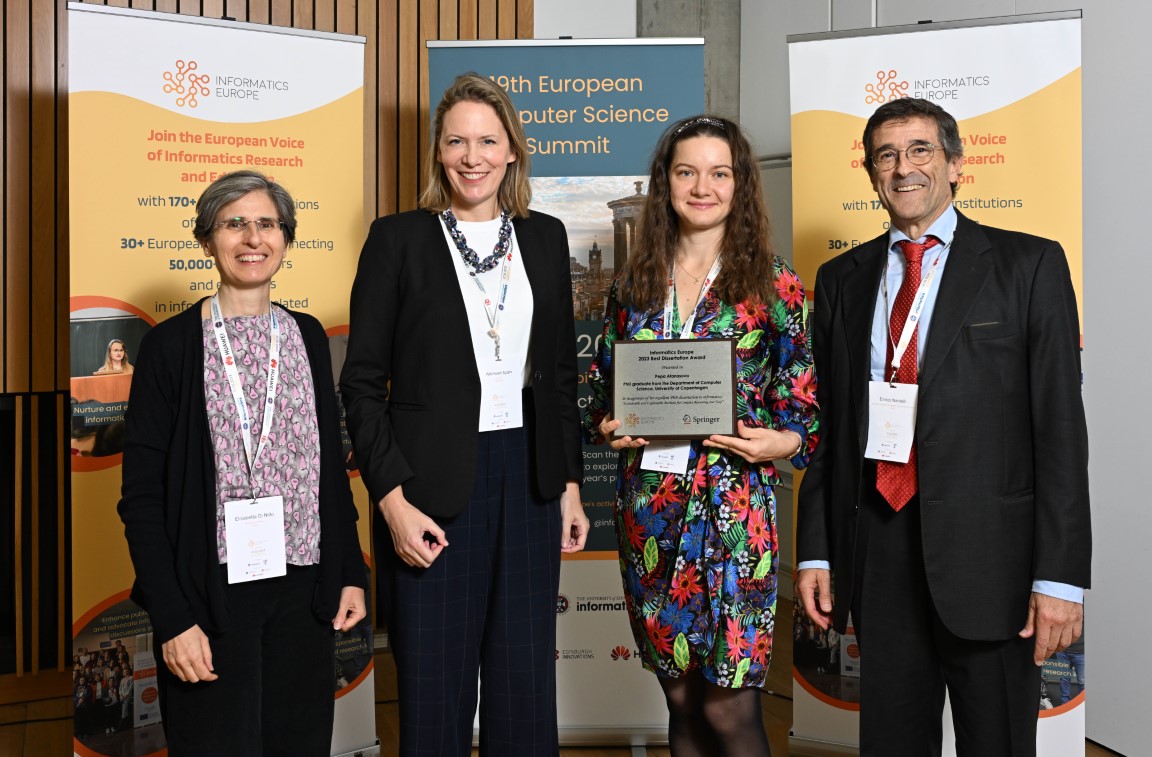
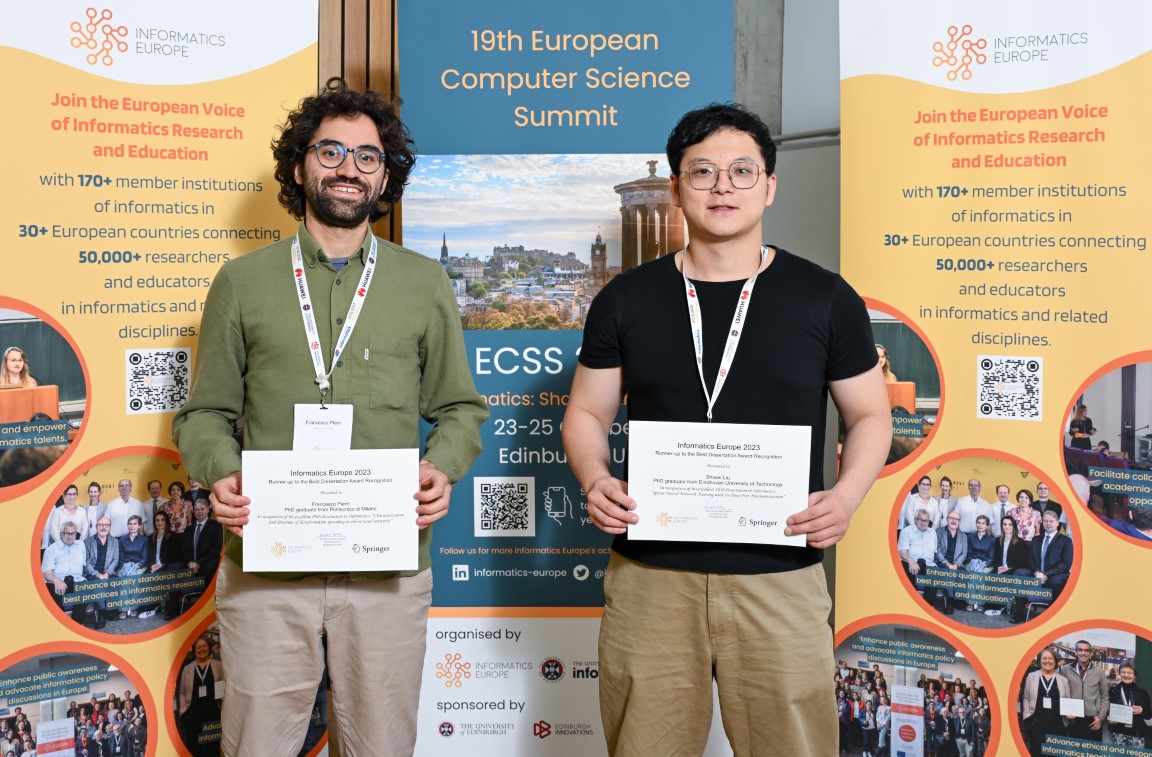
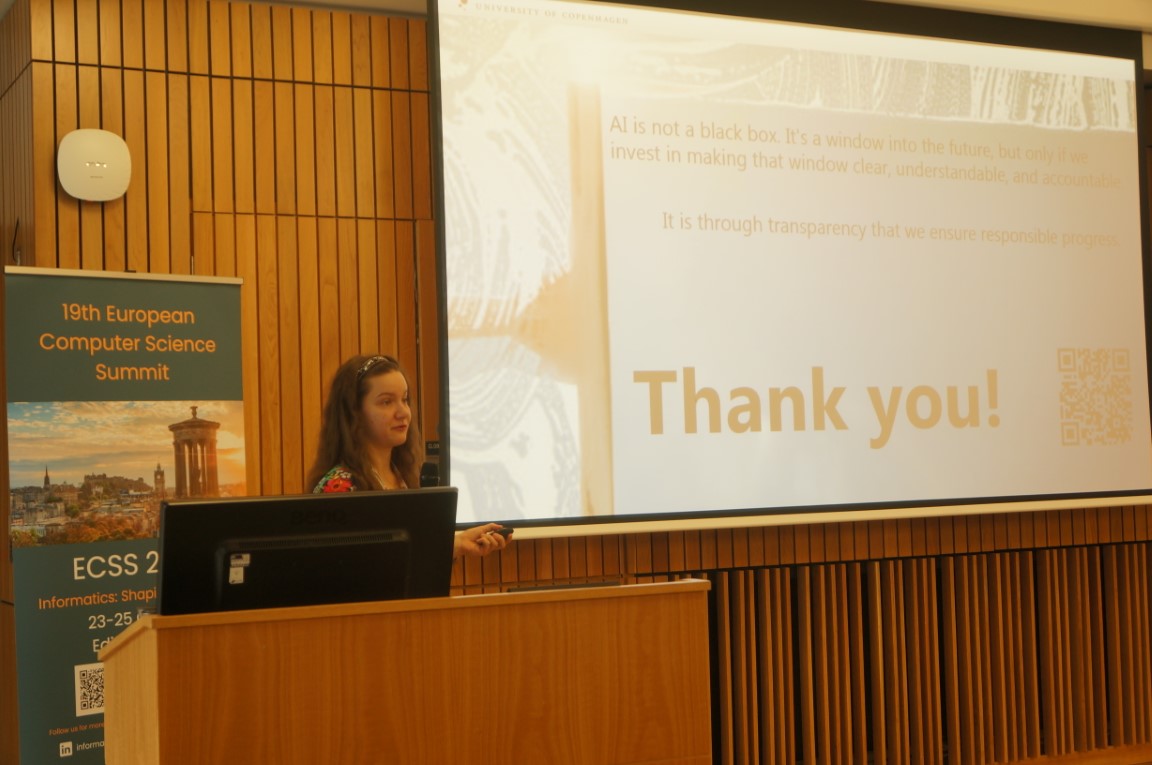
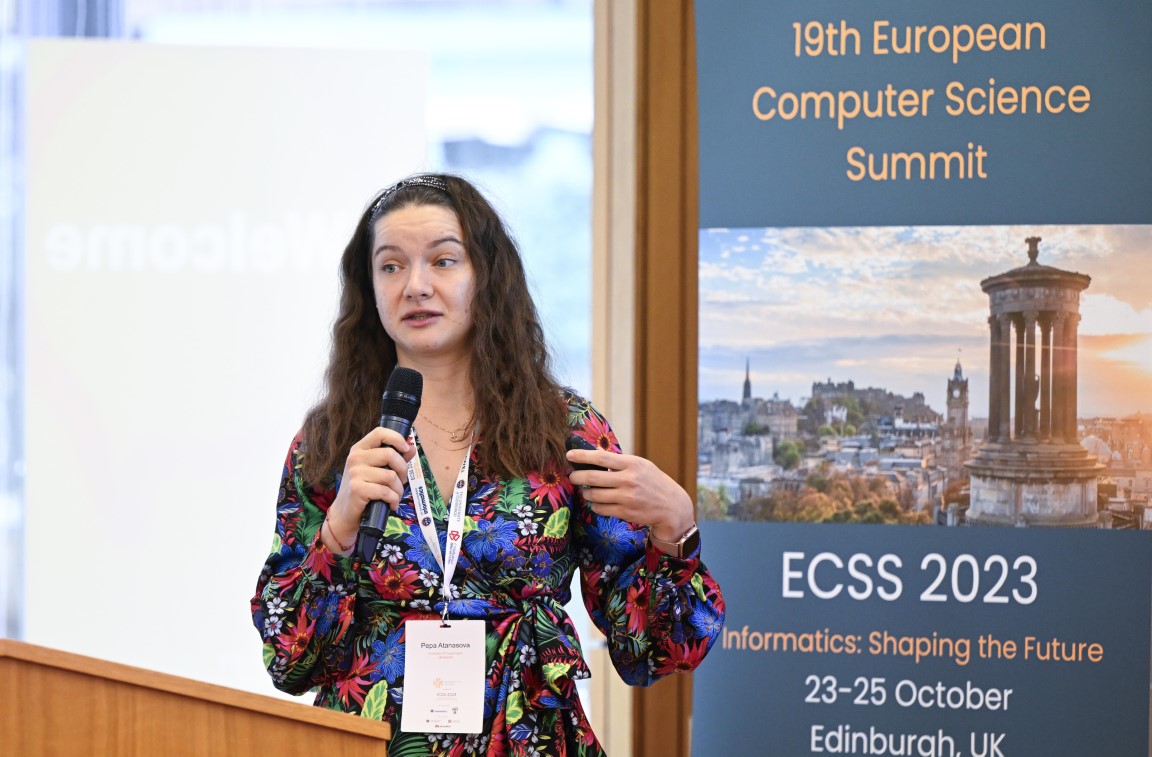
This year, we were delighted to announce at our award ceremony that Pepa Atanasova, a PhD graduate from University of Copenhagen, Denmark won the inaugural IE Best Dissertation Award (BDA). The ceremony was attended by our award sponsor Springer, represented by Welmoed Spahr (Vice President Computer Science Books) who presented the Award to Pepa, along with the runners-up Shiwei Liu (Eindhoven University of Technology, the Netherlands) and Francesco Pierri (Politecnico di Milano, Italy).
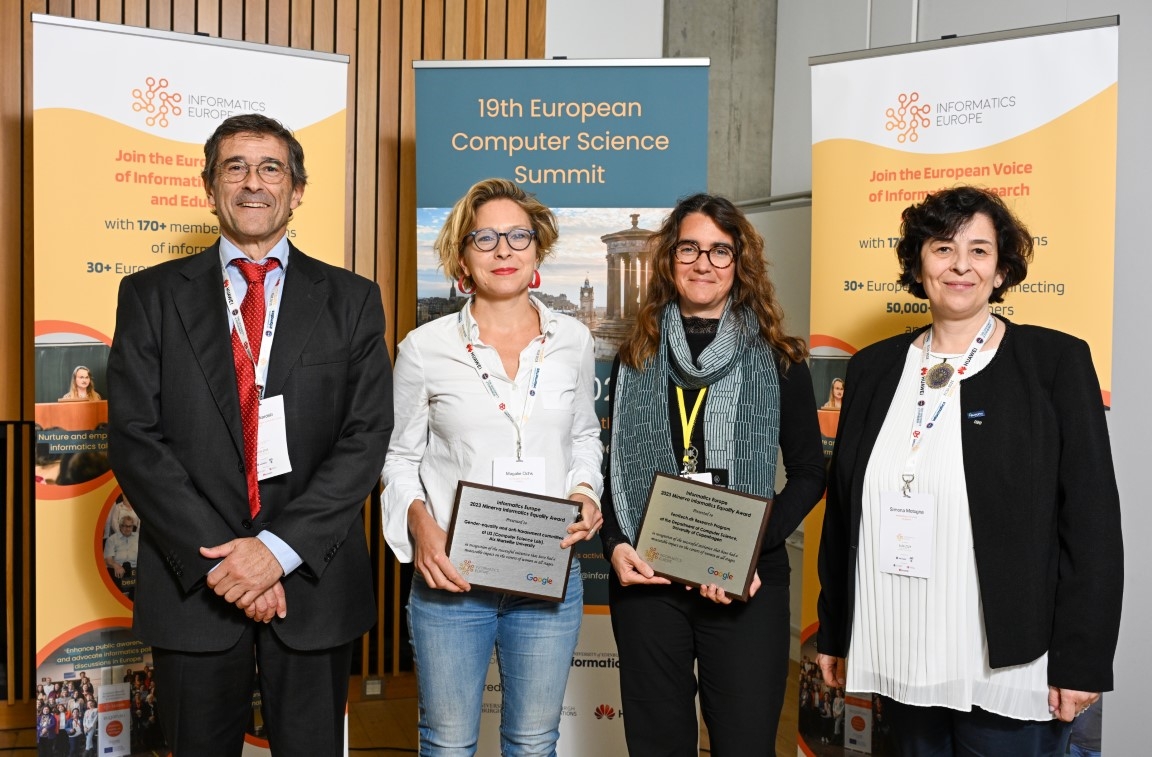
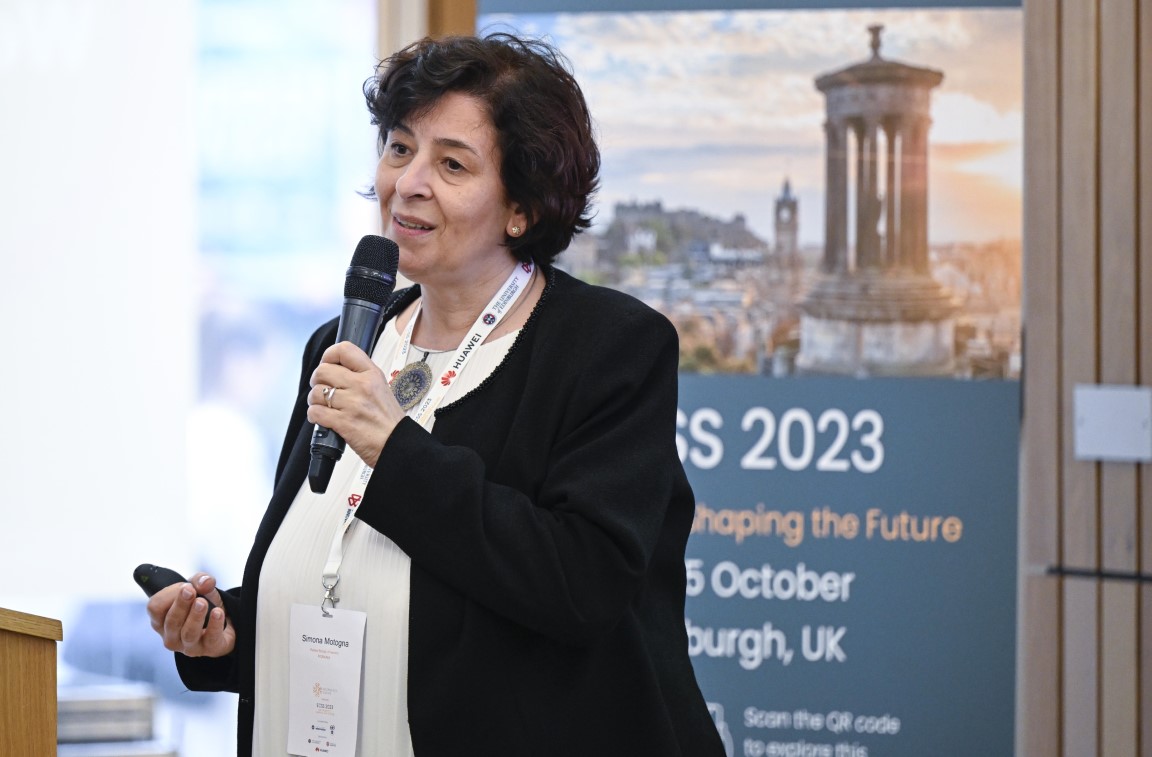
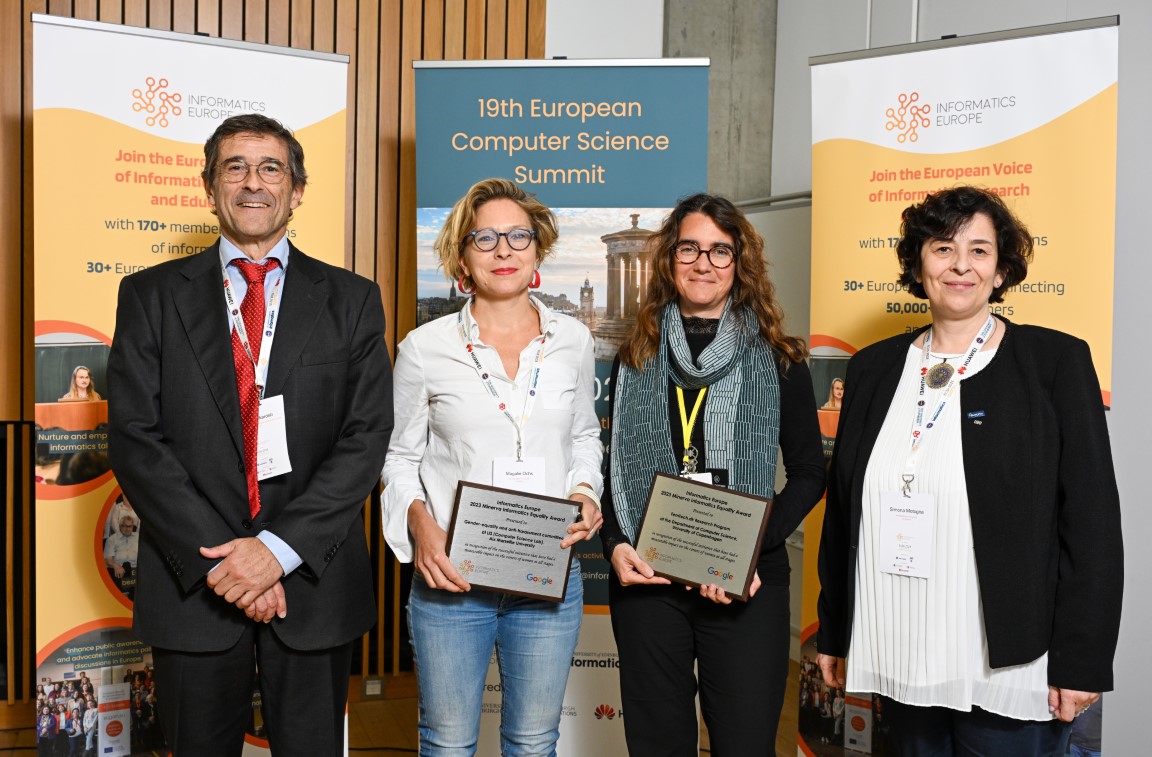
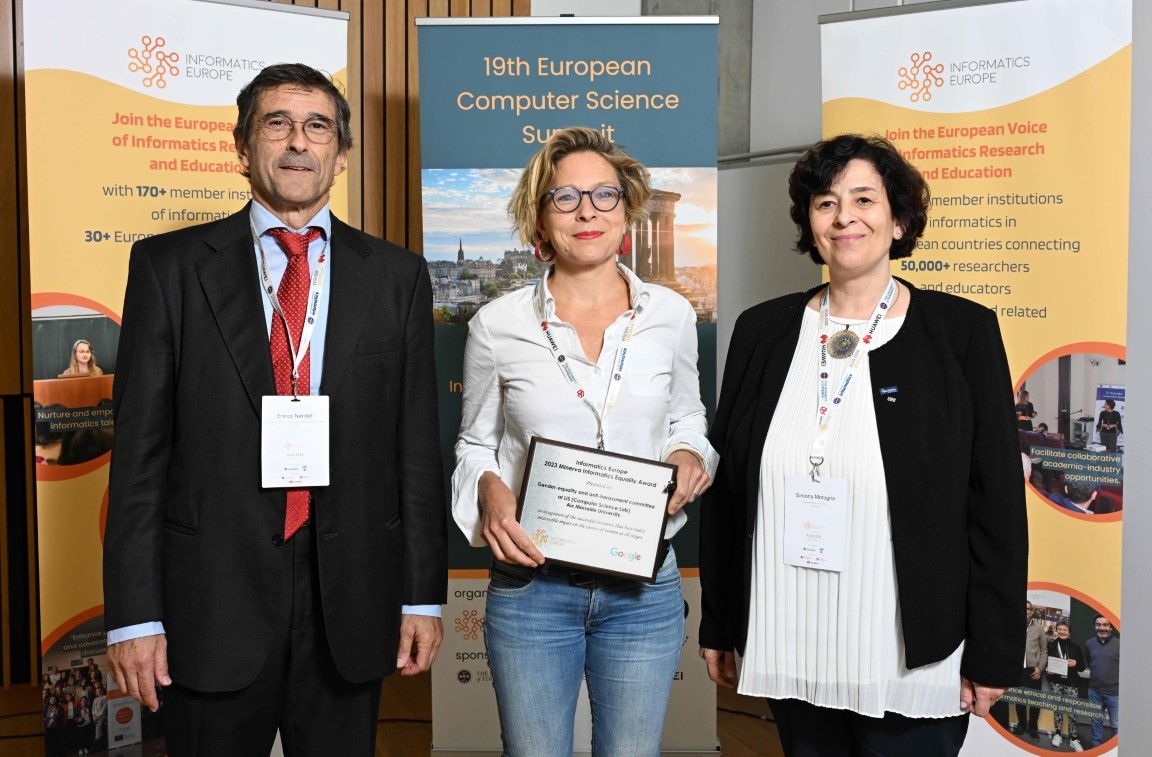
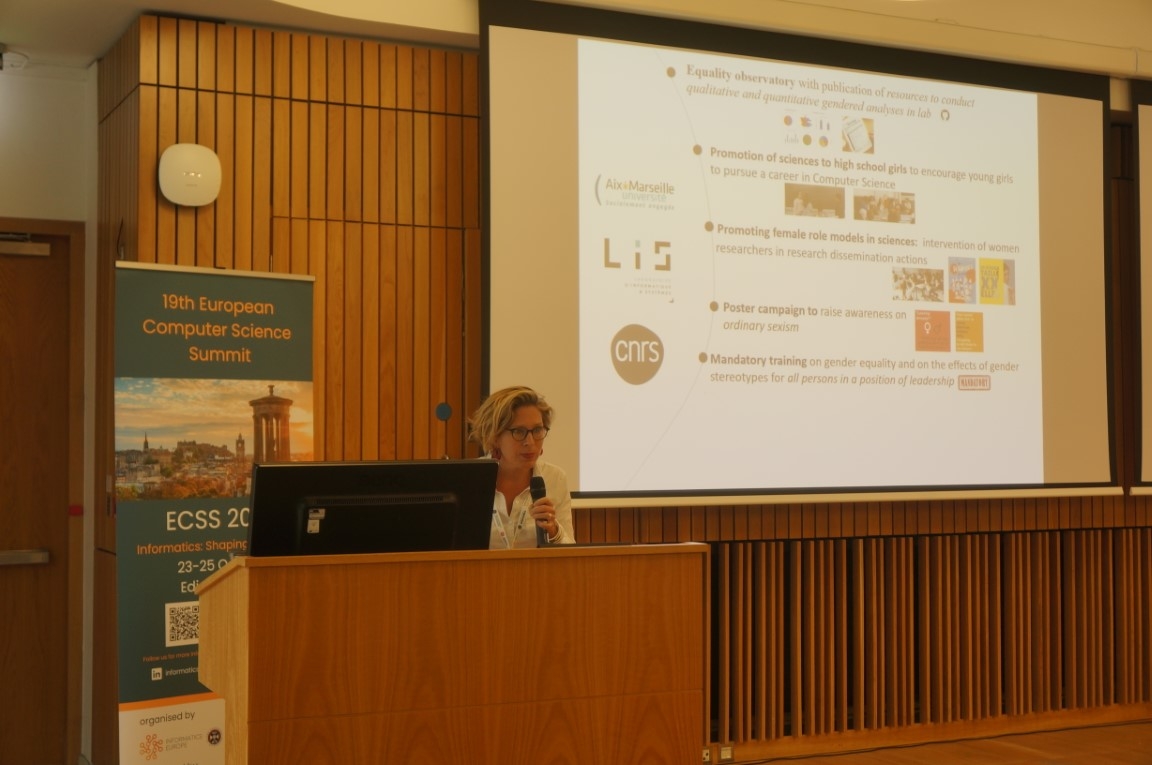
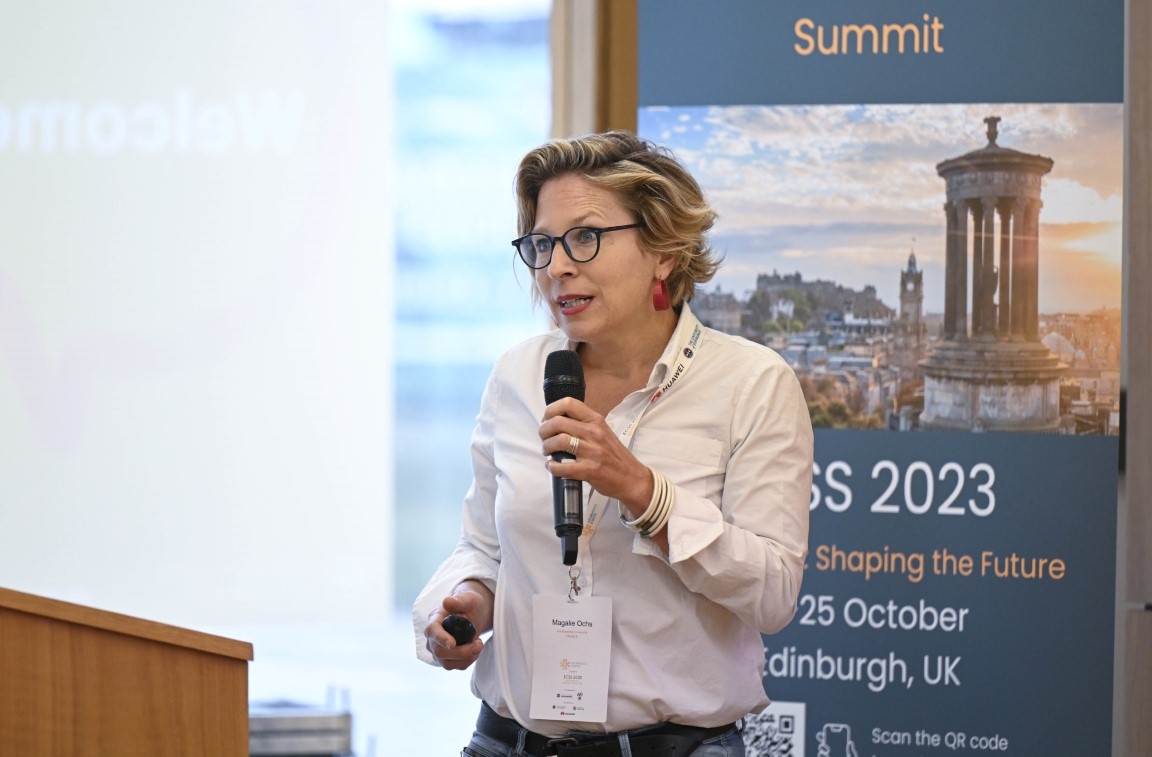
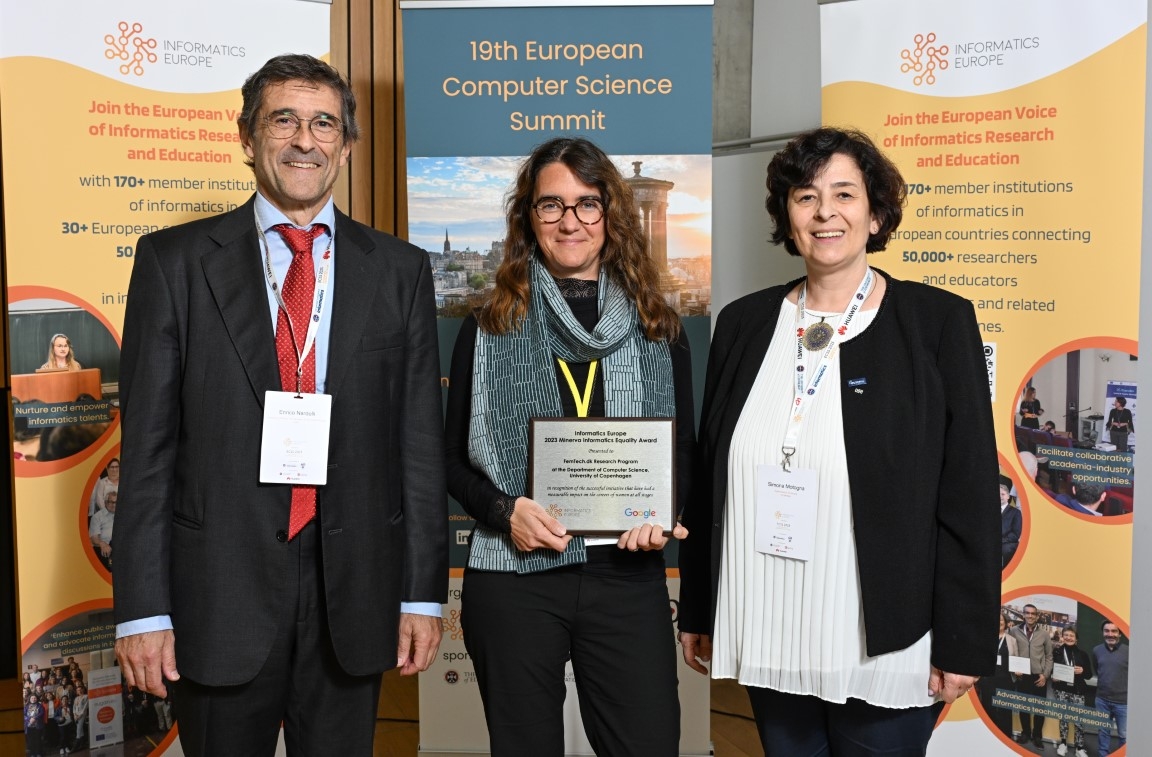
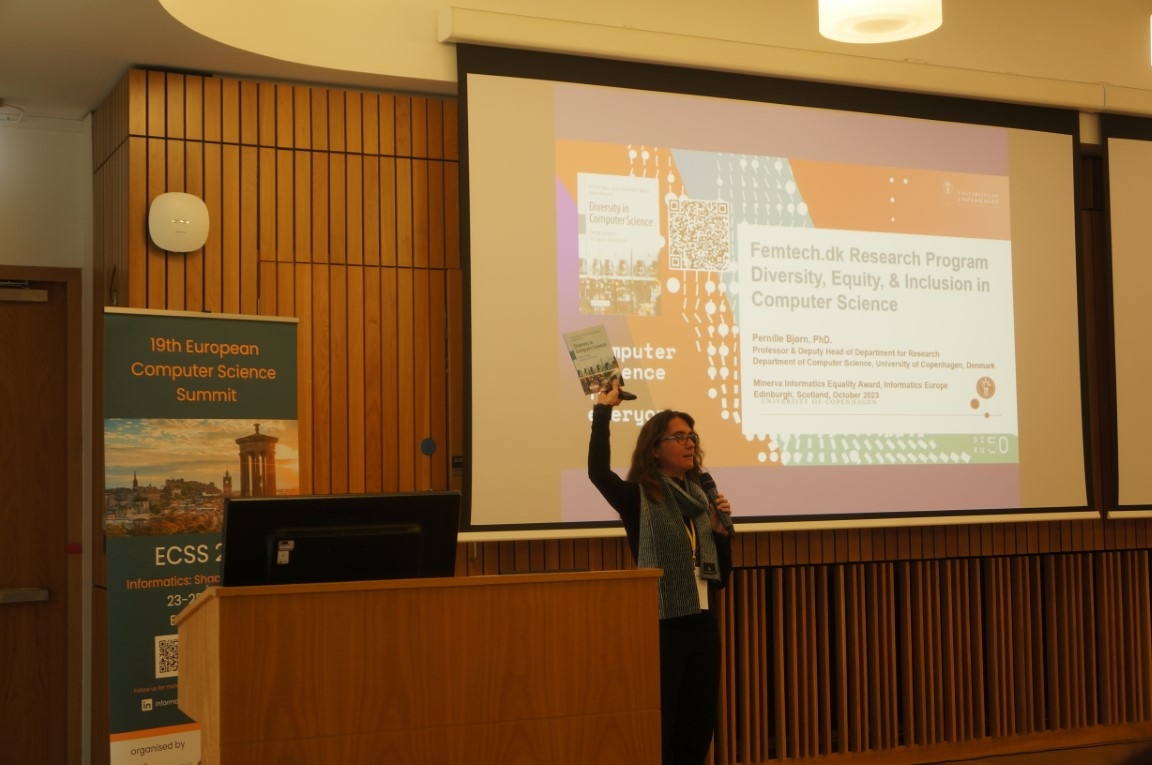
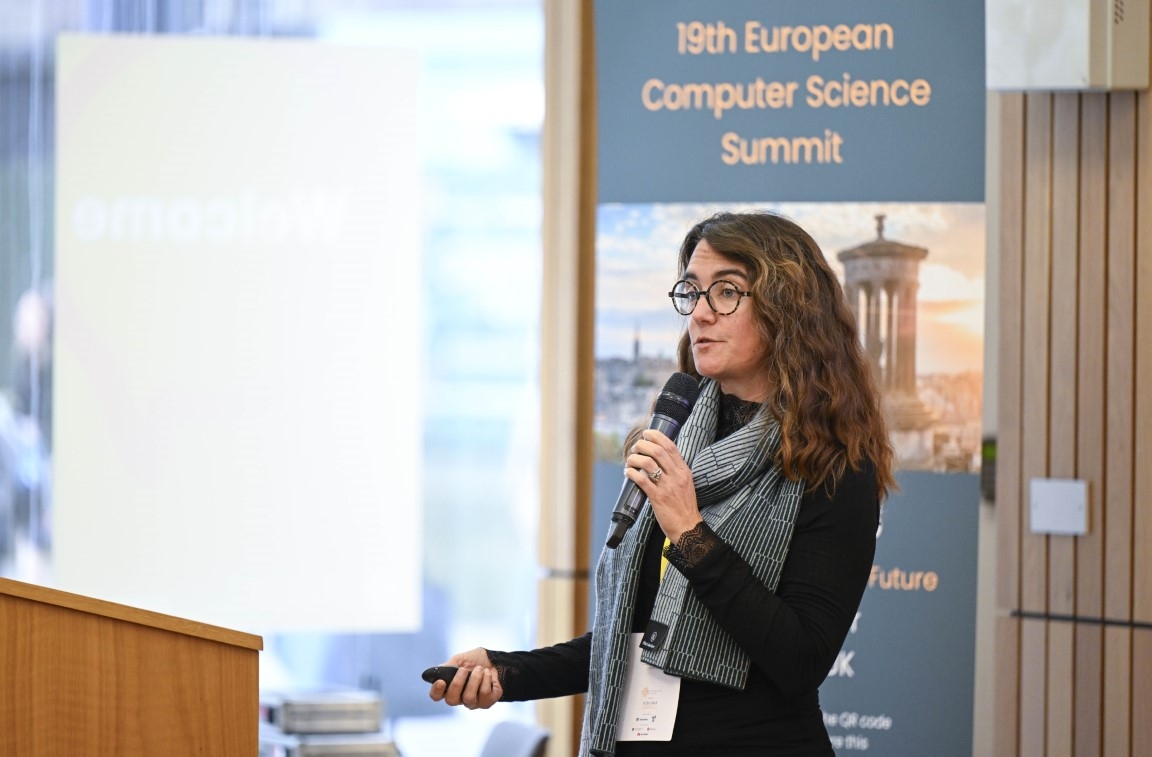
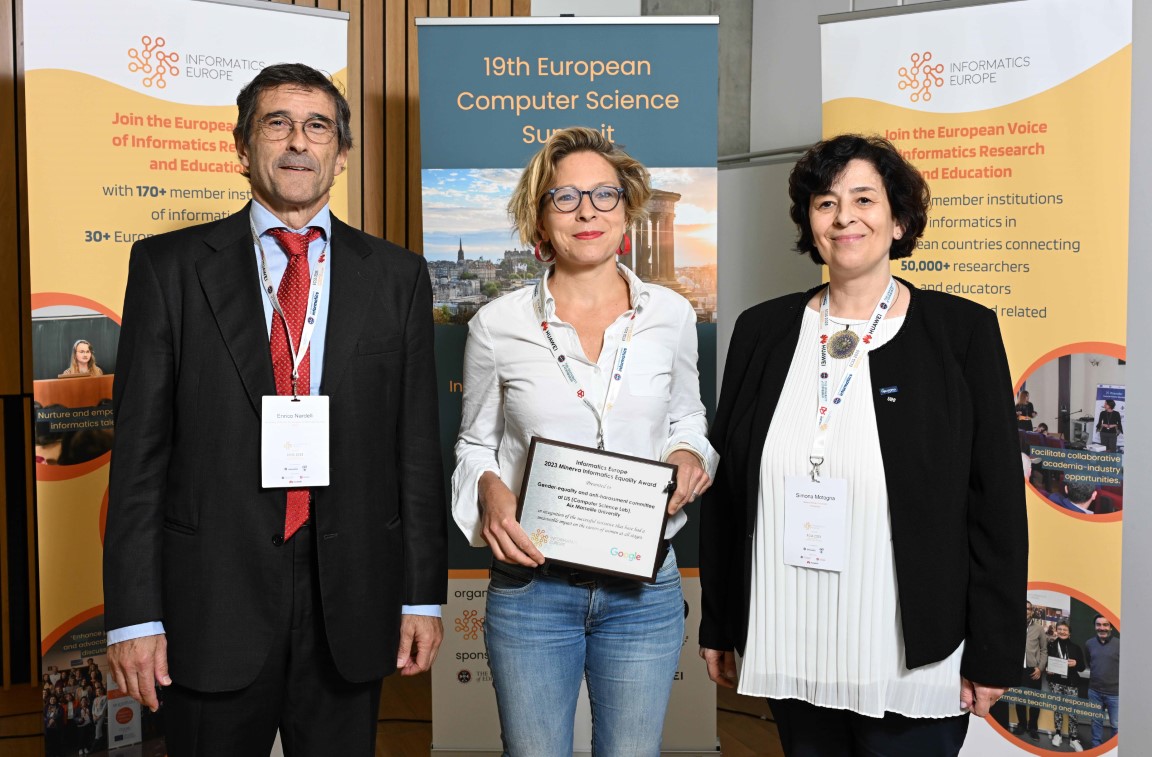
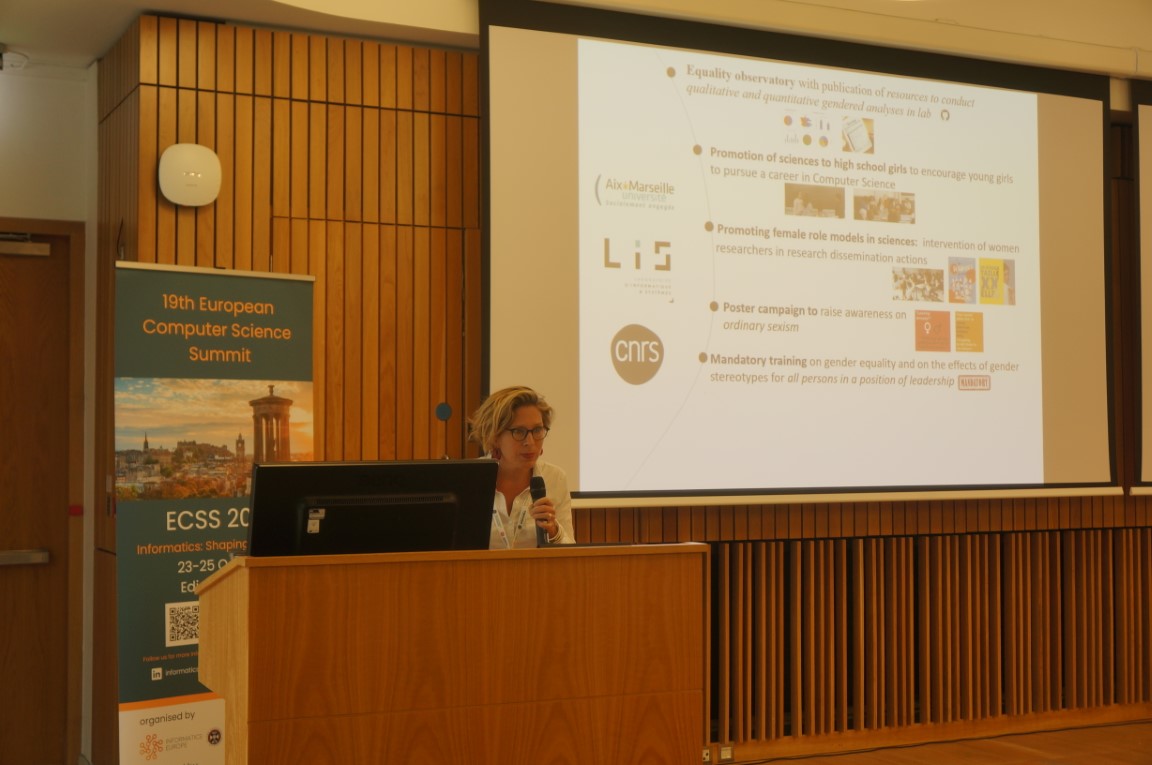
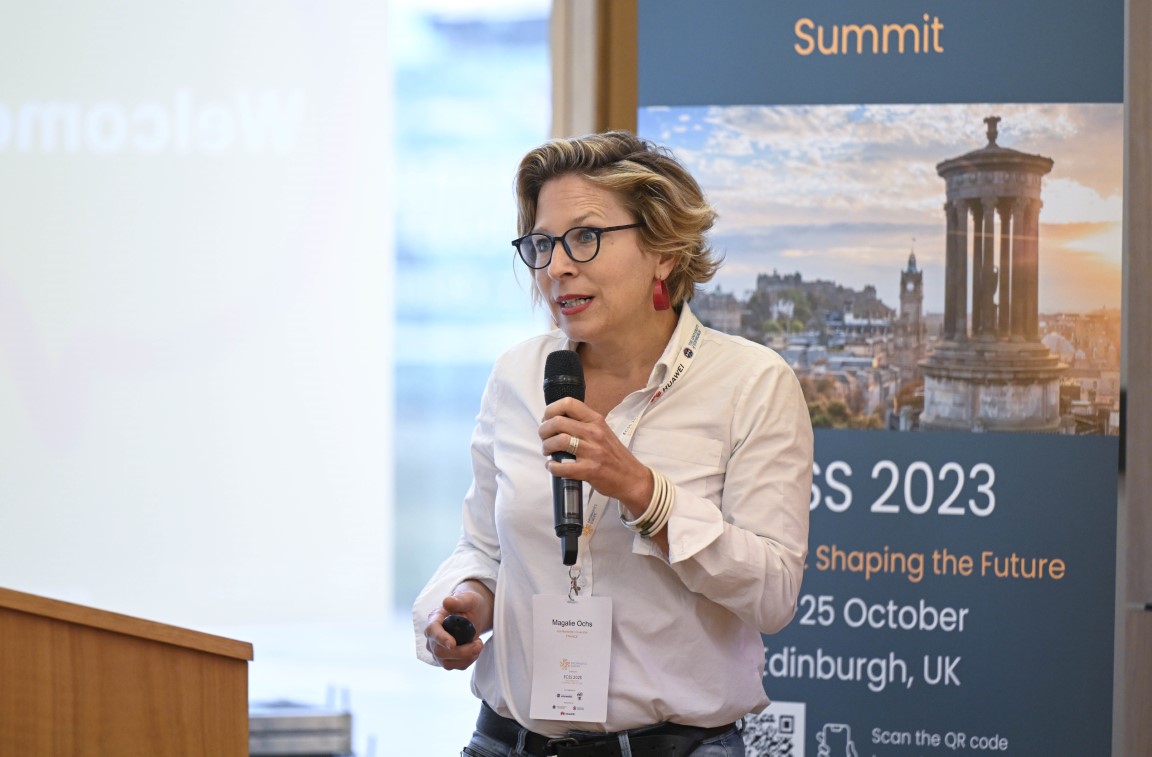
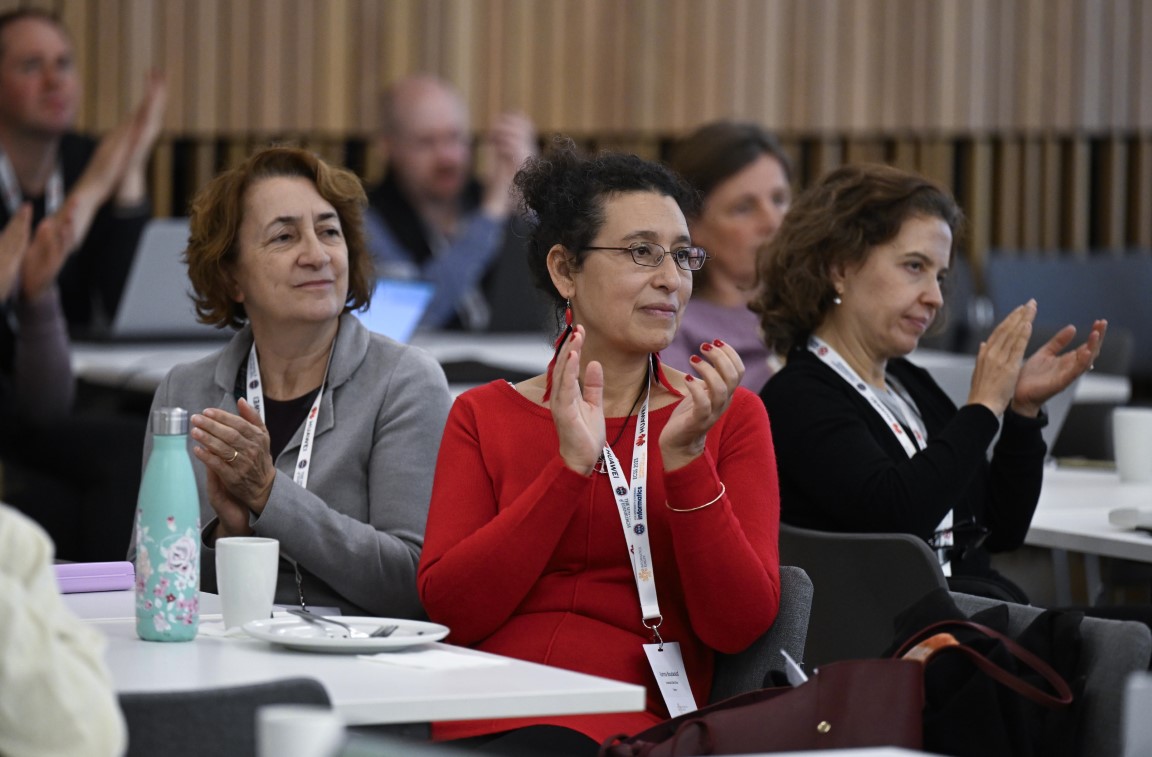
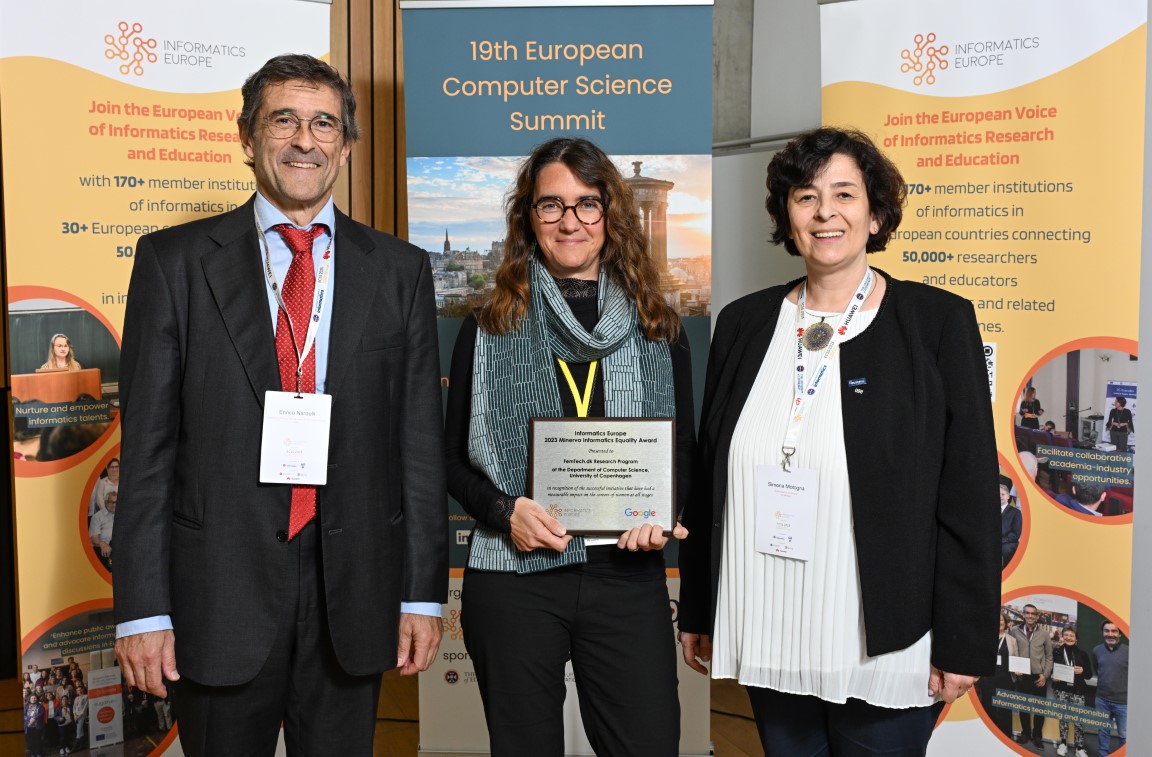
In collaboration with COST Action EUGAIN, the IE 2023 Minerva Informatics Equality Award (MIEA), sponsored by Google, acknowledged efforts and dedication from initiatives that support women in informatics education and research. This year we again celebrated two deserving winners: gender-equality and anti-harassment committee from LIS (Computer Science Lab), Aix Marseille University (France), and FemTech.dk research program at the Department of Computer Science, University of Copenhagen (Denmark).
For further details on the work of this year’s winners or previous years’, please explore our BDA & MIEA webpages.
Dialogue with Members - Informatics Europe Activities and Outcomes
As usual, we provided updates of IE’s key activities and achievements in a dedicated session during ECSS. Additionally, we offered IE members the chance to provide feedback and propose ideas to shape the IE strategies.
Today IE has 177 member institutions from 34 countries, connecting around 50,000 informatics researchers across Europe. The potential of IE extends as far as our collective ambitions. We encourage our members to stay engaged in our working groups, as any contribution, whether large or small, plays a crucial role in developing initiatives and activities that bring positive changes to the European informatics community.
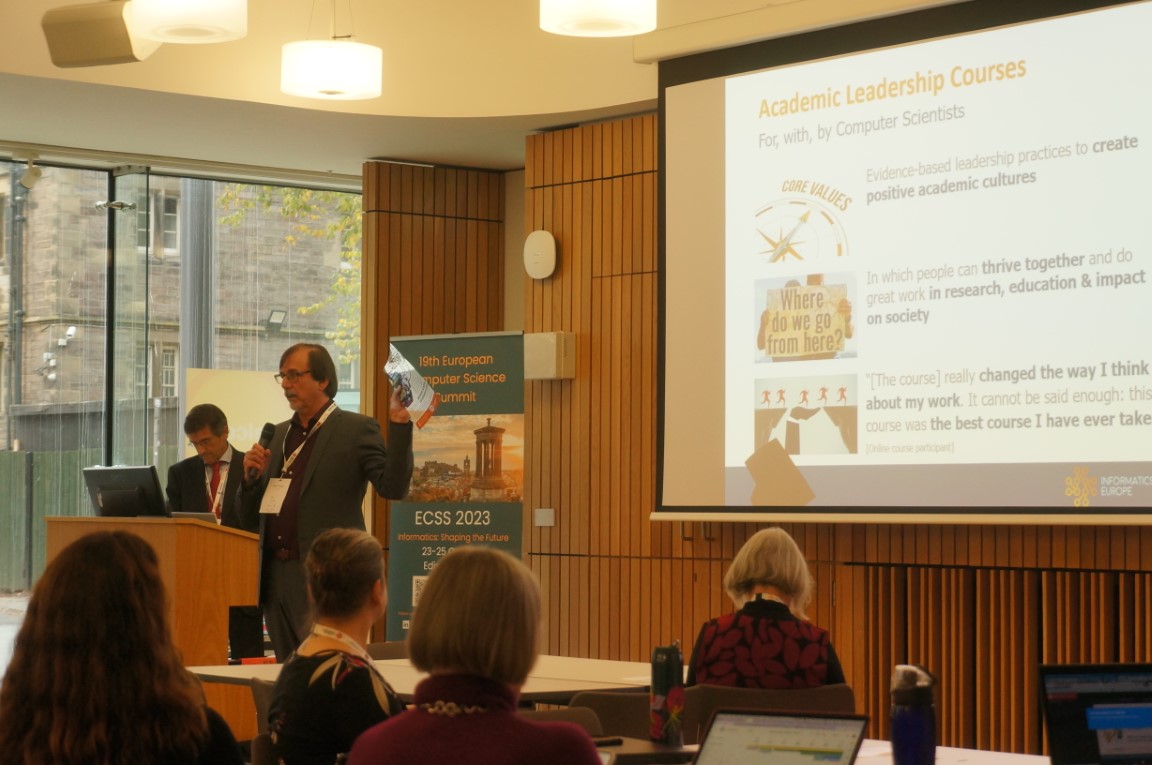
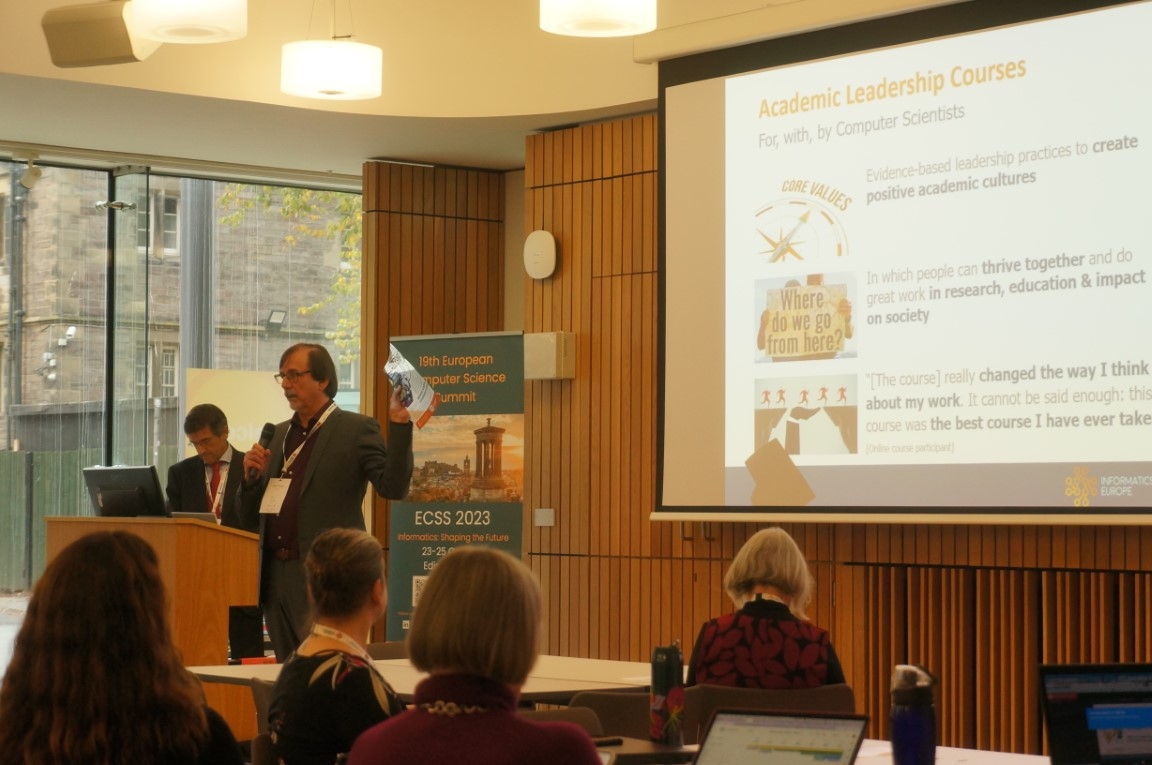
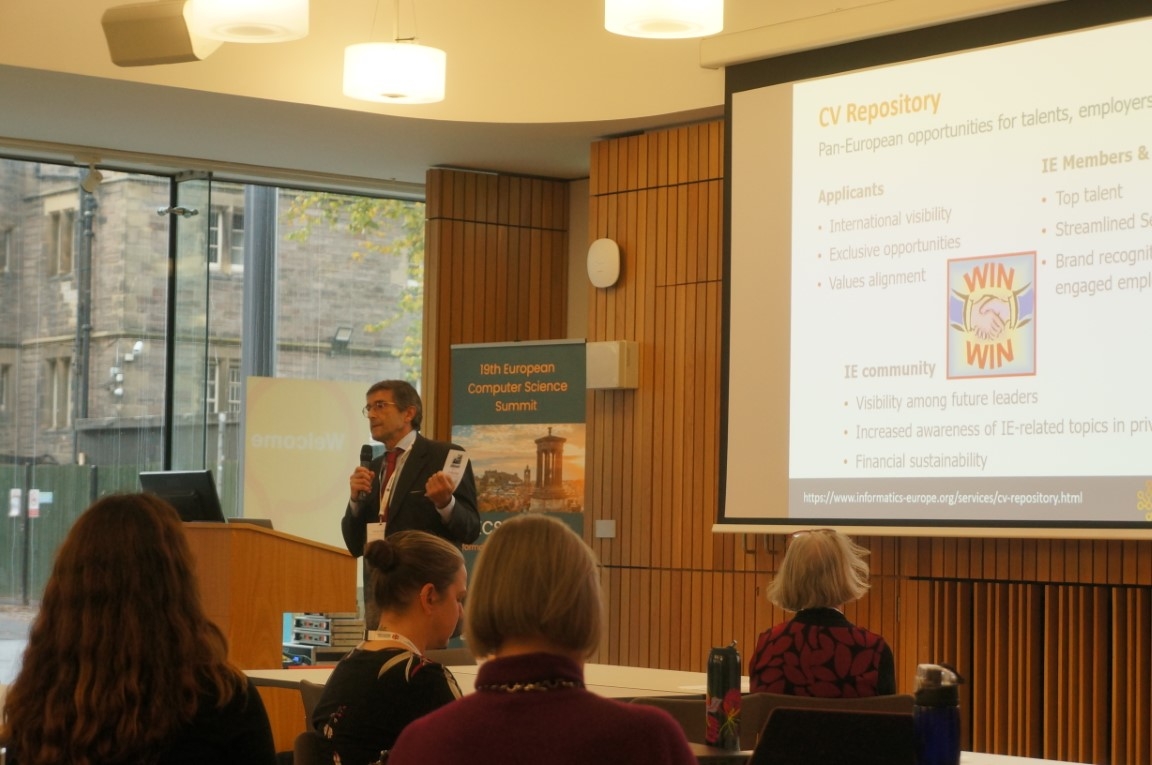
We also presented reviews and updates on various IE services such as the IE Department Evaluation Service, evidence-based Academic Leadership Courses (now customizable for individual departments) and our latest career service CV Repository offering pan-European opportunities for talents and employers in informatics and related fields. Members were reminded of the significance of supporting IE by sharing our activities within their networks, utilizing our services, and encouraging more peer institutions and colleagues to join the IE community.
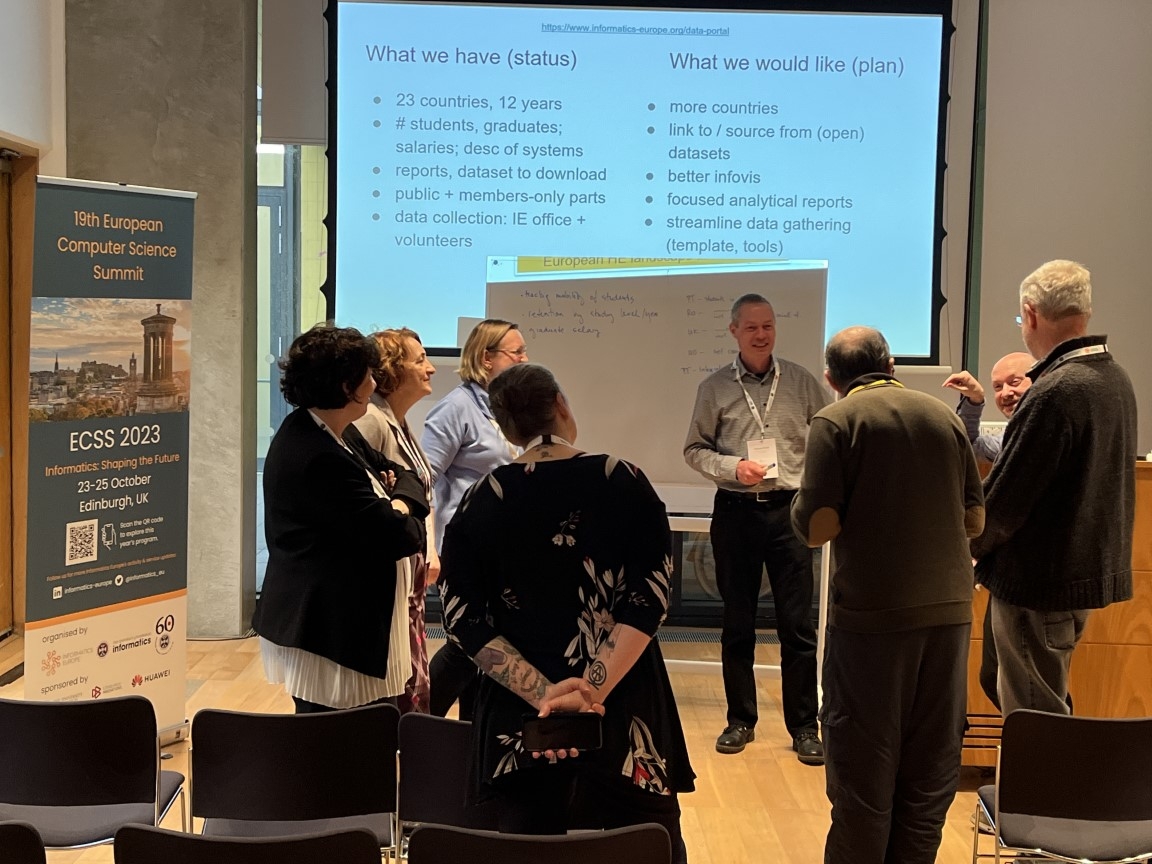
Higher Education Data Workshop
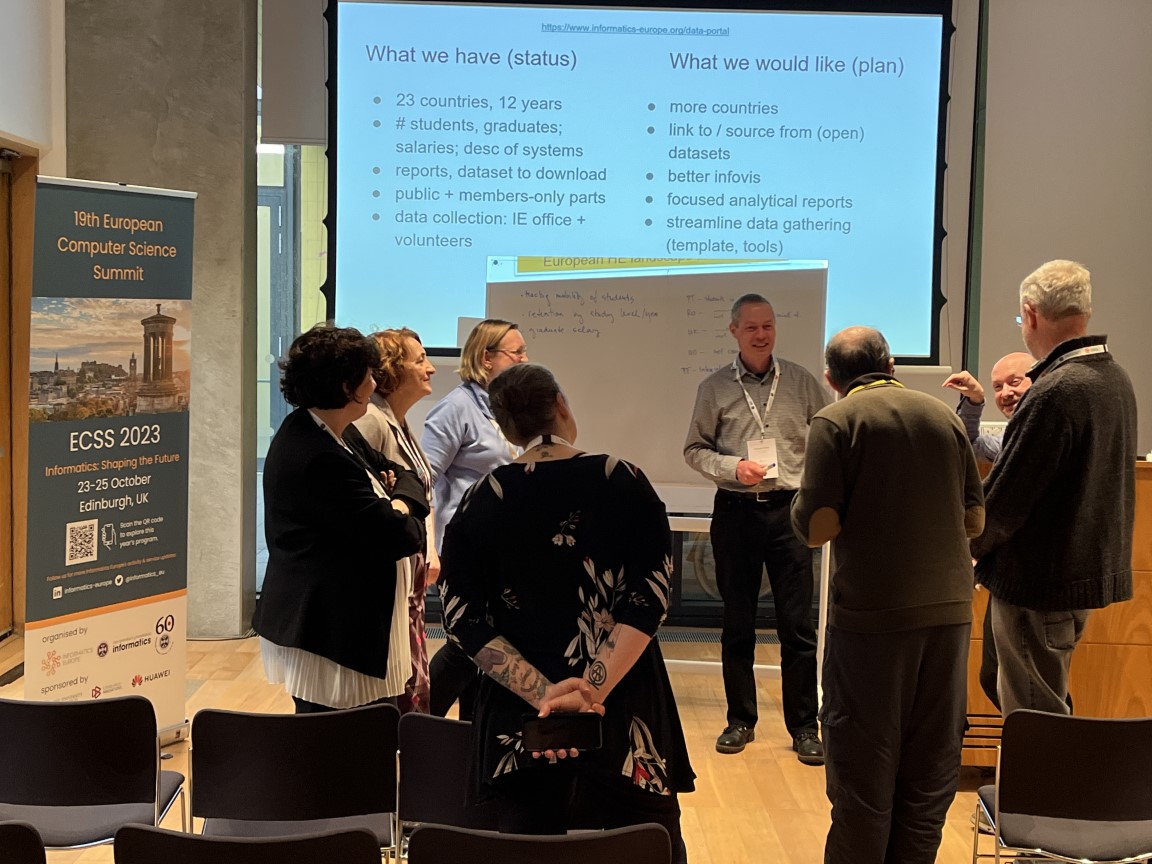
With the Higher Education Data Portal as one of our most appreciated services, this workshop presented the latest data as a result of our portal and work carried out by IE’s Data Analysis and Reporting Working Group.
Elisabetta di Nitto (Politecnico di Milano, Italy), IE’s Vice-President, presented a recent IE publication “Informatics Higher Education in Europe: A Data Portal and Case-Study” “Informatics Higher Education in Europe: A Data Portal and Case-Study” published in the November 2023 issue of the Communications of the ACM Journal. Svetlana Tikhonenko (IE’s Program Associate – Web, Data and Analysis) also gave a behind-the-scenes presentation of our data portal, explaining what constitutes the portal, where and how we gather the data, and how country representatives and other members of the organization can help in its development.
With Premek Brada (University of West Bohemia in Pilsen, Czechia) and Elisabetta di Nitto serving as moderators, participants were divided into small groups and discussed what functionalities and data from the Data Portal they would be interested in. The outcomes are ranked by priority:
- tracking of student mobility, double and joint degrees;
- language of instruction in informatics study programmes;
- evolution of informatics-related study degrees by years;
- minors that go together with informatics, programmes where informatics is a minor;
- retention and graduation rates, employability of graduates;
- student nationality and other demographics, for example, country of origin.
The Working Group will take into account these feedback as we persist in our effort to enhance our data portal. We invite organisations and colleagues to collaborate on these and other shared interests by joining our Working Group and research activities.
Academia-Industry Sessions
Chaired by Lenuta Alboaie (Alexandru Ioan Cuza University of Iasi, Romania) and Jim Ashe (University of Edinburgh, UK), two pivotal sessions carved out the intersection between academia and industry during ECSS 2023.
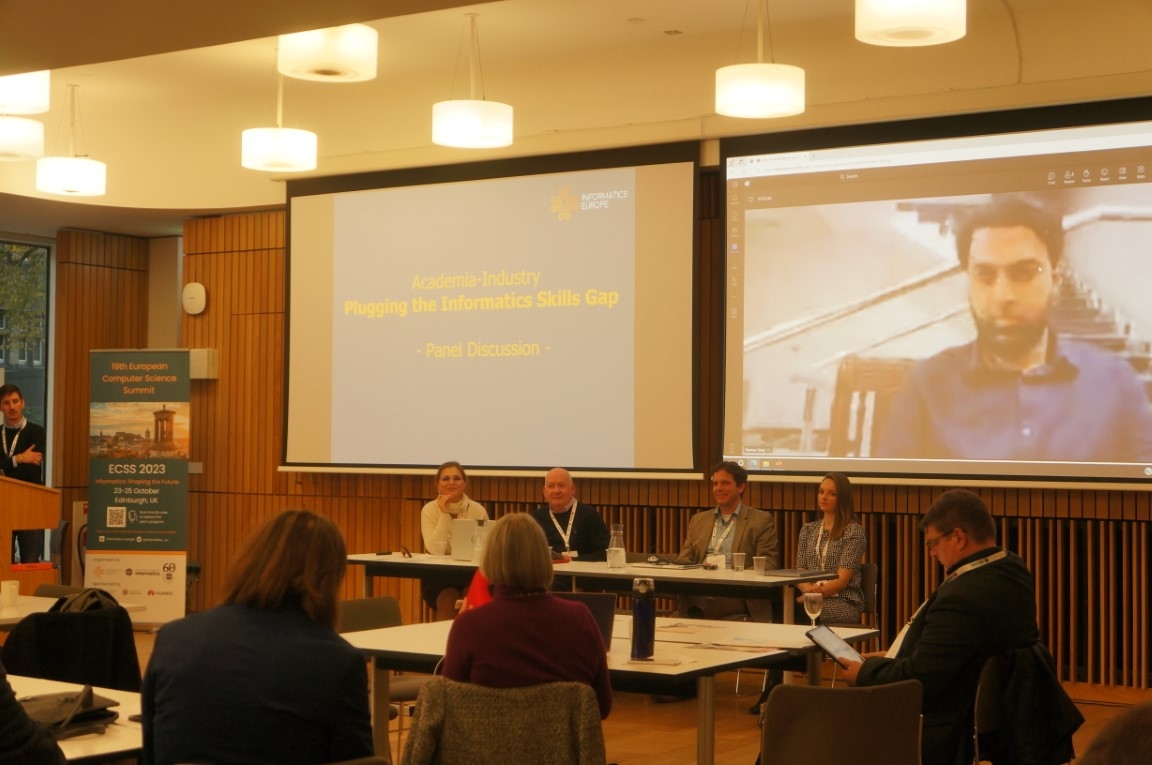
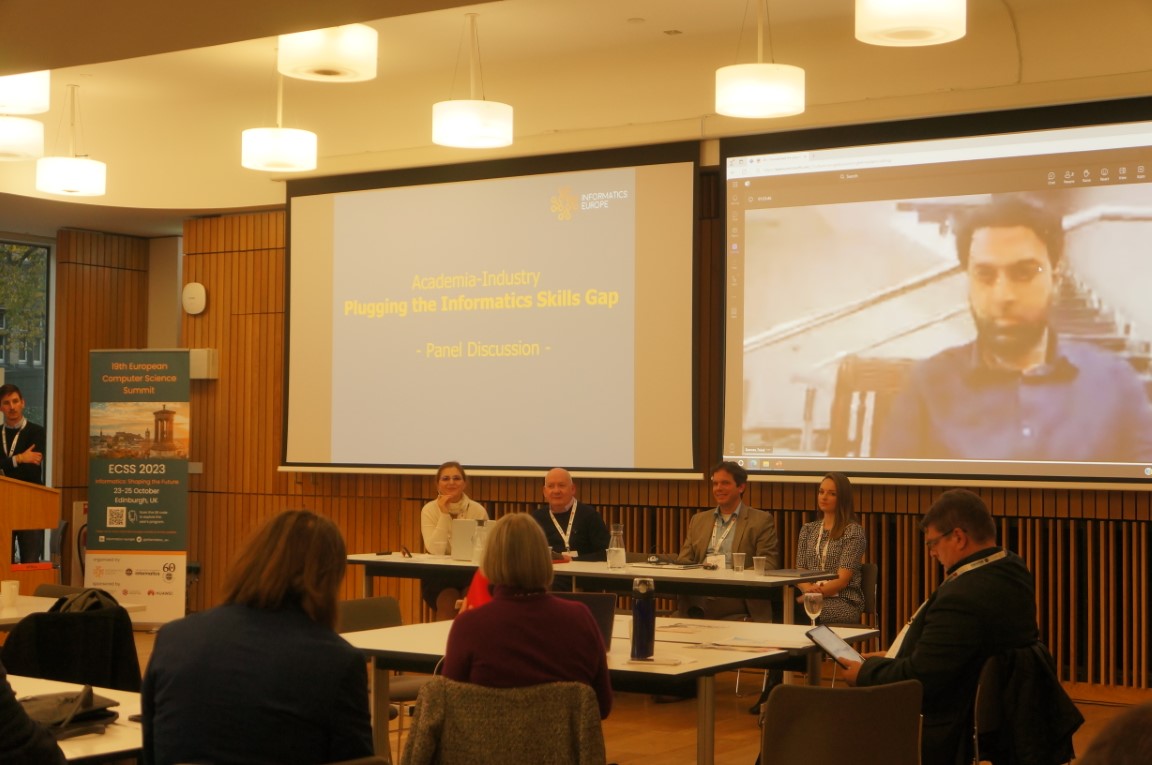
Tuesday’s session "Plugging the Informatics Skills Gap” showcased the urgency of lifelong learning in the tech domain. Critical takeaways were provided by industry leaders: Faisal Kamran (SONY) emphasized the collaborative potential between industry and academia; Michael Gienger (Honda Research Institute) highlighted the role of continuous learning in company research, and Elizabeth Barr (CISCO Networking Academy) presented a vision for an inclusive tech future.
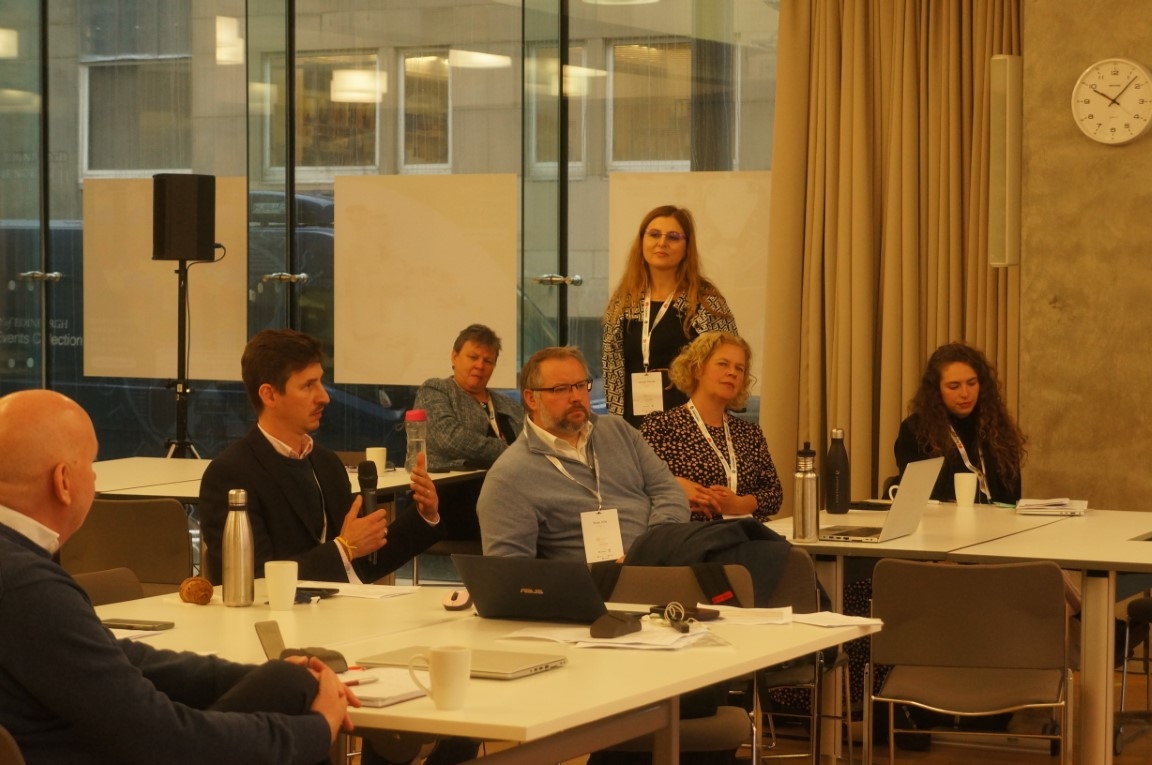
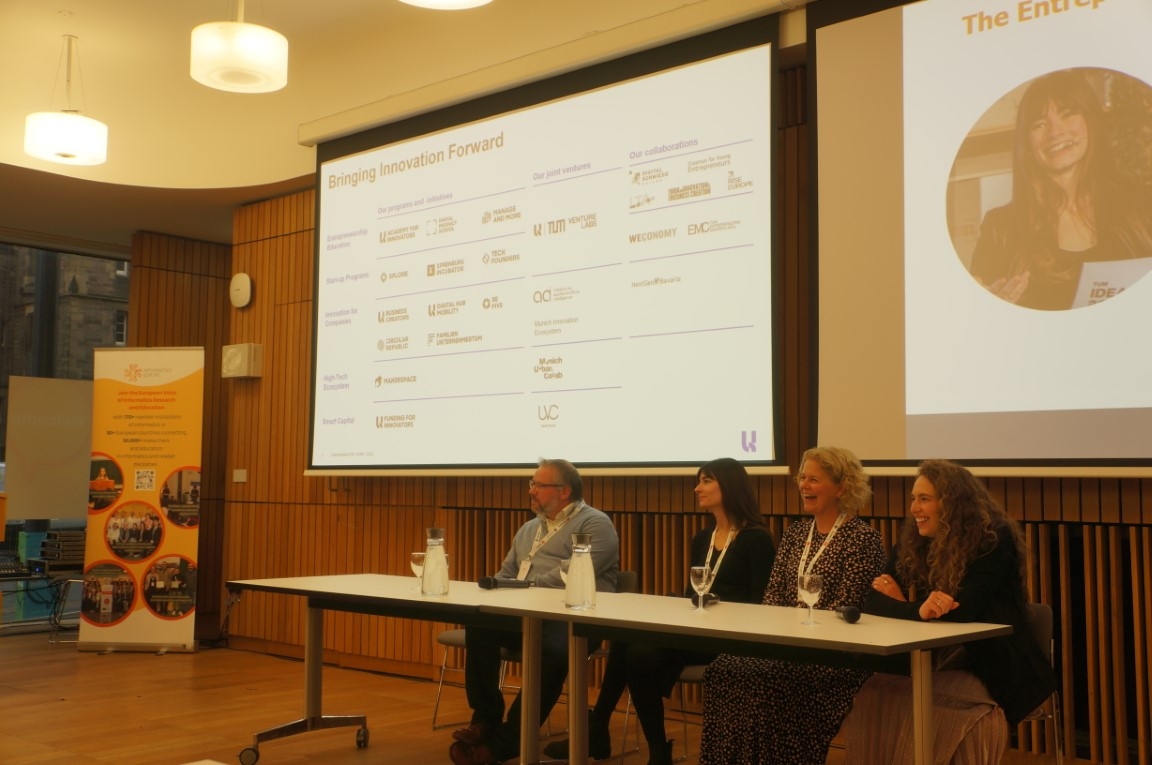
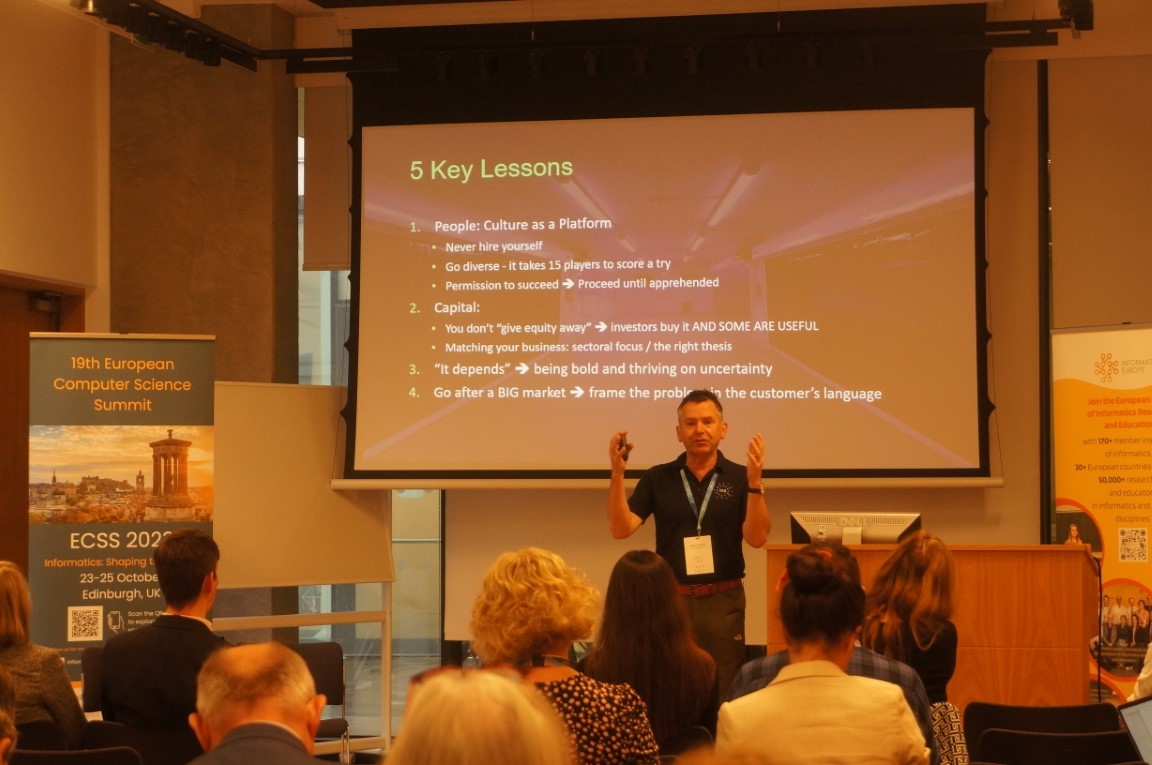
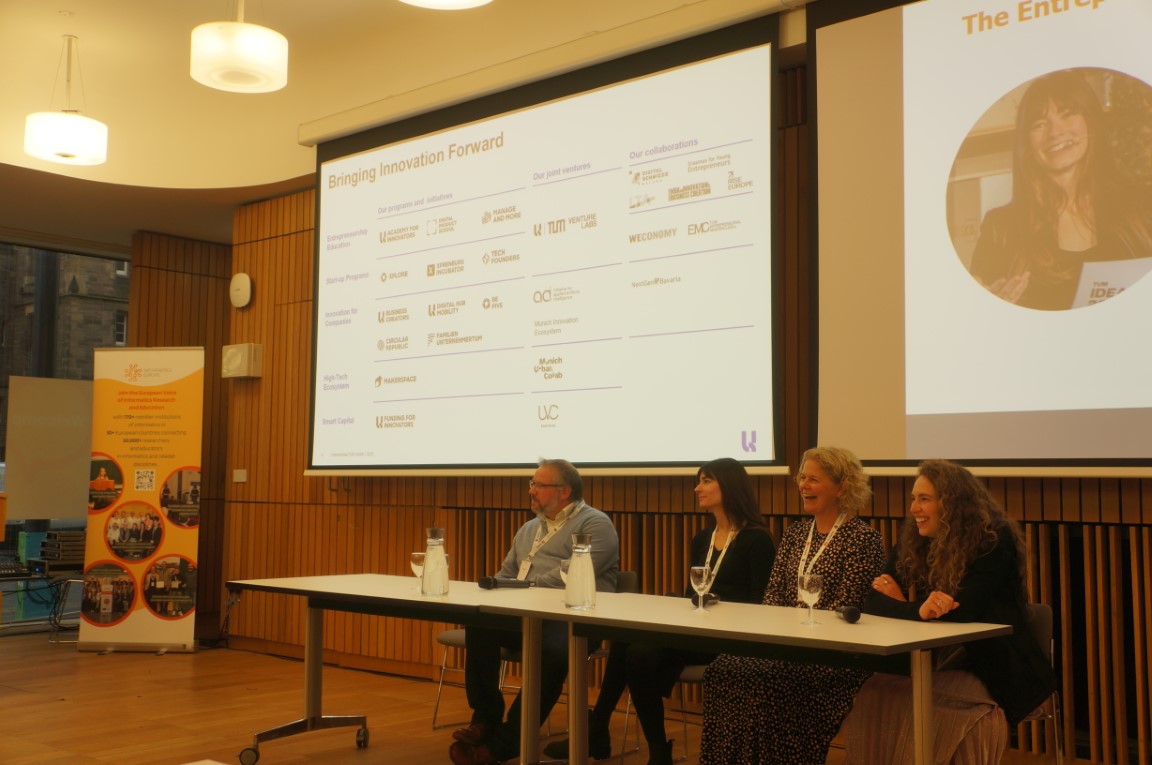
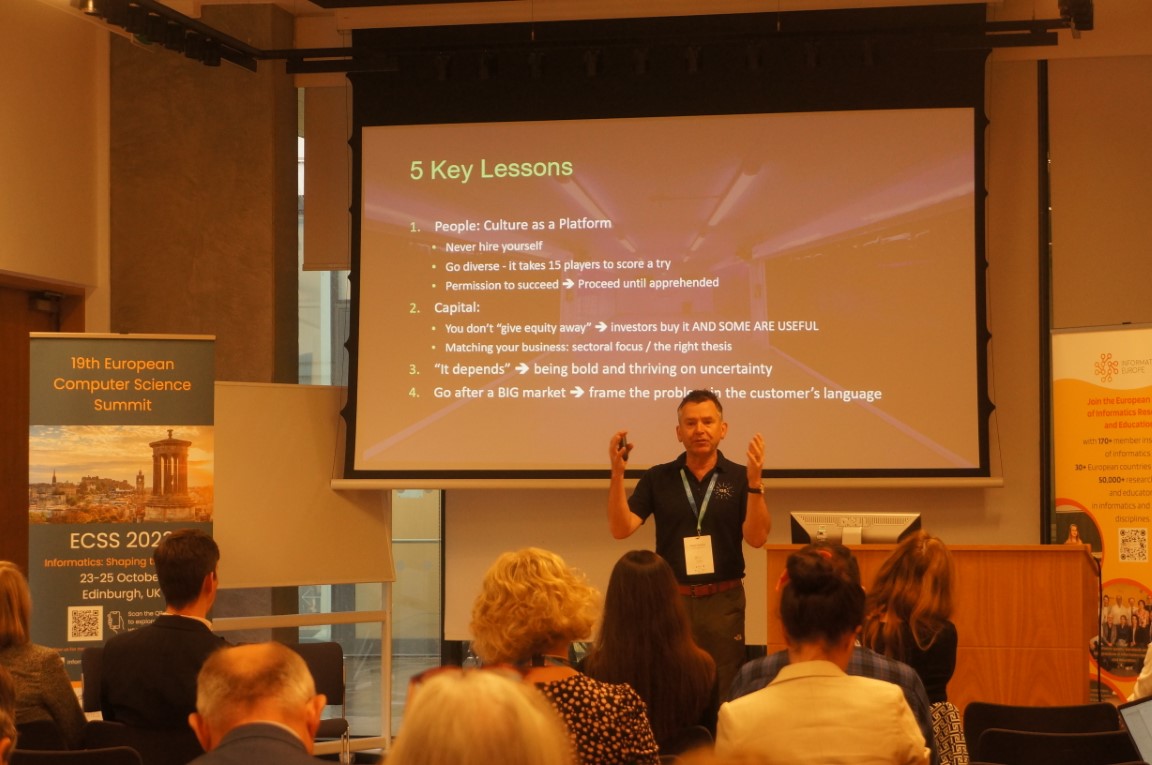
Wednesday’s session "The Journey from Higher Education to Entrepreneurship” pivoted towards monetizing academic research and nurturing entrepreneurship. Key highlights included insights from Edinburgh Innovations on creating AI-driven businesses, The DataLab's ethical journey from research to startup, and UnternehmerTUM GmbH's entrepreneurial blueprint. Moreover, success stories by David Farquhar (Intelligent Growth Solutions Limited, UK) and Chris Van der Kuyl (4J Studios, UK) resonated with budding entrepreneurs, while investment perspectives were shared by Andrea Young (Old College Capital, UK) and Kerry Sharp (Scottish Enterprise, UK), emphasizing its pivotal role in tech innovation.
In essence, these sessions underscored the evolving symbiosis between academia and industry, enriched by the insights and experiences of all participants. .
National Informatics Associations “AI and the Future of Informatics Education” Workshop
The National Informatics Associations workshop covered two areas this year: two morning sessions were devoted to the interaction between the latest developments of AI and its interaction informatics education, and one afternoon session continued last year's open science workshop, focusing on the evaluation of research in the realm of open science.
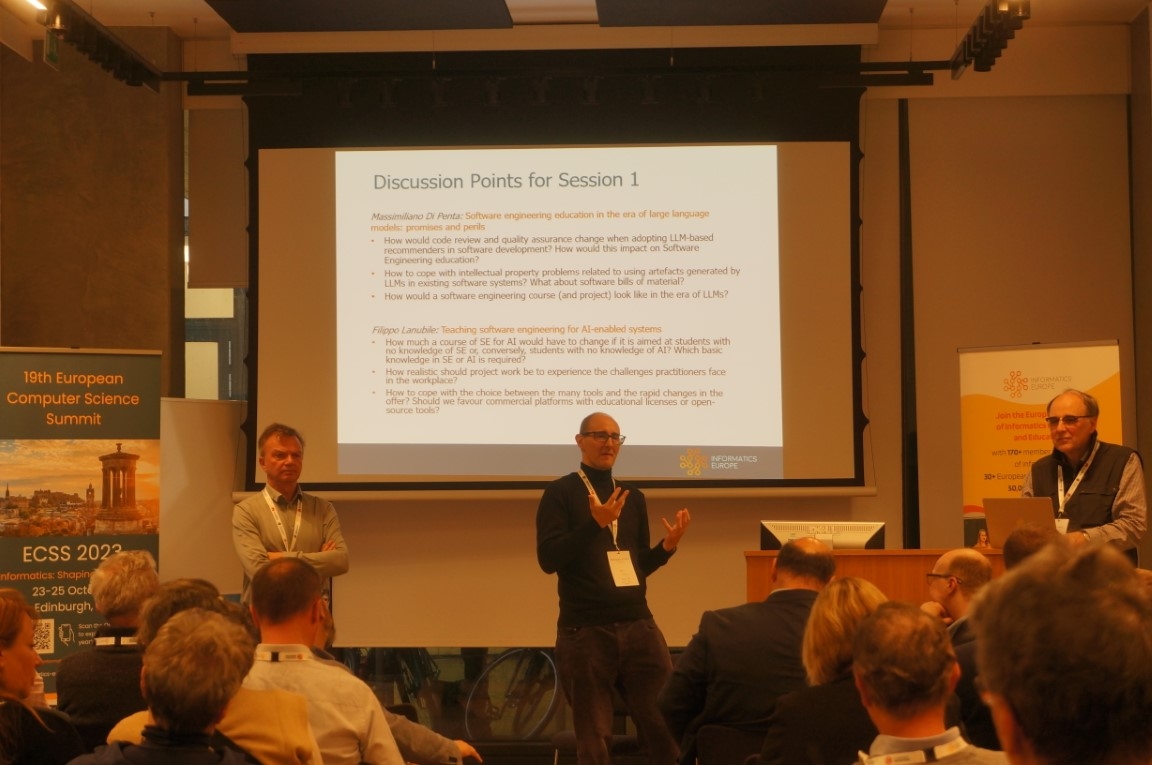
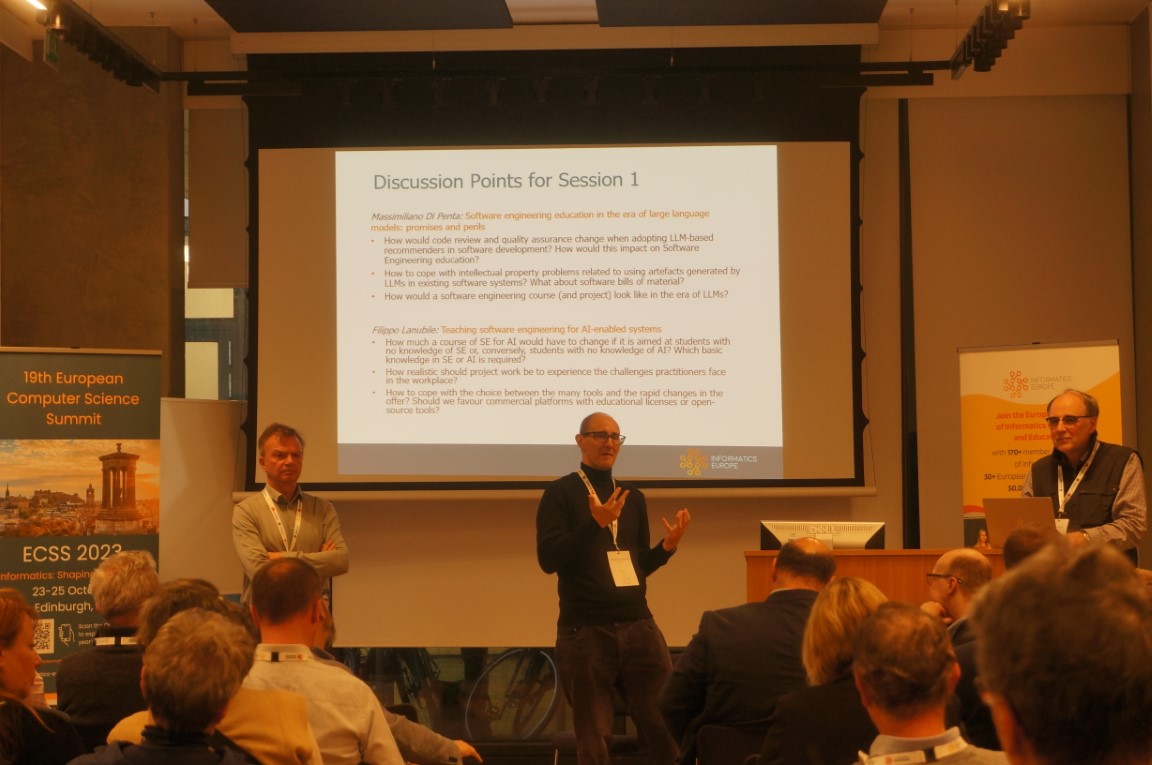
In the first morning session, two talks delved into two complementary aspects of the interplay between AI and SE. In the first talk, Massimiliano di Penta (University of Sannio, Italy) addressed the influence of Large Language Models (LLMs) in Software Engineering (SE) education, highlighting concerns arising from their effectiveness in code generation, review and bug patching. A decrease in manual code writing will continue with the ongoing progress of AI support, prompting adjustments in SE education. Students should understand AI capabilities and techniques, while also considering limitations, trust issues and legal challenges associated with AI applications, such as prompt engineering.
In the second talk, Filippo Lanubile (University of Bari, Italy) discussed how to do SE where some of the components are AI-enhanced and need training at large scale with specific data. He reported on an experimental course developed at the University of Bari and the Technical University of Catalunya, where ML components are perceived as first-class citizens and put into production as part of a more traditional SE pipeline, resulting in the concept of MLOps as a counterpart of DevOps. This brings about challenges that are not so prominent in traditional SE such as reproducibility. Students appreciated the course but noted a high workload and tool diversity, sometimes lacking robustness/documentation.
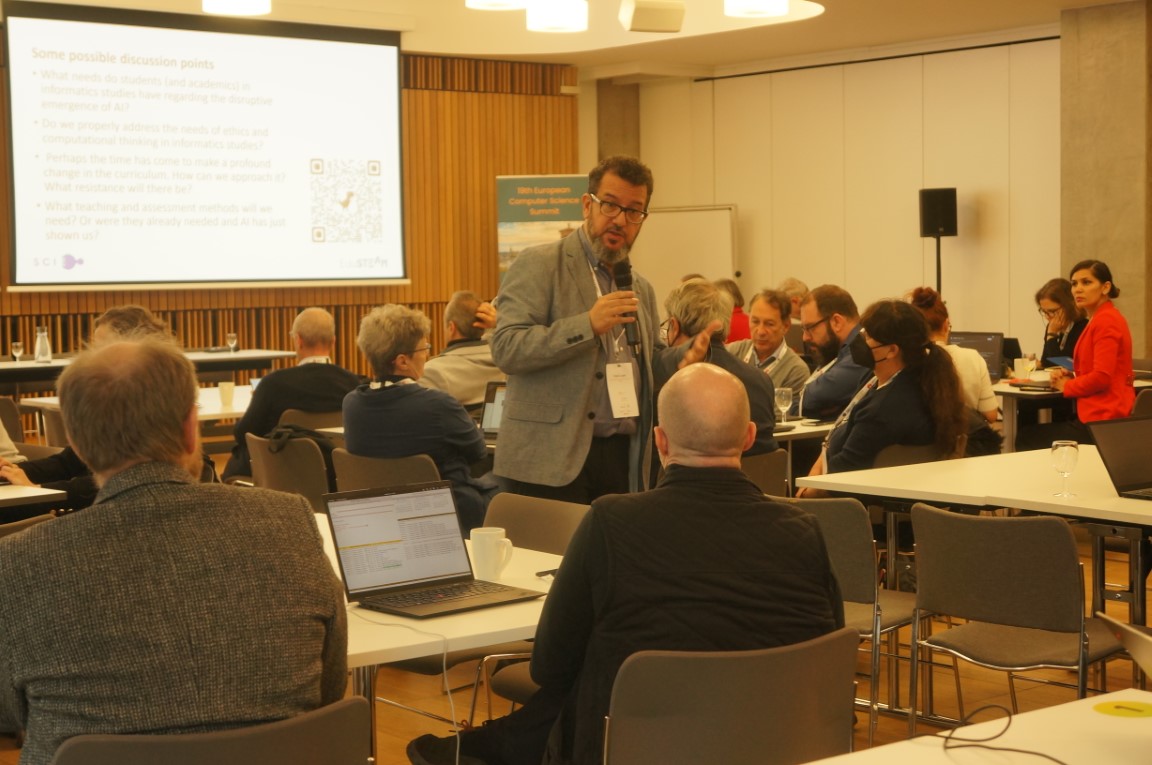
The third talk of the morning was given by David López (Scientific Society of Computing of Spain/Universitat Politècnica de Catalunya, Spain) who presented his ideas on the wide impact of AI on teaching informatics. He highlighted AI’s amplification of existing issues and the divisive opinions surrounding it. He mentioned that educators can take advantage of the potential of modern AI to overcome some of the prevalent tenets in current education practices, such as homogeneity and repetition. AI can be leveraged to, for example, create tailored curricula and use alternative, open-ended evaluation methods that encourage creativity. This should be coupled with, on the one hand, general training on AI and, on the other hand, ethical codes and guidelines.
David’s presentation was followed by Thomas Gross (ETH Zurich, Switzerland) who delved into the question "up to which point can AI-enhanced tools replace programmers?". His talk reported on experimental data using Copilot on a series of code tasks usually delivered to students at ETH Zurich. Preliminary results suggest that such tools can be effective, but under the command/hints of a fairly seasoned programmer. At the moment, this programmer needs to have the skills necessary to read a problem statement and come up with a feasible solution for the task at hand (so that they can judge on the correctness and quality of the code generated by the AI program), and to craft tests to check that the code behaves as expected.
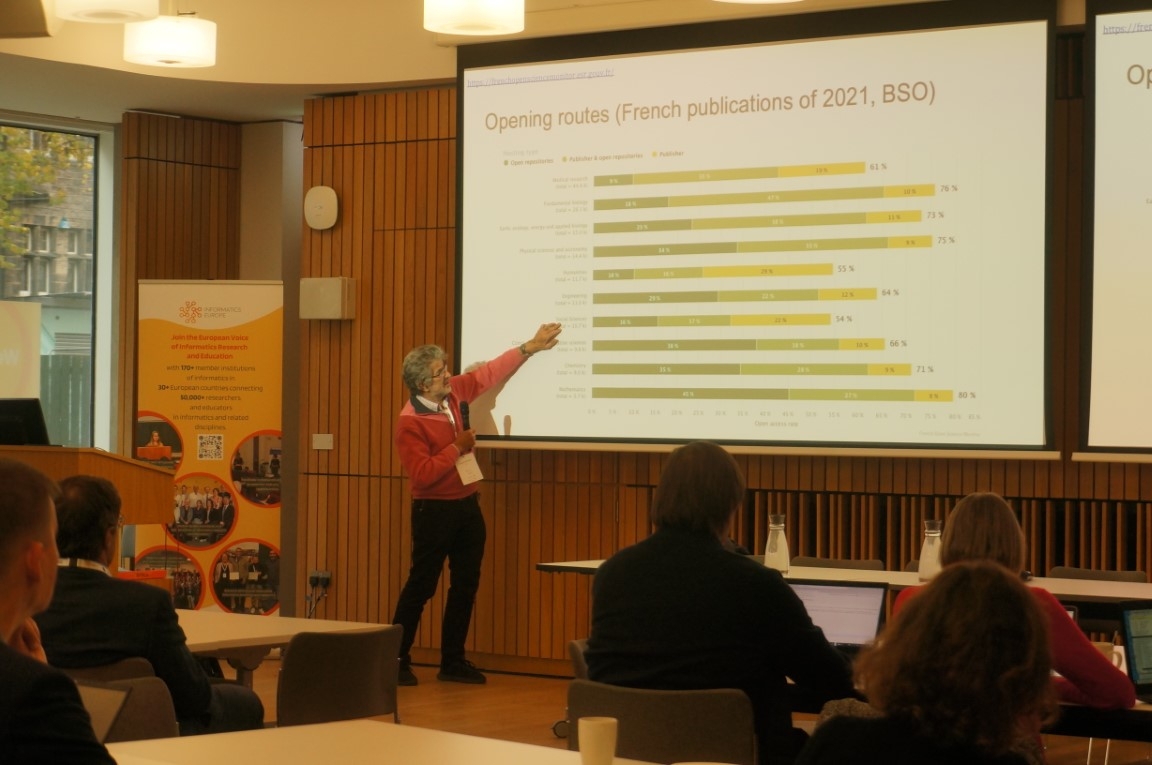
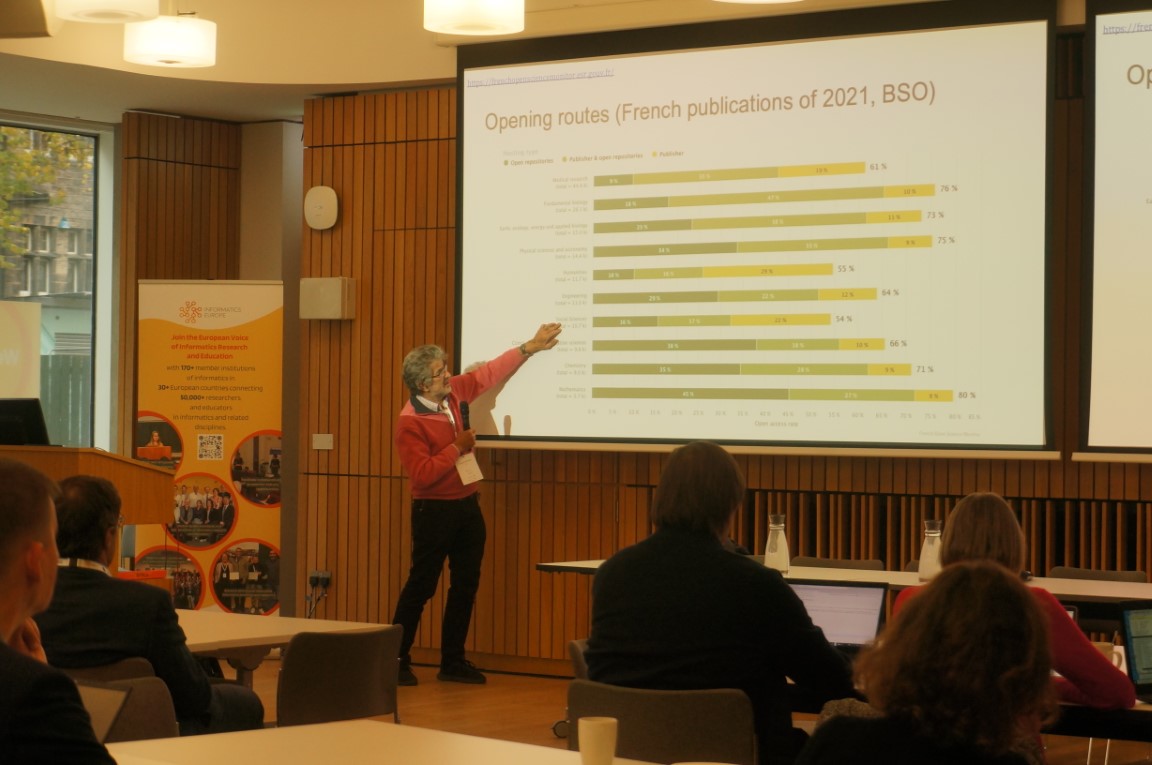
The afternoon session of the workshop addressed the topic of evaluating informatics research in view of the developments in open science. Pierre Paradinas (CNAM/SIF, France) and Laurent Romary (Inria, France) jointly presented on the theme with the aim of generating questions, rather than providing definitive answers. Informatics has specific characteristics, such as being inaccurately represented by journal publications, which make many widespread evaluation techniques inadequate. Moreover, in the realm of open science, also research outcomes such as code and data ought to be evaluated. There are existing initiatives to save, categorise, and link papers, code, and data, with different impact and prevalence in different communities, both within informatics and in closely related areas. Some questions to be pondered would be the right criteria for a fair and balanced research assessment in informatics; how to monitor contributions; and what tools can be produced to help automate this evaluation.
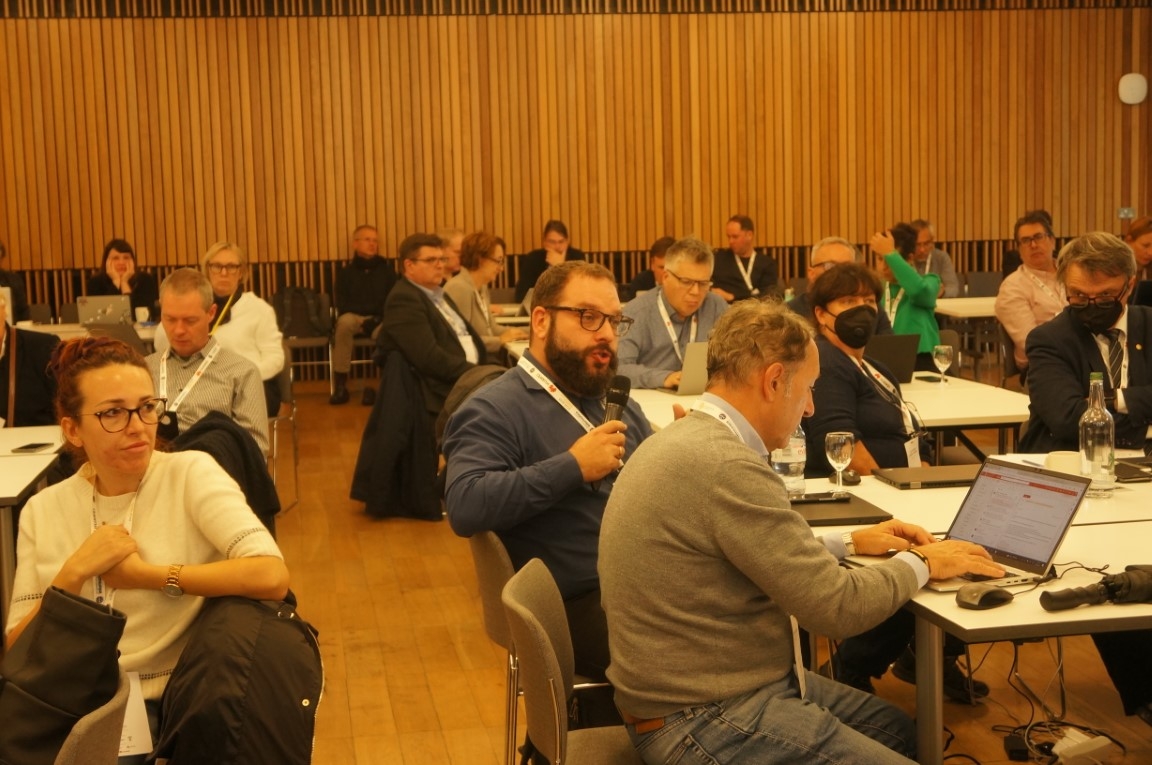
The talks were attended by a very interactive audience who posed several questions to speakers, with identified needs for further guidelines in the areas of teaching informatics/SE in the era of AI and informatics research assessment that accounts for open science. These themes will be developed within the IE working groups as future points of action. .
Green ICT and ICT for Green Workshop
Led by IE Green ICT Working Group Chair Marco Aiello (University of Stuttgart, Germany), the workshop kicked off with an insightful panel. Vasilios Andrikopoulos (University of Groningen, the Netherlands) highlighted challenges in measuring energy usage in cloud architectures and pinpointed the constraints of the Greenhouse Gas Protocol for cloud systems. Kawsar Haghshenas (University of Groningen, the Netherlands) underscored the energy-intensive nature of scheduling machine learning tasks in data centers. Brian Keegan (TU Dublin, Ireland) provided insights into weaving sustainability into computer science education.
A robust discussion ensued, delving into topics like the complexities of calculating embodied emissions, the interdisciplinary nature of ICT and sustainability, and the indispensable contributions required from experts across fields like psychology, sociology, economics, law, and power systems. Regulatory considerations came to the fore, with emphasis on the potential conflicts between societal sustainability objectives and the industry's economic ambitions, necessitating regulations, particularly in Europe.
The workshop concluded that IE’s Green ICT working group should focus on a proposal for enforcing data center transparency in terms of sustainability measurements and goals; the need to define how to educate computer scientists and engineers about sustainability and incorporate it into their ability to design systems; and to define software engineering processes that have sustainability as a core element.
ECSS 2024 in Malta
The next Summit, ECSS 2024, will take place in Malta, marking the 20th anniversary of ECSS, renamed as the European InformatiCs LeaderS Summit to better reflect its focus and goals. It will be again a unique opportunity to join your international peers to debate the future of informatics and contribute to a stronger European informatics community.
We warmly welcome you to become our ambassador and contribute to the growth of our community for enhanced collaborations in informatics and related fields. We would therefore reward you with complimentary registration to attend the next ECSS for any successful referral of new IE members.
Save the dates on your calendar: ECSS 2024, 28-30 October 2024 – we look forward to welcoming you and your colleagues again in our annual flagship summit next year!
To revisit the ECSS presentations, please check out the slides now available to download on our conference schedule webpage. More workshop photos* and additional materials are also available under respective workshop/session pages.
*Please note that the photos below are better viewed when applying zoom out.










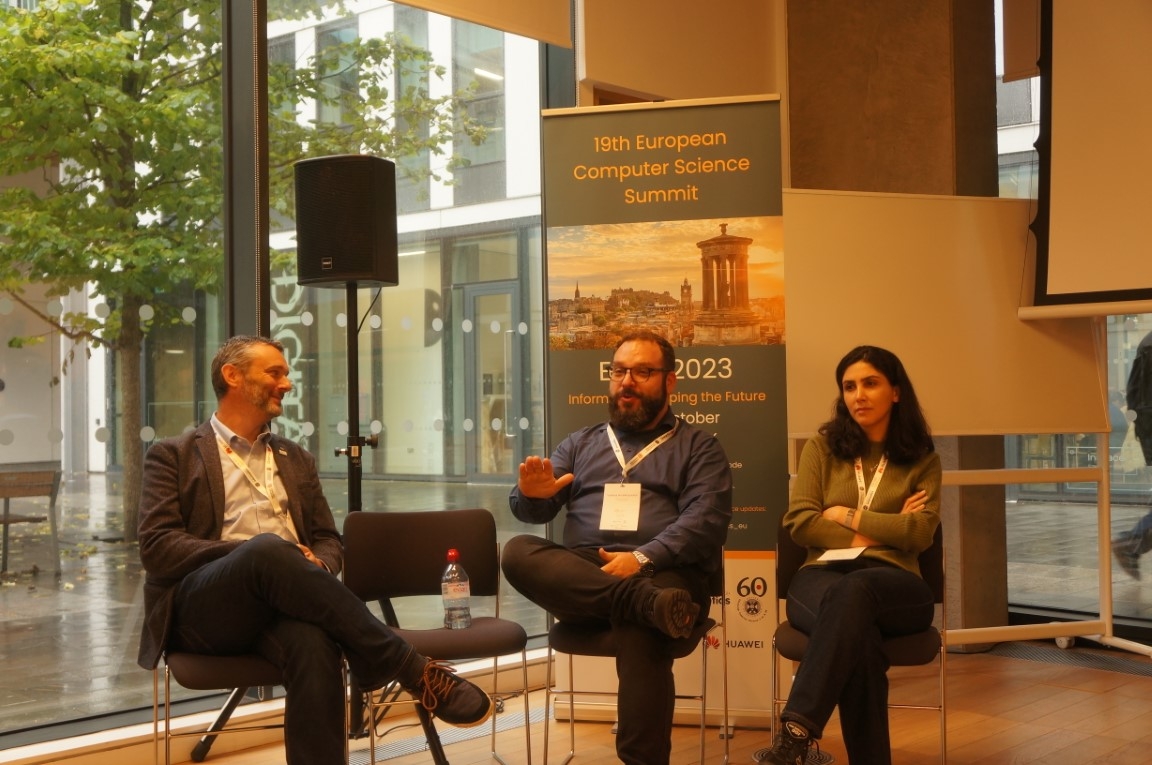

-
Special Informatics Europe Introductory Session
-
Special Informatics Europe Introductory Session
-
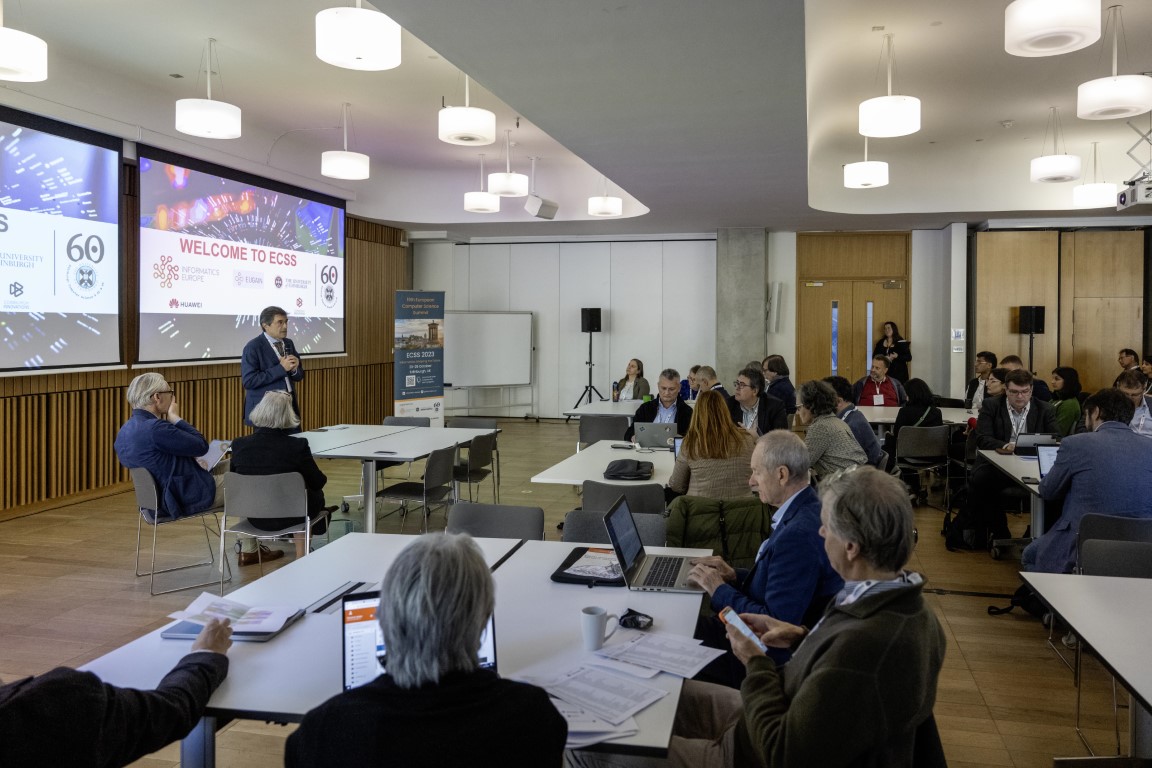
ECSS 2023 Official Opening
-
ECSS 2023 Opening by Iain Grant Gordon, University of Edinburgh (UK), Vice-Principal and Head of College of Science and Engineering
-
Enrico Nardelli, University of Roma "Tor Vergata" (Italy), President of Informatics Europe
-
Jane Hillston (University of Edinburgh, UK) at ECSS 2023 Official Opening
-
Leaders Workshop Speaker: Marieke Huisman, University of Twente (the Netherlands) & EUGAIN COST Action member
-
Leaders Workshop
-
ECSS 2023
-
ECSS 2023: Bridging the Gap between Academia & Industry in Informatics
-
Richard Boardman (2Macs,UK) facilitating “Where do you draw the line?” session at Leaders Workshop
-
Feedback session/reflections on discussions in subgroups at Leaders Workshop
-
Leaders Workshop's panel discussion with panellists from underrepresented groups
-
Early Career Researchers Workshop Panelist: Ambrish Rawat, IBM Research Europe (Ireland)
-
Early Career Researchers Workshop
-
Early Career Researchers Workshop Poster Session
-
Welcome Cocktail including the Early Career Researchers Poster Session
-
Early Career Researchers Poster Session
-
IE Office at ECSS 2023
-
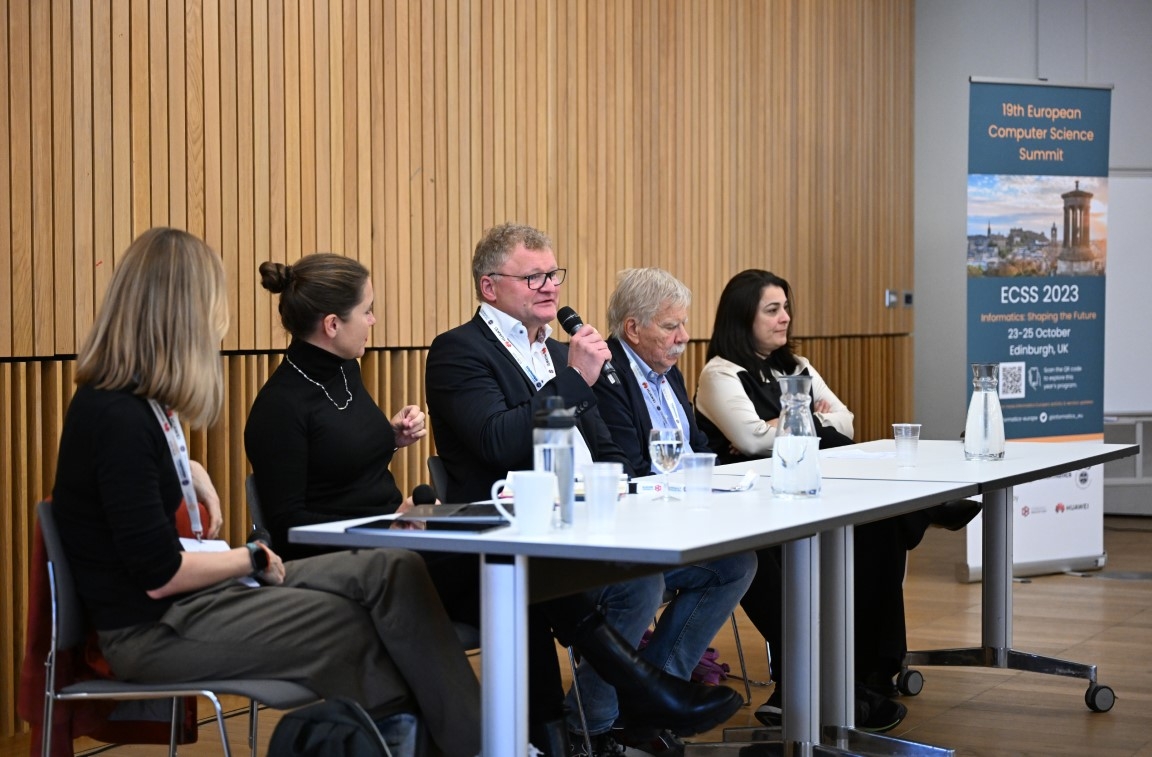
Panel Discussion with Main Theme Keynote Speakers
-
Panel Discussion with Main Theme Keynote Speakers
-
Panel Discussion with Main Theme Keynote Speakers
-
ECSS 2023: a must-go event for research and education leaders
-
Welmoed Spahr, Best Dissertation Award Sponsor Representative at Awards Session
-
Award Ceremony of Best Dissertation Award 2023
-
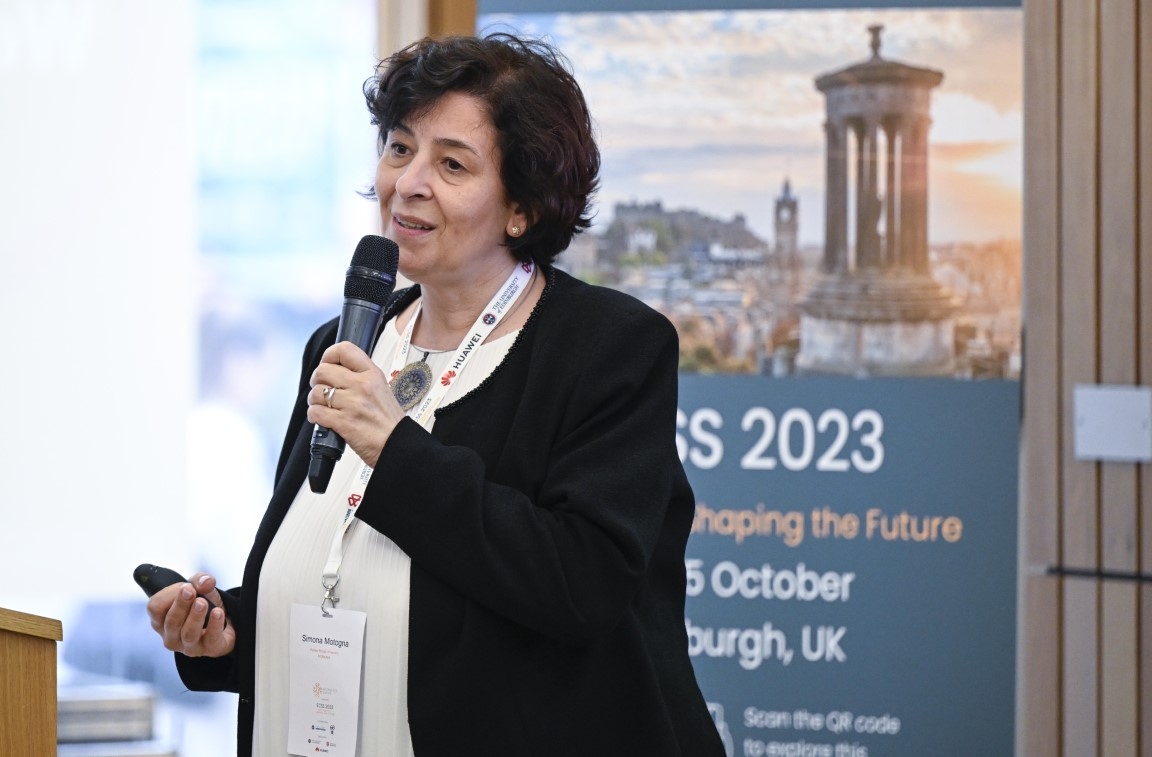
Simona Motogna (Babeș Bolyai University, Romania), Chair of Minerva Informatics Equality Award Committee 2023
-
Award Ceremony of Minerva Informatics Equality Award 2023
-
Informatics Europe Awards Session 2023
-
Informatics Europe Award Ceremony 2023
-
IE Dialogue with Members Session
-
IE Dialogue with Members Session
-
Academia-Industry Way Forward - Panel Discussion
-
Academia-Industry Session
-
"Fostering & Supporting Data-Driven Start-ups in Academia" Q&A Session
-
Higher Education Data Workshop
-
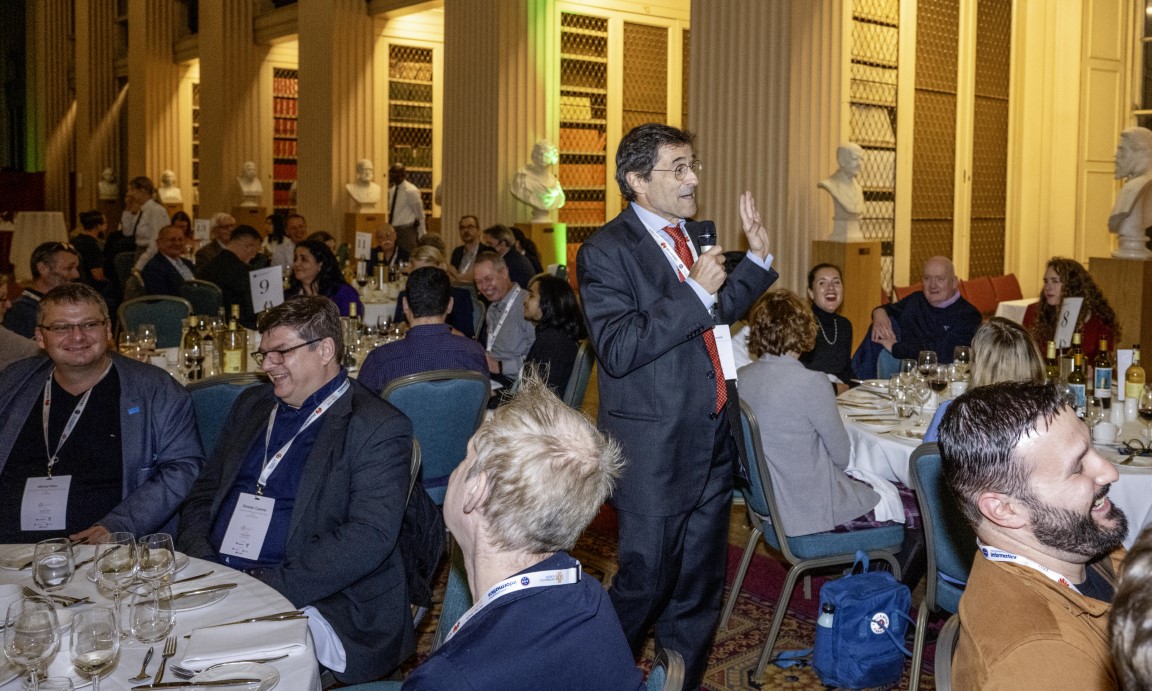
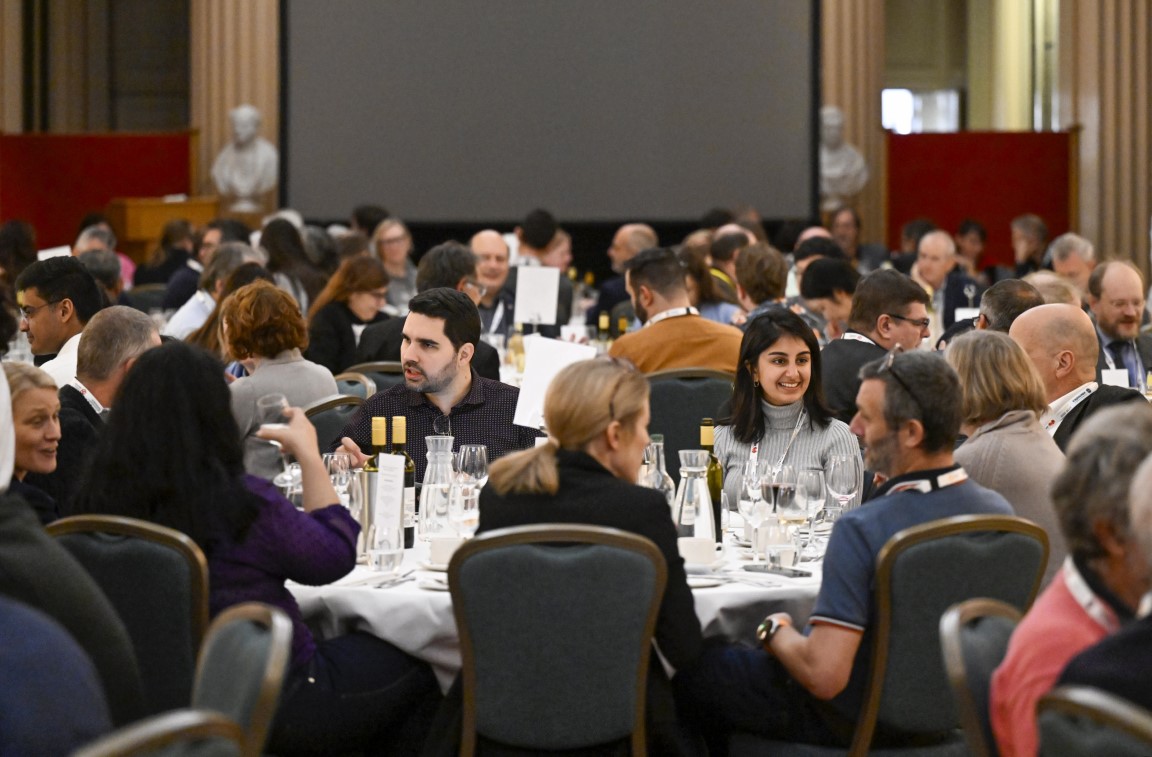
ECSS 2023 Official Dinner
-
ECSS 2023 Official Dinner
-
ECSS 2023 Official Dinner
-
ECSS 2023 Official Dinner
-
ECSS 2023 Official Dinner
-
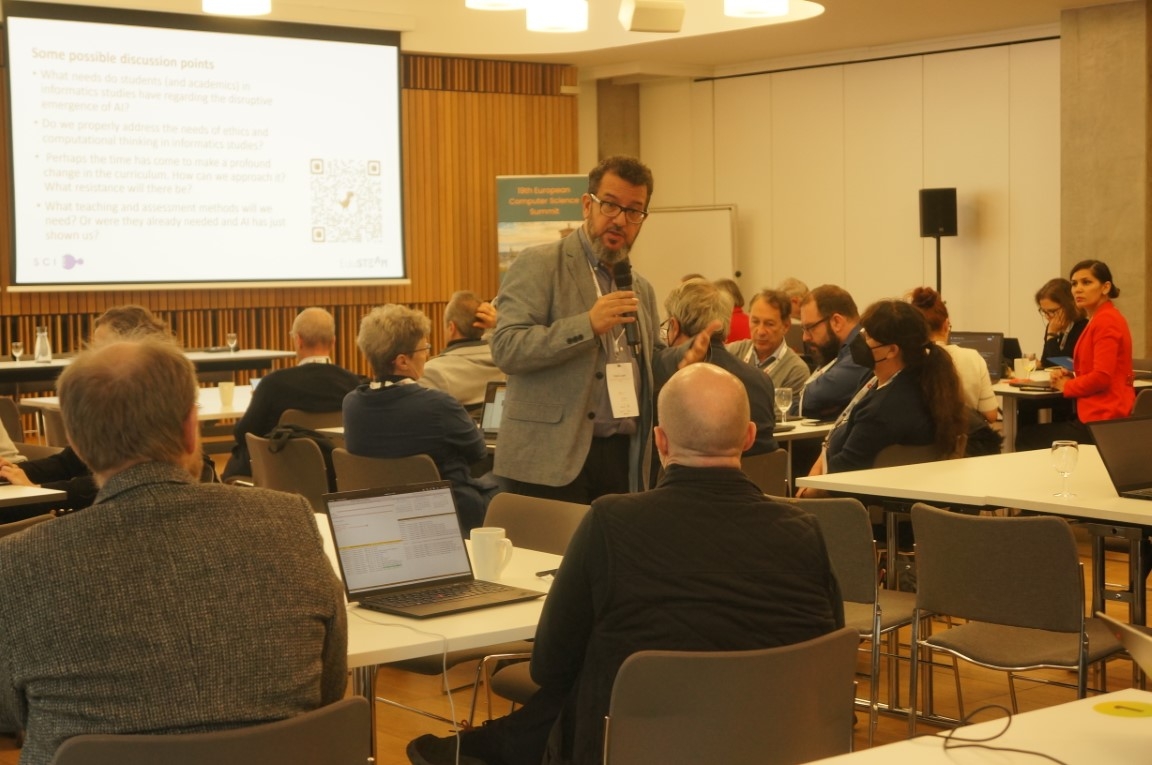
Discussion Session of "AI and the practice of teaching Software Engineering"
-
ECSS 2023
-
AI and the Future of Informatics Education Workshop
-
Laurent Romary (Inria, France) at "The future of Informatics research evaluation" Session
-
"The impact of AI on Informatics curricula and educational practices" Session
-
David Farquhar (Intelligent Growth Solutions Limited) at Academia-Industry Session
-
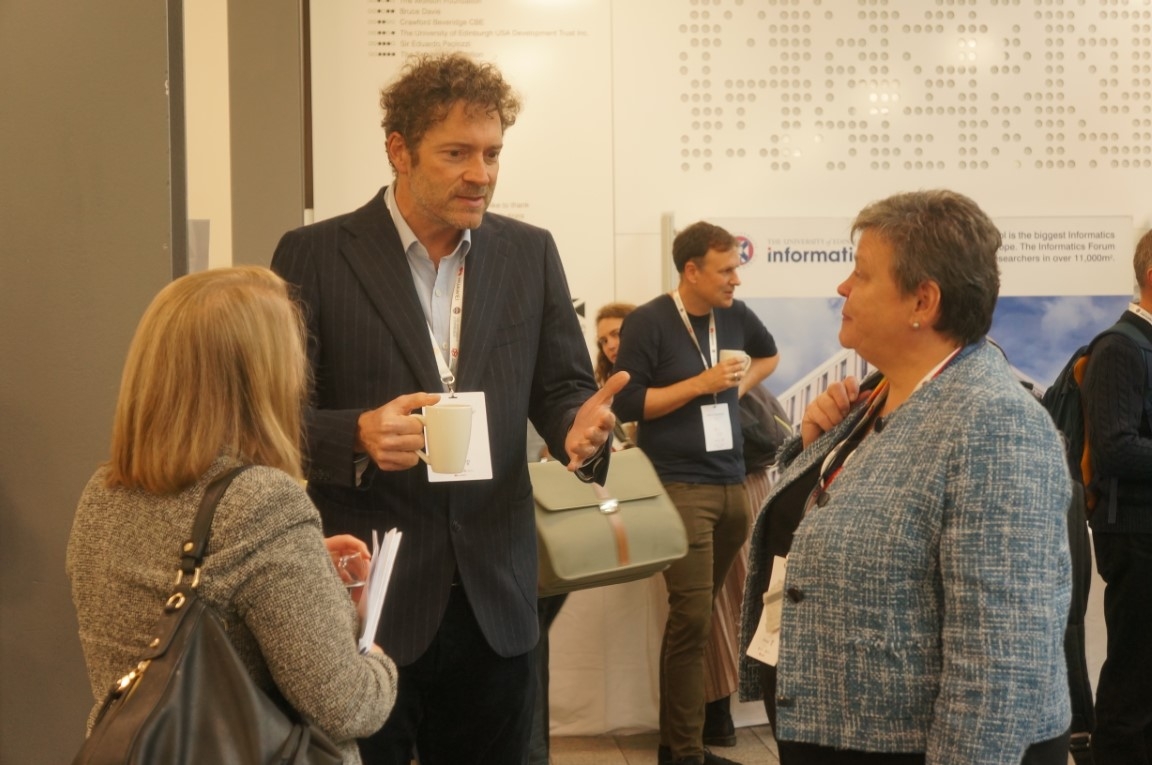
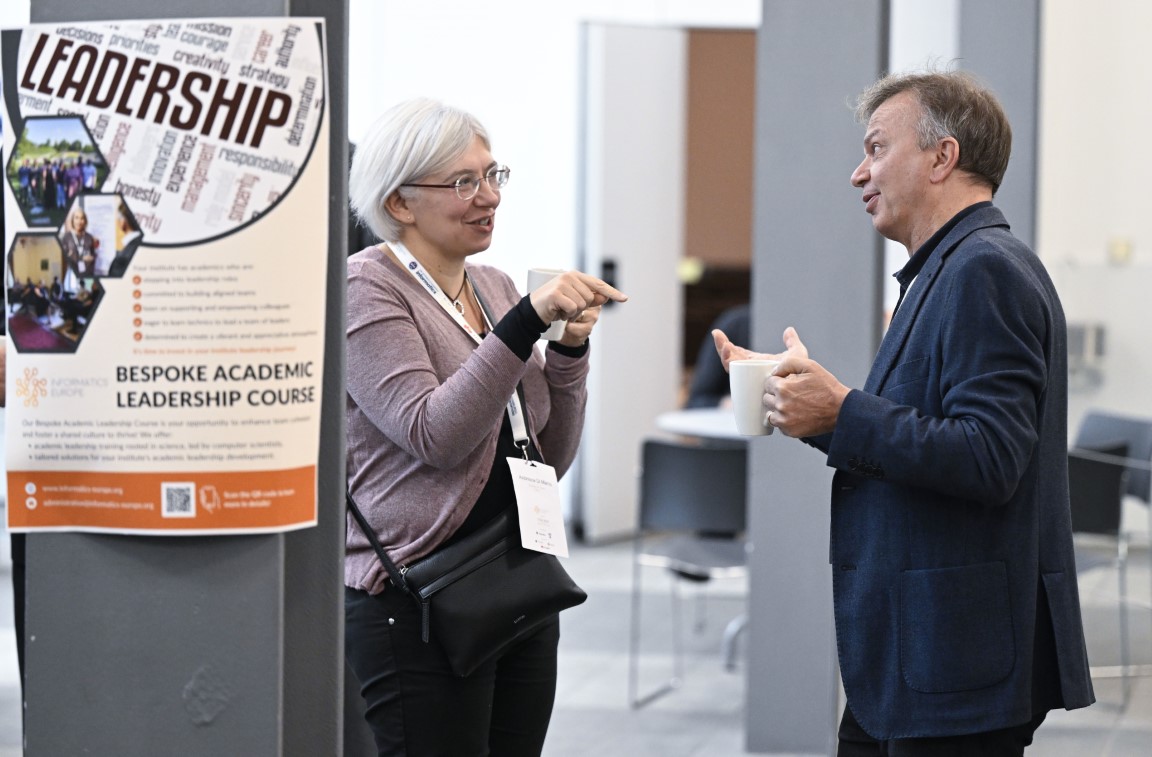
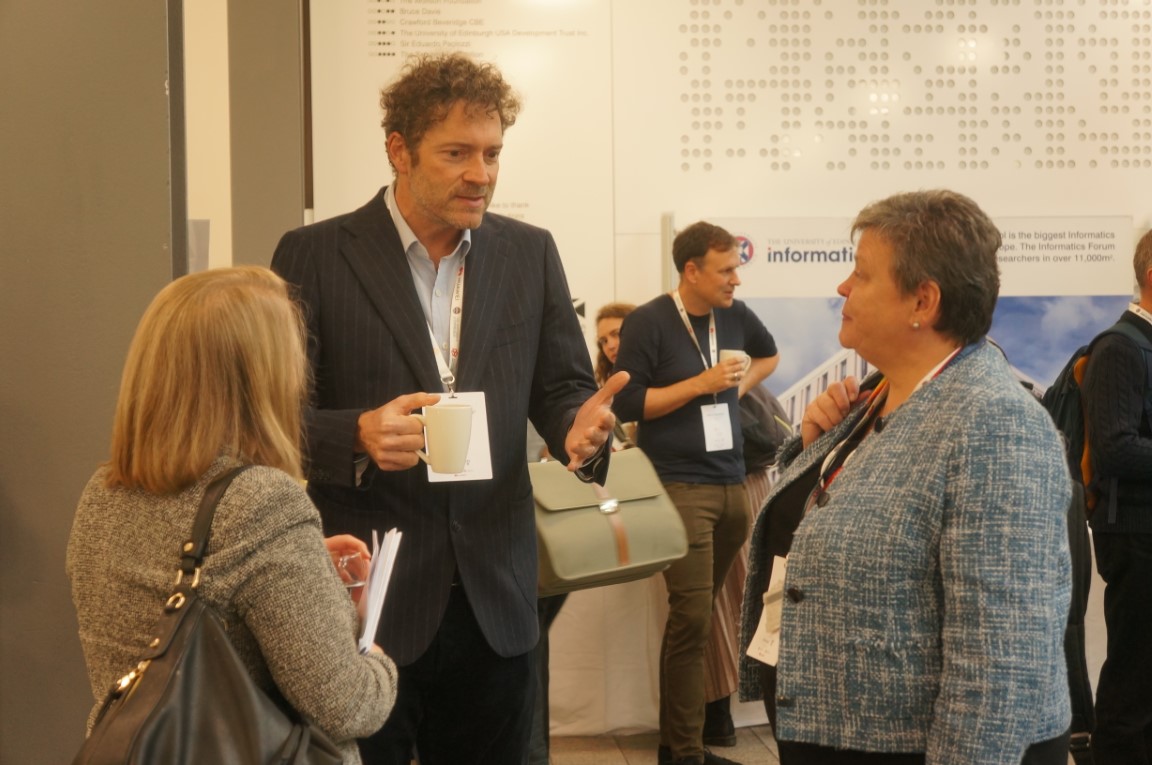
Coffee Break Networking at Academia-Industry Session
-
ECSS 2023
-
Panel Discussion at Academia & Industry Session
-
ECSS 2023
-
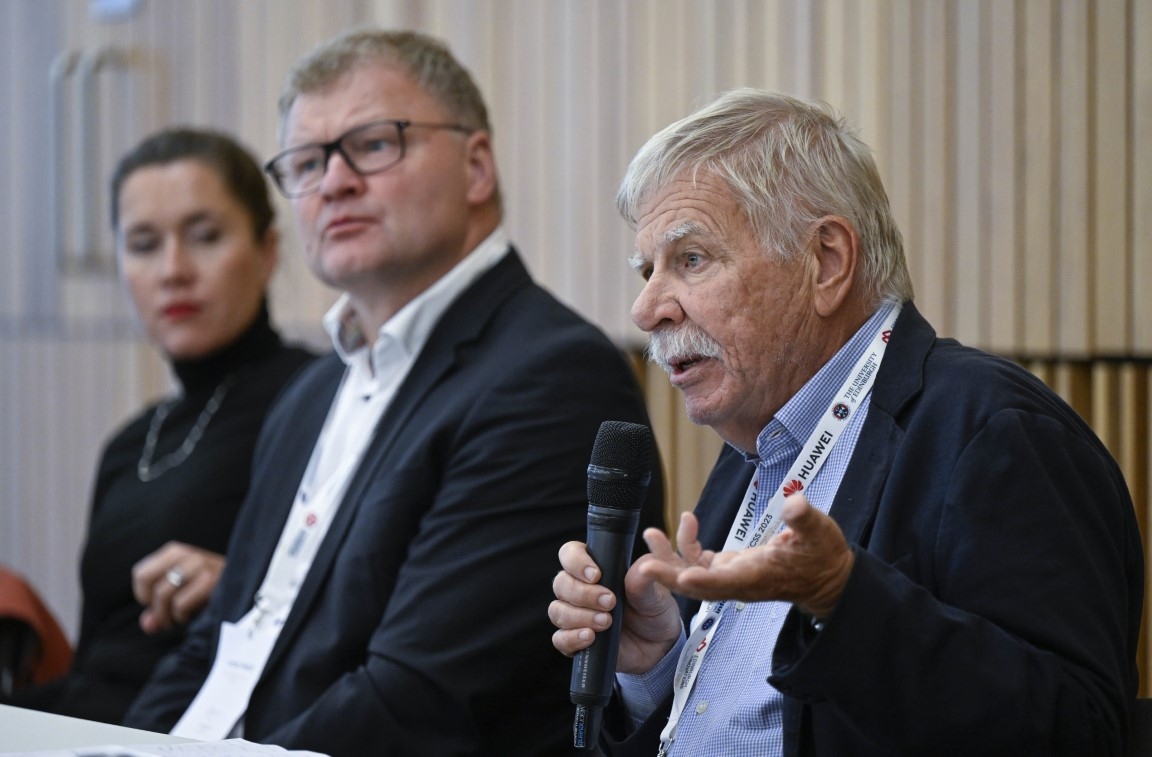
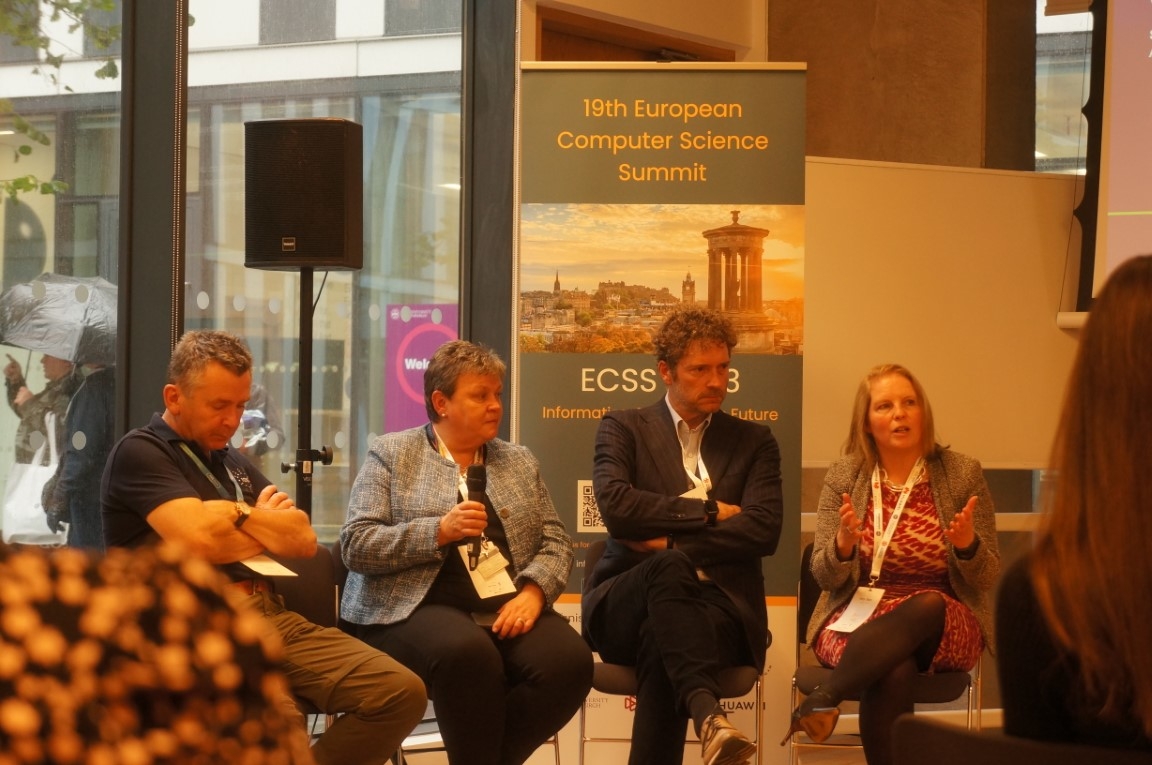
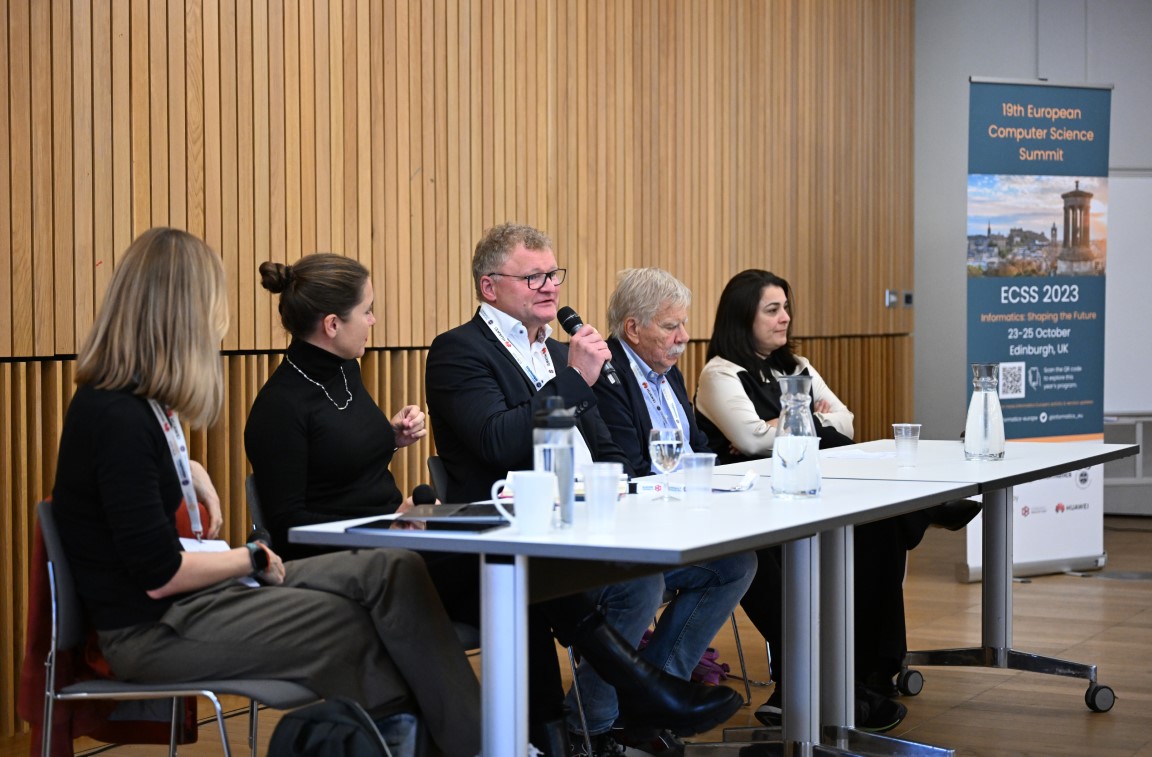
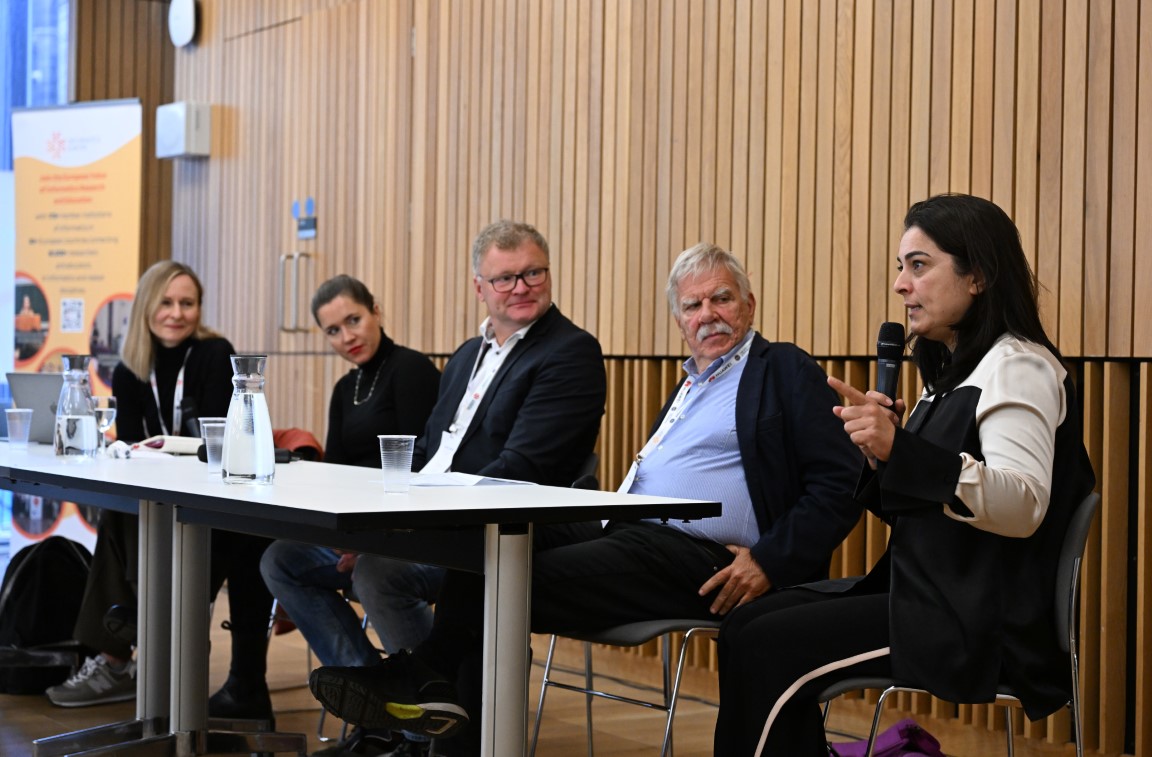
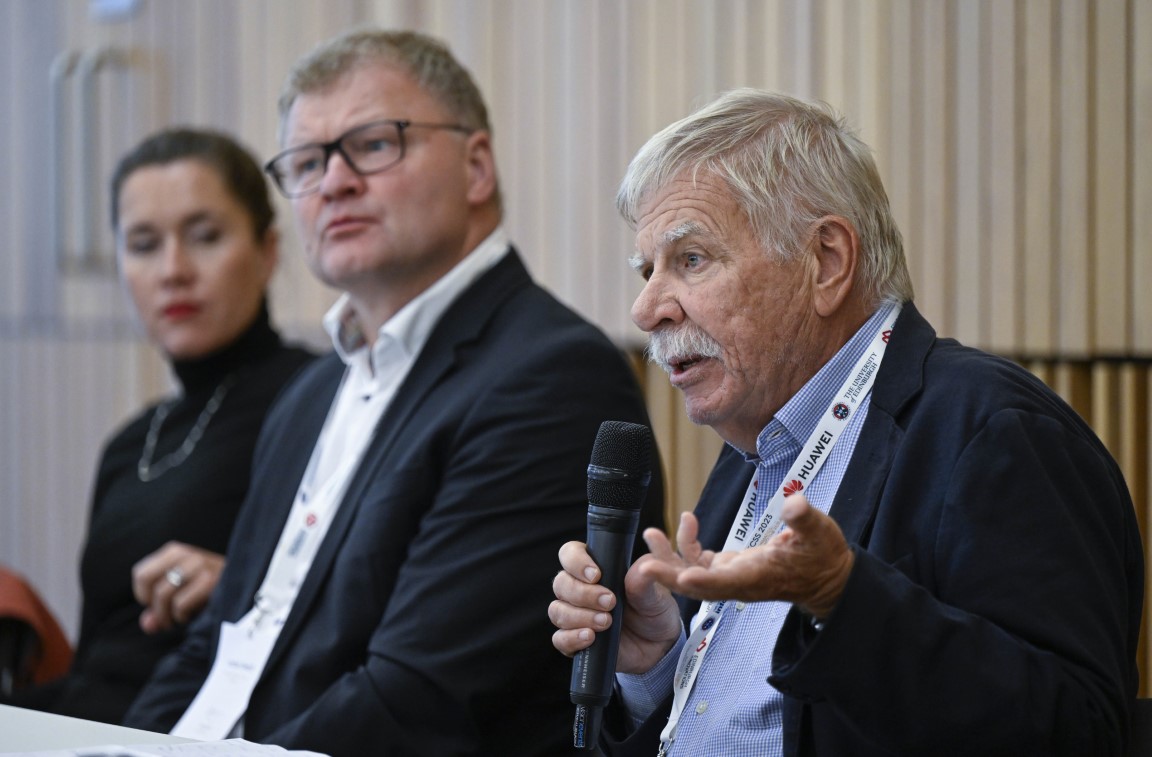
Open discussion with panellists at Green ICT and ICT for Green Workshop
-
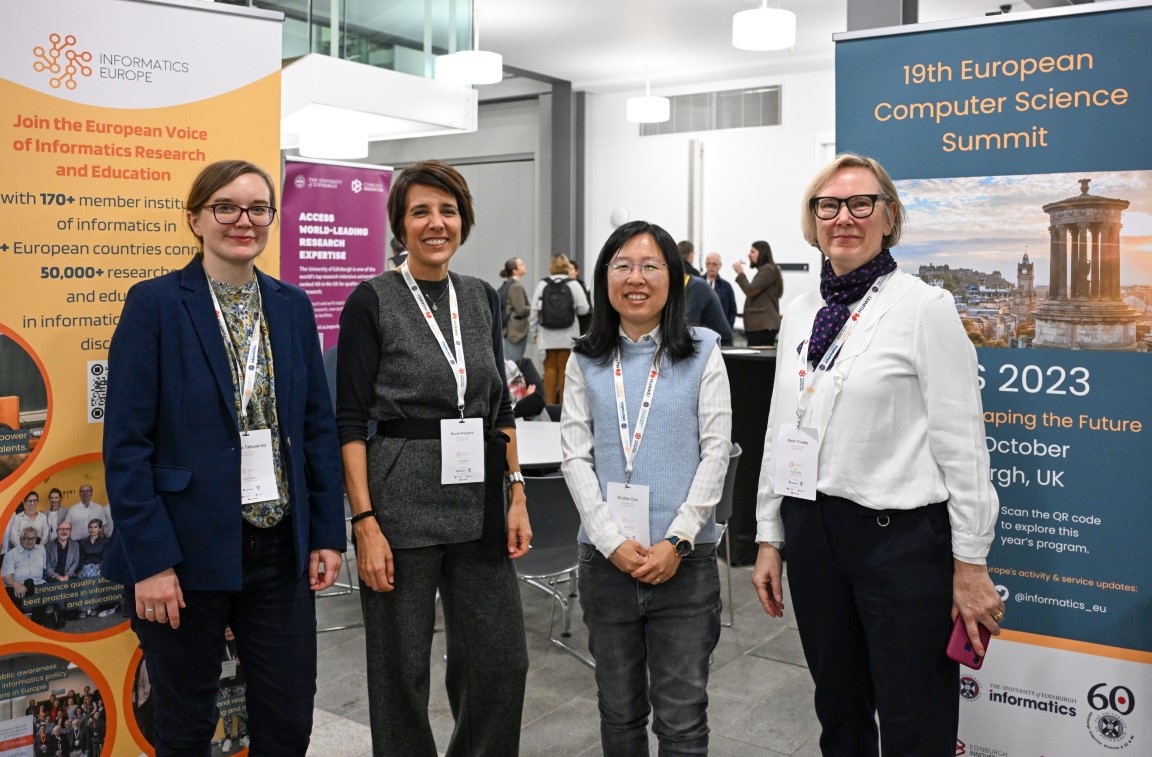
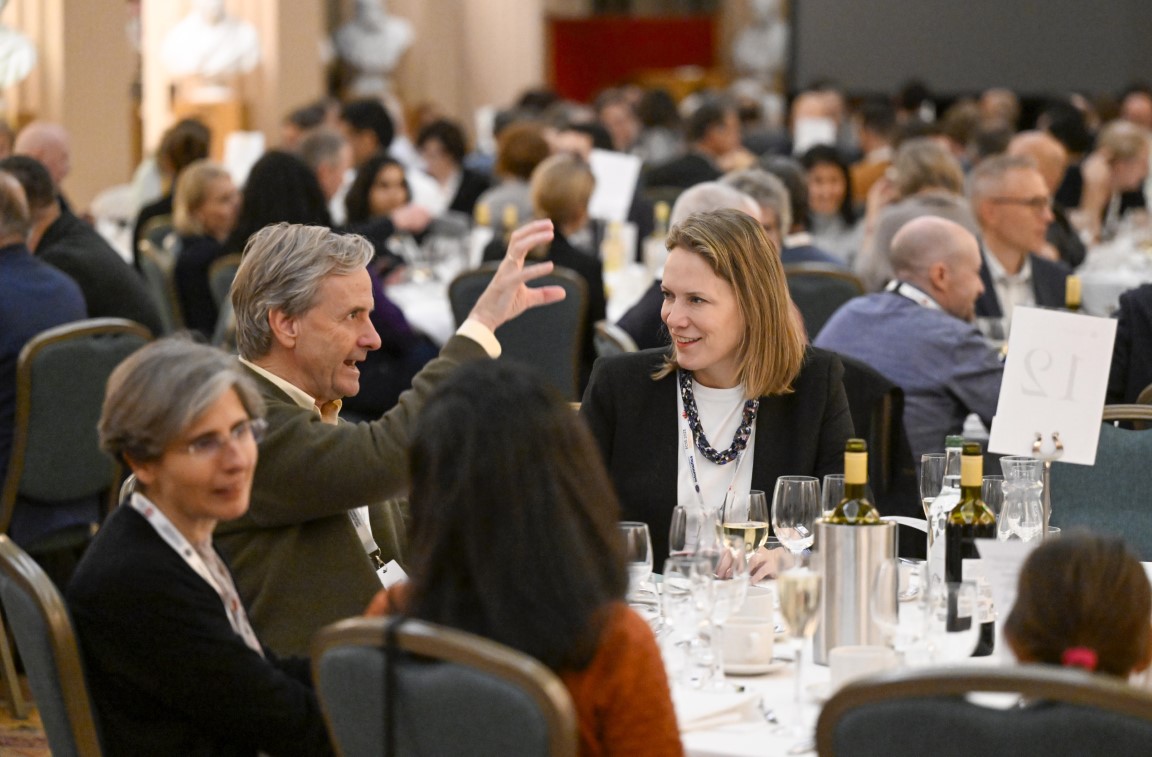
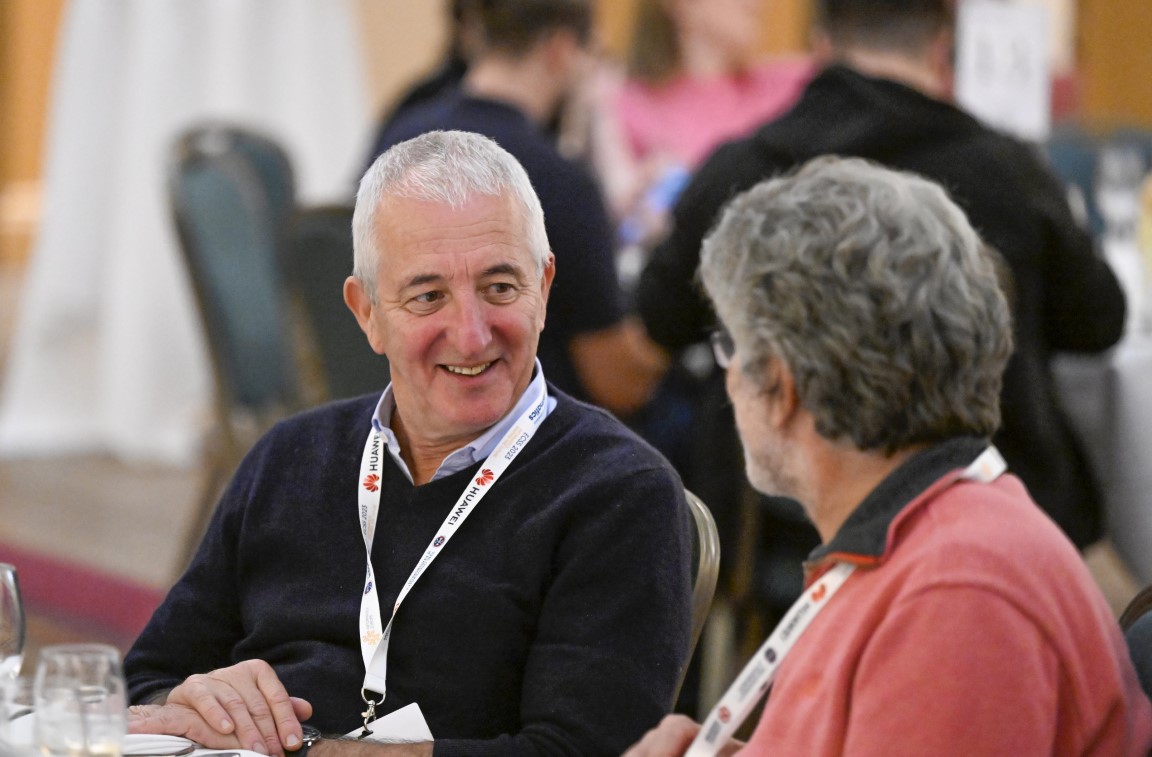
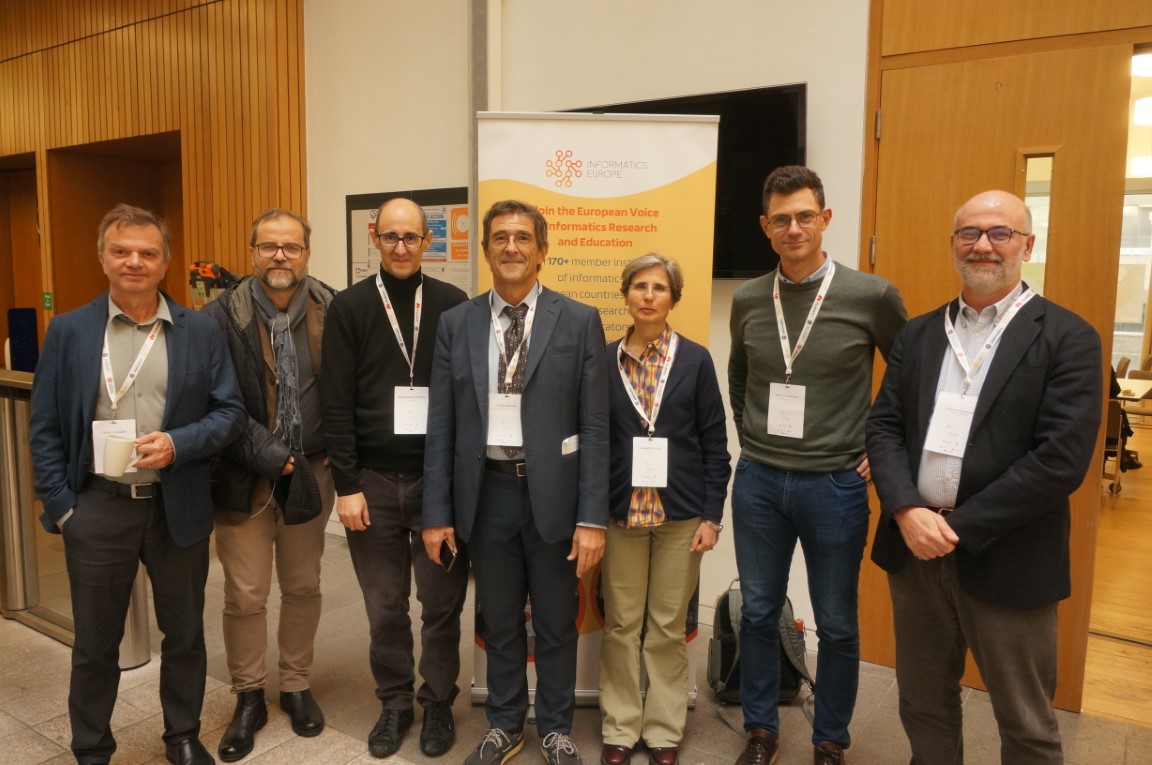
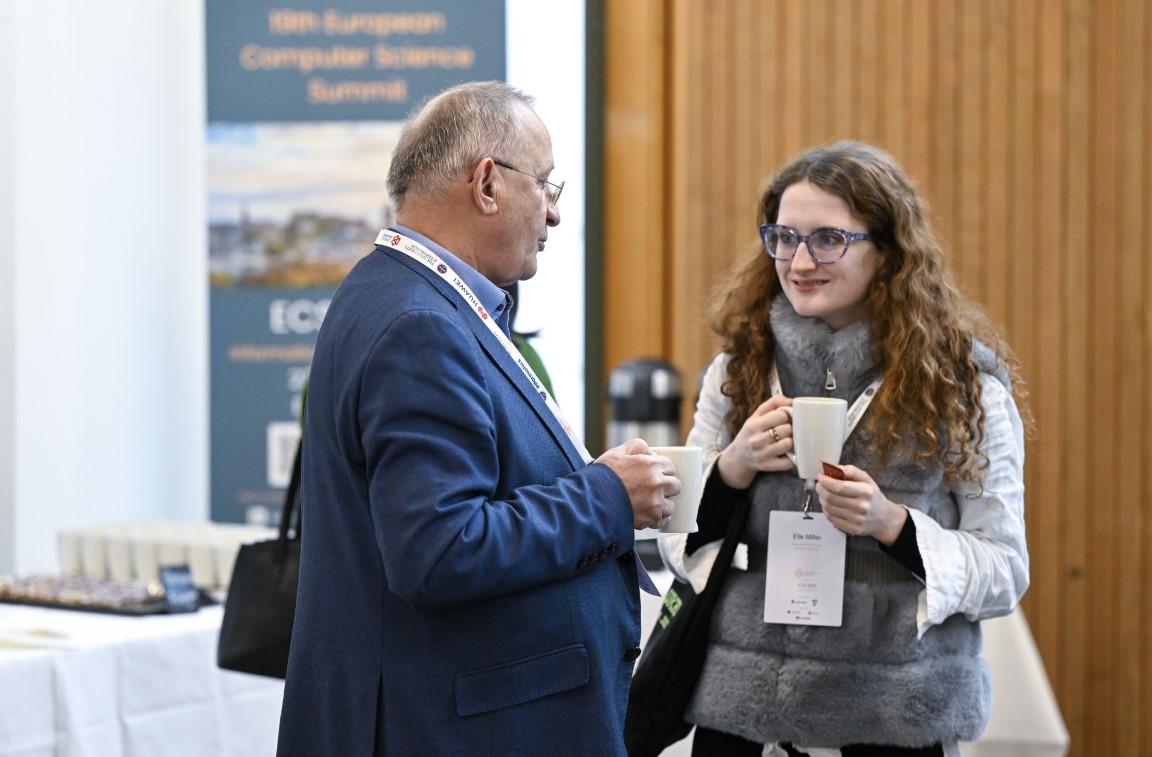
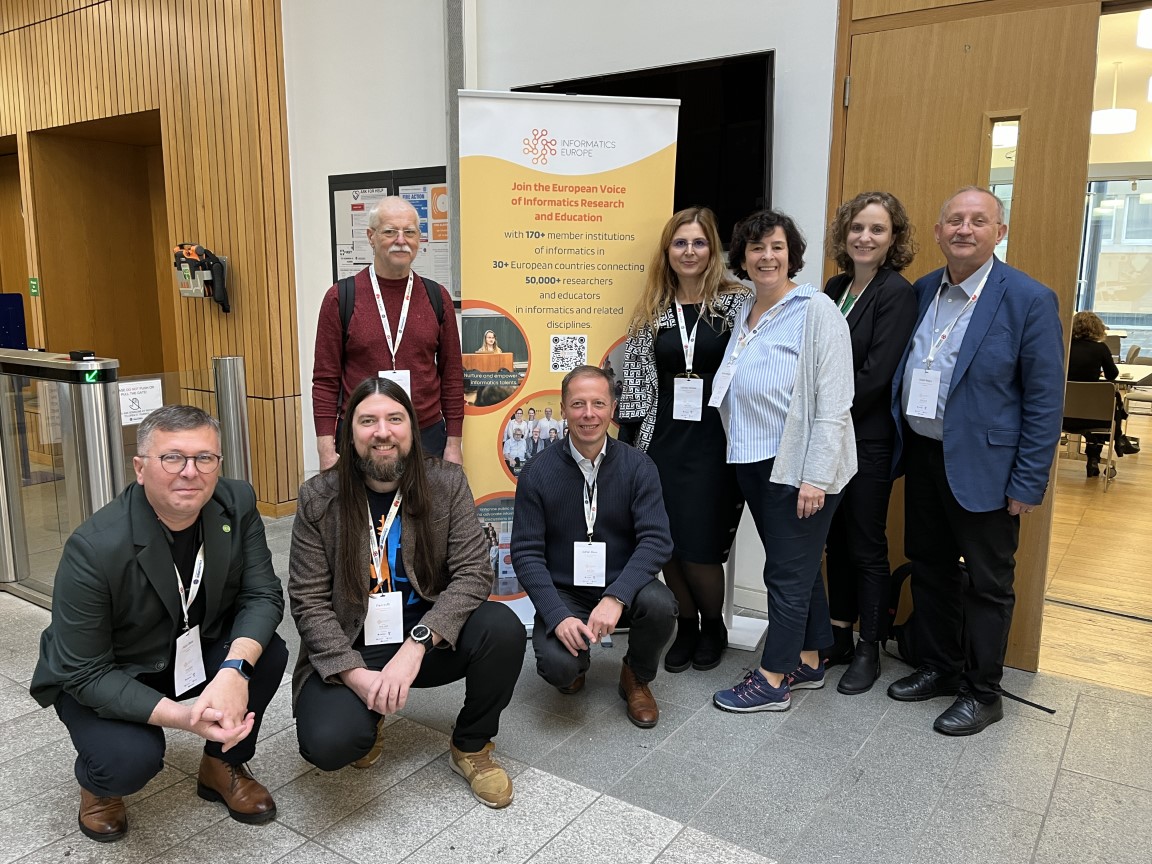
IE Members at ECSS 2023


-
Special Informatics Europe Introductory Session
-
Special Informatics Europe Introductory Session
-
ECSS 2023 Official Opening
-
ECSS 2023 Opening by Iain Grant Gordon, University of Edinburgh (UK), Vice-Principal and Head of College of Science and Engineering
-
Enrico Nardelli, University of Roma "Tor Vergata" (Italy), President of Informatics Europe
-
Jane Hillston (University of Edinburgh, UK) at ECSS 2023 Official Opening
-
Leaders Workshop Speaker: Marieke Huisman, University of Twente (the Netherlands) & EUGAIN COST Action member
-
Leaders Workshop
-
ECSS 2023
-
ECSS 2023: Bridging the Gap between Academia & Industry in Informatics
-
Richard Boardman (2Macs,UK) facilitating “Where do you draw the line?” session at Leaders Workshop
-
Feedback session/reflections on discussions in subgroups at Leaders Workshop
-
Leaders Workshop's panel discussion with panellists from underrepresented groups
-
Early Career Researchers Workshop Panelist: Ambrish Rawat, IBM Research Europe (Ireland)
-
Early Career Researchers Workshop
-
Early Career Researchers Workshop Poster Session
-
Welcome Cocktail including the Early Career Researchers Poster Session
-
Early Career Researchers Poster Session
-
IE Office at ECSS 2023
-
Panel Discussion with Main Theme Keynote Speakers
-
Panel Discussion with Main Theme Keynote Speakers
-
Panel Discussion with Main Theme Keynote Speakers
-
ECSS 2023: a must-go event for research and education leaders
-
Welmoed Spahr, Best Dissertation Award Sponsor Representative at Awards Session
-
Award Ceremony of Best Dissertation Award 2023
-
Simona Motogna (Babeș Bolyai University, Romania), Chair of Minerva Informatics Equality Award Committee 2023
-
Award Ceremony of Minerva Informatics Equality Award 2023
-
Informatics Europe Awards Session 2023
-
Informatics Europe Award Ceremony 2023
-
IE Dialogue with Members Session
-
IE Dialogue with Members Session
-
Academia-Industry Way Forward - Panel Discussion
-
Academia-Industry Session
-
"Fostering & Supporting Data-Driven Start-ups in Academia" Q&A Session
-
Higher Education Data Workshop
-
ECSS 2023 Official Dinner
-
ECSS 2023 Official Dinner
-
ECSS 2023 Official Dinner
-
ECSS 2023 Official Dinner
-
ECSS 2023 Official Dinner
-
Discussion Session of "AI and the practice of teaching Software Engineering"
-
ECSS 2023
-
AI and the Future of Informatics Education Workshop
-
Laurent Romary (Inria, France) at "The future of Informatics research evaluation" Session
-
"The impact of AI on Informatics curricula and educational practices" Session
-
David Farquhar (Intelligent Growth Solutions Limited) at Academia-Industry Session
-
Coffee Break Networking at Academia-Industry Session
-
ECSS 2023
-
Panel Discussion at Academia & Industry Session
-
ECSS 2023
-
Open discussion with panellists at Green ICT and ICT for Green Workshop
-
IE Members at ECSS 2023
About Edinburgh
Edinburgh is considered one of Europe's most beautiful cities and is located on the southern shore of the Firth of Forth (river estuary) overlooking the sea. It is the seat of the Scottish Government, Parliament and highest courts in Scotland and the Palace of Holyrood house is the official residence of the British monarchy in Scotland. The city is famous for its Castle, medieval Old Town and elegant Georgian New Town (listed as a UNESCO World Heritage Site) as well as its national cultural institutions and world-famous arts festival. In addition to being the UK’s second-most visited tourist destination it is also the second-largest financial hub in the UK. It has long been a center of education with three universities in the city, of which the University of Edinburgh, founded in 1582 is considered one of the best research institutions in the world.
The weather in October can be variable, so expect rain with temperatures between 6°C and 11°C.

Find out more:
Accommodation
For the convenience of ECSS 2023 participants, a limited number of rooms have been pre-booked with two hotels close to the conference venue from 23rd to 25th October. To benefit from these blocked rates, please book your accommodation as soon as possible via the ECSS Registration site.
SCHOLAR Hotel 4* (15-20 min walk to the venue)
| Room type | Blocked Rate |
Cancellation Policy |
|
Double/Twin Deluxe Room (single occupancy)
|
£110.00
|
|
|
Double/Twin Deluxe Room (double occupancy)
|
£130.00
|
KM Hotel 3* (5 min walk to the venue)
| Room type | Blocked Rate |
Cancellation Policy |
|
Double Ensuite Room (single occupancy)
|
£100.00
|
|
|
Double Ensuite Room (double occupancy)
|
£120.00
|
*Prices are per room & per night. Breakfast included in the price.
Alternatively, the above hotels can also be booked directly at the hotels' websites with the prices and cancellation terms available at the time of booking (different from the above). The promotional code “EVENT” grants a discount to a limited number of direct bookings.
The following additional hotels are recommended by the local organizer. No preferential conditions have been negotiated.
- Ten Hill Place
- Leonardo Royal Hotel Edinburgh
- Motel One
- Marriot Courtyard
- Novotel Edinburgh Centre
- Ibis Edinburgh Centre South Bridge, Royal Mile
- Hub by Premier Inn Edinburgh Royal Mile
- Grassmarket Hotel
Note that Edinburgh is a popular tourist destination, so we highly recommend that you book your accommodation well ahead of ECSS!
Awards Session
Every year, as part of the ECSS program, Informatics Europe organised an Award ceremony on the second day of the Summit, where the winners of its annual awards were presented:
- The Minerva Informatics Equality Award recognising best practices in departments or faculties of European universities and research labs that encourage and support the careers of women in Informatics research and education. Read this year's Press Release here.
- Debut in 2023, the Best Dissertation Award aims to stimulate young researchers by rewarding them, and disseminating excellent research findings to the Informatics Europe community and beyond. Read this year's Press Release here.
The award winners had the opportunity to present their achievements in a short talk during the Awards session.
*Please note that the photos below are better viewed when applying zoom out.
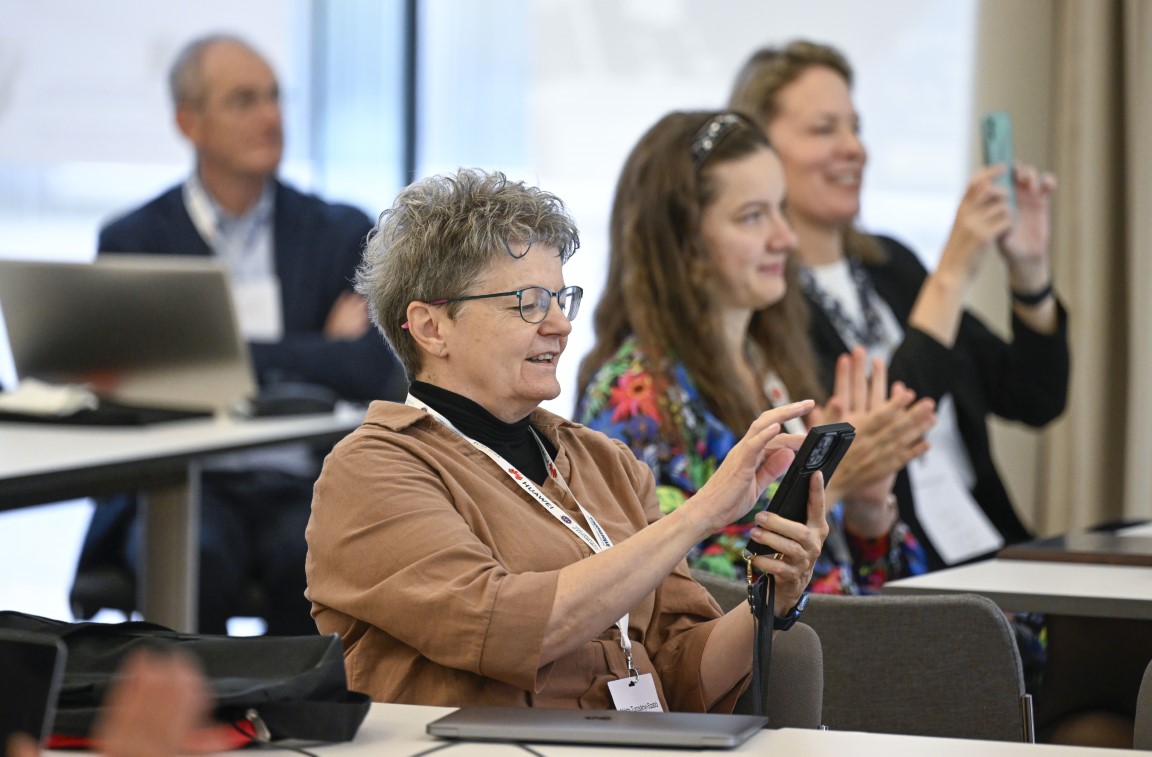
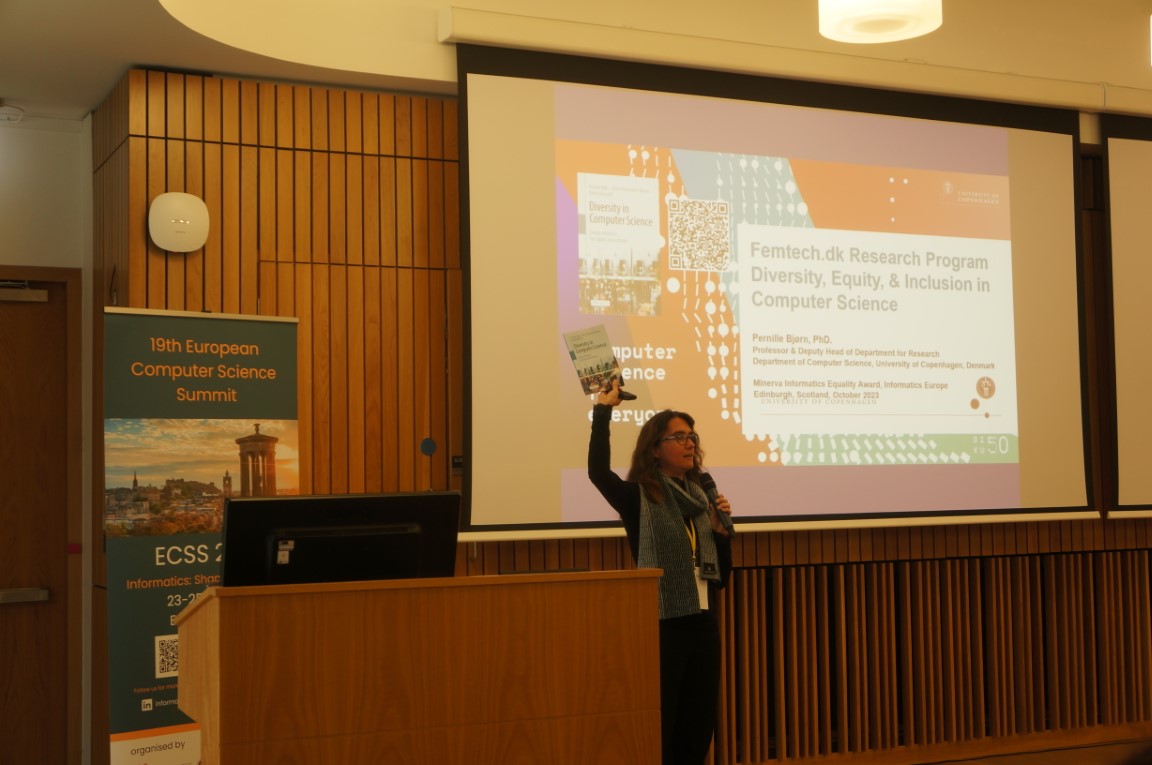
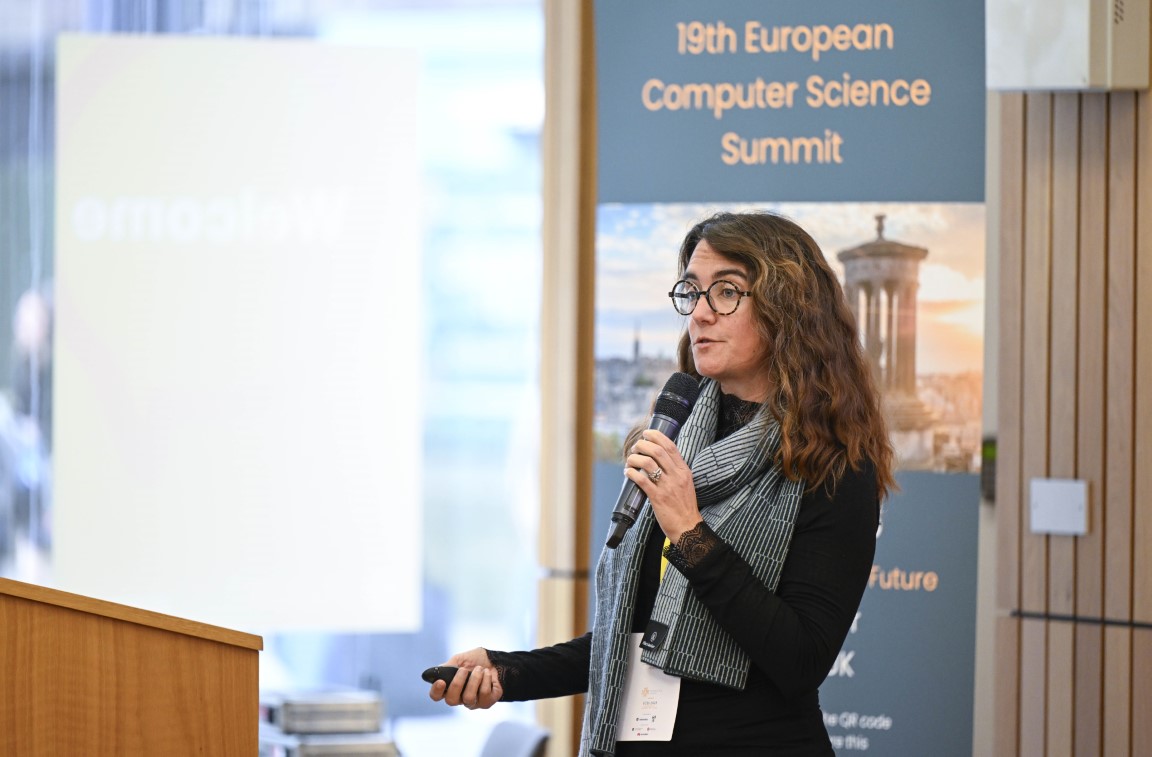
-
Welmoed Spahr, Best Dissertation Award Sponsor Representative at Awards Session
-
Award Ceremony of Best Dissertation Award 2023
-
Award Ceremony of Best Dissertation Award 2023
-
Runners-up of Best Dissertation Award 2023
-
Winner Presentation of Best Dissertation Award 2023
-
Best Dissertation Award 2023 Winner
-
Simona Motogna (Babeș Bolyai University, Romania), Chair of Minerva Informatics Equality Award Committee 2023
-
Award Ceremony of Minerva Informatics Equality Award 2023
-
Award Ceremony of Minerva Informatics Equality Award 2023
-
Talk by MIEA 2023 Winner: Gender-equality and anti-harassment committee from LIS (Computer Science Lab), Aix Marseille University, France
-
Prof. Magalie Ochs (Associate Professor at LIS, Aix Marseille University) presenting at MIEA 2023 Award Ceremony
-
Informatics Europe Awards Session 2023
-
Award Ceremony of Minerva Informatics Equality Award 2023
-
Informatics Europe Awards Session 2023
-
Informatics Europe Awards Session 2023
-
Talk by MIEA 2023 Winner: FemTech.dk research program at the Department of Computer Science, University of Copenhagen, Denmark
-
Prof. Pernille Bjørn (University of Copenhagen) presenting at MIEA 2023 Award Ceremony
-
Informatics Europe Award Ceremony 2023


Call for Participation
ECSS 2023 - 19th European Computer Science Summit
"Informatics: Shaping the Future"
Annual Summit for Leaders and Decision-makers in Informatics and Related Disciplines
23-25 October 2023, Edinburgh, UK
This year’s summit is co-organised with our member institute the School of Informatics of the University of Edinburgh, who celebrates 60 years of Artificial Intelligence (AI) and Computer Science research. Devoted to crucial and timely strategic issues and trends regarding all aspects of informatics, ECSS continues to be the unique opportunity where we gather for knowledge exchange, networking and strategy-setting activities in informatics and related disciplines. We call for the participation of the community at ECSS 2023, in particular of informatics research and education leaders at all levels.
Co-chaired by Jane Hillston from University of Edinburgh and Enrico Nardelli from Informatics Europe/ University of Rome "Tor Vergata", ECSS 2023 organizational committee has prepared an exciting program of workshops, presentations by leading experts, and social activities:
Leaders Workshop: “Diversity and Inclusion in a Multicultural World”
As informatics leaders, how can you bring out the best of your colleagues with various backgrounds and experiences, and accommodate the diversity in a fair and inclusive way? Share your own experiences and gain insights from others to develop strategies to lead in an inclusive way. This session is co-organised with EUGAIN Cost Action and IE’s Diversity and Inclusion Working Group.
Professional Development Workshop for Early Career Researchers
Turn your research career into a success story! Dedicated to PhD students and post-doctorates, this session invites you to reflect on your vision and leadership qualities, devise your research career plan, and complement it with feedback from established researchers. Join also the ECSS poster session to share your research with all ECSS participants and broaden your professional network.
Main Theme Session: “Informatics: Shaping the Future”
Informatics advances have a profound impact on our way of living, which places great responsibility on us as leaders and researchers in informatics. In this session, we will learn more about some of the hot topics, such as quantum computing, health or languages models, and discuss how to leverage our knowledge and talent in shaping our dream future through informatics.
Two Academia-Industry Sessions
Highlighting the needs and challenges around highly topical issues such as life-long learning of informatics professionals and commercialization of research, speaker talks and panel discussions will bring the academic as well as the industrial viewpoints on these topics. Don’t miss this unique opportunity to discuss how to jointly tackle these issues as a community.
Higher Education Data Workshop
Join the strategic conversation: explore the power of IE's Higher Education Data Portal and how our work on data analysis can facilitate university management and policymakers on informatics research and education initiatives in Europe with reliable facts and figures.
AI and the Future of Informatics Education Workshop
Co-organised with our member National Informatics Associations and open to all participants, the workshop will focus on the impact on the practice of software engineering education, as well as the broader impacts on the informatics curriculum and educational practices. The progress of the Open Science working group initiatives, discussed at last year’s ECSS, will also be reviewed.
Green ICT and ICT for Green Workshop
Join a panel of experts to engage in a tactical dialogue on relevant research directions and what Europe could do at the policy level to improve on Green ICT and take advantage of it, both technically and socially.
Informatics Europe annual Awards Ceremony, Dialogue with Members Session as well as General Assembly will also take place, along with a number of socializing sessions through our three-day Summit. The full preliminary program is available here.
Registration is now open until 16 October. Register up to 15 September to enjoy our early bird offer!
Here are more ways to stay in touch:
- through updates on our Summit website, LinkedIn and Twitter;
- subscribe to our monthly newsletter Bulletin, issued around the second week of each month (except Jan & August) and/or IE-announce mailing list to receive occasional emails about events such as ECSS hosted/co-organised by IE, as well as new IE services or major updates/changes to existing ones;
- write to our
This email address is being protected from spambots. You need JavaScript enabled to view it. so that you will be informed once ECSS 2023 registration opens.
We look forward to welcoming you at ECSS 2023 – a must-go event to establish and strengthen connections and strategic collaborations with informatics leaders and decision-makers at all levels, from academia to industry!
About ECSS
ECSS conferences are devoted to discussions of strategic issues and trends regarding all aspects of informatics/computer science such as research, education, entrepreneurship, funding, career development, management and policies. The key audience includes:
- Heads (deans, chairs) of academic informatics/computer science departments (schools, faculties, institutes);
- Research directors and managers of research centers, institutes and labs on informatics/computer science, both in public institutions and in the industry;
- Informatics/computer science faculty members and researchers from both academia and industry;
- Members of funding and governmental agencies for informatics/computer science at European, national, regional and local levels;
- Experts, advisors and thinkers of numerous key issues like ethics, the relation between informatics and other scientific disciplines, informatics’ future and its influence on the academic world and society;
- PhD students and post-doctorates conducting research on informatics/computer science.
Committees
Conference Chairs
- Enrico Nardelli, Informatics Europe / University of Rome "Tor Vergata" (Italy)
- Jane Hillston, University of Edinburgh (UK)
Main Theme Chairs
- Gregor Engels, SICP - Software Innovation Campus Paderborn (Germany)
- Jane Hillston, University of Edinburgh (UK)
Chairs of the Leaders Workshop
- Jean-Marc Jézéquel, IRISA / University of Rennes (France)
- Jane Hillston, University of Edinburgh (UK)
Chairs of the Professional Development Workshop for Early Career Researchers
- Dimka Karastoyanova, University of Groningen (the Netherlands)
- Tobias Grosser, University of Edinburgh (UK)
Chairs of the Session with Industry
- Lenuta Alboaie, Alexandru Ioan Cuza University of Iași (Romania)
- Jim Ashe, University of Edinburgh (UK)
Chairs of the Higher Education Data Workshop
- Přemek Brada, University of West Bohemia (Czechia)
Chairs of the Sustainability Workshop
- Marco Aiello, University of Stuttgart (Germany)
Chairs of the Workshop organized with National Informatics Associations
- Pekka Orponen, Aalto University (Finland)
- Manuel Carro, Technical University of Madrid/IMDEA Software Institute (Spain)
Chair for Industry Liaison
- Cristian Novotny, University of Edinburgh (UK)
General Organizing Committee
- Lorna Adams, University of Edinburgh (UK)
- Stefano Albrecht, University of Edinburgh (UK)
- Nuria Anguera, Informatics Europe
- Myrto Arapinis, University of Edinburgh (UK)
- Yang Cao, University of Edinburgh (UK)
- Kit Wan Chui, Informatics Europe
- Sonja Saage, Paderborn University (Germany)
- Kerstin Sellerberg, Paderborn University (Germany)
- Svetlana Tikhonenko, Informatics Europe
- Karin Triviere, Informatics Europe
How to Register
ECSS 2023 is closed for registration.
A limited number of grants are available for PhD students who participate in ECSS 2023. We accepted applications through emails. Details on the requirements can be found here.
HEADS UP: We have recently learned of an email scam falsely claiming to represent ECSS 2023 organising affiliates. Please note that the only official contact for ECSS registration matters is
Registration Fees
The registration fee for the ECSS 2023 (23-25 October) covered:
- Participation in all activities of the Summit
- Coffee breaks, lunches
- Conference Welcome Cocktail on Monday, 23 October**
- Conference Dinner on Tuesday, 24 October**
- Conference materials
The registration for the Professional Development Workshop for Early Career Researchers (ONLY), covered the coffee break, lunch, and Welcome Cocktail on Monday, 23 October.
Prices***
Normal registration:
- £ 490,00 (Member of Informatics Europe)
- £ 570,00 (Non-Member)
- £ 250,00 (PhDs and PostDocs)
Early Career Researchers Workshop ONLY:
- £ 65,00
* Register early to enjoy your best benefits and no worries about unforeseen events! It is important that you and your institution are present in ECSS. We will transfer your registration to another name where necessary. For assistance, please email
**Spouses invitations for the Welcome Cocktail and Dinner are available for purchase (Extra Tickets). They are not included in the registration fee but are available through the registration system.
*** Please note that the amount of the bank transfer will have to include any bank fee related to the transfer and/or processing.
Venue
The ECSS 2023 was held at:
Informatics Forum of University of Edinburgh
10 Crichton Street, Edinburgh, EH8 9AB
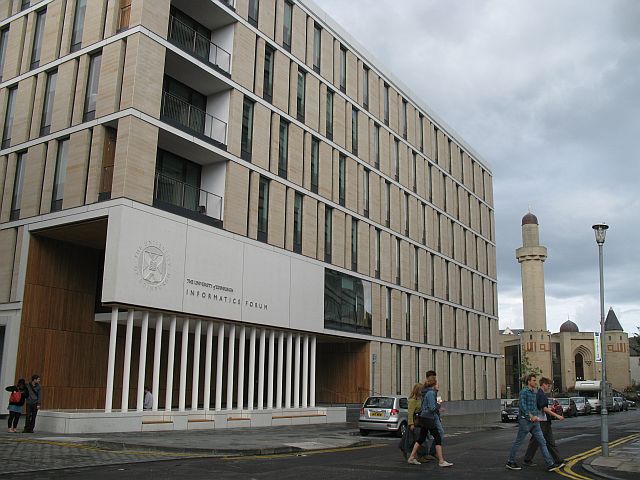
The Informatics Forum is a major building on the Central Area campus of the University of Edinburgh. Completed in 2008, it houses the research institutes of the university's School of Informatics. It is easily accessible from the city centre by public transportation. Closest bus stop: Surgeons' Hall (about 4 min) or Lauriston Place (about 4 min).
Download the detailed floor plan or have a look at the virtual tour of the venue.
How to reach ECSS 2023 Venue
By Public Transport:
- From the Edinburgh Airport:
- Take the 100 Airlink bus or the Edinburgh Tram, see the possible route in Google maps (adjusted according to the current traffic situation).
- From Waverley Railway Station:
- You can walk there by foot (around 1300 m, or 16 min) or take a bus, see the possible route in Google maps (adjusted according to the current traffic situation).
By taxi:
- Address: Informatics Forum, 10 Crichton Street, Edinburgh, EH8 9AB
- City Cabs (taxi booking): https://www.citycabs.co.uk
Venue per session - rooms
ECSS 2023 was hosted by the School of Informatics at the University of Edinburgh which has the leading research position in the UK and is recognised internationally for excellence of its research outputs, education and knowledge exchange. With over 280 academic and research staff and over 2000 taught and research students, The School of Informatics at the University of Edinburgh is the largest in the UK and one of the largest in Europe and is consistently ranked among the best in the world.
In 2023, the School of Informatics at the University of Edinburgh celebrated 60 years of Artificial Intelligence (AI) and Computer Science research. Read more here about the history and events that mark the anniversary.
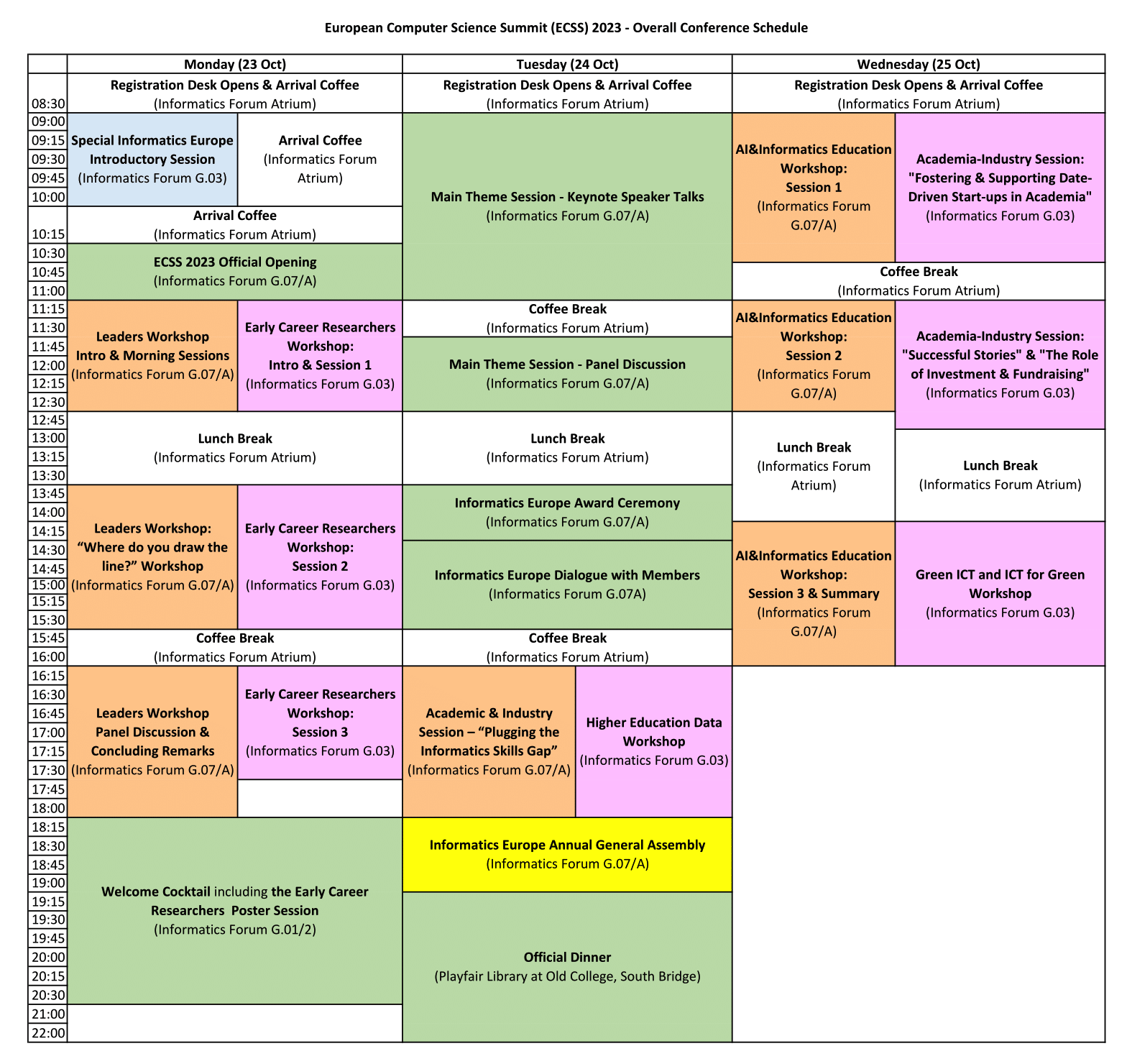
Conference Schedule
Mon, 23 Oct Tue, 24 Oct Wed, 25 Oct
The slides of talks given during the conference are available for download from the program below.
Monday, 23 October 2023
08:30 - reception desk opens only for Special Informatics Europe Introductory Session participants.
09:00 - reception desk opens for ALL & arrival coffee
09:00 - 10:00 Special Informatics Europe Introductory Session [Slides]
10:30 - 11:00 ECSS 2023 Official Opening
- Enrico Nardelli, University of Roma "Tor Vergata" (Italy), President of Informatics Europe
- Iain Grant Gordon, University of Edinburgh (UK), Vice-Principal and Head of College of Science and Engineering
- Jane Hillston, University of Edinburgh (UK)
Two sessions will run in parallel between 11:00 and 18:00.
11:00 - 18:00 Leaders Workshop - "Diversity and Inclusion in a Multicultural World"
Chairs: Jean-Marc Jézéquel, IRISA (France), Jane Hillston, University of Edinburgh (UK) and EUGAIN COST Action member.
11:00 - 11:10 Introduction
11:10 - 12.:00 “Where did you come from and where are you now”, session facilitated by Jane Hillston, University of Edinburgh (UK) and EUGAIN COST Action member. [Slides]
12:00 - 12:30 "Alice and Eve/Recommendations on Hiring and Promoting Women for CS Departments" by Marieke Huisman, University of Twente (the Netherlands) and EUGAIN COST Action member. [Slides]
12:30 - 13:30 Lunch
13:30 - 15:00 “Where do you draw the line?”, workshop facilitated by Richard Boardman, 2Macs (UK) [Slides]
Tackle these key areas:
(1) Rights & Entitlements vs. Wants & Preferences (2) Acceptability
(3) Where Do You Draw The Line? (4) What Can We Do, individually and collectively?
Full details of this session are on our Speakers page.
15:00 - 15:30 Feedback session/reflections on discussions in subgroups
15:30 - 16:o0 Coffee break
16:00 - 17:30 Panel discussion with panellists from underrepresented groups
- Aurora Constantin, University of Edinburgh (UK)
- Jacques Fleuriot, University of Edinburgh (UK)
- Sara Shinton, University of Edinburgh (UK)
17:30 - 18:00 Concluding remarks and further actions, session by Jane Hillston & Sara Shinton, University of Edinburgh (UK) [Slides]
11:00 - 17:30 Professional Development Workshop for Early Career Researchers
Chairs: Dimka Karastoyanova, University of Groningen (the Netherlands), Tobias Grosser, University of Edinburgh (UK)
11:00 - 11:05 Welcome and Introduction
11:05 - 12:30 Session 1: “A Fresh Approach to Research Leadership" by Sara Shinton, University of Edinburgh (UK) [Slides]
12:30 - 13:30 Lunch
13:30 -15:30 Session 2: panell discussion "How to turn a research career into a success"
- Marco Aiello, University of Stuttgart (Germany) [Slides]
- Manuel Carro, Technical University of Madrid/IMDEA Software Institute (Spain) [Slides]
- Victor Lomüller, CodePlay (UK)
- Dympna O'Sullivan, TU Dublin (Ireland) [Slides]
-
Ambrish Rawat, IBM Research Europe (Ireland)
15:30 - 16:00 Coffee break
16:00 - 17:30 Session 3: "Sustainable growth in research career"
Round table discussions between the workshop participants and the speakers of the panel will be held in small groups. During these discussions, participants will have the opportunity to review their career vision board in interaction with both the panellists and peers.
18:15 - 20:30 Welcome Cocktail including the Early Career Researchers Poster Session
Featured Posters:
- "Automated Identification and Analysis of Structures in Large-scale Electron Microscopy Images" by Anusha Aswath, University of Groningen (the Netherlands) [Poster]
- "Machine Learning Predictive Models Applied to COVID-19 Datasets to Estimate the Infection Risk in Specific Geographic Regions" by Diogen Babuc, West University of Timisoara (Romania) [Poster]
- "Qualitative insights into abstraction skills from exam scripts" by Julia Crossley, City University of London (UK) [Poster]
- "Self-Adaptive Smart Grids: A Case Study on EV Charging Stations" by Vick Dini, Politecnico di Milano (Italy) [Poster]
- "ChatterGlove - A healthcare appliance for speech/hearing impaired individuals" by Theodor-Radu Grumeza, West University of Timisoara (Romania) [Poster]
- "Empowering Women in the ICT Sector: Addressing Gender Inequality in Albania and the Wider Western Balkans" by Elva Leka, Polytechnic University of Tirana (Albania) [Poster]
- "An Eternal Dilemma Resolved: The Choice Between Pure Reasoning and Raw Performance" by Anton Lorenzen, University of Edinburgh (UK) [Poster]
- "Challenges and Strategies of Women in STEM. Gender Balance - Albanian Case." by Olgerta Idrizi, Mediterranean University of Albania (Albania) & Miranda Harizaj, Polytechnic University of Tirana (Albania) [Poster]
- "Building A National Spatio-Temporal Datacube" by Alexandru Munteanu, West University of Timisoara (Romania) [Poster]
- "Enabling Efficient Exploration of Linux Configuration Space with Incremental Build" by Georges Aaron Randrianaina, IRISA Rennes (France) [Poster]
Monday's coffee breaks are scheduled at 10:00 & 15:30 and lunch at 12:30, for all sessions.
Tuesday, 24 October 2023
08:30 - reception desk opens & arrival coffee
09:00 - 12:30 Main Theme - "Informatics: Shaping the Future"
Chairs: Gregor Engels, Paderborn University (Germany), Jane Hillston, University of Edinburgh (UK)
09:00 - 09:30 "Finding the Quantum Advantage" by Elham Kashefi, The National Quantum Computing Centre (UK) [Slides]
09:30 - 10:00 "Large Language Models" by Mirella Lapata, University of Edinburgh (UK) [Slides]
10:00 - 10:30 "Big data in life sciences, from theory to applications" by Stefano Ceri, Politecnico di Milano (Italy) [Slides]
10:30 - 11:00 "Beyond common Computing – Does Sustainability require new (and old) Alternatives to “classical” Digital Computing Machines?" by Jochen Viehoff, Heinz Nixdorf MuseumsForum (Germany) [Slides]
11:00 - 11:30 Coffee break
11:30 -12:30 Panel Discussion: "How do we ensure that informatics shapes the future that we hope for?"
Panel chair: Ewa Luger, University of Edinburgh (UK)
- Stefano Ceri, Politecnico di Milano (Italy)
- Elham Kashefi, The National Quantum Computing Centre (UK)
- Jochen Viehoff, Heinz Nixdorf MuseumsForum (Germany)
- Mira L. Wolf-Bauwens, IBM Research Europe
13:30 - 14:15 Informatics Europe Awards Ceremony
- Best Dissertation Award 2023 (sponsored by Springer) - Winner announcement by Elisabetta Di Nitto, Politecnico di Milano (Award Committee Chair) and Short Talk by Winner [Slides]
- Minerva Informatics Equality Award 2023 (sponsored by Google and co-organized with EUGAIN COST Action) - Winner announcement by Simona Motogna, Babeş-Bolyai University (Award Committee Chair) and Short Talks by Winners. [Slides]
14:15 - 15:30 Informatics Europe Dialogue with Members
Chairs: Enrico Nardelli and Nuria Anguera, Informatics Europe [Slides]
Two sessions will run in parallel between 16:00 and 18:00.
16:00 - 18:00 Academia & Industry - "Plugging the Informatics Skills Gap"
Chairs: Lenuta Alboaie, Alexandru Ioan Cuza University of Iasi (Romania), Jim Ashe, University of Edinburgh (UK)
16:00 - 16:05 Welcome by the session chairs
16:05 - 17:25 Informatics Life-long learning: the industry perspective
- "Industry and Academia Collaboration - from a Sony Perspective" by Faisal Kamran, Principal Technology Analyst, SONY [Slides]
- "Innovate Through Science – Life-long Learning in Company Research" by Michael Gienger, Chief Scientist, Honda Research Institute [Slides]
- "The Cisco Networking Academy: Powering an Inclusive Future for All" by Elizabeth Barr, Business Development Manager, CISCO Networking Academy, UK&I, CISCO [Slides]
17:25 - 17:55 Academia-Industry way forward - panel discussion
17:55 - 18:00 Closing
16:00 - 18:00 Higher Education Data Workshop
Chair: Přemek Brada, University of West Bohemia (Czechia)
16:00 - 16:05 Welcome and introduction
16:05 - 17:20 Turning Data into Information: driving changes with IE Data Portal
- "Informatics Higher Education in Europe: A Data Portal and Case-Study", Elisabetta di Nitto, Politecnico di Milano (Italy) [Slides]
- “Behind-the-scenes of the IE Data Portal”, Svetlana Tikhonenko, Informatics Europe [Slides]
17:20 - 17:50 Joint work by participants
17:50 - 18:00 Wrap up and next steps
18:00 - 19:00 Informatics Europe Annual General Assembly
Chairs: Enrico Nardelli and Nuria Anguera, Informatics Europe
19:00 - 22:00 Official Dinner
Tuesday's coffee breaks are scheduled at 11:00 & 15:30 and lunch at 12:30, for all sessions.
Wednesday, 25 October 2023
08:30 - reception desk opens & arrival coffee
Two sessions will run in parallel for the whole day.
09:00 - 16:00 AI and the Future of Informatics Education Workshop, co-organised with National Informatics Associations
Chairs: Pekka Orponen, Aalto University (Finland), Manuel Carro, Technical University of Madrid/IMDEA Software Institute (Spain)
09:00 - 10:30 Session 1: AI and the practice of teaching Software Engineering
- "Software engineering education in the era of large language models: promises and perils"
by Massimiliano Di Penta, University of Sannio (Italy) [Slides] - "Teaching software engineering for AI-enabled systems" by Filippo Lanubile, University of Bari (Italy) [Slides]
10:30 - 11:00 Coffee break
11:00 - 12:30 Session 2: The impact of AI on Informatics curricula and educational practices
- "Benefits, risks, and challenges of AI in informatics education" by David López, Scientific Society of Computing of Spain/Universitat Politècnica de Catalunya (Spain) [Slides]
- "Should we still teach 'Programming'?" by Thomas Gross, ETH Zurich (Switzerland) [Slides]
12:30 - 14:00 Lunch
14:00 - 15:30 Session 3: The future of Informatics research evaluation
- "Open science and research assessment: Which agenda should the informatics community push forward?"
by Pierre Paradinas, CNAM/SIF (France) & Laurent Romary, Inria (France) [Slides]
15:30 - 16:00 Summary and next steps
09:00 - 12:30 Academia & Industry - "The Journey from Higher Education to Entrepreneurship"
Chairs: Lenuta Alboaie, Alexandru Ioan Cuza University of Iasi (Romania), Jim Ashe, University of Edinburgh (UK)
09:00 - 09:05 Welcome by the session chairs
09:05 - 10:05 Fostering & Supporting Data-Driven Start-ups in Academia
- "Creating and nurturing data science-based and AI-driven businesses" by Laura Bernal & Katy Guthrie, Edinburgh Innovations (UK) [Slides]
- "From research lab to startup: Navigating the ethical AI journey" by Brian Hills, The DataLab [Slides]
- "The entrepreneurship journey at TUM" by Marisa Schneider, UnternehmerTUM GmbH (Germany) [Slides]
10:05 - 10:30 Q&A Session
10:30 - 11:00 Coffee Break
11:00 - 11:40 Successful Stories
- "From start-up to scale-up and exit: lessons learned from 30 years of building and selling technology companies in transactions round the world" by David Farquhar, Intelligent Growth Solutions Limited (UK) [Slides]
- "Minecraft and other stories: The story of building 4J Studios" by Chris Van der Kuyl, 4J Studios (UK)
11:40 - 12:10 The Role of Investment & Fundraising
- "Why investment matters - from an Edinburgh Perspective" by Andrea Young, Old College Capital (UK) [Slides]
- "Why investment matters - from a Scotland Perspective" by Kerry Sharp, Scottish Enterprise (UK) [Slides]
12:10 - 12:40 Panel discussion
- David Farquhar, Intelligent Growth Solutions Limited (UK)
- Chris Van der Kuyl, 4J Studios (UK)
- Andrea Young, Old College Capital (UK)
12:40 - 12:45 Closing
12:45 - 13:30 Lunch
13:30 - 15:30 Green ICT and ICT for Green Workshop
Chair: Marco Aiello, University of Stuttgart (Germany) [Slides]
14:00 - 14:30 Panellists' sharing
- "Software as a Service through the Cloud: who is responsible for what emissions?" by Vasilios Andrikopoulos, University of Groningen (the Netherlands) [Slides]
- “Environmental Impact of Deep Neural Network Training” by Kawsar Haghshenas, University of Groningen (the Netherlands)[Slides]
- "Embedding Sustainability into Third Level Education to meet Sustainable Development Goals" by Brian Keegan, TU Dublin (Ireland) [Slides]
14:30 - 15:30 Open discussion with panellists, moderated by Marco Aiello, University of Stuttgart
with additional contributions from Green ICT Working Group member: Rafael Capilla, Rey Juan Carlos University, Spain [Slides]
15:30 - 16:00 Wrap up and next steps toward a green ICT agenda
Wednesday's coffee break is scheduled at 10:30 and lunch available from 12:30, for all sessions.
ECSS 2025 is organised by
 |
 |
Sponsored by
 |
 |
 |
 |
|
 |
  |
 |
Support ECSS
What's New
ECSS 2025, 27-29 Oct, Rennes. France
Save the dates for ECSS 2026:
26-28 Oct in Porto, Portugal



 Netlogica