
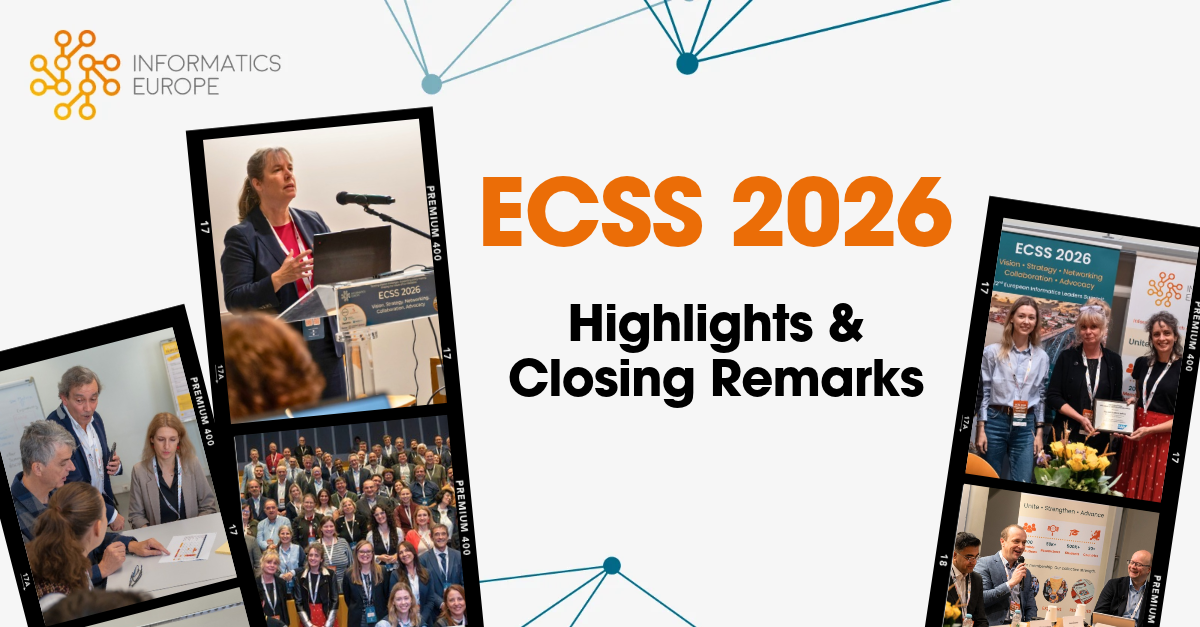
The 22nd European Informatics Leaders Summit concluded in Porto, Portugal, bringing together over 130 participants for three days of strategic discussions, knowledge exchange and collaboration across the European Informatics research and education community.
Hosted by the Department of Informatics Engineering, Faculty of Engineering, University of Porto, the Summit explored the profound changes reshaping informatics, with of course artificial intelligence emerging as a central theme across education, research, institutional strategy and the broader societal impact of our discipline.
AI Reshaping Informatics: Challenges and Opportunities
Throughout ECSS 2026, discussions highlighted how AI is transforming not only what Informatics institutions teach and research, but also how they operate, attract students, develop talent and engage with society.
The Education Research Workshop examined the implications of generative AI for curricula, teaching and assessment, alongside concerns about students' foundational skills, preparedness for higher education and evolving professional expectations. The Strategy Workshops explored how institutions can adapt to a rapidly changing environment, including the opportunities and challenges of AI-driven university transformation and its implications for scientific publishing.
AI also featured prominently in discussions on cybersecurity, research integrity and ethics. Participants examined the need to strengthen critical AI literacy, preserve independent technical competencies, address AI's impact on scientific authorship and peer review, and promote responsible practices in the development and use of emerging technologies.
In her keynote, Prof. Gitta Kutyniok brought these perspectives together by highlighting the fundamental challenges of building AI systems that are not only powerful, but also reliable, trustworthy and sustainable. Her call for a system-wide approach, integrating mathematical foundations, algorithms, software and hardware, underscored the importance of interdisciplinary collaboration and the continued relevance of foundational Informatics research.
Turning Discussions into Action
Beyond identifying challenges, ECSS 2026 provided opportunities to advance concrete initiatives. The workshops contributed to ongoing efforts on responsible AI use, Informatics competencies and research integrity. The Open Science Workshop explored recognition of research software and more sustainable open-source infrastructures, while the Cybersecurity Workshop laid the groundwork for a new Informatics Europe Working Group.
The IE Community Session invited participants to reflect on shared institutional challenges and identify opportunities for collective action. The discussions generated proposals for exchanging good practices, developing common guidelines, strengthening institutional collaboration and informing policy. The IE Board is reviewing these proposals to shape priorities for 2027 and beyond, building on existing Working Groups and Task Forces or launching new initiatives.
The Summit also celebrated outstanding contributions to Informatics research and education through the Best Dissertation Award and the Minerva Informatics Equality Award, while the Professional Development Workshop supported early-career researchers in navigating the opportunities and challenges of academic careers.
Building on the Momentum
ECSS 2026 reinforced a key message: as AI transforms Informatics and its role in society, European research and education institutions must help shape that transformation, rather than simply adapt to it. This calls for strong scientific foundations, responsible innovation, forward-looking education and greater collaboration across institutions and disciplines.
Informatics Europe provides a platform for this collective effort. We encourage colleagues to engage in our Working Groups, contribute their expertise and help translate the ideas emerging from Porto into coordinated initiatives with lasting impact.
Our sincere thanks go to the Department of Informatics Engineering, Faculty of Engineering, University of Porto, the conference organisers, speakers, workshop chairs, contributors and all participants for making ECSS 2026 such a stimulating and productive gathering.
We look forward to continuing these exchanges at ECSS 2027 in Tallinn, Estonia, on 25–27 October 2027, co-hosted by the School of Information Technologies, Tallinn University of Technology.
Explore the ECSS 2026 Highlights for detailed session summaries, presentations, photos, and opportunities to get involved.




 Netlogica