
Social Events
This year, ECSS 2025 offered an enhanced social programme, with even more ways to network, connect, and explore together:
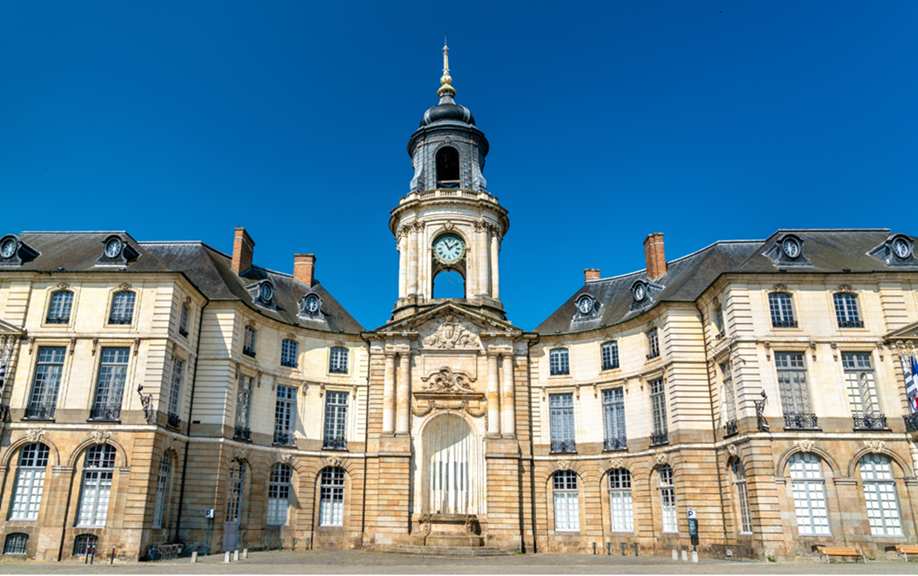
- Welcome Reception at Rennes City Hall (Monday, 27 Oct, 18:00–19:30)
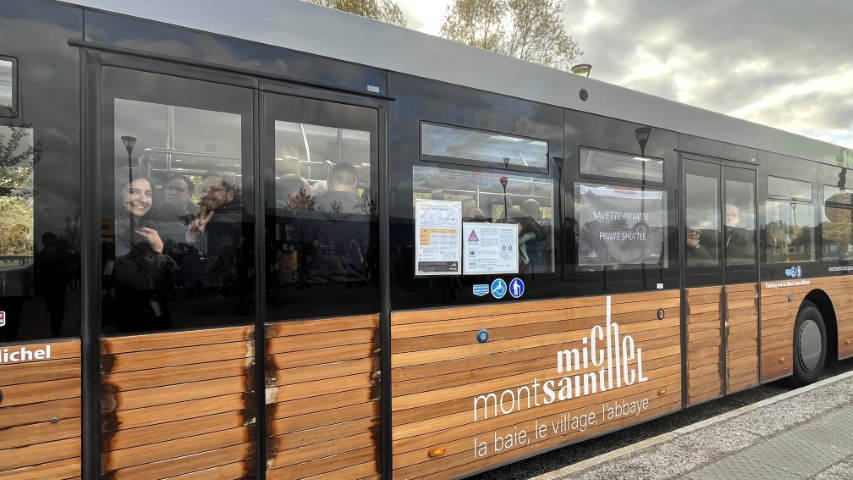
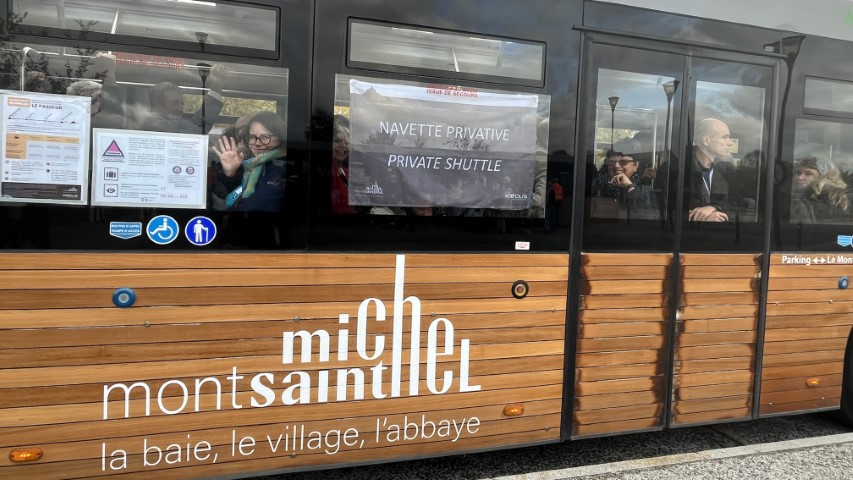
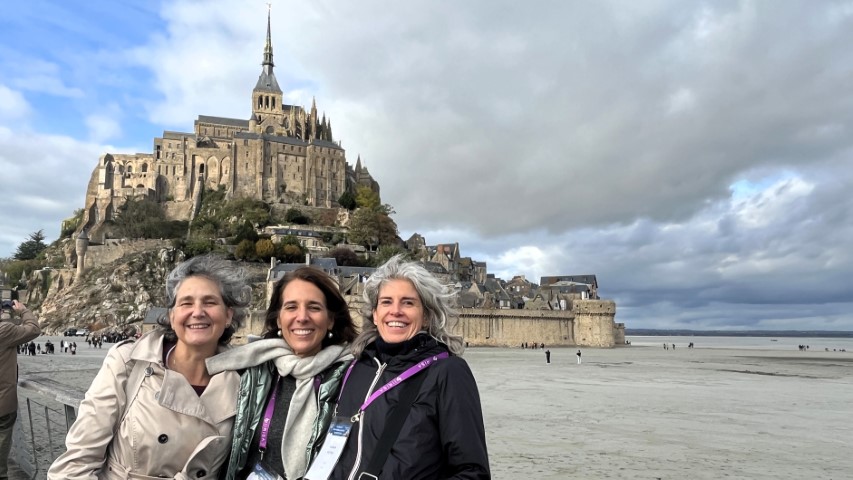
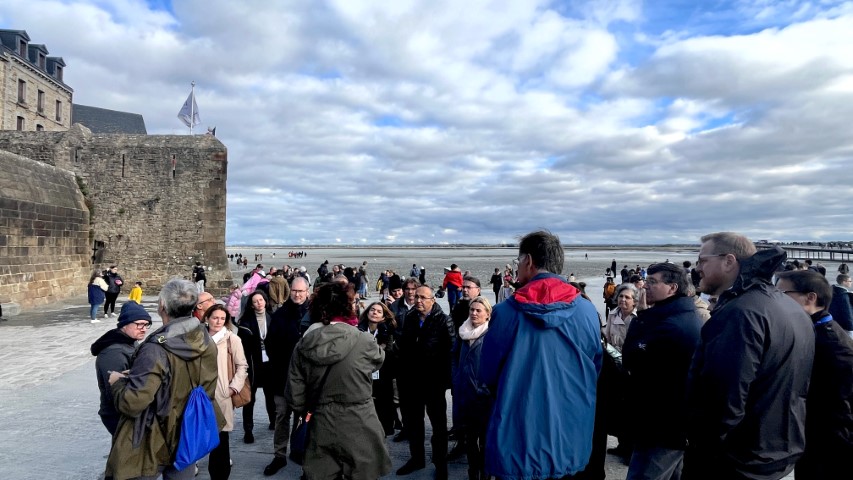
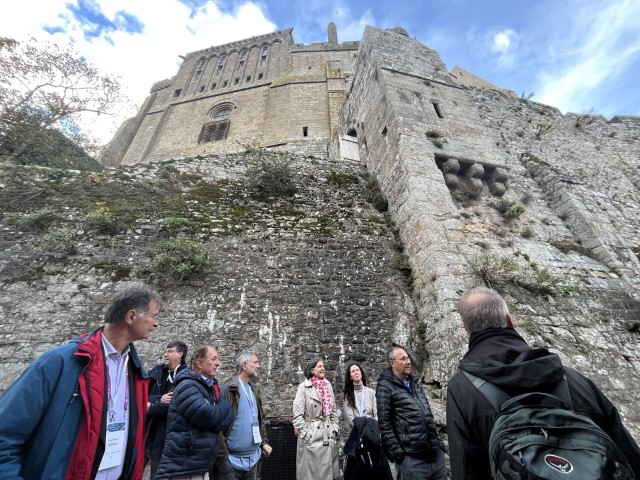
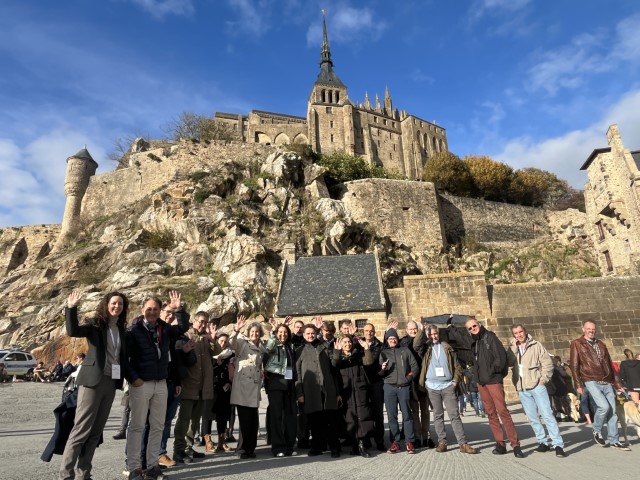
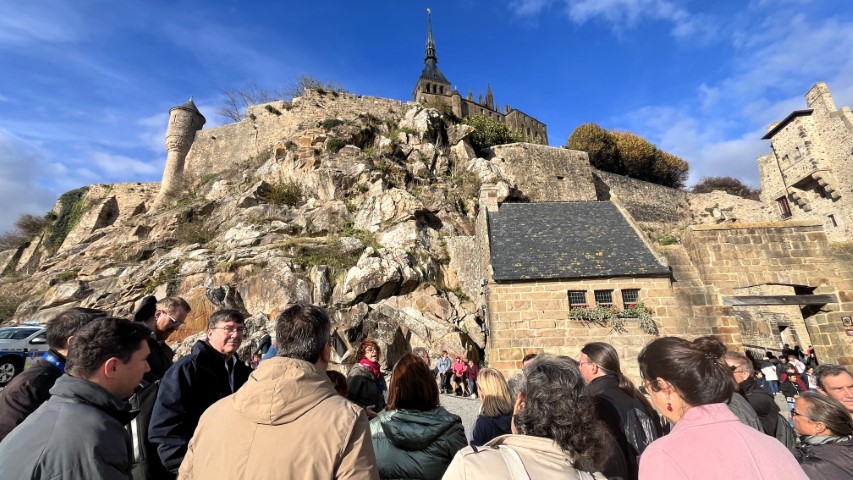
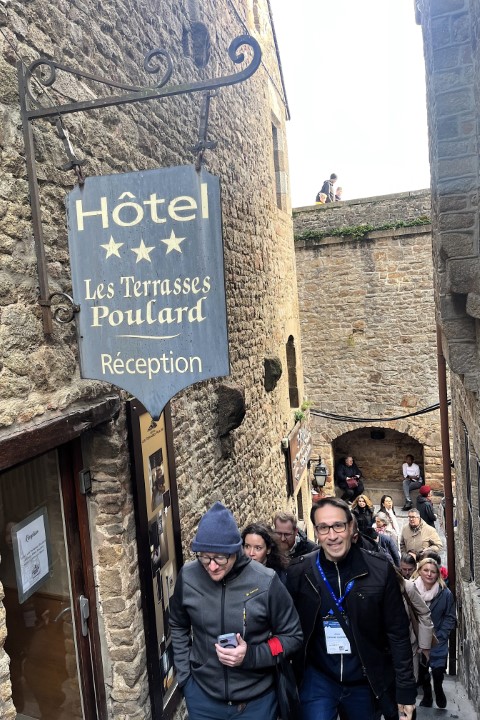
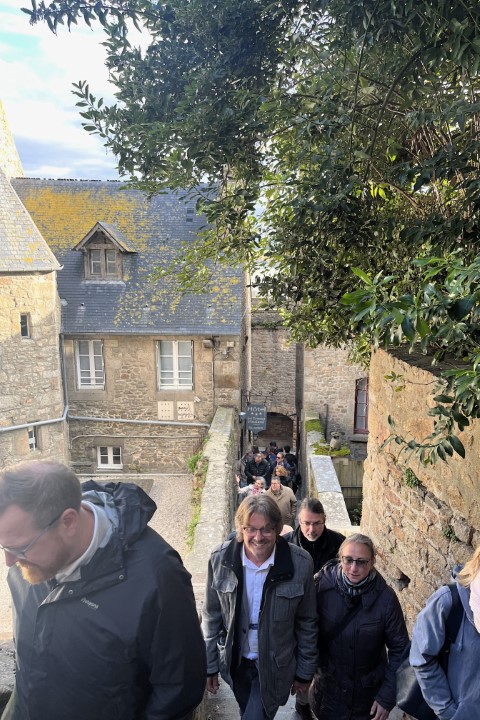
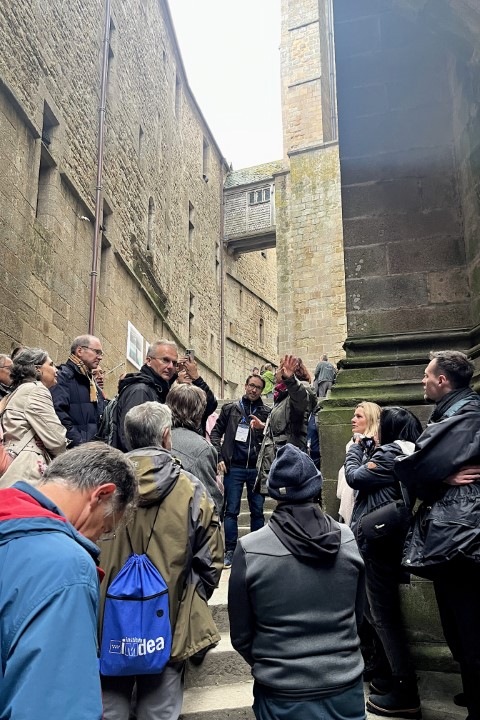
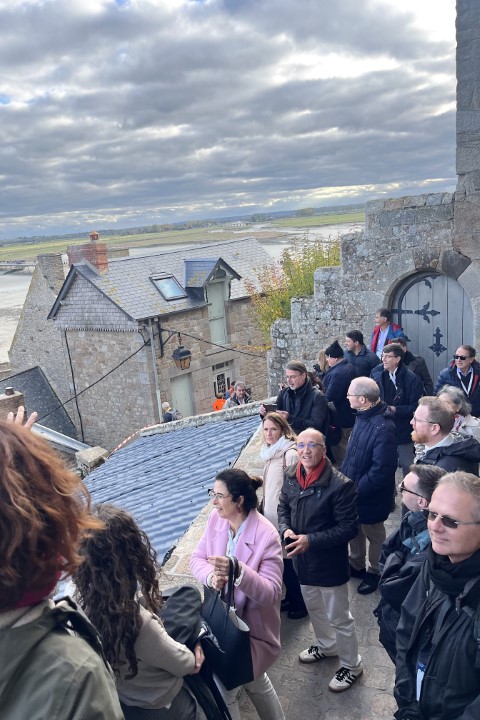
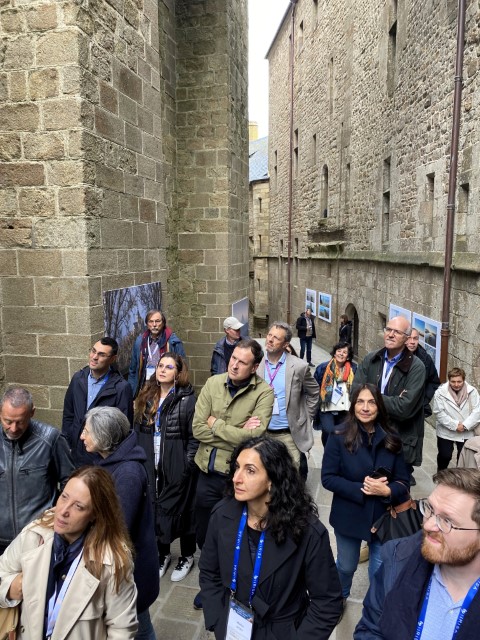
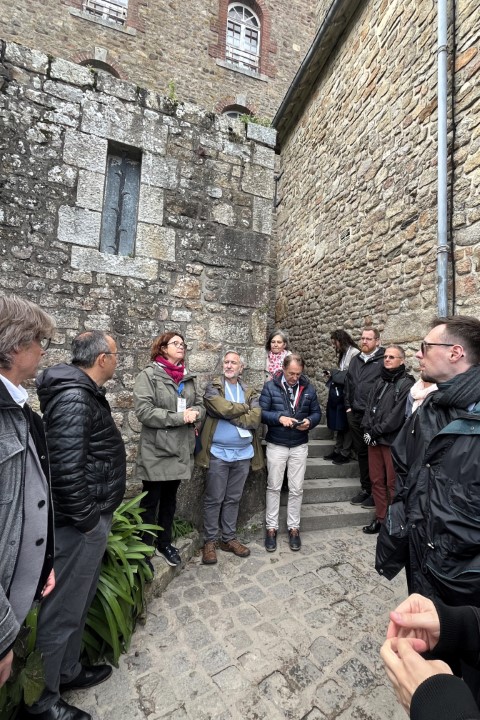
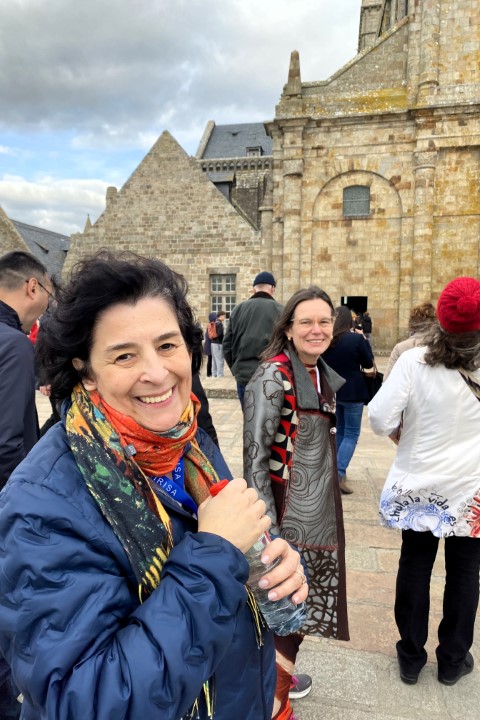
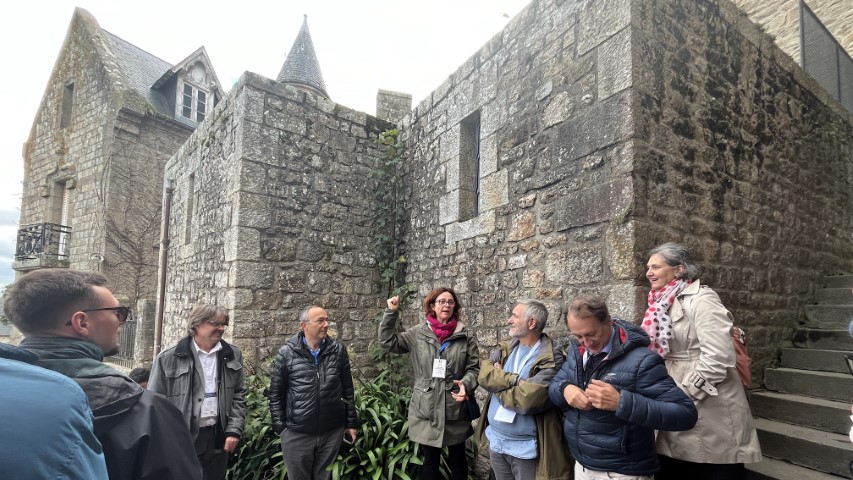
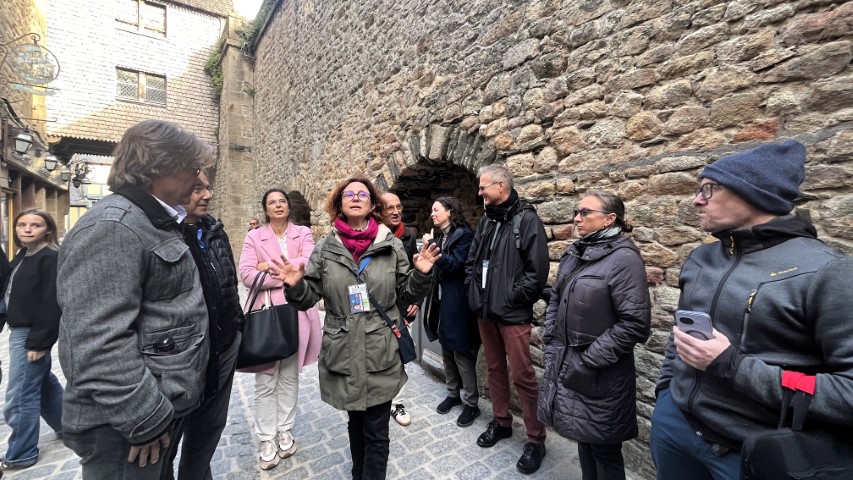
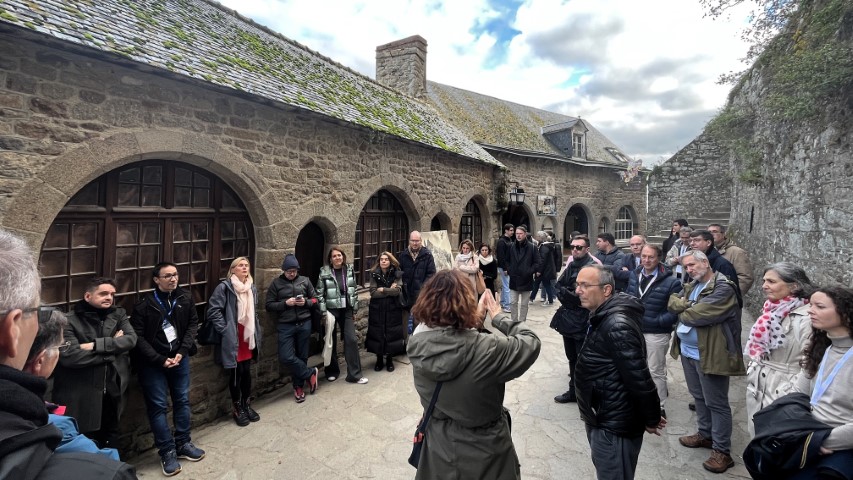
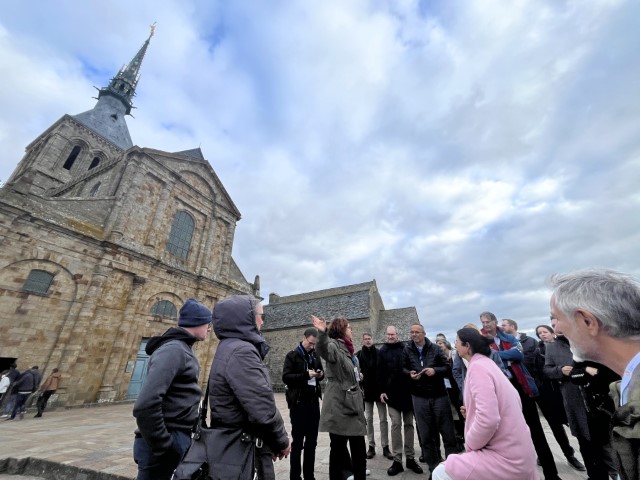
An informal gathering to kick off the summit and meet ECSS participants. - Guided Trip to Mont Saint‑Michel (Tuesday, 28 Oct, 13:30–19:00)
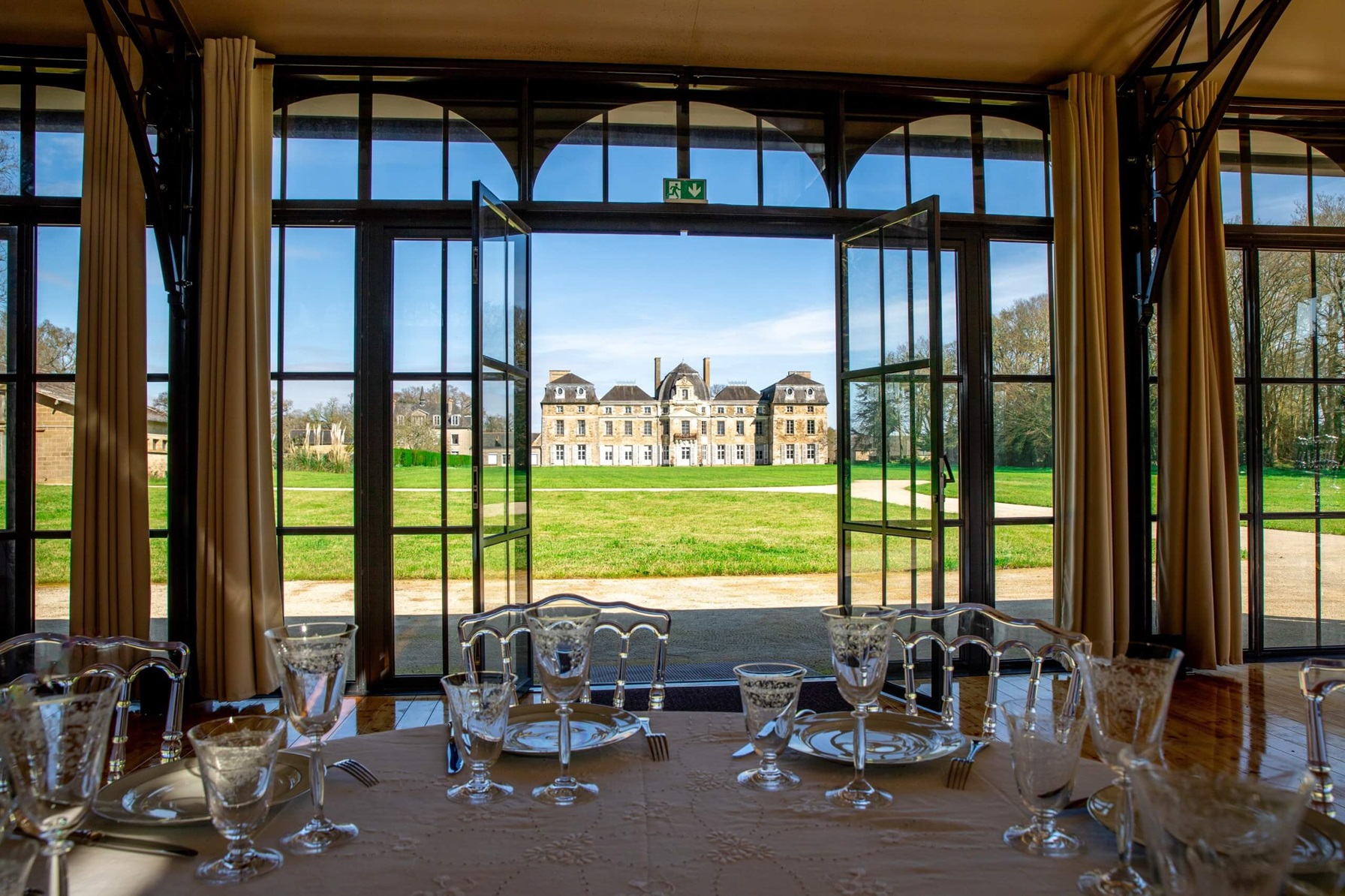
Explore this renowned UNESCO World Heritage site, with bus transfer included. - Official Dinner at Château de Cucé (Tuesday, 28 Oct, 19:45–22:00)
Join us for a memorable dinner together at this charming and historic Breton château, featuring the 2025 ECSS Award Ceremony as part of the evening programme.
 |
 |
 |
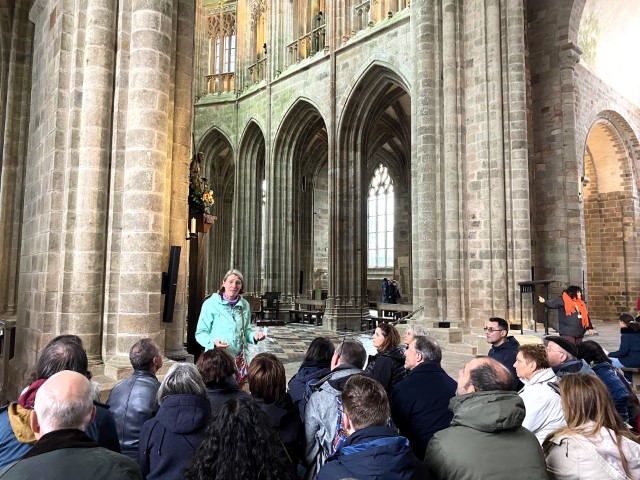
Gallery of Guided Trip to Mont Saint‑Michel
*Please note that you may need to zoom out for the best photo viewing experience.




IE Working Group Sessions
Each year at ECSS, IE Working Groups lead dynamic workshops that spark dialogue on key issues in Informatics research, education, and its societal impact.
These sessions offer the chance to explore ongoing work, provide feedback, and inspire collaborations that shape the strategic direction of each group and the broader future of Informatics in Europe.
Explore these parallel workshops and join them to advance shared goals and help amplify the collective impact of the European Informatics community. All sessions will take place on 29 October at ECSS 2025:
Green ICT & ICT for Green Workshop
co-chaired by Marco Aiello (University of Stuttgart, Germany) & Monica Vitali (Politecnico di Milano, Italy)
Date: Wednesday morning, 29 October
Session Description:
The workshop offers participants a deep dive into the evolving landscape of Green ICT, with a focus on both academic research and real-world practices in industry and institutions across Europe. It is designed for anyone interested in the intersection of sustainability and digital technologies, including researchers, educators, policy-makers, and industry professionals.
The session will open with a keynote presentation (speaker to be announced), providing a high-level perspective on the critical role of sustainable ICT in the broader climate and digital transformation agendas.
Participants will then hear three short contributions from Green ICT Working Group members, showcasing current research and practical approaches to reducing the environmental impact of ICT.
We will conclude with a report on an ongoing European-wide study into Green ICT adoption and policy practices, offering a unique overview of how institutions and industries are responding to the sustainability challenge and what opportunities exist for alignment and action.
This session is intended as an opportunity to gain a well-rounded understanding of the state of Green ICT in Europe, exchange knowledge with peers, and contribute to shaping a more sustainable digital future.
Open Science & Open Source Workshop
co-chaired by Lenuta Alboaie (Alexandru Ioan Cuza University of Iași, Romania) & Philippe Krief, Eclipse Foundation
Date: Wednesday morning, 29 October
Session Description:
From Vision to Implementation – Open Science, OSPOs and Institutional Transformation
This workshop explores how Open Source Program Offices (OSPOs) — originally designed to foster open source practices in industry and universities — can be leveraged as strategic instruments to embed Open Science principles within academic institutions. By drawing on successful models and proven methodologies from both sectors, we aim to bridge the gap between open source and open science. Through expert talks, real-world case studies, and a dynamic panel discussion, we will examine concrete pathways from policy vision to institutional implementation. Participants will gain insight into OSPO models from both industry and academia, with contributions from leading voices in the OSPO Alliance, Open Science networks, and European projects. Together, we will explore the potential for launching or reactivating a dedicated Working Group within Informatics Europe, focused on Open Science and Open Source collaboration. Let’s collectively build a roadmap to empower universities to lead in openness, innovation, and structured public engagement.
Diversity & Inclusion Workshop
co-chaired by Simona Motogna (Babeş-Bolyai University, Romania) & Lola Burgueño (University of Malaga, Spain)
Date: Wednesday afternoon, 29 October
Session Description:
In today's interconnected and diverse world, academic departments are spaces that bring together people from diverse backgrounds, cultures or locations, with diverse expectations and views. This workshop explores the dimensions that make these spaces inclusive, and create collaborative, safe and flexible communities.
Welcoming all ECSS participants, the session will present invited talks, panel discussions and collaborative interaction to address inclusion from participants' perspective, but also from leaders who built such spaces.
13:30 – 13:35 Welcome and Intro
13:35 – 14:25 Invited presentations
14:25 – 15:00 Panel discussion
15:00 – 16:00 Interactive collaborative activity – Co-design activity to propose change for inclusion in working spaces
Ethics Workshop
chaired by Covadonga Rodrigo (UNED, Spain)
Date: Wednesday afternoon, 29 October
Session Description:
Ethics provides a critical lens to identify issues and challenges related to information and technology. This session will focus on the Societal Impact of Information and Technology Use, as well as their interaction with human beings. We will address the responsible development and application of information systems, encompassing areas such as privacy, security, access, and intellectual property, and motivating best practices across the field.
Welcoming all ECSS participants, the session will present a panel discussion and an interactive activity designed to address ethics from the WG members' perspective, as well as from leaders across our community.
13:30 – 14:15 Collaborative interaction activity (based on Ethics4EU resources)
14:15 – 14:30 State of the art of forthcoming report "State of the Art of Ethics in HE studies"
14:30 – 16:30 Round table & Panel discussion
Upskilling & Societal Engagement WS
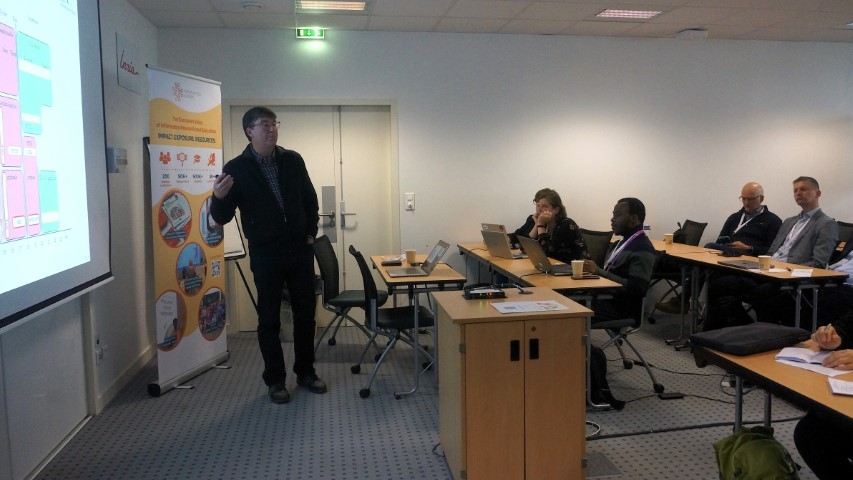
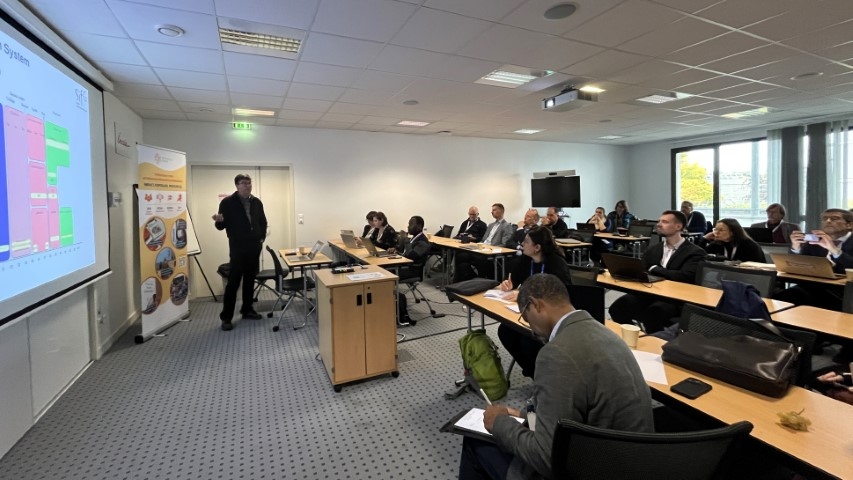
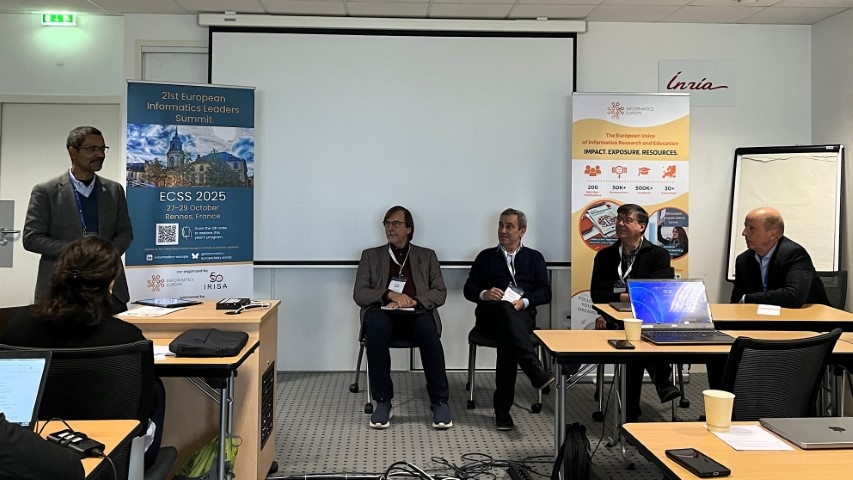
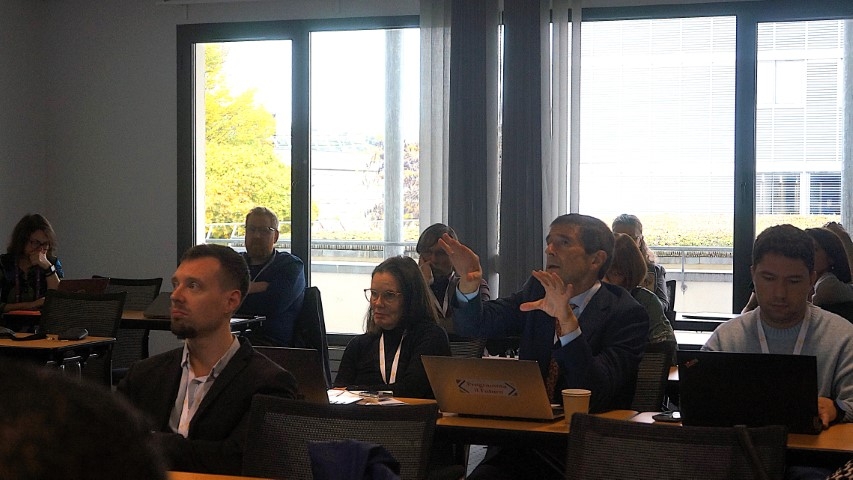
Informatics Europe, together with our member National Informatics Associations (NIAs), organises an annual workshop on timely and strategic themes in Informatics. The 2025 edition, themed "Upskilling & Societal Engagement"‘and chaired by Heri Ramampiaro (NTNU, Norway), was held on Wednesday morning, 29 October, focusing on two key topics:
-
Engaging Society and Youth with Informatics
How can we raise public understanding of Informatics and inspire more young people to choose it as a field of study? -
Upskilling for a Rapidly Evolving Future
How can we support educators and professionals to stay up to date in a fast-changing technological landscape?
These themes build on past discussions, particularly around the transformative impact of generative AI and other emerging technologies on Informatics education and society at large (revisit presentations at our Workshop in 2023 and 2024). The 2025 session aimed to move from diagnosis to action, highlighting practical initiatives and strategies from across Europe, encouraging knowledge exchange and collective learning.
Structured in two parts, the programme included brief, focused contributions from NIA and industry representatives, followed by dynamic panel discussions. Participants were actively invited to join the conversation, share experiences, and bring forward challenges or initiatives from their own institutions or countries.
Welcoming all ECSS participants, this session offered a unique opportunity to explore how the Informatics community can work together to boost visibility, relevance, and resilience—within universities and across society.
Workshop Rundown, Slides & Highlights
Speaker bios and abstracts are available on the ECSS speakers page by clicking their photos.
Read the workshop highlights here.
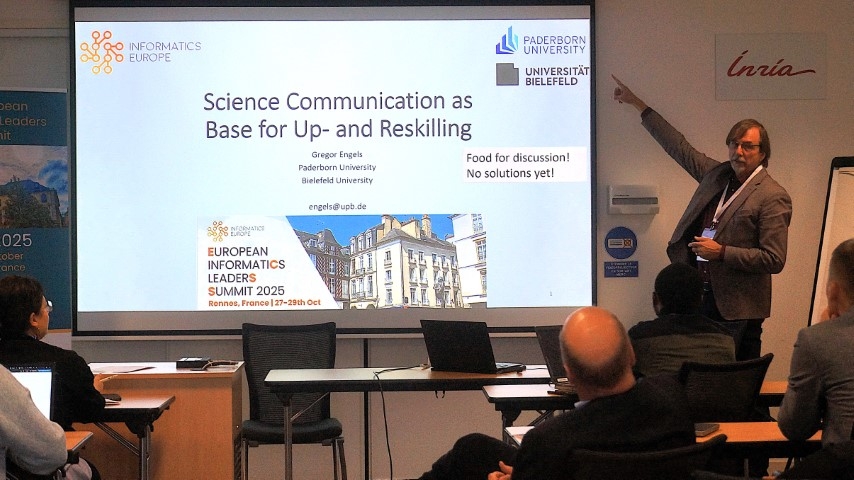
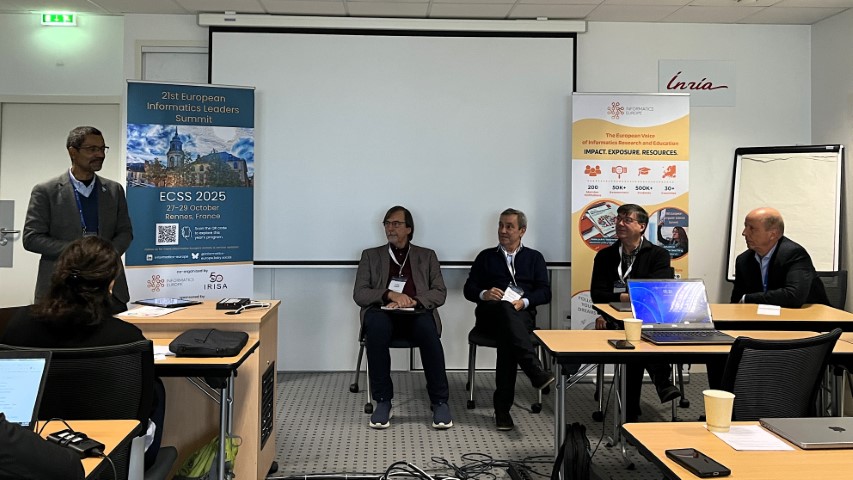
09:00 - 09:30 "Engaging Society and Youth with Informatics" Session
- Enrico Nardelli, University of Rome "Tor Vergata" (Italy)
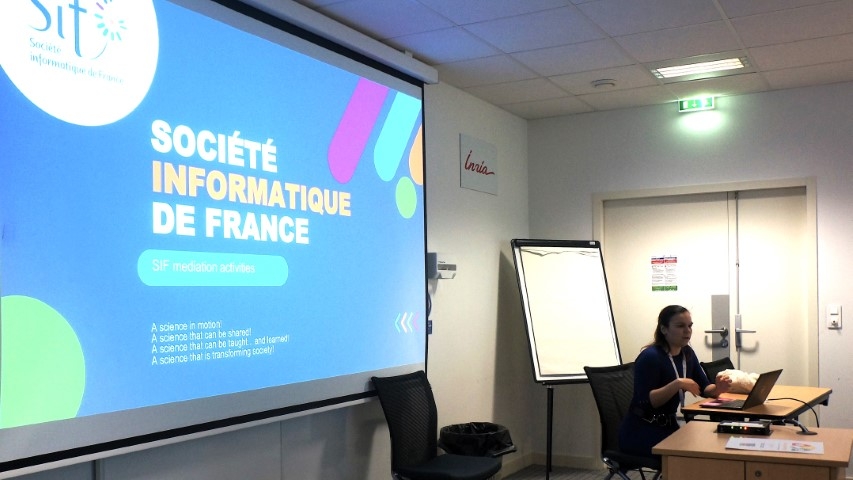
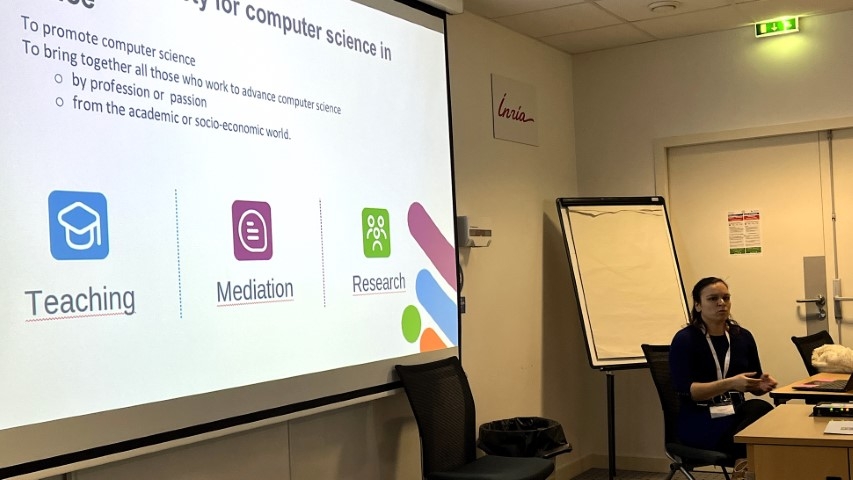
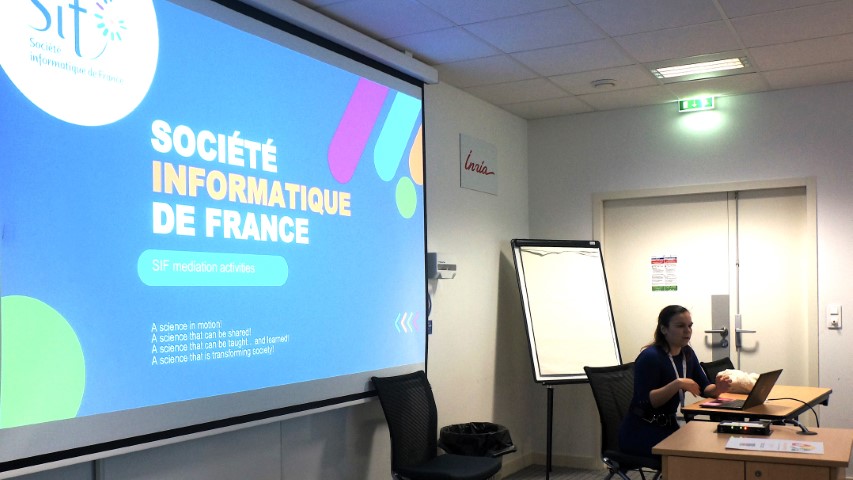
Initiatives in Italy to Engage Young People and Schools in Informatics [Slides] - Constance Thierry, SIF - Societé Informatique de France / IRISA (France)
Approaches Implemented in France to Raise Awareness of Informatics among a Diverse Audience [Slides]
09:30 - 10:00 Panel Discussion
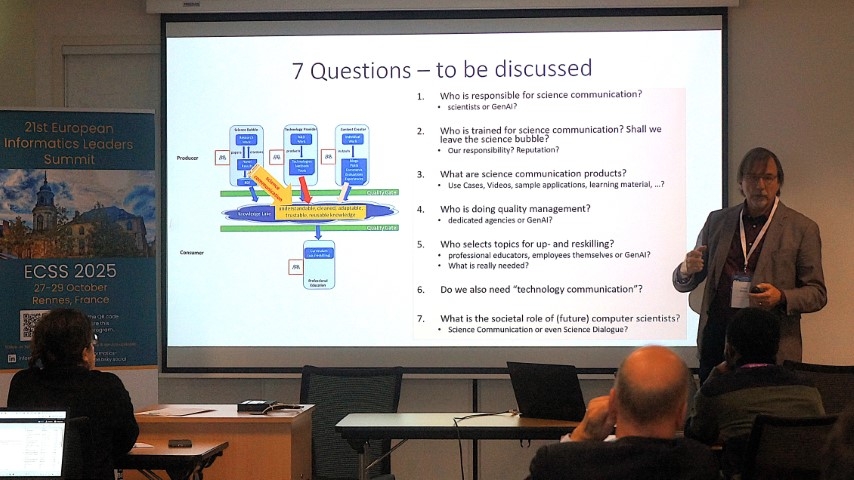
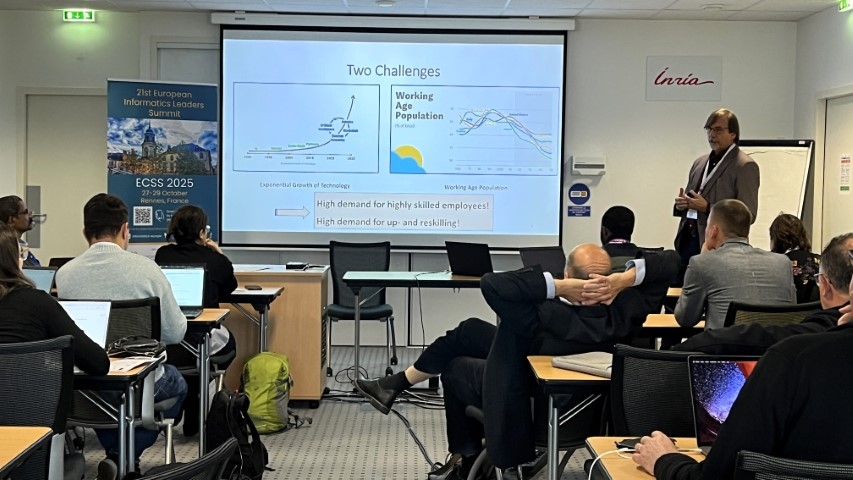
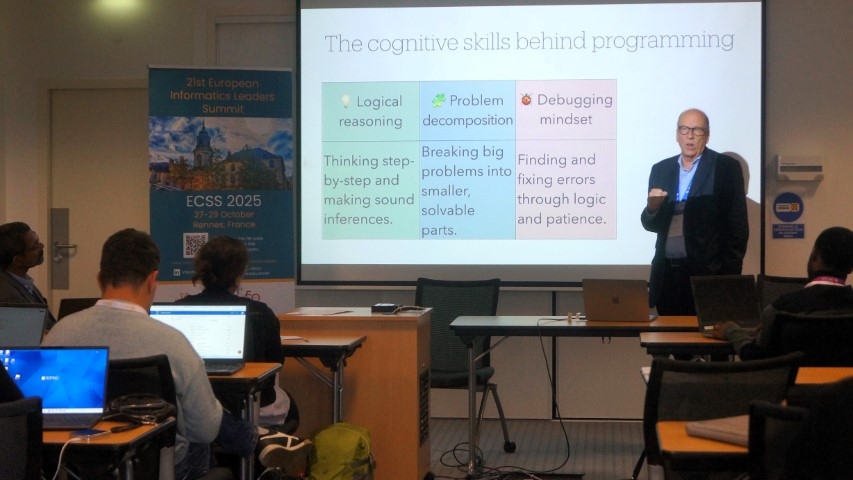
10:00 - 10:30 "Upskilling for a Rapidly Evolving Future" Session
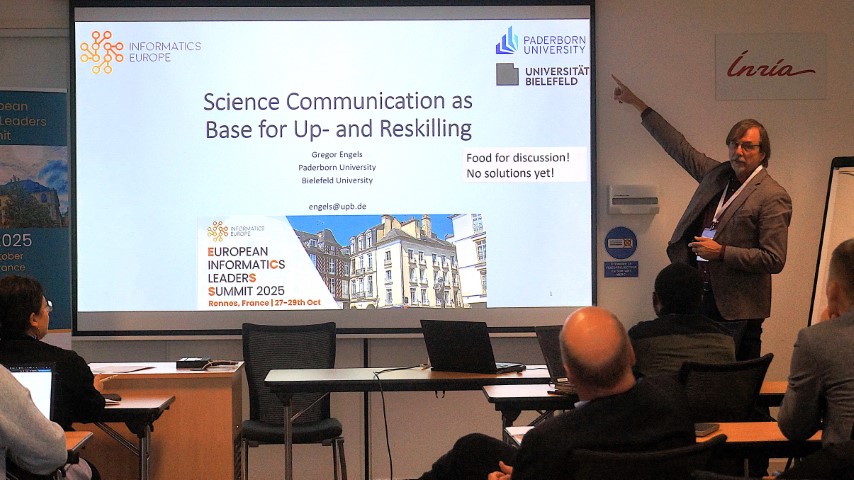
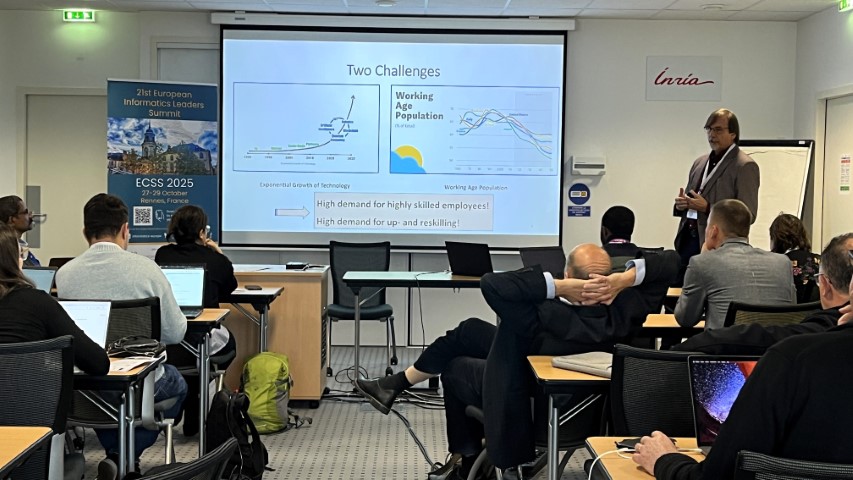
- Gregor Engels, Paderborn University (Germany)
Science Communication as Base for Up- and Reskilling [Slides] - Martin Hitz, Informatik Austria / University of Klagenfurt (Austria)
AI is excellent at programming – why should I still learn to program? [Slides]
10:30 - 11:00 Coffee break
11:00 - 11:15 "Upskilling for a Rapidly Evolving Future" Session (continued)
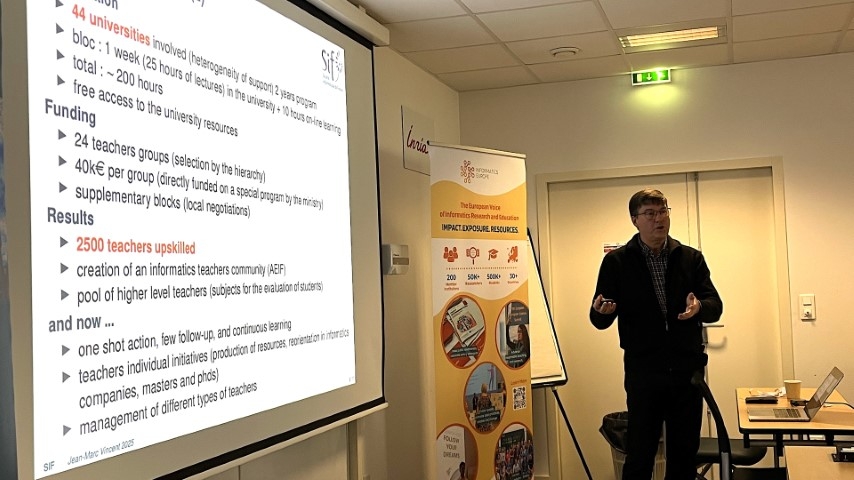
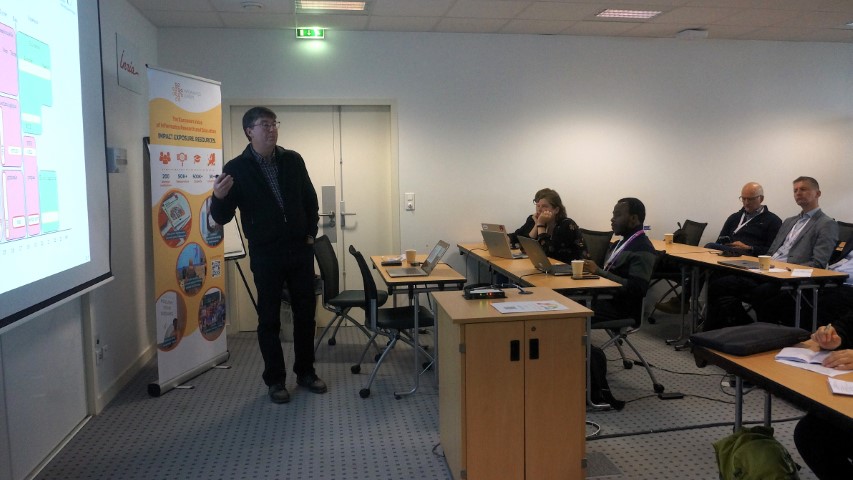
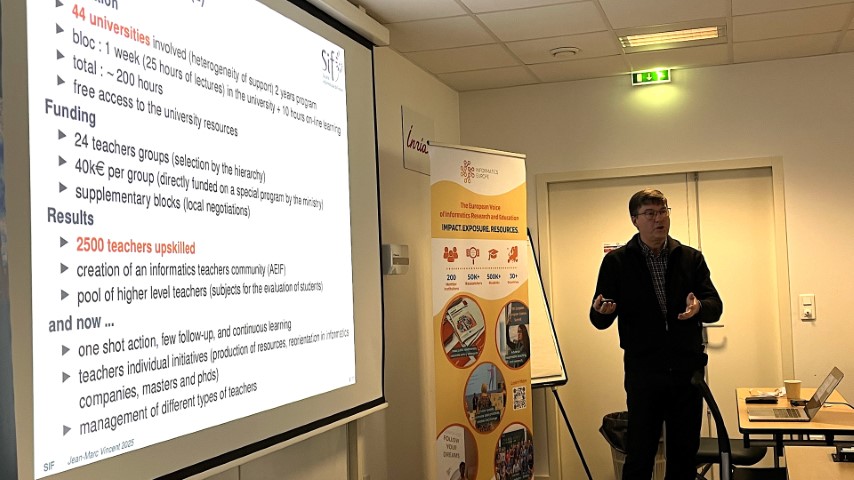
- Jean-Marc Vincent, Université Grenoble Alpes (France)
How to Upskill in Informatics a (Very) Large group of Teachers [Slides]
11:15 - 12:15 Panel Discussion
12:15-12:30 Closing Remarks
*Please note that you may need to zoom out for the best photo viewing experience.







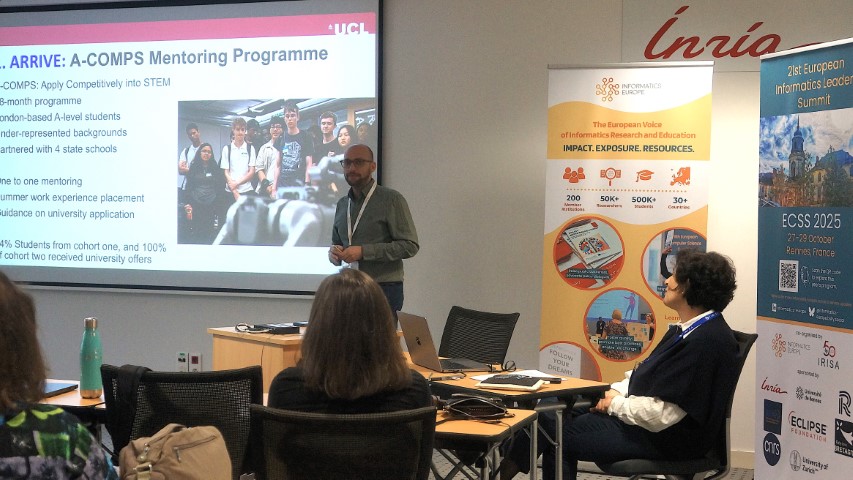
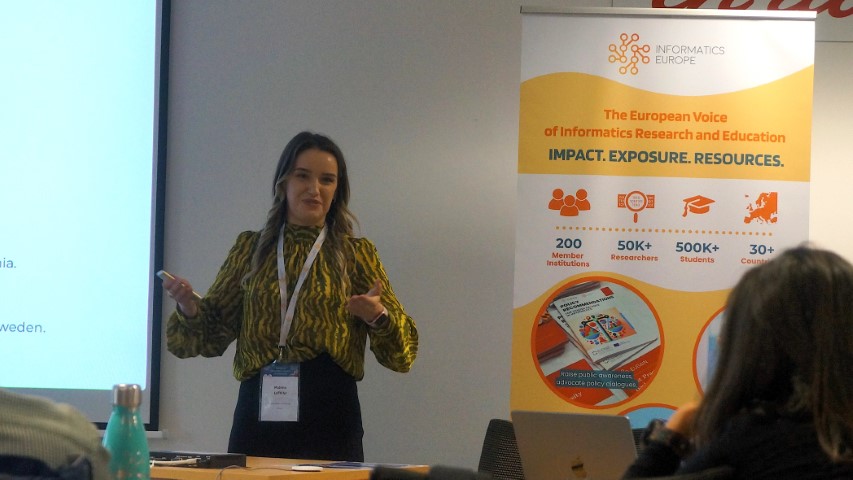
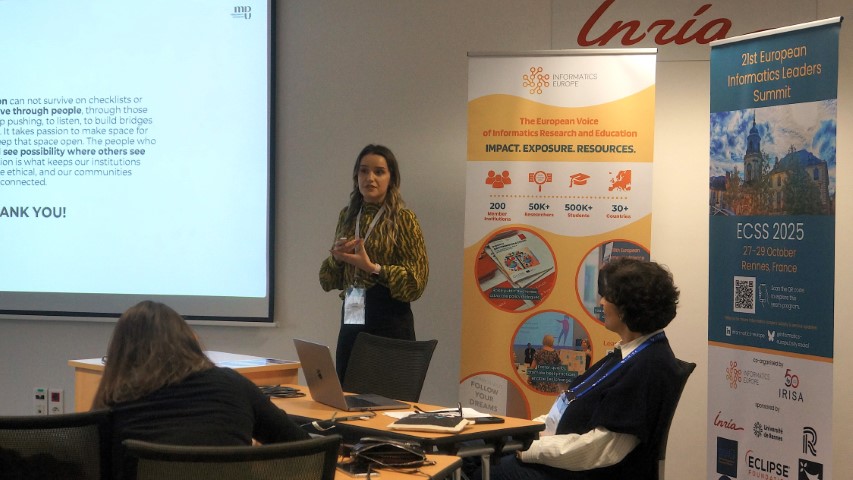
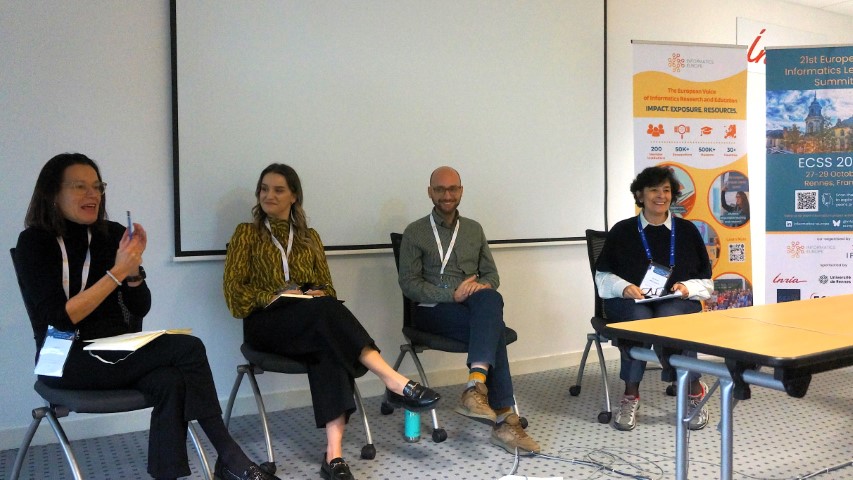
Diversity & Inclusion Workshop
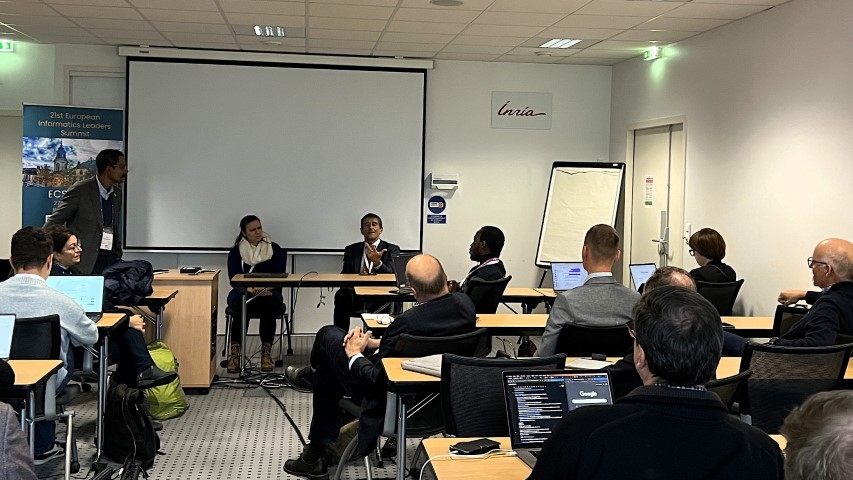
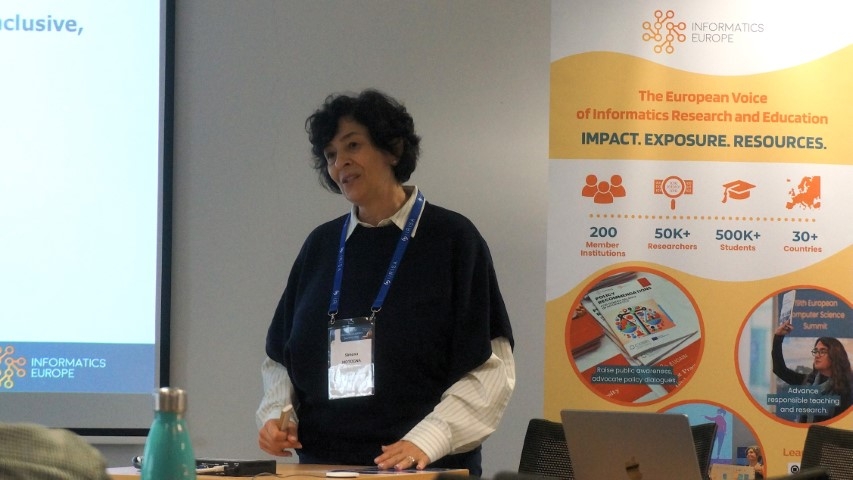
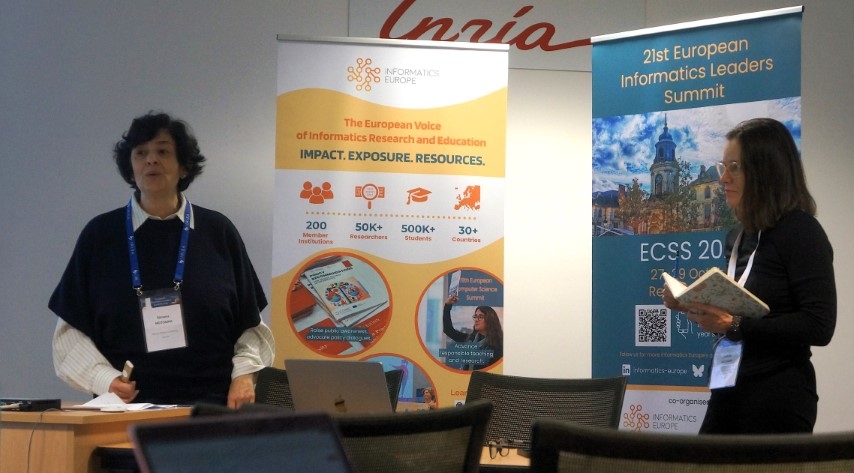
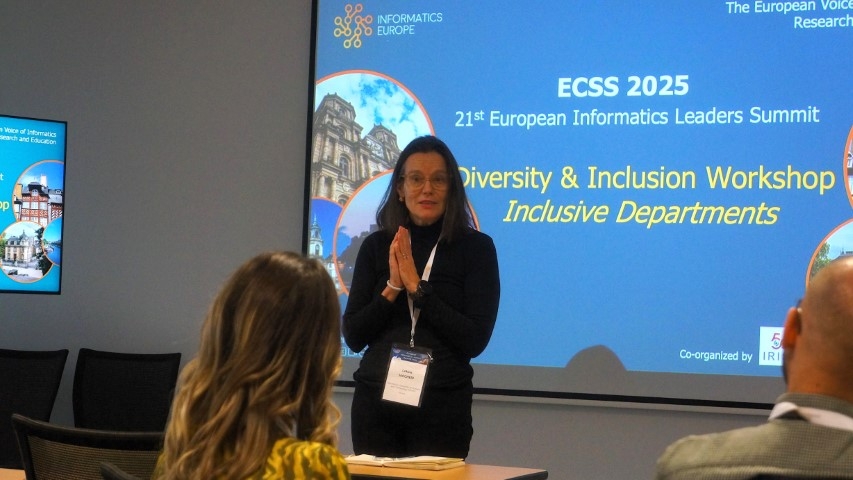
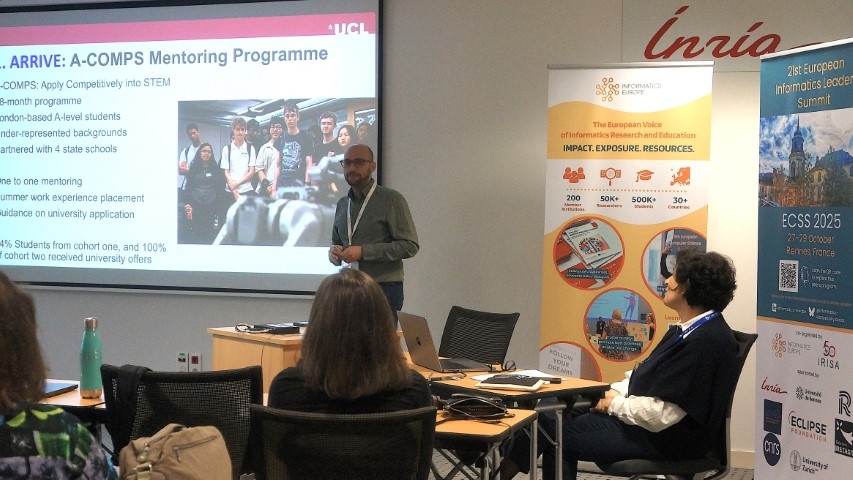
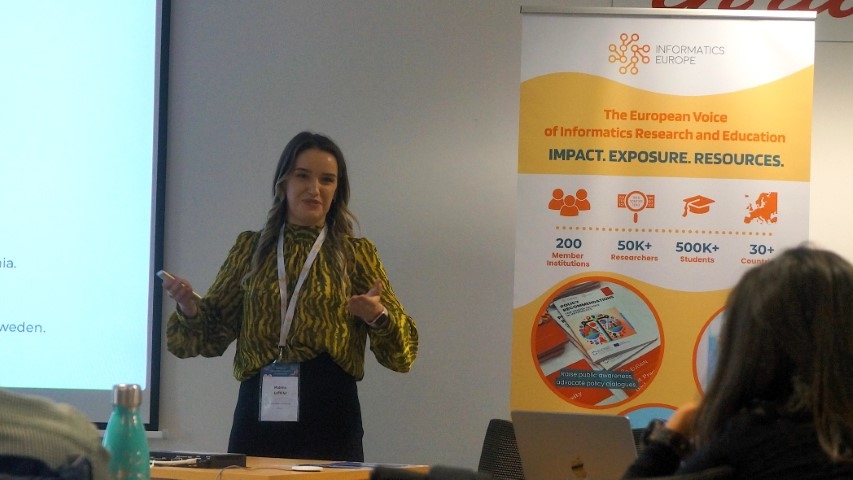
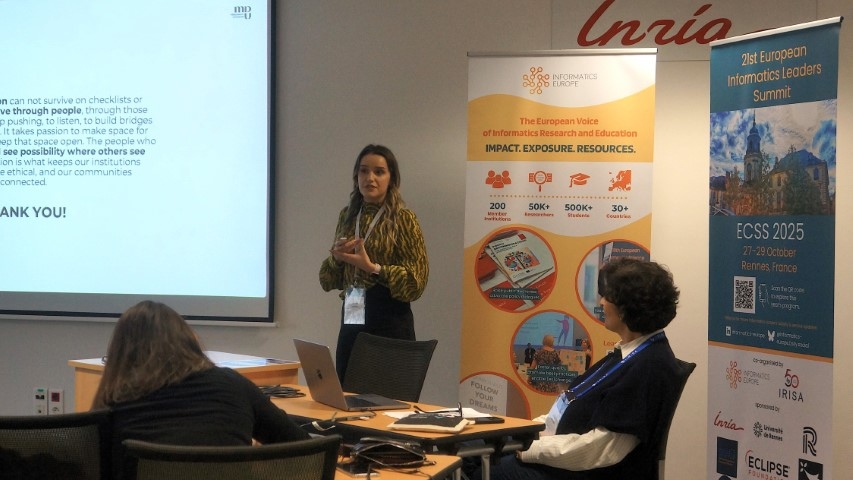
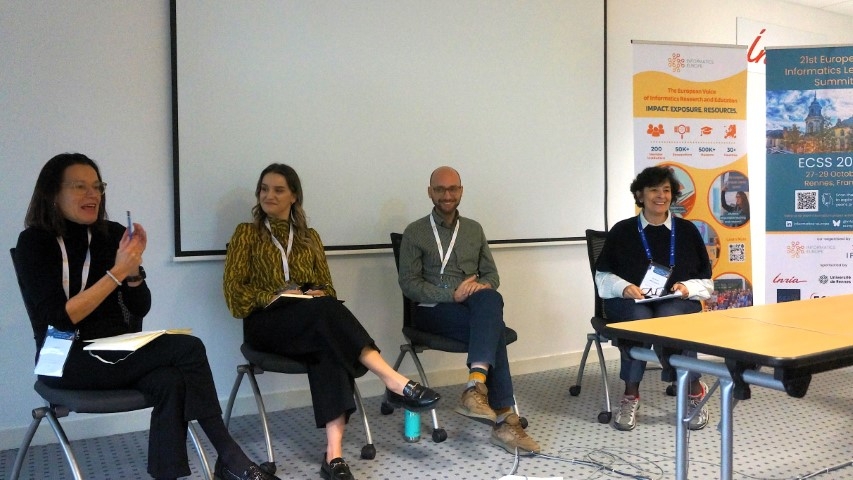
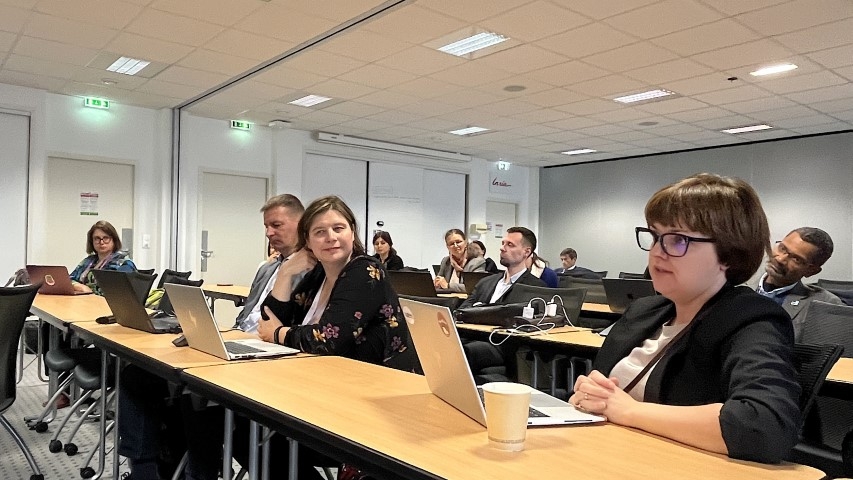
The workshop, open to all ECSS participants, was held on Wednesday afternoon, 29 October, and co-chaired by Simona Motogna (Babeş-Bolyai University, Romania), Chair of the Diversity & Inclusion Working Group, Oana Andrei (University of Glasgow, UK) and Lola Burgueño (University of Malaga, Spain).
In today's interconnected and diverse world, academic departments are spaces that bring together people from diverse backgrounds, cultures or locations, with diverse expectations and views. This workshop explored the dimensions that make these spaces inclusive, and create collaborative, safe and flexible communities.
Welcoming all ECSS participants, the session hosted short presentations followed by a panel discussion and collaborative interaction to address inclusion from participants' perspective, but also from leaders who built such spaces.
Workshop Rundown, Slides & Highlights
Speaker bios and abstracts are available on the ECSS speakers page by clicking their photos.
Read the workshop highlights here.
13:30 - 13:45 Voices of Inclusion: Experiences and Initiatives
-
- Matthew Grech-Sollars, University College London (UK) [Slides]
- Letizia Jacheri, NTNU (Norway)
- Malvina Latifaj, Mälardalen University (Sweden) [Slides]
13:45 – 14:30 Panel discussion
14:30 - 15:00 Interactive collaborative activity part 1: Co-design activity to propose change for inclusion in working spaces
15.00 - 15.30 Coffee break
15.30 - 16.00 Interactive collaborative activity part 2: Co-design activity to propose change for inclusion in working spaces
*Please note that you may need to zoom out for the best photo viewing experience.
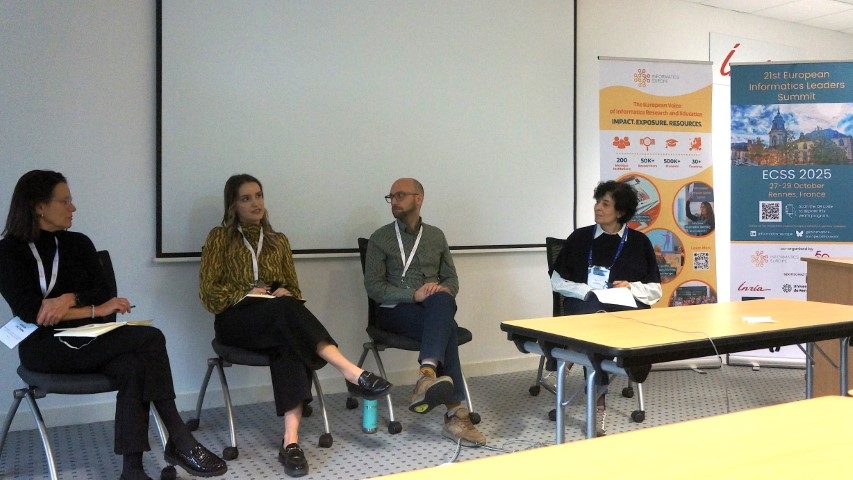
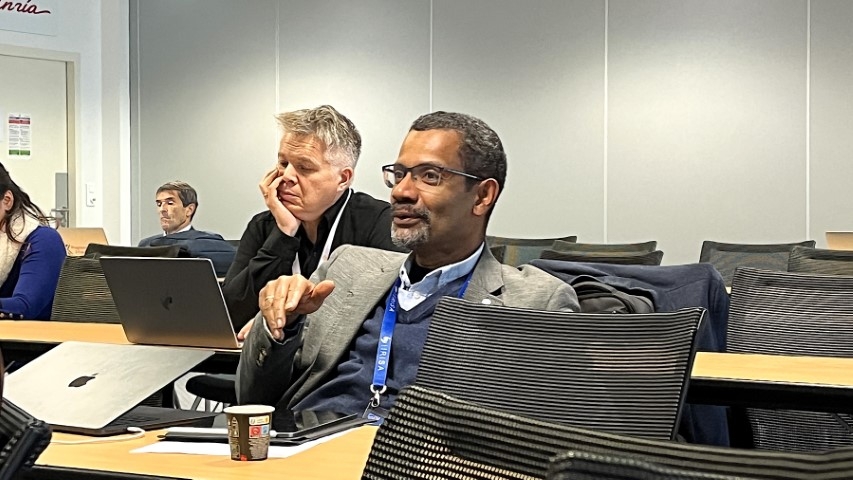
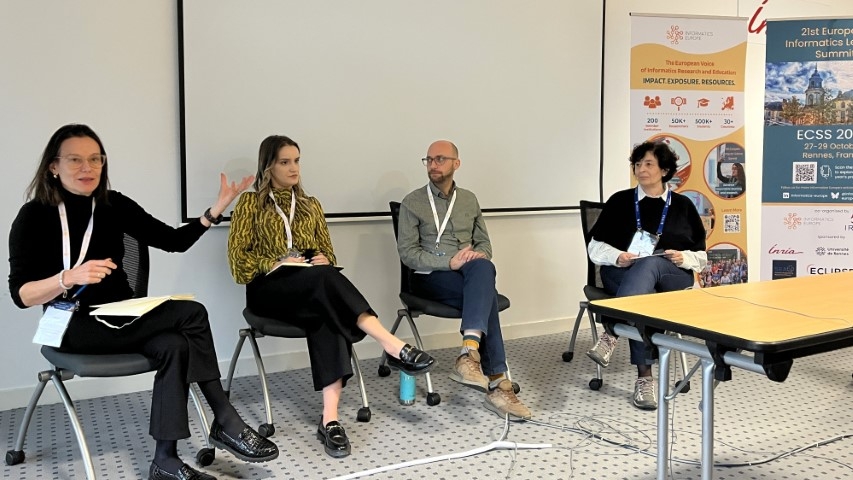
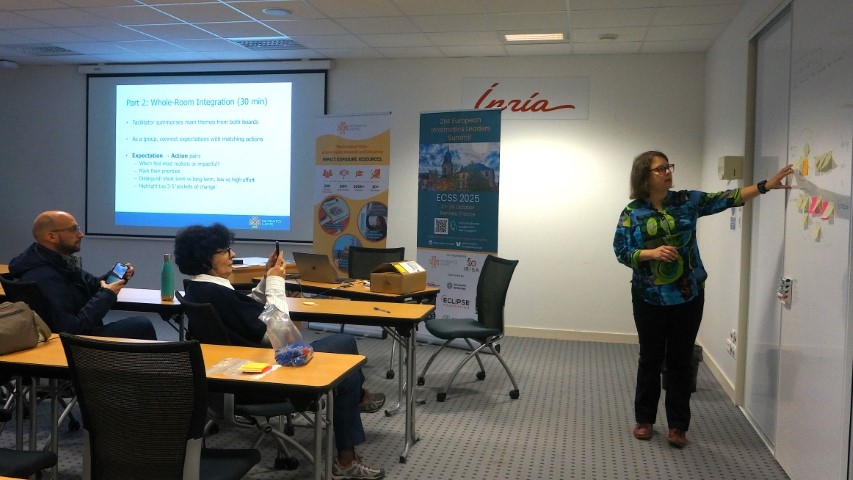
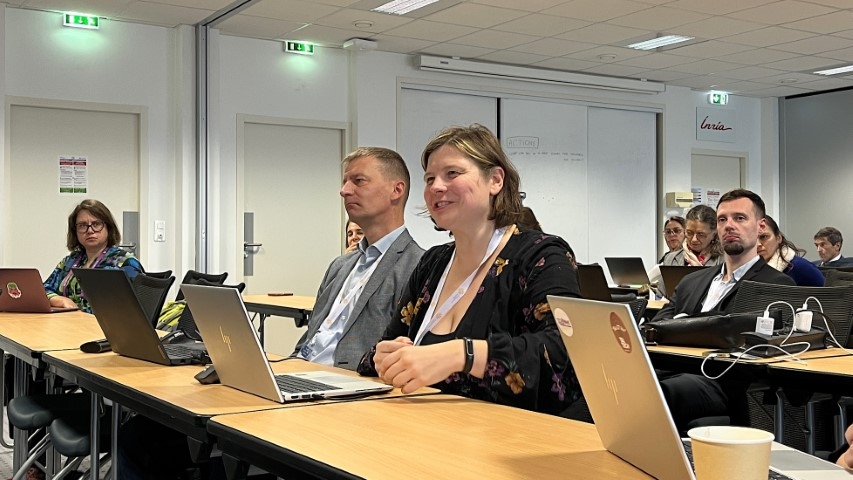
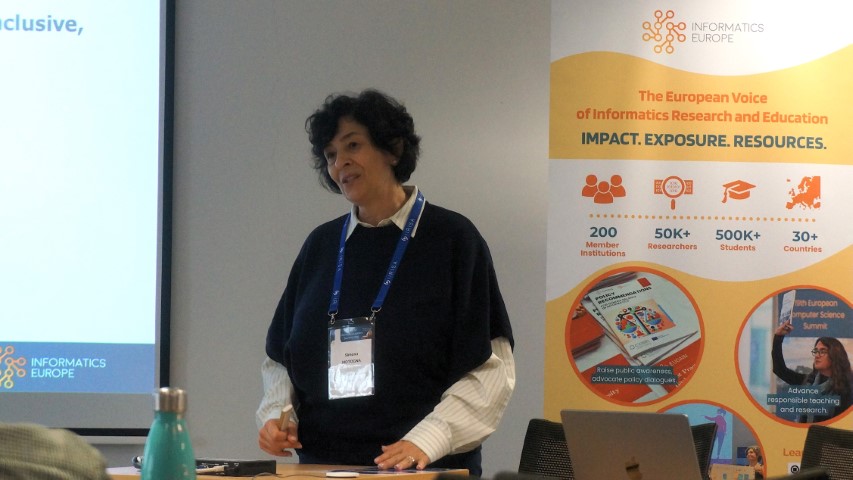
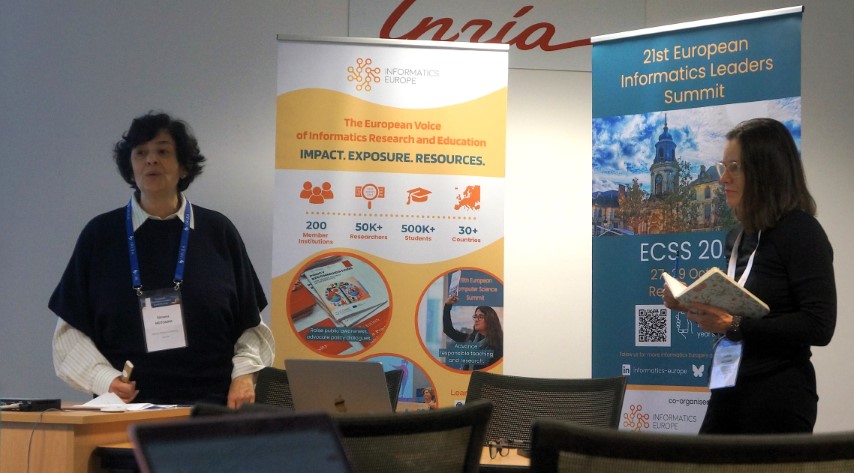
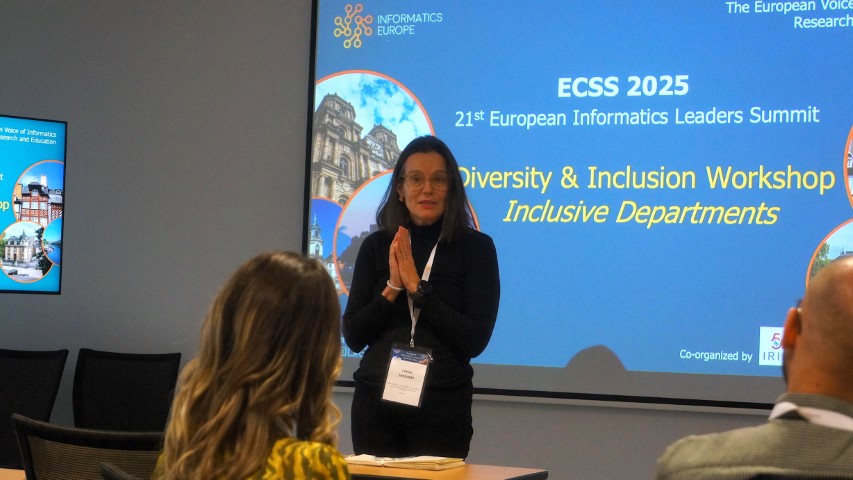
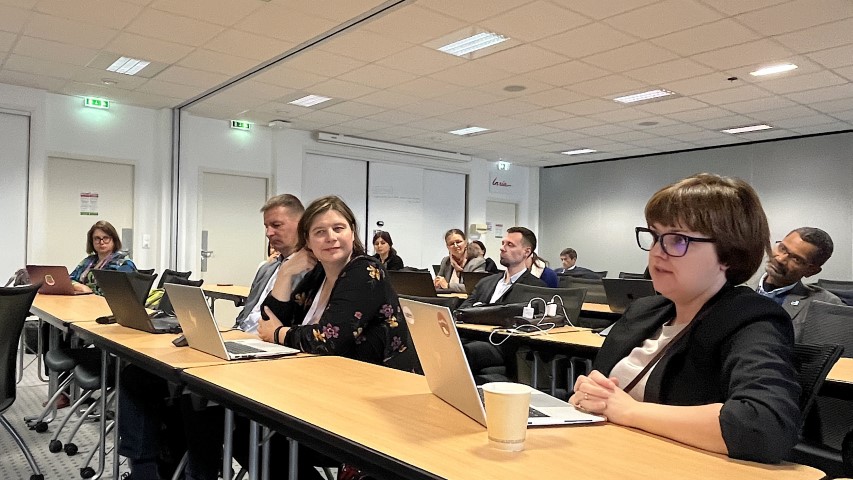
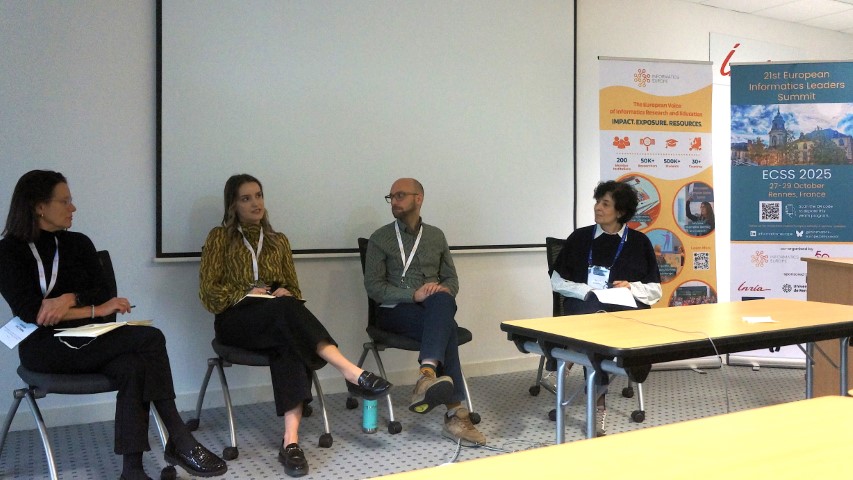
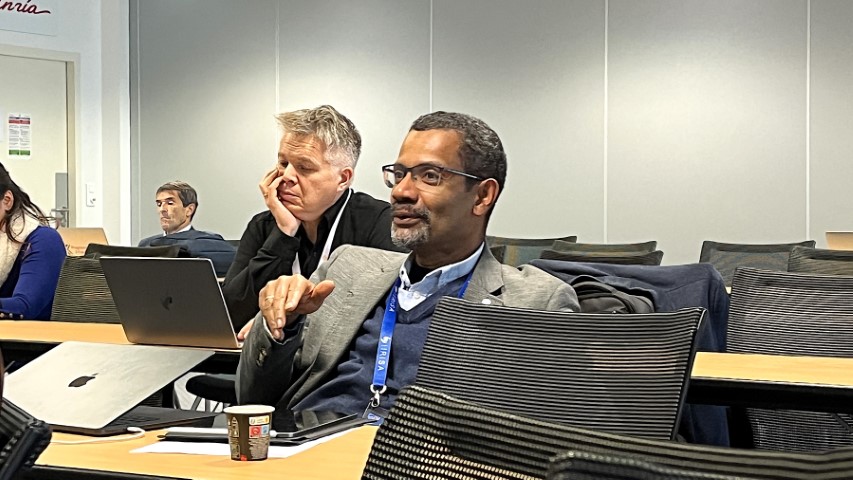
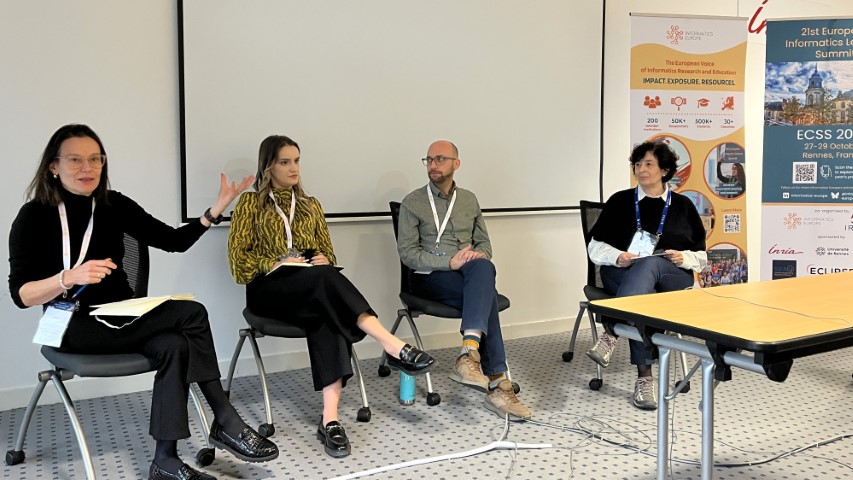
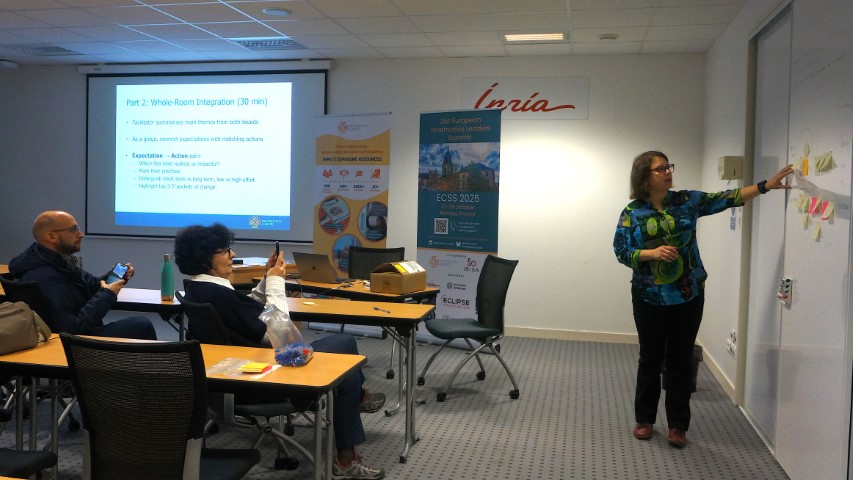
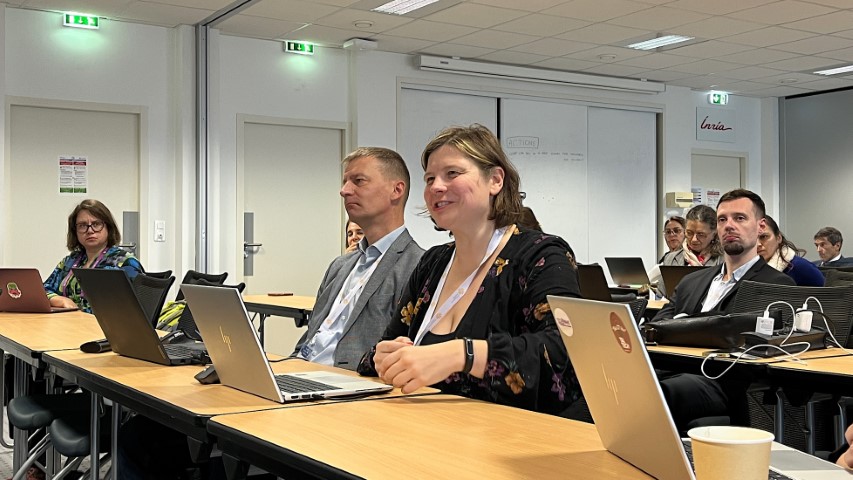


Each year at ECSS, IE Working Groups lead dynamic workshops that spark dialogue on key issues in Informatics research, education, and its societal impact. Join these parallel sessions on 29 October to explore ongoing work, provide feedback, and inspire collaborations that shape the strategic direction of each group and the broader future of Informatics in Europe.
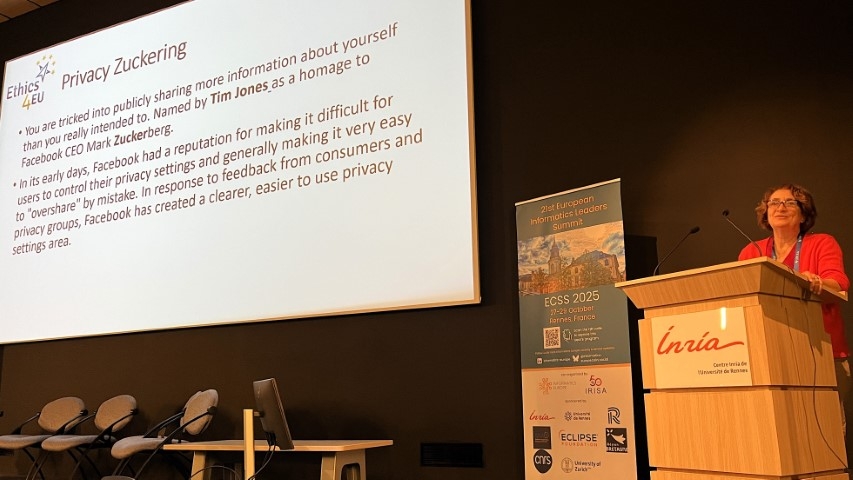
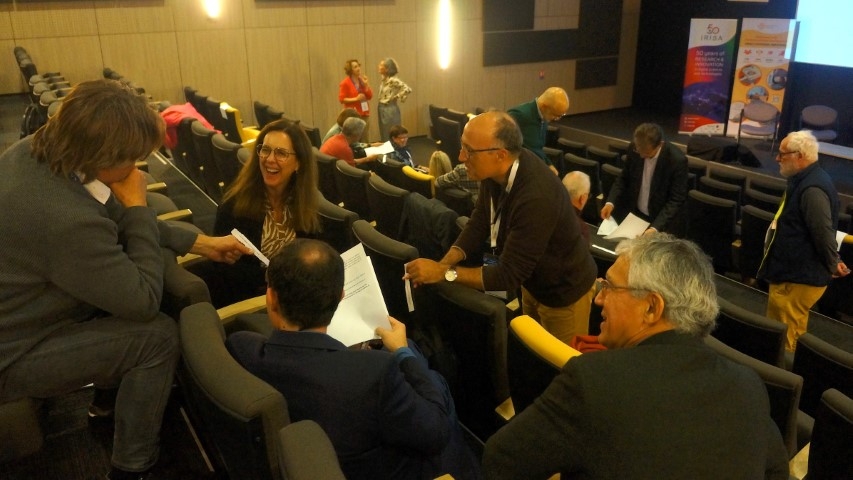
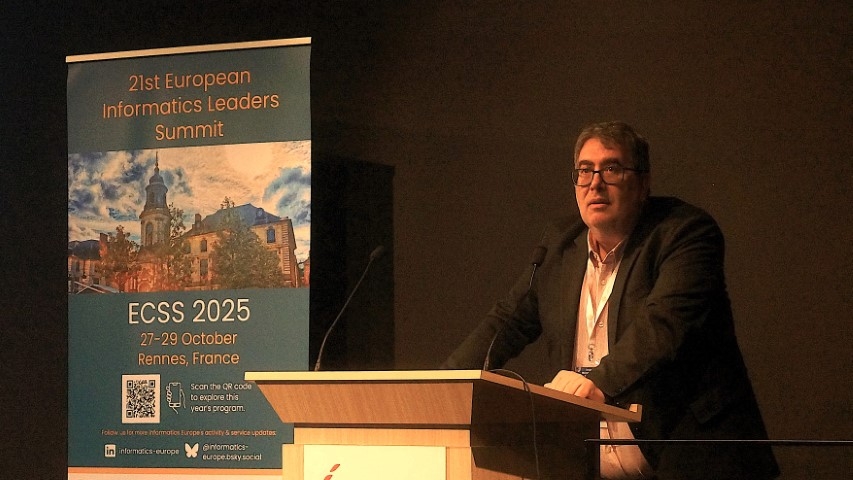
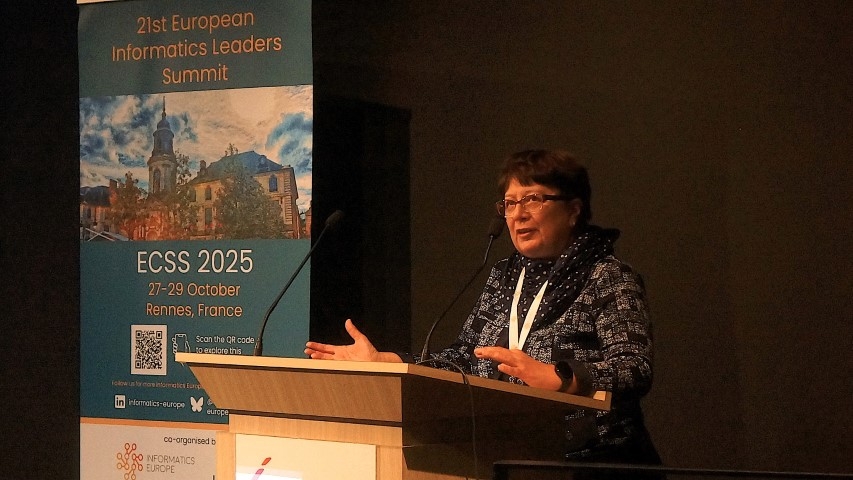
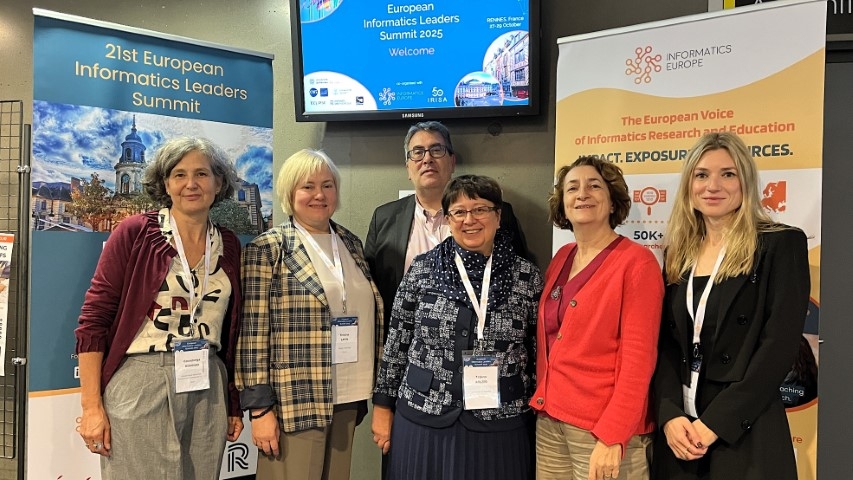
Ethics Workshop
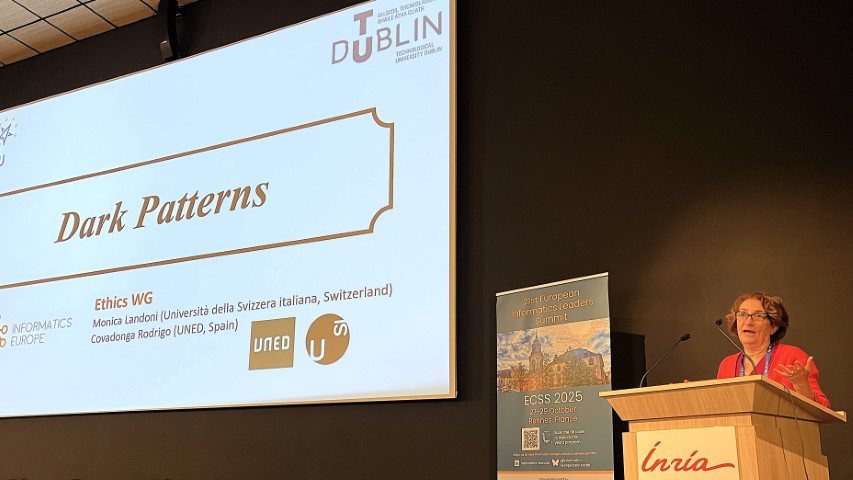
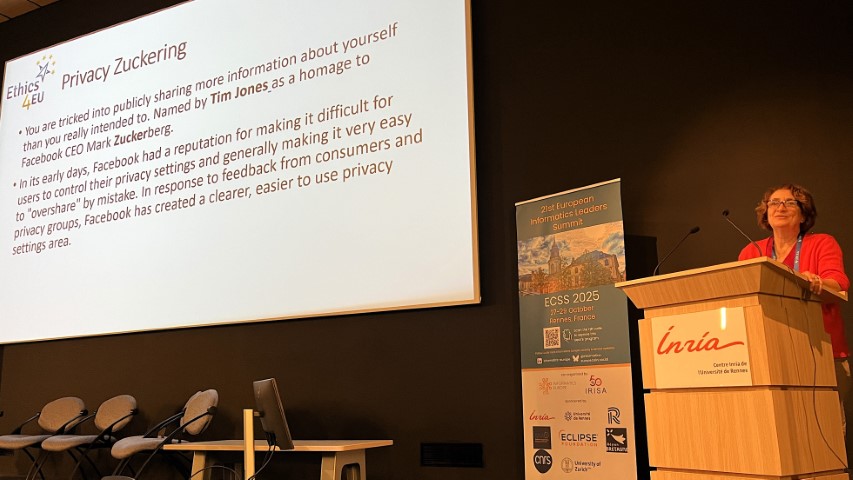
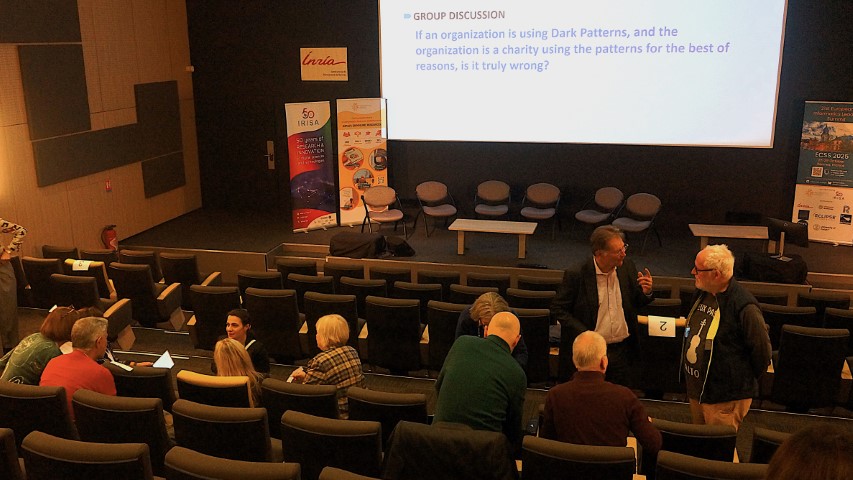
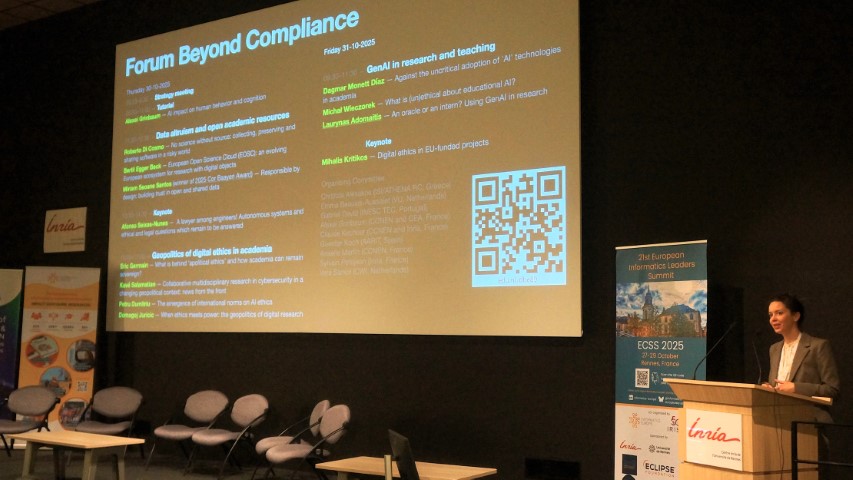
The workshop, chaired by Covadonga Rodrigo (UNED, Spain), Chair of the Ethics Working Group, was held on Wednesday afternoon, 29 October.
Ethics provides a critical lens to identify issues and challenges related to information and technology. This session focused on the Societal Impact of Information and Technology Use, as well as their interaction with human beings. We addressed the responsible development and application of information systems, encompassing areas such as accountability, misinformation, ethical awareness nad tools and motivating best practices across the field.
Welcoming all ECSS participants, the session presented a panel discussion and an interactive activity designed to address ethics from the WG members' perspective, as well as from leaders across our community.
Workshop Rundown, Slides & Highlights
Speaker bios and abstracts are available on the ECSS speakers page by clicking their photos.
Read the workshop highlights here.
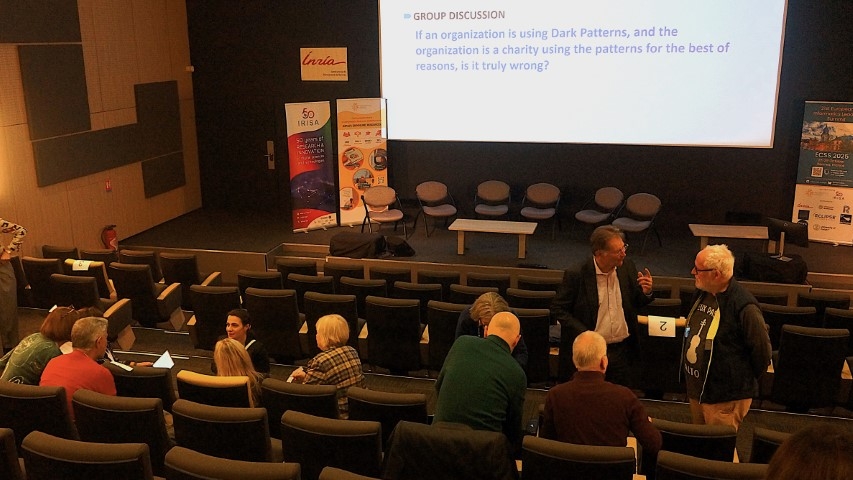
13:30 – 14:20 Interaction activity starting from an Ethics4EU resource on Dark Patterns [Slides]
co-chaired by Monica Landoni, Università della Svizzera italiana (Switzerland)
14:20 – 14:30 WG updates: Overview of aims and ongoing activities
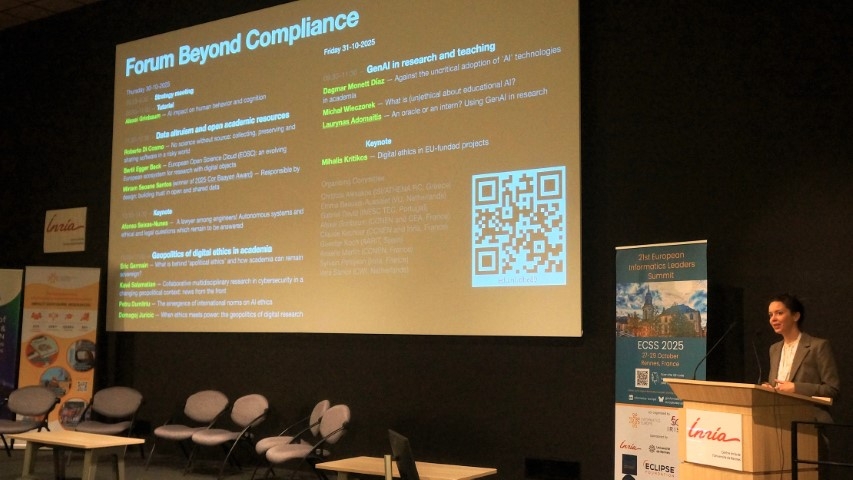
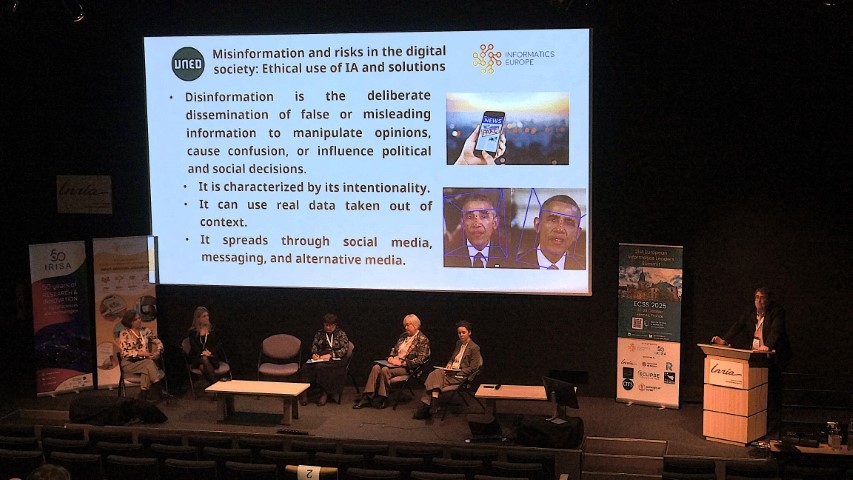
14:30 – 16:30 Round table & Panel: "Addressing ethical challenges with security in the digital society"
with an interactive exchange exploring perspectives from the WG members, as well as leaders across the Informatics Europe and ERCIM communities.
co-chaired by Emma Beauxis Aussalet, ERCIM & Vrije Universiteit (Netherlands) with panellists:
- Petra Saskia Bayerl, CENTRIC: Centre of Excellence in Terrorism, Resilience, Intelligence and Organised Crime Research (UK)
From Lab to Law: AI Accountability as practical mechanism for responsible AI [Slides] - Kristina Lapin, Vilnius University (Lithuania)
Raising Ethical Awareness to Combat Dark Patterns [Slides] - Rafael Pastor, UNED (Spain)
Misinformation and risks in the digital society: Ethical use of IA and solutions - Mirela Riveni, University of Groningen (Netherlands)
Ethical issues in decision-making with AI - Tatjana Welzer, University of Maribor (Slovenia)
Ethics and Accountability
*Please note that you may need to zoom out for the best photo viewing experience.
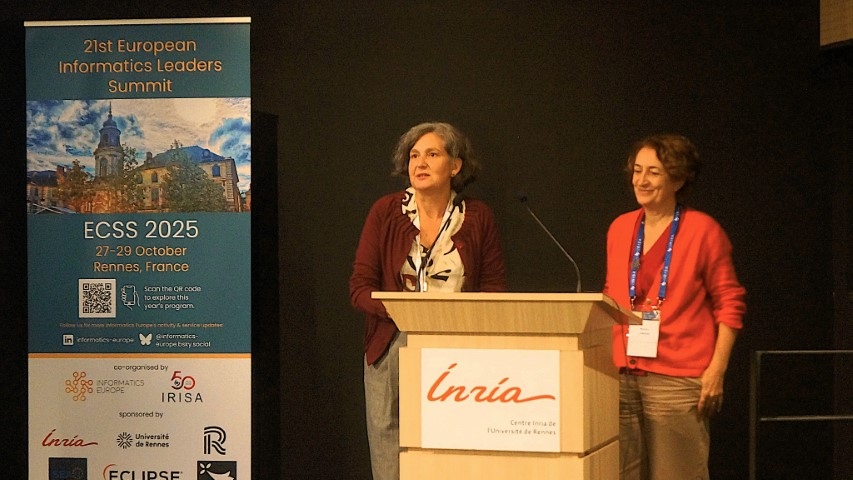
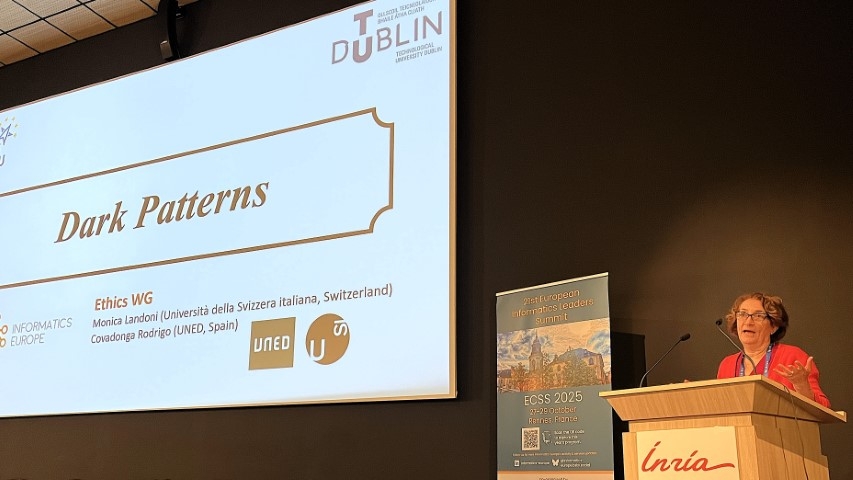
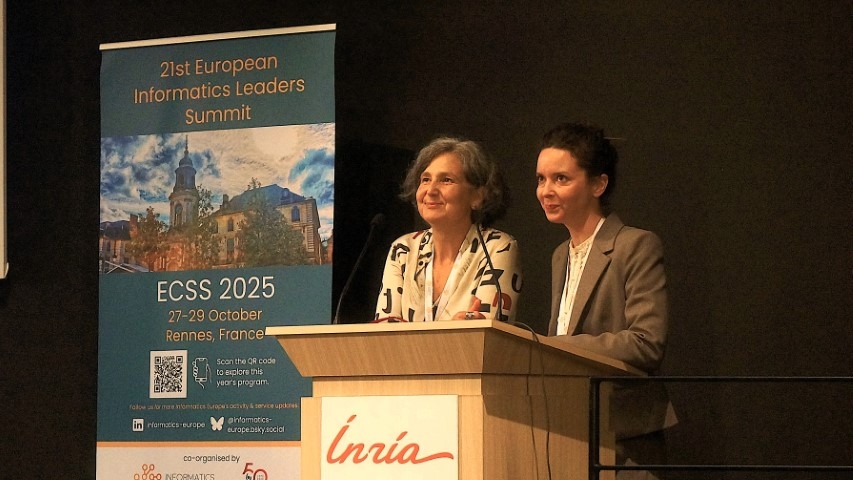
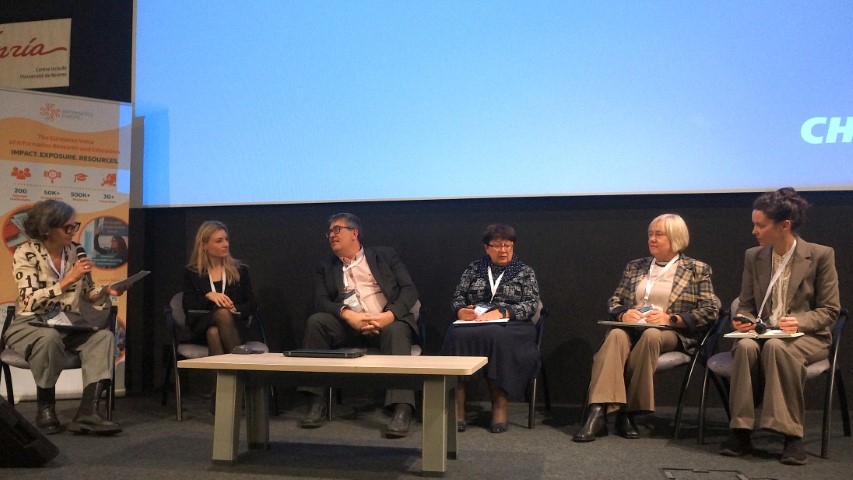
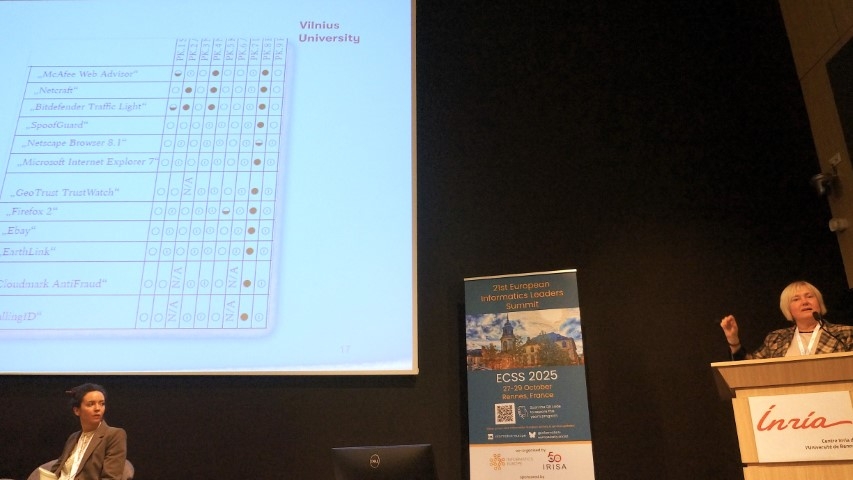
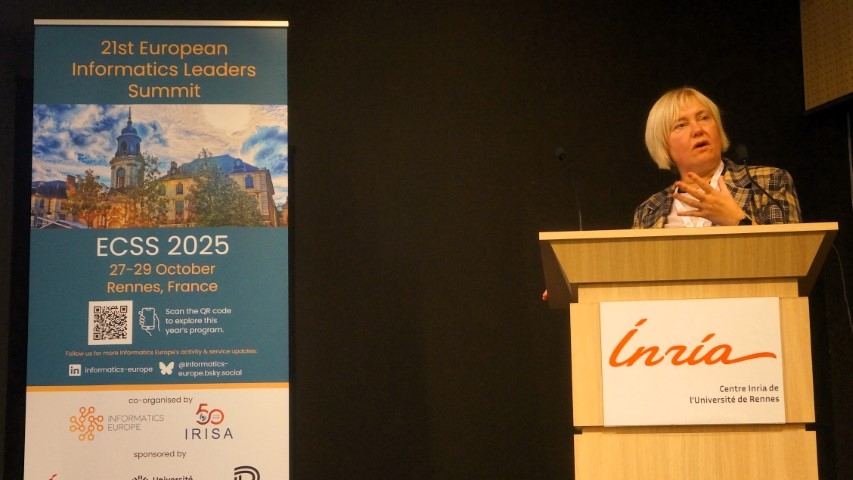


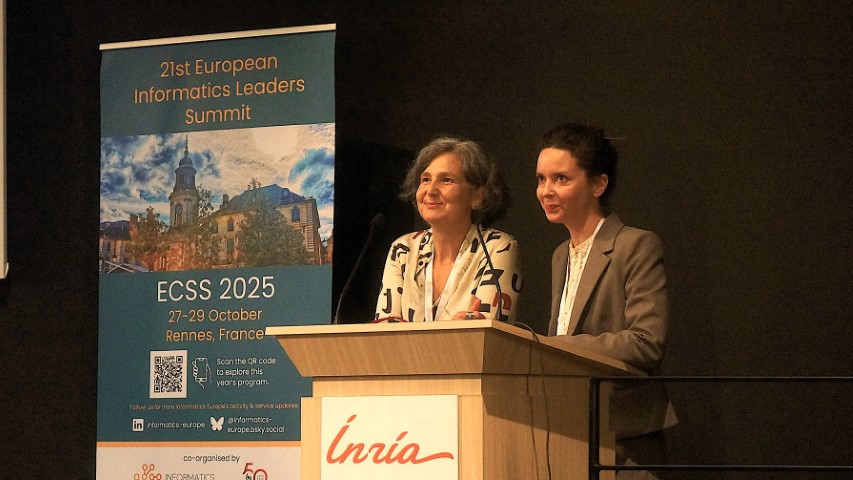
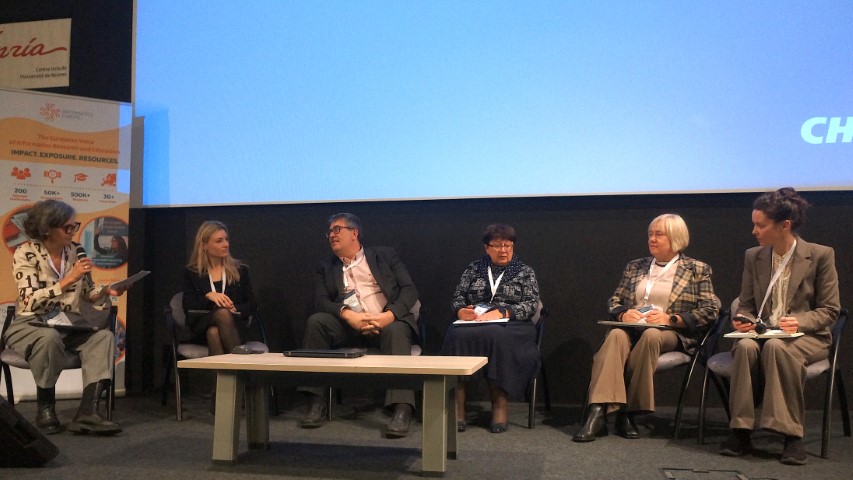

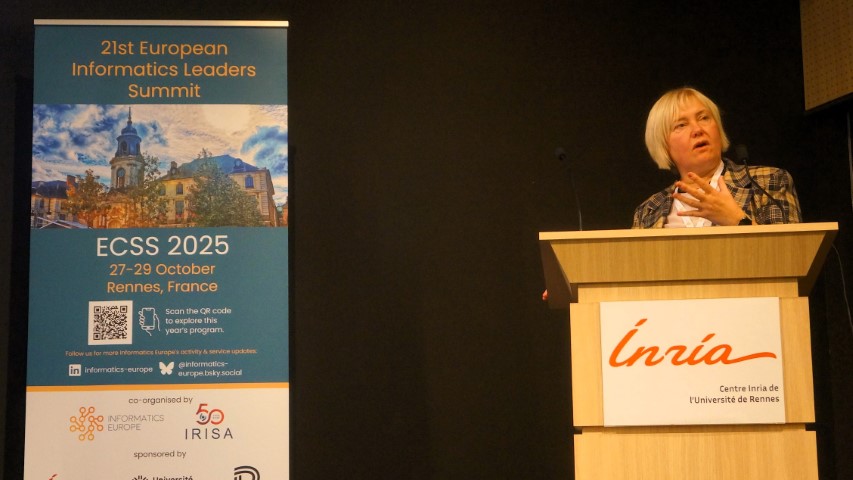
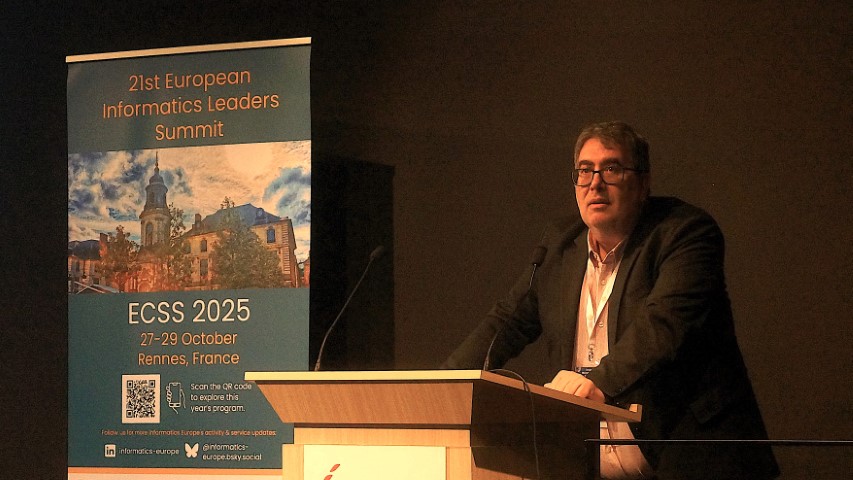

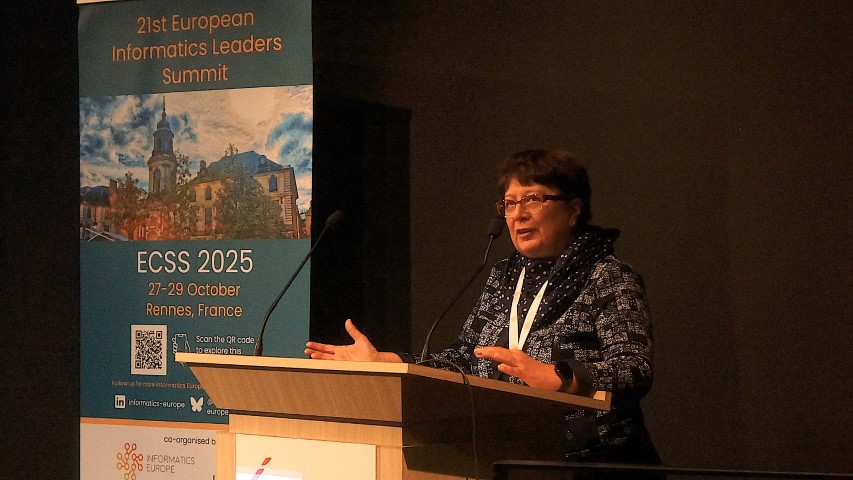


Each year at ECSS, IE Working Groups lead dynamic workshops that spark dialogue on key issues in Informatics research, education, and its societal impact. Join these parallel sessions on 29 October to explore ongoing work, provide feedback, and inspire collaborations that shape the strategic direction of each group and the broader future of Informatics in Europe.
Green ICT & ICT for Green Workshop
As part of the ECSS 2025 program, Informatics Europe organised the Green ICT & ICT for Green workshop on Wednesday morning, 29 October. The session, open to all participants, was co-chaired by Marco Aiello (University of Stuttgart, Germany), Chair of the Green ICT Working Group and Monica Vitali (Politecnico di Milano, Italy).
The workshop offered an in-depth look at the evolving landscape of Green ICT, with a focus on both academic research and real-world practices in industry and institutions across Europe. It was designed for anyone interested in the intersection of sustainability and digital technologies, including researchers, educators, policy-makers, and industry professionals.
It opened with a keynote presentation by Anne-Cécile Orgerie, CNRS, IRISA, providing a high-level perspective on the critical role of sustainable ICT in the broader climate and digital transformation agendas.
This was followed by three short contributions from Green ICT Working Group members, showcasing current research and practical approaches to reducing ICT's environmental impact.
The Workshop concluded with a report on an ongoing European-wide study into Green ICT adoption and policy practices, offering a unique overview of how institutions and industry are responding to the sustainability challenge and what opportunities exist for alignment and action.
Designed for learning, dialogue and collaboration, the Workshop offered a well-rounded understanding of the state of Green ICT in Europe, and an opportunity to contribute to a more sustainable digital future.
Workshop Rundown, Slides & Highlights
Speaker bios and abstracts are available on the ECSS speakers page by clicking their photos.
Read the workshop highlights here.
9:00 - 10:00 Keynote
- Anne-Cécile Orgerie, CNRS, IRISA (France)
Greening ICT: challenges and research directions in the field of distributed systems towards sustainability
10:00 - 10:30 Working group members’ sharing
- Gabriele Gianini, University of Milano Bicocca (Italy) [Slides]
From Solvers to Surrogates: Physics-Informed Learning for Sustainable Fluid Workflows - Gilles Perrouin, Namur Digital Institute (Belgium) [Slides]
"Sustainable Software Research @ UNamur"
10:30 - 11:00 Coffee Break
11:00 - 11:15 Presentation of the COST Action proposal “Green ICT for the Future” [Slides]
by Rafael Capilla, Rey Juan Carlos University (Spain)
11:15 - 11:30 The Future of Sustainable Digital Infrastructures - An European Study [Slides]
by Sebastian Werner, TU Berlin (Germany)
11:30 - 12:30 Towards a framework for greener computing [Slides]
moderated by Workshop Chairs, an interactive and participative session involving the workshop’s speakers and all participants.
*Please note that you may need to zoom out for the best photo viewing experience.
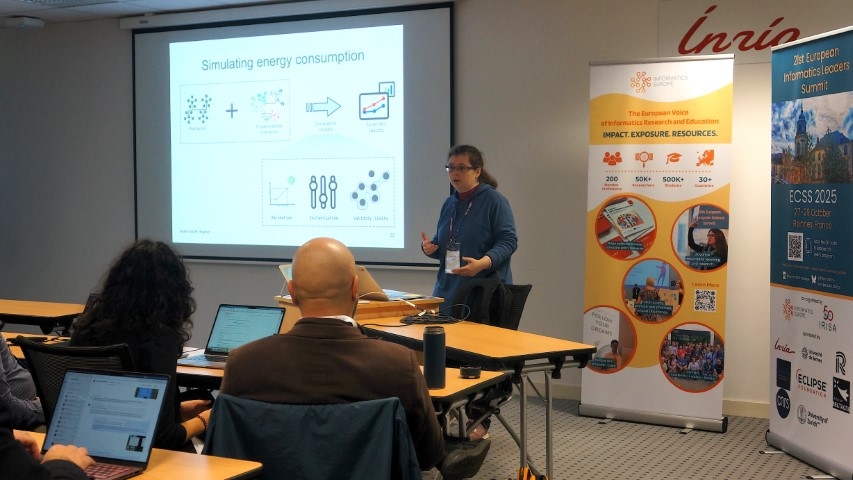
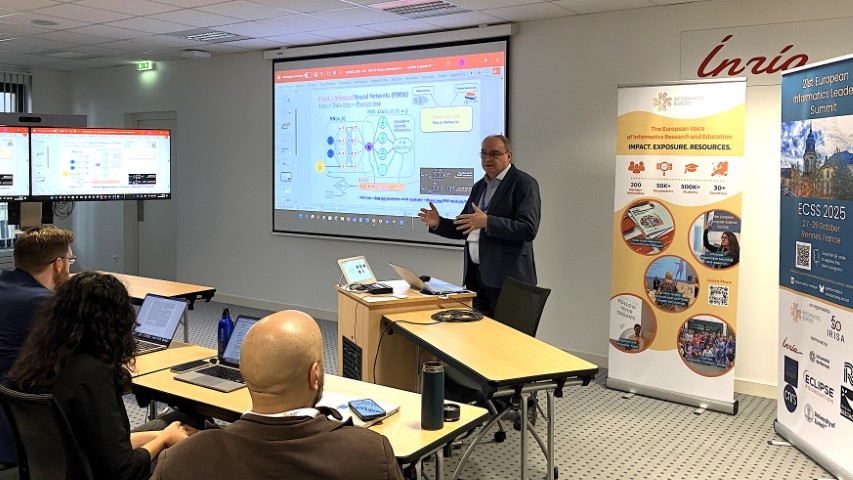
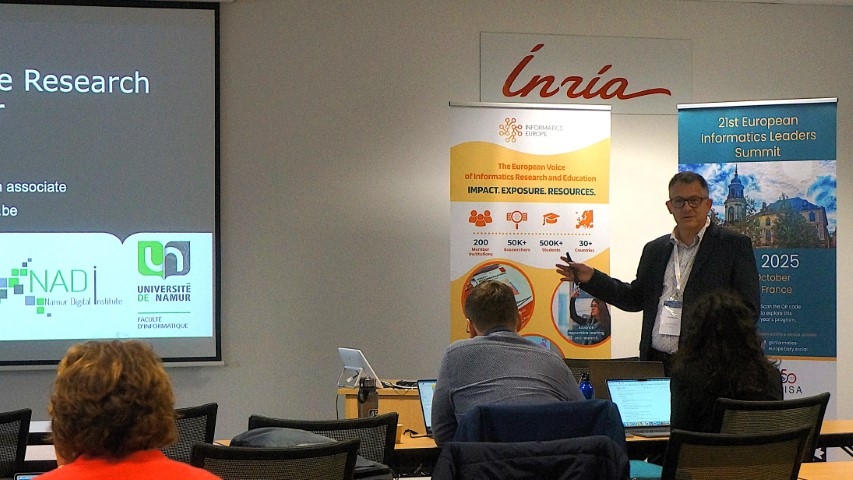
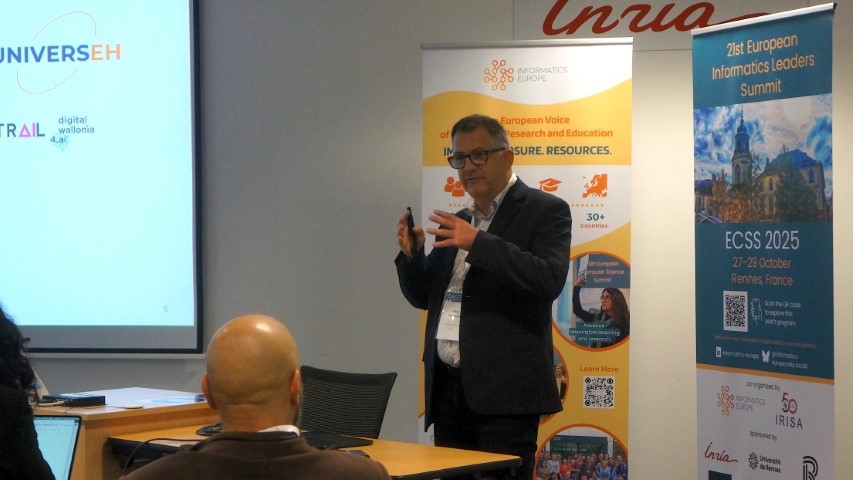
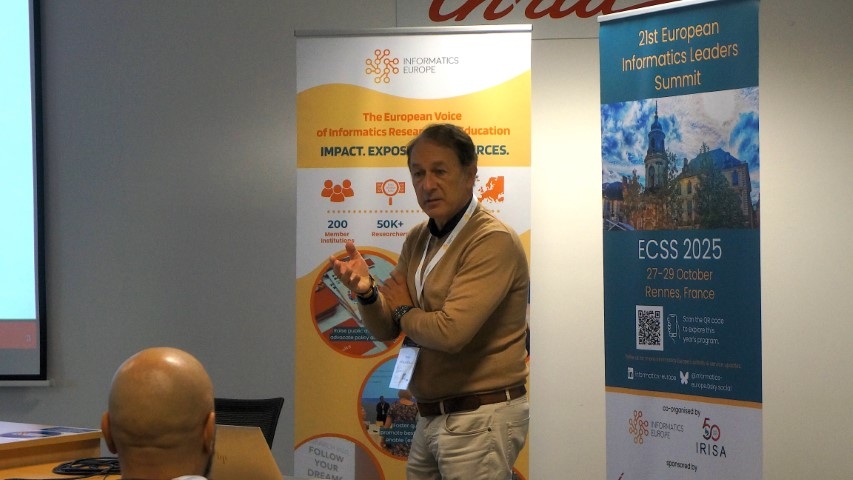
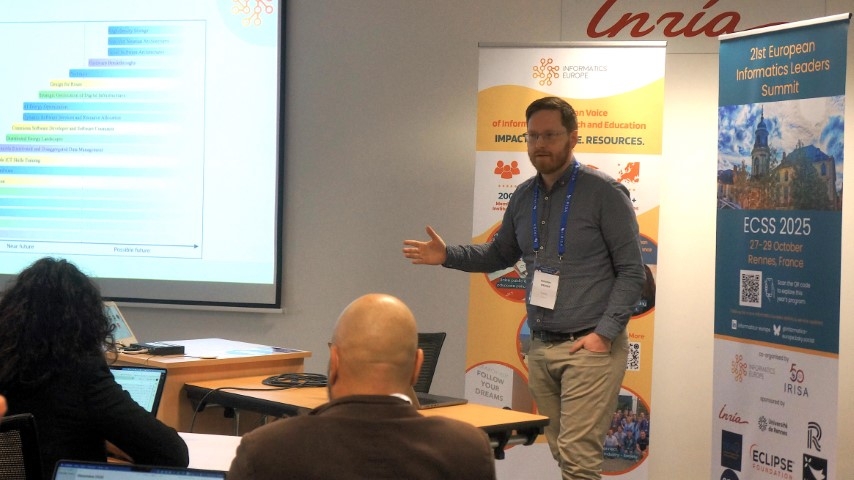
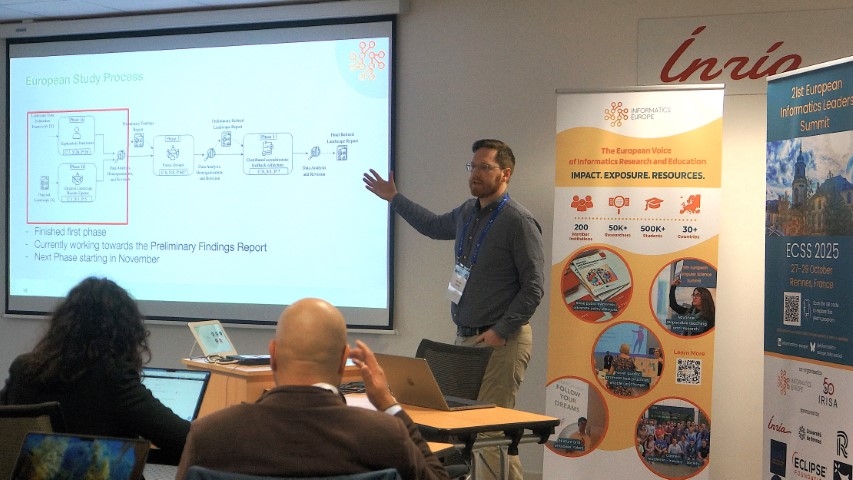
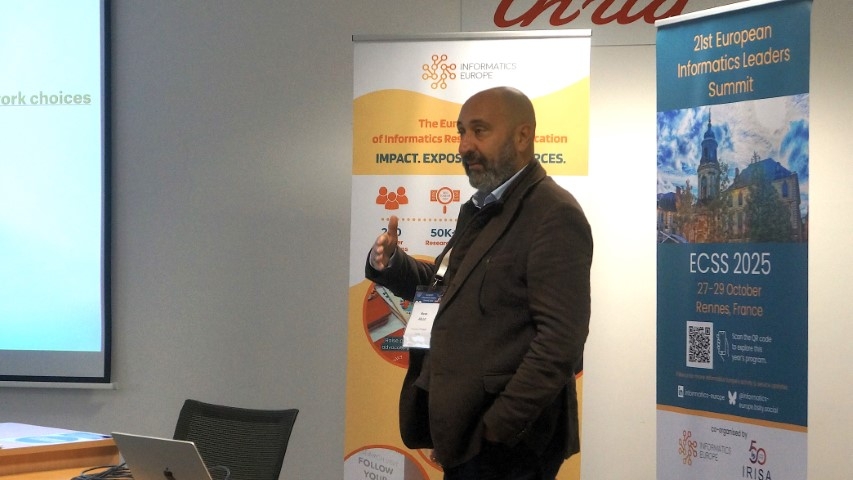

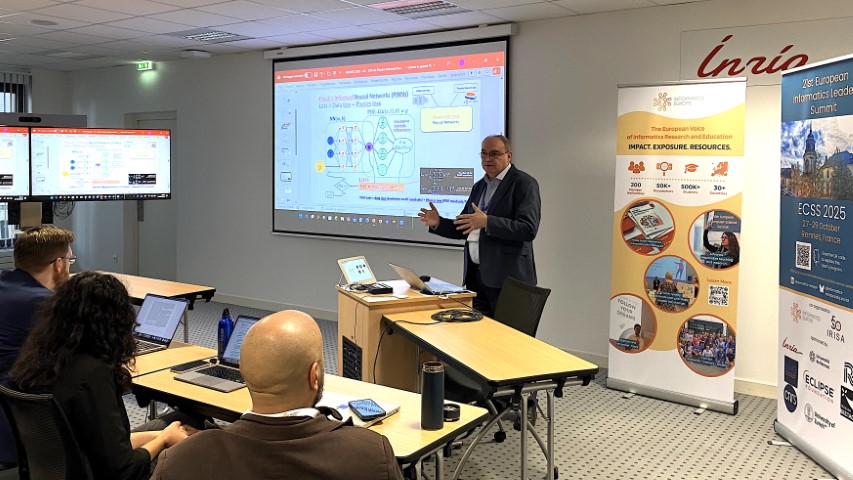

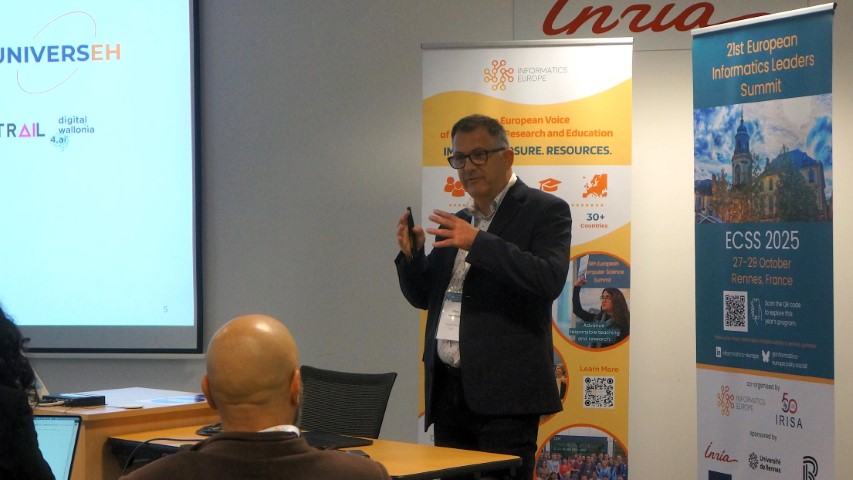
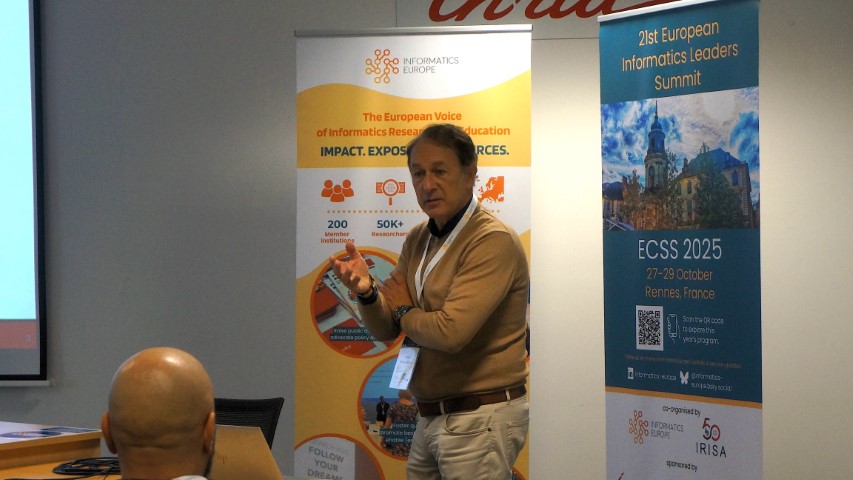

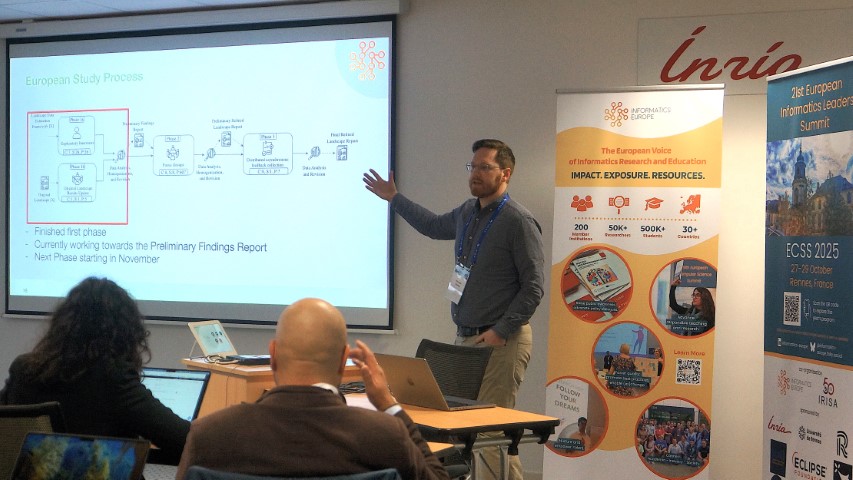
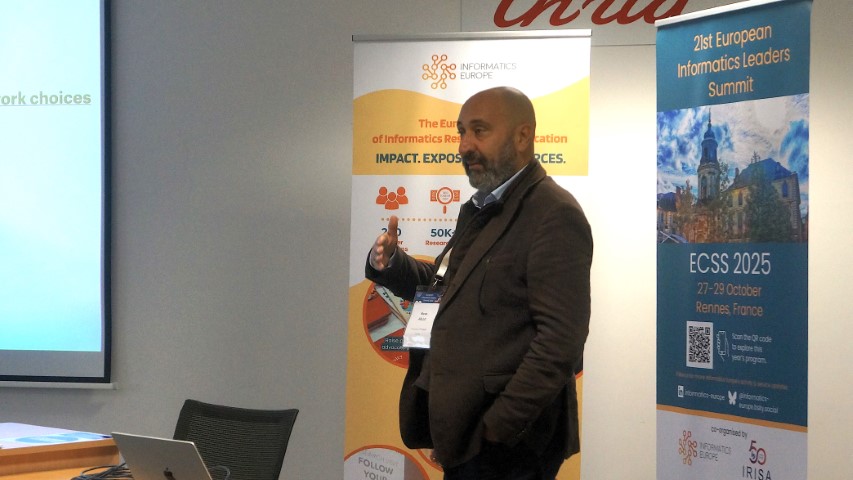


Each year at ECSS, IE Working Groups lead dynamic workshops that spark dialogue on key issues in Informatics research, education, and its societal impact. Join these parallel sessions on 29 October to explore ongoing work, provide feedback, and inspire collaborations that shape the strategic direction of each group and the broader future of Informatics in Europe.
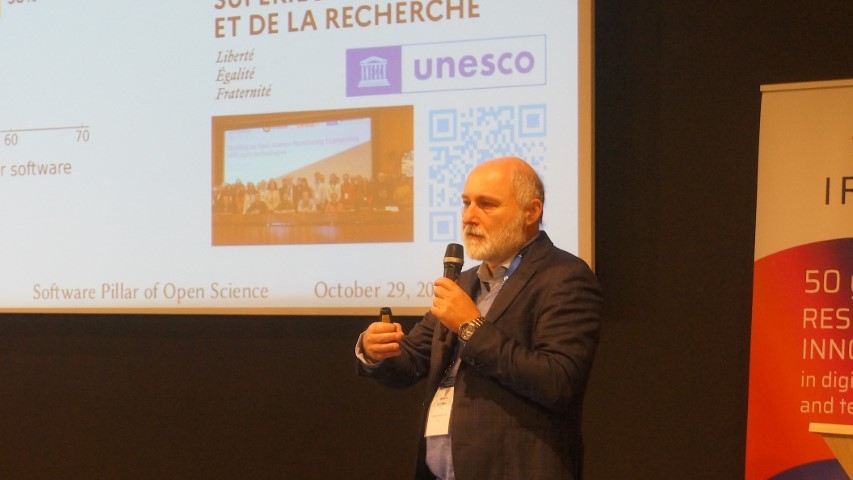
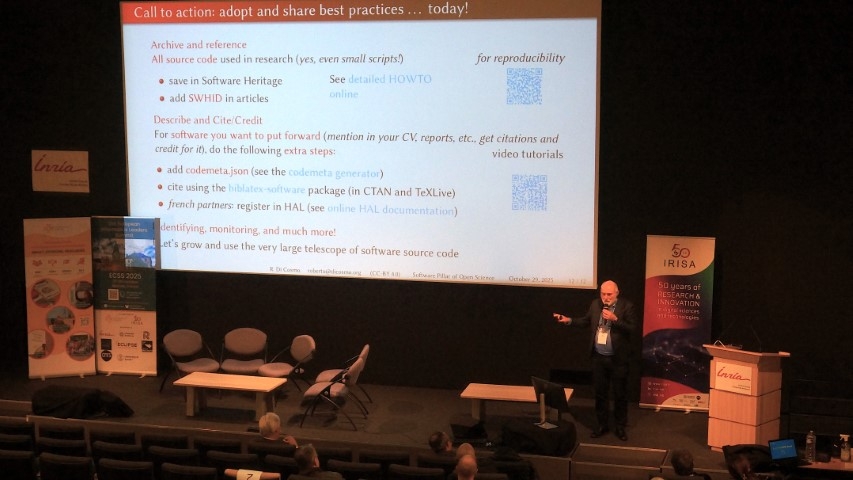
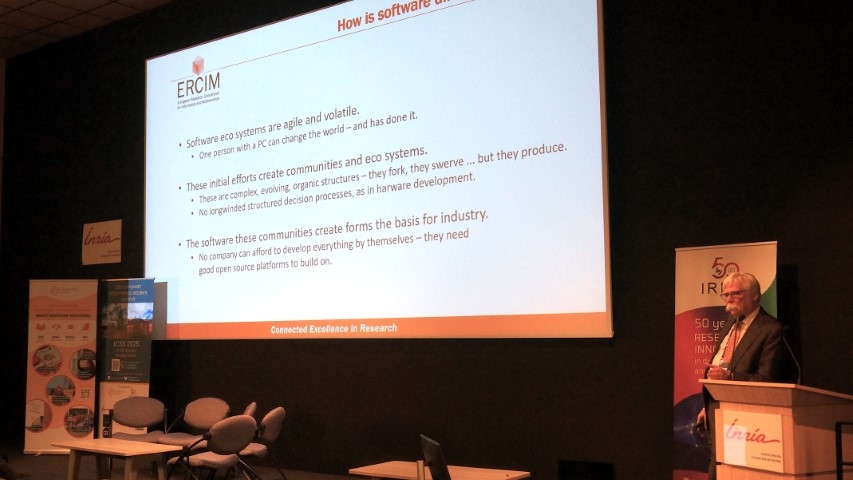
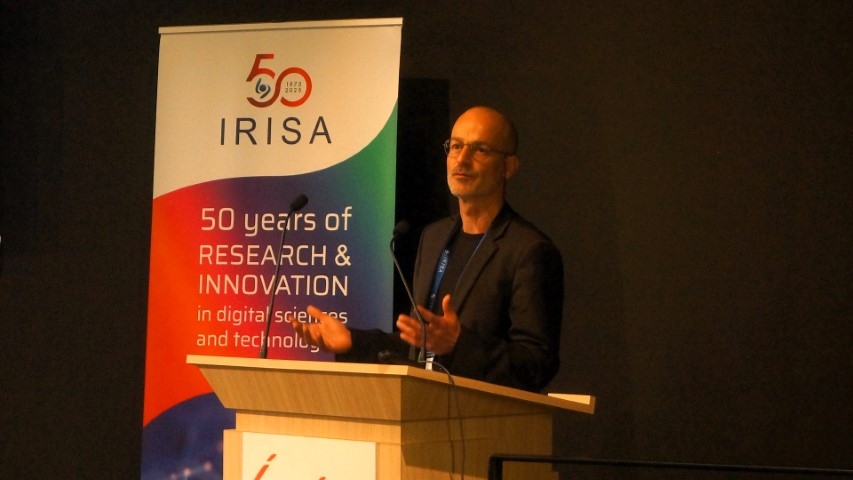
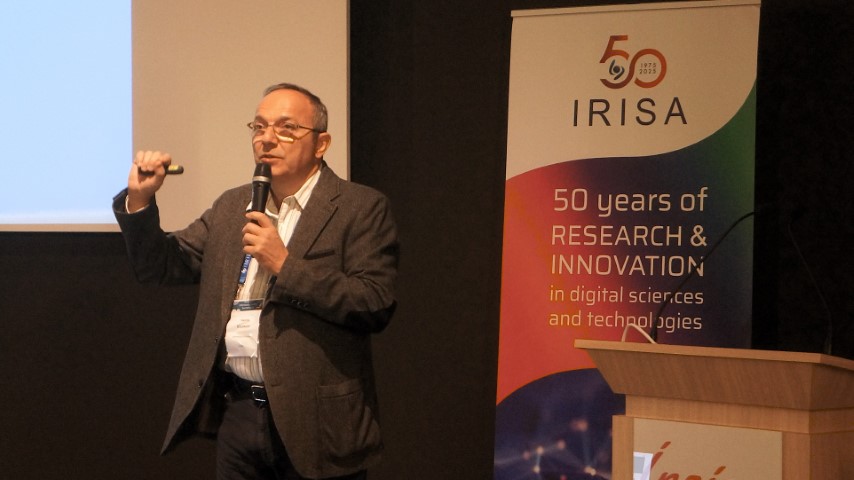
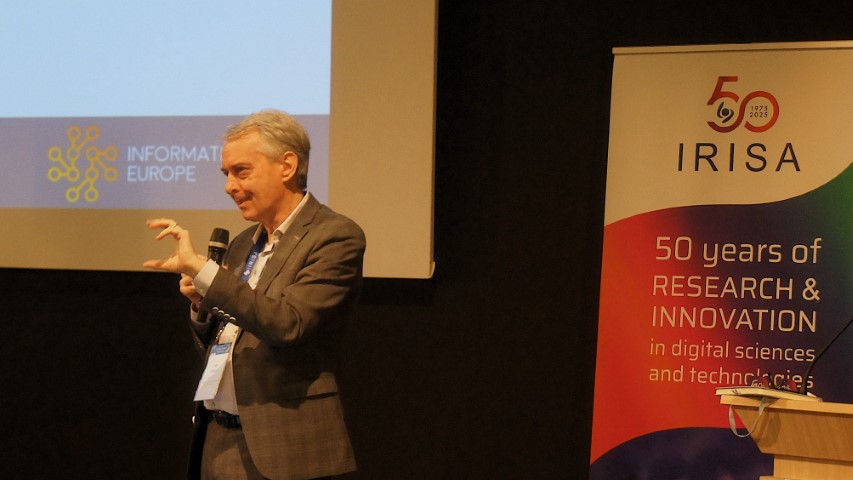
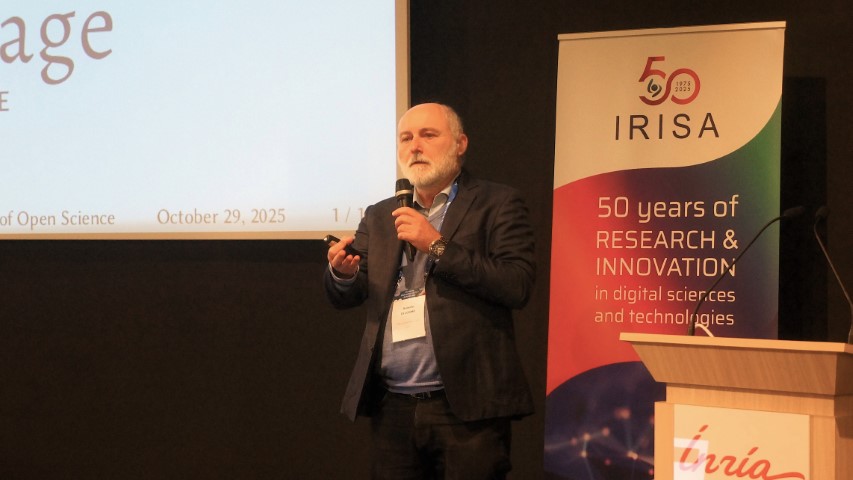
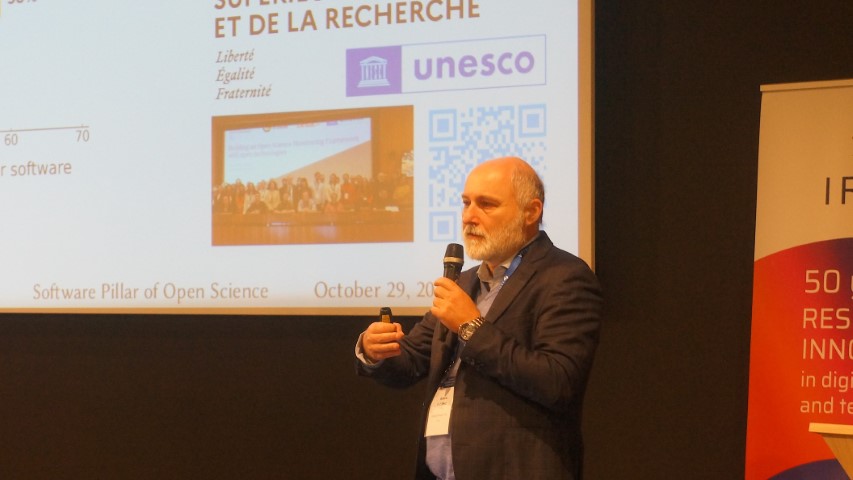
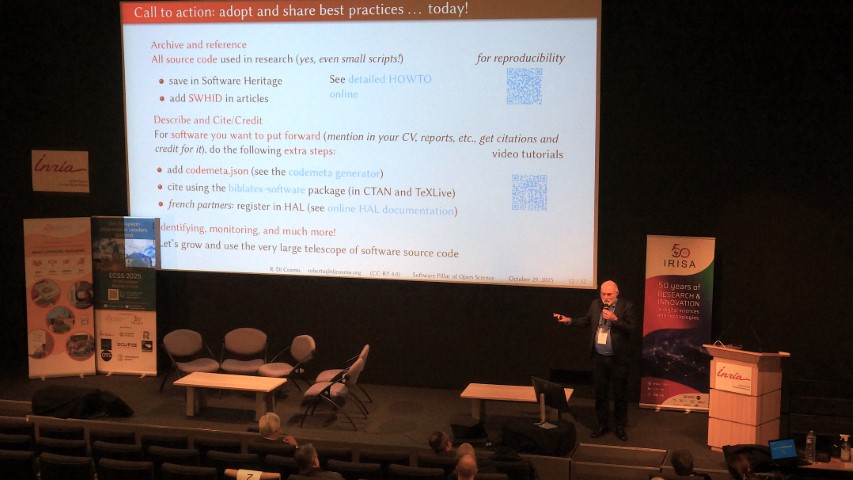
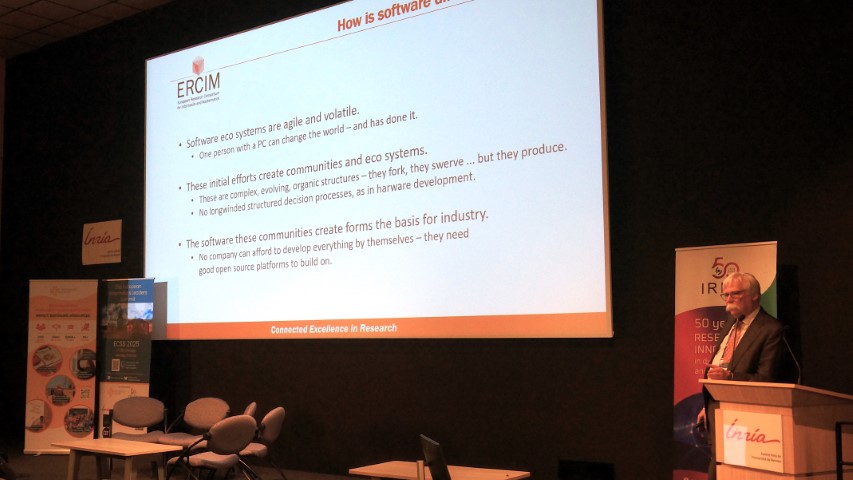
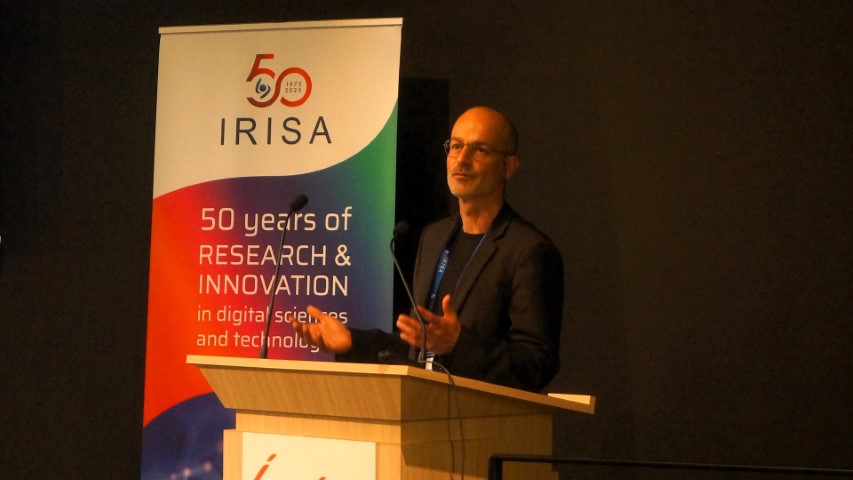
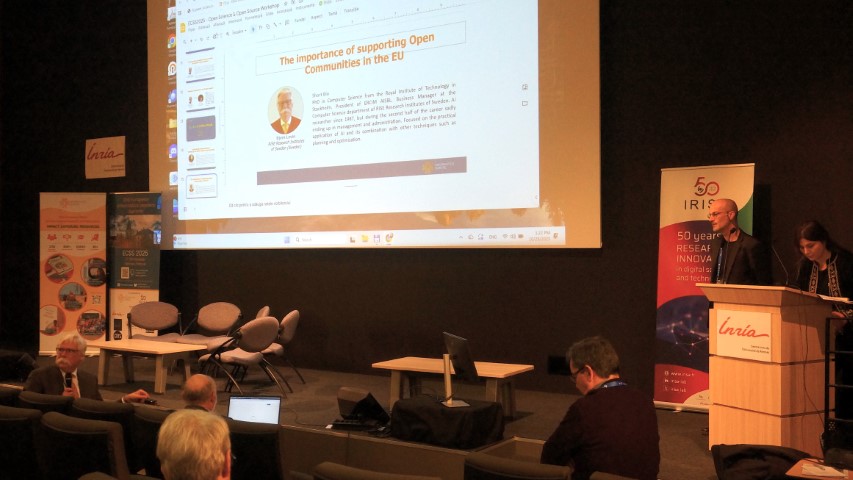
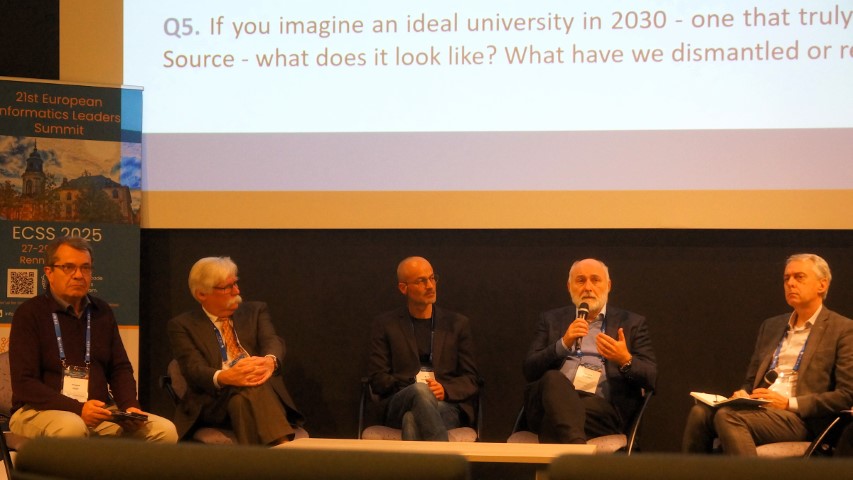
Open Science & Open Source Workshop
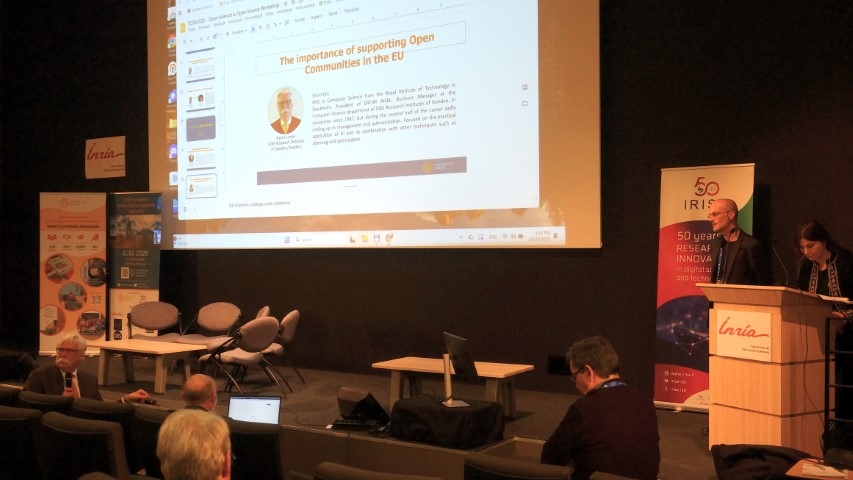
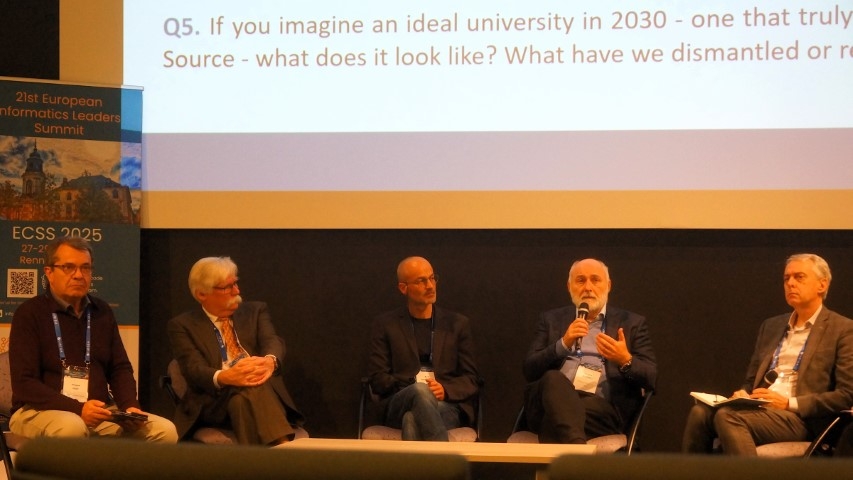
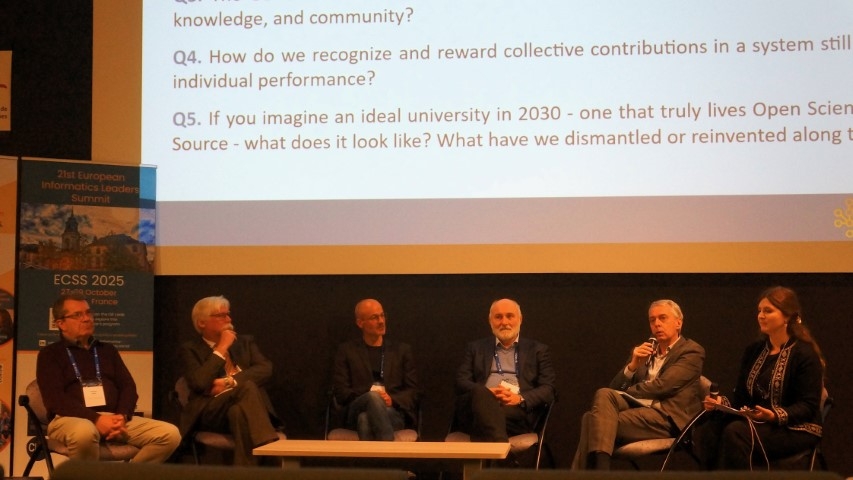
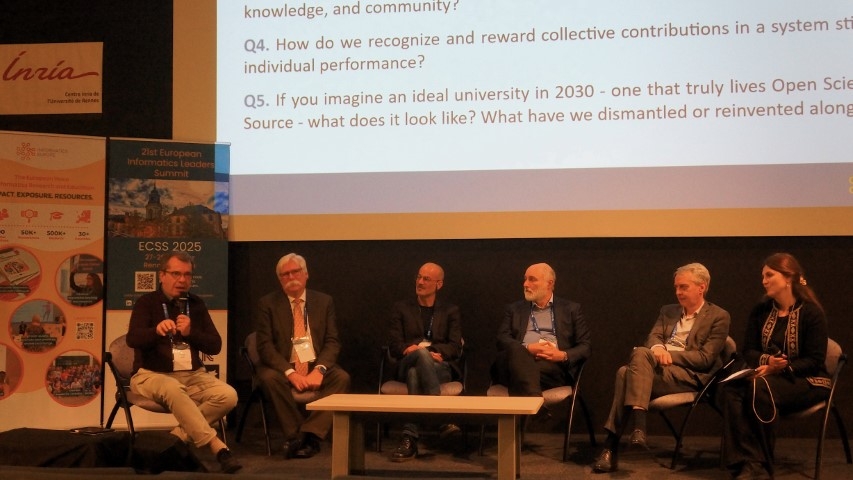
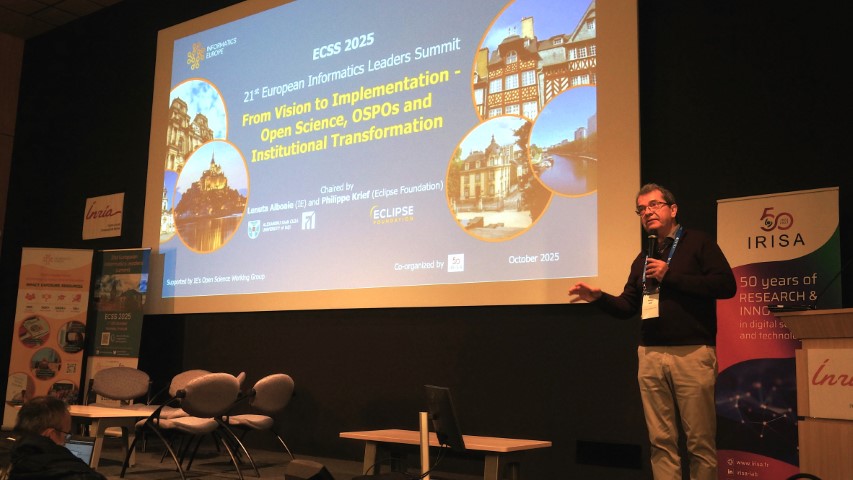
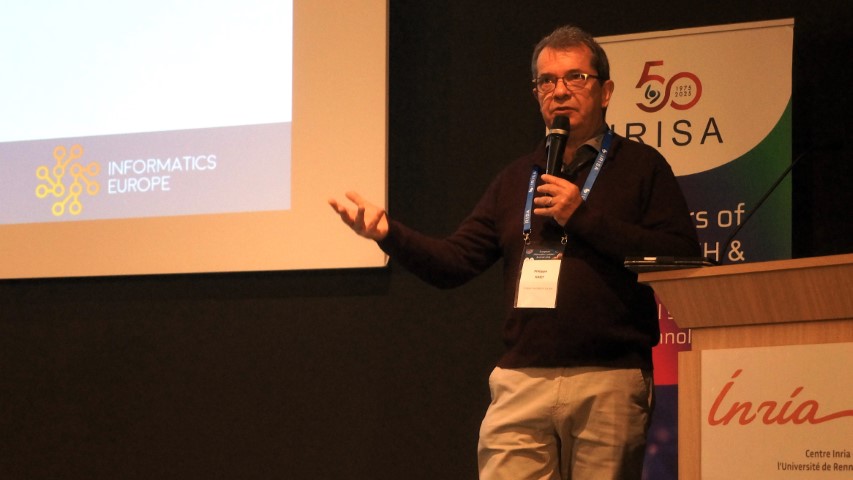
Informatics Europe organised the Open Science & Open Source workshop on Wednesday morning, 29 October. The session, open to all participants, was co-chaired by Lenuta Alboaie (Alexandru Ioan Cuza University of Iași, Romania), Chair of the Open Science Working Group, and Philippe Krief, Eclipse Foundation.
From Vision to Implementation – Open Science, OSPOs and Institutional Transformation
This workshop explored how Open Source Program Offices (OSPOs) — originally designed to foster open source practices in industry and universities — can serve as strategic instruments to embed Open Science principles within academic institutions. By drawing on successful models and proven methodologies from both sectors, we aimed to bridge the gap between open source and open science.
Through expert talks, real-world case studies, and a dynamic panel discussion, we examined concrete pathways from policy vision to institutional implementation. Participants gained insight into OSPO models from both industry and academia, with contributions from leading voices in the OSPO Alliance, Open Science networks, and European projects. Together, we exploref the potential for launching or reactivating a dedicated Working Group within Informatics Europe, focused on Open Science and Open Source collaboration. Let’s collectively build a roadmap to empower universities to lead in openness, innovation, and structured public engagement.
Workshop Rundown, Slides & Highlights
Speaker bios and abstracts are available on the ECSS speakers page by clicking their photos.
Read the workshop highlights here.
09:00 - 09:10 Welcome & Opening
09:10 - 09:30 Interactive Kick-off – SPEED BOAT Game
09:30 – 10:30 Expert Talks
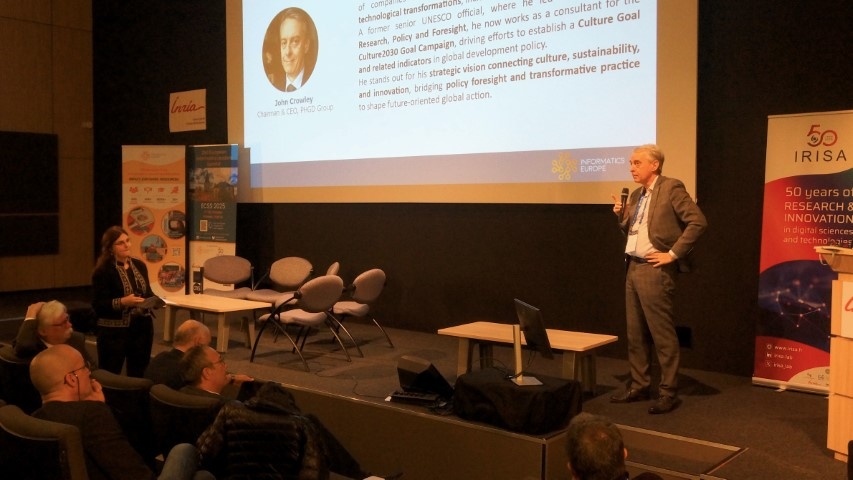
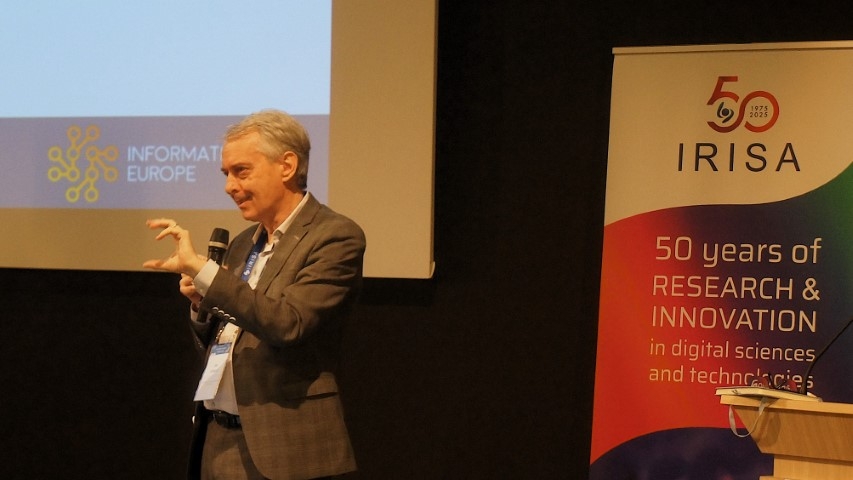
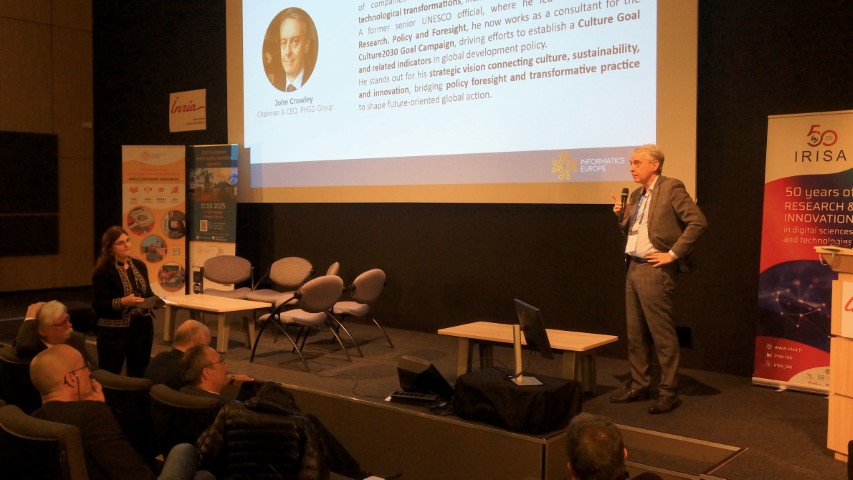
- John Crowley, PHGD Group
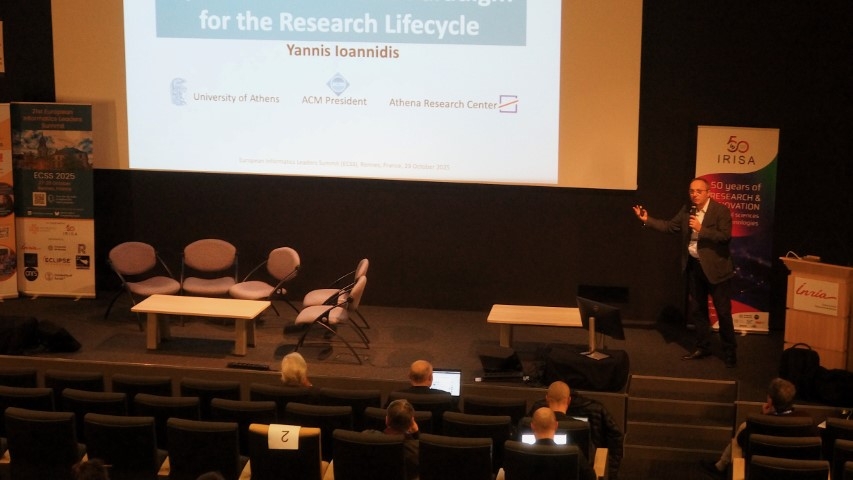
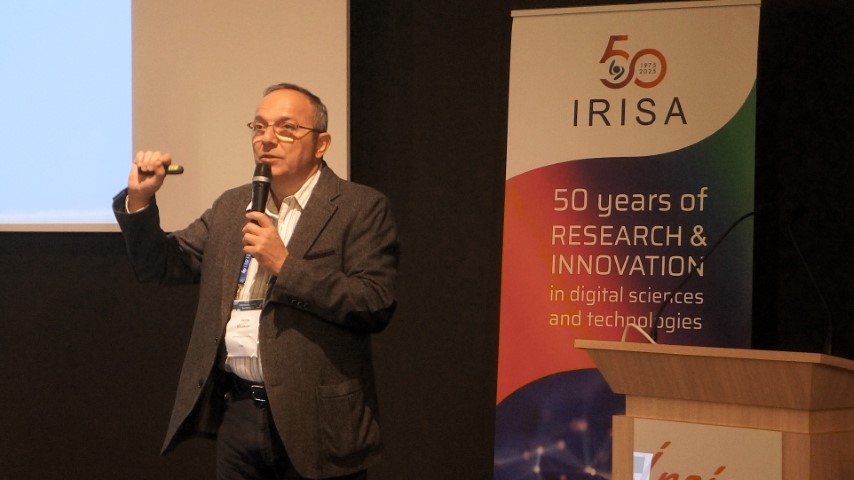
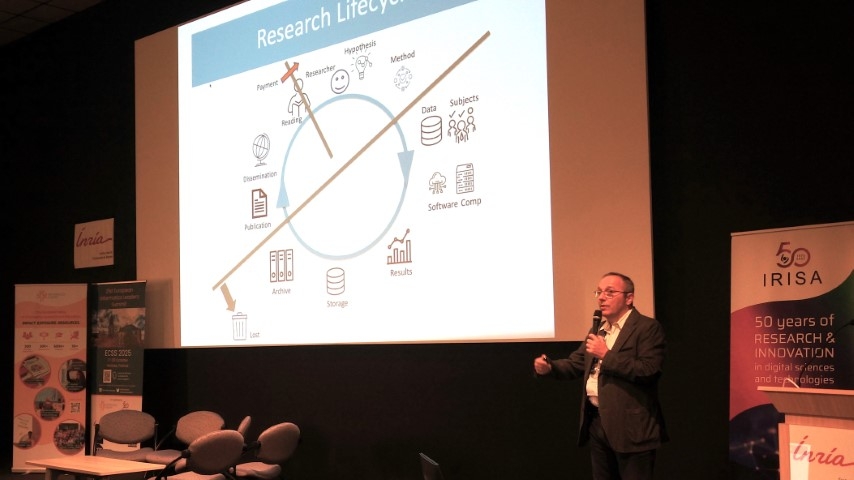
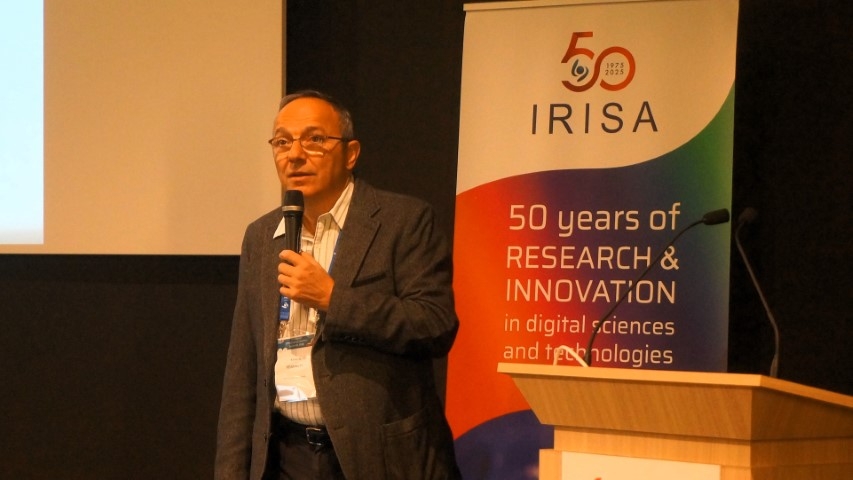
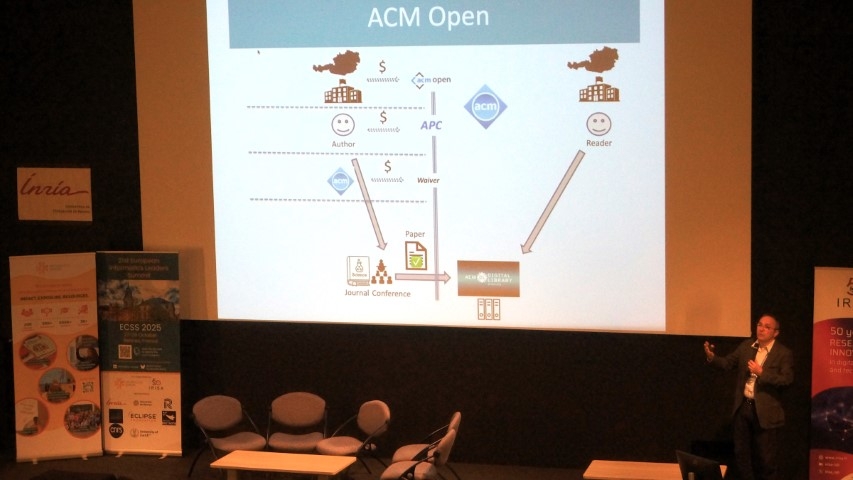
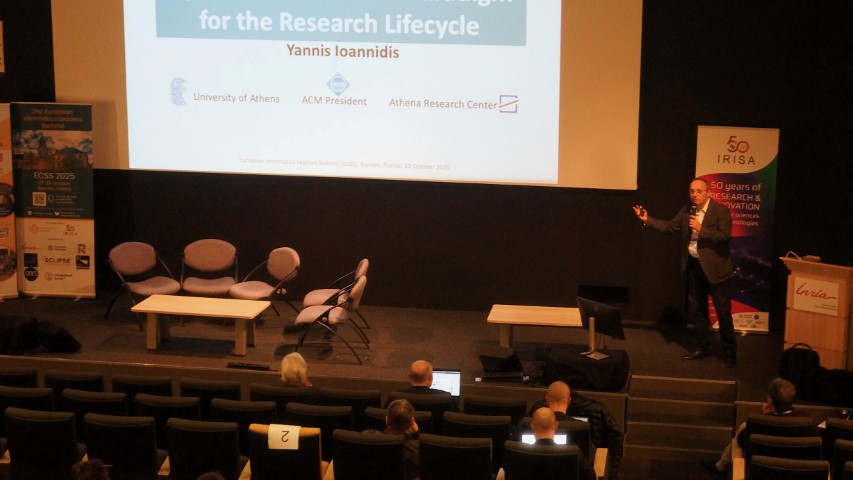
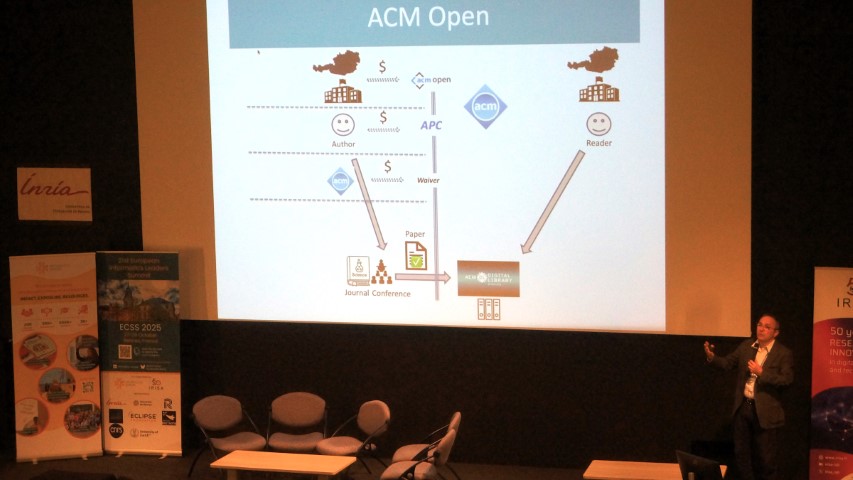
Opening: why Open Science matters - Yannis Ioannidis, Association for Computing Machinery (ACM) / National and Kapodistrian University of Athens (Greece)
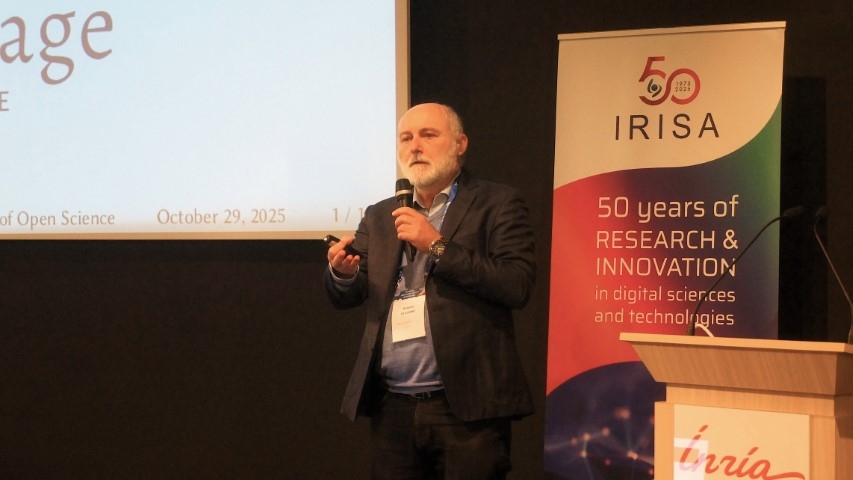
Open Science: A New Paradigm for the Research Lifecycle [Slides] - Roberto Di Cosmo, Software Heritage/Inria/University Paris Cité (France)
Infrastructure to support (Open) Source as a pillar of Open Science [Slides] - Roberto Di Cosmo on behalf of Isabelle Blanc, Ministry of Higher Education and Research (France)
National coordination and public support [Slides] - Violaine Louvet, Université Grenoble Alpes (France)
Institutional implementation: "setting up an OSPO: lessons from the field" [Slides]
10:30 - 10:45 Coffee Break
10:45 - 11:15 Expert Talks (cont')
- Bjorn Levin, RISE Research Institutes of Sweden (Sweden)
The Importance of Software Eco Systems in Europe [Slides] - Boris Baldassari, OSPO Alliance, Eclipse Foundation
Community frameworks and governance [Slides]
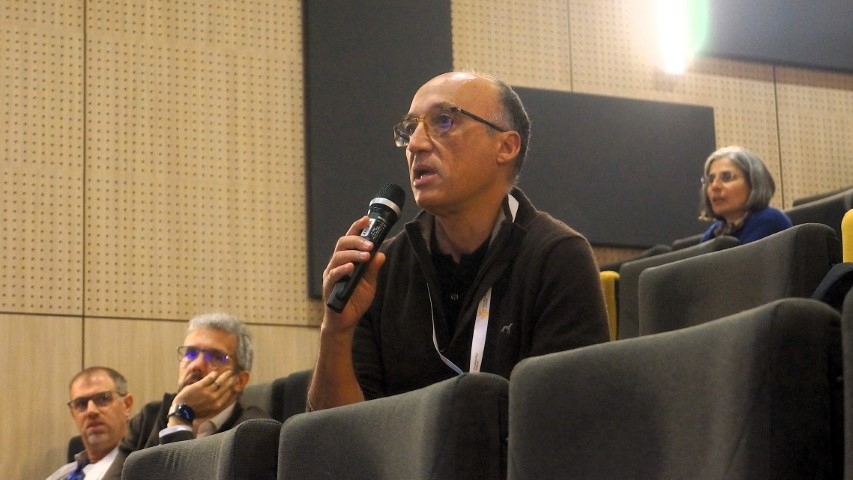
11:15 - 11:45 Open discussion with the panelists
11:45 - 12:30 Wrap-up & Action
*Please note that you may need to zoom out for the best photo viewing experience.
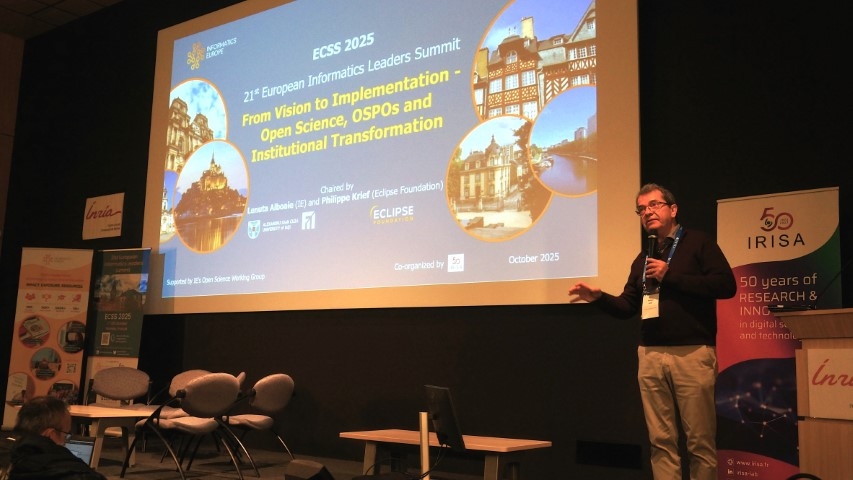
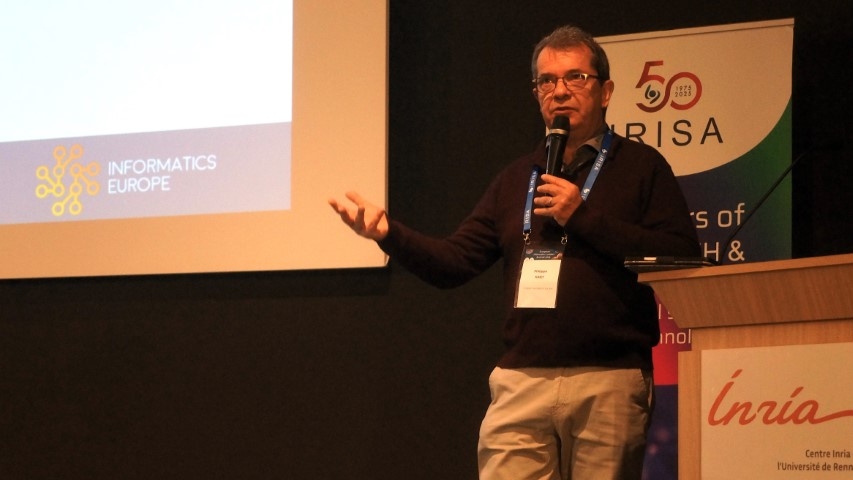



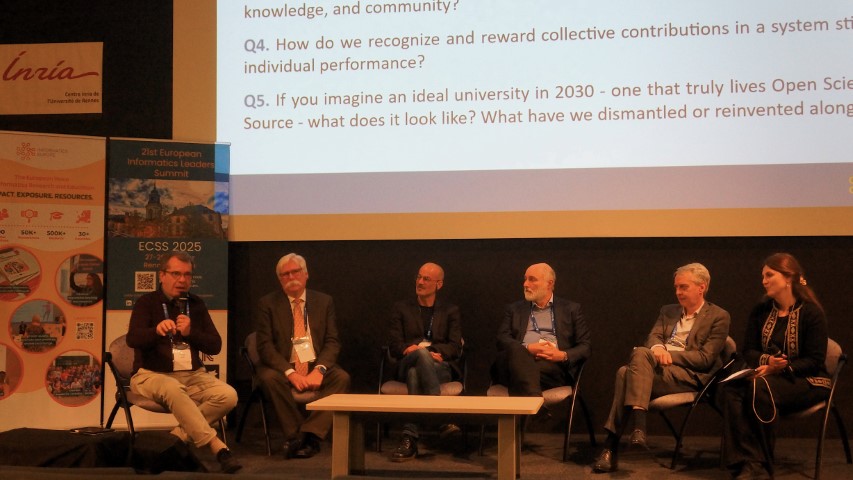


Each year at ECSS, IE Working Groups lead dynamic workshops that spark dialogue on key issues in Informatics research, education, and its societal impact. Join these parallel sessions on 29 October to explore ongoing work, provide feedback, and inspire collaborations that shape the strategic direction of each group and the broader future of Informatics in Europe.
Early Career Researchers Workshop
Informatics Europe invites early career researchers to participate in the "Professional Development Workshop for Early Career Researchers" (ECRWS) on Monday, 27 October, as part of ECSS 2025.

Co-chaired by Dimka Karastoyanova (University of Groningen, the Netherlands), Elisabetta Di Nitto (Politecnico di Milano, Italy) and Gregor Engels (University of Paderborn, Germany), the Workshop commenced with a joint opening session and panel discussion held in collaboration with the Leaders Workshop. Fostering dialogues and engagement between emerging and established leaders in the field, the workshop aimed to nurture talent and cultivate a diverse pool of future leaders.
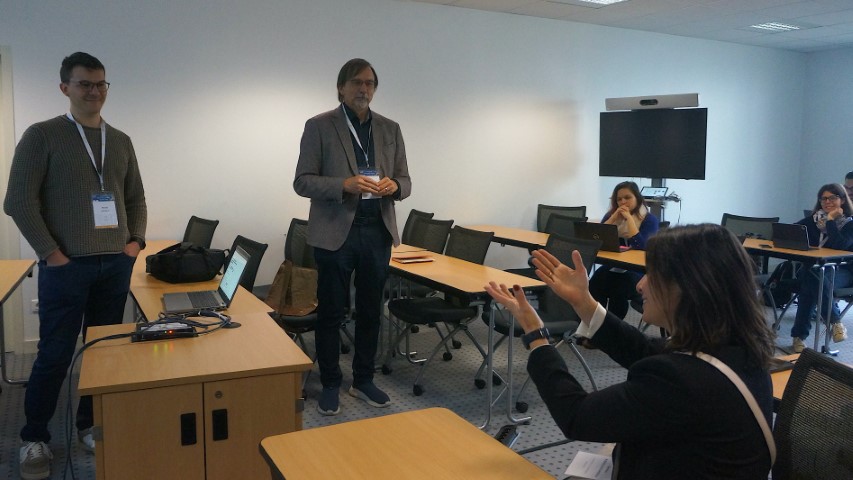
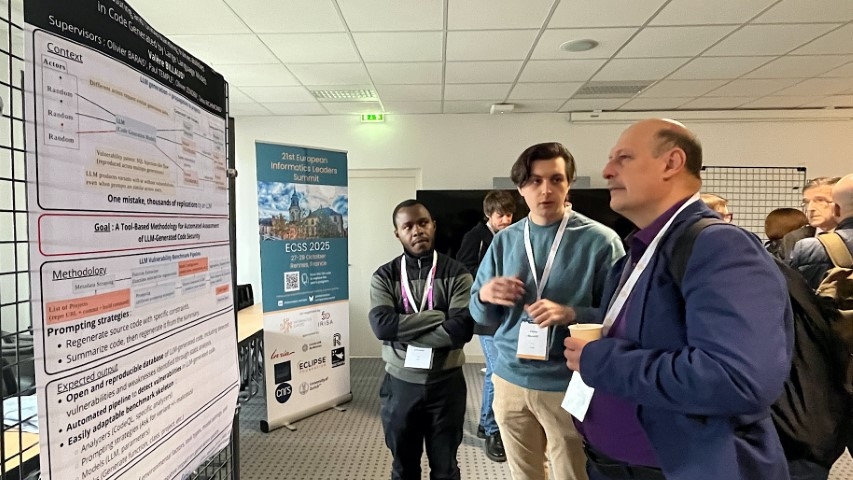
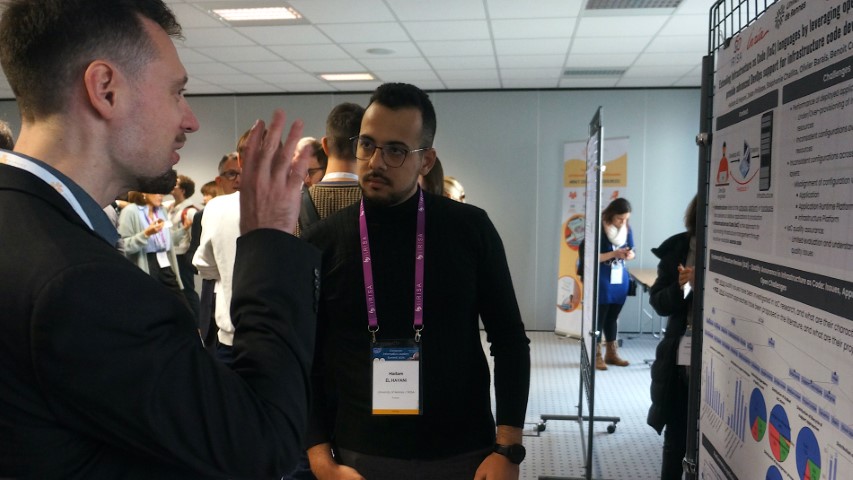
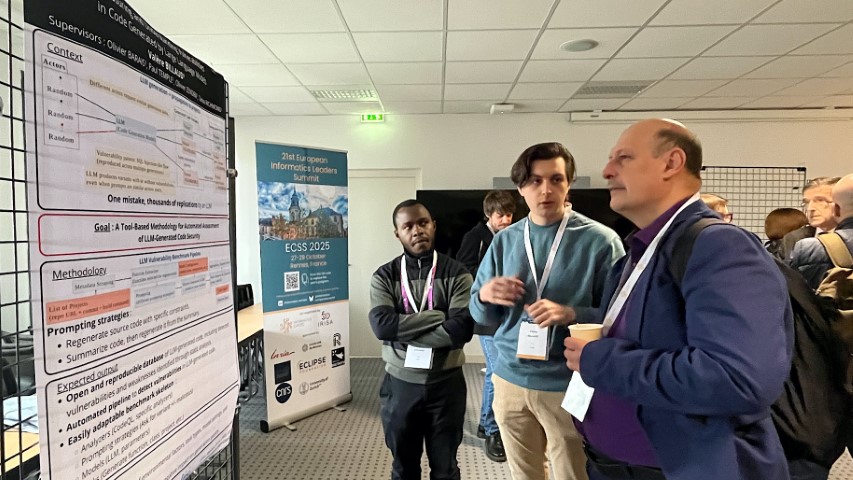
In addition, ECRWS attendees could contribute a poster to the ECSS poster session. This year, the poster session ran through Monday’s breaks, offering a valuable opportunity to network and share your work with the broader ECSS audience. PhD candidates also had the opportunity to present at the Workshop's PhD Symposium to receive additional advice on their research from experienced colleagues and peer early career researchers.
Workshop Rundown, Presentation Materials & Highlights
Speaker bios and abstracts are available on the ECSS speakers page by clicking their photos.
Read the workshop highlights here.
09:00 - 10:30 Joint Opening Session with Leaders Workshop
Welcome Speech:
- Patrick Gros, Director of the Inria centre at University of Rennes (France)
- Jean-Marc Jézéquel, Informatics Europe President, IRISA/University of Rennes (France)
Featured Talks:
- Moore’s Law Calls for the Next-Generation University
Maarten Steinbuch, Eindhoven University of Technology (the Netherlands) [Slides] - Shaping Future Leaders: Lessons from Recent Doctorates
- Andrea Cini, PhD Graduate from Università della Svizzera italiana (Switzerland) [Slides]
Currently: Postdoc Researcher, Università della Svizzera italiana (Switzerland) - Drishti Yadav, PhD Graduate from TU Wien (Austria) [Blog Post]
Currently: Research Associate, University of Luxembourg (Luxembourg)
- Andrea Cini, PhD Graduate from Università della Svizzera italiana (Switzerland) [Slides]
10:30 - 11:00 Coffee Break
11:00 - 12:30 Joint Panel Session with Leaders Workshop
"Sharing Best Practices among Deans/Leaders — Identifying key challenges in adapting to change"
12:30 - 13:30 Lunch
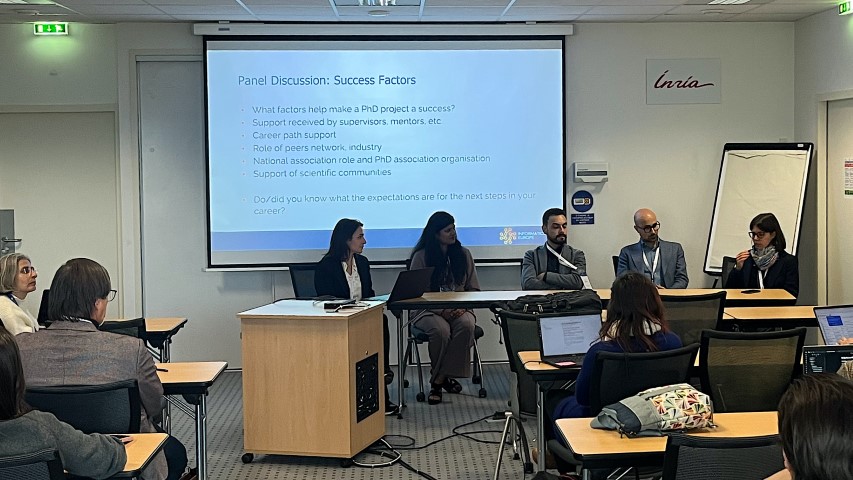
13:30 - 15:00 Career Development Support Session
The session featured a panel discussion on the career support needed for ECRs in Informatics. We had a conversation on best practices in career support for ECRs along the topics:
- role of leadership skills for career success of ECRs
- importance of mentoring and support networks to promoting ECR development
- leadership in activities beyond the PhD project
- national association role and PhD association organisation
- support of scientific communities
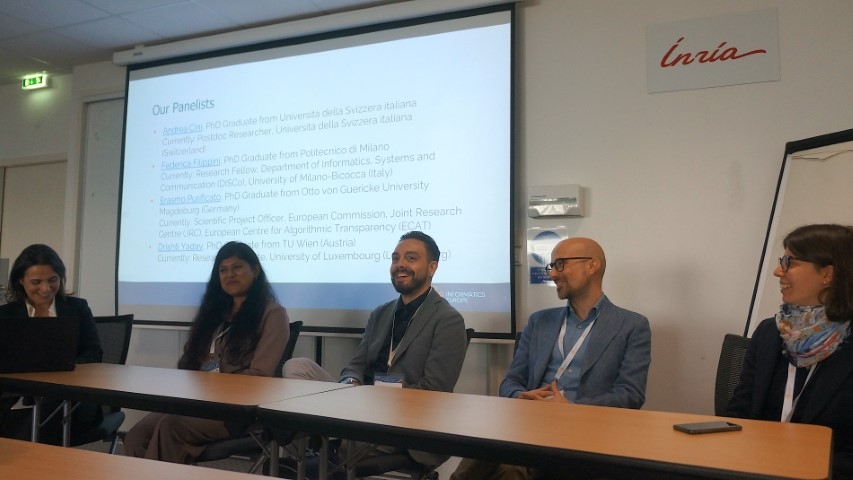
Panel of 2025 Best Dissertation Award Finalists:
- Andrea Cini, PhD Graduate from Università della Svizzera italiana (Switzerland)
Currently: Postdoc Researcher, Università della Svizzera italiana (Switzerland) - Federica Filippini, PhD Graduate from Politecnico di Milano (Italy)
Currently: Research Fellow, Department of Informatics, Systems and Communication (DISCo), University of Milano-Bicocca (Italy) - Erasmo Purificato, PhD Graduate from Otto von Guericke University Magdeburg (Germany)
Currently: Scientific Project Officer, European Commission, Joint Research Centre (JRC), European Centre for Algorithmic Transparency (ECAT) - Drishti Yadav, PhD Graduate from TU Wien (Austria)
Currently: Research Associate, University of Luxembourg (Luxembourg)
15:00 - 15:30 Coffee Break
Featured Posters:
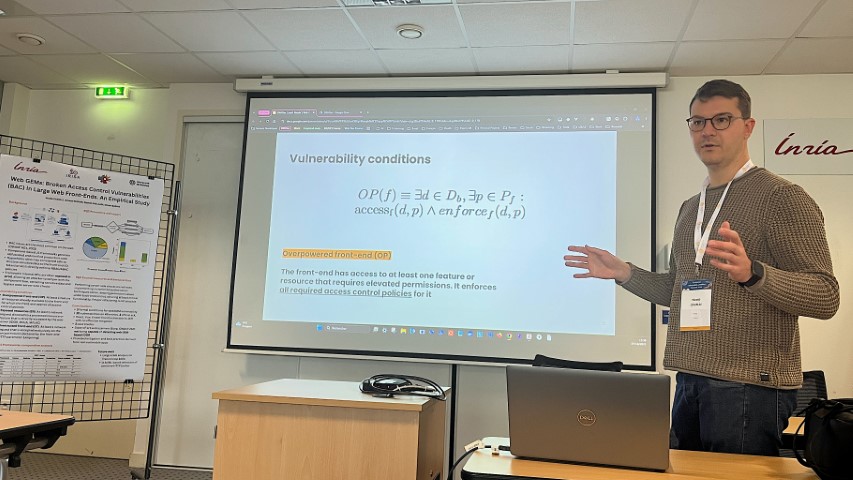
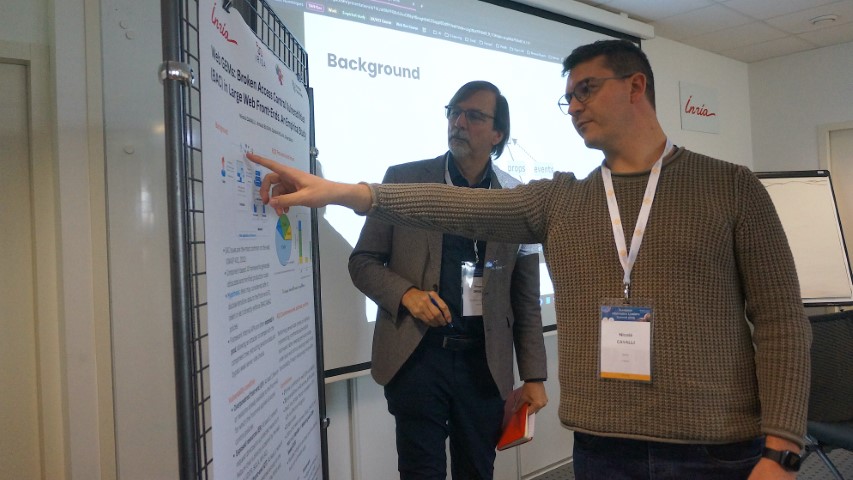
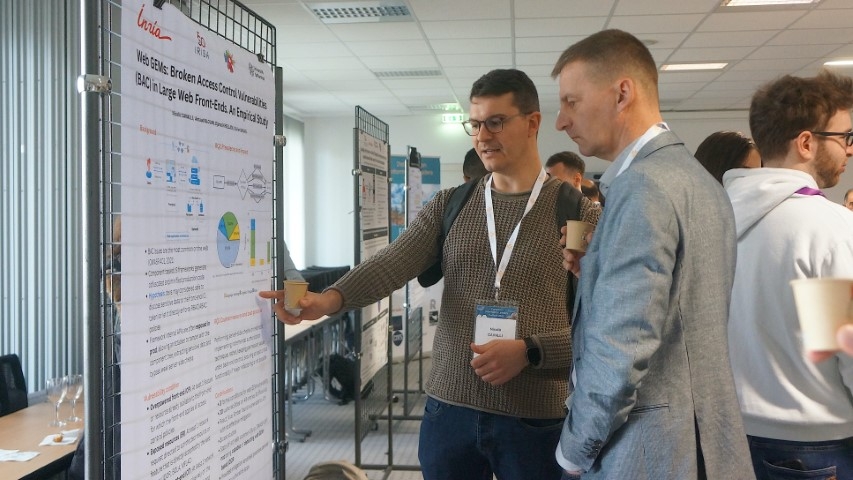
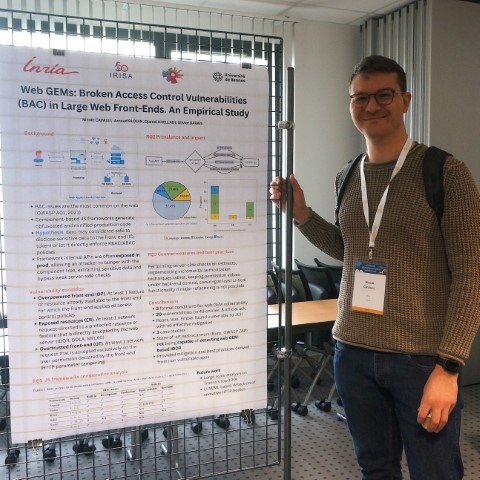
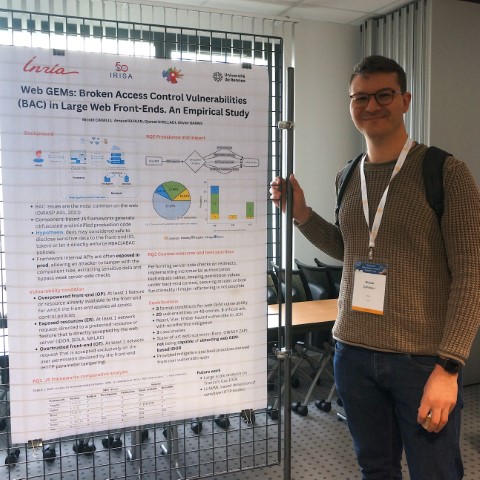
- Web GEMs: Broken Access Control Vulnerabilities (BAC) in Large Web Front-Ends. An Empirical Study [Poster]
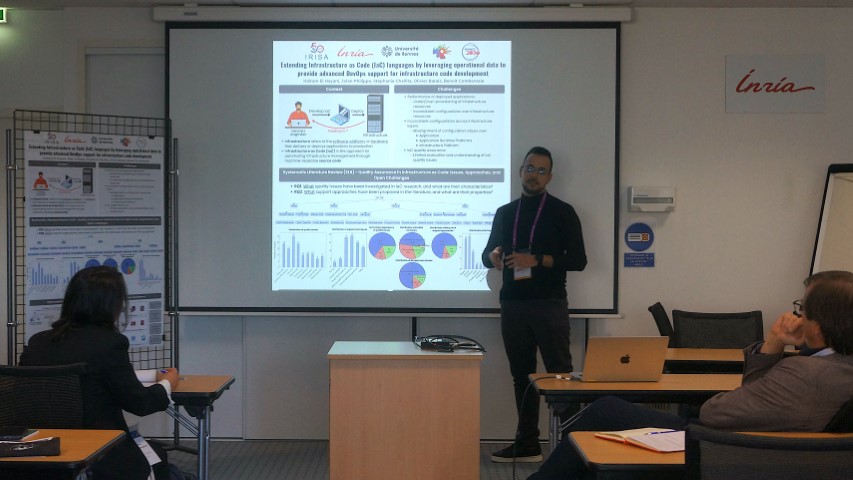
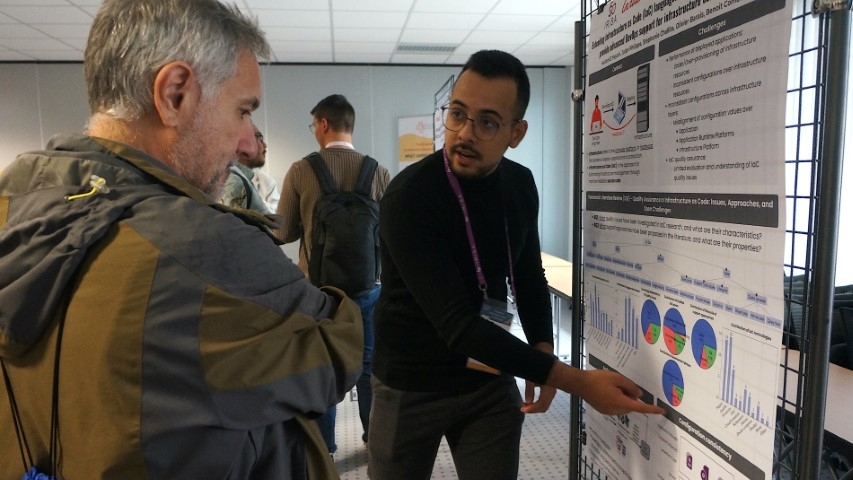
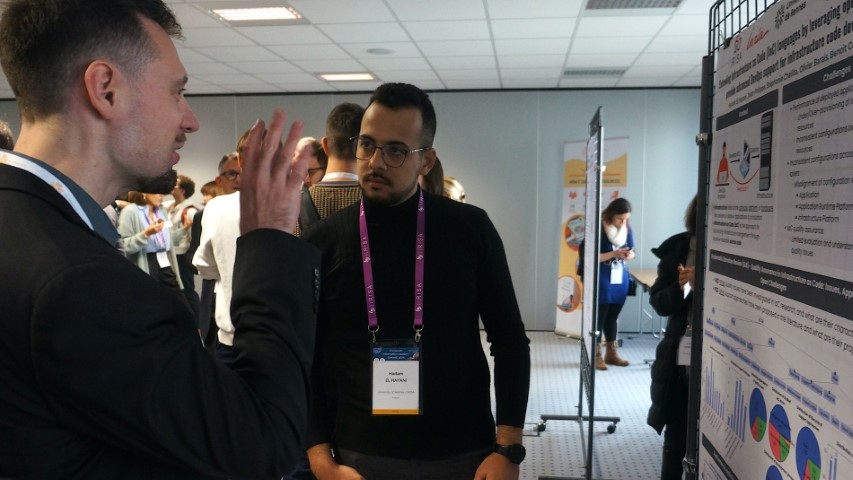
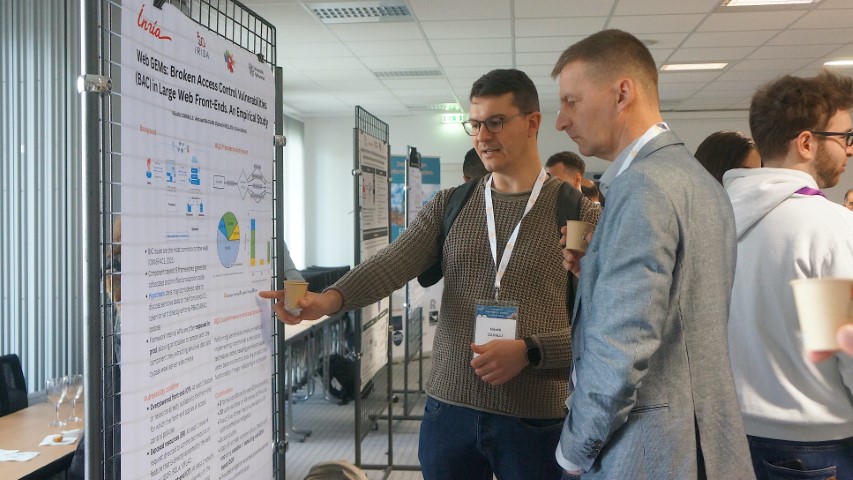
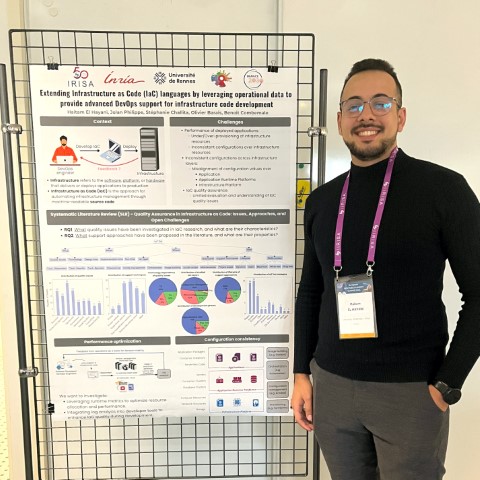
presented by Nicolò Cavalli, University of Rennes (France) - Extending Infrastructure as Code (IaC) languages by leveraging operational data to provide advanced DevOps support for infrastructure code development [Poster]
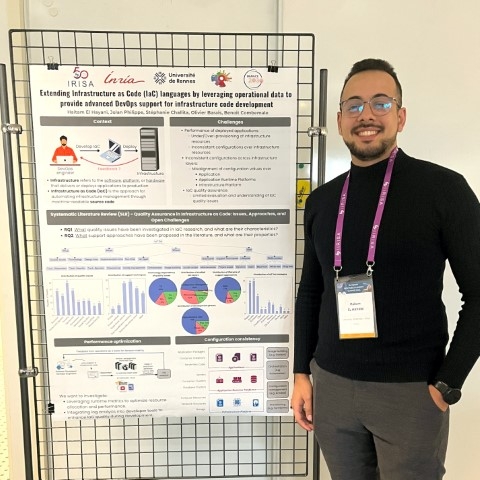
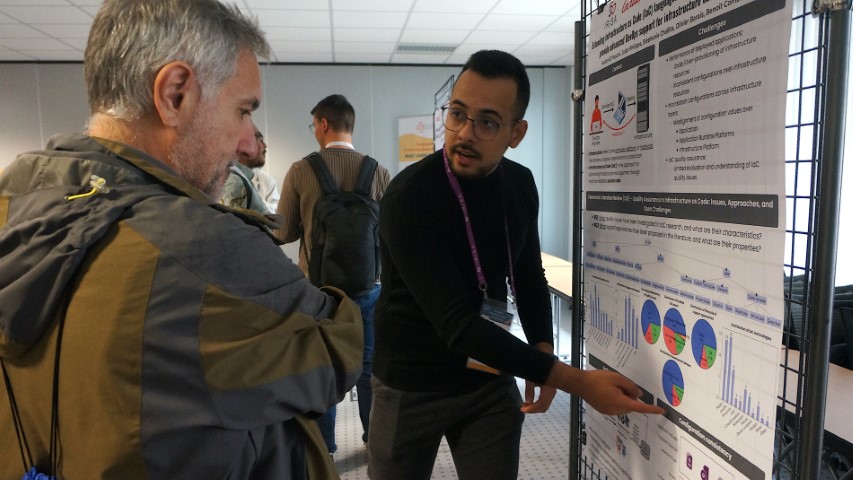
presented by Haitam El Hayani, University of Rennes (France)
The Symposium offered PhD candidates the opportunity to present their research through posters, receive additional guidance from experienced colleagues and encourage discussion among Symposium participants, helping to foster a network of early-career researchers.
Poster abstracts must be submitted via EasyChair following the provided guidelines below, where you will have the option to indicate your interest in presenting at the Symposium.
Important Dates
- PhD Symposium submission deadline: 17 October 2025
- General Poster (WITHOUT Symposium presentation) submission deadline: 17 October 2025
- Notification of acceptance: within 1 week following the date of submission
Poster & PhD Symposium Submission Guidelines
Don’t miss the chance to engage with Informatics leaders across Europe: poster submissions are highly recommended for PhD students, PostDocs, and other early career researchers.
- Submit via “ECSS2025” EasyChair platform: https://easychair.org/conferences?conf=ecss2025
- Under “Title and Abstract”, include your poster title and abstract.
If you wish to be considered for PhD Symposium, please outline in the abstract your project research field, challenges/research questions, contributions and positioning in related research. Abstract should not exceed 300 words. - Under “Keywords”, type a list of relevant keywords.
- Under “Other Information and Files”, you may upload a PDF of the poster if available. In “Additional notes”, you may briefly explain your motivation to participate in the Early Career Researcher Workshop/ECSS.
- Submissions must be made through EasyChair; others will be disregarded.
Participants with accepted posters:
- will be featured in a dedicated section of the ECSS program,
- may request an electronic certificate of attendance upon completion of the PhD Symposium.
For enquiries, please do not hesitate to contact the
*Please note that you may need to zoom out for the best photo viewing experience.





About Rennes
Nestled in the heart of Brittany, Rennes is a vibrant city where tradition and modernity harmonize. With its medieval streets, iconic timber-framed houses, and the historic Parlement de Bretagne, Rennes tells a rich story of over 2,000 years.
As a thriving tech and research hub, home to institutions like the ECSS 2025 co-host INRIA, Rennes is a beacon of innovation and digital excellence, second only to Paris in its concentration of ICT firms.
Combine this with world-class gastronomy and proximity to the stunning Breton coastline, and Rennes becomes the perfect stage for this year's annual summit ECSS - where leaders in Informatics from across Europe come together, continue to inspire, connect, and advance the future of Informatics education and research.
 |
 |
How to get to Rennes:
- By plane or plane & train
Rennes airport offers direct flights from the 3 hubs of Paris CDG, Amsterdam Schiphol and Frankfurt. This makes it easy to reach Rennes from most overseas flights. Note that Paris CDG airport has a train station where you can directly reach Rennes by fast train in ~2 hours and 30 minutes (~ 8 trains per day). Amsterdam is also connected to Paris by train using Thalys, and London is connected to Paris by Eurostar trains. - How to get from Rennes train station to downtown Rennes by public transport?
The train station of Rennes is in the south of the city center and is connected to the metro lines, making everywhere downtown accessible in 3 minutes. - How to get from Rennes airport to downtown Rennes by public transport?
The city center of Rennes is reachable in about 30 minutes by public transport by taking the line C6.
Find out more about Rennes:
Poster Session
Expand the reach of your research and gather diverse feedback with the support of Informatics Europe.
The ECSS poster session, taking place on Monday, 27 October, invites contributions from Informatics researchers at all career stages, fostering rich exchange and connections across the Informatics community.
Submissions are reviewed and accepted on a first-come-first-served basis. Follow the guidelines below:
Important Dates
- Poster submission: 17 October 2025
- Notification of acceptance: within 1 week following the date of submission
Submission Guidelines
- Submit via “ECSS2025” EasyChair platform: https://easychair.org/conferences?conf=ecss2025
- Under “Title and Abstract”, include your poster title and abstract (300 words).
- Under “Keywords”, type a list of relevant keywords.
- Under “Other Information and Files”, you may upload a PDF of the poster if available. In “Additional notes”, you may briefly explain your motivation to join ECSS.
- Submissions must be made through EasyChair; others will be disregarded.
All levels of informatics researchers are welcome. Any research areas of Informatics and related disciplines are welcome. If you're a PhD candidate, we encourage you to join the PhD Symposium, held as part of the Professional Workshop for Early Career Researchers. Learn more here.
For enquiries, please do not hesitate to contact the
*Please note that you may need to zoom out for the best photo viewing experience.


ECSS 2025 is organised by
 |
 |
Sponsored by
 |
 |
 |
 |
|
 |
  |
 |
Support ECSS
What's New
ECSS 2025, 27-29 Oct, Rennes. France
Save the dates for ECSS 2026:
26-28 Oct in Porto, Portugal



 Netlogica