
Special Offer
When joining Informatics Europe from July to October, your institution receives complimentary registration to the ECSS for one individual.
For details about membership, please visit our Membership page.
For further information about this offer, please contact
About Hamburg
 Hamburg, the largest city in Germany after the capital of Berlin, is located on the Elbe River in northern Germany. The city is best known for its famous harbor area, the Port of Hamburg. In addition to being a major transportation hub, Hamburg has become one of Europe's most important cultural and commercial centers, as well as a major tourist destination. Among Hamburg’s many other facets are a network of canals; lakes, parks, and verdant suburbs full of gracious houses; elegant shopping arcades; richly endowed museums; and vibrant cultural life.
Read more:
Awards Session
Every year, as part of the ECSS program, Informatics Europe organises an Award ceremony, where the winners of its annual awards are presented:
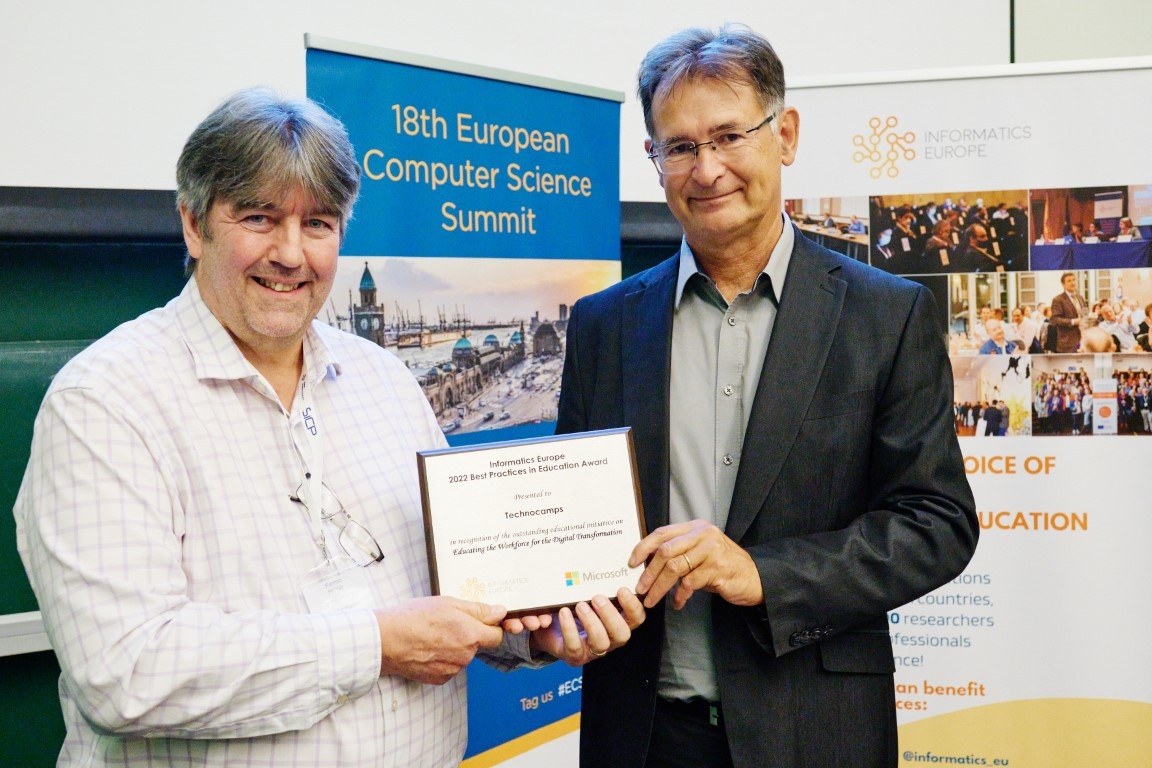
- The Best Practices in Education Award recognising educational initiatives across Europe that improve the quality of Informatics teaching and the attractiveness of the discipline. Read this year's Press Release here.
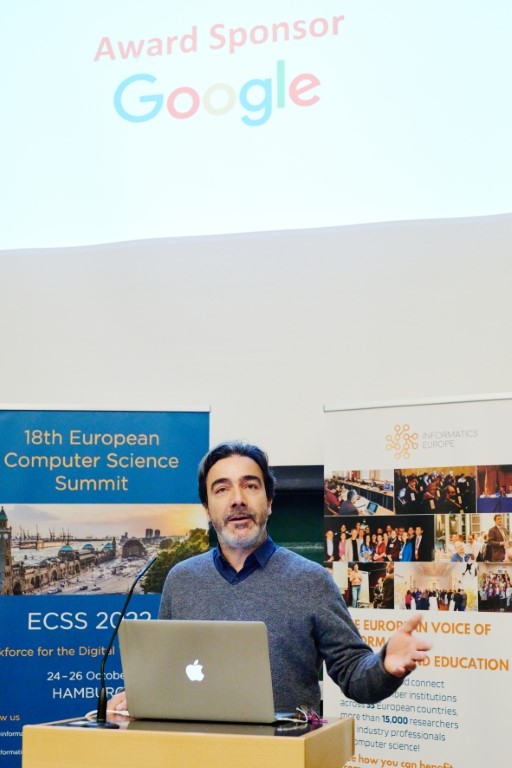
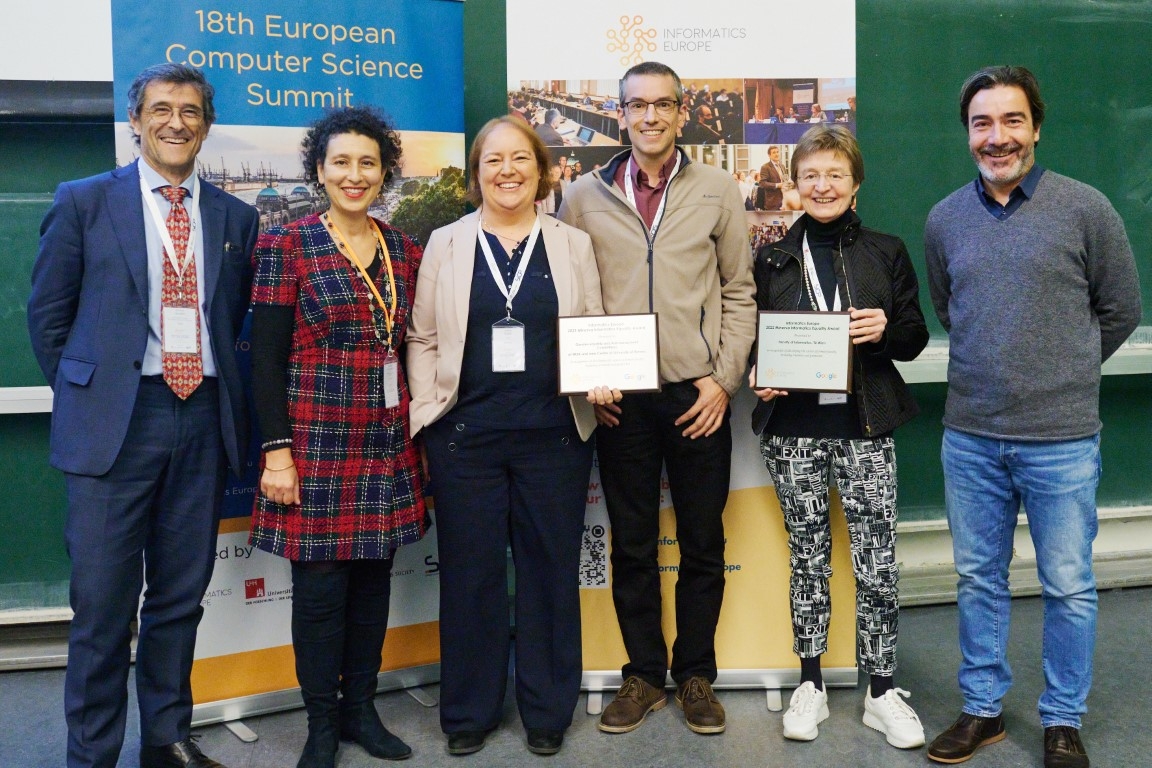
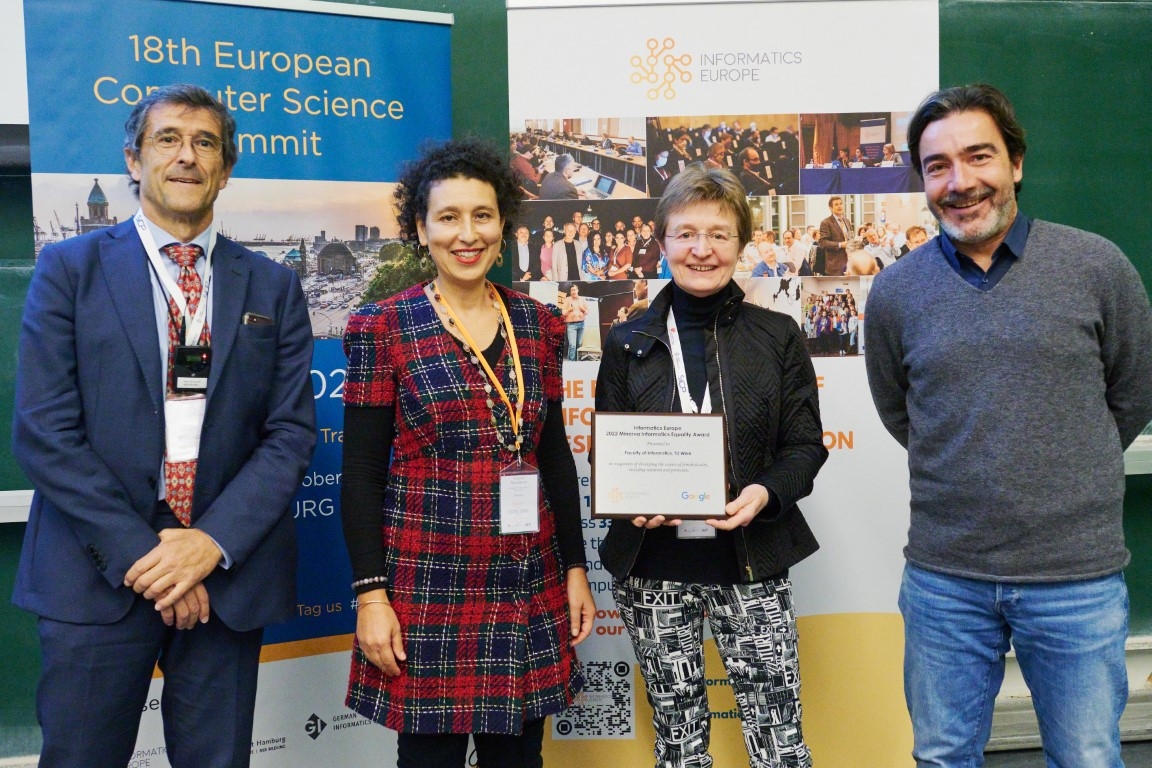
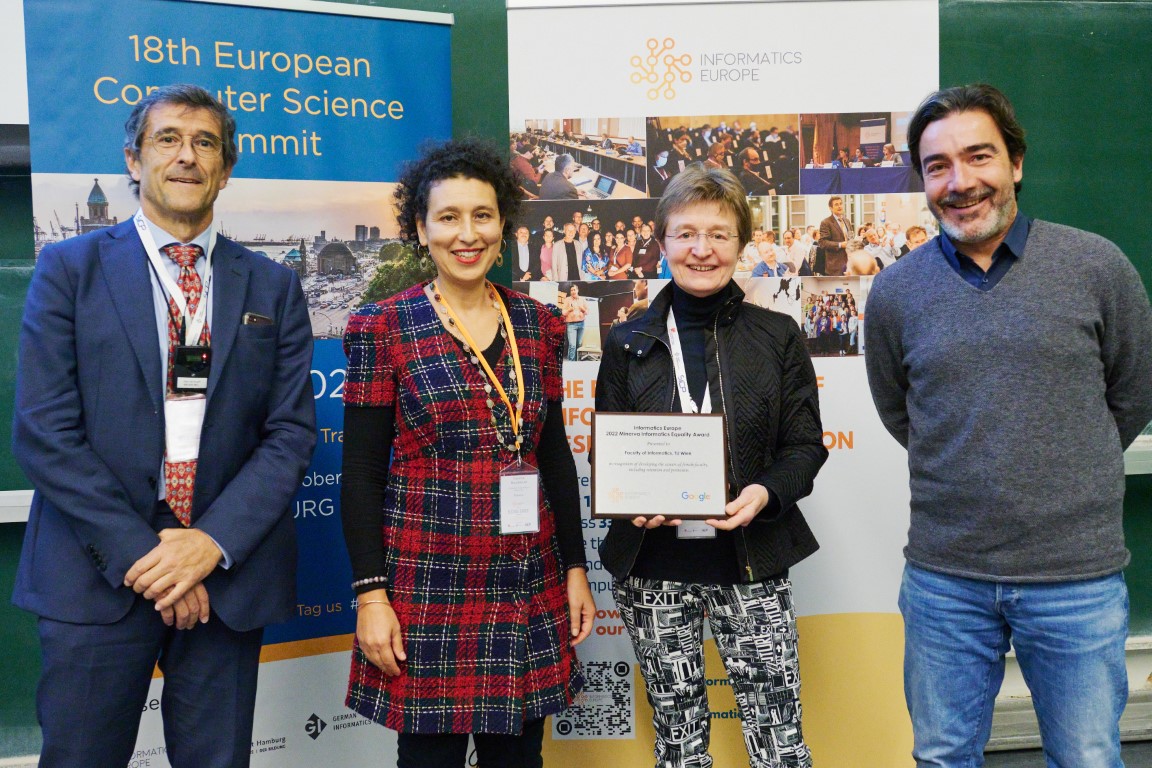
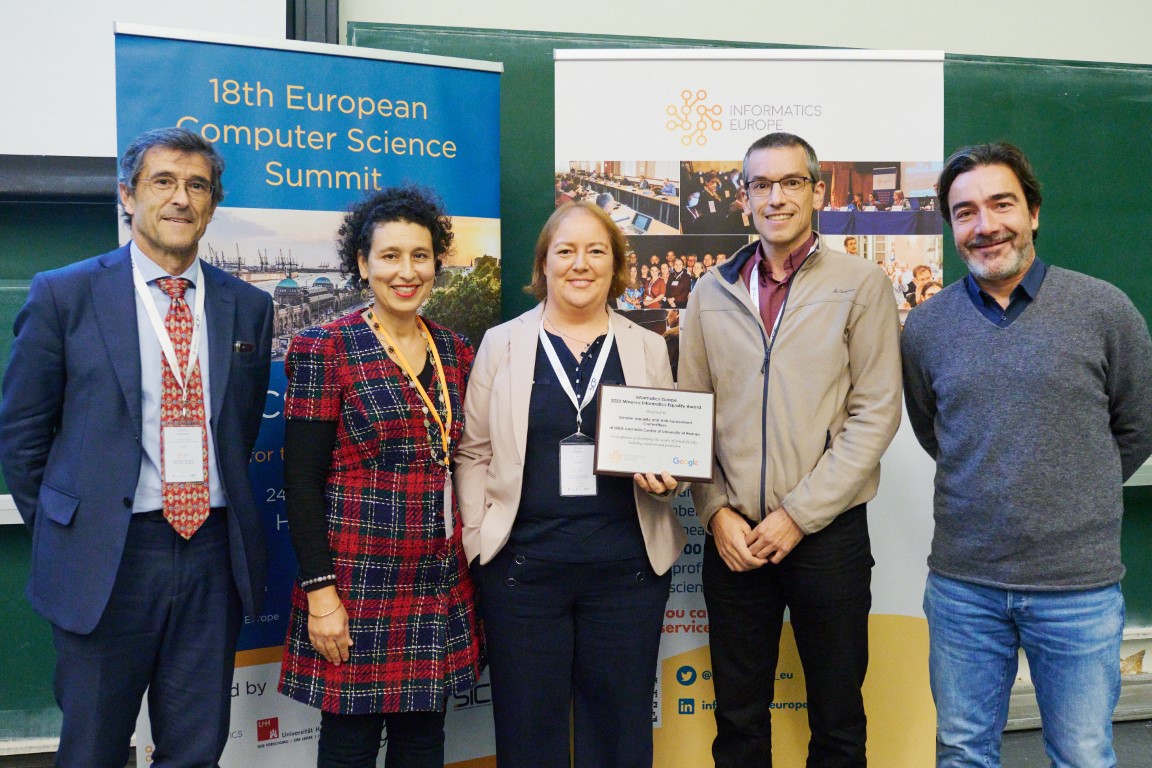
- The Minerva Informatics Equality Award recognising best practices in departments or faculties of European universities and research labs that encourage and support the careers of women in Informatics research and education. Read this year's Press Release here.
The award winners had the opportunity to present their achievements in a short talk during the Awards session. Their presentation slides are available to download under "Informatics Europe Awards Ceremony" here.
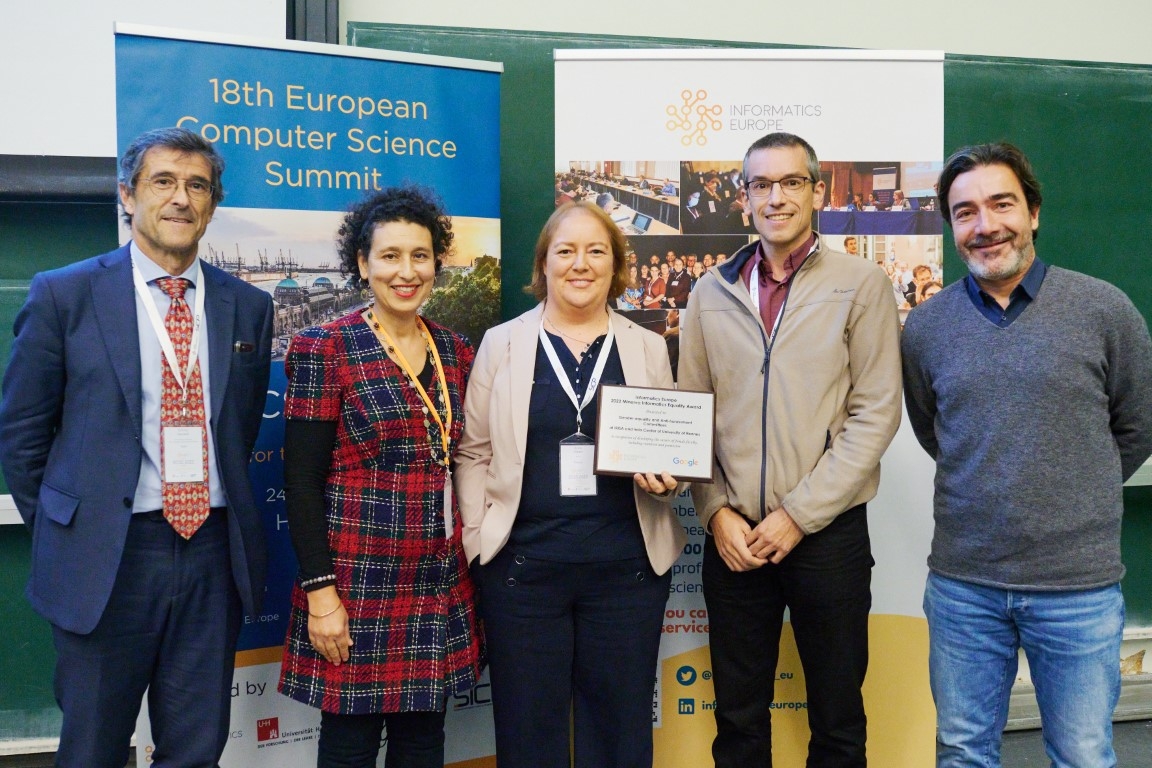
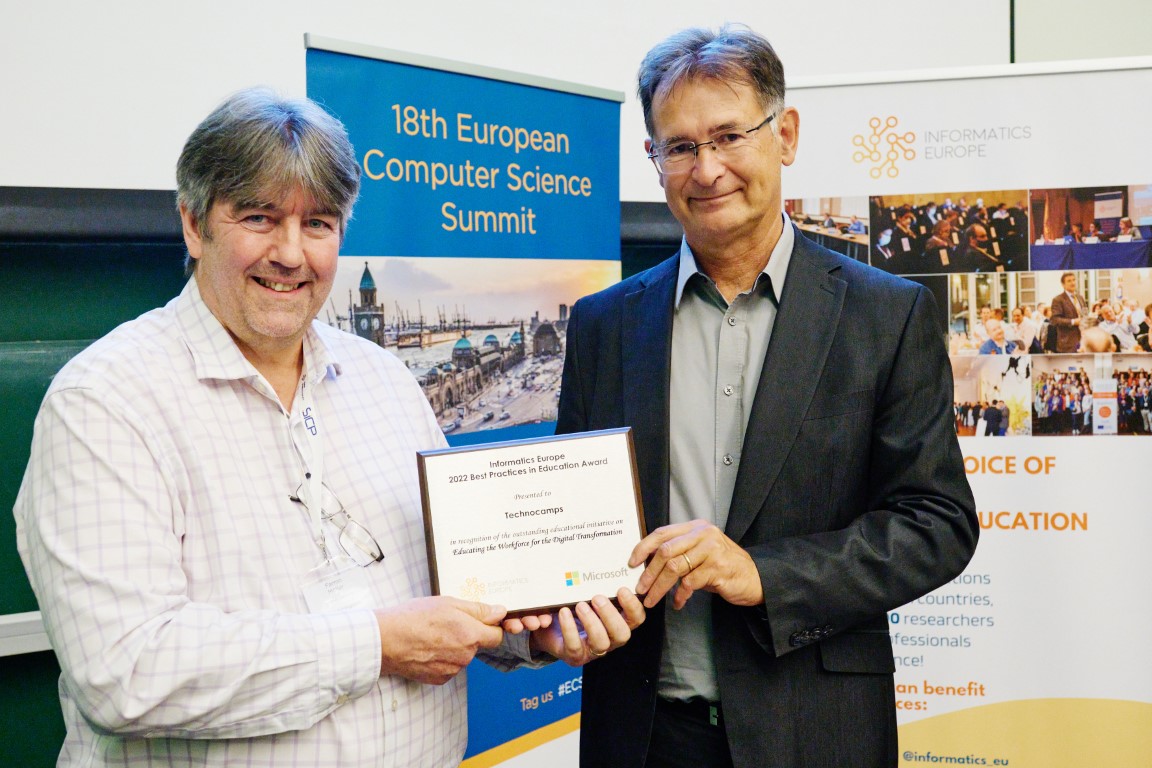
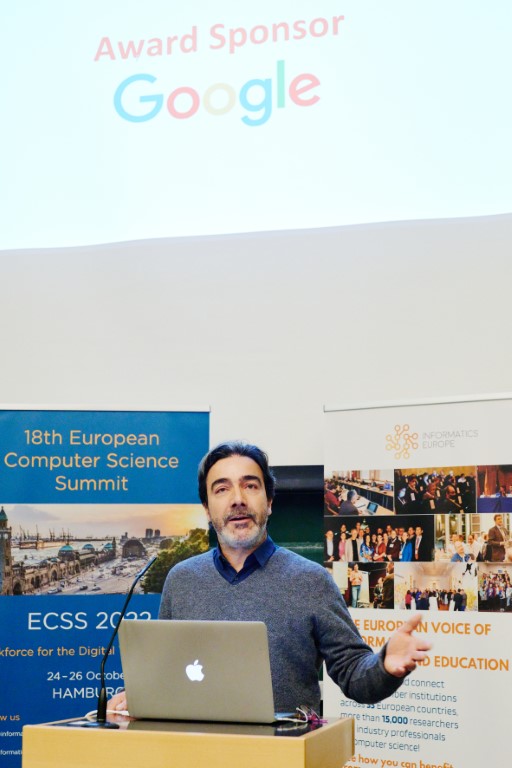
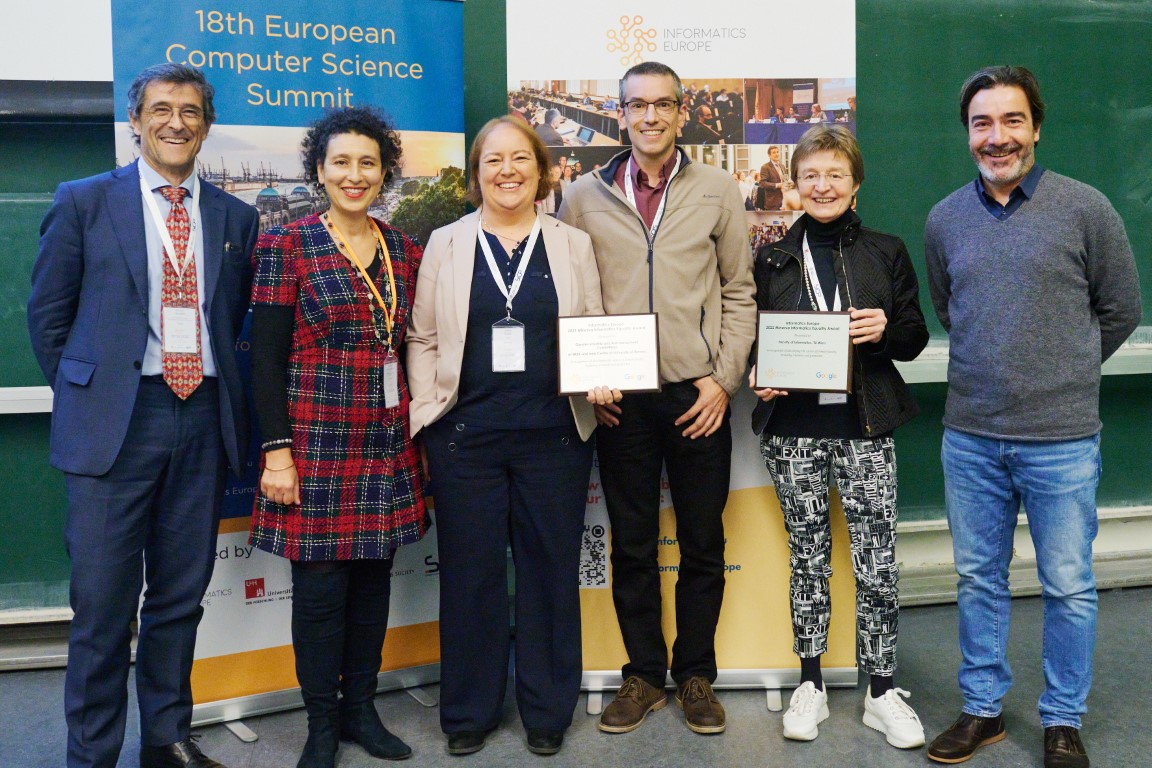
-
Award Ceremony of Best Practices in Education Award 2022
-
Jens Redmer, Google Representative at Award Ceremony of Minerva Informatics Equality Award 2022
-
Award Ceremony of Minerva Informatics Equality Award 2022
-
Award Ceremony of Minerva Informatics Equality Award 2022
-
Award Ceremony of Minerva Informatics Equality Award 2022


*Please note that the photos above are better viewed when applying zoom out.
Call for Participation
ECSS 2022 - 18th European Computer Science Summit
"Workforce for the Digital Transformation"
Annual Summit for leaders and decision makers in
informatics/computer science research, education and policies in Europe
24 – 26 October 2022, Hamburg, Germany
Digital transformation and informatics: how do they influence each other, and how can they be utilized to bring greater benefits to science, education, and society?
With this year’s scientific main theme “Workforce for the Digital Transformation”, the 18th European Computer Science Summit (ECSS) 2022 will be addressing this key topic from the scientific, economic, political, and social perspectives.
The ECSS 2022 will be held in Hamburg, Germany, from October 24-26. The Summit will be hosted as an on-site event by the University of Hamburg, and co-organised by GI - Gesellschaft für Informatik, and SICP - Software Innovation Campus Paderborn.
Conference Program
A preliminary conference schedule is now available and is constantly updated on our ECSS 2022 website. Confirmed ECSS 2022 activities include:
Monday – October 24th
- Parallel Sessions: Leaders Workshop and Early Career Researchers Workshop
- Special welcome cocktail session featuring Early Career Researchers Posters Session in the evening
Tuesday – October 25th
- Scientific Main Theme Sessions “Workforce for the Digital Transformation”
- Education Workshop
- Societal Impact of Digital Transformation Workshop
- Informatics Europe Special Sessions and Informatics Europe Awards Ceremony
- IE Members Exclusive: Informatics Europe Annual General Assembly
Wednesday – October 26th
All sessions and workshops will include a mix of keynote talks by a selection of distinguished speakers from all over Europe, with ample time for interaction, discussion and knowledge sharing. The welcome cocktail on Monday and gala dinner on Tuesday evening will allow for further exchange and networking, boosting top-level international dialogues on key topics of informatics/computer science.
Visit our YouTube Channel to revisit the inspiring sessions from ECSS 2021 and ECSS 2020!
Registration
Registration for ECSS 2022 now opens.
How can you benefit from ECSS? Watch here. Browse through our website, follow us on Twitter and LinkedIn with hashtag #ECSS_2022 for more exciting details of the Summit!
About ECSS
ECSS conferences are devoted to important and timely strategic issues and trends regarding all aspects of informatics/computer science such as research, education, entrepreneurship, funding, career development, management and policies. The key audience includes:
- Heads (deans, chairs) of academic informatics/computer science departments (schools, faculties, institutes);
- Research directors and managers of research centers, institutes and labs on informatics/computer science, both in public institutions and in industry;
- Informatics/computer science faculty members and researchers from both academia and industry;
- Members of funding and governmental agencies for informatics/computer science at European, national, regional and local level;
- Experts, advisors and thinkers of numerous key issues like ethics, the relation between informatics and other scientific disciplines, informatics’ future and its influence on the academic world and society;
- PhD students and post doctorates conducting research on informatics/computer science.
Committees
Conference Chairs
- Enrico Nardelli, Informatics Europe / University of Rome "Tor Vergata"
- Norbert Ritter, University of Hamburg
Local Chairs:
- Fabian Panse, University of Hamburg
Main Theme Chairs
- Norbert Ritter, University of Hamburg
- Patricia Lago, Vrije Universiteit Amsterdam
Chairs of the Leaders Workshop
- Harald Gall, University of Zurich
- Hannes Federrath, University of Hamburg
Chairs of the Professional Development Workshop for Early Career Researchers
- Dick Bultermann, CWI / Vrije Universiteit Amsterdam
- Sanaz Mostaghim, Otto von Guericke University of Magdeburg
Chairs of the Education Workshop
- Michael E. Caspersen, IT-vest
- Jan Vahrenhold, University of Münster
Chairs of the Societal Impact of Digital Transformation Workshop
- Gregor Engels, SICP - Software Innovation Campus Paderborn
- Gordana Dodig-Crnkovic, Chalmers University of Technology
Chairs of the WIRE-EUGAIN Workshop
- Karima Boudaoud, Université Côte d’Azur
- Barbora Buhnova, Masaryk University
- Letizia Jaccheri, NTNU
Chairs of the Workshop organized with National Informatics Associations
- Pekka Orponen, Aalto University
- Michael Goedicke, University of Duisburg-Essen
Organizing Committee
- Nuria Anguera, Informatics Europe
- Anne Awizen, University of Hamburg
- Kit Wan Chui, Informatics Europe
- Felix Kiehn, University of Hamburg
- Mareike Schmidt, University of Hamburg
- Svetlana Tikhonenko, Informatics Europe
How to Register
Registration for ECSS 2022 is closed.
A limited number of travel grants were available for early-career researchers. ECSS2022 participants could apply for them by sending an email to
Registration Fees
The registration fee of the ECSS 2022 (24-26 October) covers:
- Participation in all activities of the Summit
- Coffee breaks, lunches
- Conference Welcome Cocktail on Monday, 24 October*
- Conference Dinner on Tuesday, 25 October*
- Conference materials
The registration for the Professional Development Workshop for Early Career Researchers (ONLY), covers coffee break, lunch, and Welcome Cocktail on Monday, 24 October.
Prices**
Normal registration :
- € 585,00 (Member of Informatics Europe)
- € 685,00 (Non-Member)
- € 380,00 (PhDs and PostDocs)
- € 525,00 (Member of Informatics Europe and EUGAIN COST Action)
- € 625,00 (Member of EUGAIN COST Action)
Early Career Researchers Workshop ONLY:
- € 70,00
*Spouses invitations for the Welcome Cocktail and Dinner are available for purchase (Extra Tickets). They are not included in the registration fee but available through the registration system.
** Please note that the amount of the bank transfer will have to include any bank fee related to the transfer and/or processing.
Venue
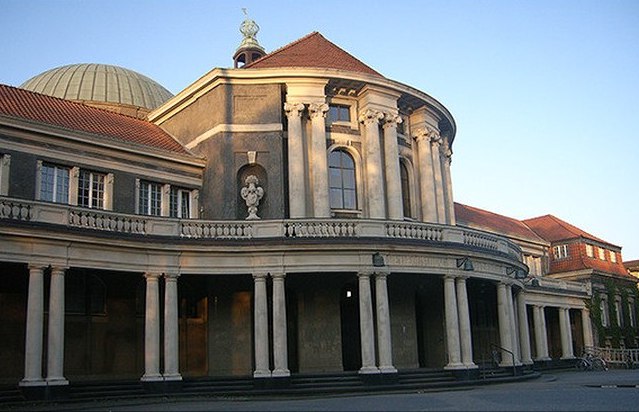
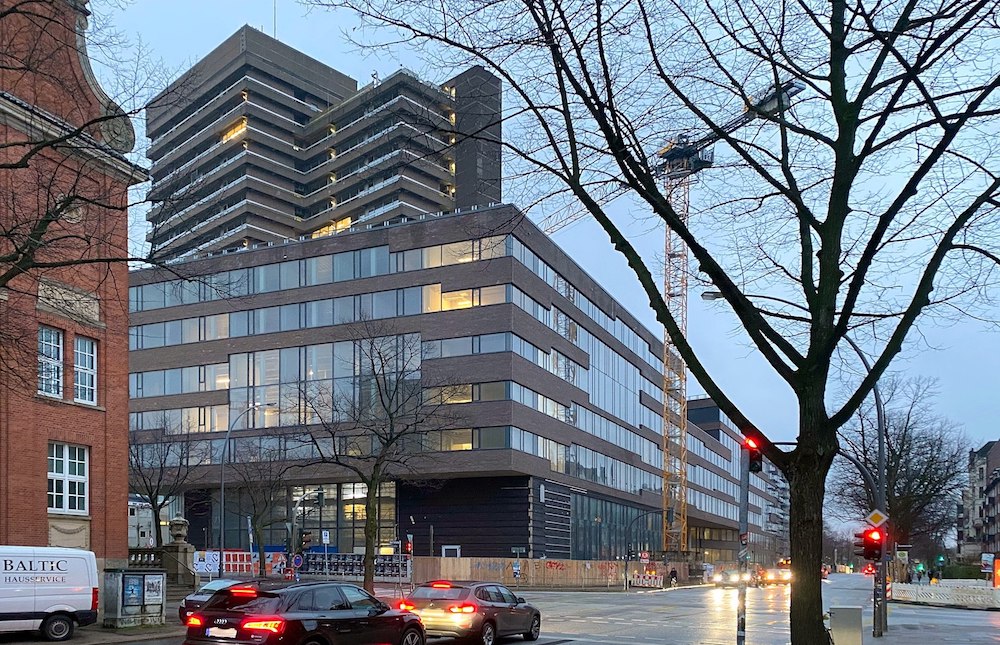
The ECSS 2022 was held at the University of Hamburg, in the Faculty of Mathematics, Informatics and Natural Sciences, at the Campus "Bundesstraße", which is easily accessible from the city center by public transportation or even by walking.
Most of the ECSS sessions took place in the following buildings:
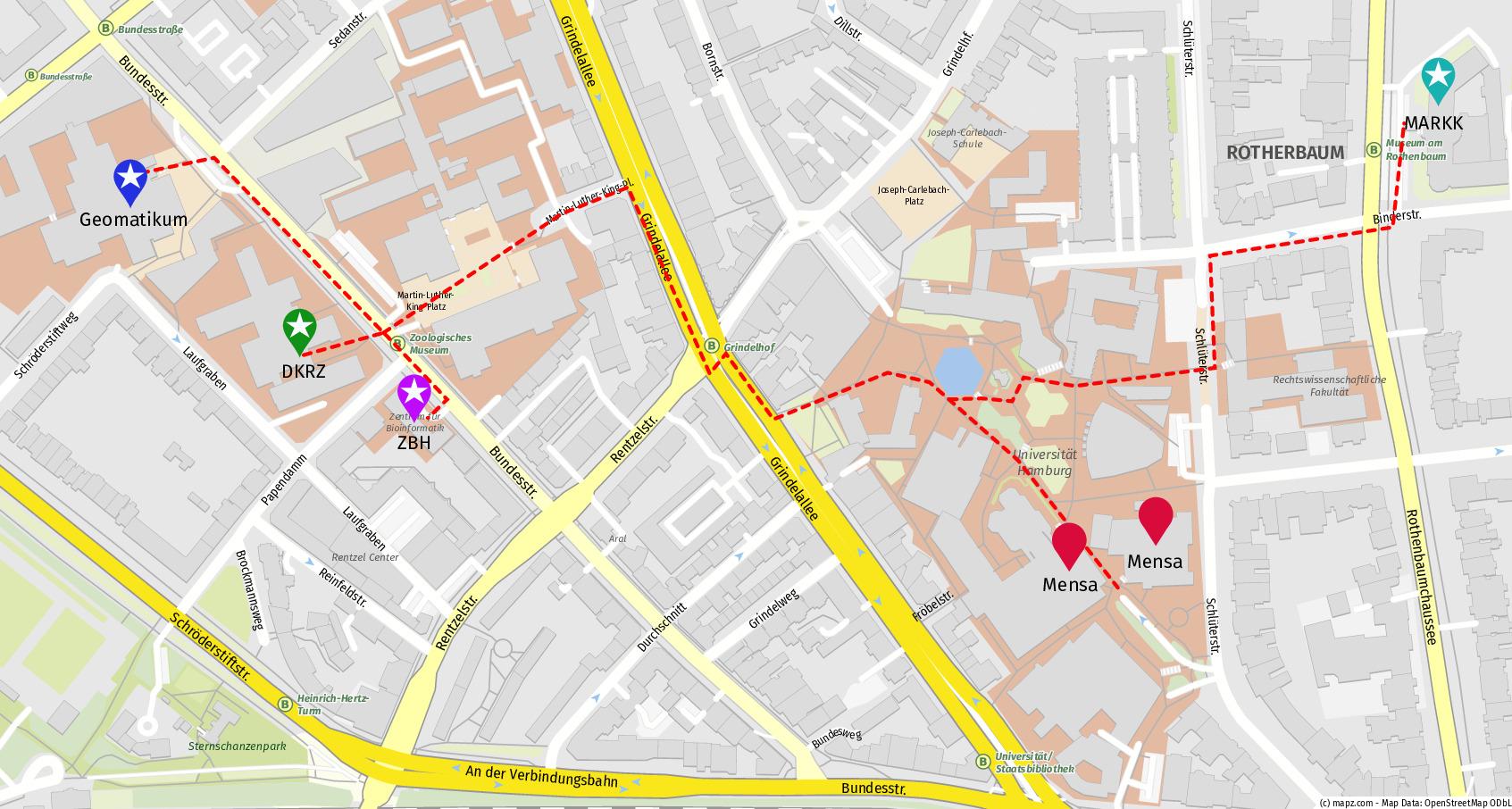
- Geomatikum (Bundesstrasse 55, click here to check how to reach the venue or download a pdf with detailed instructions and maps).
- German Climate Computing Center - DKRZ (Bundesstrasse 45a)
 |
 |
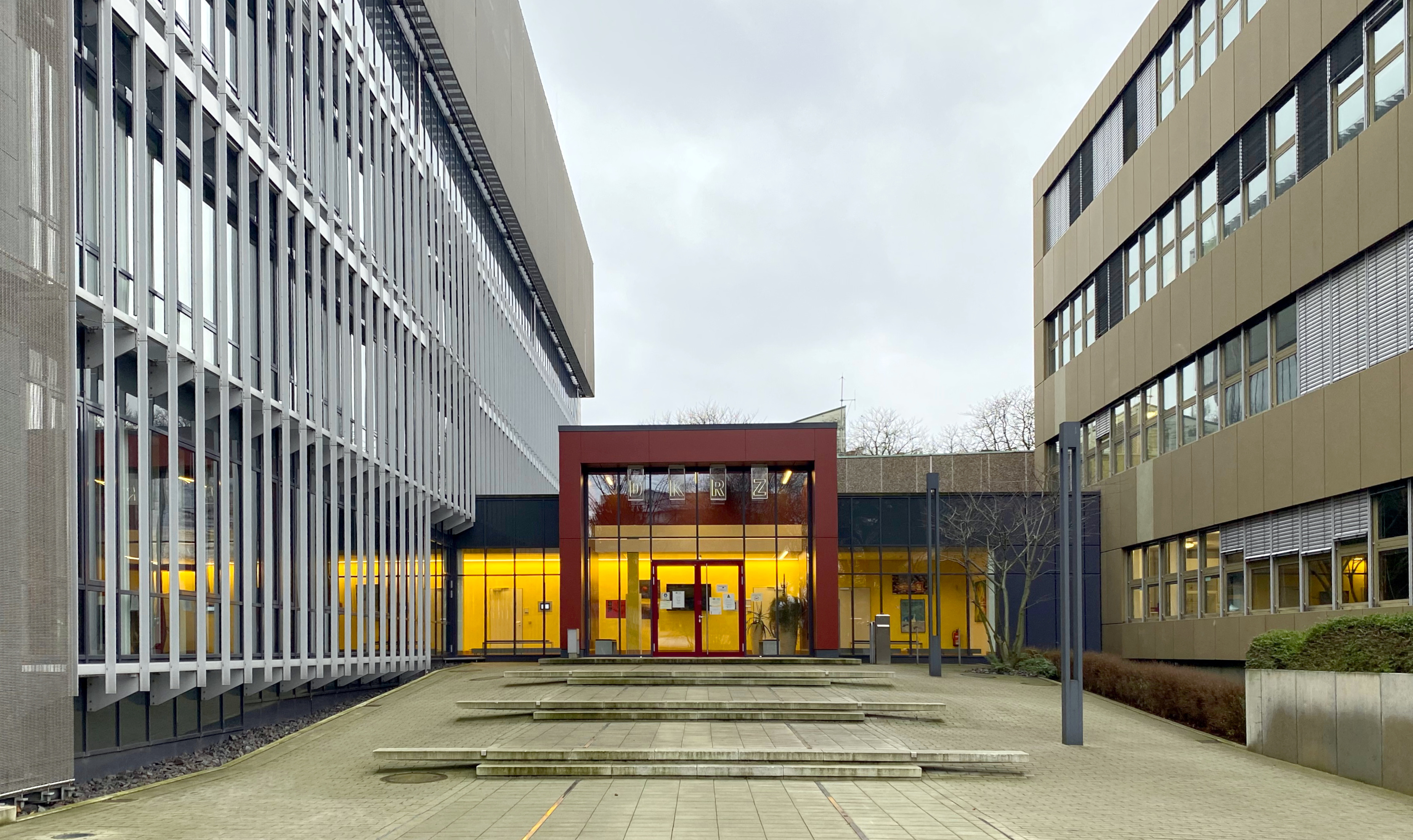 |
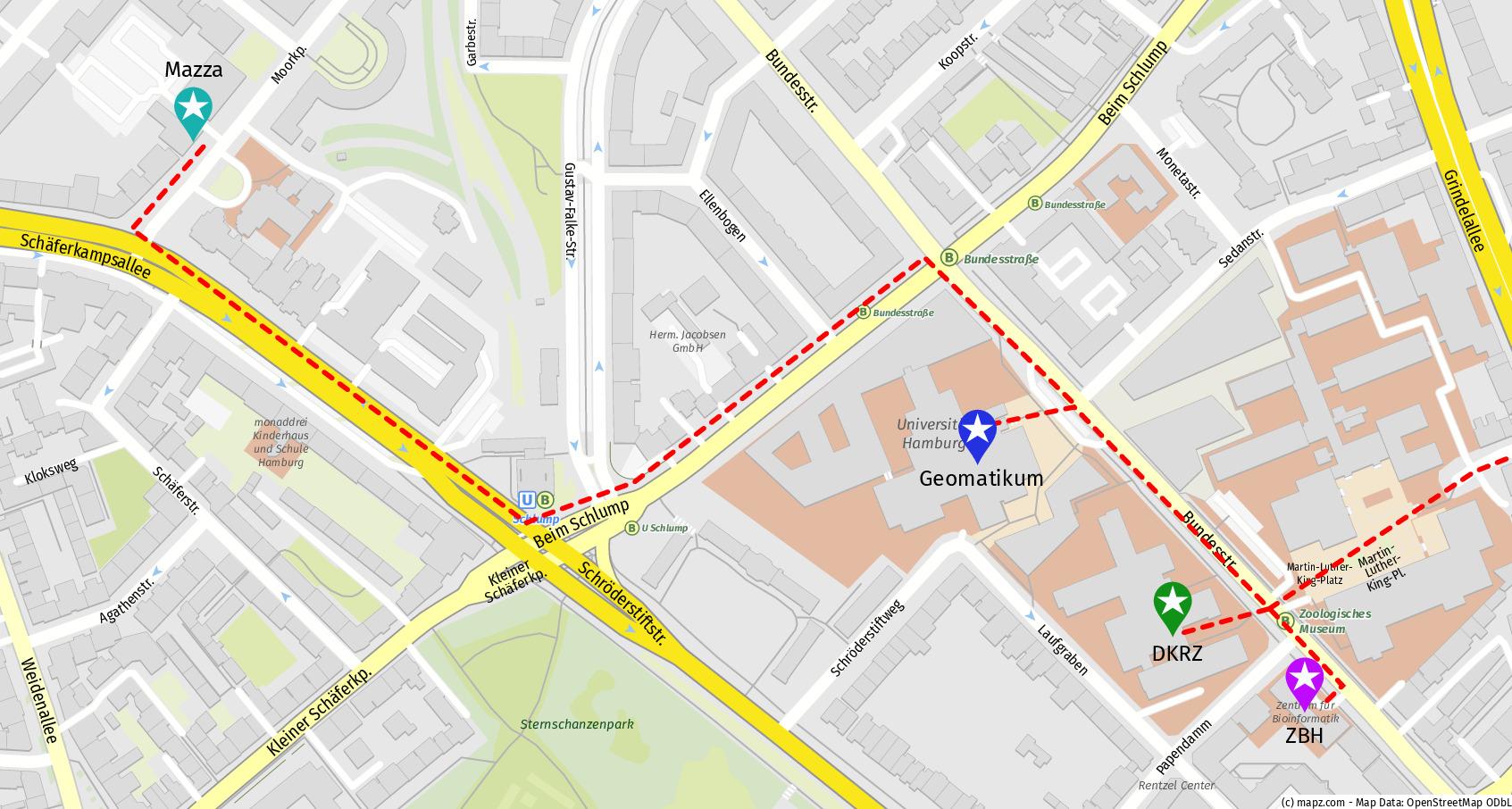
The closest suburban train station to the ECSS venue is "Schlump". For further details, please see the University of Hamburg Campus Navigator.
Founded in 1919 by local citizens, University of Hamburg is the largest institution for research and education in northern Germany. As one of the country’s largest universities, it offers a diverse range of degree programs and excellent research opportunities. The University boasts numerous interdisciplinary projects in a broad range of fields and an extensive partner network of leading regional, national, and international higher education and research institutions.
How to reach ECSS 2022 Venue (Geomatikum building)
By Public Transport :
- From the Airport:
Take Train Line S1 from "Hamburg Airport" (direction "Wedel") to change at "Barmbek", then change to Underground Line U3 (direction "Hauptbahnhof Süd“) to get off at "Schlump“, walk 400 m (around 5 minutes).
- From the Main Railway Station:
Take Train Line S31, S21, S11 from "Hamburg Hbf" (directions S31 "Altona“, S21 "Elbgaustraße", S11 "Blankenese") to change at "Dammtor" (first stop), then take Bus Line 4 (direction "Wildacker“) to get off at "Bundesstraße“, walk 180 m (around 2 minutes).
Public transportation is organized by the hvv. Individual routes to the venue can be found at https://www.hvv.de/en (destination: "Bundesstraße 55“)
Note that in Hamburg it is mandatory to wear an FFP-2-mask at buses and trains as well as in covered stations!
By car or taxi:
- GPS coordinates: 53.568114066887574, 9.974105059328268
- Note that going by car is not recommended since there are only few parking lots available.
- Alternative for taxi : ridesharing sevice MOIA.
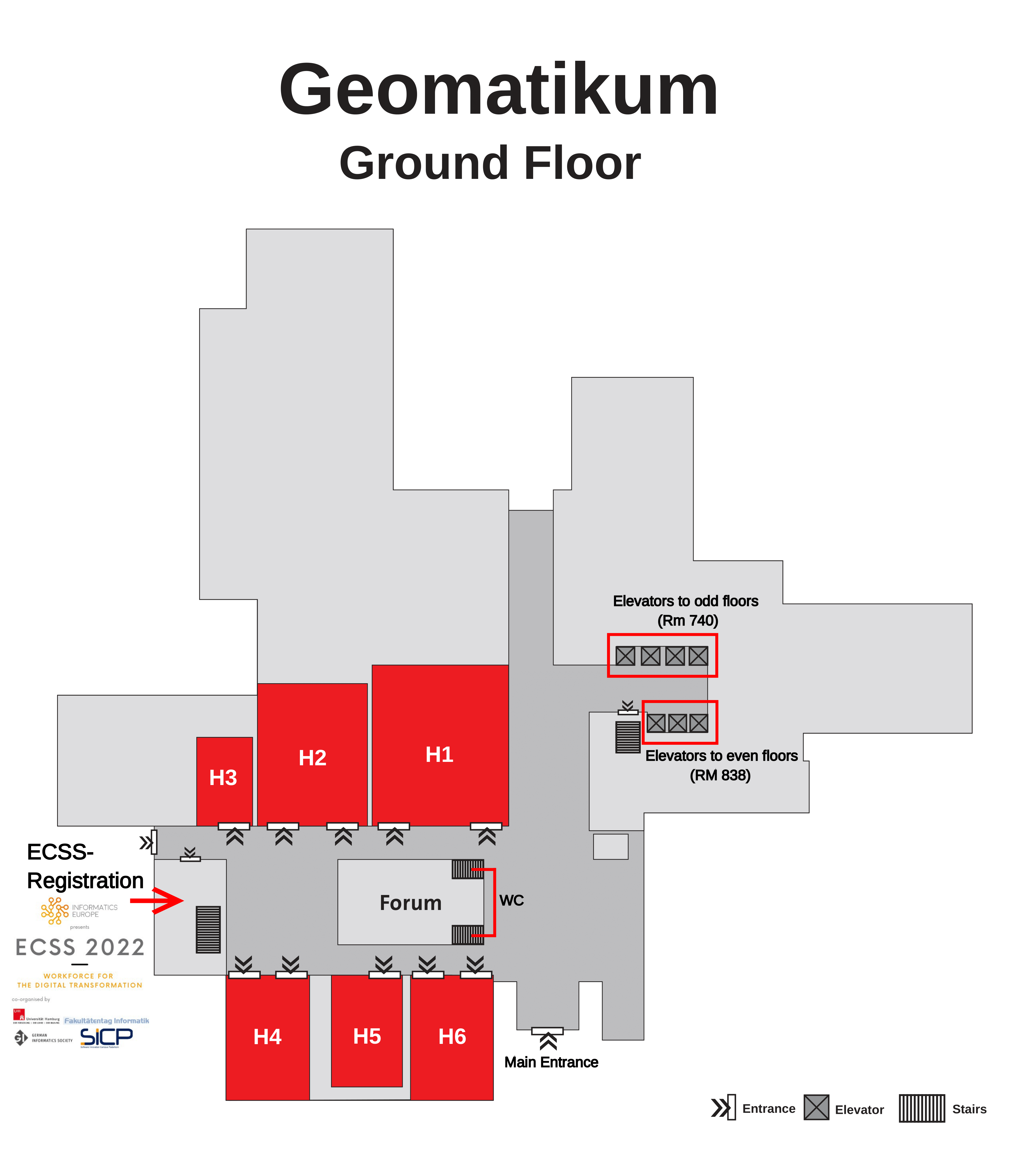
Venue buildings - maps
Venue per session - rooms
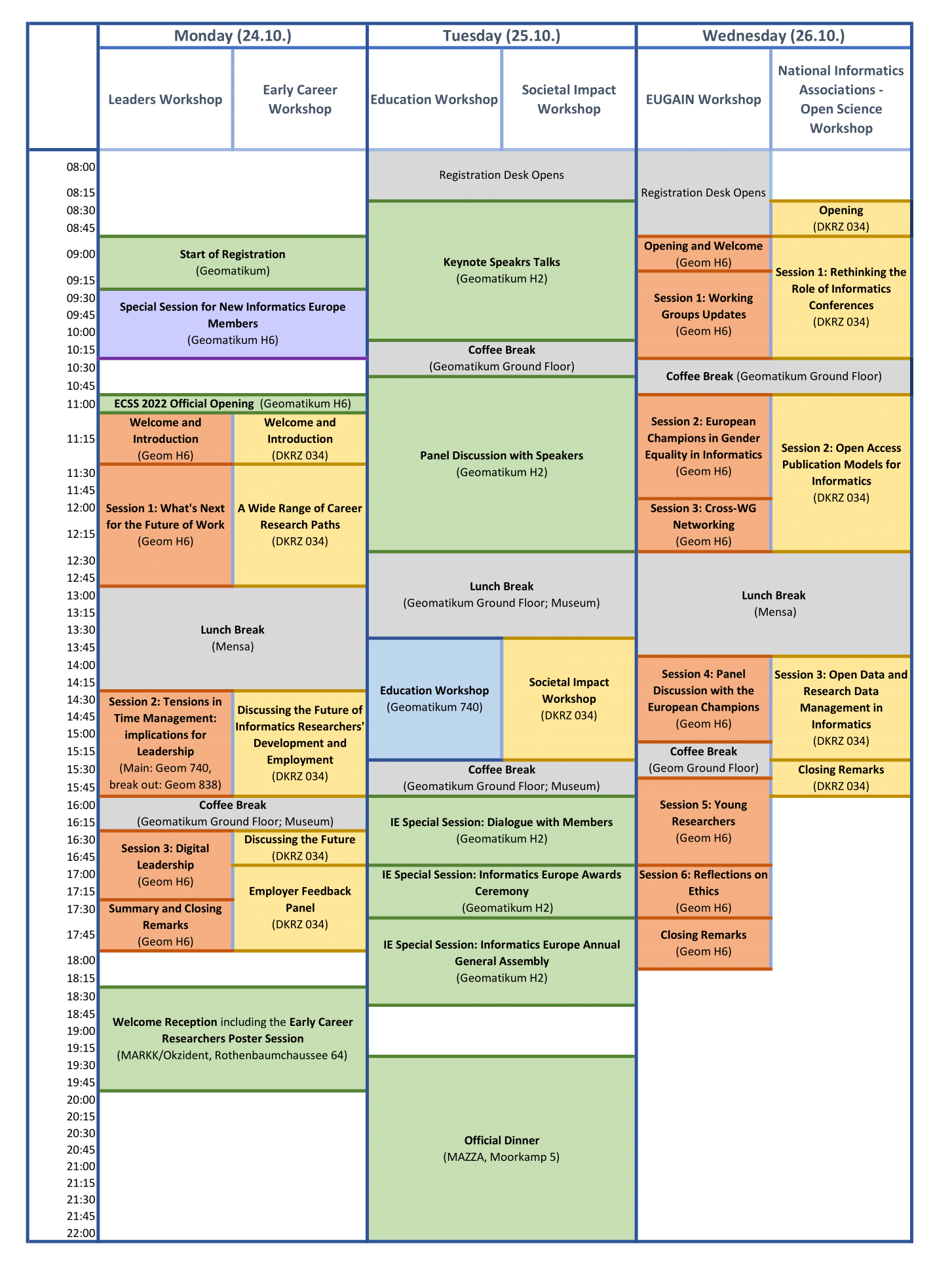
Conference Schedule
Oct. 24 Oct. 25 Oct. 26
The slides of talks given during the conference are available for download from the program below.
09:30 - 10:30 Special session for New (2022) Informatics Europe Members
11:00 - 11:15 ECSS 2022 Official Opening (Geomatikum H6)
- Bettina Stark-Watzinger, German Federal Minister for Education and Research, Video Welcome Address
- Enrico Nardelli, University of Roma "Tor Vergata", President of Informatics Europe
- Norbert Ritter, University of Hamburg, Dean of the Faculty of Mathematics, Informatics and Natural Sciences
Leaders Workshop - "Digital Leadership: Workplace Culture and Digital Dexterity" (parallel sessions)
Workshop Chairs: Harald Gall, University of Zurich, and Hannes Federrath, University of Hamburg
- 11:15 - 11:30 Welcome and introduction (Harald Gall) (Geomatikum H6)
- 11:30 - 13:00 Session 1. What’s Next for the Future of Work (keynote talk and Q&A, Geomatikum H6)
Laura Giurge, London School of Economics and Political Science (LSE), UK, What’s Next for the Future of Work
- 13:00 - 14:30 Lunch Break (Mensa)
- 14:30 - 16:00 Session 2. Tensions in time management: Implications for leadership
Workshop chaired by Laura Giurge, London School of Economics and Political Science (LSE), UK, and Jennifer Sparr, University of Zurich, Switzerland [Slides]
(main session - Geomatikum 740, breakout out sesssion - Geomatikum 838)
- 16:00 - 16:30 Coffee Break (Geomatikum Ground Floor, Museum)
- 16:30 - 17:30 Session 3. Digital Leadership (keynote talk and Q&A, Geomatikum H6)
Schahram Dustdar, TU Wien, Austria, Digital Leadership [Slides]
- 17:30 - 18:00 Summary and Closing remarks (Geomatikum H6)
Professional Development Workshop for Early Career Researchers (parallel sessions)
Workshop Chairs: Dick Bultermann, CWI / Vrije Universiteit Amsterdam, and Sanaz Mostaghim, Otto von Guericke University of Magdeburg
(Venue:DKRZ 034)
- 11:15 - 11:20 Welcome and introduction
- 11:20 - 13:00 A wide range of career research paths
- Patricia Lago, Vrije Universiteit Amsterdam, the Netherlands [Slides]
- Sebastian Gerling, CDO University of Hamburg, Germany [Slides]
- Jean-Marc Jézéquel, IRISA, France
- Ante Vilenica, Justice department of Hamburg, Germany [Slides]
- Gabriel Orsini, Otto GmbH & Co KG, Germany [Slides]
- 13:00 - 14:30 Lunch Break (Mensa)
- 14:30 - 16:00 Discussing the future of informatics researchers’ development and employment (breakout session)
- 16:00 - 16:30 Coffee Break (Geomatikum Ground Floor, Museum)
- 16:30 - 17:00 Discussing the future of informatics researchers’ development and employment (feedback at plenary session)
- 17:00 - 18:00 Employer feedback panel
Welcome Cocktail
- 18:30 - 20:00 Welcome cocktail including the Early Career Researchers Posters Session (venue: MARKK/Okzident, Rothenbaumchaussee 64, 20148 Hamburg)
Main Theme - "Workforce for the Digital Transformation"
(Venue: Geomatikum H2)
Chair: Tilo Böhmann, University of Hamburg
- 08:30 - 10:15 Welcome Address and Keynote Speakers Talks
-
-
Rolf Greve, Head Hamburg Authority for Science and Research, Online Welcome Address
-
Keynote Talks:
-
- Judith Simon, University of Hamburg, Germany, IT for Good? Ethics in Computer Science Education & Practice [Slides]
- Walter Quattrociocchi, Sapienza Università di Roma, Italy, Information spreading in a disintermediated environment [Slides]
- Anna Cox, University College London, UK, Digital Transformation for Work-Life Boundary Management [Slides]
- 10:15 - 10:45 Coffee Break (Geomatikum Ground Floor)
- 10:45 - 11:30 Keynote Speaker Talks
-
- Michael Müller Wünsch, CIO Otto (GmbH & Co KG), Germany, How to: Digital Literacy and Competence in our society [Slides]
- Hannes Federrath, University of Hamburg / Former President of German Informatics Society, Challenges and topics in Digital Transformation — from the viewpoint of a Computer Society [Slides]
- 11:30 - 12:30 Panel Discussion with all Keynote Speakers
12:30 - 13:45 Lunch Break (Geomatikum Ground Floor, Museum)
Education Workshop (parallel sessions)
(Venue: Geomatikum 740)
Chairs: Jan Vahrenhold, University of Münster. and Michael E. Caspersen, IT-vest – networking universities
- 13.45 – 13:55 Introduction, Welcome (Jan Vahrenhold, Michael E. Caspersen)
- 13:55 – 14:05 Informatics for All – past activities (Enrico Nardelli). A brief presentation of the Informatics for All coalition and past activities [Slides]
- 14:05 – 14:15 Informatics Reference Framework for School (Michael E. Caspersen). A brief presentation of the Informatics for All coalition's proposal for a framework to provide high-quality informatics education to all pupils in Europe [Slides]
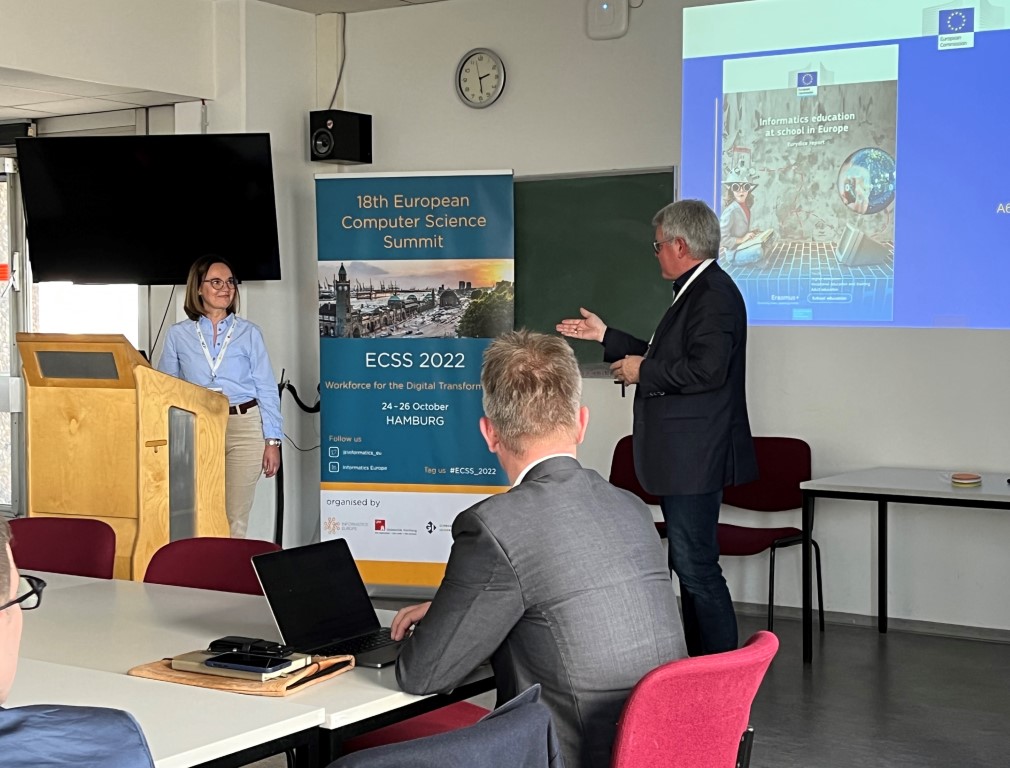
- 14:15 – 14:40 A map of informatics in school education across Europe (Sonia Piedrafita Tremosa, European Education and Culture Executive Agency). A presentation of the Eurydice report published in September 2022 describing the provision of informatics in school education across Europe. [Slides]
- 14.40 – 14:50 Informatics Europe's Working Group on Informatics Education and Research (Michael E. Caspersen). A brief presentation and potential next steps [Slides]
- 14.50 – 15:20 Group and plenary discussion on next steps
- What should the Informatics for All coalition do?
- What should Informatics Europe's Working Group on Informatics Education and Research do?
- 15:20 – 15:30 Wrap-up (Jan Vahrenhold, Michael E. Caspersen)
Societal Impact of Digital Transformation Workshop (parallel sessions)
(Venue: DKRZ 034)
Chairs: Gordana Dodig-Crnkovic, Chalmers University of Technology, and Gregor Engels, SICP - Software Innovation Campus Paderborn.
- 13.45 - 13:50 Introduction, Welcome (Gordana Dodig-Crnkovic, Gregor Engels)
- 13:50 – 14:05 Ethics at Development and Operations (DevOps) of Software Background (Alexander Pretschner) [Slides]
- 14:05 - 14:20 Q&A Plenary discussion
- 14:20 - 14:30 Ethics4EU (Dympna O’Sullivan) [Slides 1] [Slides 2]
- 14:30 - 14:40 Q&A Plenary discussion
- 14:40 - 15:20 Plenary / Group Discussions on Aspects of Ethics and their Impact on Society (Moderators: Alexander Pretschner, Suzana Alpsancar, Dympna O’Sullivan, Andrea Curley)
- 15:20 – 15:30 Wrap-up (Gordana Dodig-Crnkovic, Gregor Engels)
- Informatics Europe Working group on Societal Impact and Ethics
- Activity plan for the future
15:30 – 16:00 Coffee Break (Geomatikum Ground Floor, Museum)
16:00 – 17:00 Informatics Europe Special Sessions - Dialogue with Members [Slides]
(Venue: Geomatikum H2)
Chairs: Enrico Nardelli and Nuria Anguera, Informatics Europe
17:00 – 17:45 Informatics Europe Awards Ceremony
- Best Practices in Education Award (sponsored by Microsoft) - Winner announcement by Jean-Marc Jézéquel, IRISA / University of Rennes (Award Committee Representative) and Short Talk by Winner. [Slides]
- Minerva Informatics Equality Award (sponsored by Google) - Winner announcement by Karima Boudaoud, Université Côte d’Azur (Award Committee Co-Chair) and Short Talks by Winner.
[Award Committee Slides] [Winner 1 Slides] [Winner 2 Slides]
17:45 – 18:45 Informatics Europe Special Sessions - Annual General Assembly
Chairs: Enrico Nardelli and Nuria Anguera, Informatics Europe
19:30 - 22:30 Official Dinner (Venue: Mazza, Moorkamp 5, 20357 Hamburg)
WIRE-EUGAIN WS - "Attracting & Retaining Female Students from Bachelor and Master to PhD" (parallel sessions)
(Venue: Geomatikum H6)
Workshop Chairs: Karima Boudaoud, Université Côte d’Azur, Barbora Buhnova, Masaryk University, and Letizia Jaccheri, NTNU.
- 09:00 - 09:10 Opening and Welcome from the Workshop Chairs
- 09:10 - 10:30 Session 1. Working Groups Updates (Chair: Özge Misirli, Eskisehir Osmangazi University) [Slides]
- 10:30 - 11:00 Coffee Break (Geomatikum Ground Floor)
- 11:00 - 12:00 Session 2. European Champions in Gender Equality in Informatics (Chairs: Simona Motogna, Babeş-Bolyai University, and Jane Hillston, University of Edinburgh)
- Daniela Nicklas, University of Bamberg, Germany [Slides]
- Svetlana Hensman, TU Dublin, Ireland [Slides]
- Laura Kovács, Gerti Kappel, TU Wien, Austria [Slides]
- Anne Siegel, Nicolas Markey, IRISA, France [Slides]
- 12:00 - 12:30 Session 3. Cross-WG Networking (Chair: Maria Roussou, National and Kapodistrian University of Athens)
- 12:30 - 14:00 Lunch Break (Mensa)
- 14:00 - 15:15 Session 4. Panel discussion with the European Champions (Chair: Simona Motogna, Babeş-Bolyai University)
- 15:15 - 15:45 Coffee Break (Geomatikum Ground Floor)
- 15:45 - 17:00 Session 5. Young Researchers (Chair: Monica Landoni, Università della Svizzera italiana, and Patricia Lago, Vrije Universiteit Amsterdam)
- Karolina Bolesta, Warsaw School of Economics, Poland [Slides]
- Serena Versino, Università di Pisa, Italy [Slides]
- Sonay Caner-Yıldırım, Erzincan Binali Yıldırım University, Turkey [Slides]
- Irene Zanardi, Università della Svizzera italiana, Switzerland [Slides]
- Sunny Miranda, University of Coimbra, Portugal [Slides]
- 17:00 - 17:45 Session 6. Reflections on Ethics (Gordana Dodig-Crnkovic, Chalmers University of Technology) [Slides]
- 17:45 - 18:15 Closing Remarks
----------------------------------------------------------------------
(Venue: DKRZ 034)
Workshop Chairs: Pekka Orponen, Aalto University, Michael Goedicke, University of Duisburg-Essen.
- 08.30-08:40 Opening and introduction to the Informatics Europe Open Science Working Group
- Pekka Orponen, Aalto University, Finland
- Manuel Carro, Technical University of Madrid and IMDEA Software Institute, Spain [Slides]
- 08:40-09:00 Open Science and the future of Informatics
- Michael Goedicke, University of Duisburg-Essen, Germany
- 09:00-10:30 Session 1. Rethinking the role of Informatics conferences
- Carlo Ghezzi, Politecnico di Milano, Italy [Slides]
- Stefano Paraboschi, President of «Gruppo di Ingegneria Informatica», University of Bergamo, Italy, Experience from the GII-GRIN-SCIE Conference Rating system [Slides]
- 10:30-11:00 Coffee Break (Geomatikum Ground Floor)
- 11:00-12:30 Session 2. Open access publication models for Informatics
- Roberto Di Cosmo, Inria / Software Heritage, France [Slides]
- Laurent Romary, IRISA, France, From APC to Repository – a tour of the French and Inria open science context [Slides]
- Welmoed Spahr, Apress / Spring Nature Books Group, Supporting Open Science: a Publisher’s Perspective
- 12:30-14:00 Lunch Break (Mensa)
- 14:00-15:30 Session 3. Open data and research data management in Informatics
- Michael Goedicke, University of Duisburg-Essen, Germany [Slides]
- 15:30-16:00 Closing Remarks
Leaders Workshop
Every year Informatics Europe organises a special Workshop for Leaders of Informatics Research and Education, where academic and research leaders of Informatics universities, departments and research labs address specific challenges they encounter in their role. This year the workshop was held as part of the ECSS 2022 program on Monday, 24 October, opened to all participants and chaired by Harald Gall, University of Zurich, and Hannes Federrath, University of Hamburg.
The theme of the 2022 Leaders Workshop was
"Digital Leadership: Workplace Culture and Digital Dexterity".
Focus
Digitalization (aka Digital Transformation) creates a new outlook to work, productivity, and modernization in the workplace. Traditional ways of working are in question, modernization of processes and tasks are demanded, and job profiles are being revolutionized. Traditional models of why, how, or when we gather with colleagues for work are scrutinized. Mobile working is one of the key movements of this era, which comes with empowerment of employees and a continuous innovation in processes and tooling. This plays a major role for leaders in the university context, in particular for deans and directors, team or workgroup leaders, and researchers and teachers per se.
Good digital leadership in the context of a university and informatics departments is needed: one that is knowledgeable of digital assets and tools, that is willing to experiment and take risks, but one that is open for change while motivating. So digital skillfulness of university leaders spans a broad range of topics such as, for example, the ambition and ability to build digital and mobile work environments or to generate added value for teaching and learning when working in presence or mobile. “High digital dexterity in an organization increases the likelihood of successful digital transformation by 3.3 times. .. however, only 16% of all leaders have high digital dexterity” [Harvrd Business Review 2021].
A good workplace culture is significant for any organization, in particular at times of digital transformation and even more for university and department leaders. Enthusiasm and passion of leaders for new ways of working are needed to cope with the increasing discussion about the meaning of work. Challenges such as ‘how many days of work per week’, ‘fewer work days in favor of family/friends or health’, ‘no longer moving leisure to retirement’, or ‘not only working till 70+ but with continuous recreation’ - researchers can give some answers, and university and department leaders can adopt good practices. Informatics departments face similar if not the same challenges and deans and directors of those need to provide answers for mobile working, the added value of presence for teaching and research, and the cultural changes that need to be actively managed.
Challenges to be addressed
This year’s Leaders Workshop addressed leadership for all academic and research leaders of informatics departments from the perspective of digital dexterity and the need for a healthy and productive culture in the workplace:
- How to generate a motivating and enriching culture at the workplace?
- How to make mobile working a part of the solution for the new generation workforce?
- How digital leadership can actively foster digital dexterity both for faculty and students?
- How digital leaders can devise processes for onboarding, retention, and continuous productivity of the workforce in their respective university settings?
- How digitalization effects in Higher Ed can be actively addressed for the future of work?
Workshop Style
The Leaders Workshop featured a mix of impulse presentations, active discussions, peer’ knowledge sharing, exchange in smaller peer groups, and consolidation and presentation of the results to all participants, with ample time for interaction, discussion, reflection, and Q&A.
Due to the wide scope, the many facets, and the many challenges of the theme, this workshop would only be able to touch some of the key points. However, we expected that the discussions would be illustrative enough to provide workshop attendees with some good take-home messages and good practice examples to further enhance their digital dexterity as leaders.
Confirmed Speakers
- Schahram Dustdar , TU Wien, Austria [Slides]
- Laura Giurge, London School of Economics and Political Science, UK [Slides]
- Jennifer Sparr, University of Zurich, Switzerland
Workshop Highlights
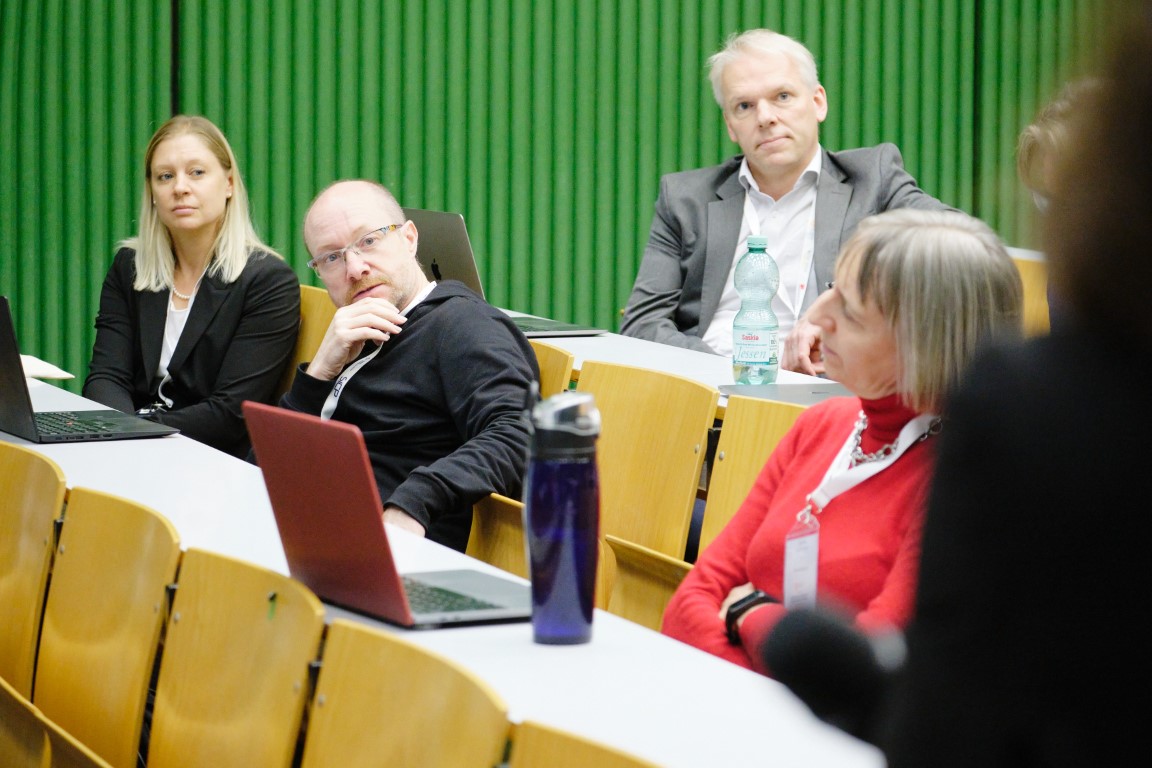
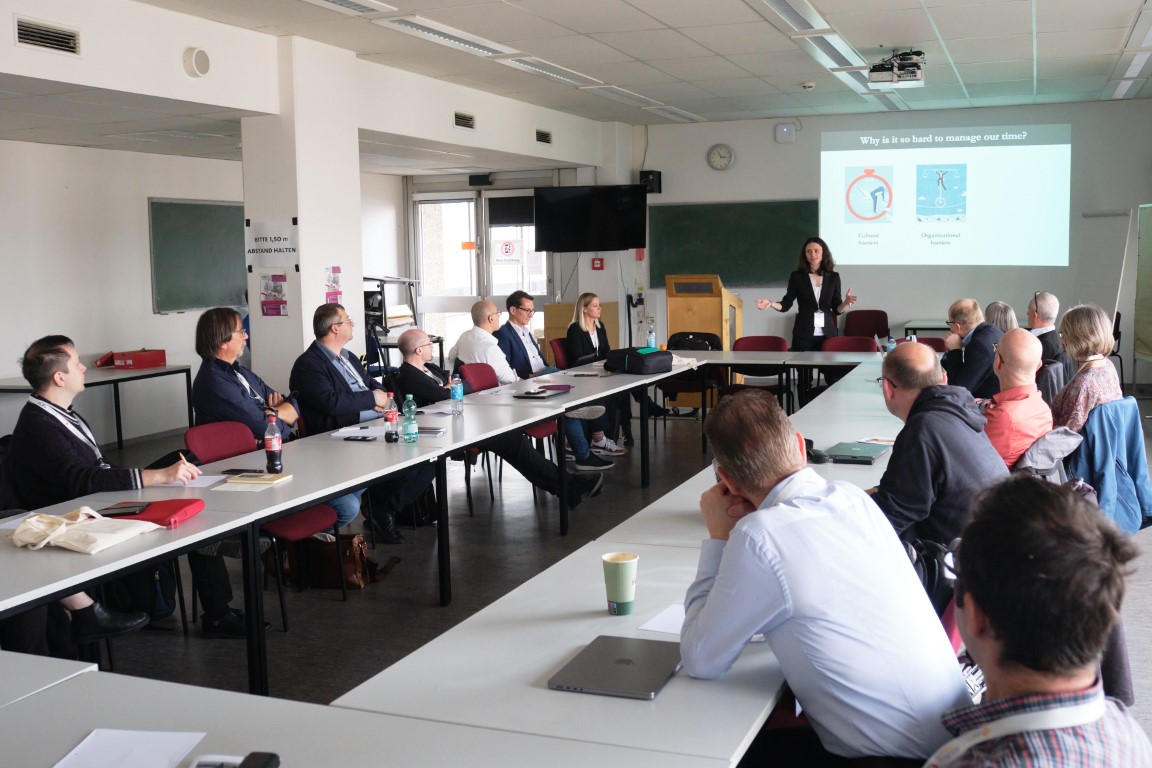
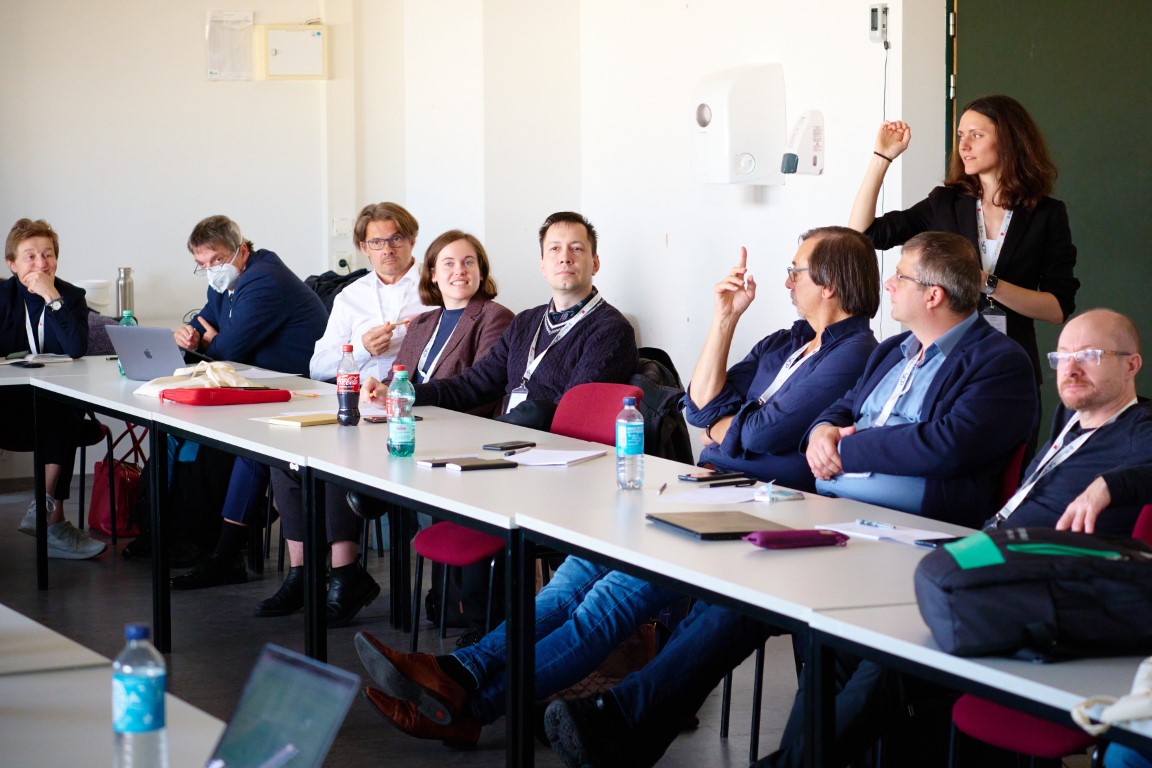
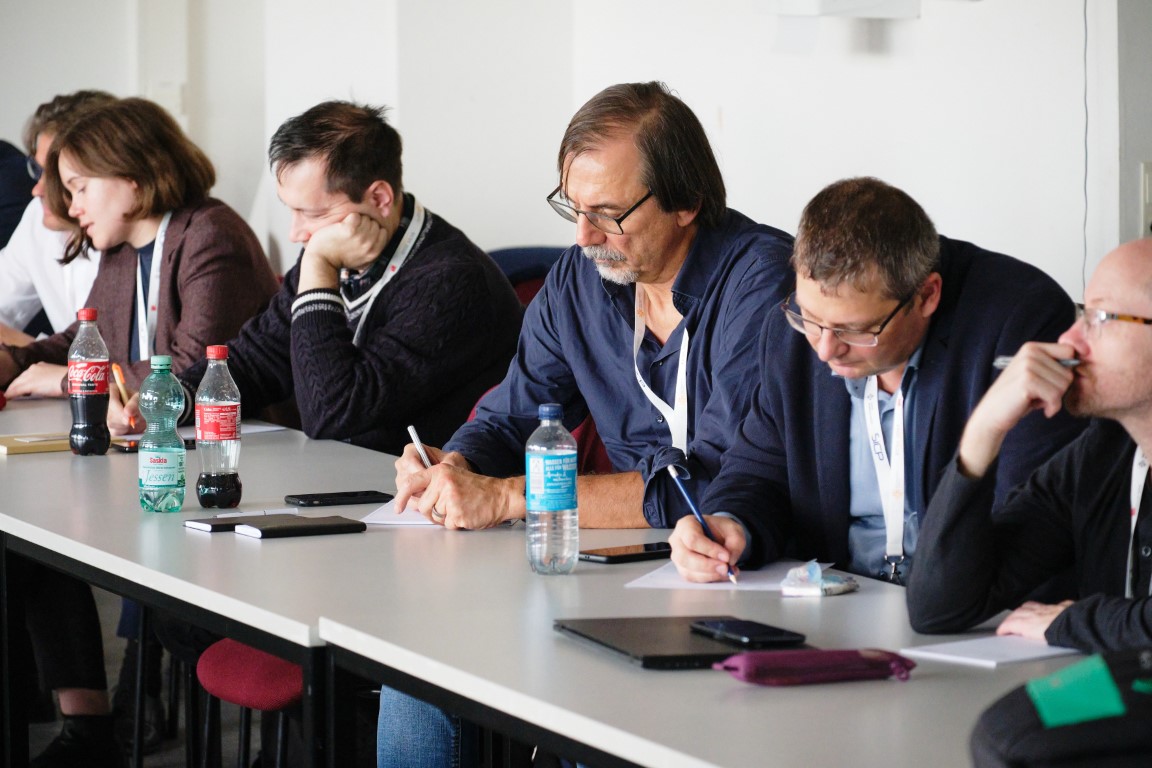
In the morning, Laura Giurge shared some of her latest research on the future of work, with an interactive and engaging talk with the audience. Topics were around the downsides of flexible work hours, the well-being implications of how we engage with technology at work, the productivity and happiness boost of carving out time to pursue our most important work tasks and the critical role that leadership support plays in changing how we work, and last but not least, how leaders who acknowledge well-being along productivity can lead more financially resilient organizations. These talks formed the basis for the afternoon sessions to be followed in a hands-on style.
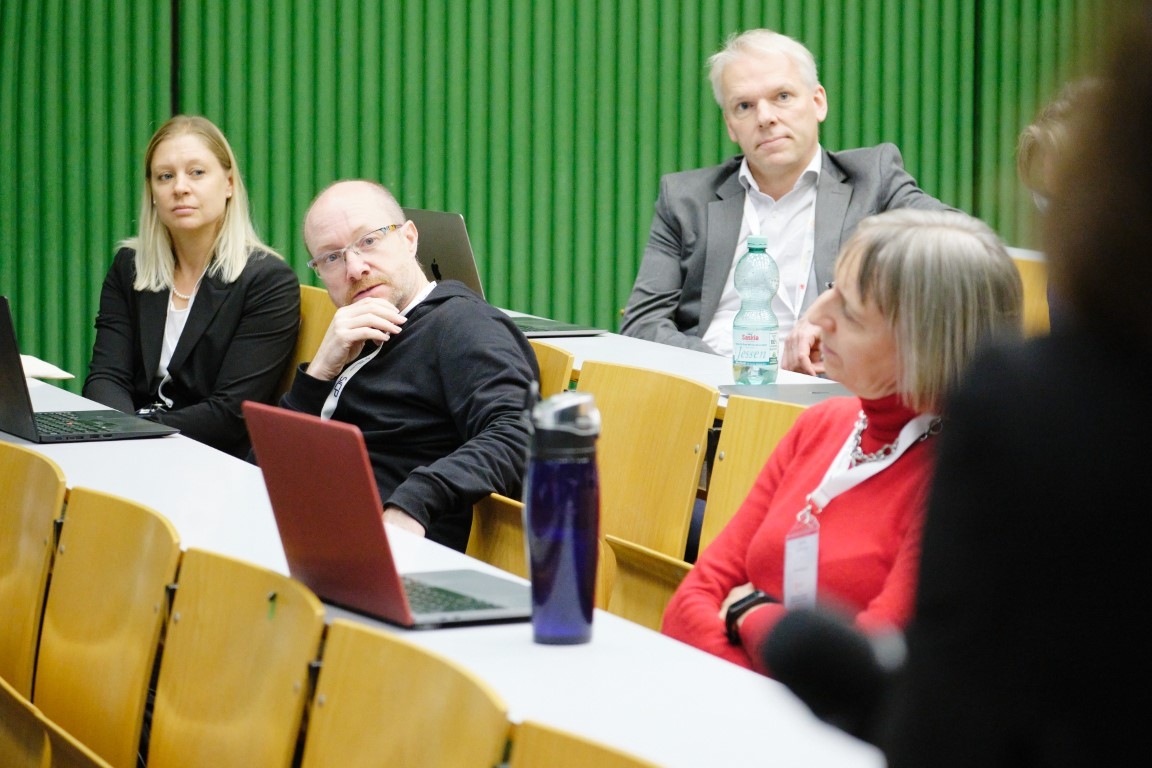
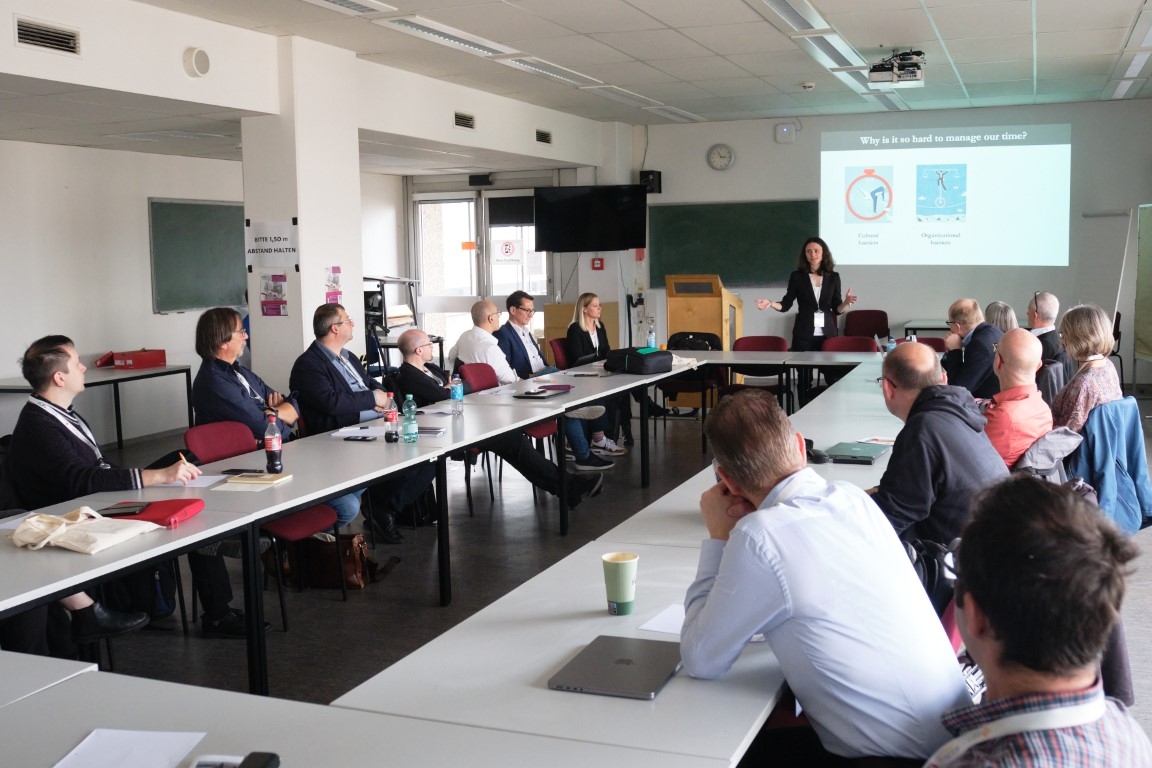
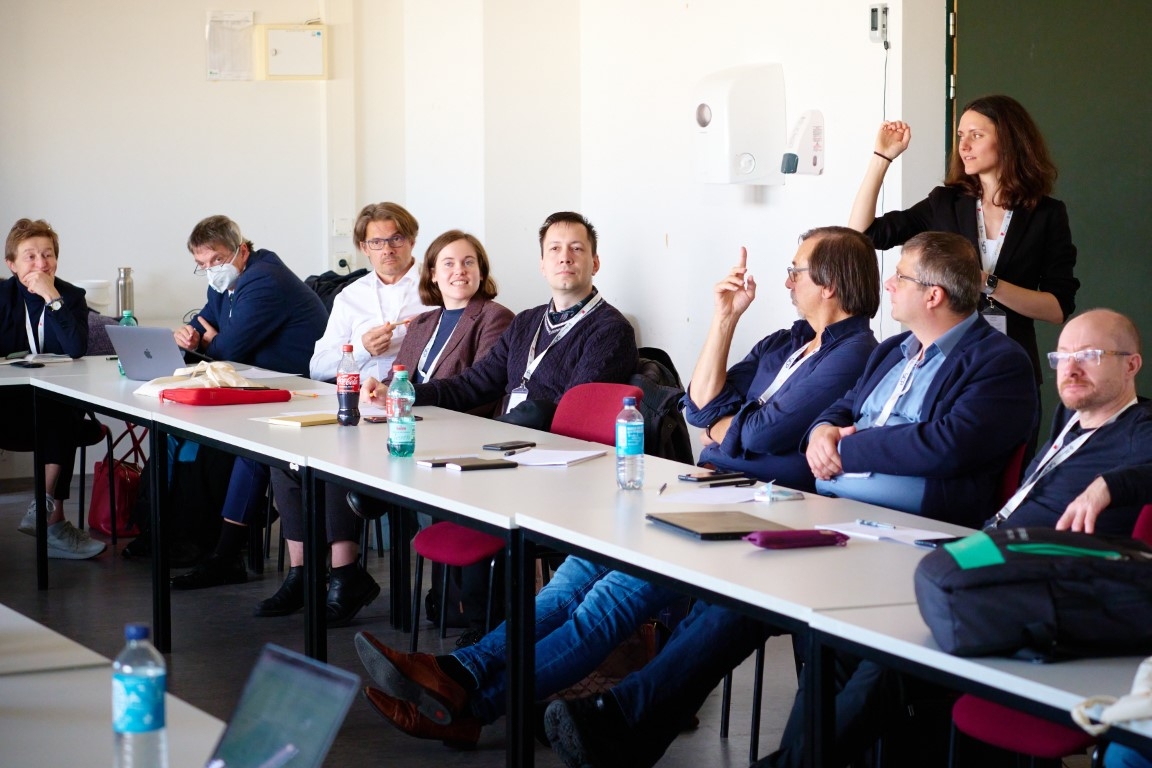
In the first afternoon session, Laura Giurge together with Jennifer Sparr invited the audience to reflect on how they allocate one of our most precious resources – time – and to analyze one of the most salient tensions in leadership, namely the tension between needing to be flexible with one’s schedule while also needing to plan one’s time to accomplish core leadership tasks. Giurge kicked off the session with some insights on the factors that prevent us from managing our time well, from the acceleration of the pace of life, to fragmented time, and future time slack (e.g., the belief that we have more time in the future than we do today, leading us to overcommit to more future tasks than we can achieve). Participants then engaged in a mini time-audit exercise where they analyzed whether their schedule reflected their most important goals. Then, participants engaged in the polarity map exercise where they dissected the flexibility vs. planning tension and learnt how to move away from thinking about this tension as an either/or problem to thinking about it as a both/and: leaders need and can be both flexible and strict with their time.
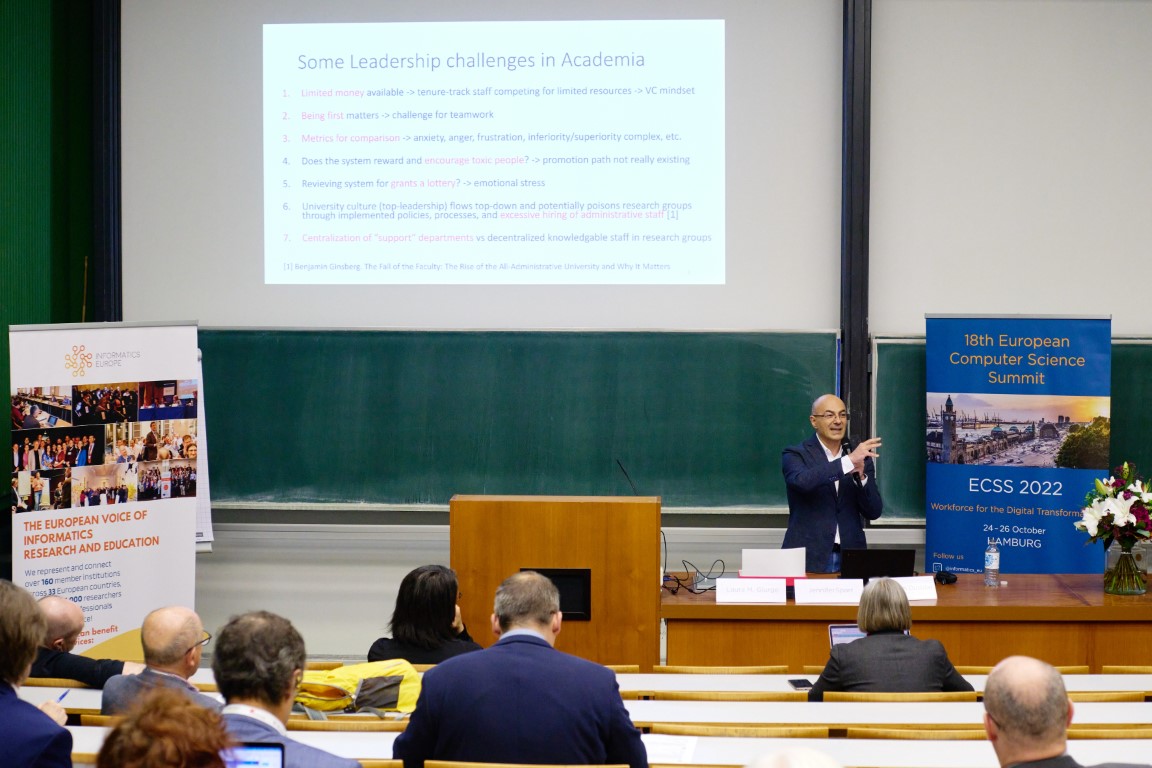
Concluding the workshop, Schahram Dustdar addressed digital leadership from an ecosystem perspective in the second afternoon session. He described leadership as an ecosystem, in which everything relates in some form to everything with varying levels of sensitivity. Such a model can be adopted for leadership and university leaders who play a crucial role in rebuilding the notions of inter-university teams, or organizational structures such as departments or universities. He discussed challenges of the research landscape and how disruption is needed to adapt to the rising expectations of leadership in the digital age.

-
Leaders Workshop
-
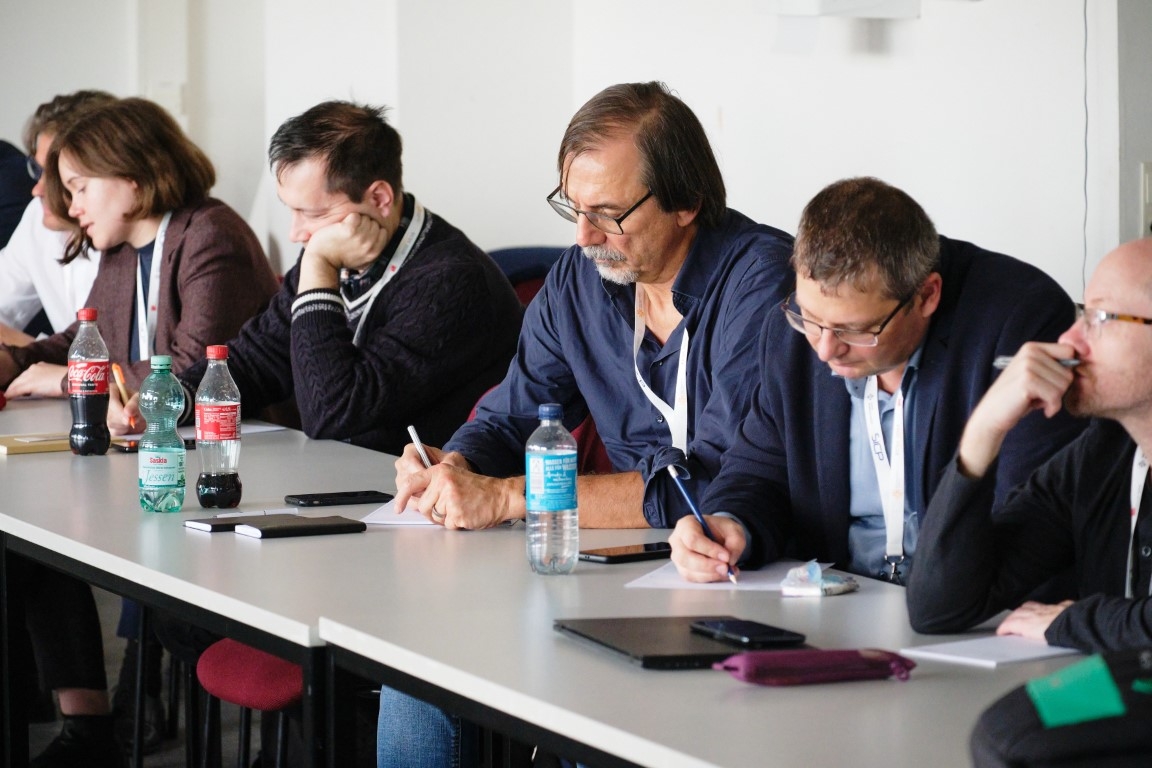
Leaders Workshop's Afternoon Session
-
Interactive Session at Leaders Workshop
-
Participants engaging in Leaders Workshop exercises
-
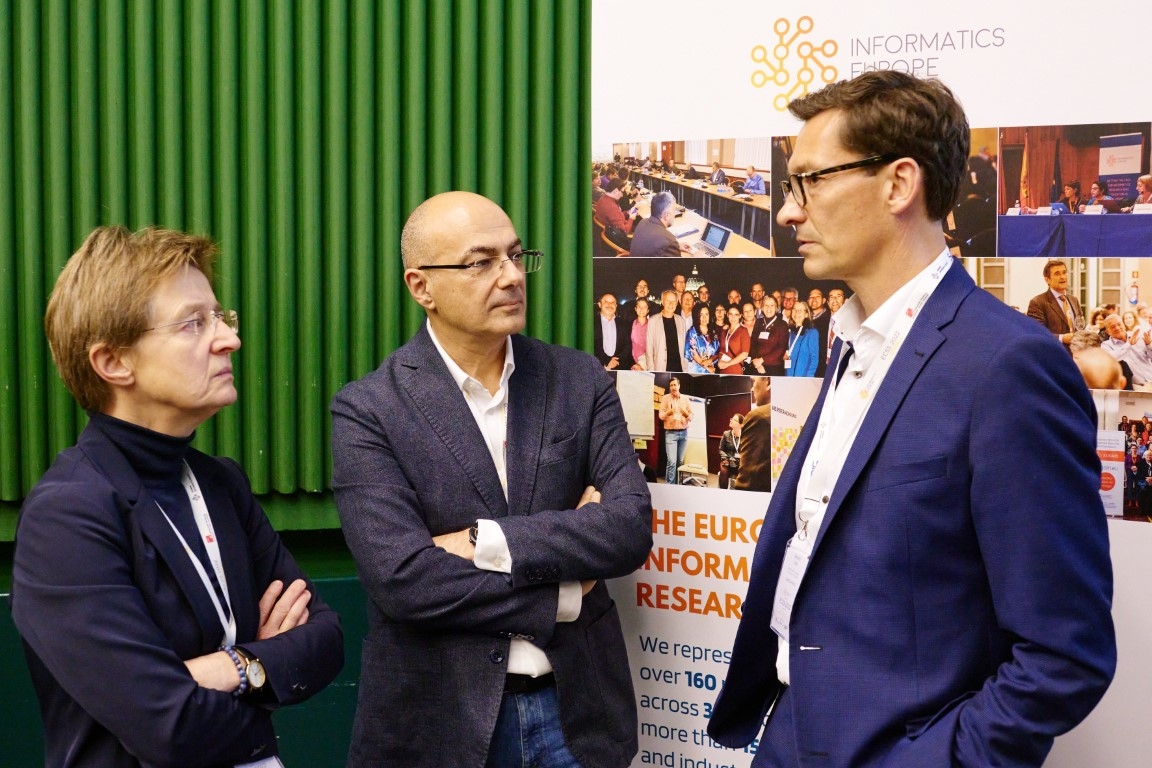
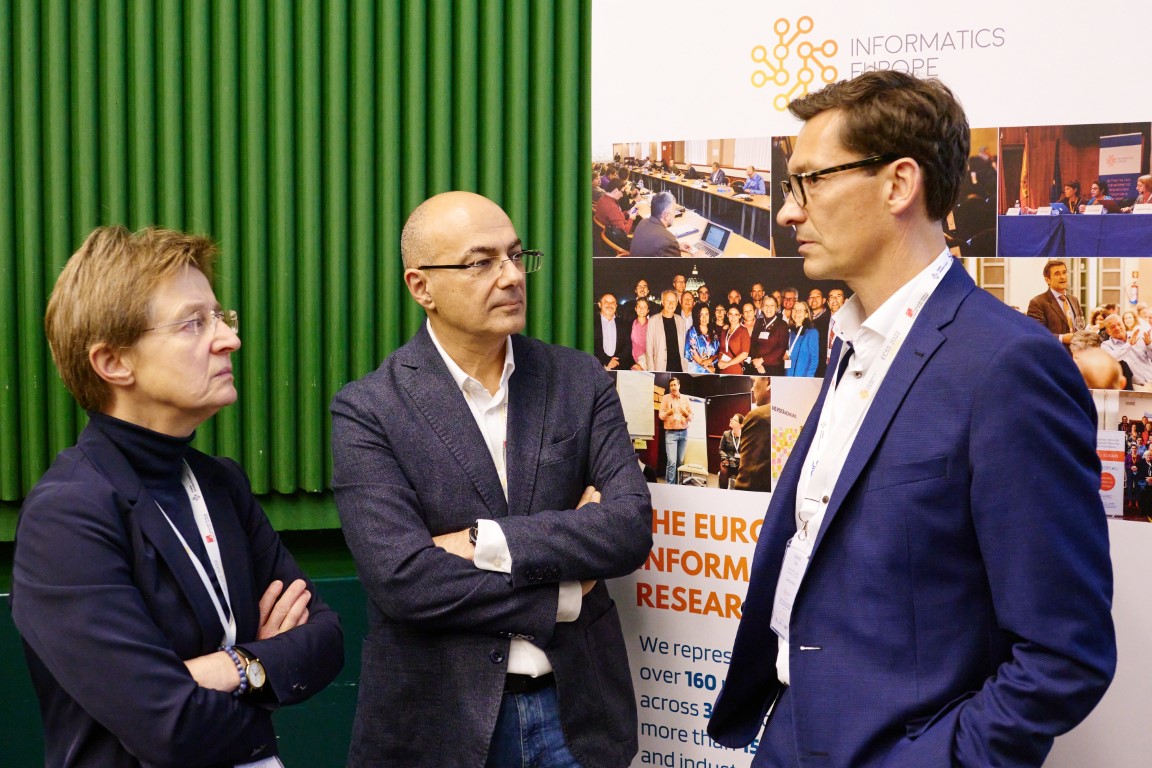
Networking at ECSS 2022
-
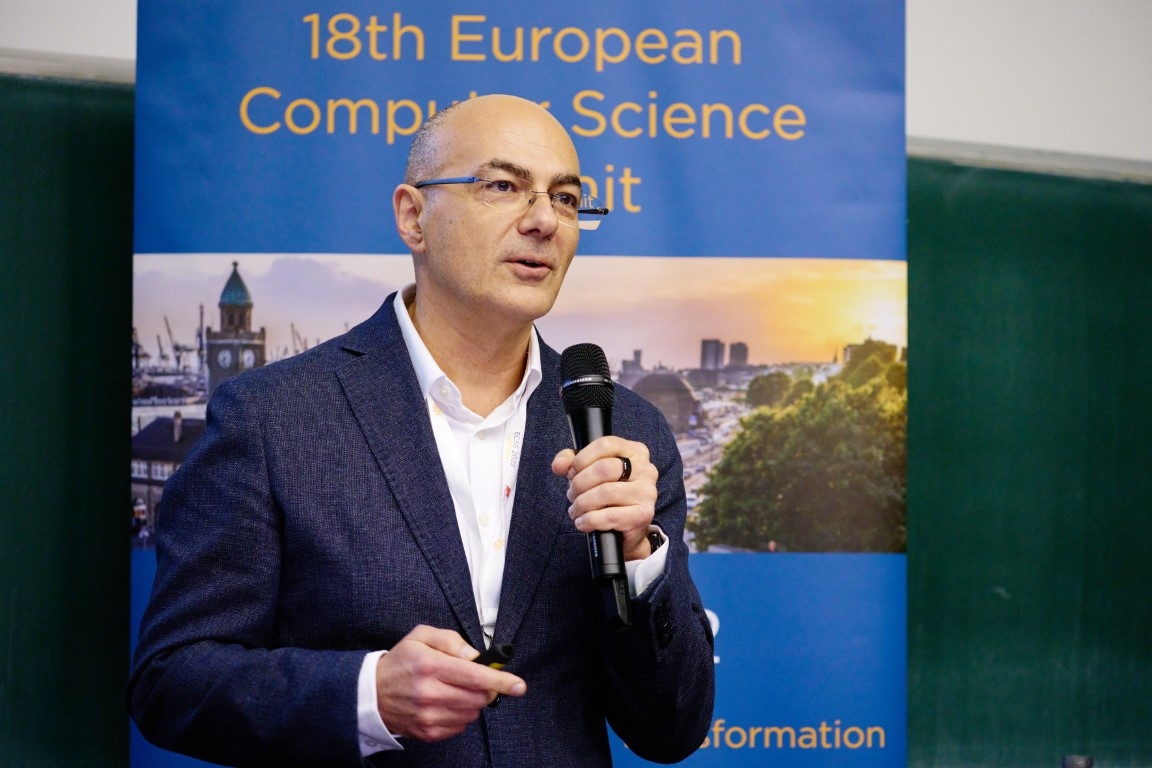
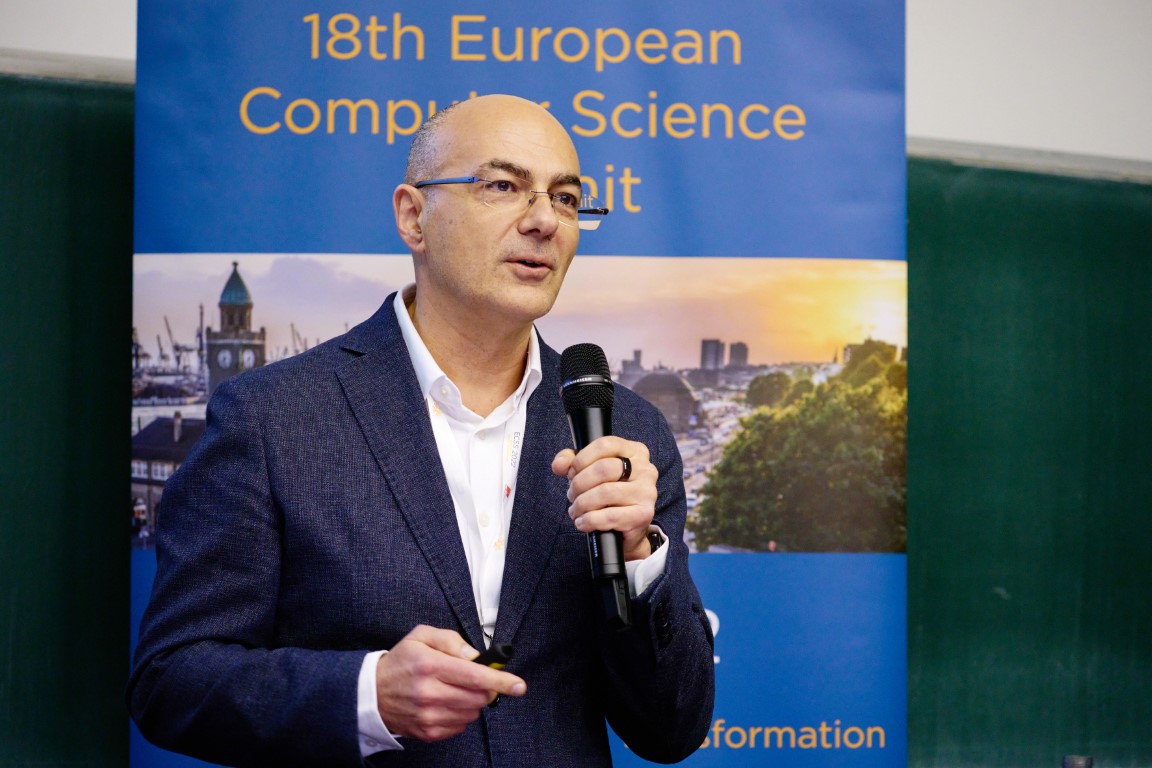
Schahram Dustdar , TU Wien, Austria
-
Schahram Dustdar (TU Wien, Austria) presenting at Leaders Workshop
-
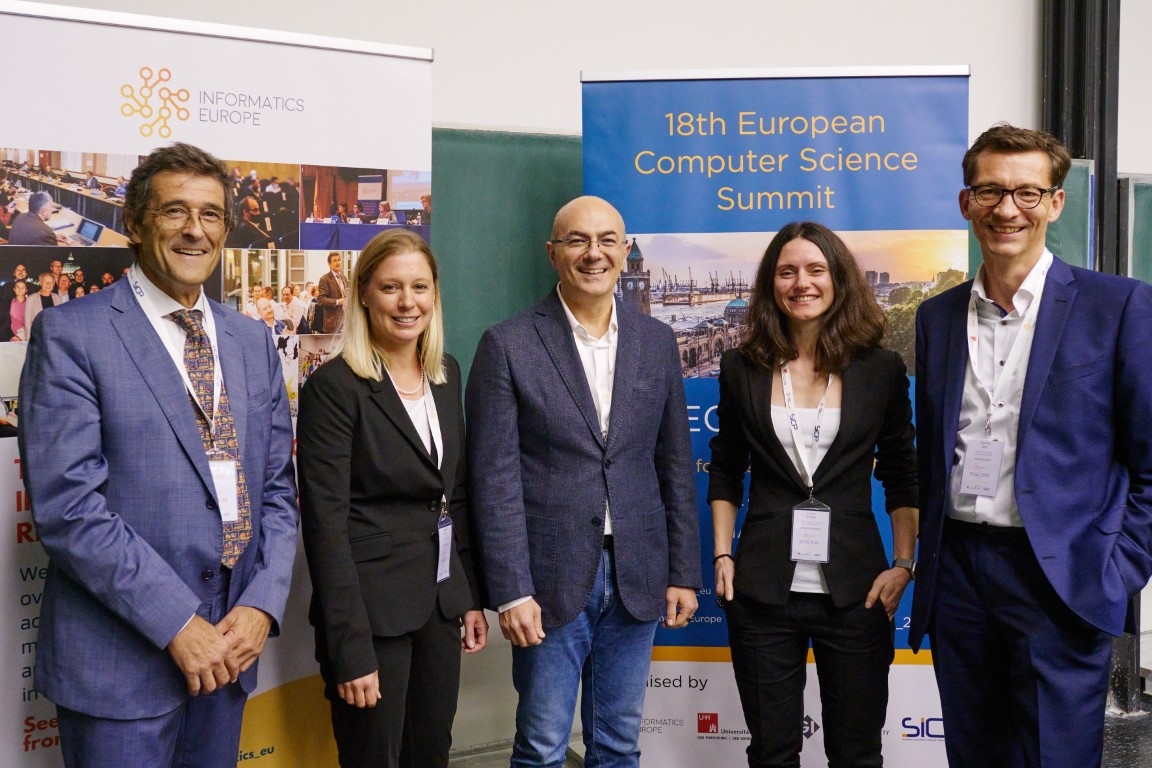
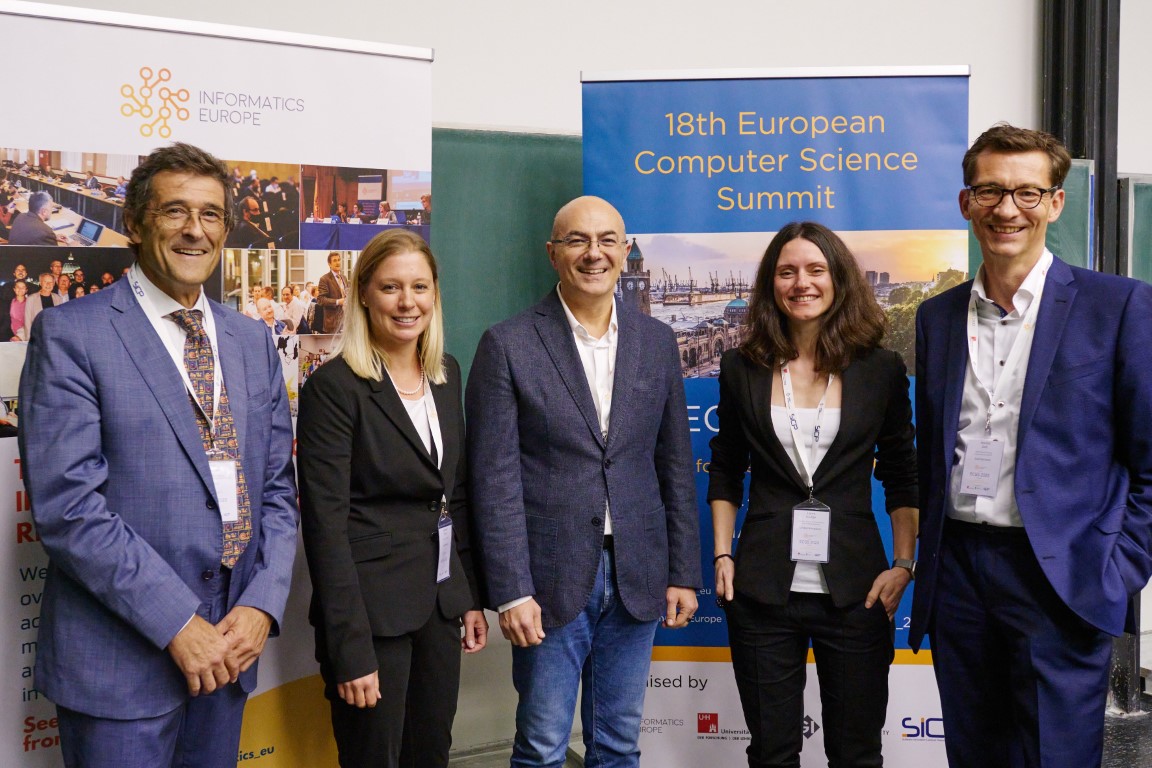
IE Board Directors and Leaders Workshop's Keynote Speakers


*Please note that the photos above are better viewed when applying zoom out.
Presentation slides are available to download under the workshop schedule here.
Education Workshop
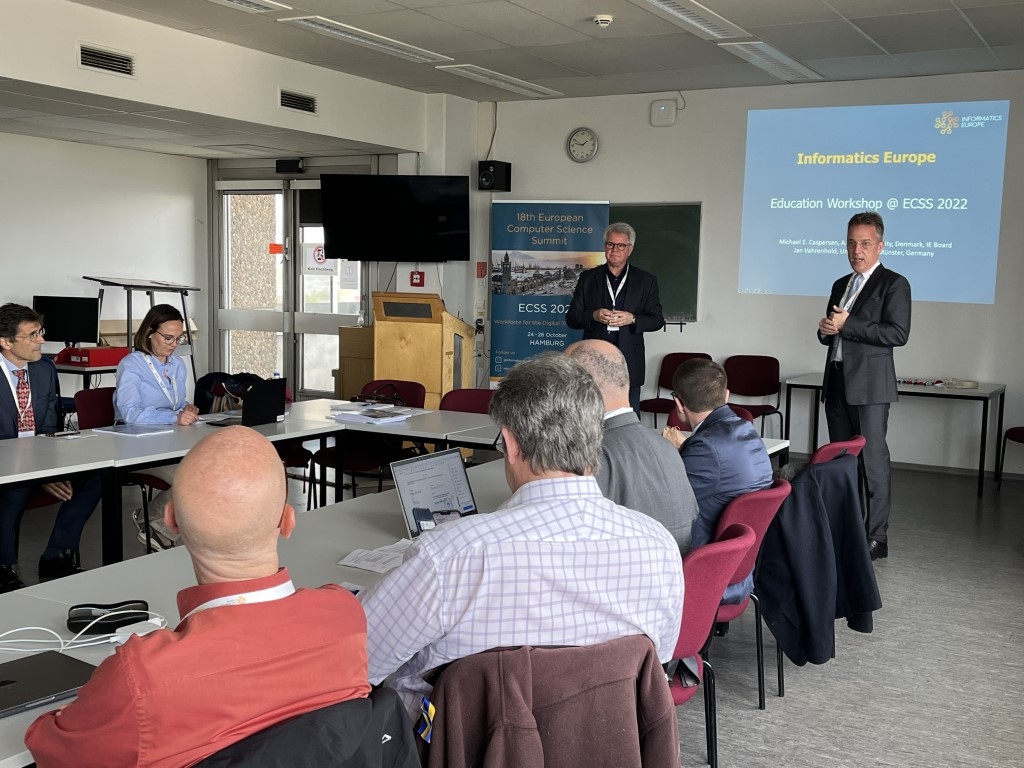
As part of the ECSS 2022 program, Informatics Europe organised the Education Workshop on Tuesday afternoon, 25 October, open to all participants, and chaired by Jan Vahrenhold, University of Münster. and Michael E. Caspersen, IT-vest – networking universities..
Globally, informatics education is becoming part of general education. The European Commission has digital education and skills as one of the top three priorities in the current decade (the two others being green transition and resilience) aiming to fulfil the Commission's priority, a Europe fit for the Digital Age. In 2018, the Informatics for All coalition was established to advocate for the inclusion of Informatics as a foundational discipline in schools across Europe.
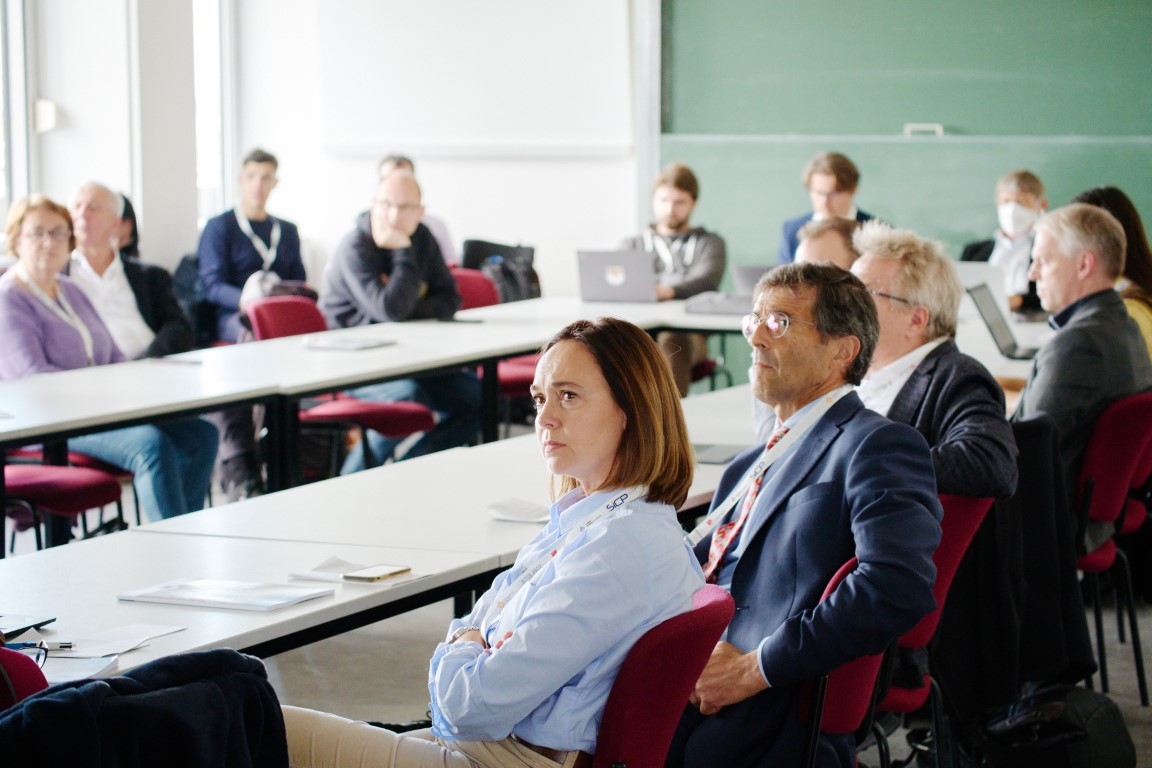
In the first part of the workshop, the results of the Informatics for All coalition were presented and discussed together with the European Commission's Eurydice report describing the provision of informatics in school across Europe.
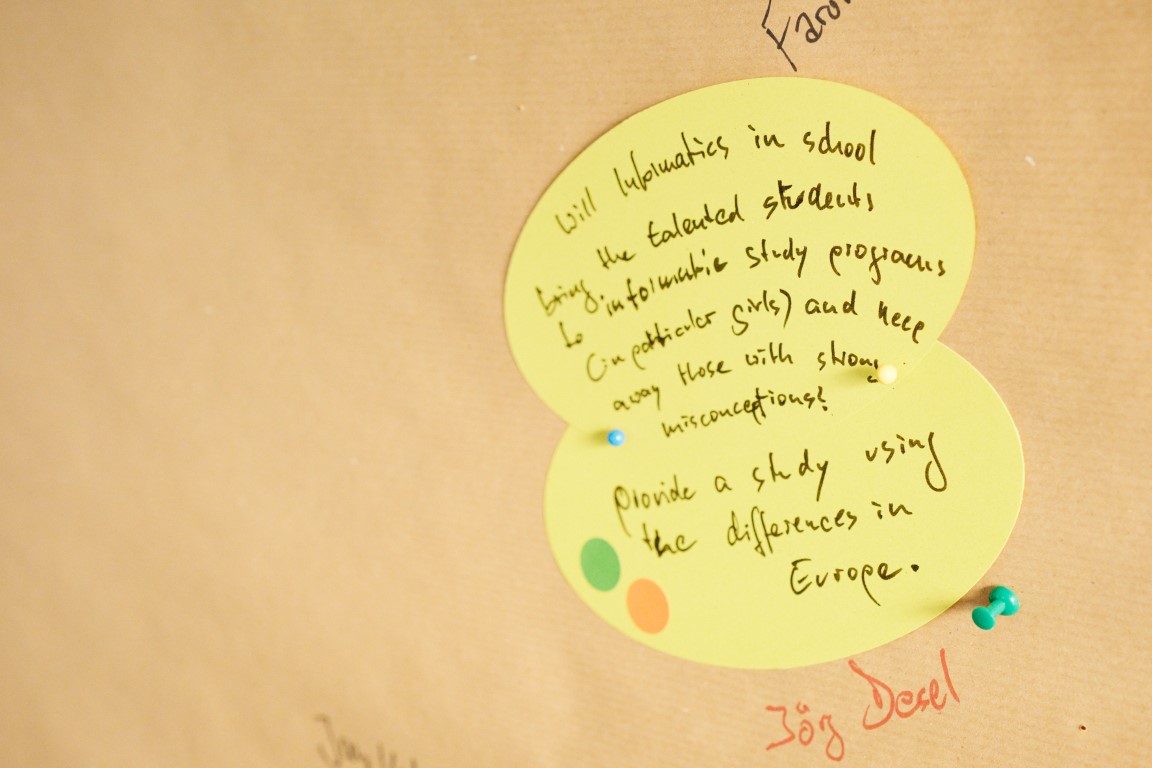
In the second part of the workshop, we discussed what the Informatics for All coalition and Informatics Europe's Working Group on Informatics Education and Research should take as next steps.
Workshop Highlights
The Workshop started with a presentation of activities of the Informatics for All coalition, including a presentation of the Informatics Reference Framework for School published earlier this year. The reference framework is a proposal for a coherent vision and shared terminology related to providing informatics to all pupils in Europe, as requested by the European Commission.
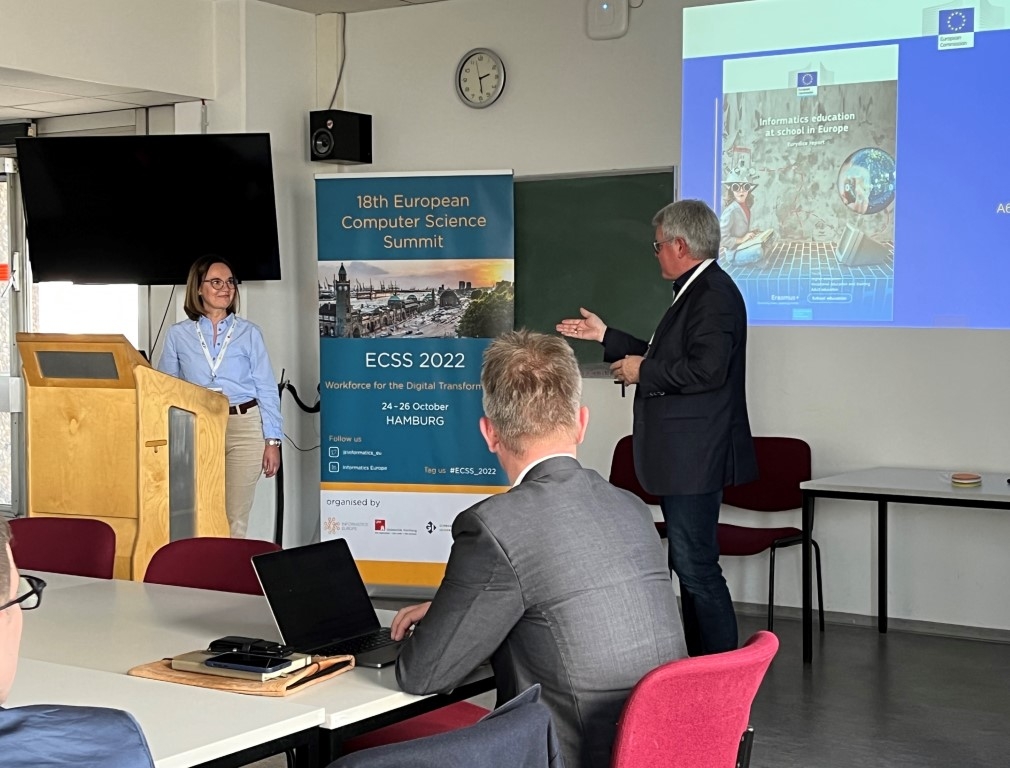
A key part of the workshop was a presentation by Sonia Piedrafita Tremosa of the Eurydice report Informatics education at school in Europe. The report marks a milestone for the Informatics for All coalition's endeavours to promote informatics as a fundamental discipline for the 21st century: (1) it is the first time 'informatics' is used in the title of an official document from the European Commission, and (2) the reference framework is systematically used to analyse learning outcomes in 39 education systems in the 27 EU member states and 10 other Erasmus+ countries.
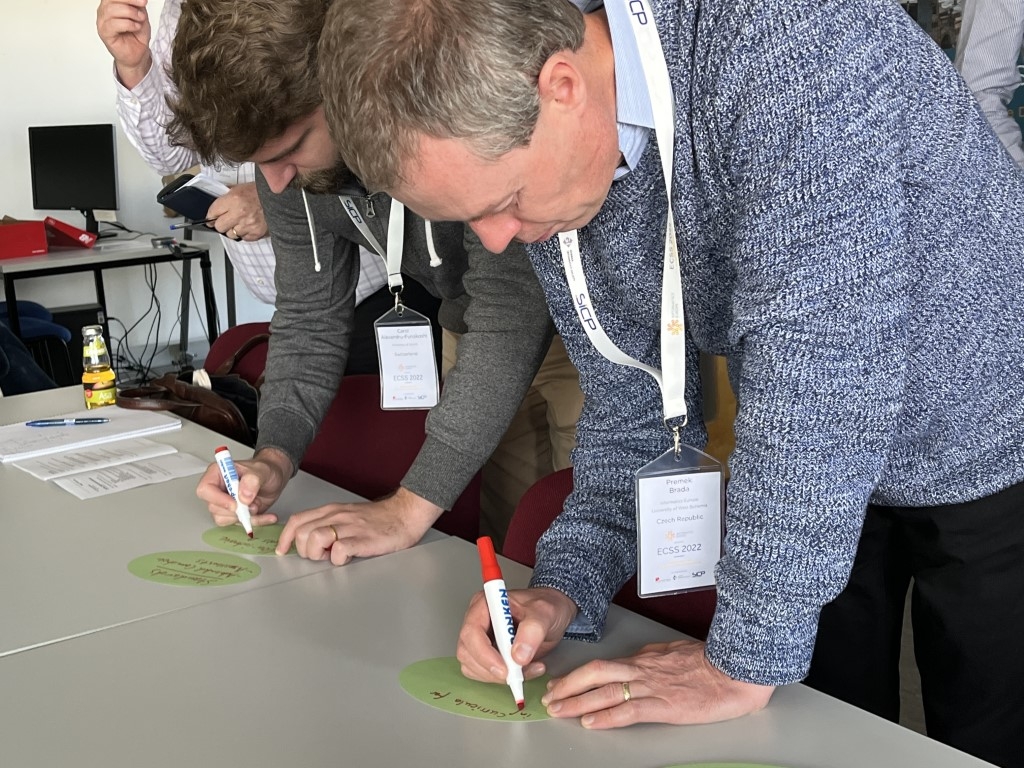
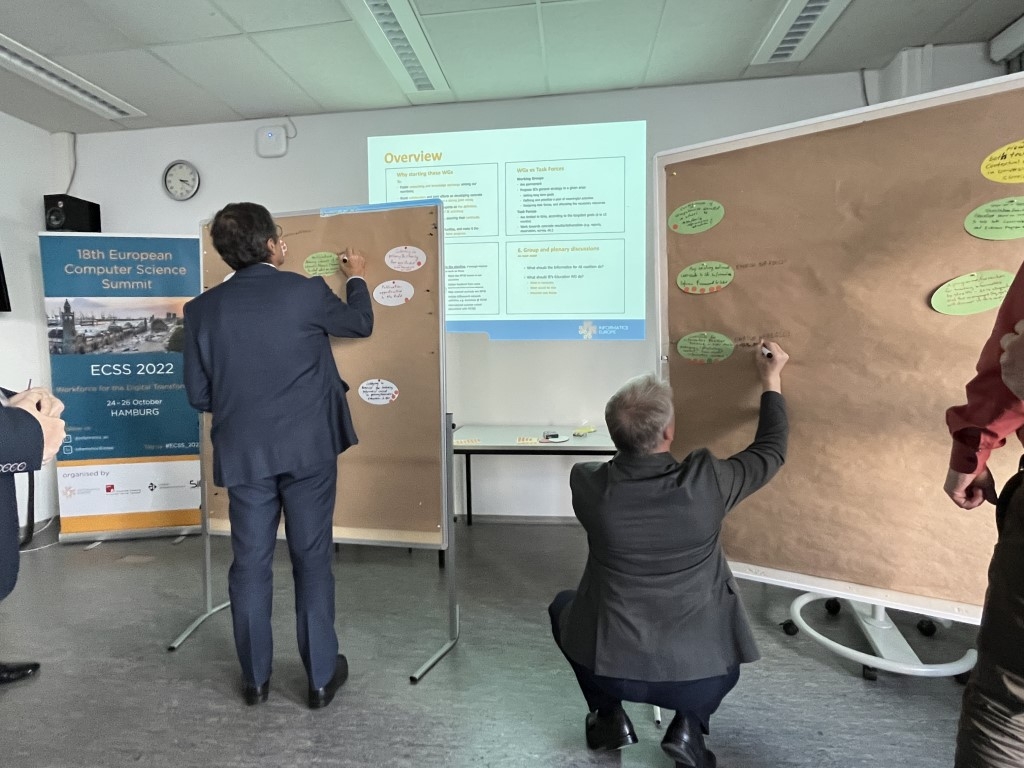
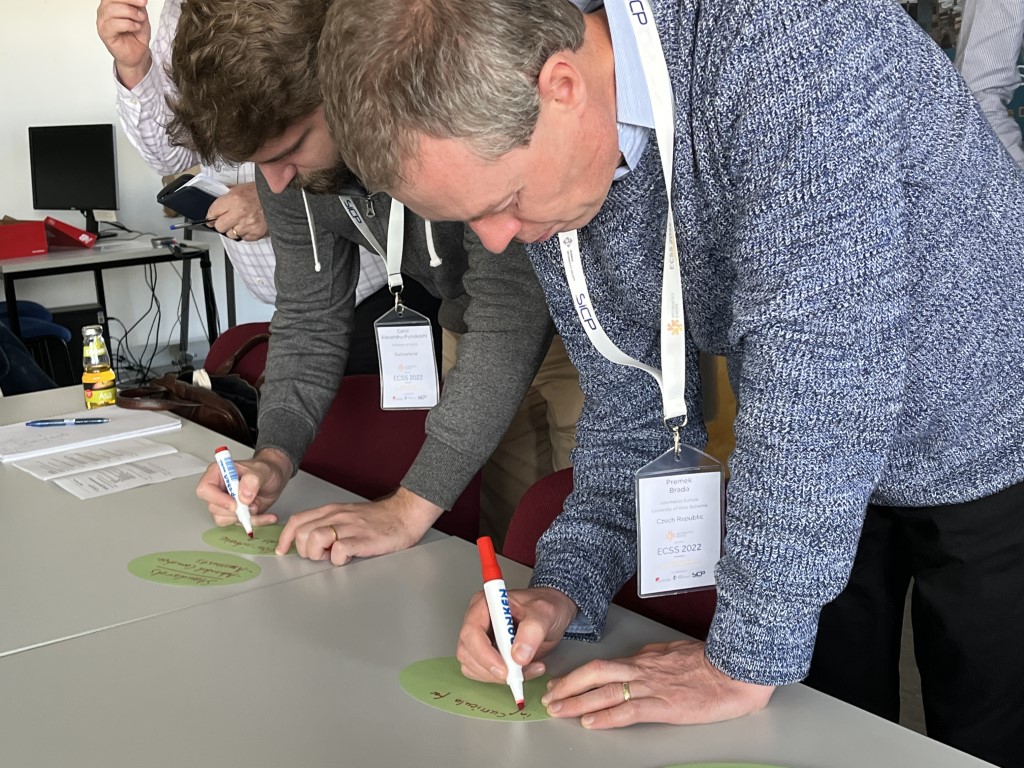
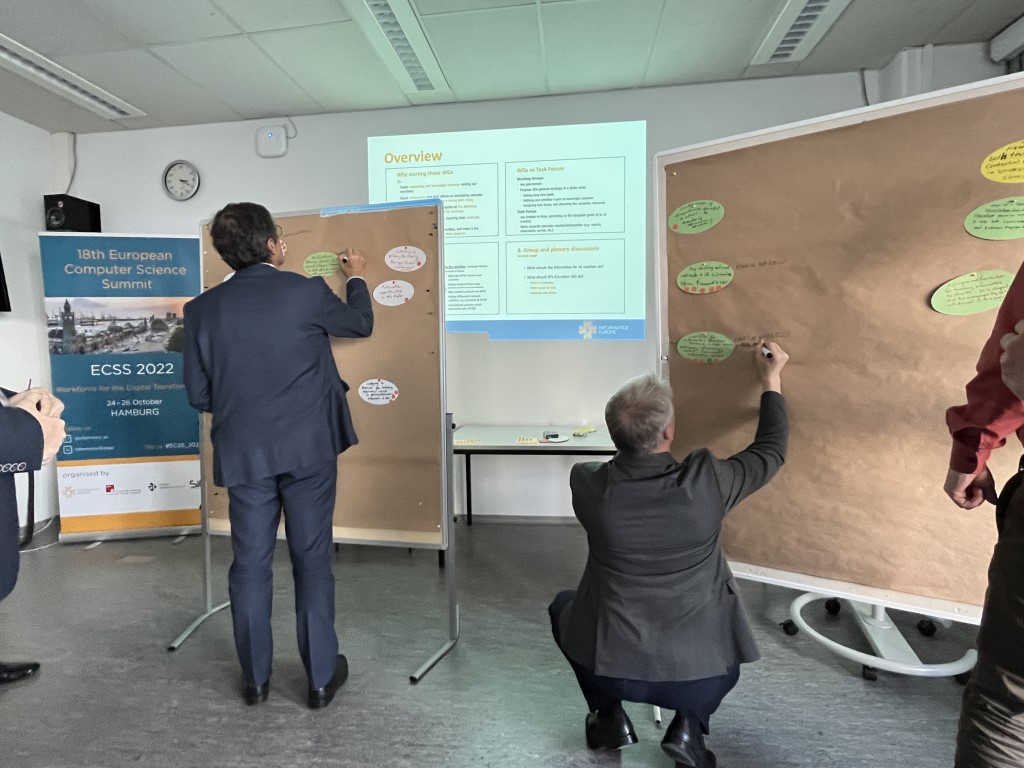
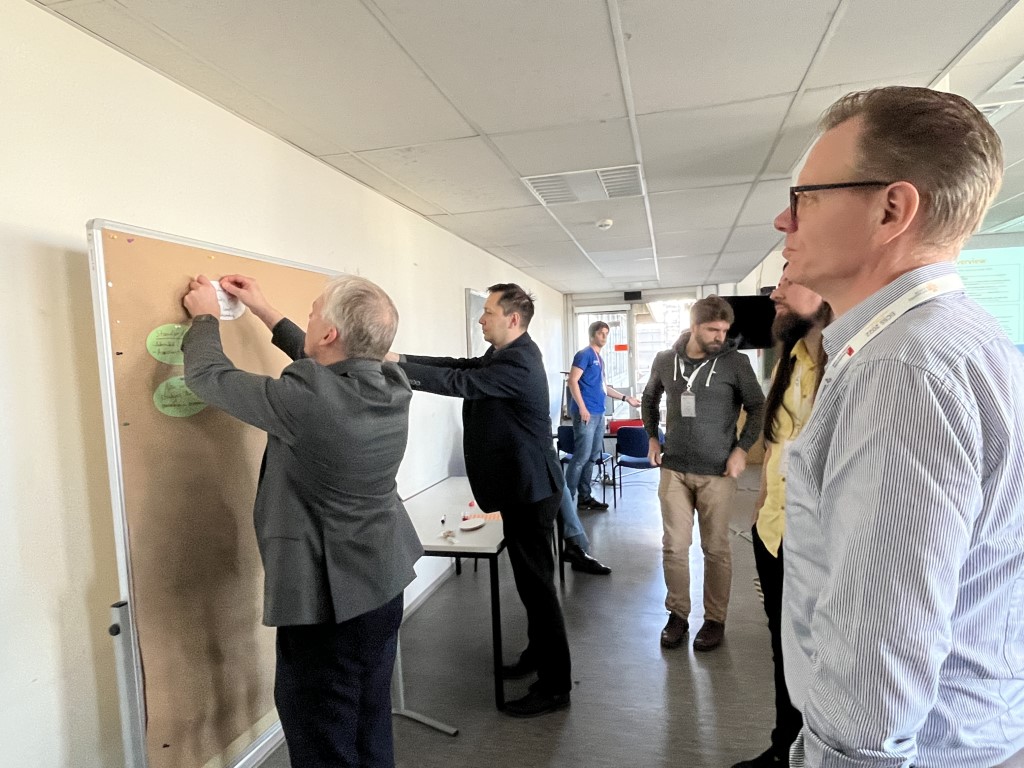
The workshop finished with an activity identifying challenges related to implementing the two-tier strategy of Informatics for All, and people volunteering to work on some of these challenges through IE’s Education Research Working Group.



-
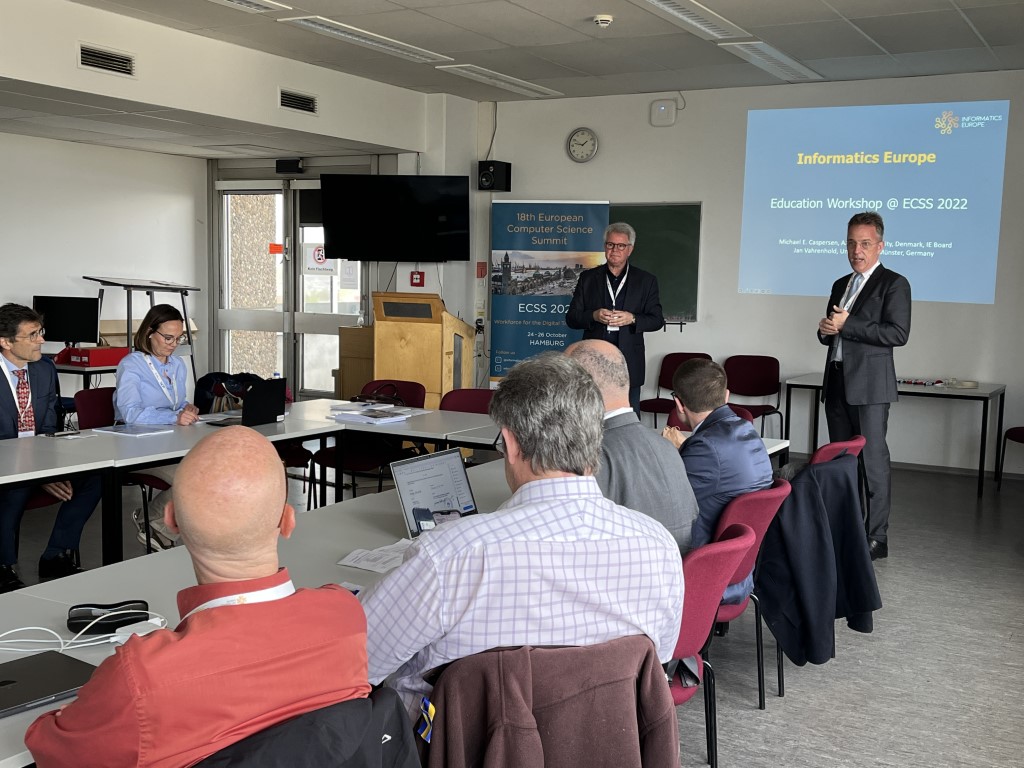
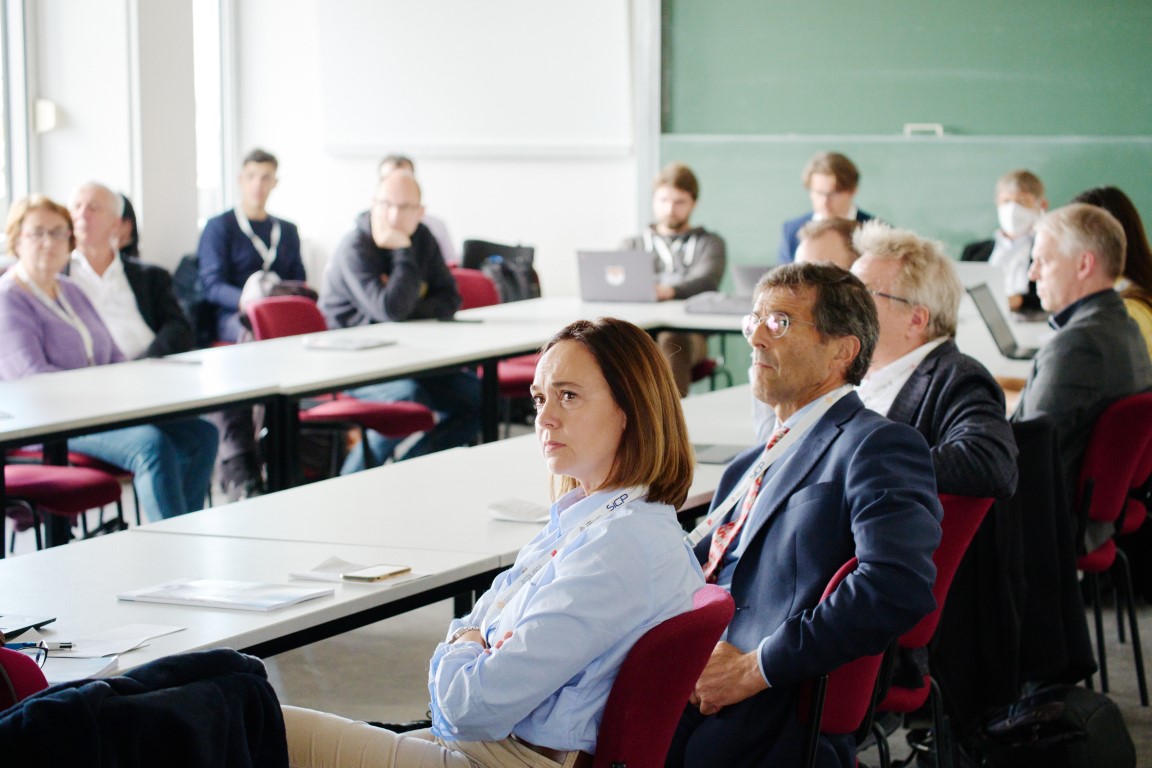
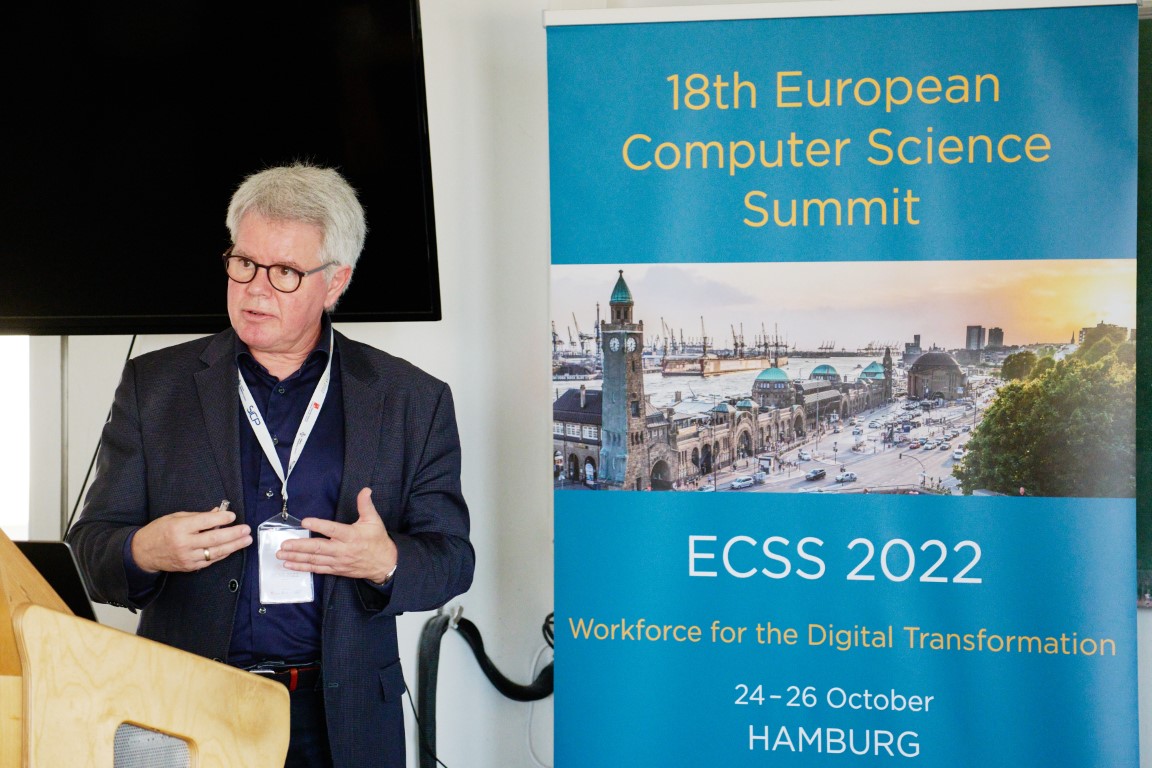
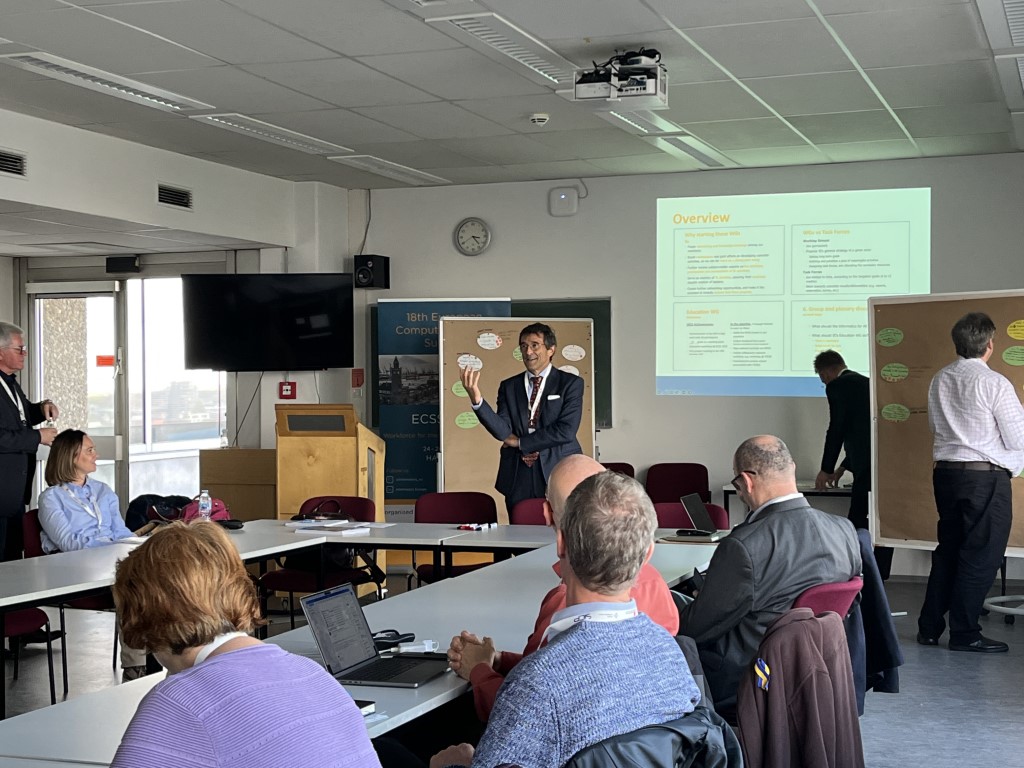
Education Workshop Chairs Giving an Introductory Talk
-
Education Workshop
-
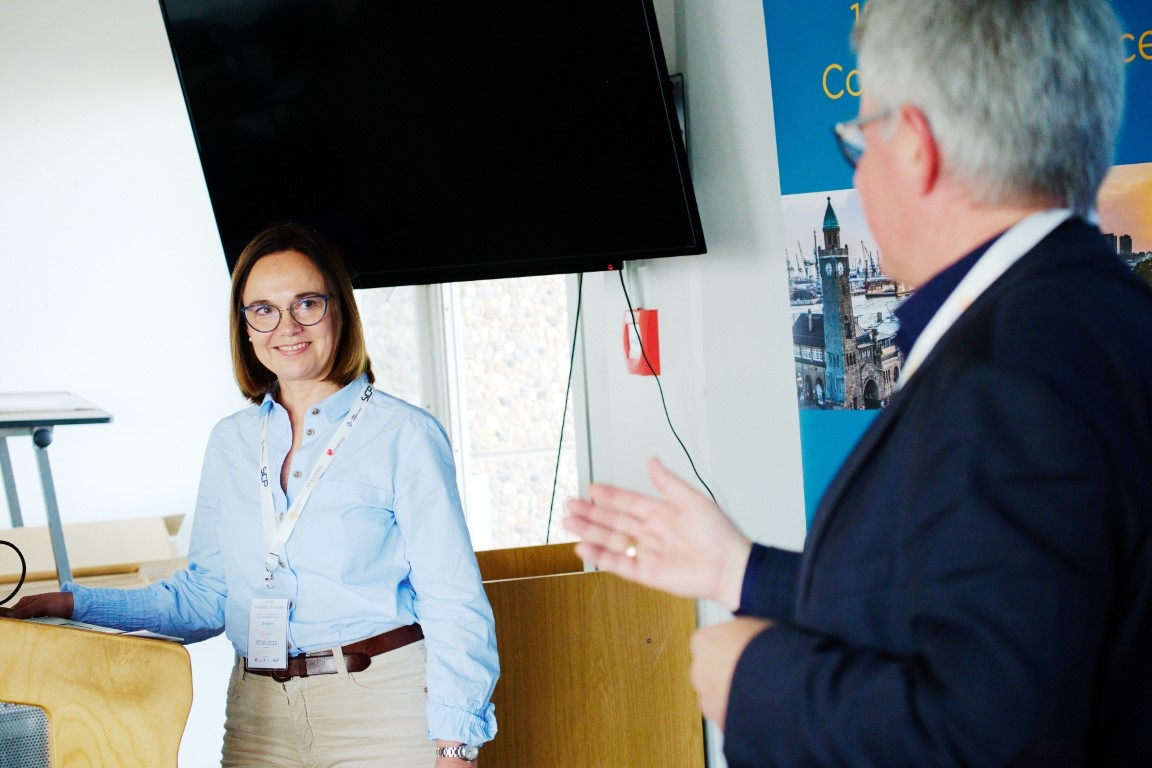
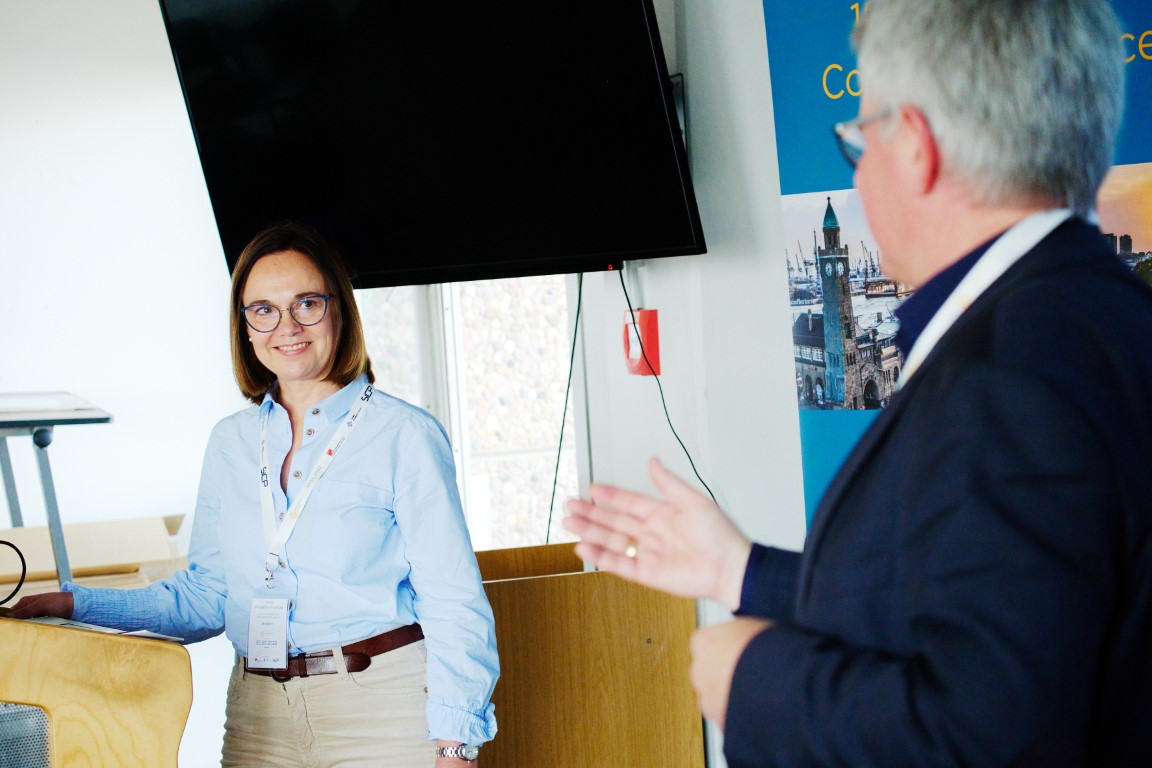
Introducing Sonia Piedrafita Tremosa (European Education and Culture Executive Agency), Keynote Speaker of the Workshop
-
Sonia Piedrafita Tremosa, European Education and Culture Executive Agency
-
Michael E. Caspersen, IT-vest – networking universities
-
Education Workshop
-
Education Workshop
-
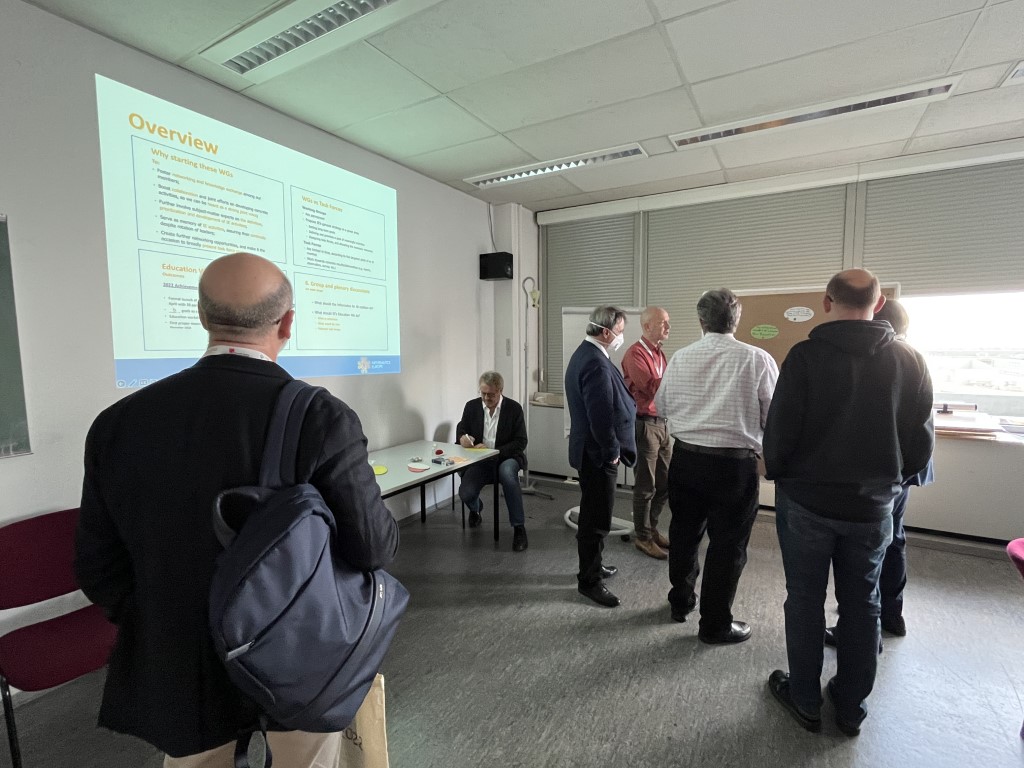
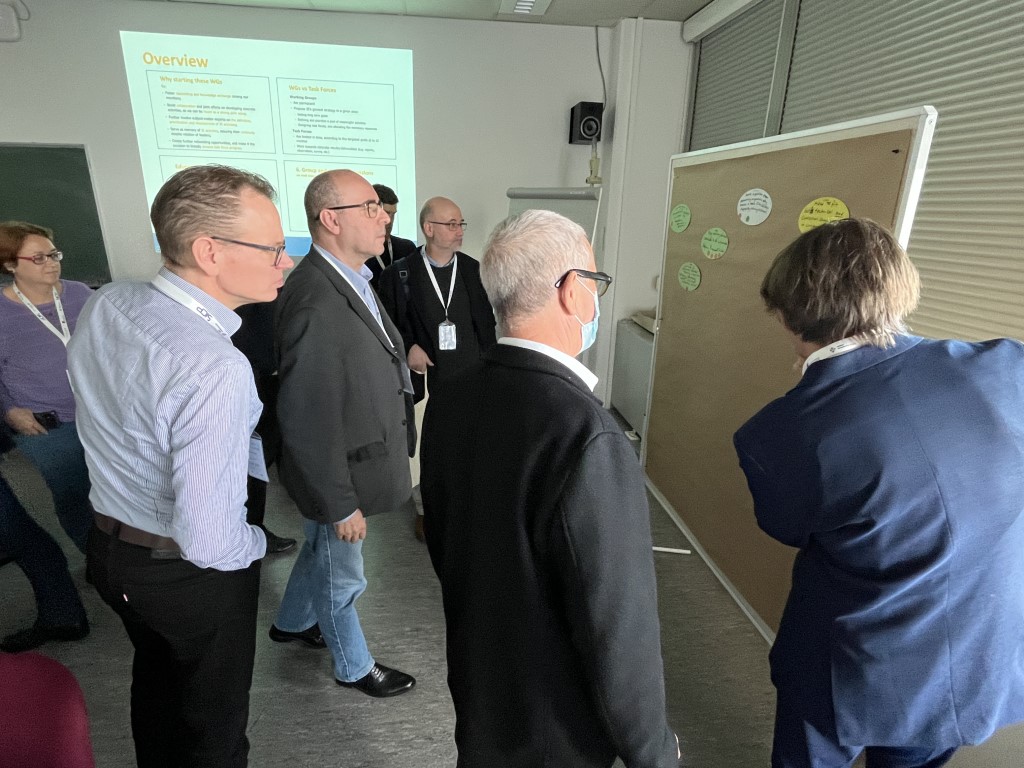
Education Workshop Group Activity
-
Education Workshop Group Activity
-
Education Workshop Group Activity
-
Education Workshop Group Activity
-
Concluding the Education Workshop Group Activity
-
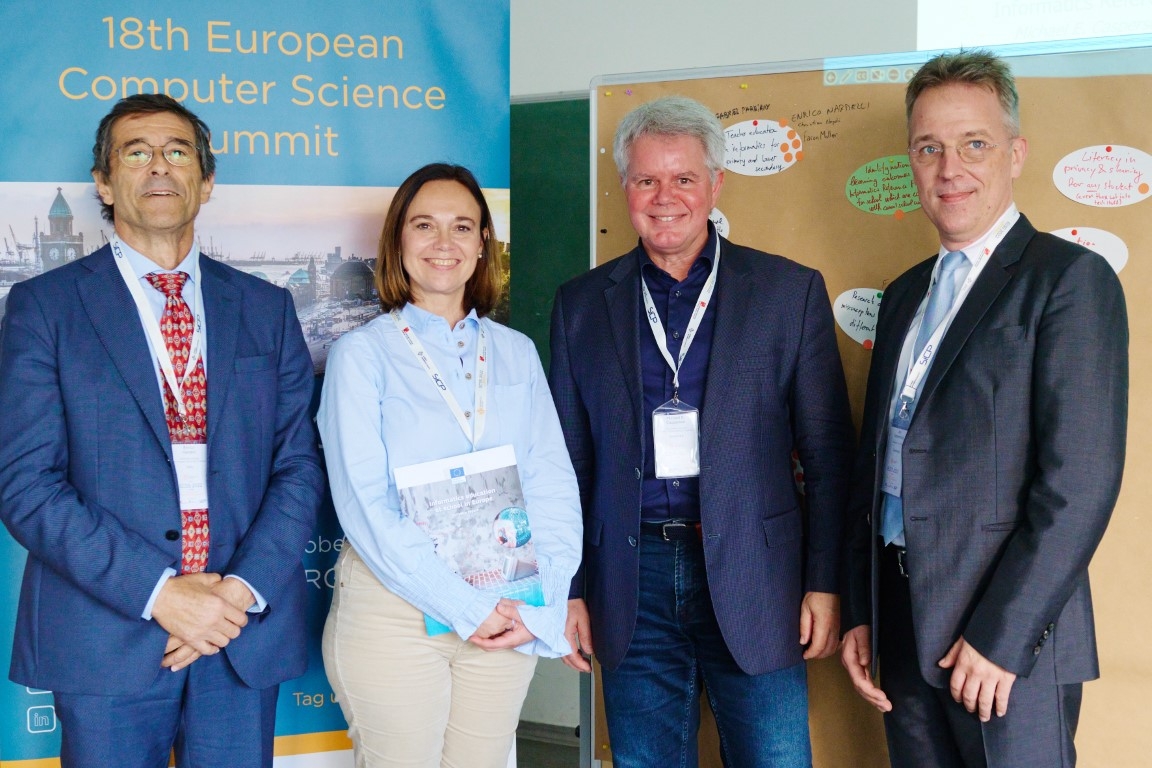
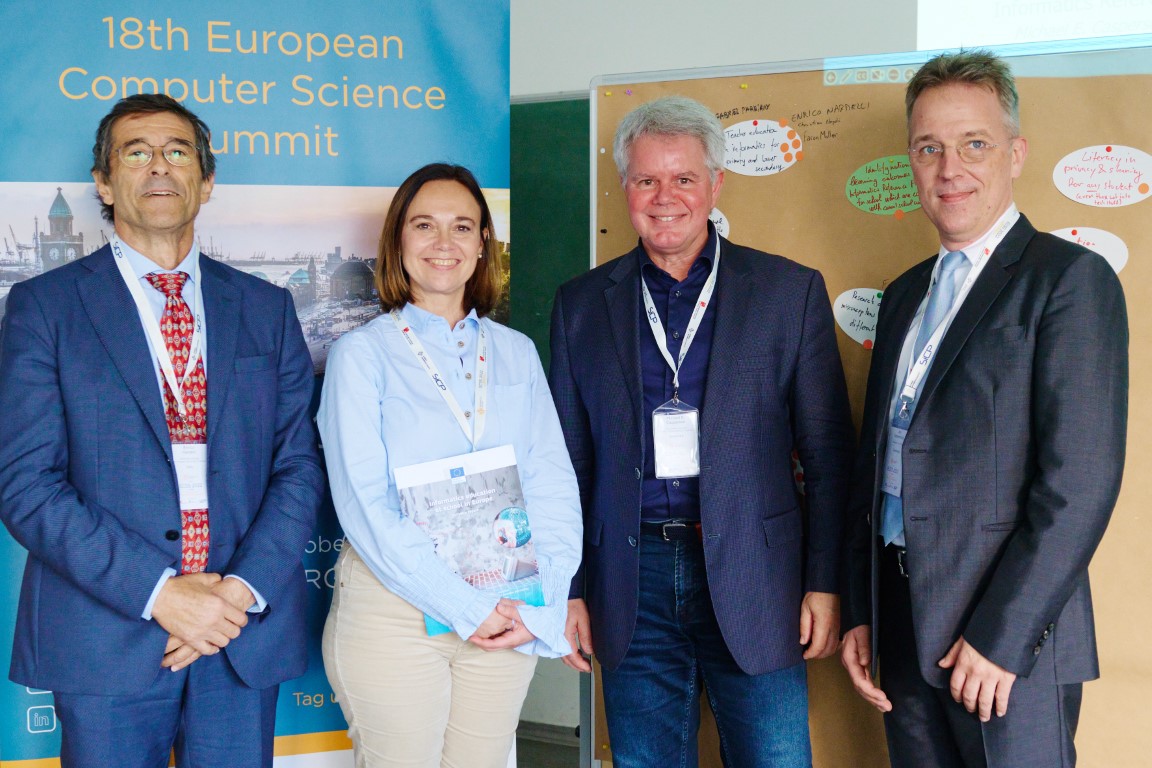
IE President, Keynote Speaker and Chairs of Education Workshop


*Please note that the photos above are better viewed when applying zoom out.
Presentation slides of the workshop are available to download here.
ECSS 2025 is organised by
 |
 |
Sponsored by
 |
 |
 |
 |
|
 |
  |
 |
Support ECSS
What's New
ECSS 2025, 27-29 Oct, Rennes. France
Save the dates for ECSS 2026:
26-28 Oct in Porto, Portugal



 Netlogica